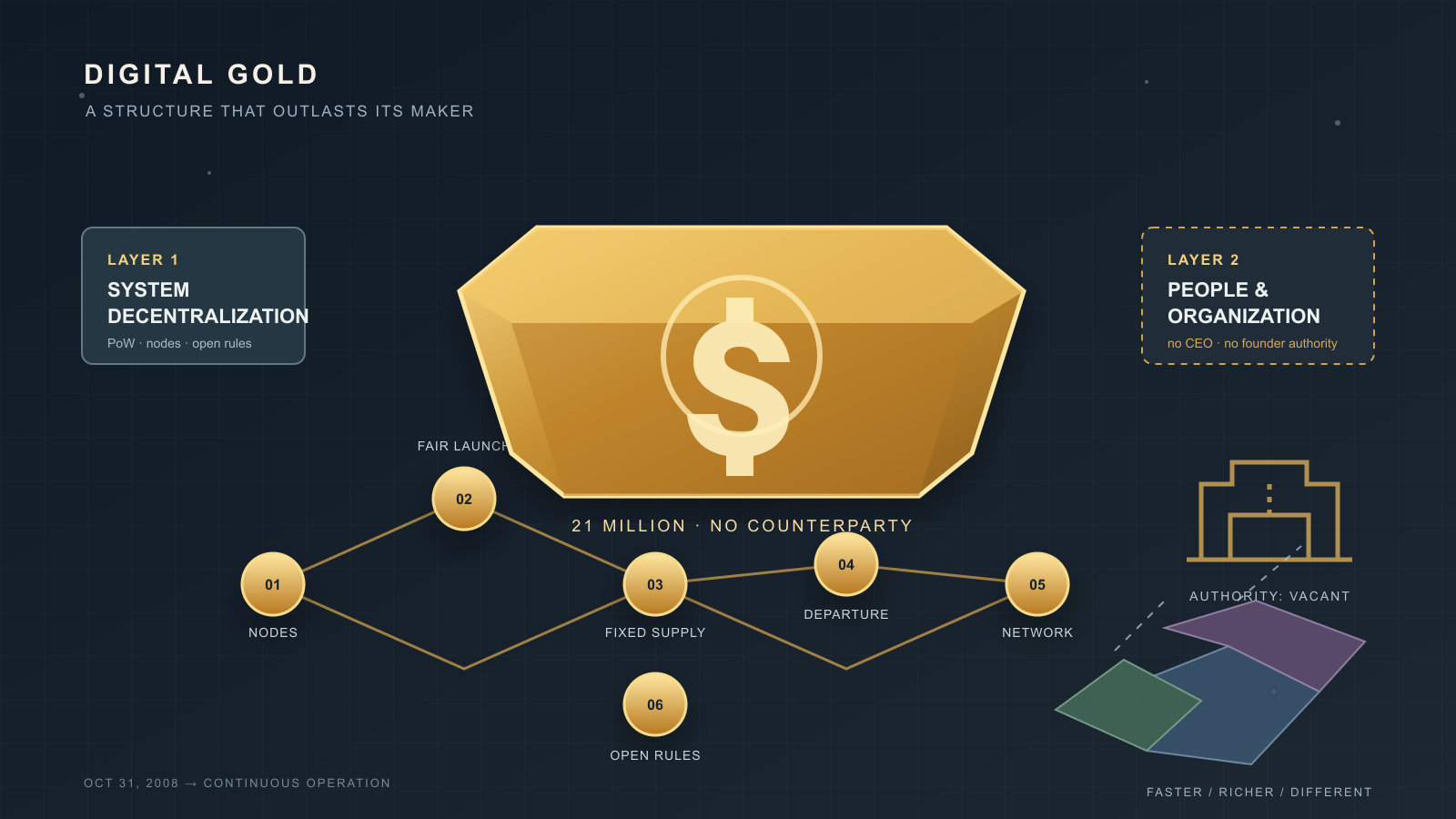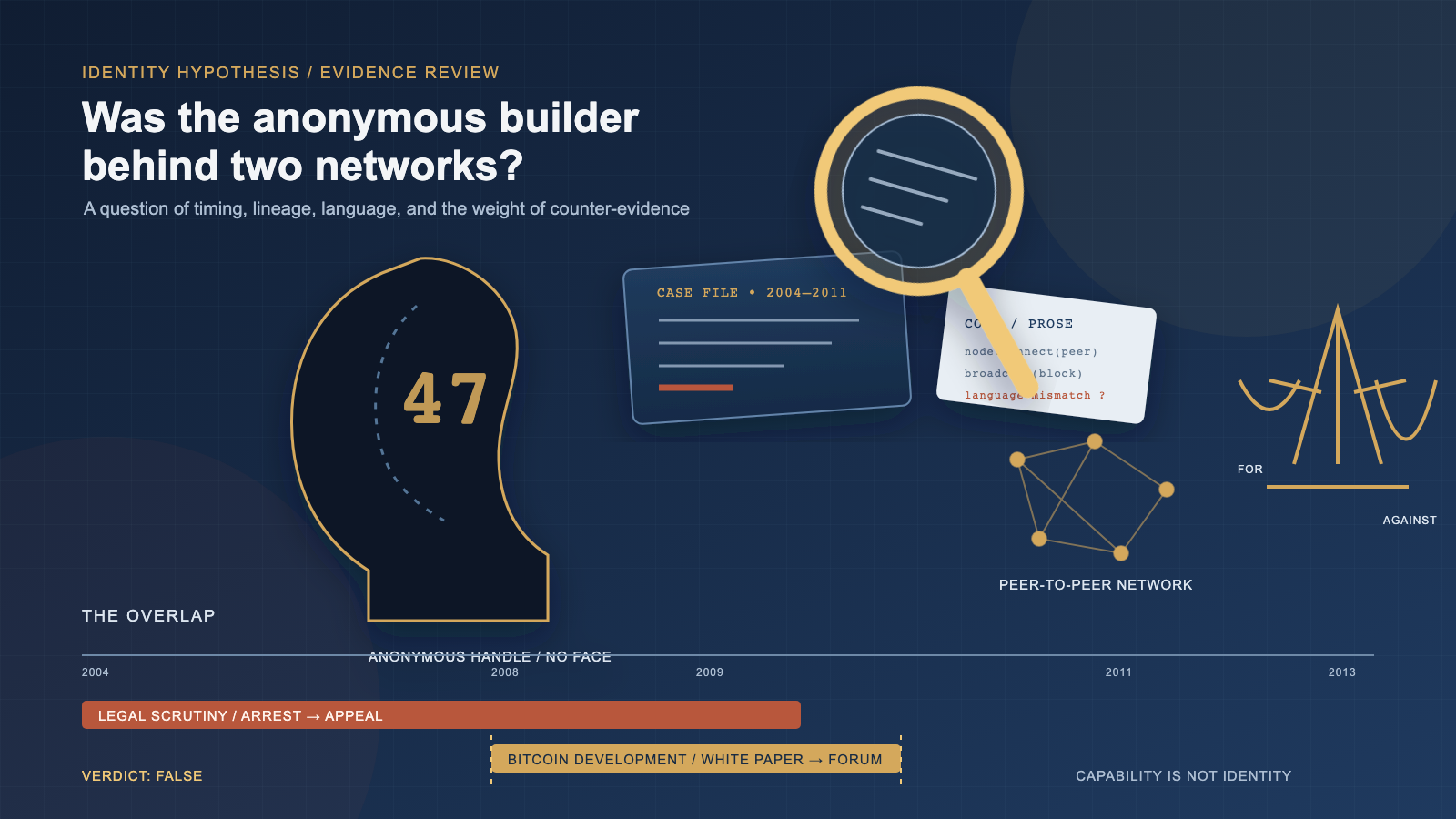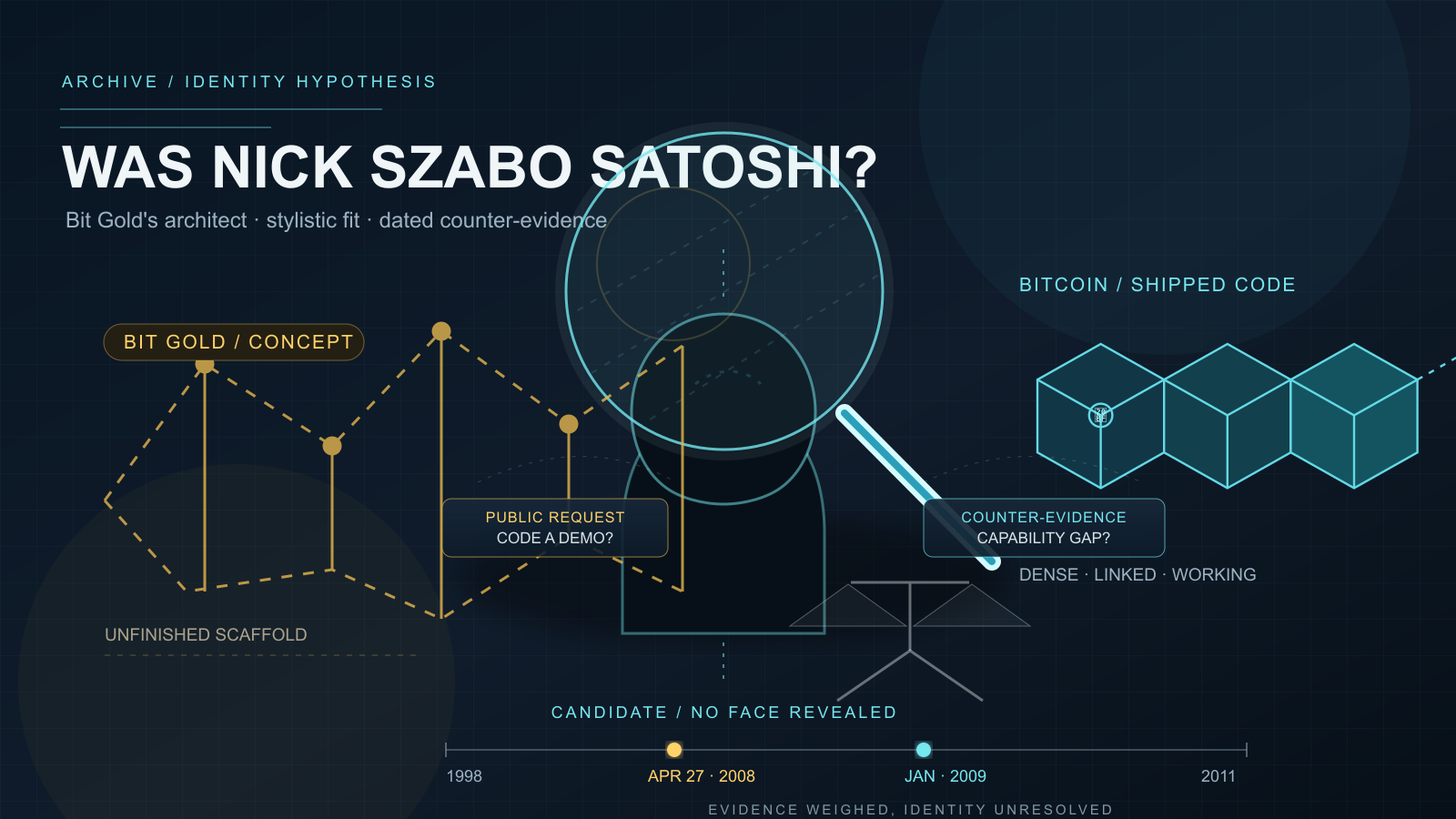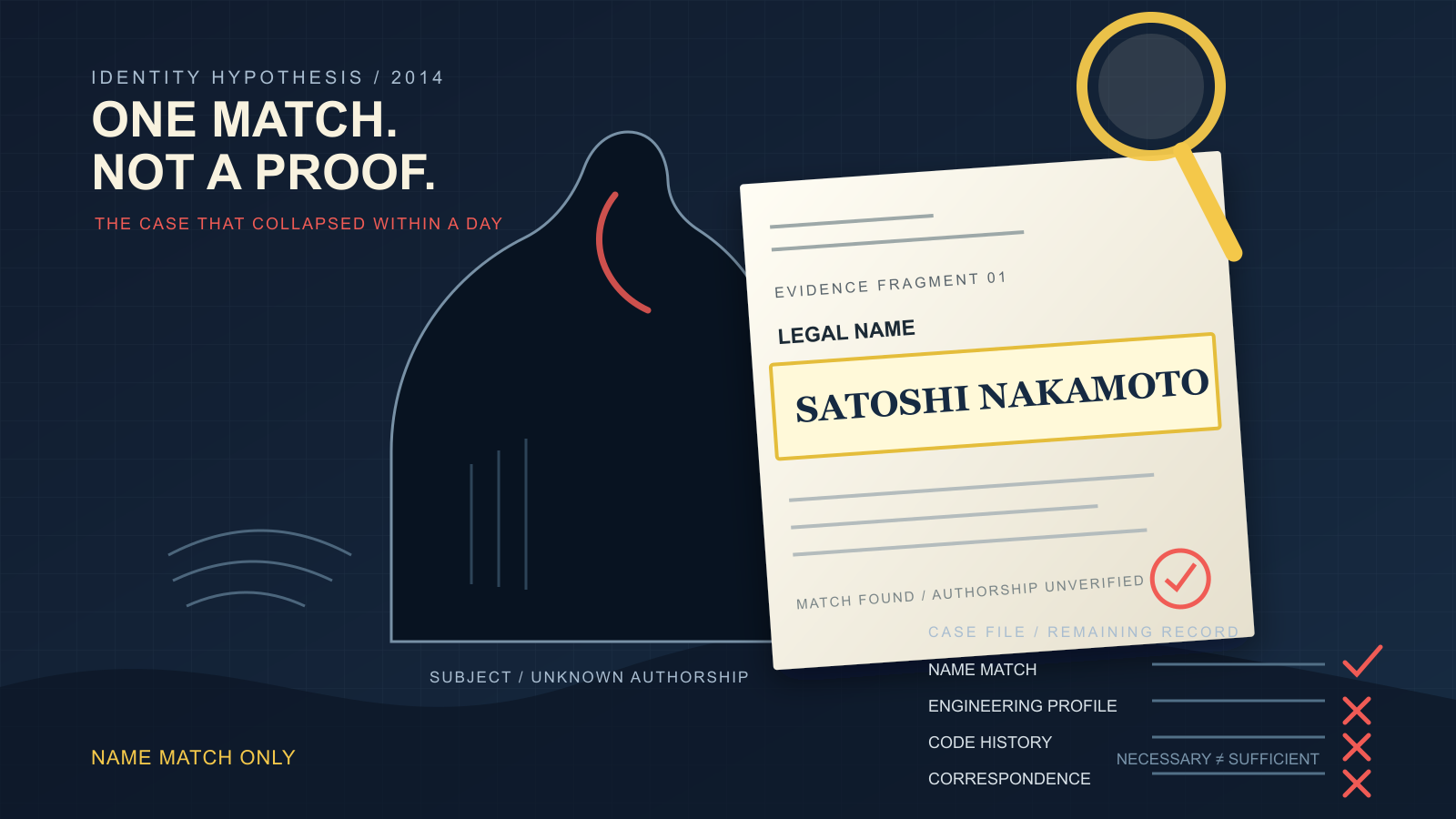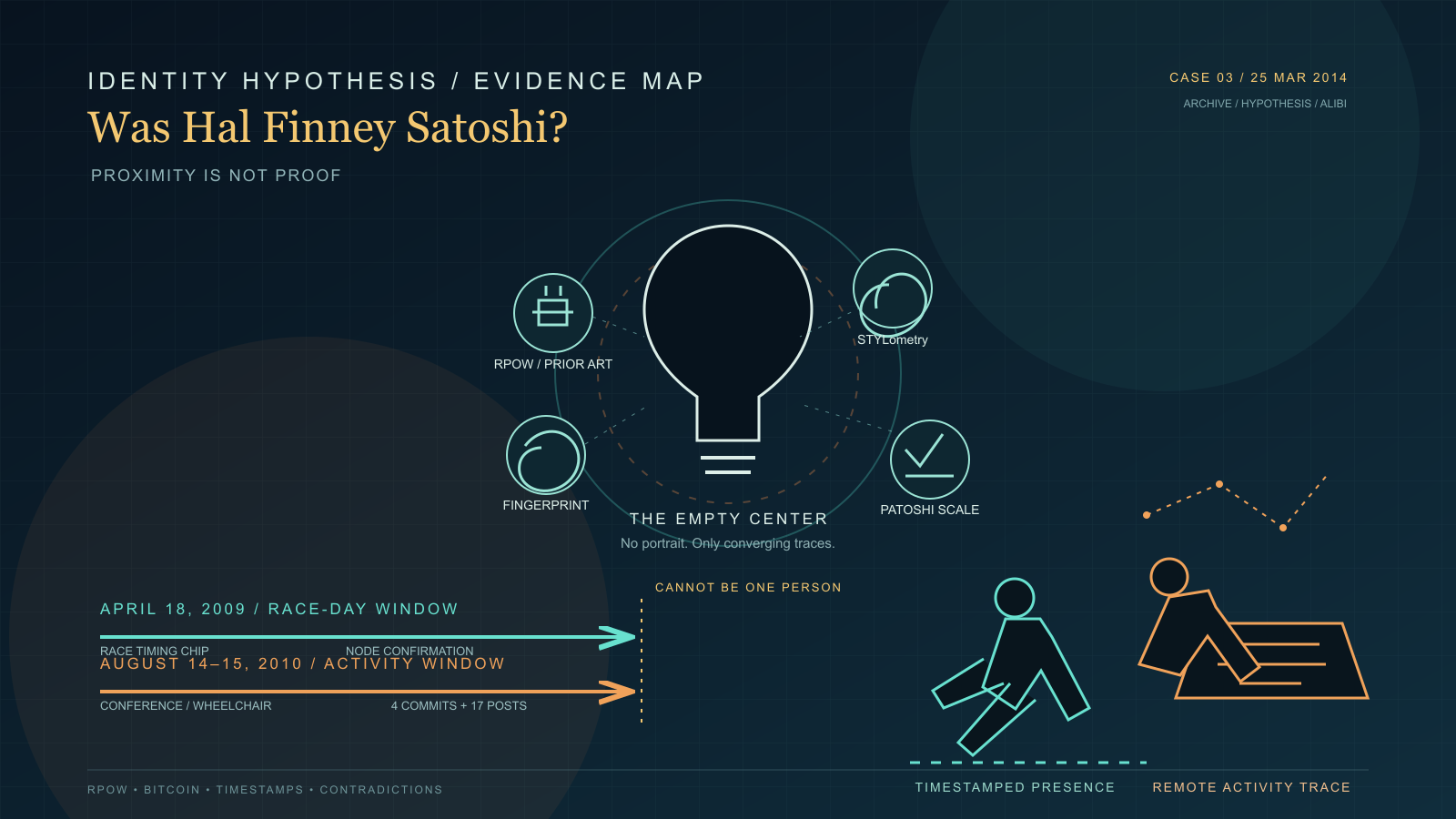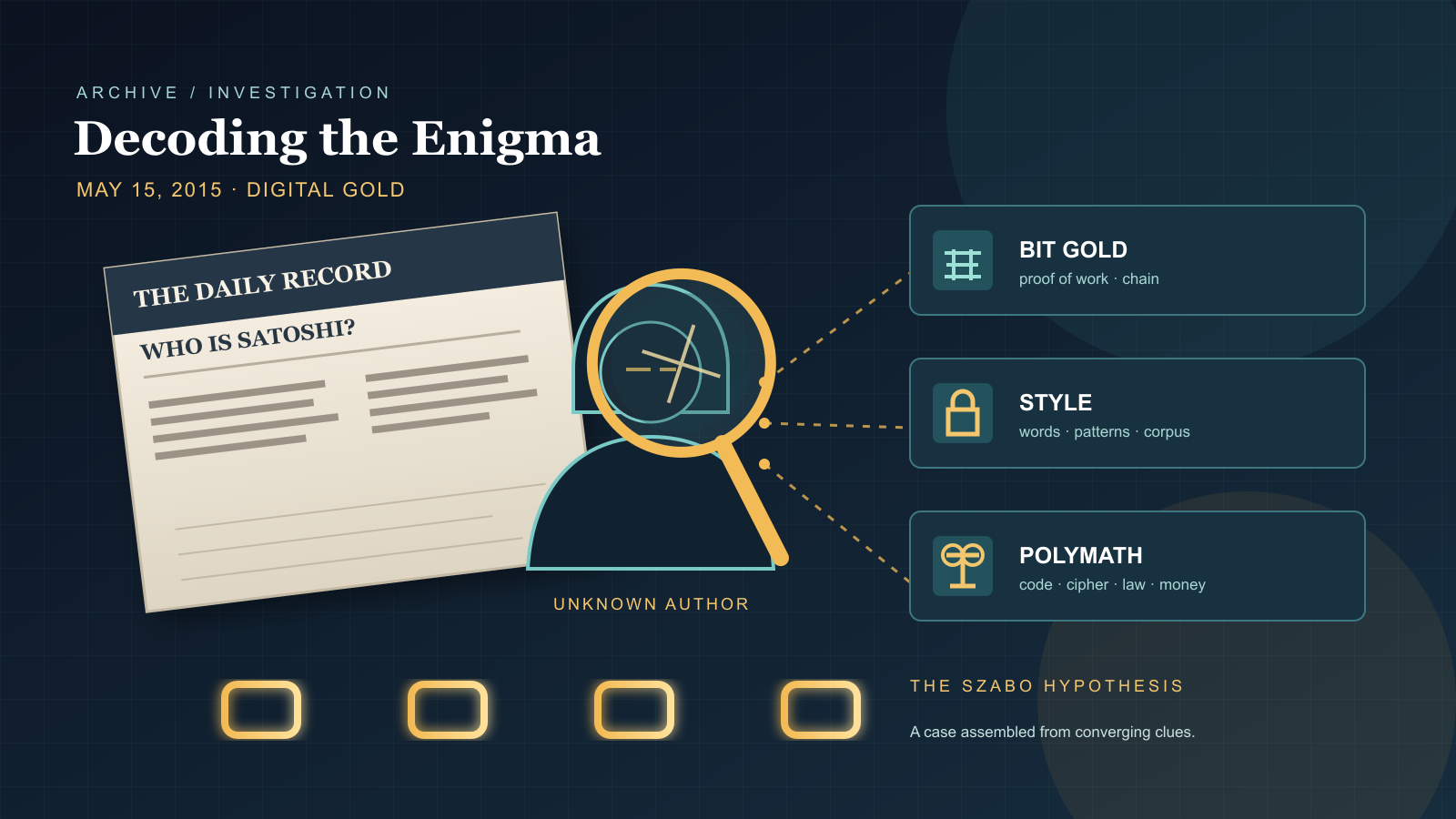
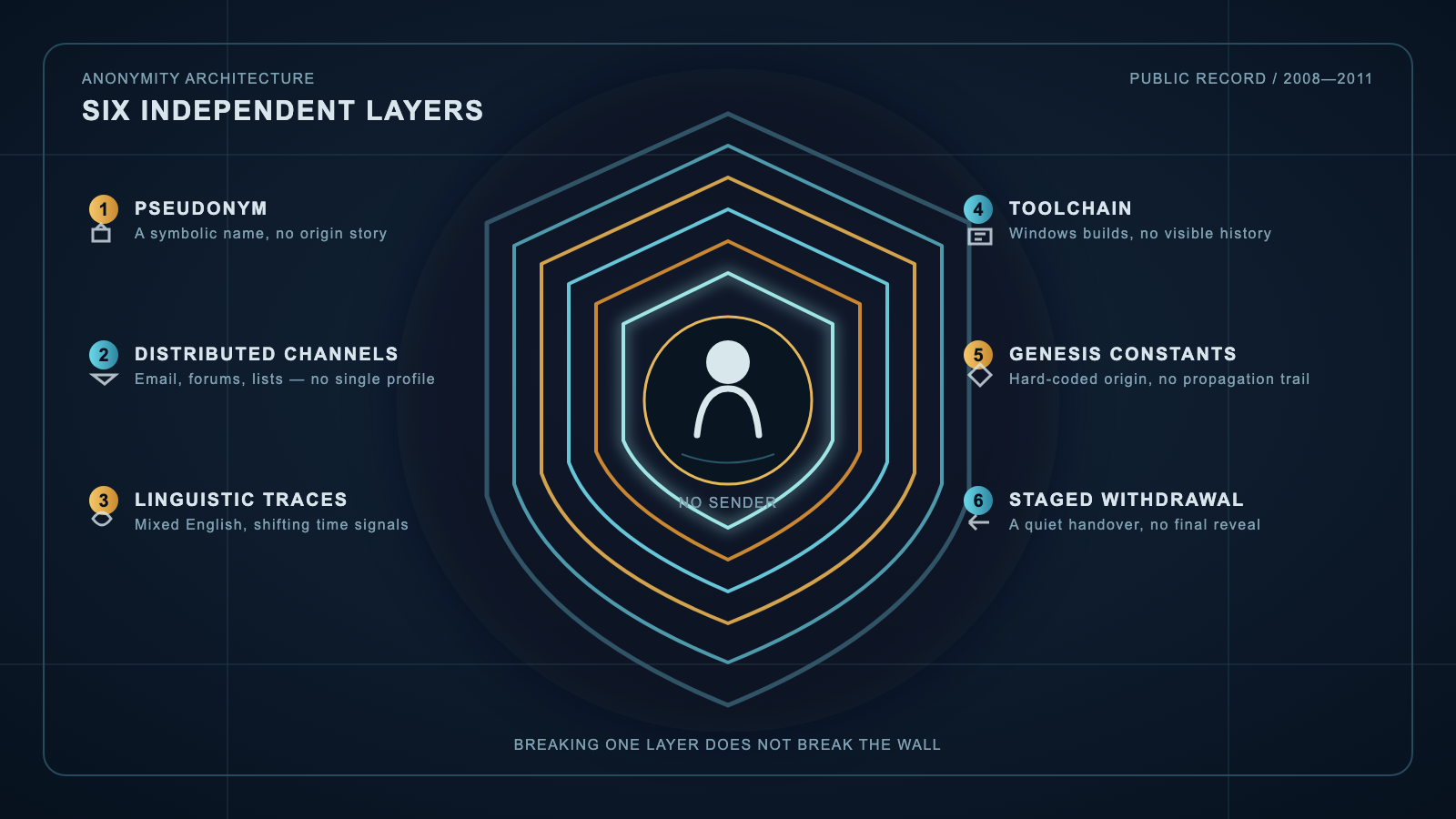
The name looks like the clue that should reveal who Satoshi was. Instead, the record scatters the problem across six layers: a Japanese-form pseudonym, anonymous mail relays, mixed language and time signals, a Windows-based release environment, a genesis block without a propagation footprint, and a withdrawal carried out in stages. Any identity hypothesis that explains only one of them has not reached the record’s actual difficulty.
This entry follows those traces from the development window (mid-2007 through August 2008) through the public phase and withdrawal. The adjacent questions have their own readings: who Satoshi is, in the identity-hypotheses overview, and why the gap persists despite so much surviving material, in the identification-asymmetry analysis.
The six-layer wall (overview)
1. The pseudonym (naming layer)
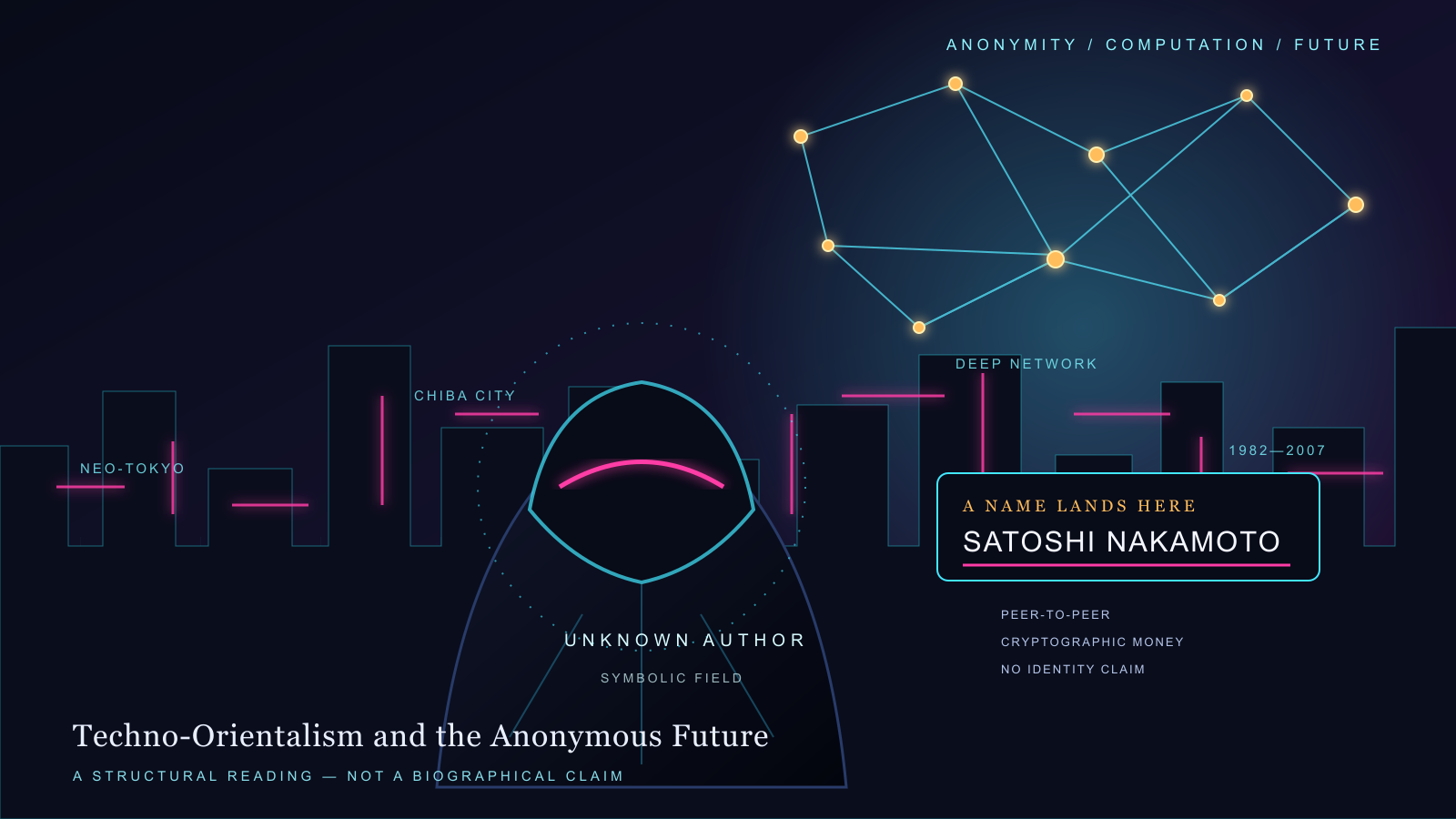
A Japanese-form pseudonym was chosen rather than a Western personal name, an obviously technical handle, or an explicitly anonymous alias. The choice falls inside an identifiable symbolic space already pre-loaded in late-1990s and early-2000s anglophone speculative fiction and hacker culture, where networked anonymity was routinely figured through East Asian (and specifically Japanese) visual and naming registers — a structural observation treated in detail in the techno-orientalism reading of the pseudonym.
For the purpose of the present entry, the pseudonym layer has one structural property: a Japanese-form name in a cryptography-mailing-list context creates an associative space (“network anonymity → Japanese-readable name → unspecified national origin”) that any identity hypothesis must displace before it can locate a specific person. The name itself does not point to a specific national or linguistic origin; it points to the symbolic space.
2. Communication channels (media layer)
Three pseudonymous email addresses are documented:
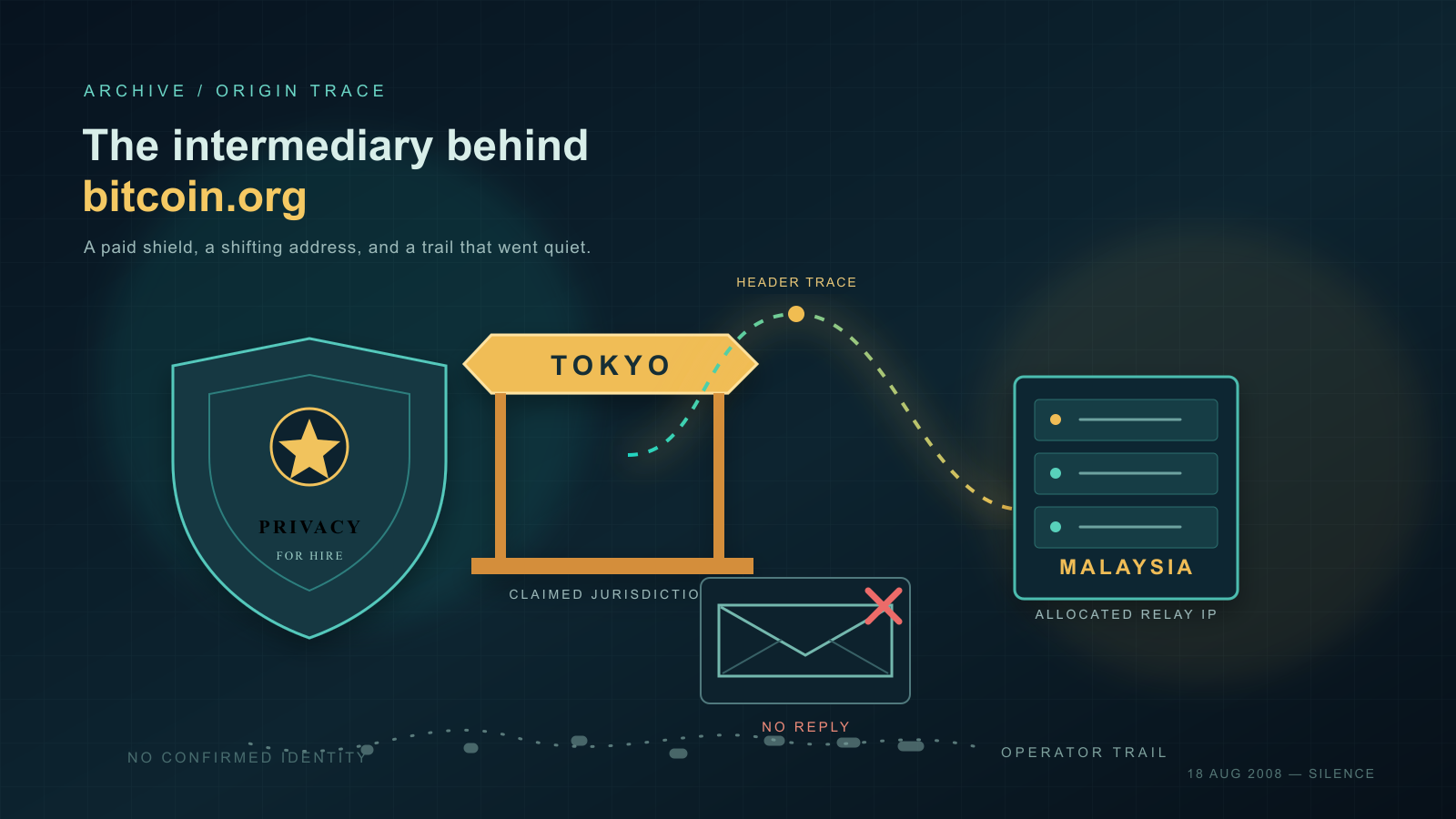
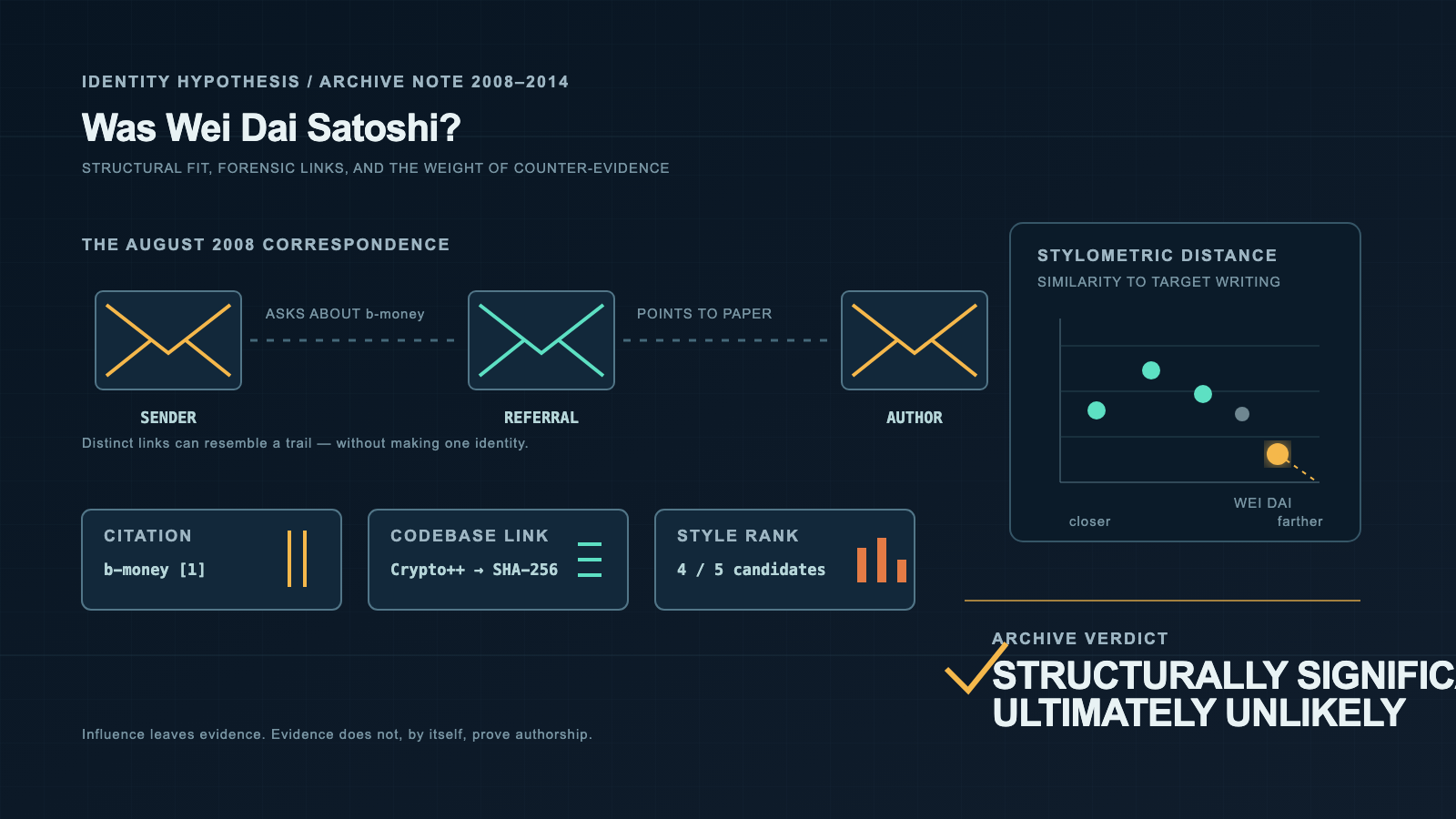
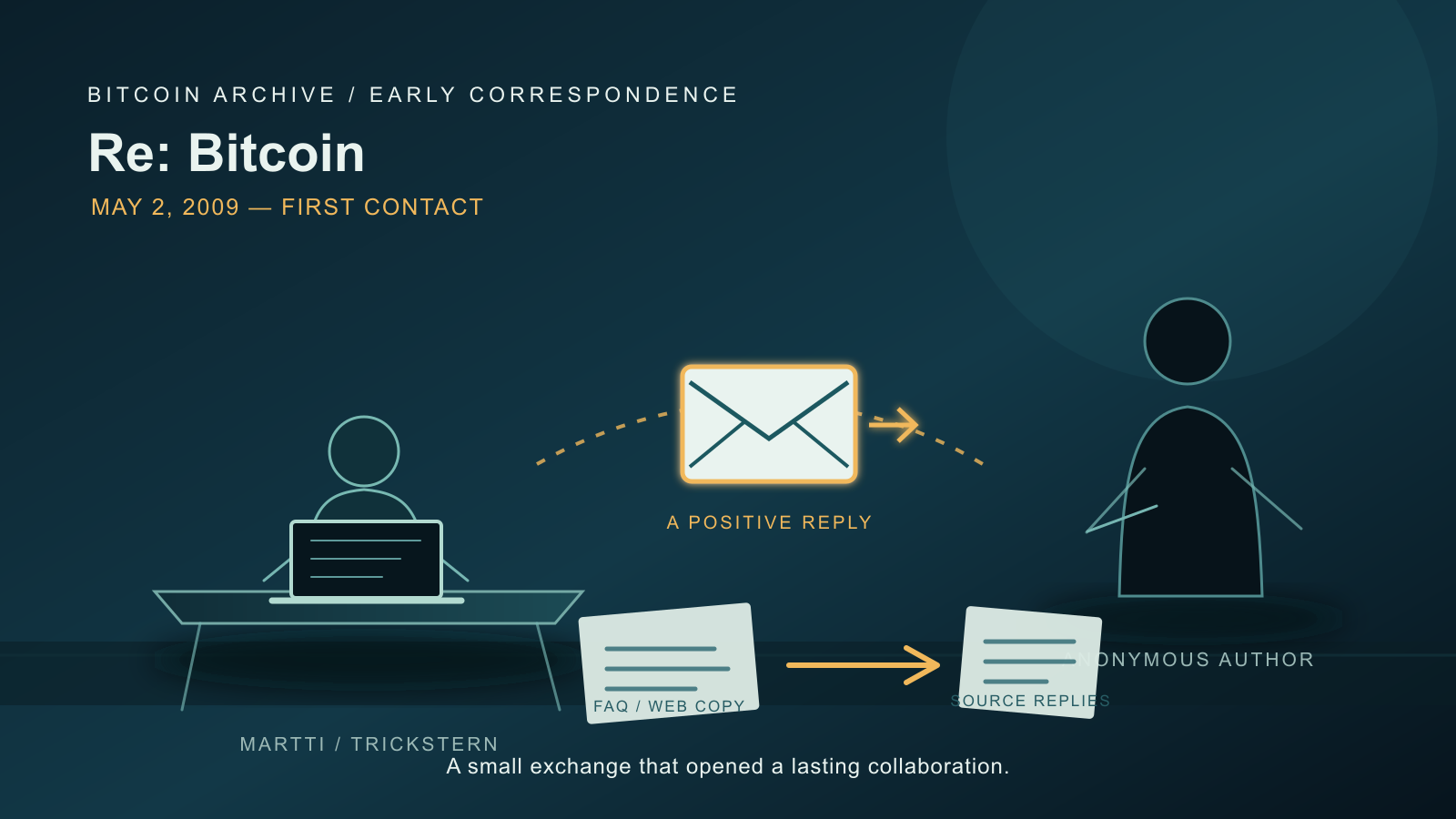
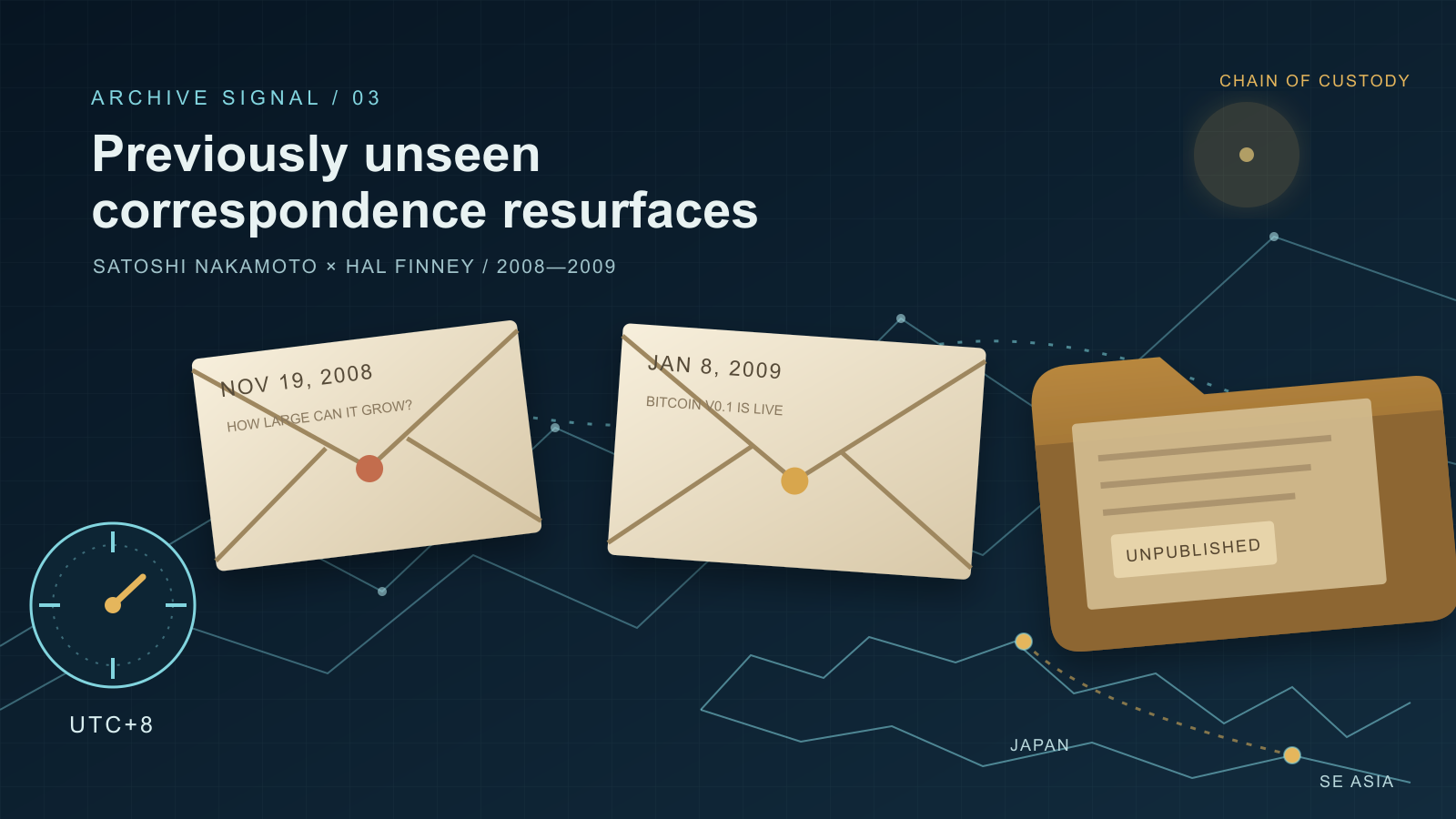
satoshi@anonymousspeech.com— used in August 2008 for the first contacts to Adam Back and Wei Dai. The same provider’s mail server, not Satoshi’s own location, is the traced source of a UTC+8 header on later 2009 emails to Hal Finney that briefly fueled location speculation.satoshi@vistomail.com— used in October 2008 on early drafts of the whitepaper and in mailing-list correspondence. Vistomail was an anonymous email service of unspecified provenance; the service itself is no longer operating.satoshin@gmx.com— used from October 2008 onward for the final whitepaper, BitcoinTalk forum activity, P2P Foundation registration, private correspondence, and the March 2014 P2P Foundation post denying the Newsweek Dorian Nakamoto identification (the authenticity of the 2014 post itself is debated; the account may have been compromised).
The three addresses are treated as established public record — attested by the metzdowd cryptography-list archive of the whitepaper announcement itself, published correspondence on mmalmi.github.io/satoshi and plan99.net, and Bitcoin Magazine’s released Adam Back correspondence.
The publication channels are similarly distributed:
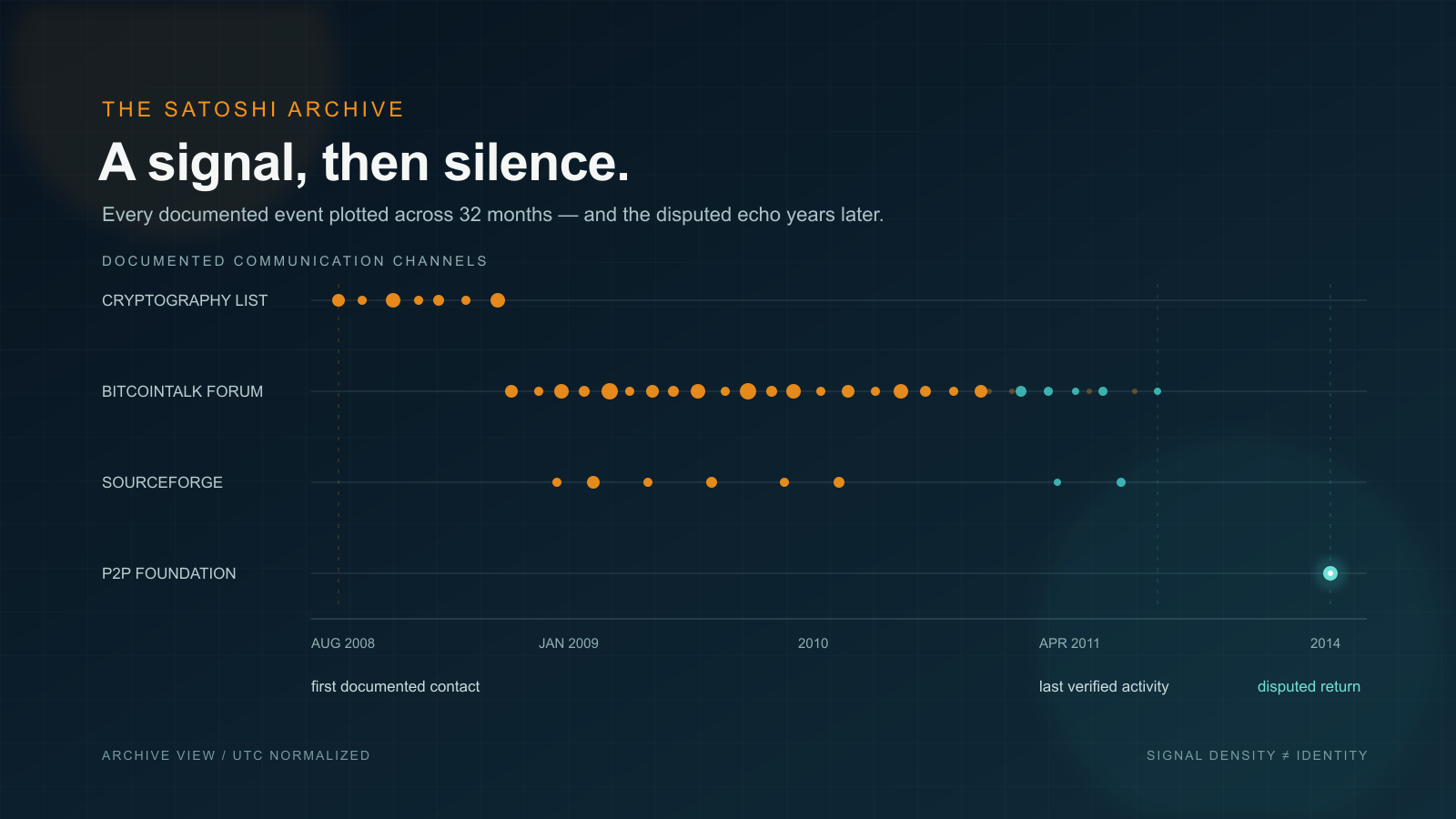
- Cryptography mailing list (Metzdowd) — first whitepaper announcement (October 31, 2008) and the v0.1 release announcement (January 8, 2009).
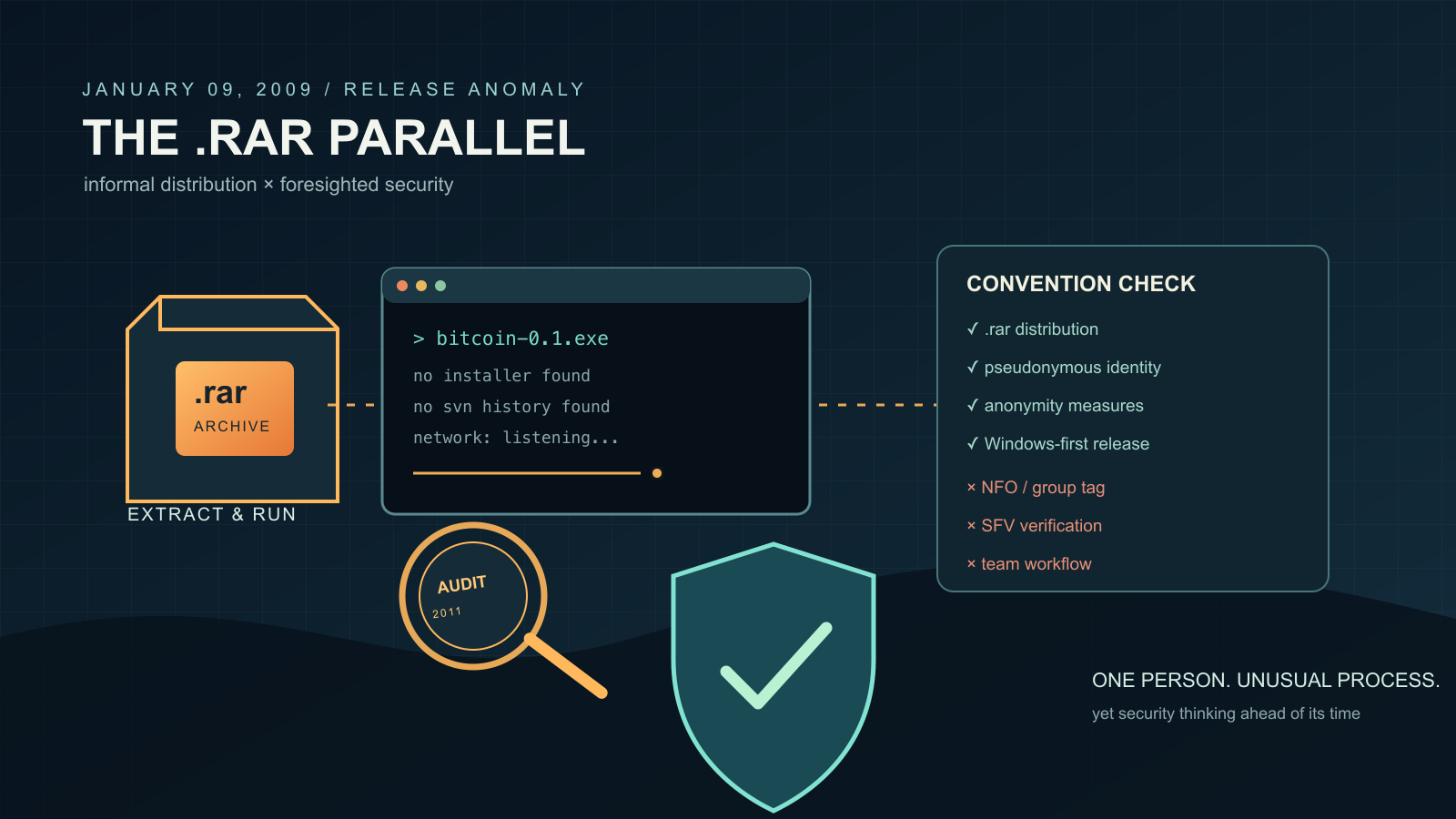
- SourceForge — initial v0.1 distribution (January 8, 2009) as a
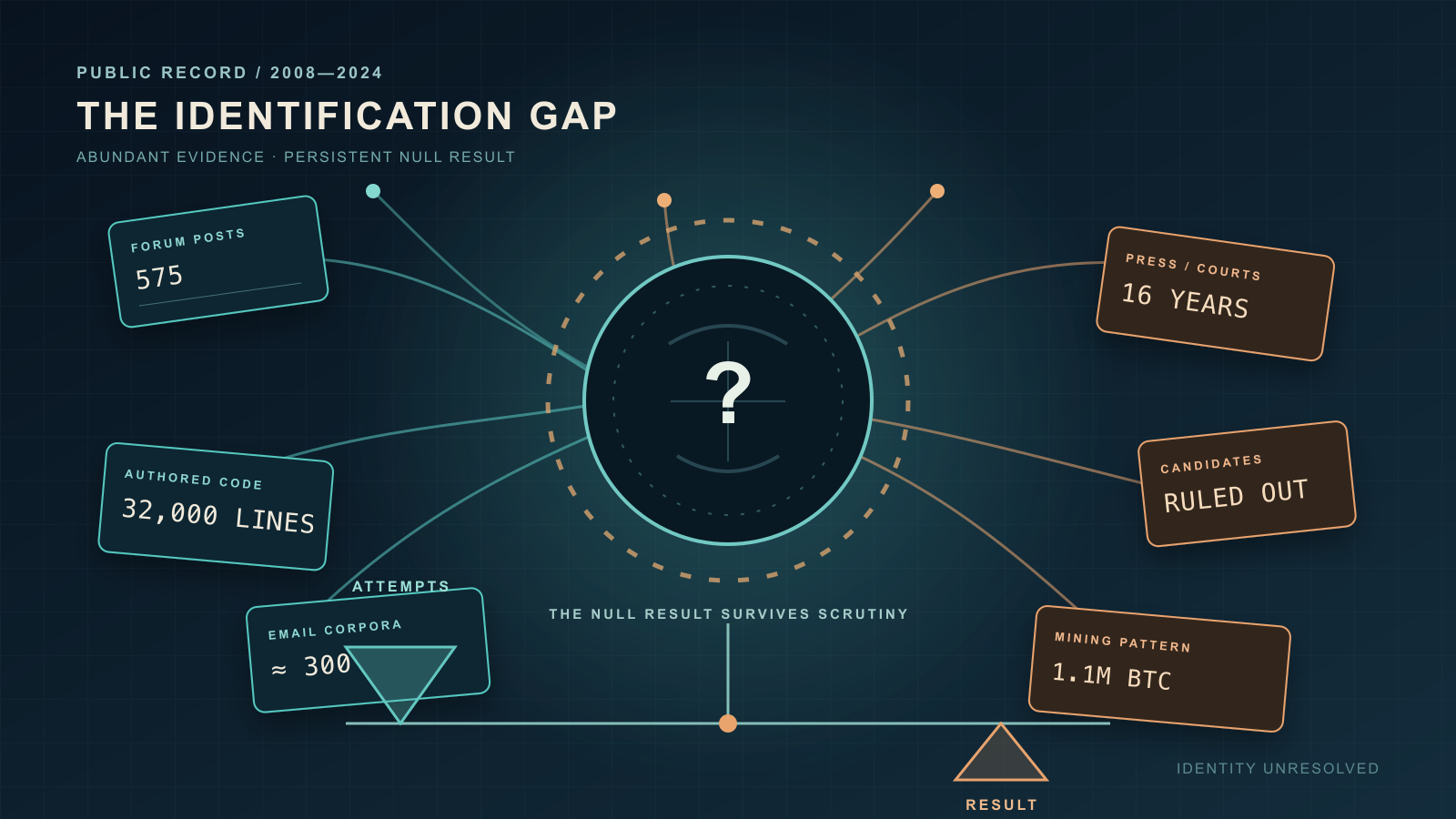
.rararchive; later SVN repository hosted from August 2009 (set up by Martti Malmi, not by Satoshi). - BitcoinTalk forum — 575 posts between November 22, 2009 and December 12, 2010.
- P2P Foundation — account created February 11, 2009; thread “Bitcoin open source implementation of P2P currency” posted the same day.
- p2p-research mailing list — parallel post on February 11, 2009.
- Domain registration via AnonymousSpeech —
bitcoin.orgregistered August 18, 2008 through an anonymous-registration intermediary.
The pattern of multiple unrelated email providers, an anonymous-registration intermediary, and a distribution among five public channels (cryptography ML, SourceForge, BitcoinTalk, P2P Foundation, p2p-research) leaves no single channel through which a holistic identity profile could be assembled.
On Tor. Two separate questions need to be distinguished. (a) Did Satoshi engage with Tor as a technical topic? Yes — Satoshi participated in the BitcoinTalk “TOR and I2P” thread (January 20, 2010 and February 4, 2010 replies), discussing .onion backend support, the Tor SOCKS port 9050, and Bitcoin’s behavior under a Tor proxy in technical detail. Engagement with Tor as a topic is on the public record.
(b) Did Satoshi personally route his own communications through Tor? This is widely asserted in secondary discussion of Satoshi’s operational profile but is not directly confirmed by any primary statement from Satoshi about his own routing. The inference rests on the operational requirements of an anonymous-email + anonymous-registration + multi-channel posting setup, not on a documented self-statement. This entry treats personal-routing Tor use as plausibly inferred but not directly verified, while noting that Satoshi’s technical familiarity with Tor is verifiable.
3. Linguistic and temporal traces (linguistic layer)
Two independent inconsistencies in the documentary record are observable from publicly accessible material.
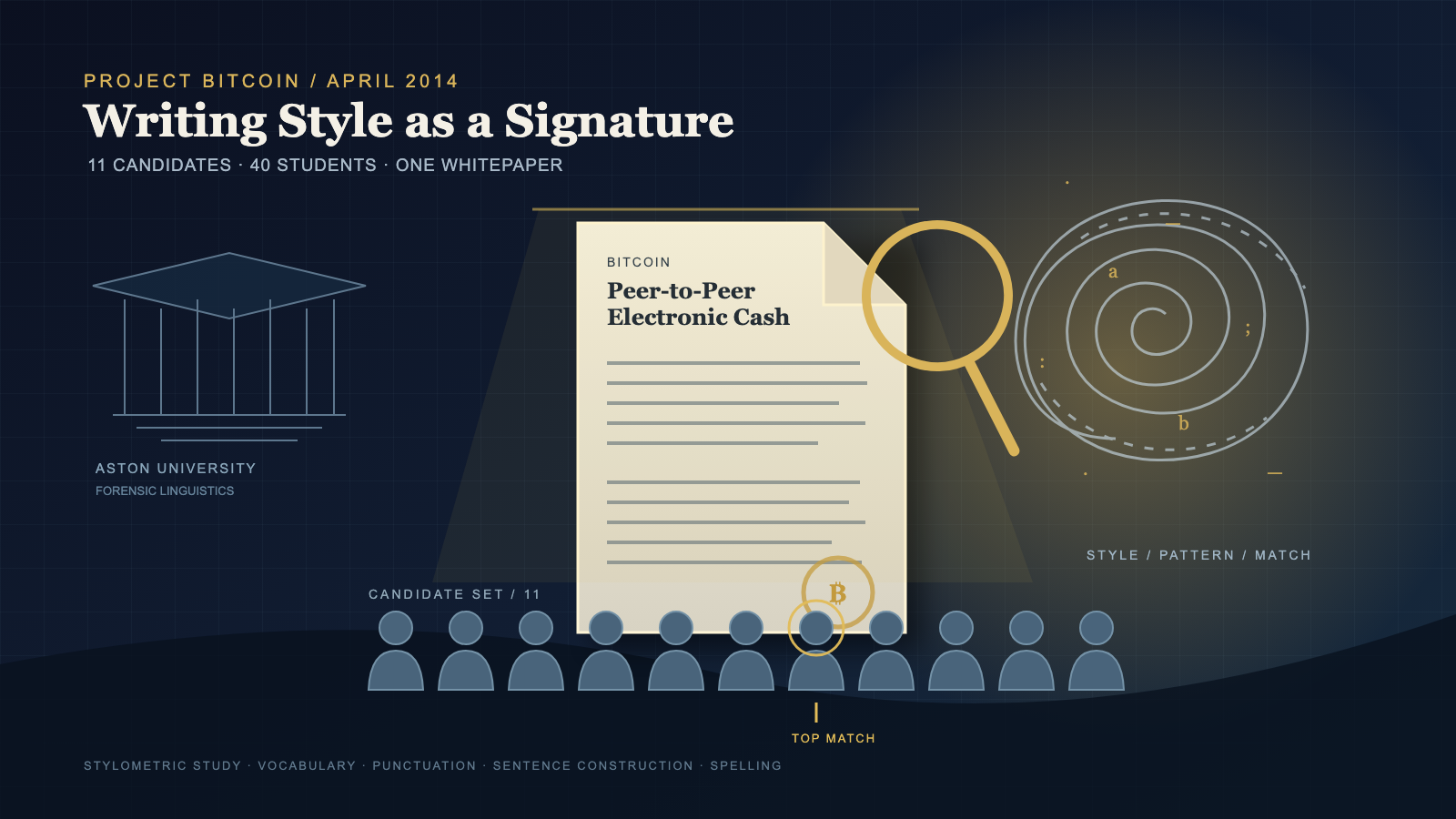
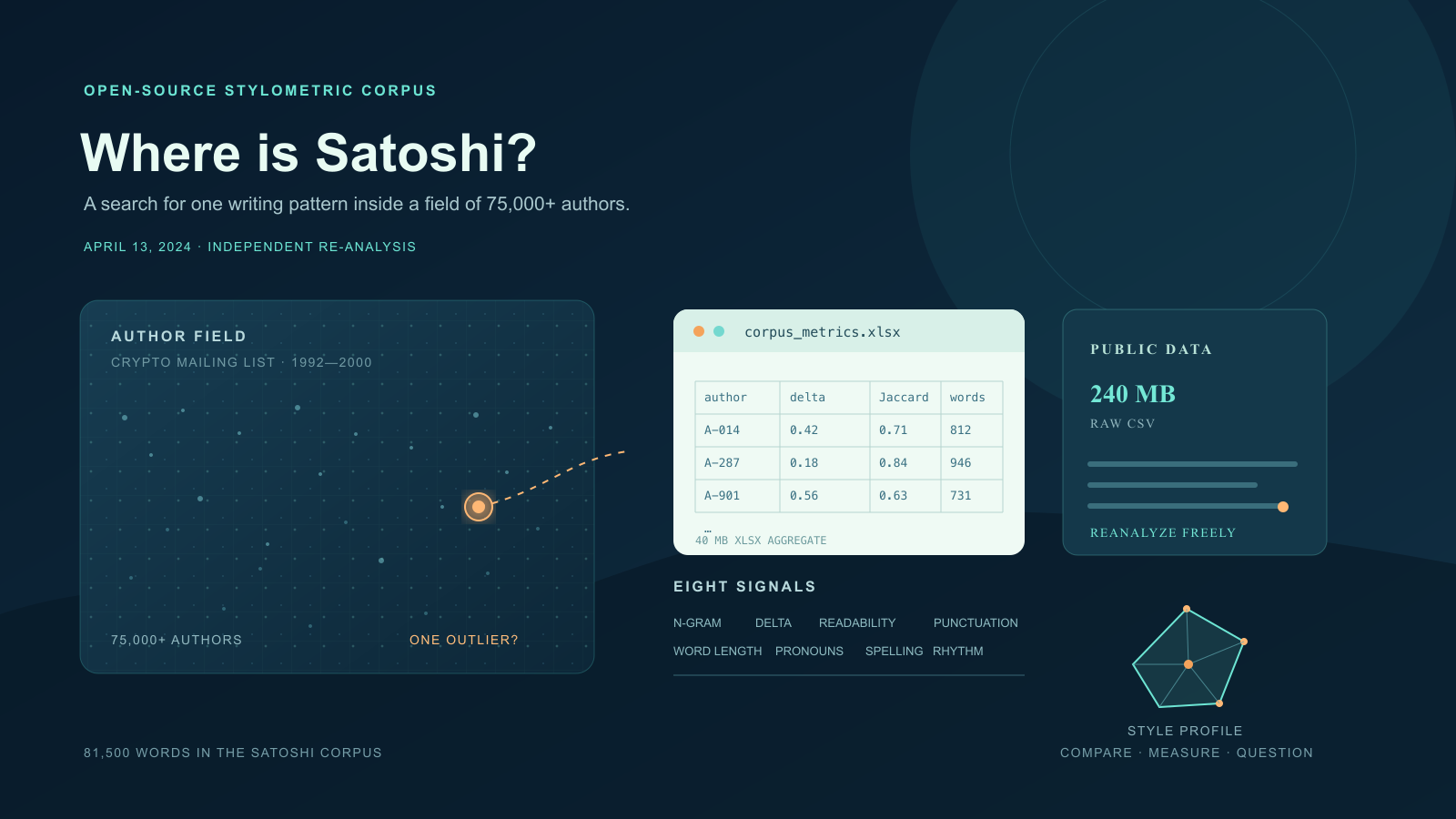
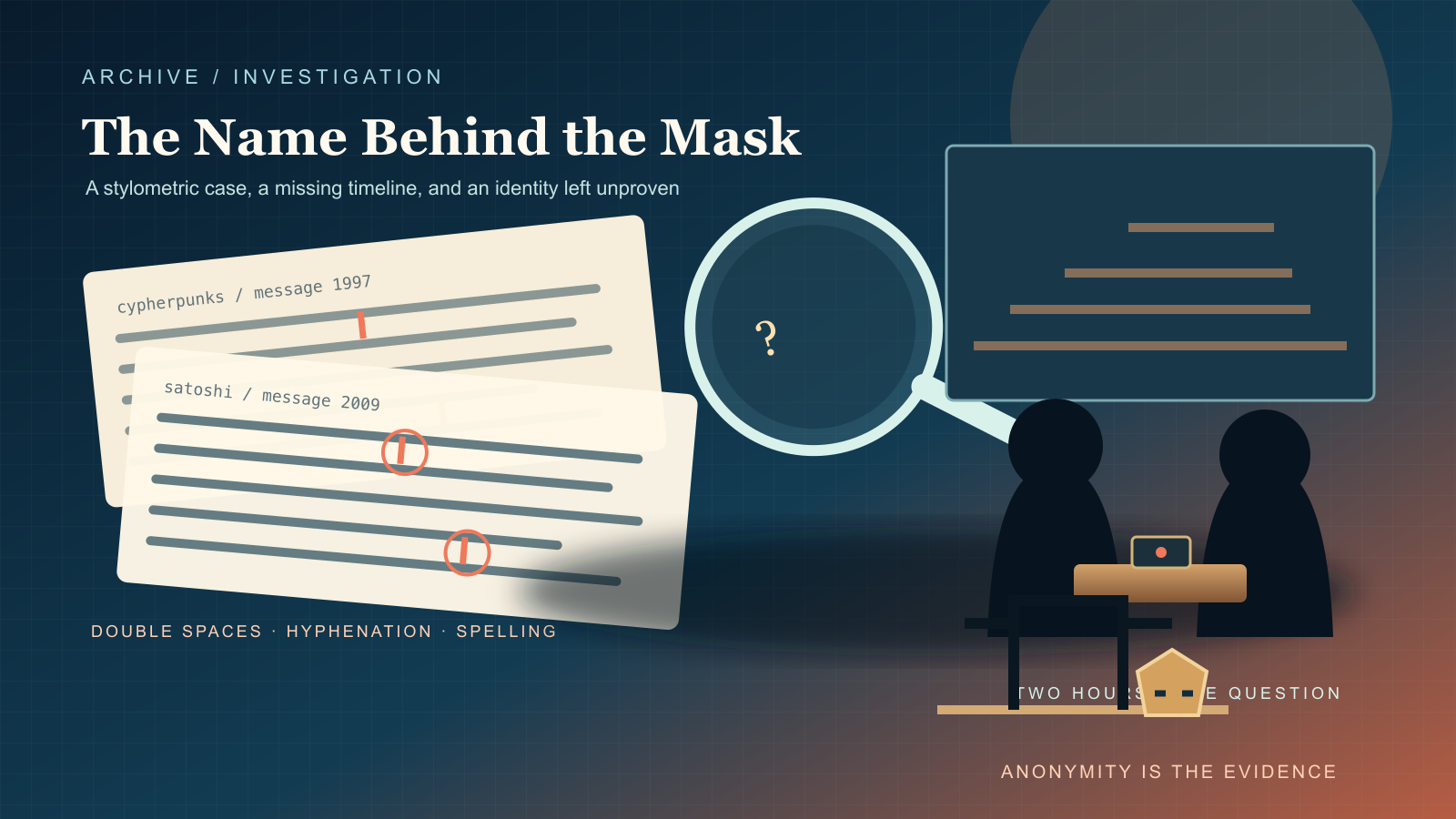
English register inconsistencies. Satoshi’s prose in BitcoinTalk posts and email correspondence mixes British and American spelling conventions. British forms (colour, favour, grey, optimise) coexist with American forms (characterized). The colloquial register includes British / Australian idiom — bloody hard (in a BitcoinTalk post), flat (for apartment), maths (for mathematics) — alongside American programming-context conventions in source code (color, catalog). This pattern is a recurring observation in long-form Satoshi-identity analyses.
Timestamp / time-zone inconsistencies. PDF metadata of two whitepaper drafts shows different time-zone offsets:
- The October 2008 draft has
Language: en-GBandCreationDate: 2008:10:03 13:49:58-07:00(Pacific time zone). - The March 2009 final has
Language: en-GBandCreationDate: 2009:03:24 11:33:15-06:00(Mountain or Central time zone, depending on daylight-saving alignment).
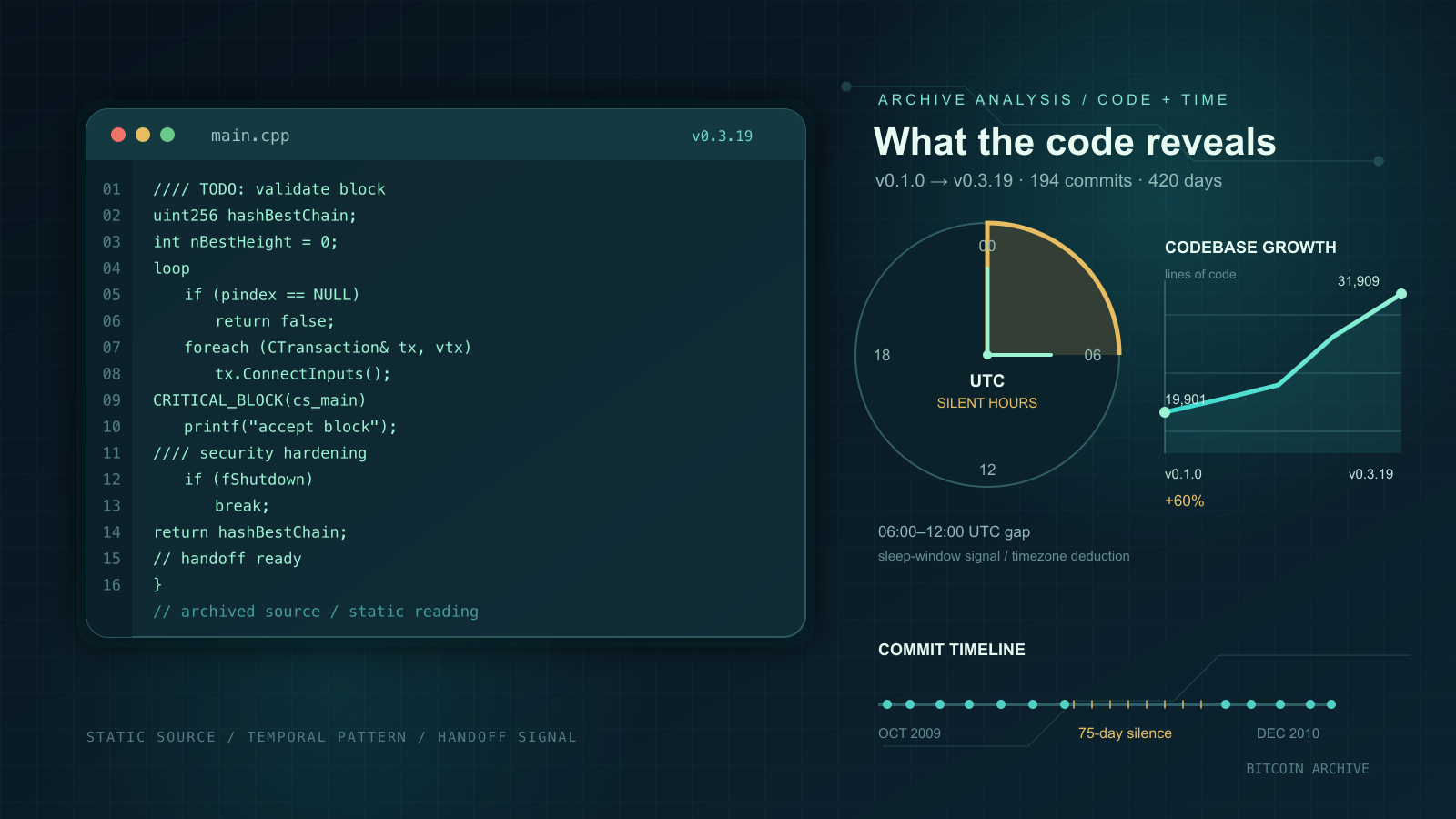
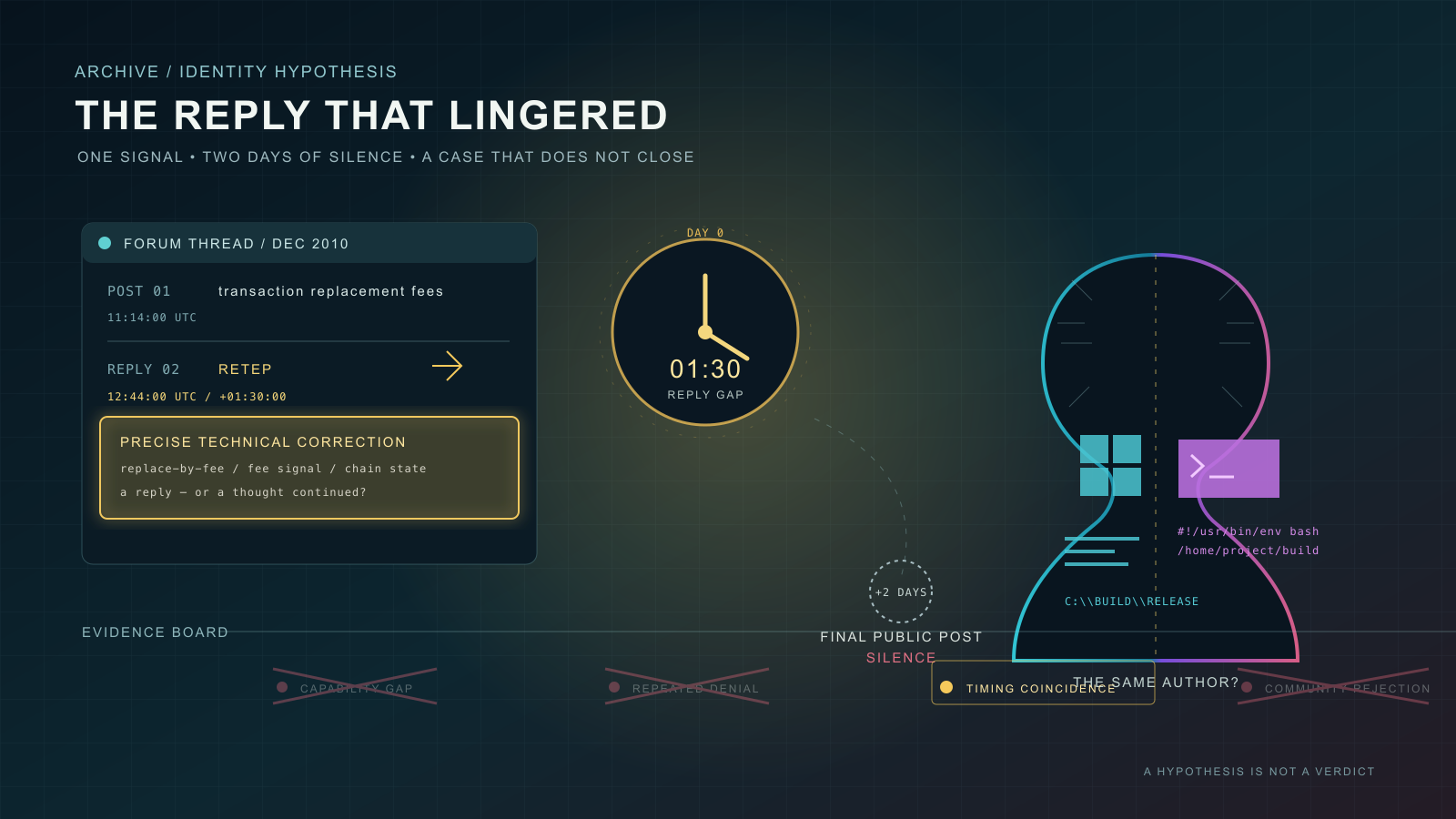
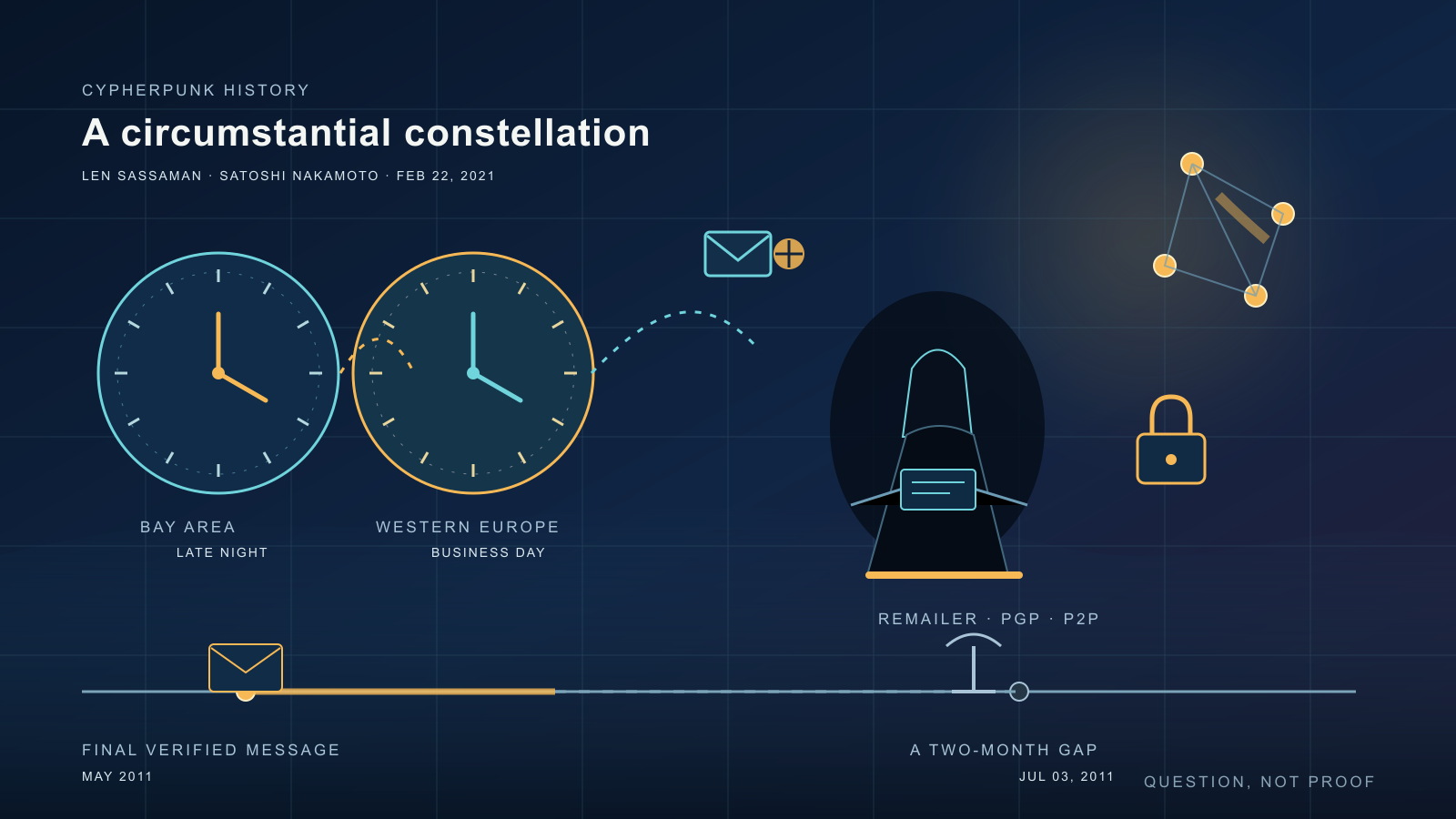
BitcoinTalk forum-post timestamps further distribute across the 24-hour clock with one consistent gap: Satoshi’s posting activity is markedly sparse in the UTC 06:00–12:00 window. This pattern can be derived from the BitcoinTalk public archive of the 575 posts. Independent timestamp analysis of Satoshi’s source-code commits (v0.1.0–v0.3.19) shows the same gap and reads it as suggestive of EST (UTC-5) or CST (UTC-6) residence — under those assumptions the gap maps to roughly 01:00–07:00 local time (a typical sleep window). Other time-zone hypotheses (GMT, JST) place the gap at unnaturally inverted hours. See the code analysis for the commit-pattern derivation.
The combined linguistic-and-temporal pattern is internally inconsistent in the sense that no single national / linguistic / time-zone profile aligns with all of the traces. Any identity hypothesis must either treat these as deliberate noise or supply an explanation in which the same person produced them organically. The same British/American spelling mix and whitepaper-PDF timezone offsets are developed at full length in the nationality-question analysis, which weighs them against the candidate national-origin hypotheses this layer alone cannot decide between.
4. Development and distribution choices (technical layer)
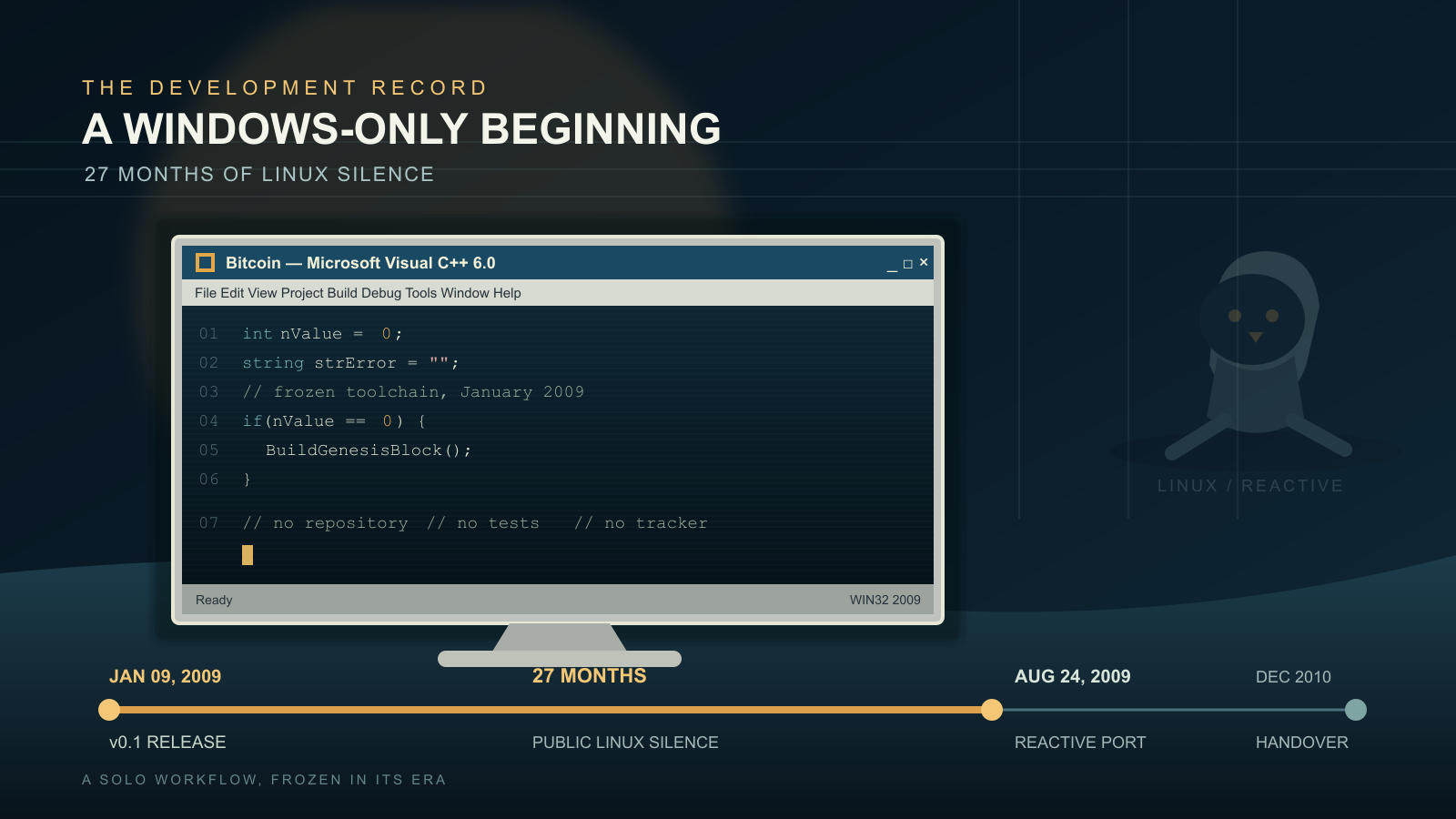
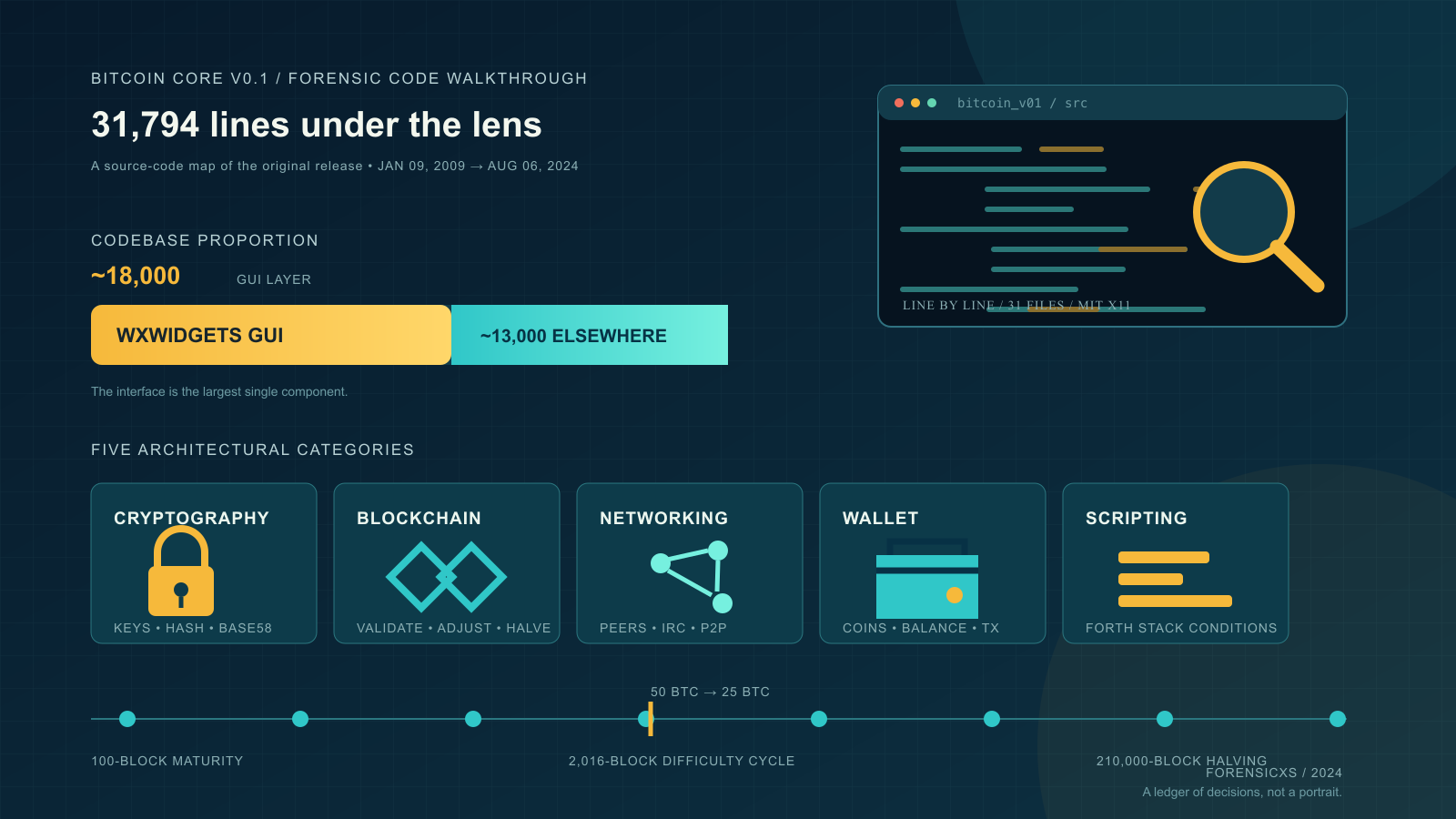
Documentary records of the v0.1 codebase, distribution archive, and version-control history establish a consistent Windows-based development environment:
- Compilation toolchain: Visual C++ 6.0 SP6 with MinGW GCC 3.4.5 (per the
Makefile.unixand binary metadata in the Bitcoin v0.1 release). - Line endings in source files: CRLF (Windows convention).
- Distribution format:
.rararchive (a format common in late-2000s Windows-software distribution rather than in Linux open-source distribution). - Hosting: SourceForge.
Detailed treatment of these traces is in the launch-environment analysis and the distribution-and-tooling-anomalies analysis.
The version-control history shows three related properties:
- The 2007 through January 2009 development period is not under version control in any publicly inspectable form. The initial January 2009 v0.1 release was a single
.rararchive on SourceForge, not a repository snapshot. - The Subversion repository was set up on the SourceForge project during the Linux port with help from Martti Malmi — not by Satoshi. The earliest preserved commits in the repository date from October 2009; see the code analysis for the commit-history breakdown.
- The GitHub
bitcoin/bitcoinrepository was created in December 2010 by Gavin Andresen during the handover, after Satoshi’s last Subversion commit (revision 202, December 15, 2010).
Satoshi’s December 3, 2010 private email to Martti Malmi contains the self-evaluation “[Gavin is] technically much more Linux capable than me” — catalogued in the self-statements entry. The remark is consistent with the Windows-environment pattern in the v0.1 codebase.
5. Genesis-block parameter constants (origin de-attribution layer)
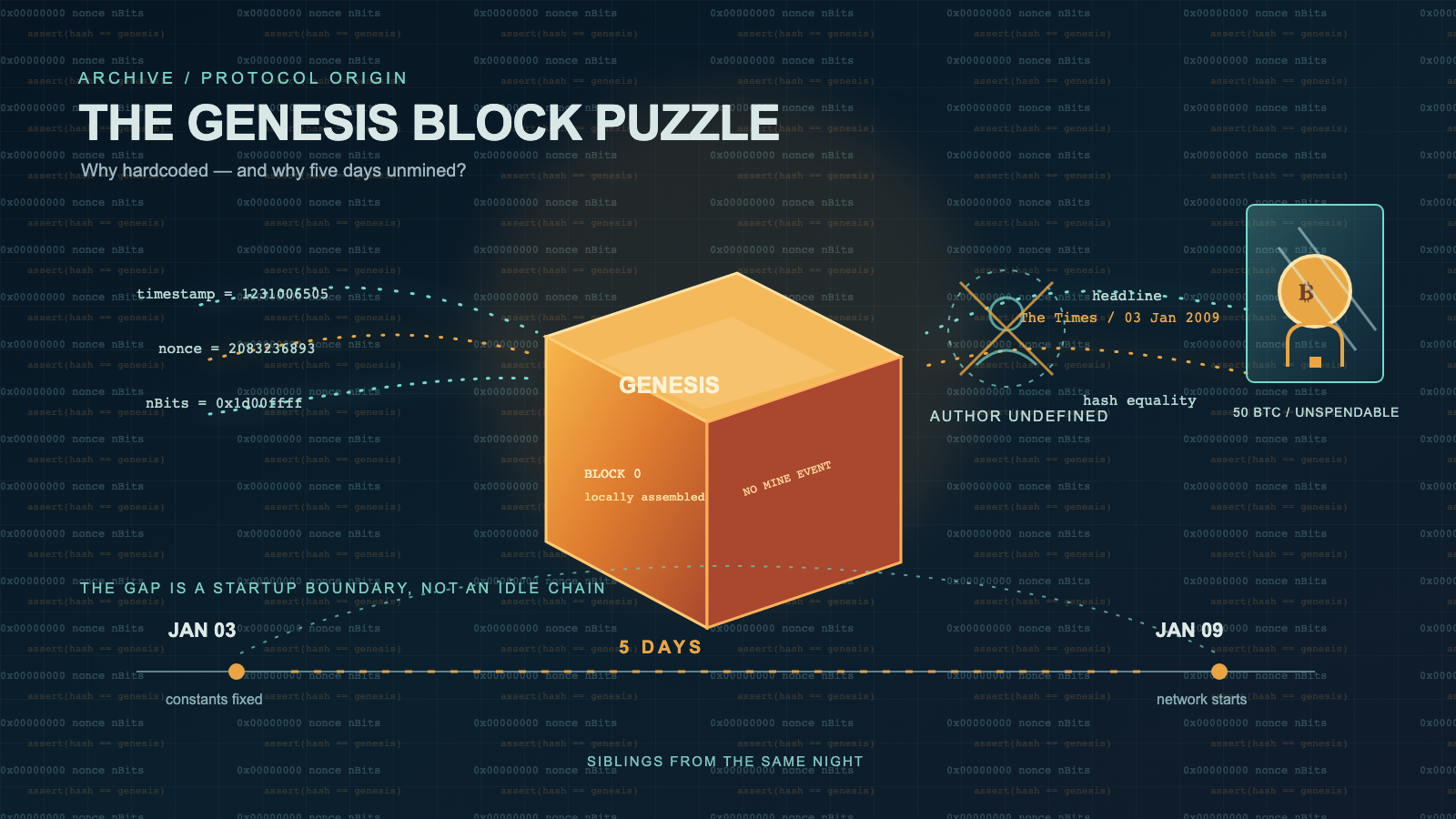
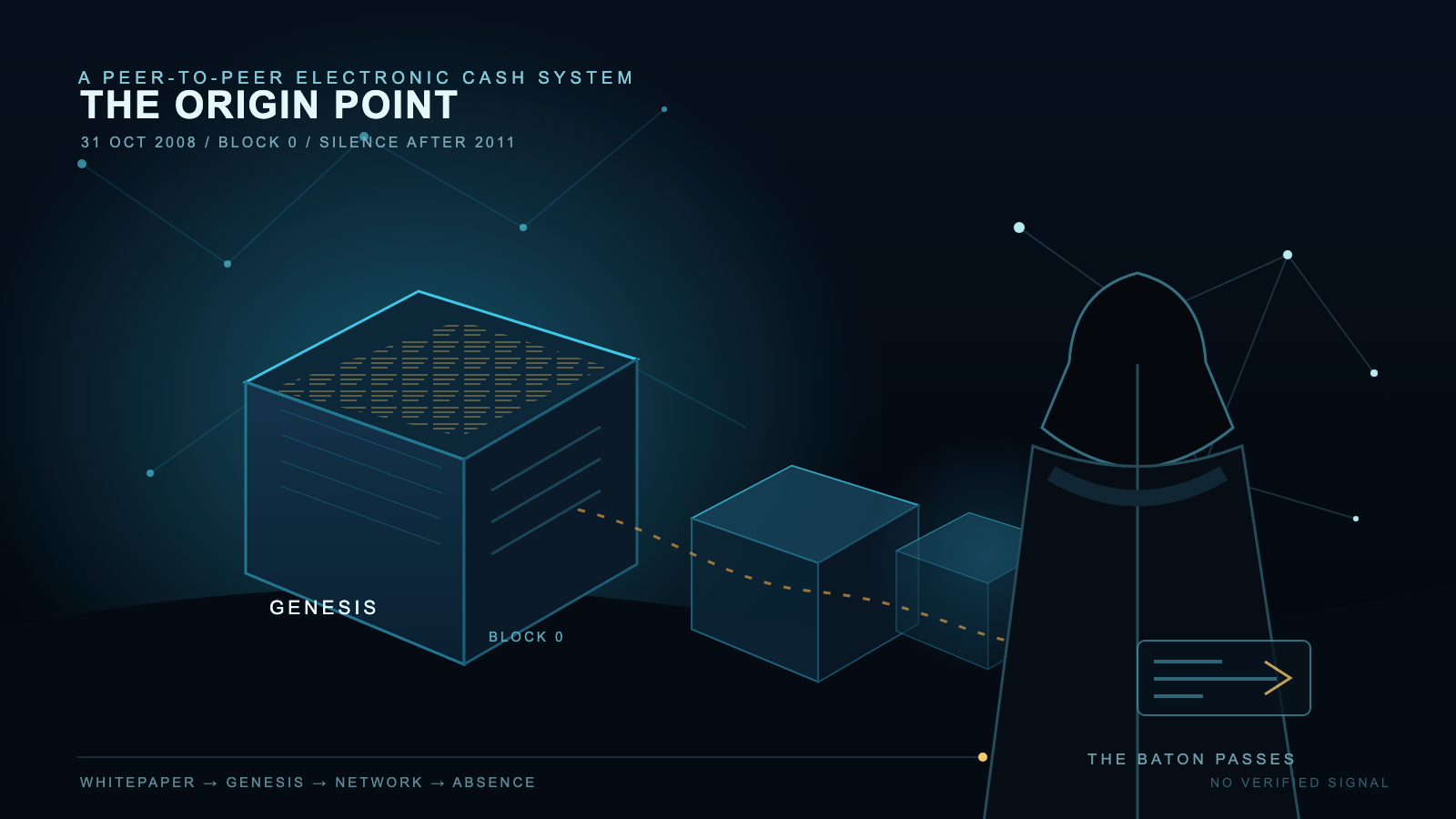
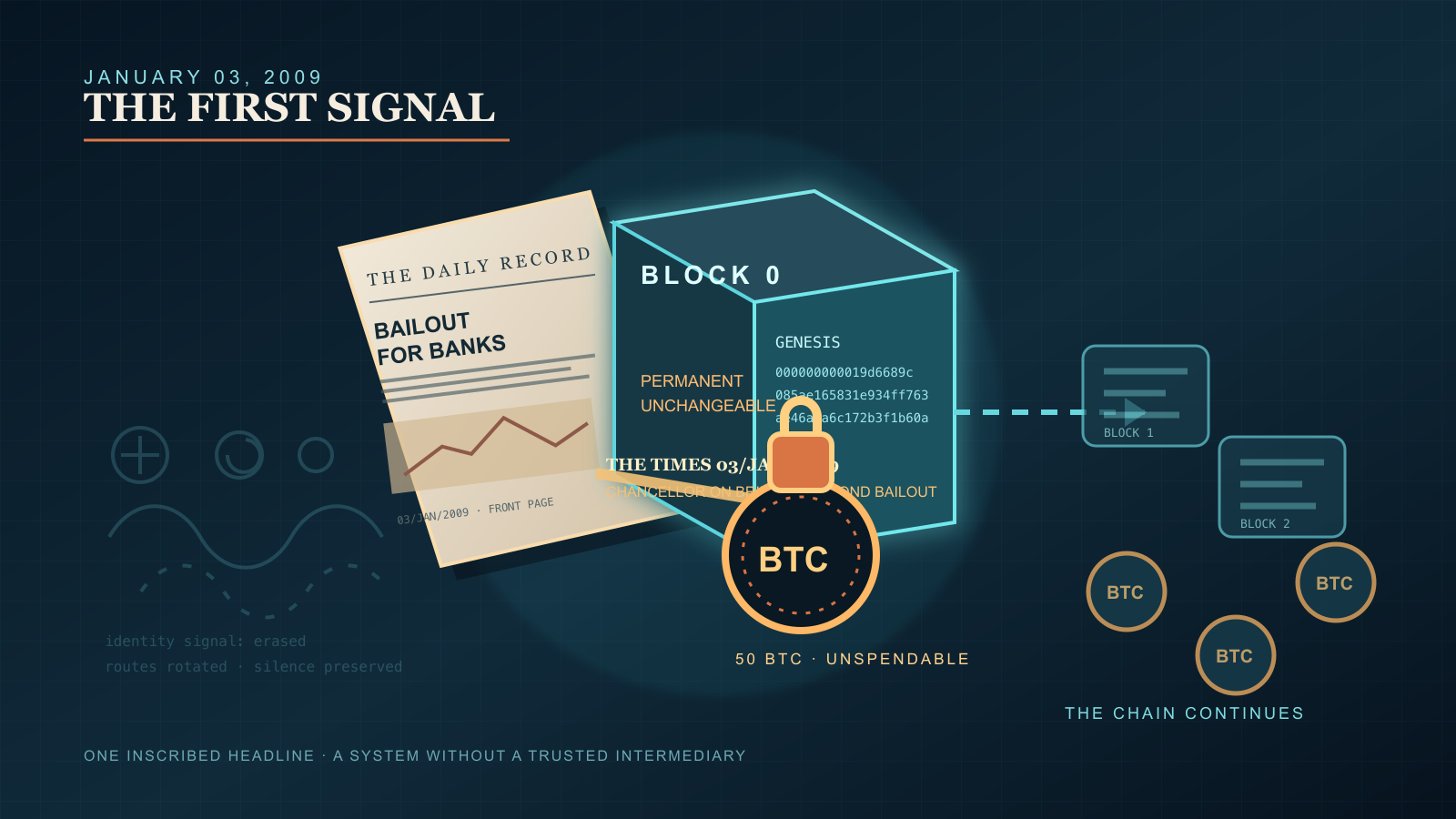
The genesis block of the Bitcoin chain (height 0) is not produced by Satoshi mining and broadcasting it. All of its parameters — timestamp 2009-01-03 18:15:05 UTC, nonce 2083236893, hash 000000000019d6689c085ae165831e934ff763ae46a2a6c172b3f1b60a8ce26f, coinbase message, Merkle root — are hard-coded into the source as constants. Any node that boots from an empty database reconstructs the same block 0 deterministically from those constants, regardless of who originally derived them.
Detailed treatment is in the genesis-block hardcode analysis.
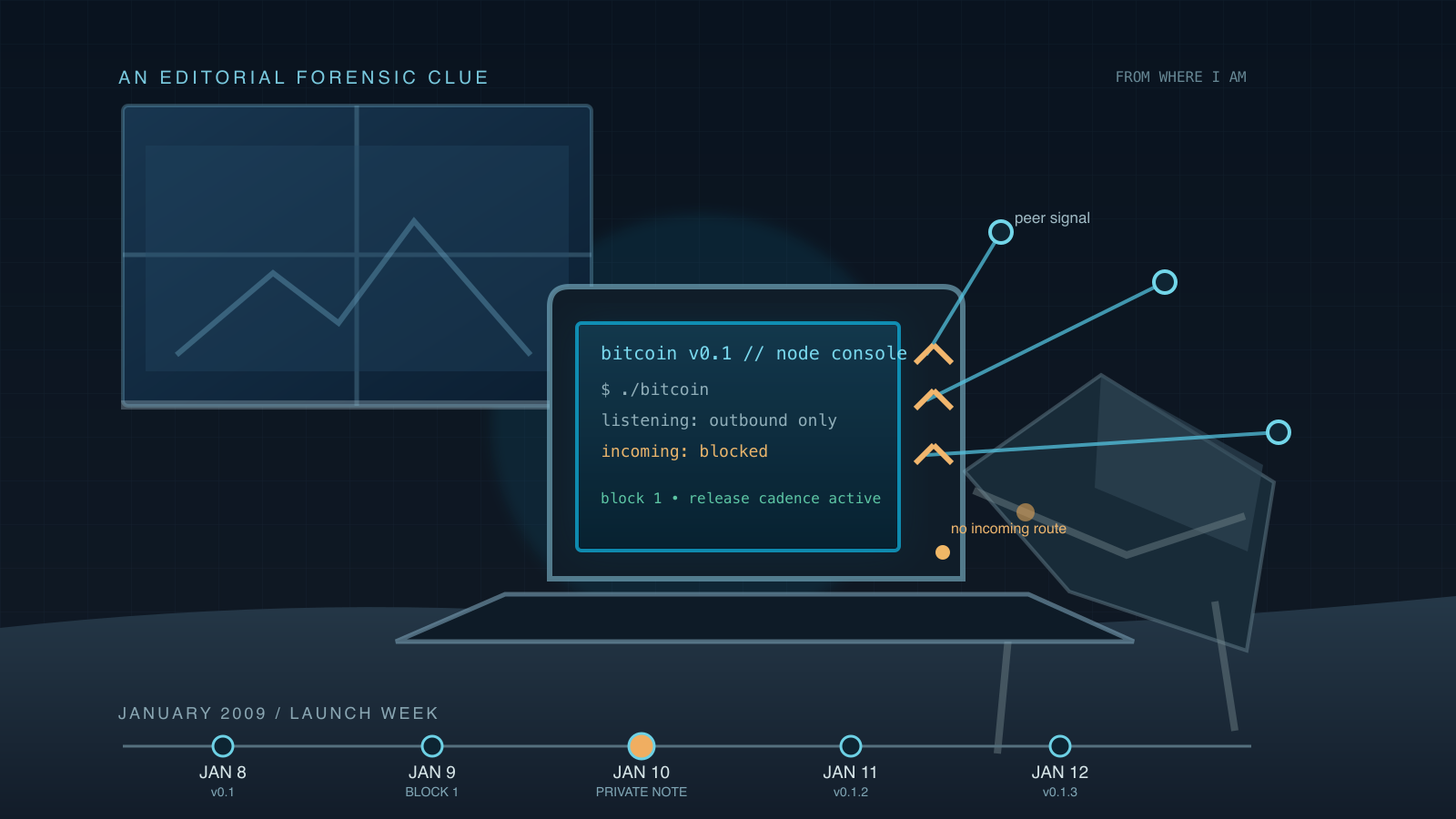
The structural property that matters for the present entry is that block 0 carries no propagation footprint. Unlike subsequent blocks, which were broadcast by a specific mining node into the peer-to-peer network and which carry an inferable arrival path, block 0 was never broadcast. The chain’s origin point is the only block that the protocol cannot trace back to a network sender.
This is a layer beyond the pseudonym, the email addresses, and the linguistic noise: the system itself, once running, contains no trace of the entity that authored its origin. Any forensic attempt to identify Satoshi from on-chain origin data cannot trace back past block 1.
6. Staged withdrawal (handover layer)
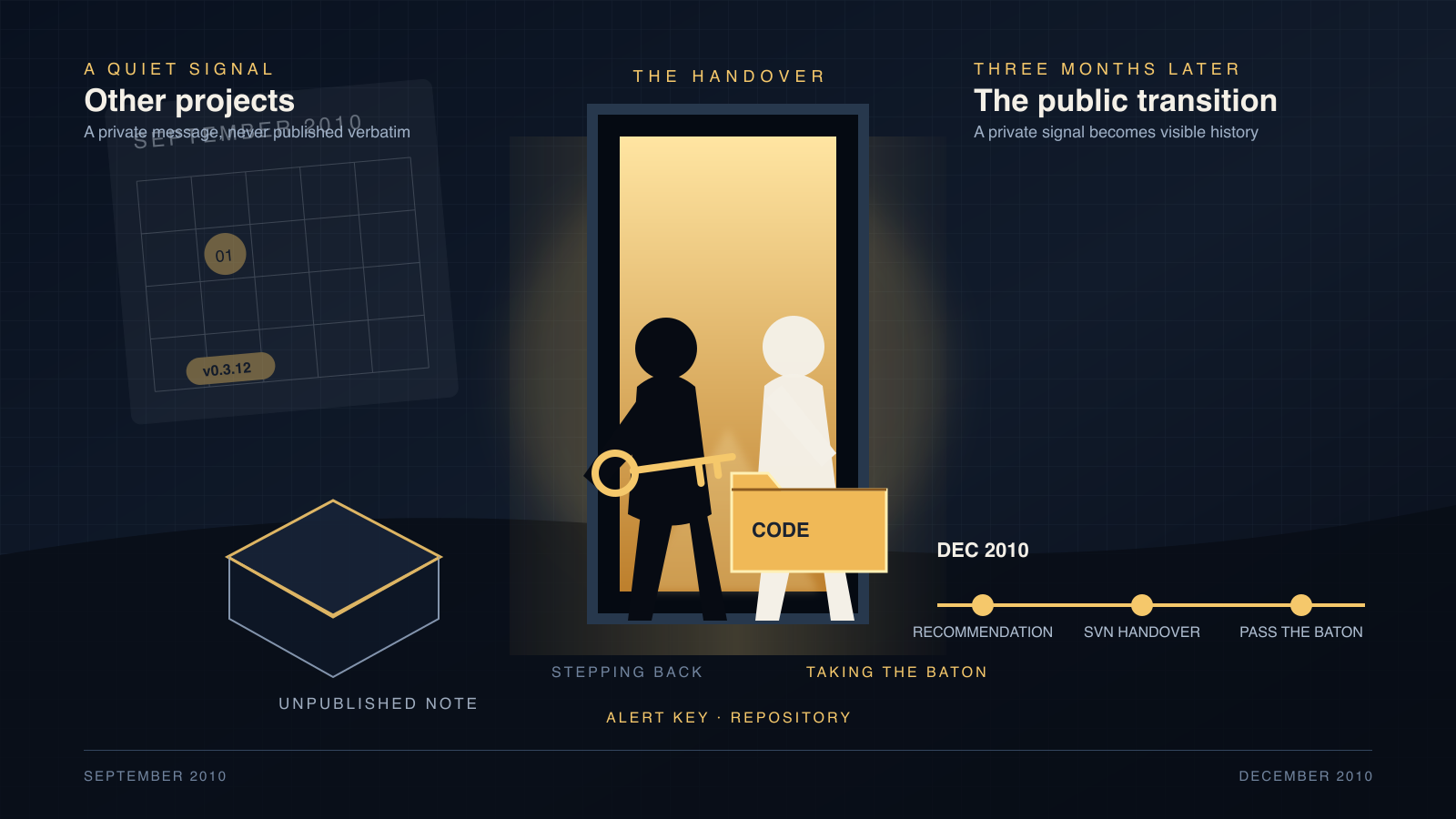
Satoshi’s withdrawal from the project does not occur as a single event. The documentary record traces a graduated sequence over approximately seven months:
| Date (UTC) | Event | Source |
|---|---|---|
| September 2010 | Satoshi tells Gavin Andresen privately that he is “working on other projects.” Exact date and medium not in the public record; reconstructed from Andresen’s later recollection. | Gavin Andresen interview (CoinMarketCap “Satoshi Files: Gavin Andresen”) |
| December 3, 2010 | Satoshi → Martti Malmi: “It should be Gavin [Andresen]. I trust him, he’s responsible, professional, and technically much more Linux capable than me.” | mmalmi.github.io/satoshi released correspondence |
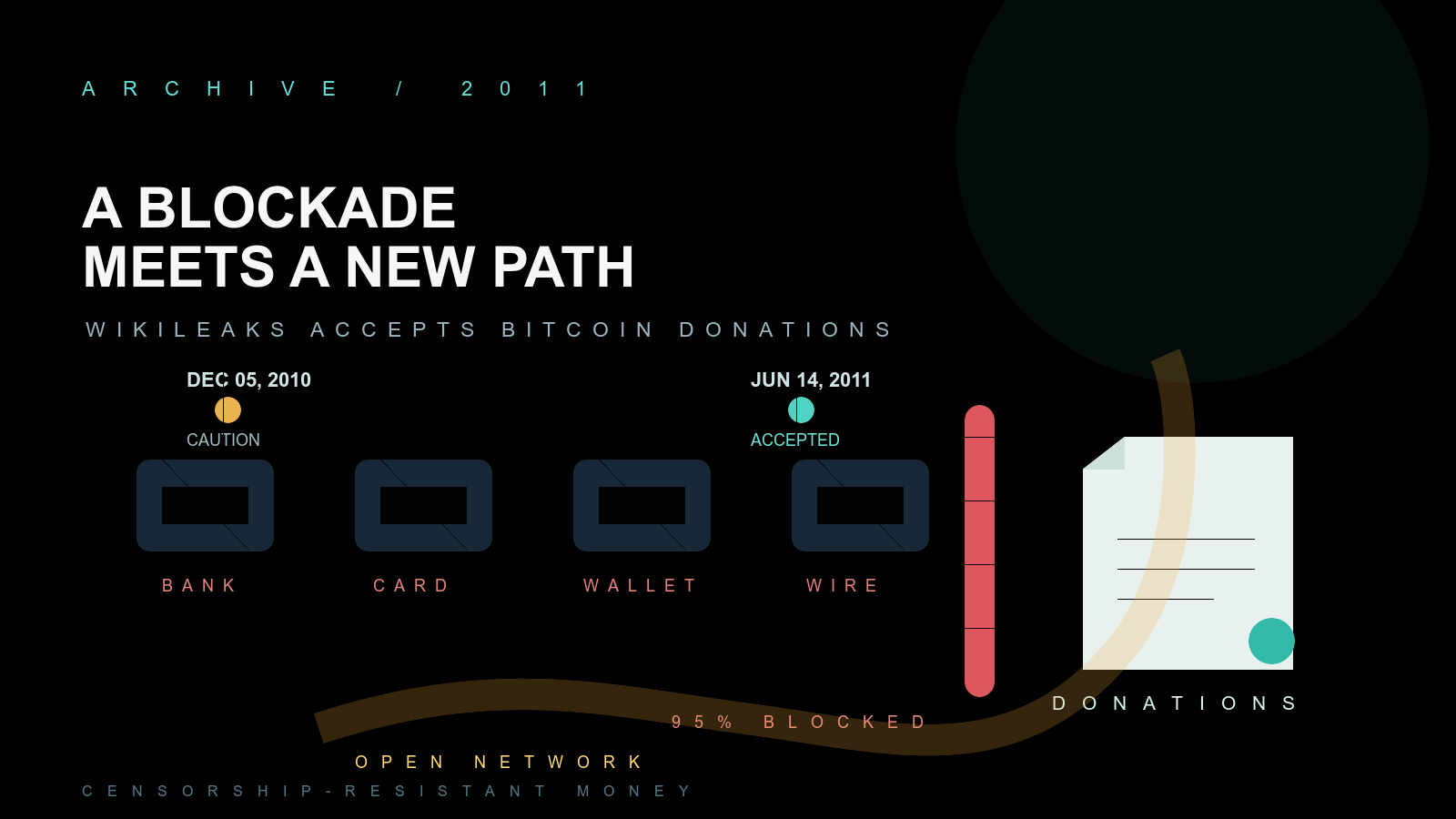
| December 5, 2010 | WikiLeaks-related thread “Bring it on” on BitcoinTalk; Satoshi posts public objection: “No, don’t ‘bring it on’. The project needs to grow gradually so the software can be strengthened along the way.” | BitcoinTalk thread, examined in full in the WikiLeaks-and-Bitcoin entry |
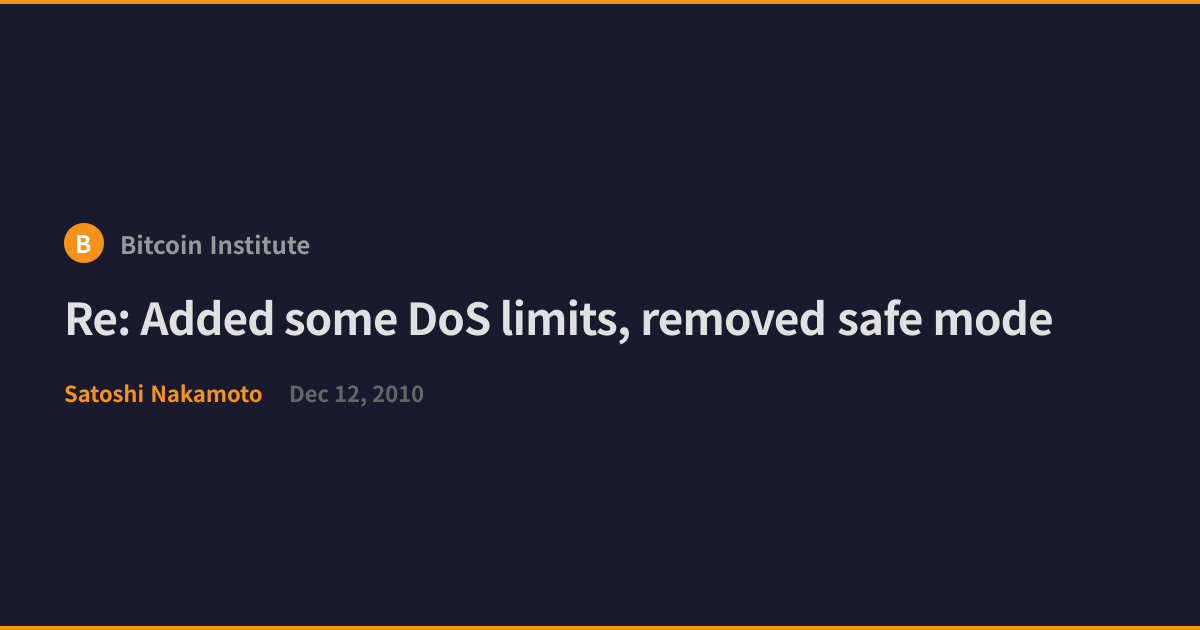
| December 12, 2010 | Satoshi grants Andresen formal commit access to the SourceForge repository (private). Public-side: Satoshi’s final BitcoinTalk post (in a DDoS-mitigation thread) closes on a purely technical note about DoS controls, with no mention of the handover or his own departure. | COPA v Wright public exhibits; BitcoinTalk thread |
| December 15, 2010 | Satoshi’s final SVN commit (revision 202) — a small change to IRC external-IP retrieval. | SourceForge SVN history |
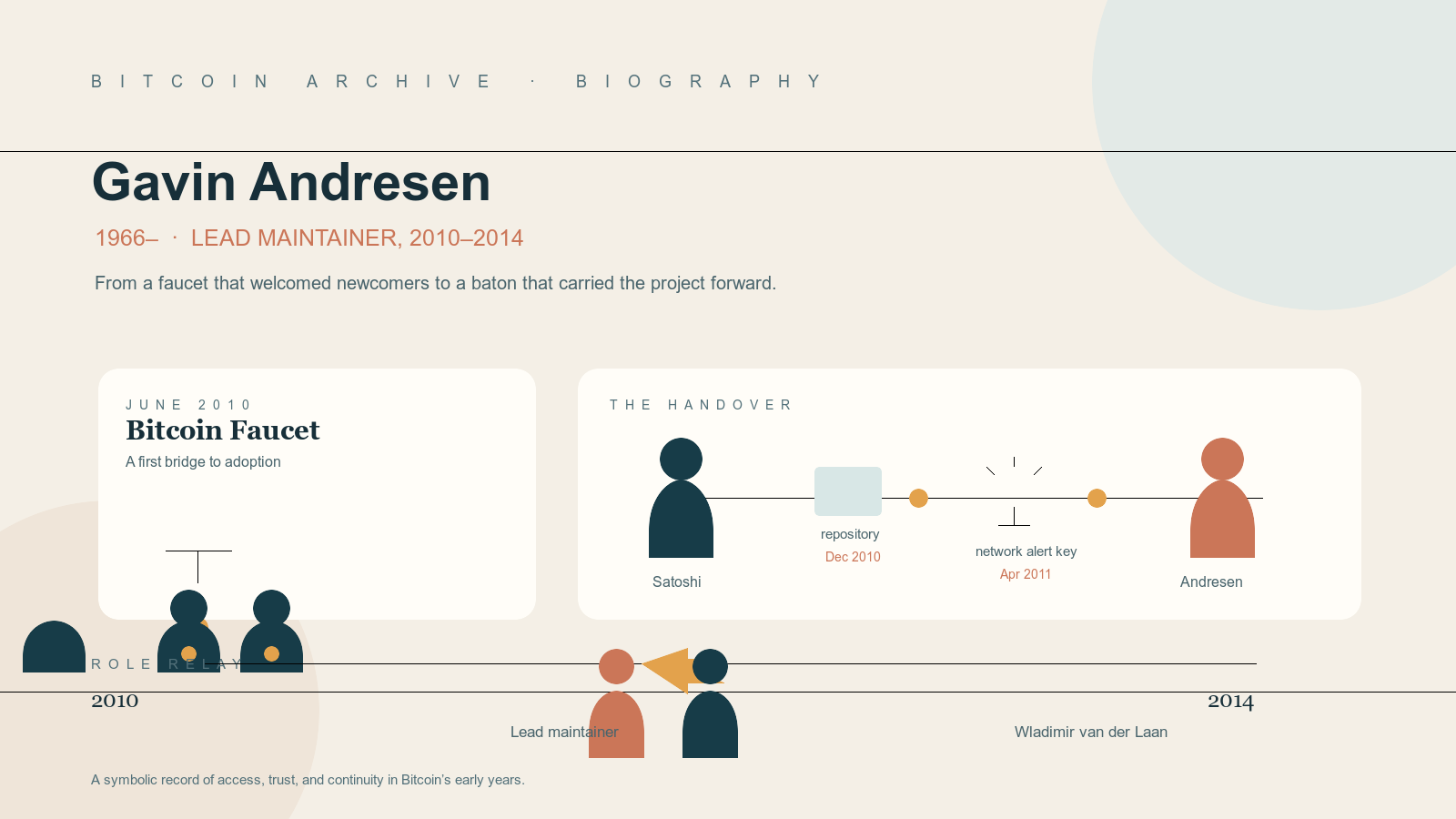
| December 19, 2010 | Andresen publicly announces lead-maintainer role. Same day, the GitHub bitcoin/bitcoin repository is created. | BitcoinTalk announcement |
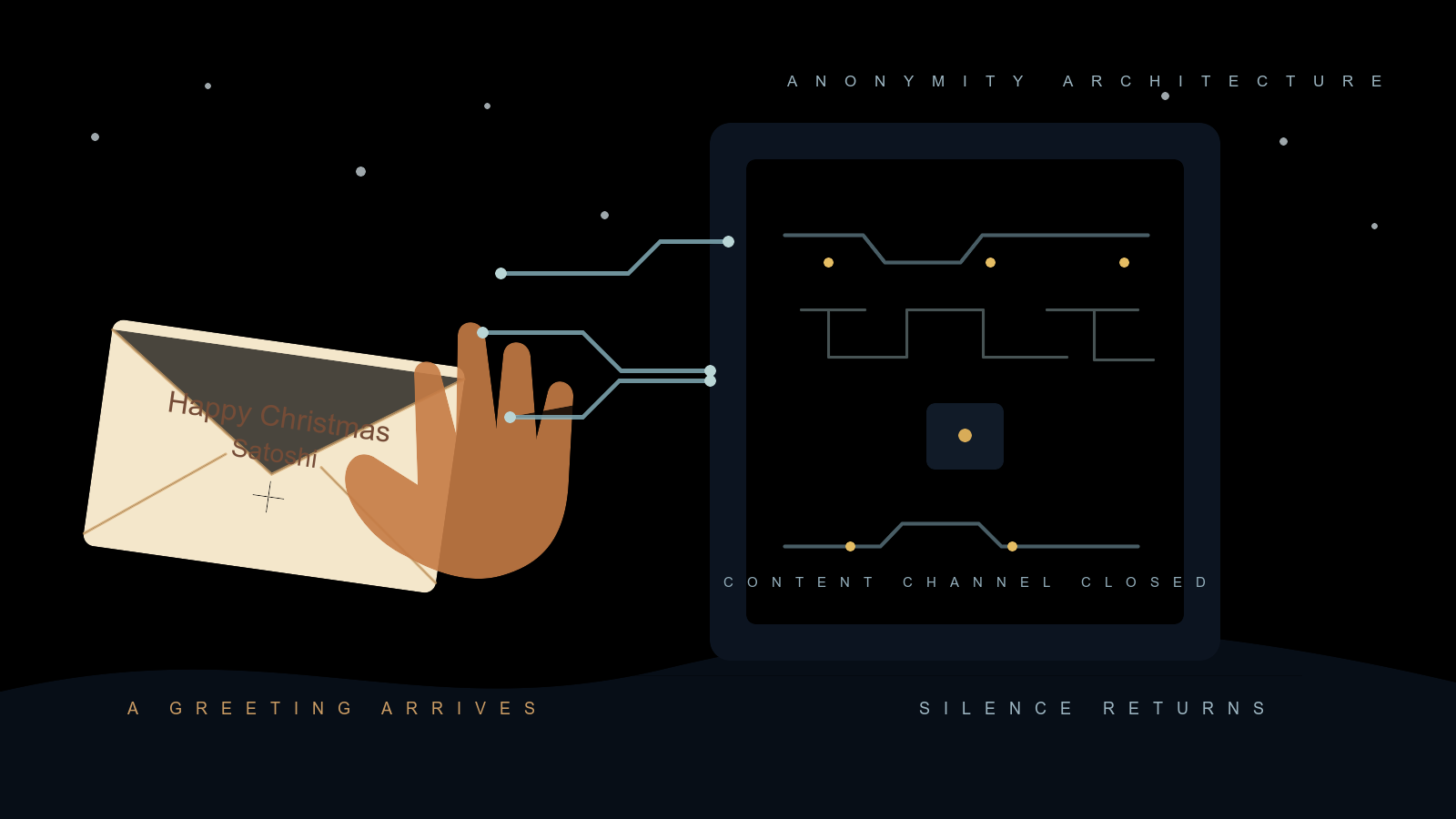
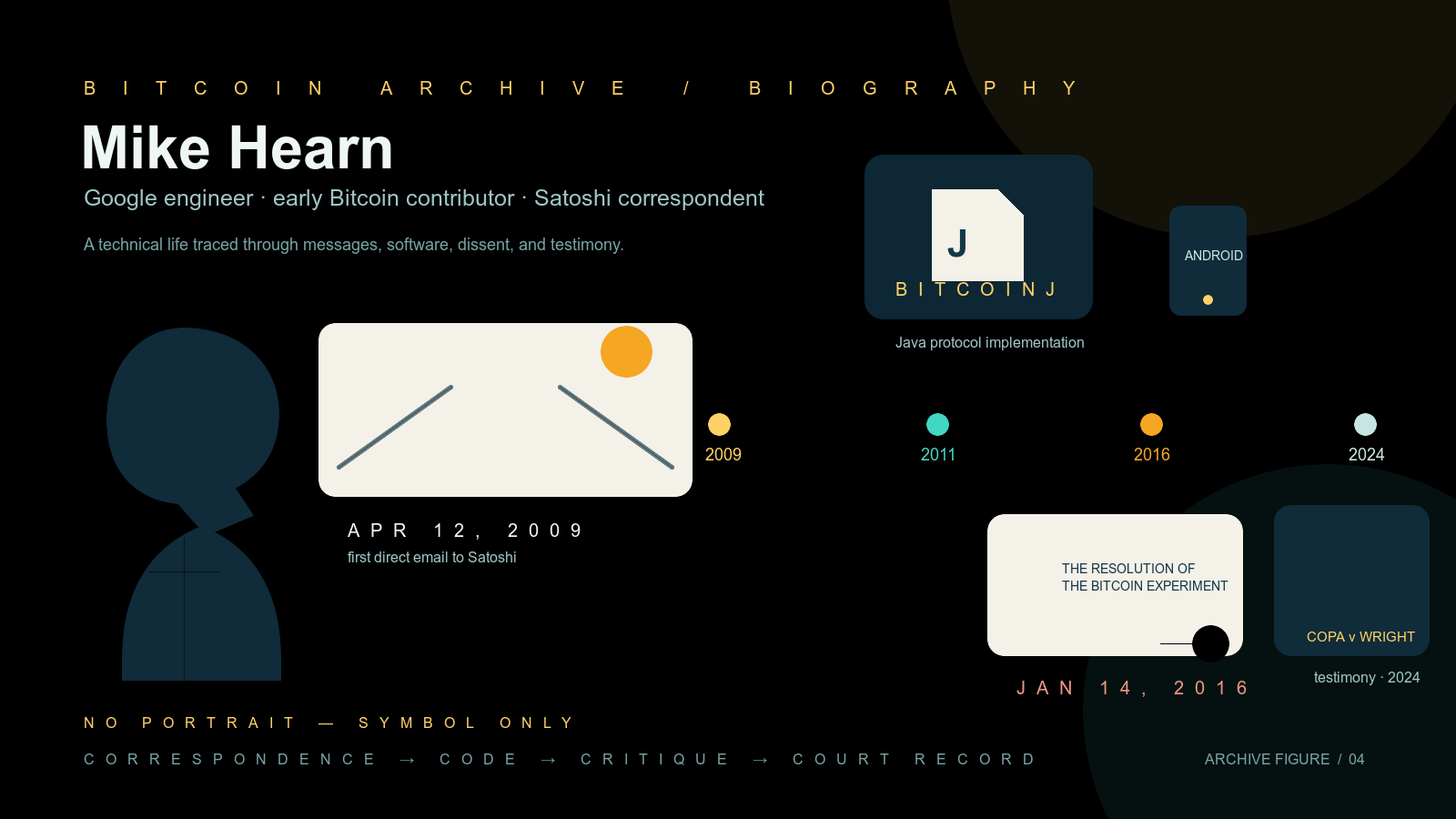
| December 27, 2010 | Mike Hearn → Satoshi: Christmas message and questions about 21M coin cap, 10-minute block target, and 500 KB block-size limit. | plan99.net released correspondence |
| December 29, 2010 | Satoshi → Mike Hearn: long-form private reply with full SPV / client-mode design discussion, “Educated guess” explanation of the 21M figure, Moore’s-Law reasoning on block-size growth. The last extended private letter Satoshi sent. | plan99.net |
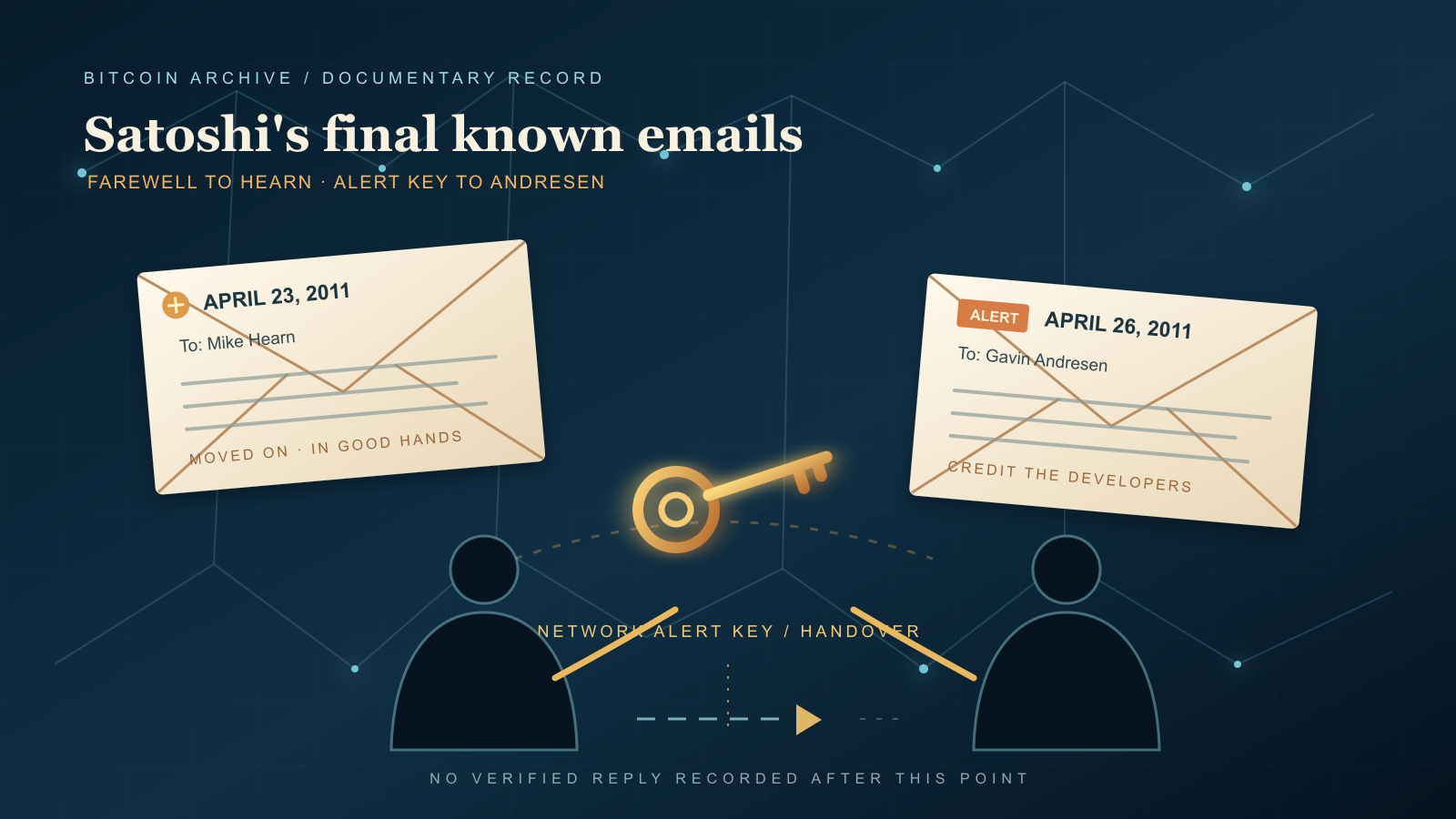
| April 23, 2011 | Satoshi → Mike Hearn: “I’ve moved on to other things. It’s in good hands with Gavin and everyone.” | plan99.net |
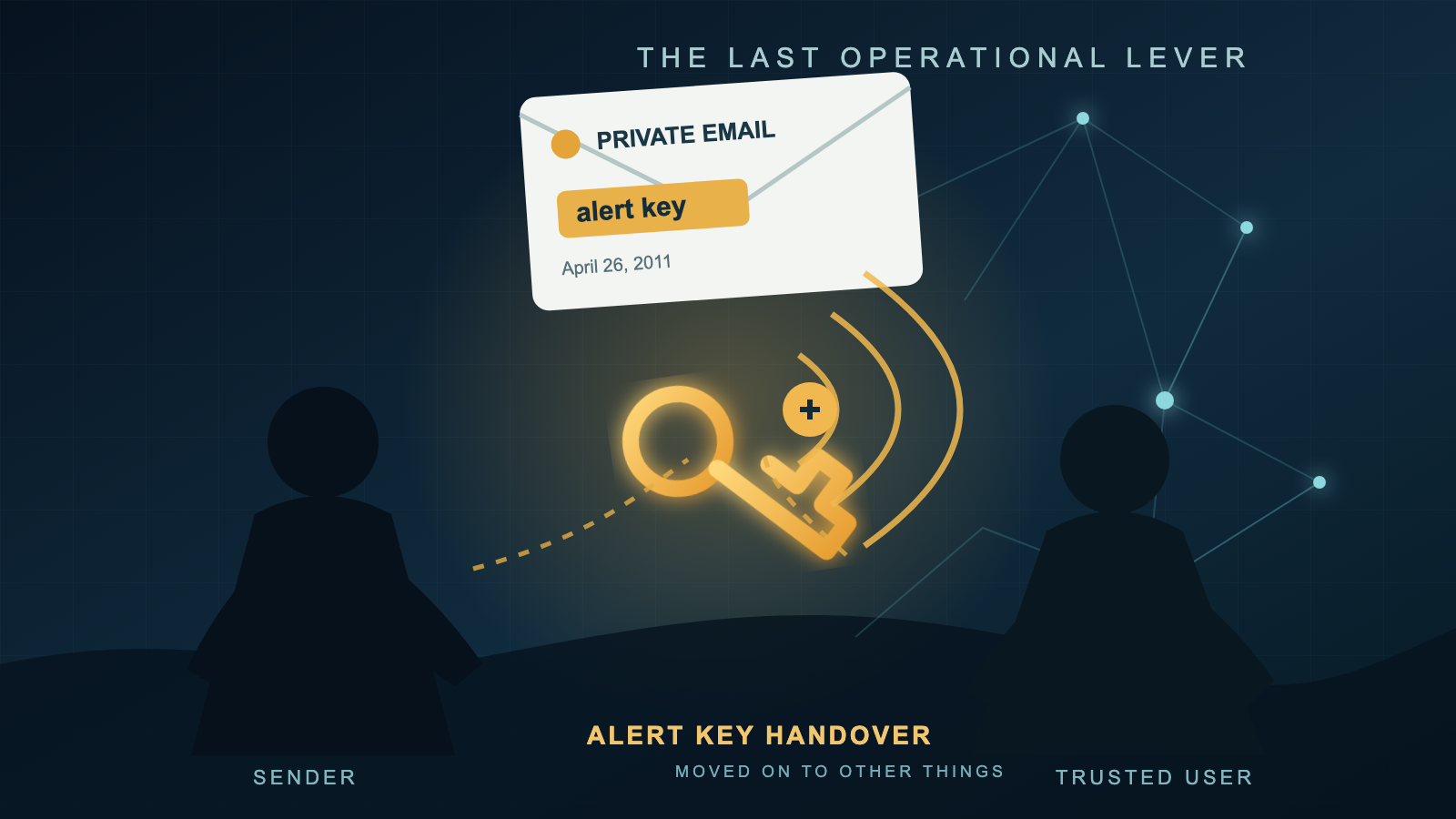
| April 26, 2011 | Satoshi → Gavin Andresen: requests Andresen stop describing him as “a mysterious shadowy figure”; transmits the CAlert key and broadcast code (the network-emergency authority — the last technical capability Satoshi had retained). | Gavin Andresen statement (CoinMarketCap) |
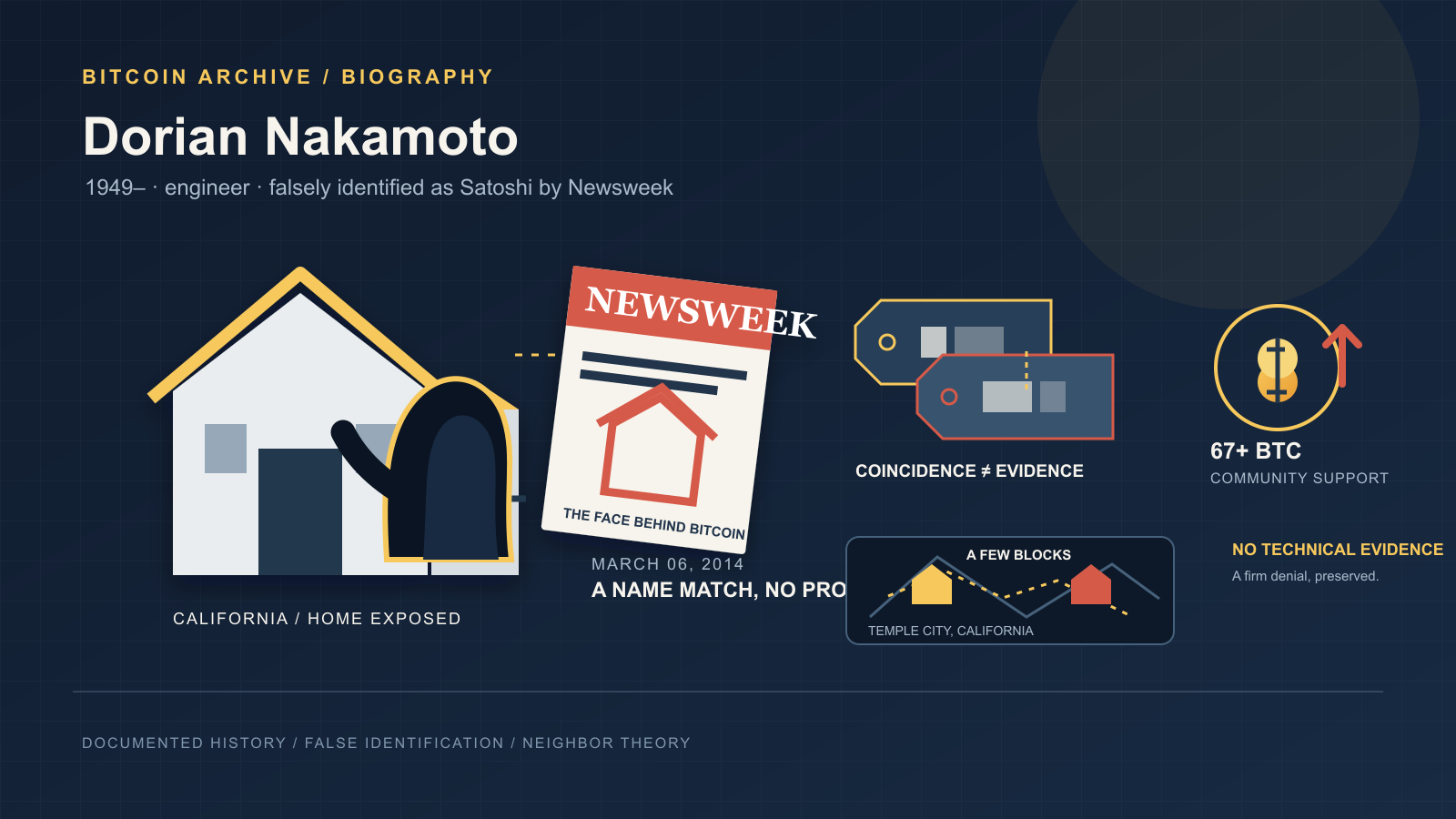
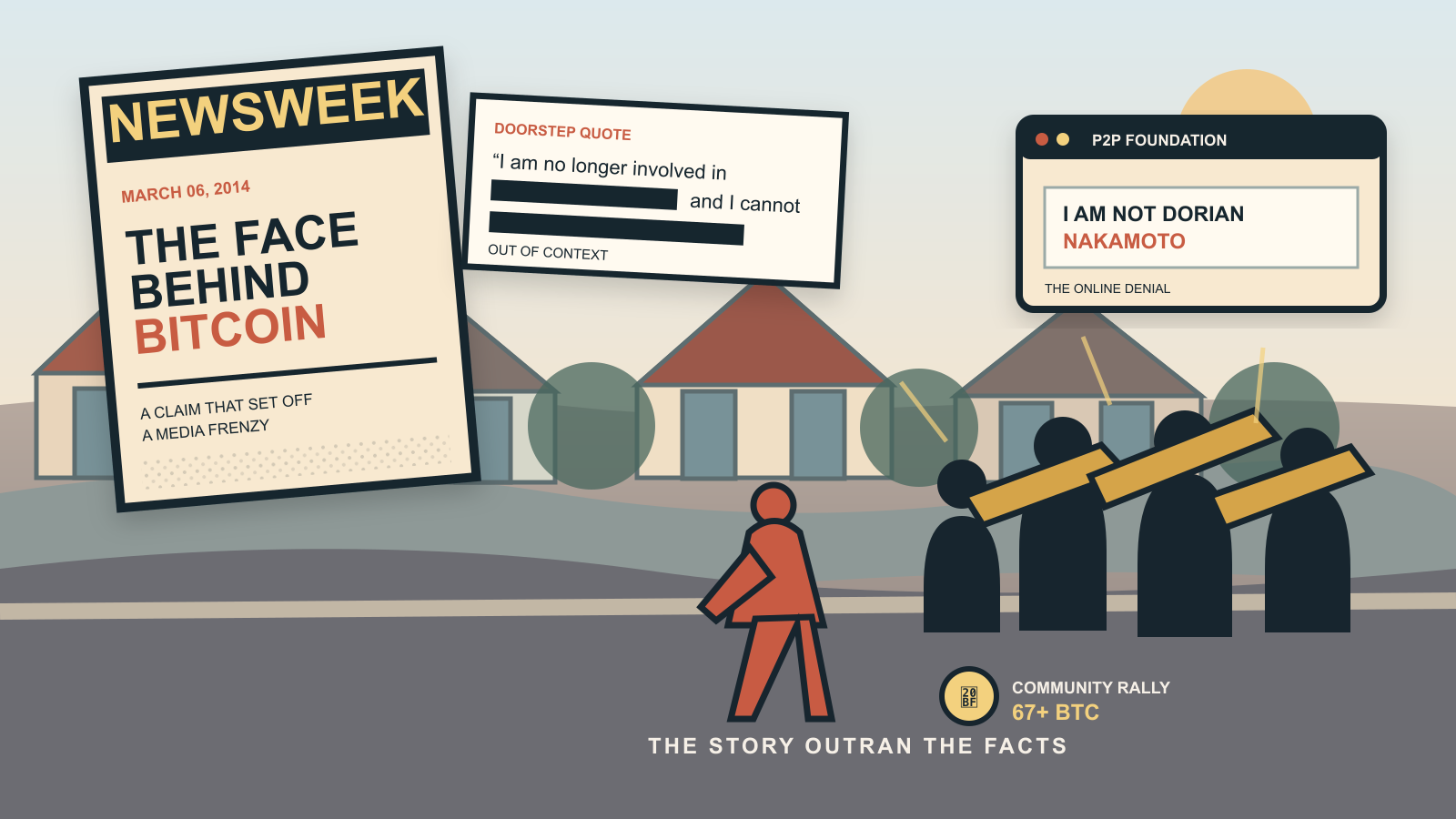
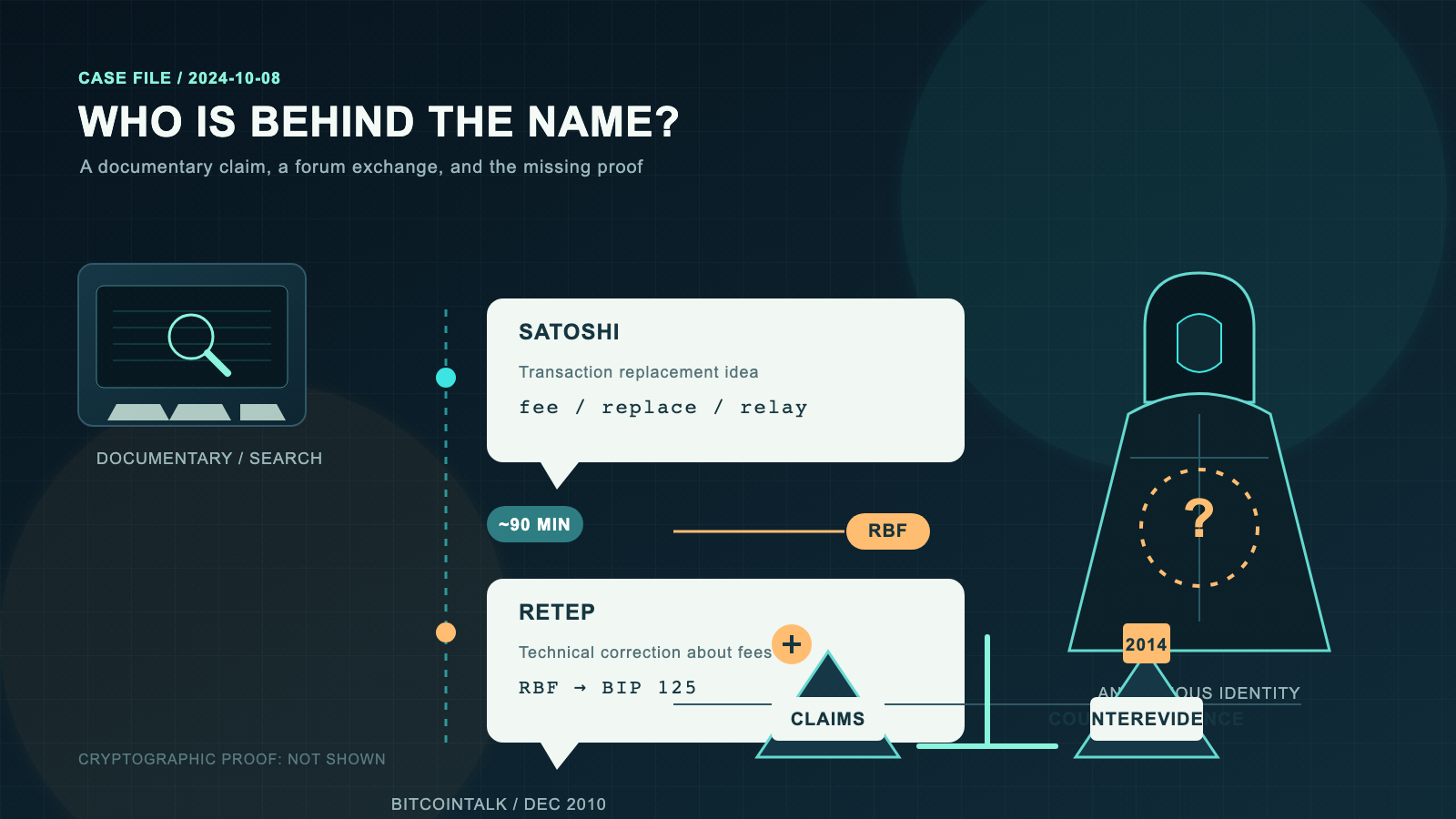
| March 7, 2014 | A post from the Satoshi P2P Foundation account: “I am not Dorian Nakamoto.” Authenticity contested; the account may have been compromised. | P2P Foundation thread |
The seven-month sequence is structurally specific: a private withdrawal signal (“working on other projects”) goes to Gavin Andresen in September 2010, with the formal code-management transfer itself unfolding over the following months and reaching public-record completion on December 12; the final BitcoinTalk post on that same date closes on a purely technical note, with no mention of the handover; a final code commit follows on December 15; and the network-emergency CAlert key — the last lever — is released on April 26, 2011. There is no single dramatic farewell. There is no public goodbye post on BitcoinTalk. The pattern matches the rest of the architecture: leverage and visibility are reduced gradually, not severed in a moment that would itself be a forensic event.
A separate observation worth noting: in the same April 26 message, Satoshi’s expressed objection (“I wish you wouldn’t keep talking about me as a mysterious shadowy figure…”) is consistent with the rest of the architecture. Becoming a focal symbolic figure is structurally inconsistent with the project’s design (“decentralized”) and provides a substrate for identity-hypothesis discourse — the very layer this entry catalogs.
7. What is observable and what is not
The six layers above are all observable from the public record. The following are not observable from the public record and are not claimed in this entry:
- Satoshi’s internal motivation for choosing anonymity. Why is not in scope; how is.
- The specific anti-fingerprinting techniques used during posting. Tor use is plausibly inferred (§2). Specific techniques such as keystroke-timing randomization, browser-fingerprint forgery, or virtual-machine isolation are not documented in primary sources.
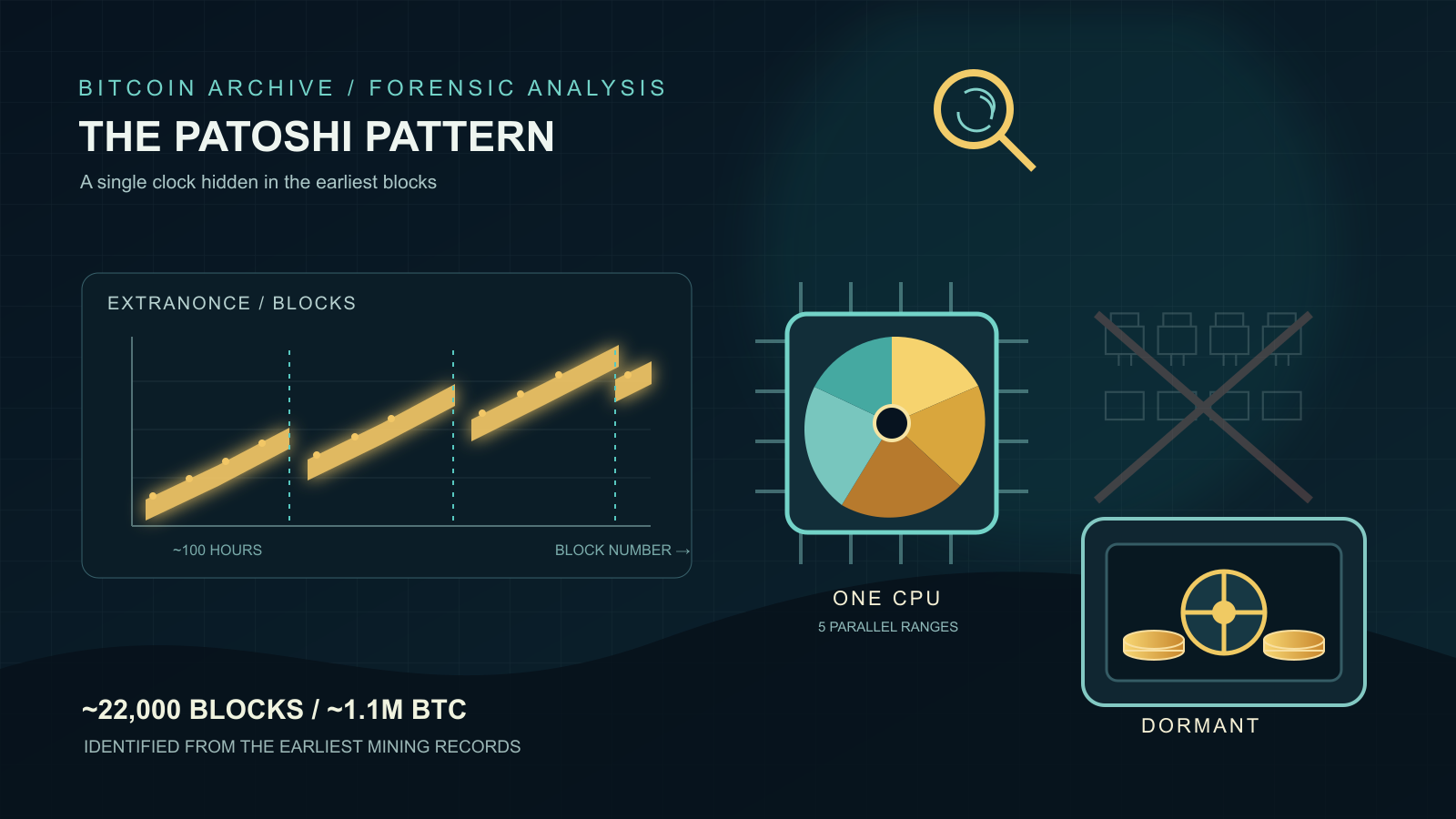
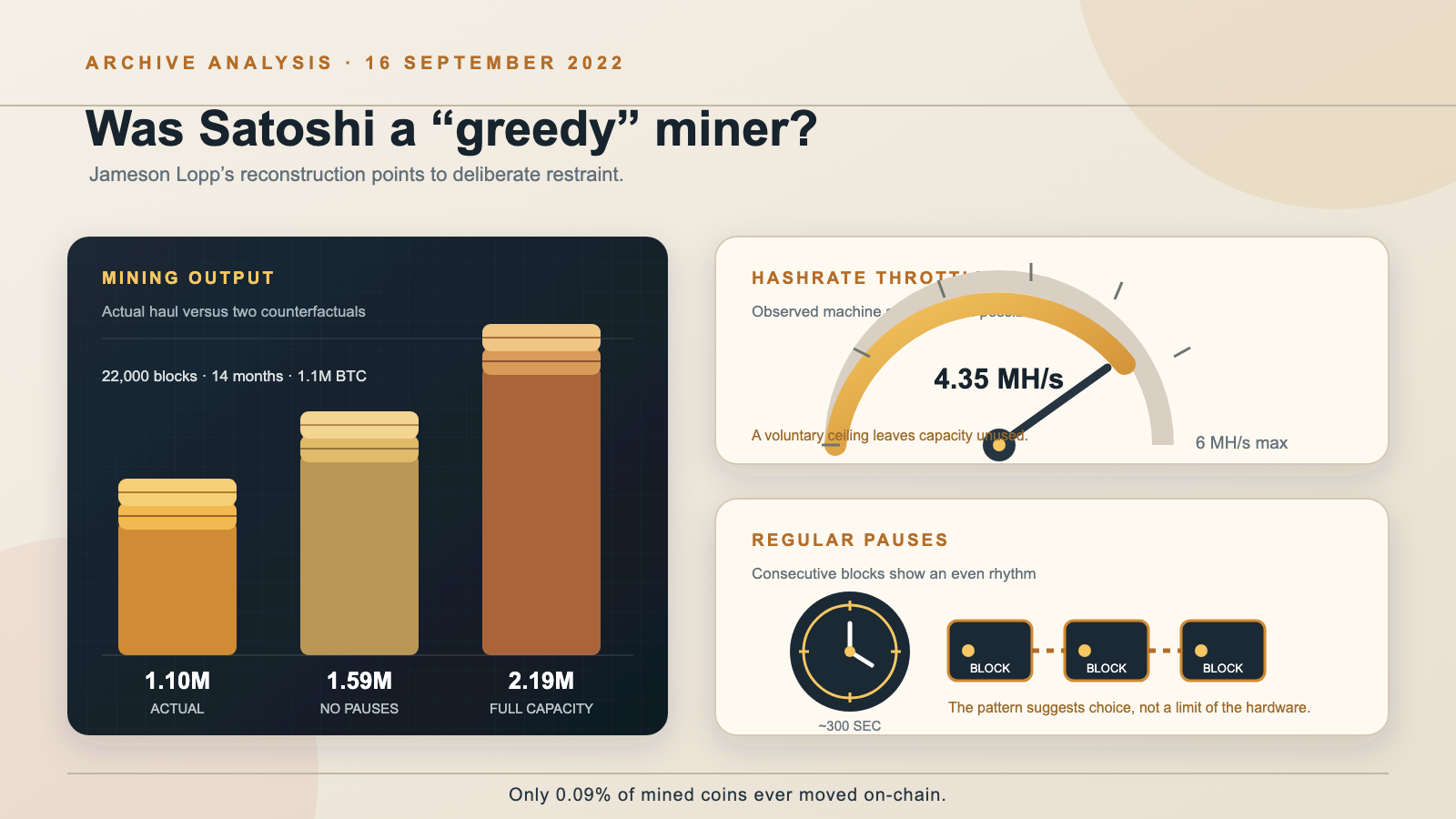
- The disposition of the approximately 1.1 million BTC associated with the Patoshi mining pattern (Lerner 2013; the full figure is discussed in the identification-asymmetry analysis). What is observable: almost none of those coins have moved on-chain. Counted on Jameson Lopp’s block list, 31 block rewards (1,550 BTC) have been spent, the latest in 2017. What is not observable: whether the corresponding private keys have been retained, lost, deliberately destroyed, or held by a successor.
- The geographic origin of the development. The Windows-environment evidence (§4) and the time-zone metadata (§3) constrain plausible work-location guesses but do not identify a single locale; the metadata is internally inconsistent (§3).
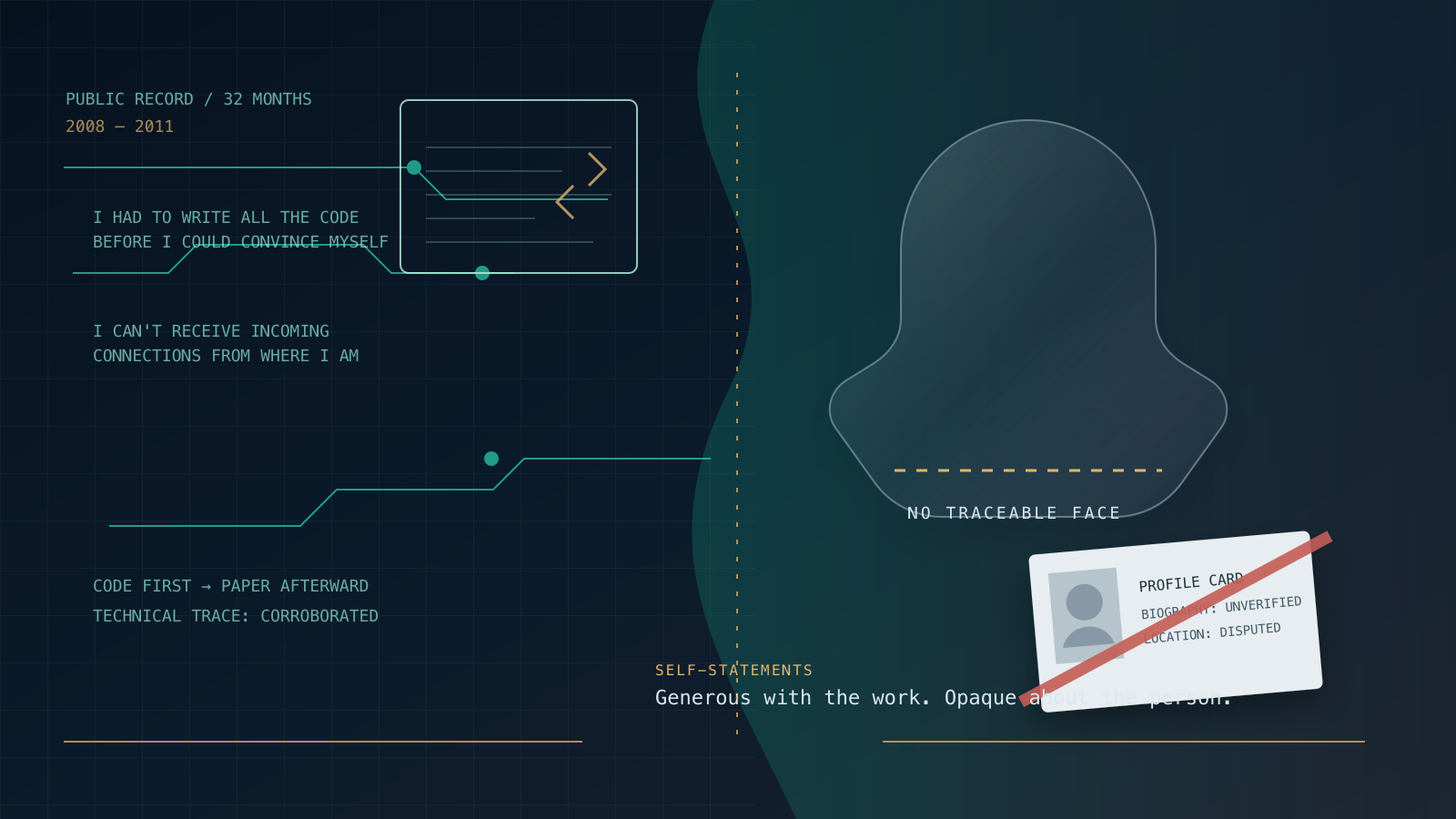
- Satoshi’s personal background, family, biography, profession, education, native language. None of this is in the public record. Inference from the layers above is one-sided: each layer eliminates certain candidates but does not positively identify a person.
8. Structural observation: layered means dilute every identity hypothesis
The six layers are independent in the sense that each can be separately observed in the public record without reference to the others. They are also independent in the sense that breaking any one layer (e.g., identifying a single node operator, recovering a private key, recovering a deleted email account) does not by itself break the others. An identity hypothesis must reconcile all six simultaneously to identify Satoshi.
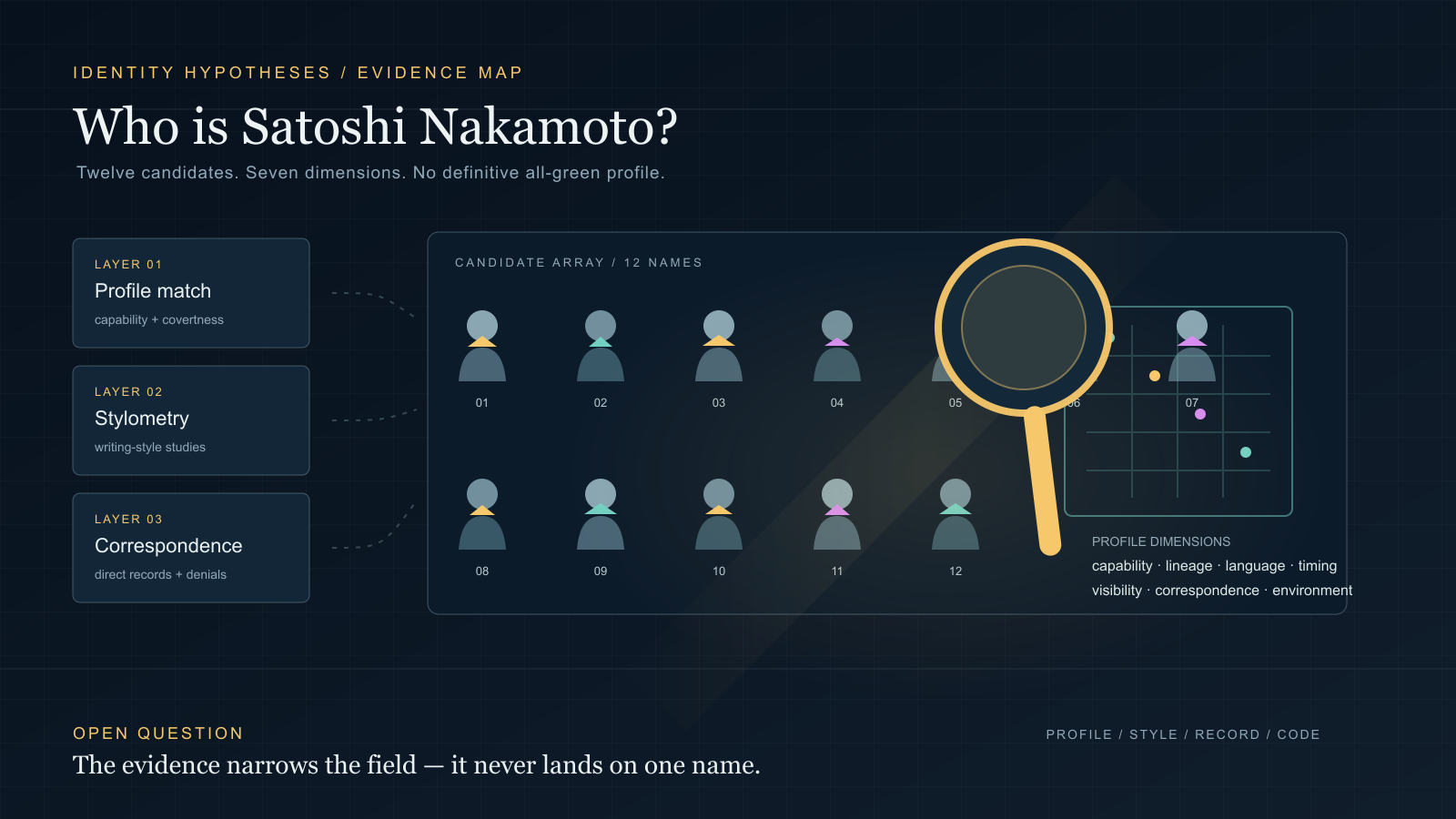
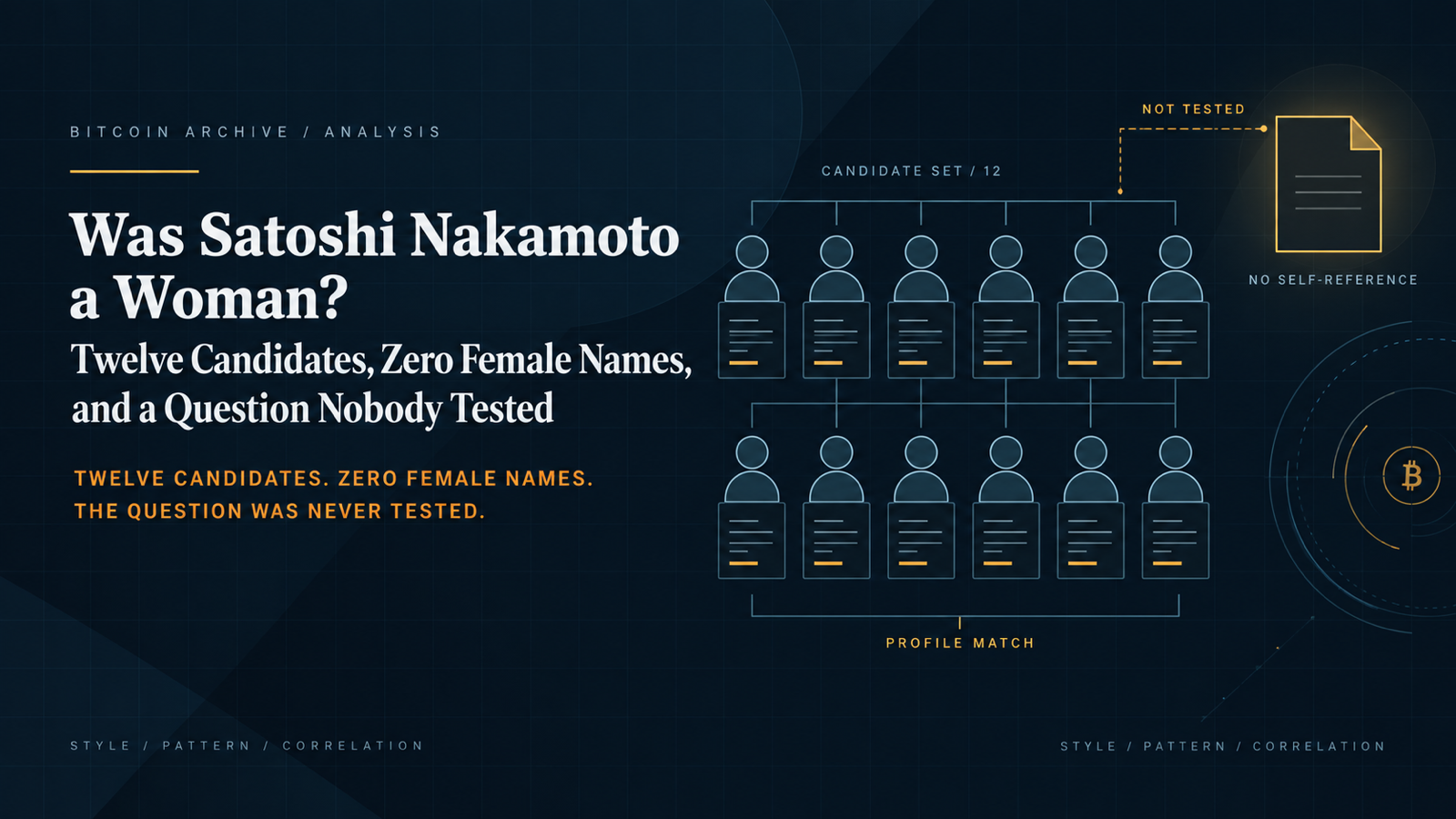
Reading the identity-hypotheses overview through the layered structure. Each named candidate aligns with some subset of the layers and fails to align with others:
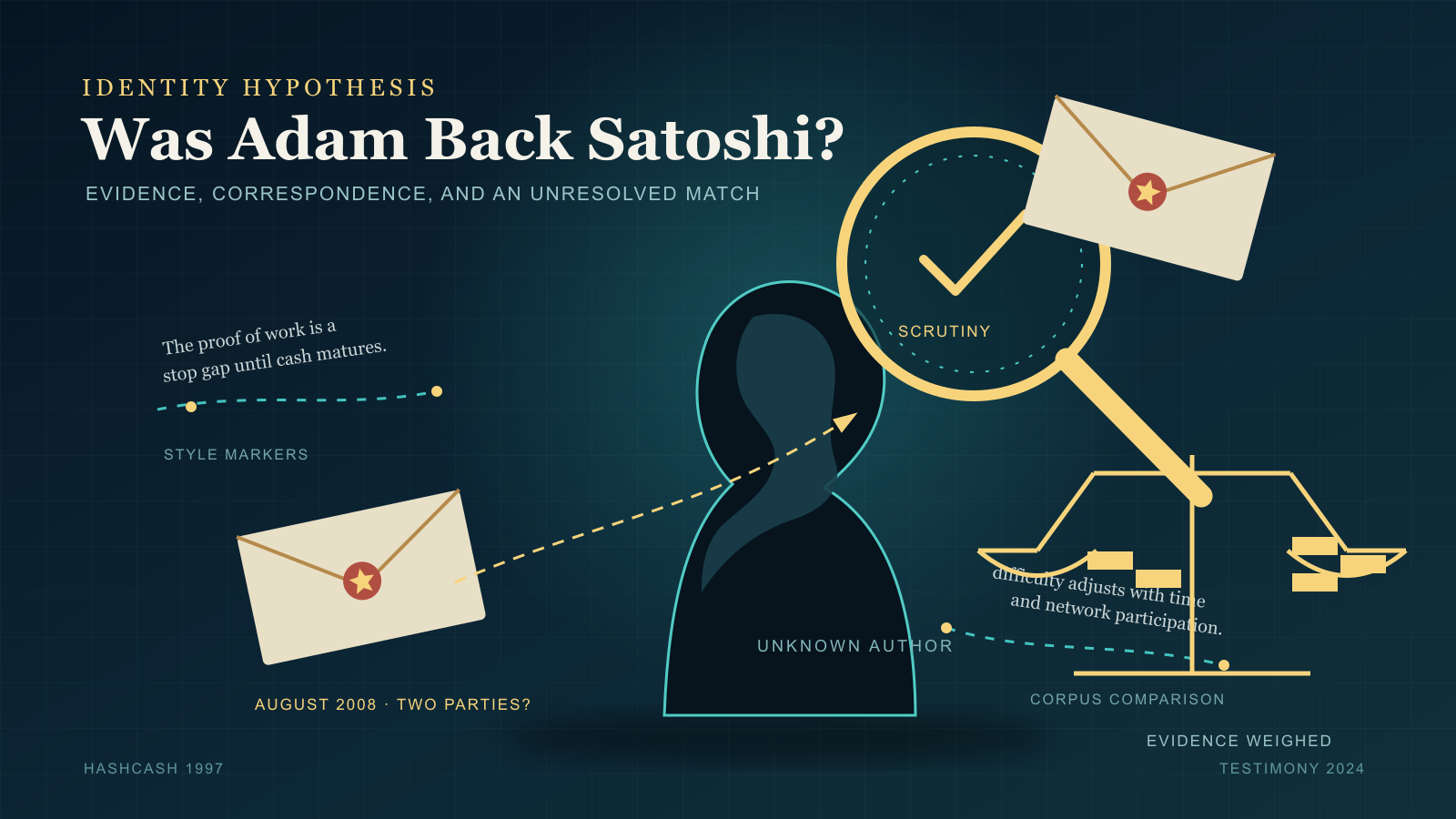
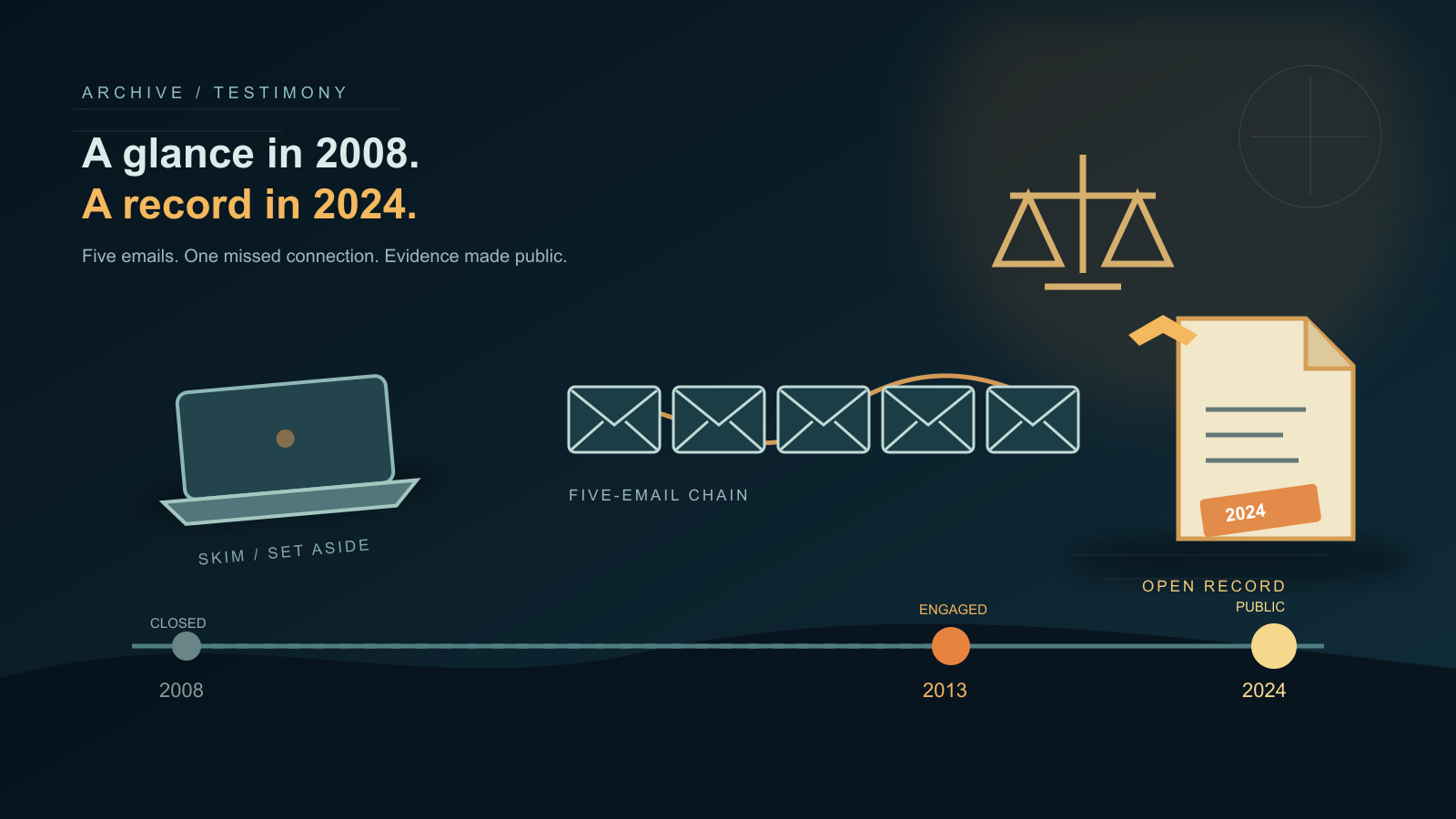
- Cypherpunk-cited candidates (Adam Back, Wei Dai) align with the cypherpunk-fora and BTC-lineage backgrounds (layers 1 and 2 background) but their pre-launch correspondence with Satoshi is itself the primary evidence against (third-party-reception behavior, not same-author scaffolding).
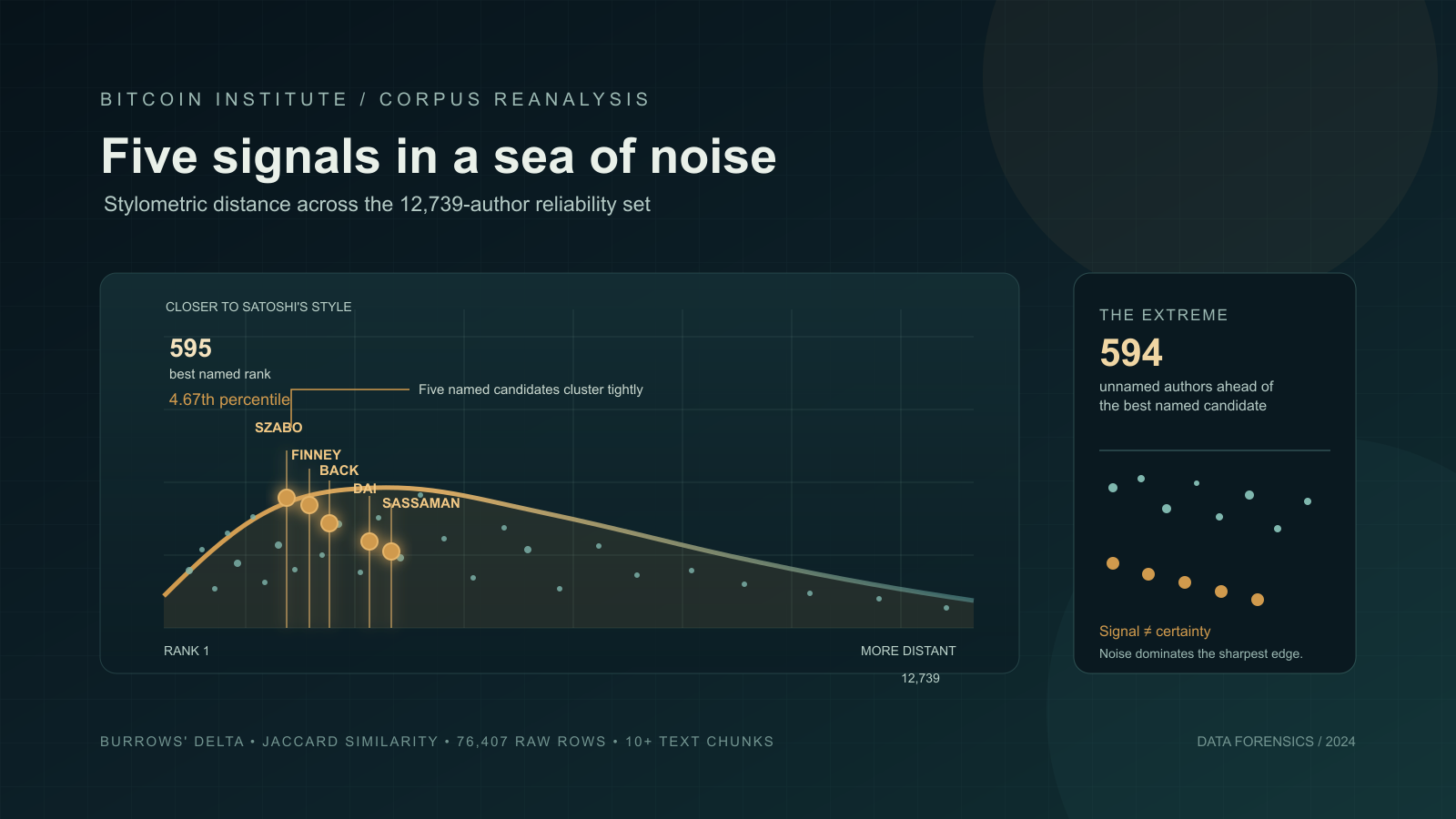
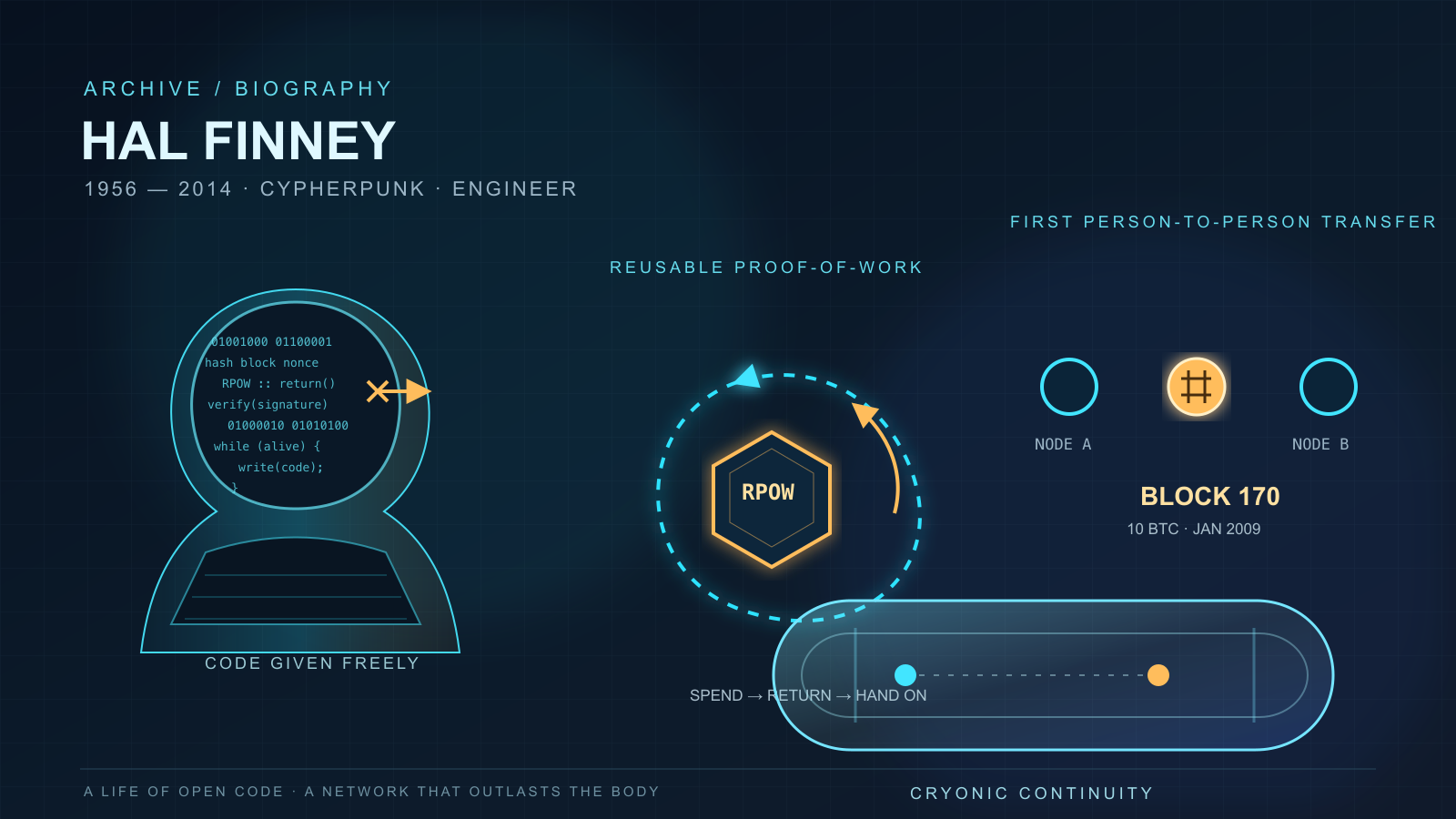
- Capability-fit candidates with documented 2007–2008 visibility (Hal Finney, Nick Szabo) fail the staged-withdrawal layer (timing) and the development-window invisibility expectation that Wei Dai’s 2014 LessWrong remark articulated.
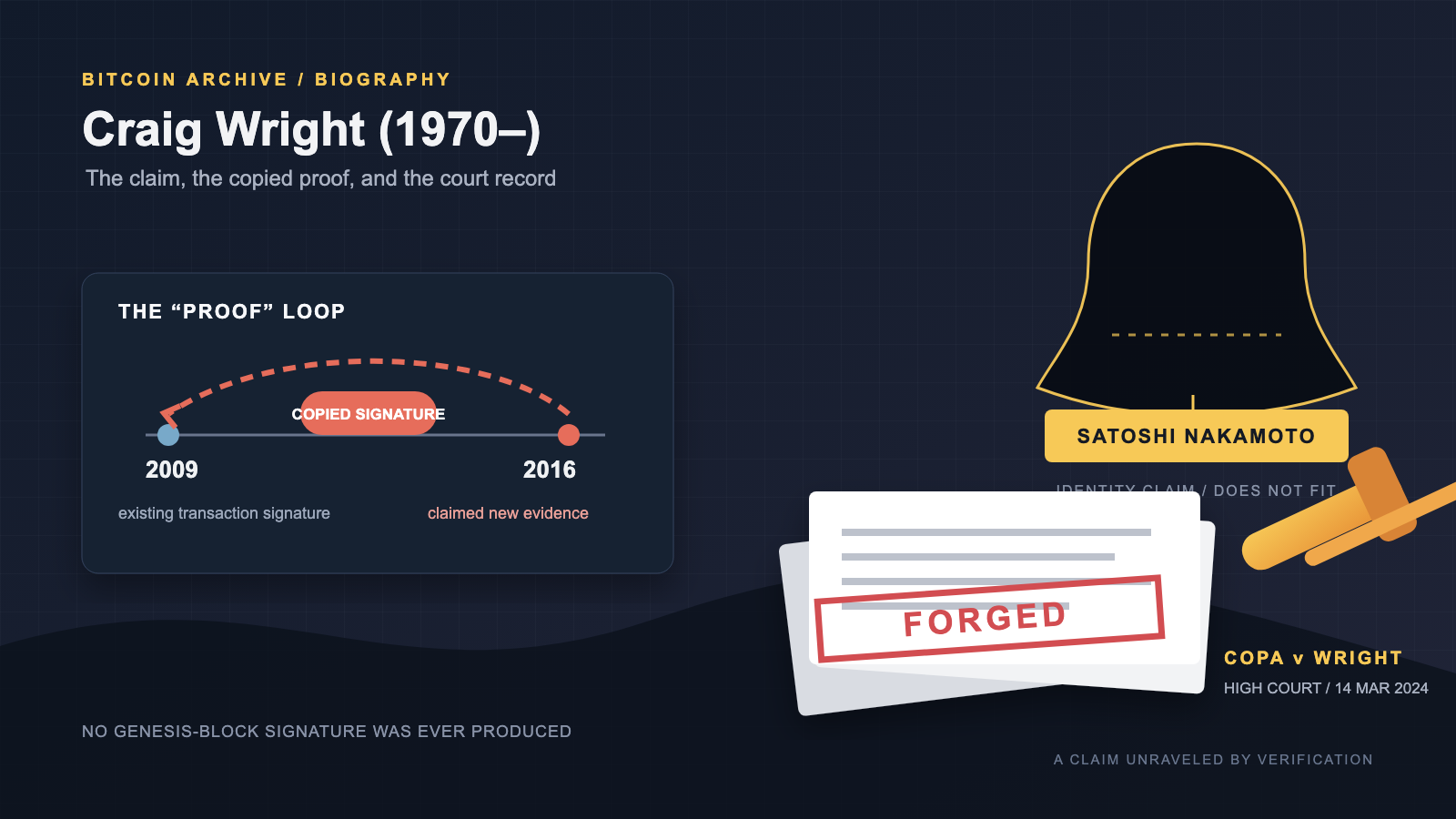
- Self-claim candidates (Craig Wright) and name-match candidates (Dorian Nakamoto) fail multiple layers simultaneously.
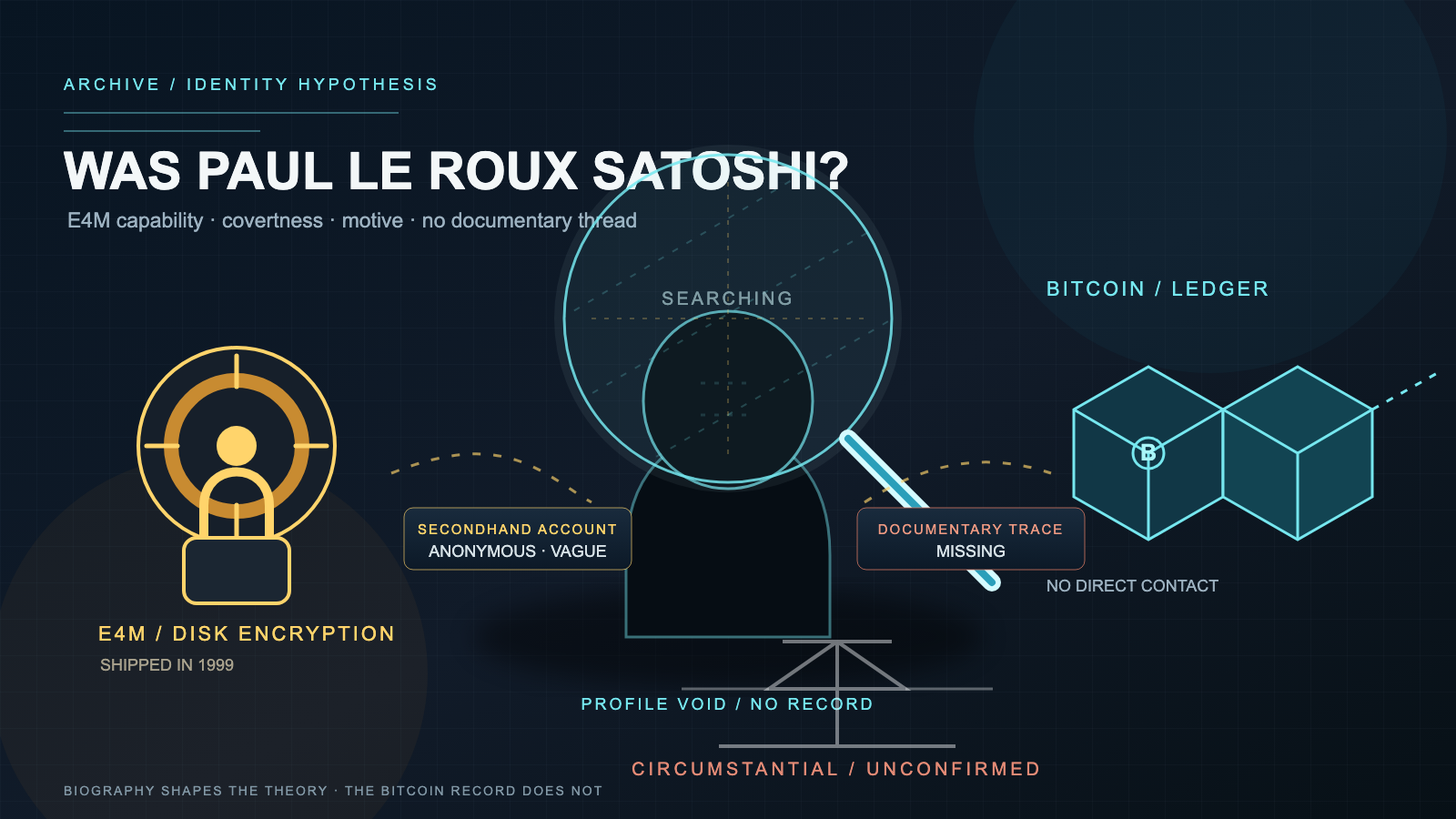
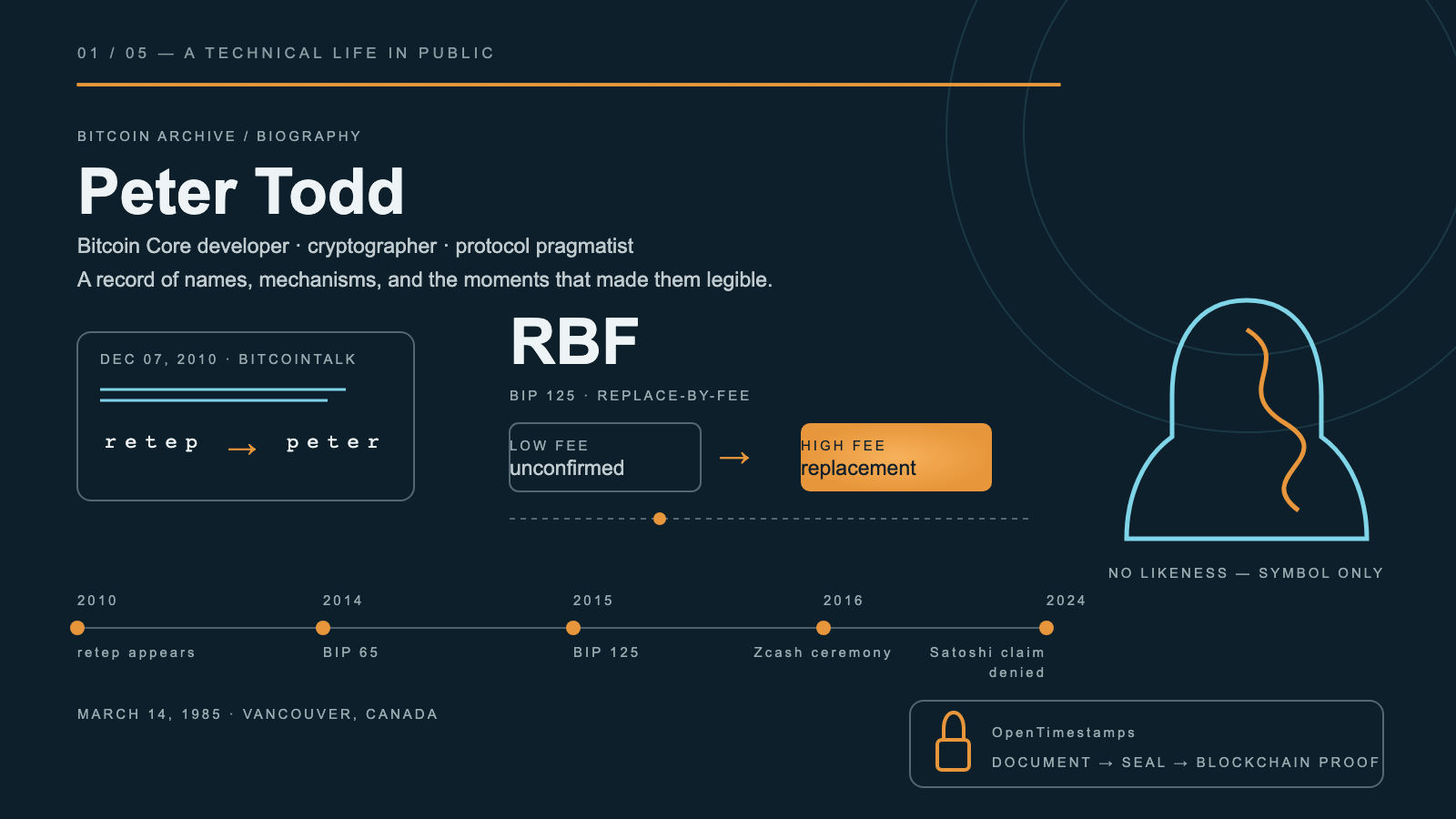
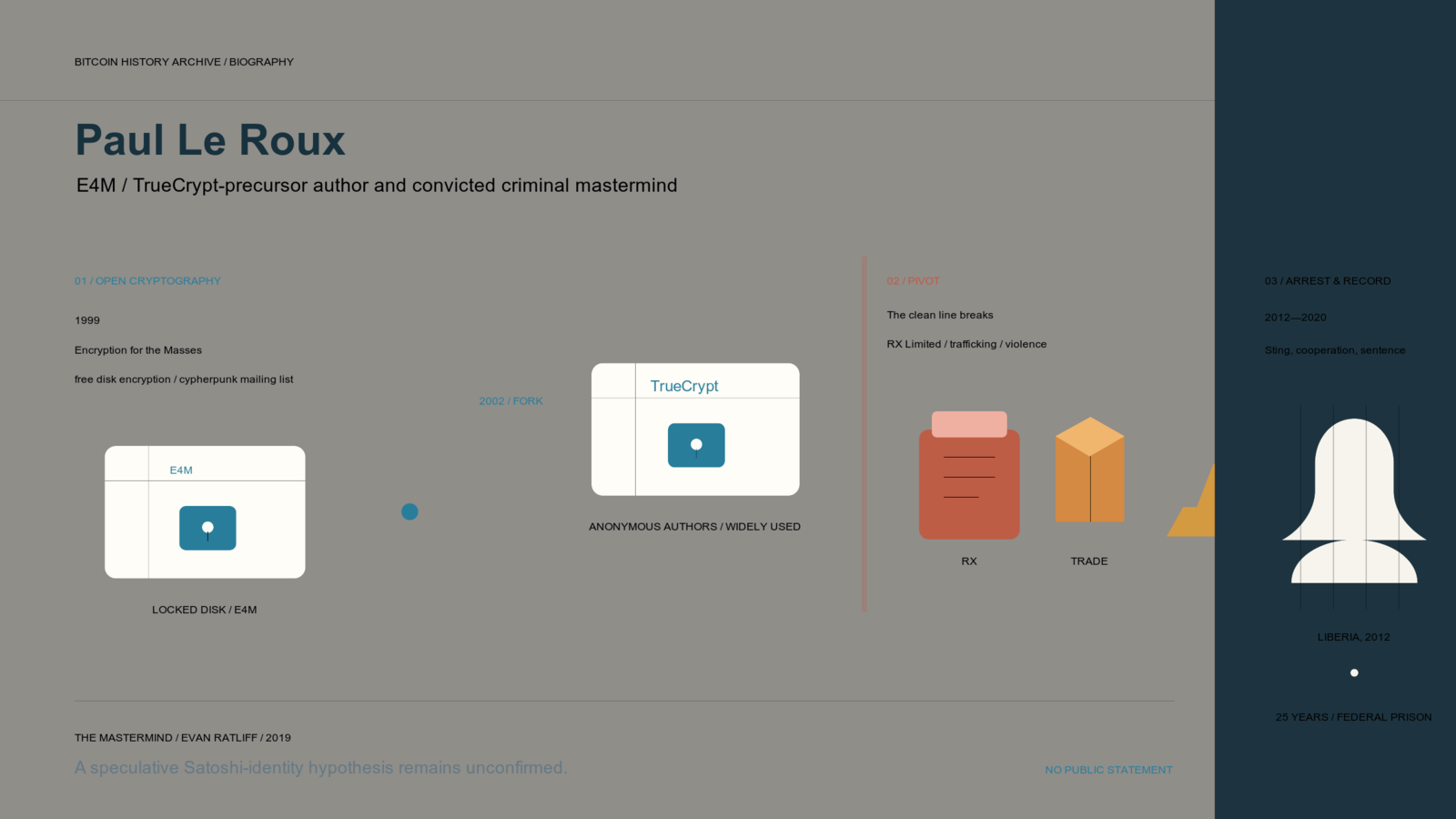
- Capability-only candidates (Peter Todd, Isamu Kaneko, Paul Le Roux) align with one or two layers (implementation capability, Japanese-name match) and fail the others.
In each case, the specific layers that fail are observable from the public record. The structural observation is that no candidate simultaneously satisfies all six. The layered architecture is not, in the present entry’s framing, the cause of this — but it is the form in which the cause manifests in the public record.
This entry does not argue that the layers were intentionally engineered to produce that result. The descriptive observation is sufficient: the layers are there, they are independent, they collectively cover six distinct dimensions of identification, and identity hypotheses that succeed on some dimensions fail on others.
9. Limits of this entry
- This entry is descriptive. It does not claim that any single intent organized the layers, or that the layers were engineered to produce non-identifiability.
- This entry does not propose a new identity candidate, rule out an existing candidate, or rank candidates against one another. Candidate-ranking is the role of the identity-hypotheses overview and the individual hypothesis entries.
- This entry does not present new evidence. Each observation is sourced to the cited primary records, established secondary literature, or other archive entries.
- The six-layer organization is a reading. Other readings are possible — for example, organizing the same traces by attack surface (forensic class) rather than by participation phase (chronological class).
- The Tor inference (§2) and the inferred work-location constraints (§7) depend on secondary literature; the primary record is silent. This entry treats them as inferences, not as established facts.
The structural-anonymity reading developed here is complemented by a behavioural-anonymity reading in Satoshi’s non-technical silence: how Satoshi responded to non-technical conversational openings — Christmas greetings, expressions of sympathy, personal questions — while remaining open to technical exchange. The two analyses are independent axes of the same documented pattern.
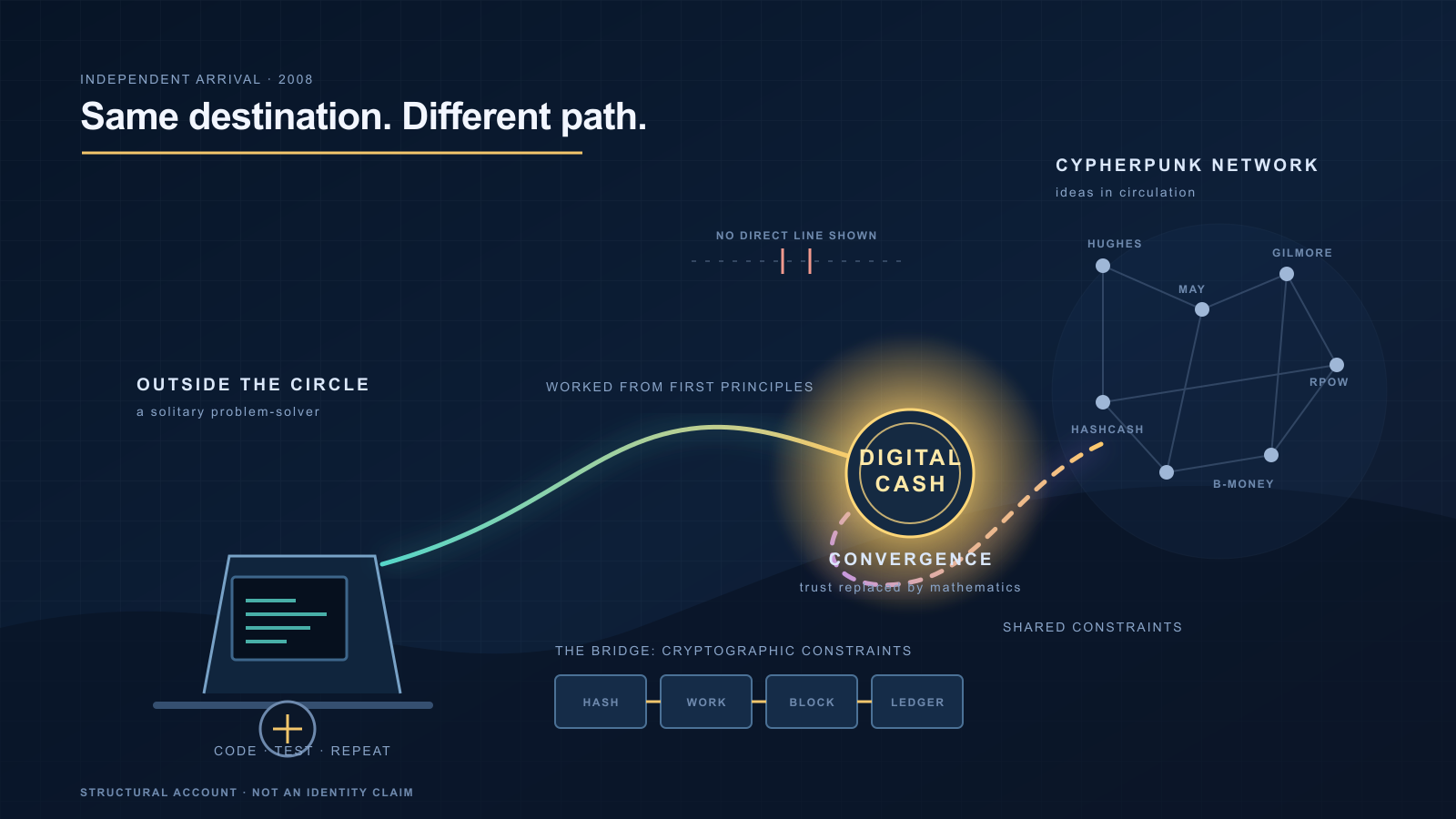
The cypherpunk-independent-arrival analysis takes the other half of the question: not who Satoshi was, but how Satoshi engaged with the cypherpunk channel.
The record does not leave us with one missing clue. It leaves six distinct traces of the same absence: a name, a channel, language and time, a machine, a genesis block, and a staged retreat. The six do not prove a single plan, and they do not become one face when overlaid. Any identity claim still has to cross that whole boundary at once.