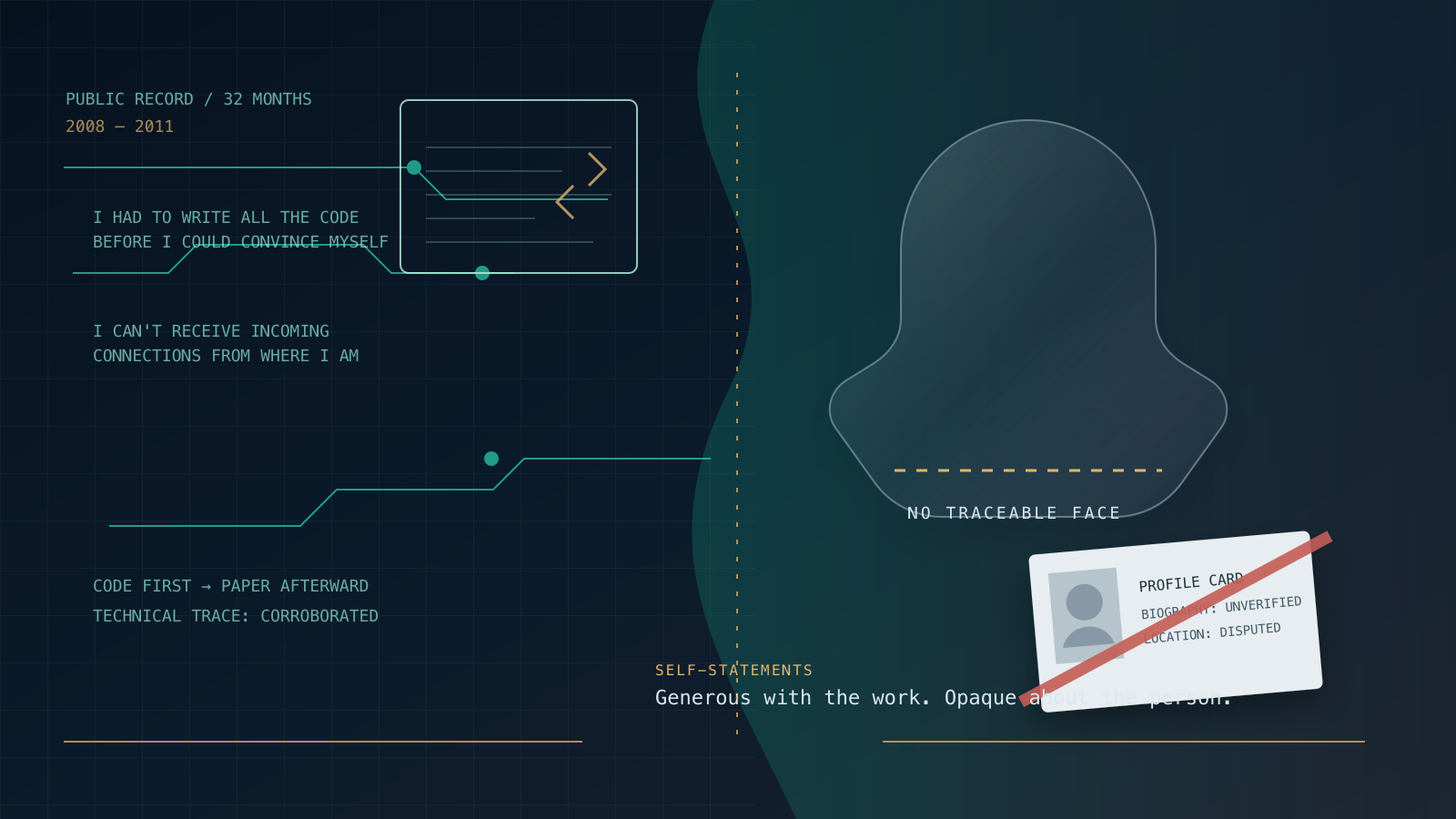
Across thirty-two months of documented public record, Satoshi Nakamoto referred to himself in writing dozens of times — not in identity claims (he made almost none of those), but in development-process disclosures (“I had to write all the code before I could convince myself”), operational-state notes (“I’ve also been busy with other things for the last month and a half”), expertise self-assessments (“That’s great because that’s where I have less expertise”), and farewells (“I’ve moved on to other things”). This entry inventories those self-references — every place where Satoshi was the subject of his own sentence in a non-trivial way — and reads them together as a single body of evidence about what Satoshi said about himself, separated from what the documented behavioural record shows.
Inclusion criterion: the statement contains a self-reference (Satoshi’s own state, position, capability, intent, or identity).
Exclusion criterion: pure business announcements with no self-reference (e.g., a request for the correct citation of a paper, a release announcement of new code, an explanation of a protocol mechanism). These appear elsewhere in the archive but are not collected here.
1. The complete inventory of self-references
Five subcategories, in chronological order within each. “Status” indicates how the statement holds up against independently verifiable evidence — not whether the statement was sincerely meant.
1.1 Identity claims (P2P Foundation profile)
| What Satoshi said | Primary source | Date | Status |
|---|---|---|---|
| Birth date: April 5, 1975 | P2P Foundation profile (Wayback) | profile creation, 2009 | Profile field; widely considered fictitious |
| Nationality: Japanese | P2P Foundation profile (Wayback) | same | Profile field; contradicted by British/Commonwealth English usage |
| Location: Japan | P2P Foundation profile (Wayback) | same | Profile field; contradicted by posting-timestamp analysis |
All three identity claims appear together on a single artifact and nowhere else in the documented record.
1.2 Development-process self-disclosures
| What Satoshi said | Primary source | Date | Status |
|---|---|---|---|
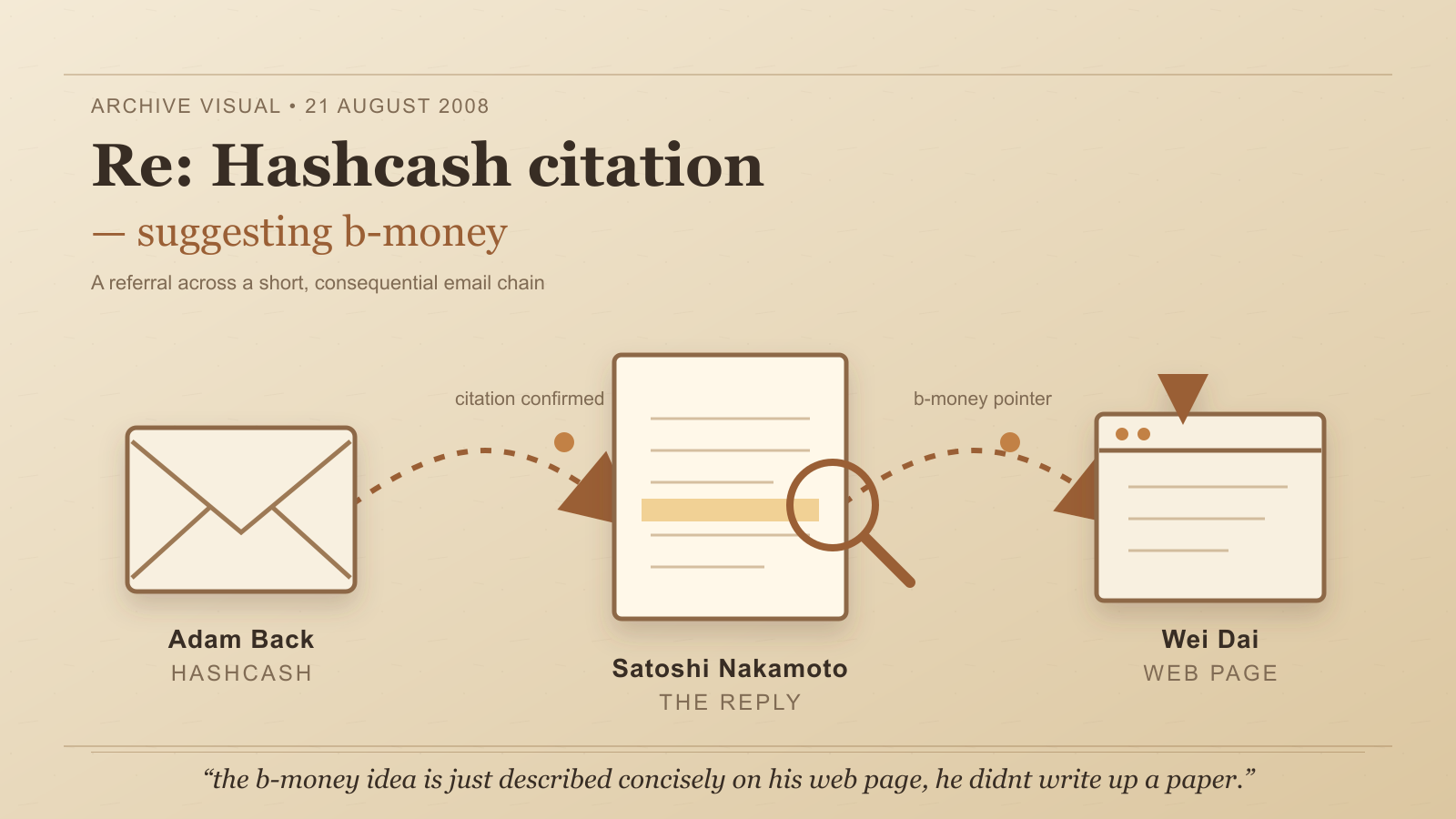
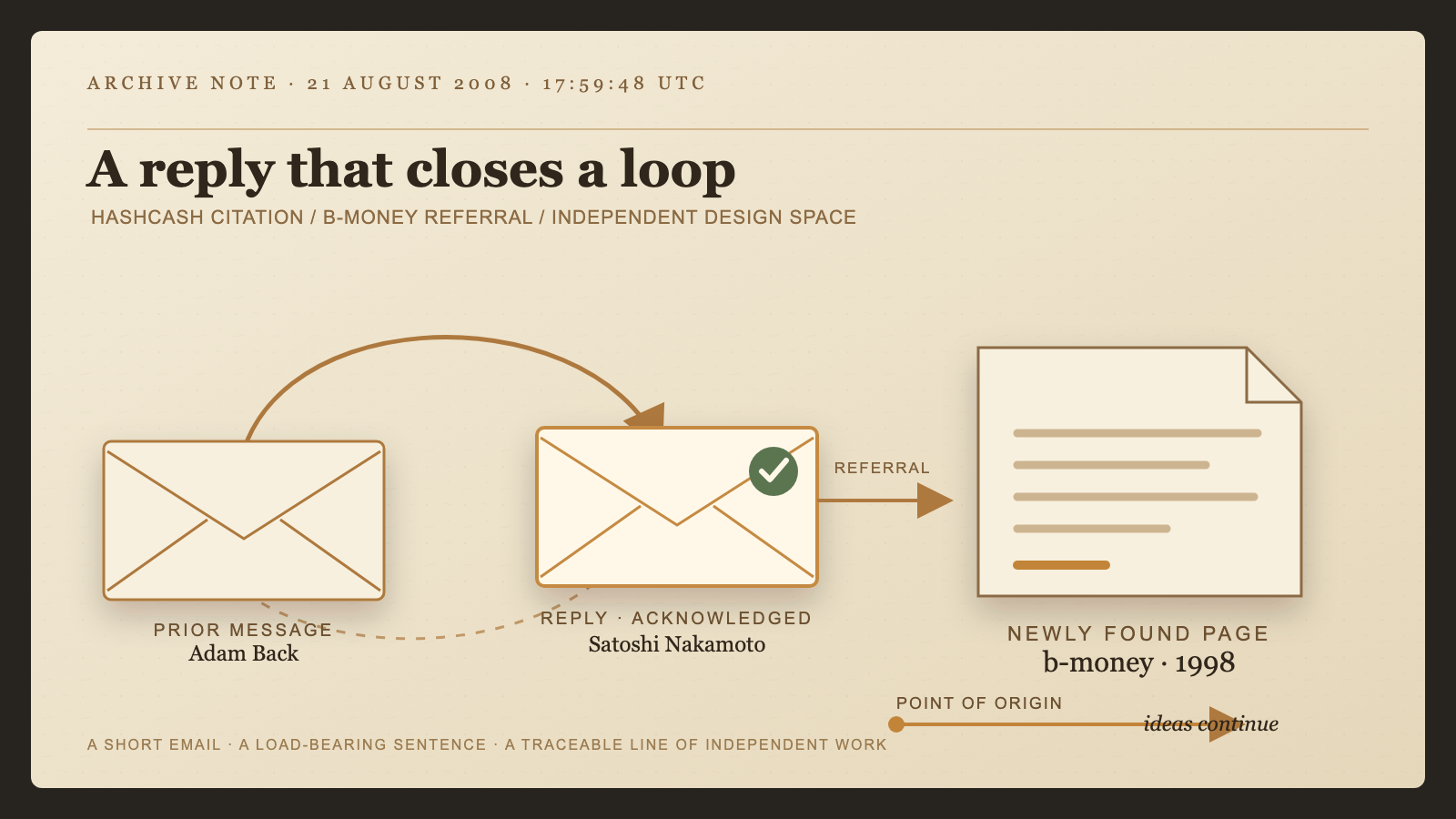
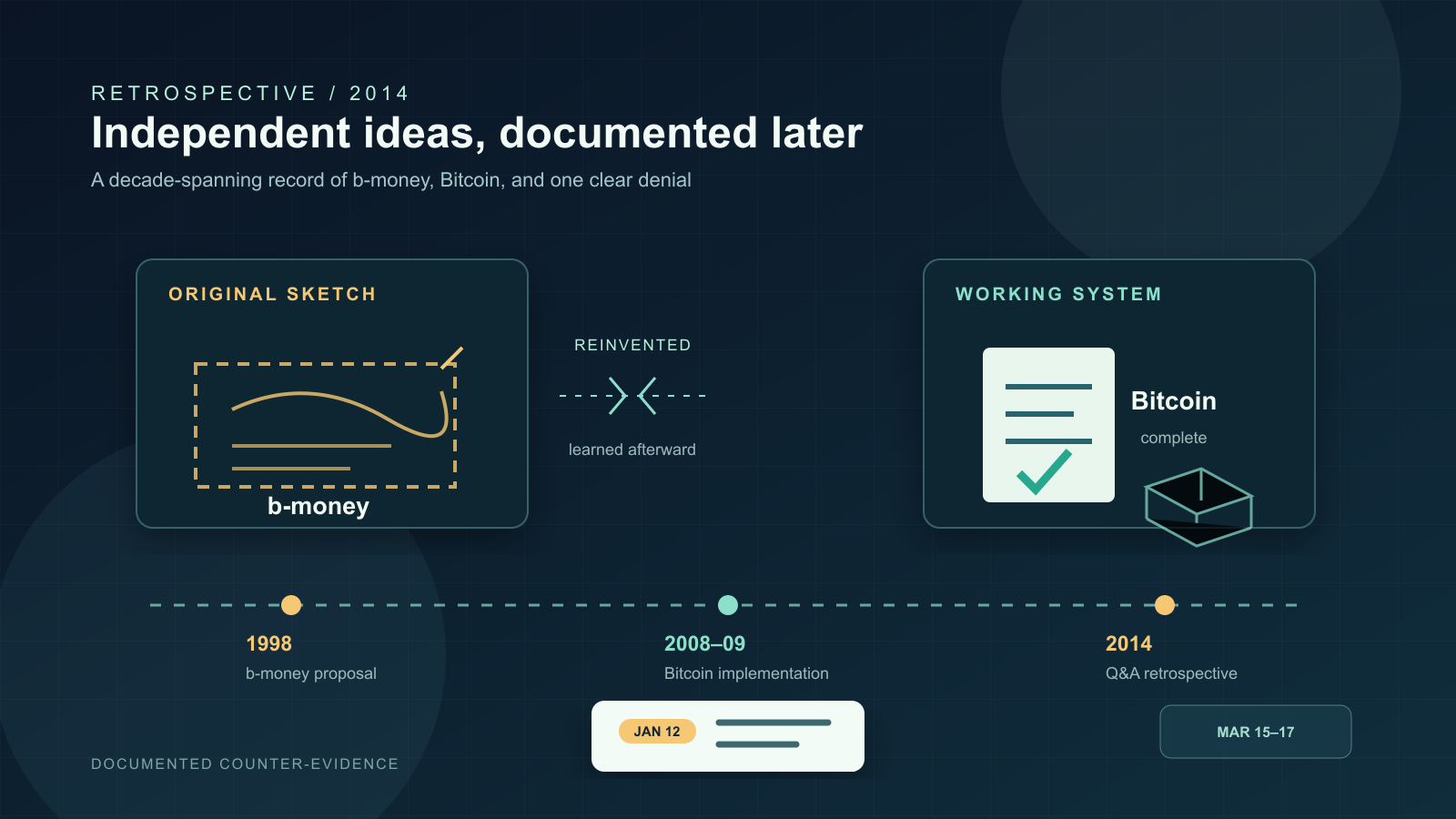
| ”Thanks, I wasn’t aware of the b-money page, but my ideas start from exactly that point” | → Adam Back, 2008-08-21 | 2008-08-21 | Self-disclosure of a specific knowledge gap during development |
| ”I was very interested to read your b-money page” (after Back’s referral) | → Wei Dai, 2008-08-22 | 2008-08-22 | Internally consistent with the prior row |
| ”I’m getting ready to release a paper that expands on your ideas into a complete working system” | → Wei Dai, 2008-08-22 | 2008-08-22 | Self-attribution of authorship and intent, immediately following the prior row in the same email; confirmed by subsequent publication |
| ”I believe I’ve worked through all those little details over the last year and a half while coding it” | cryptography ML, 2008-11-17 | 2008-11-17 | Names an approximately 18-month coding span; backward-counting locates the start of coding around mid-2007. Satoshi’s later “Since 2007” / “2 years of development before release” framing is the same pre-release work seen at a wider scope; the work order (code first, paper afterward) is framed separately in §2.2. |
| ”I’ve developed a new open source P2P e-cash system called Bitcoin… It’s completely decentralized… because everything is based on crypto proof instead of trust” | P2P Foundation forum | 2009-02-11 | First-person public authorship statement; positions the project against institutional trust |
1.3 Operational state and expertise self-disclosures
| What Satoshi said | Primary source | Date | Status |
|---|---|---|---|
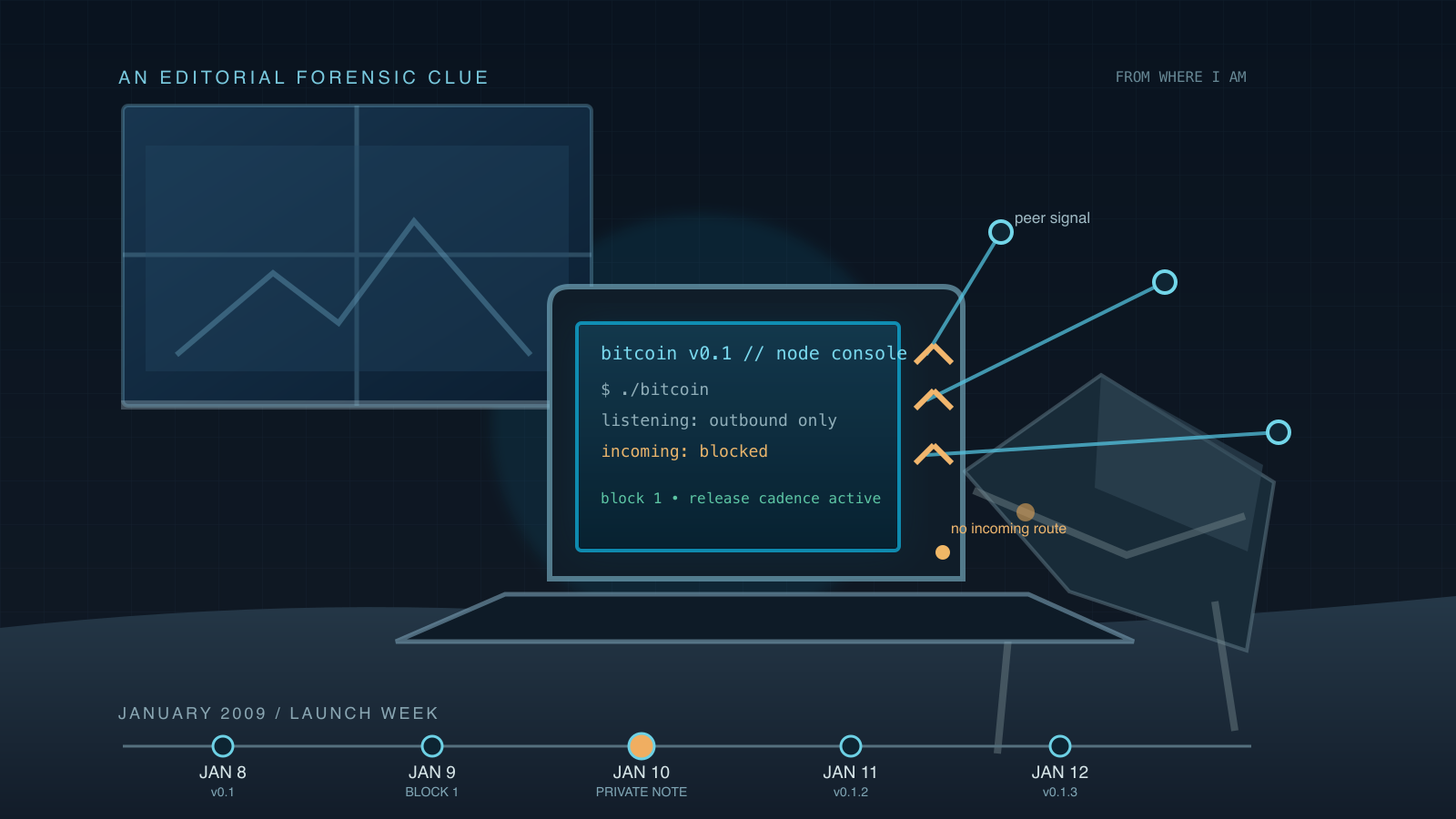
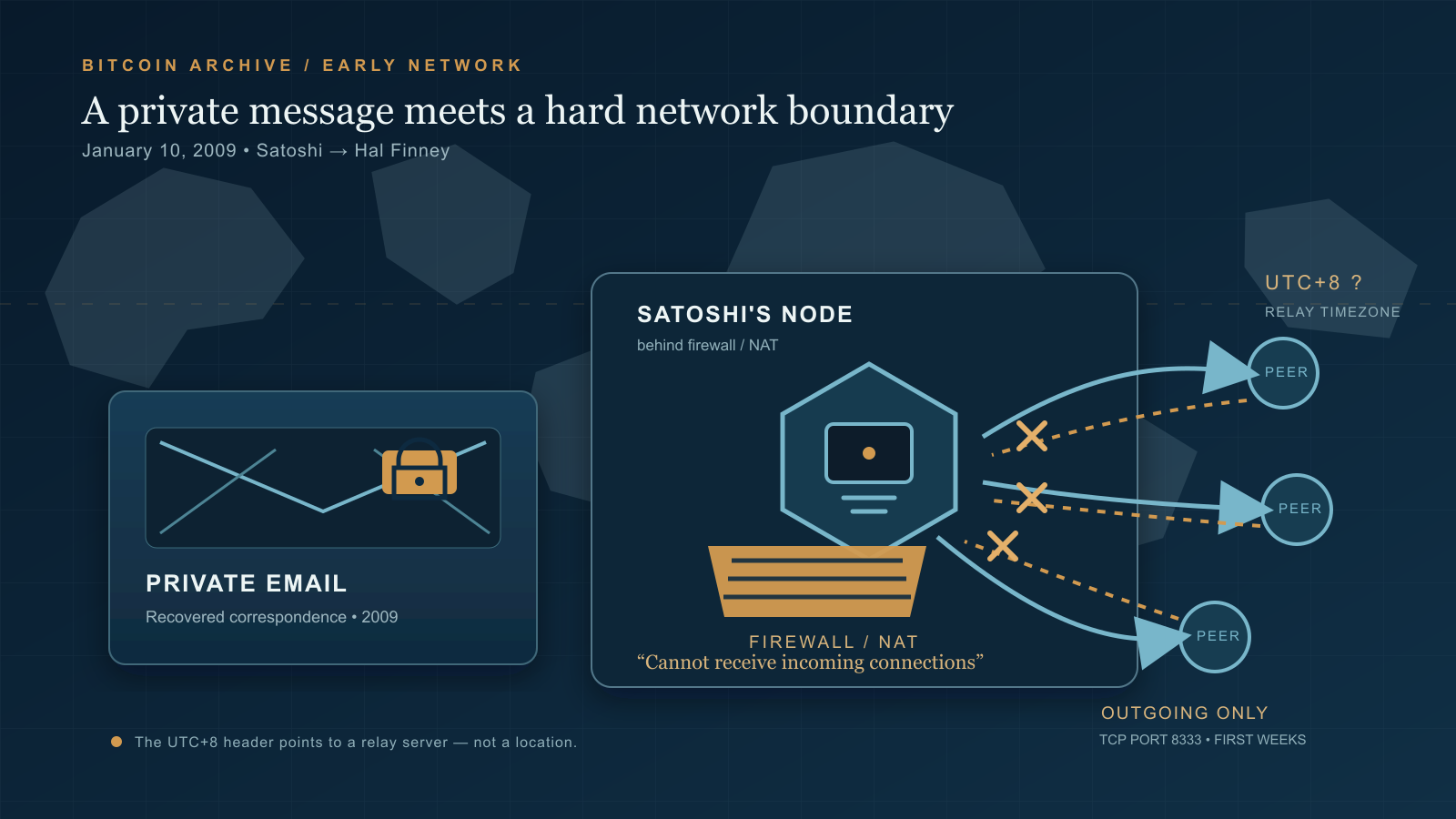
| ”Unfortunately, I can’t receive incoming connections from where I am” | → Hal Finney | 2009-01-12 | Operational self-disclosure; analyzed in launch-environment analysis |
| ”I’m not going to be much help right now either, pretty busy with work, and need a break from it after 18 months development” | → Martti Malmi, 2009-07-21 | 2009-07-21 | Names “18 months development” (scope vs. coding period left open by the phrasing); self-discloses fatigue. (The preceding sentences in the same email describe Hal Finney’s reduced involvement; Satoshi’s “either” pivots to his own state.) |
| ”That’s where I have less expertise” (regarding Linux/FreeBSD testing) | BitcoinTalk forum post, 2009-12-10 | 2009-12-10 | Cross-platform expertise gap |
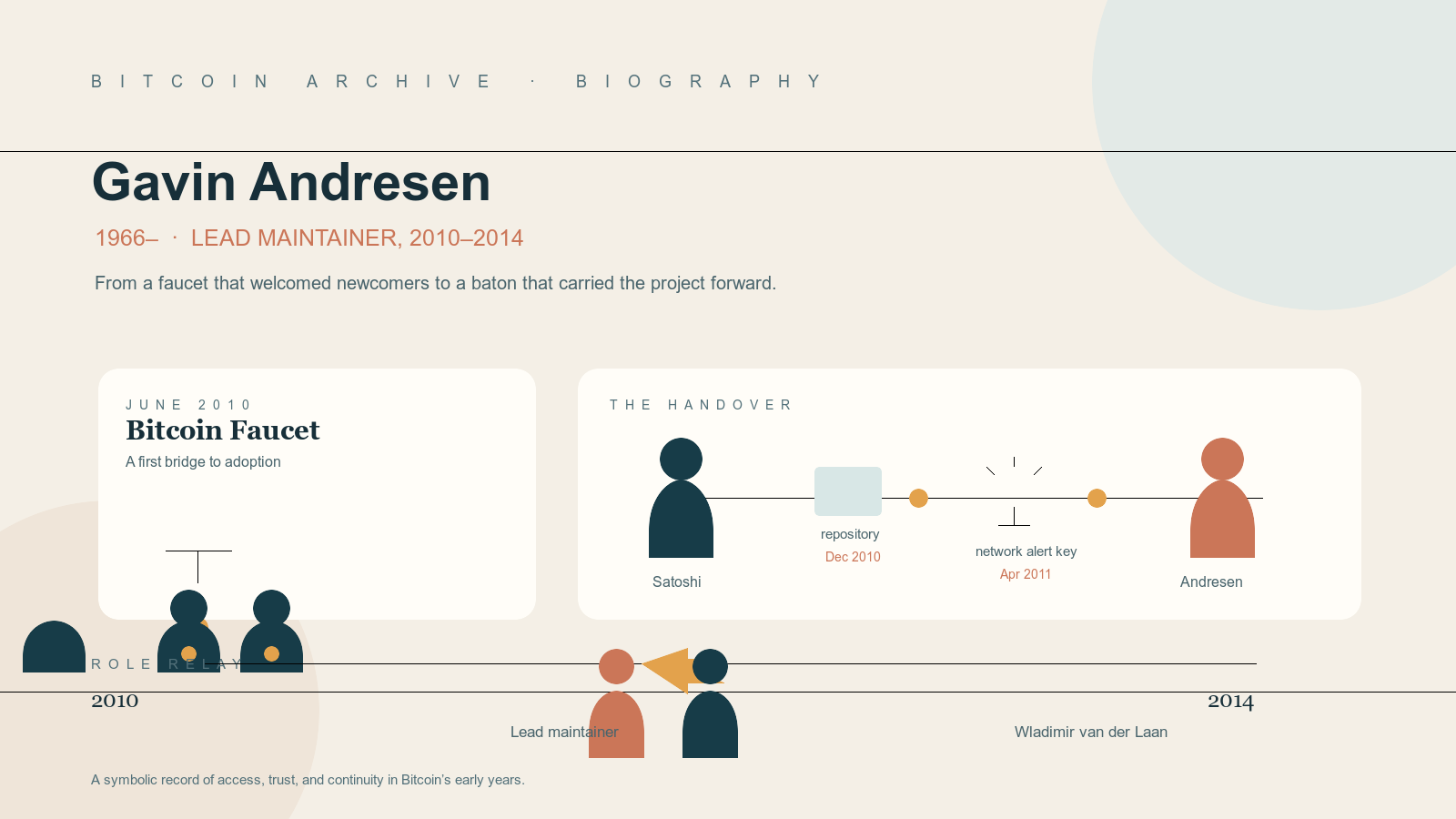
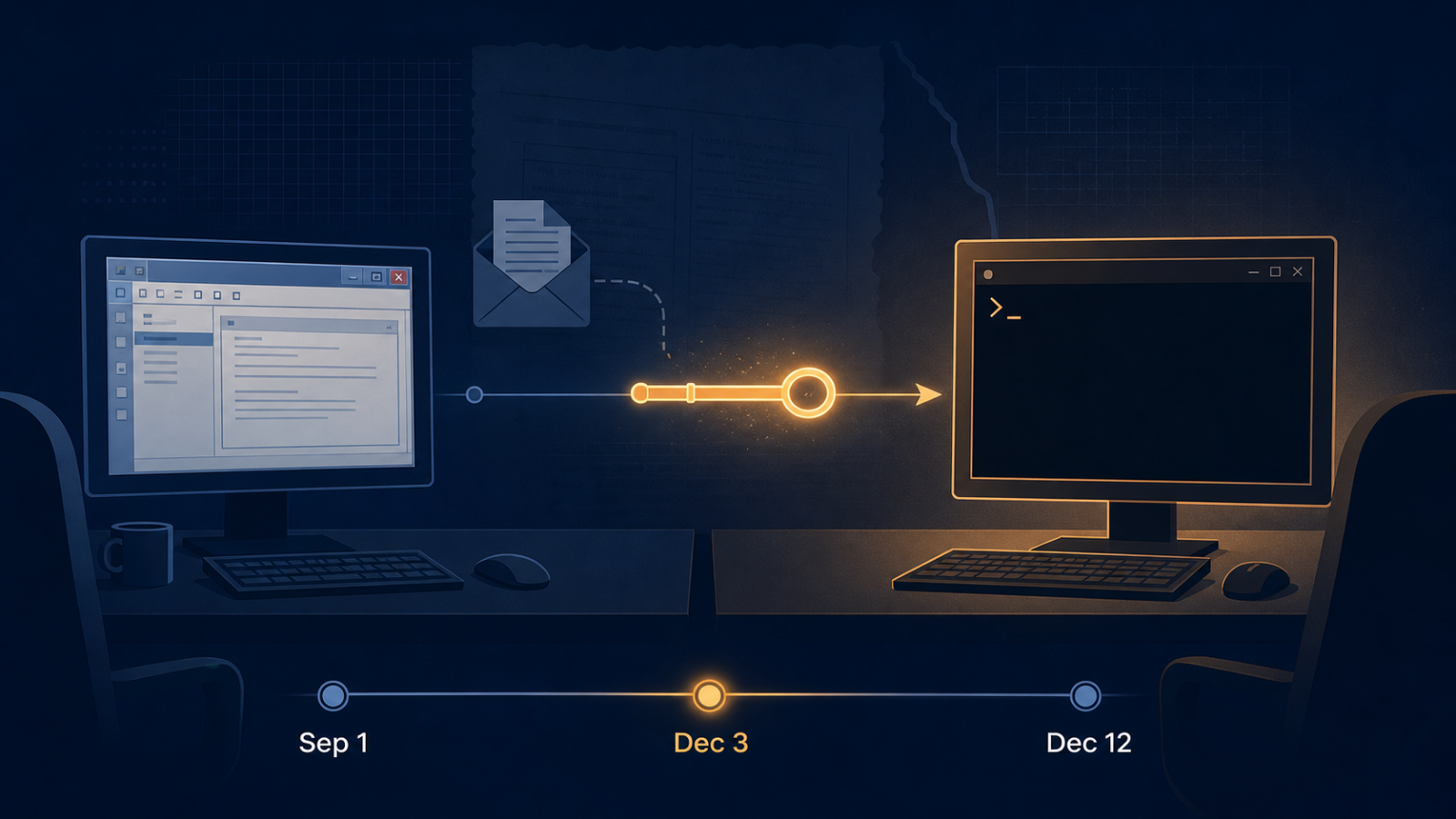
| ”[Gavin is] technically much more Linux capable than me” | → Martti Malmi, 2010-12-03 | 2010-12-03 | Comparative self-evaluation by Satoshi (his own assessment of his Linux skill relative to Gavin’s) |
1.4 Departure statements
| What Satoshi said | Primary source | Date | Status |
|---|---|---|---|
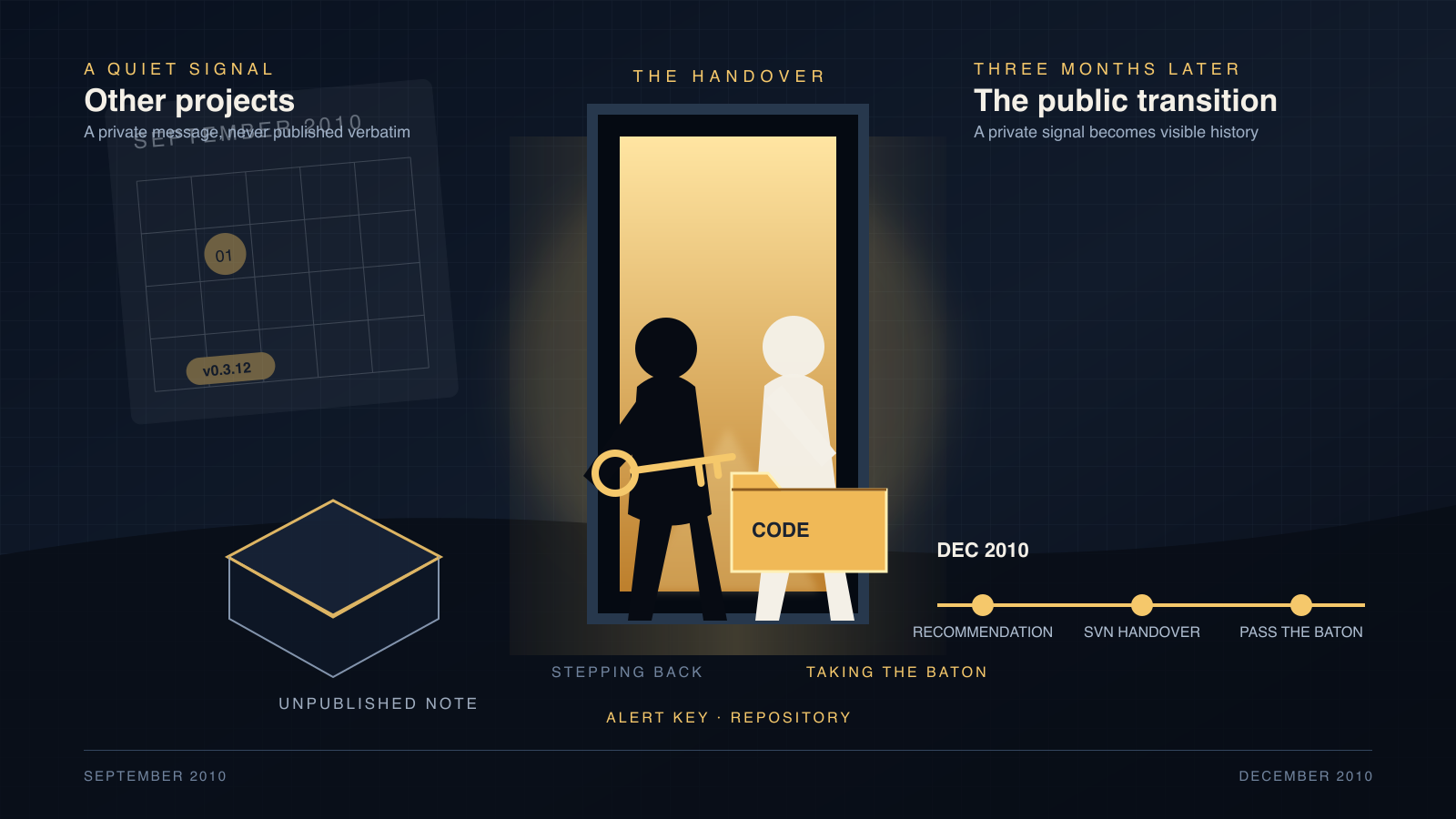
| ”[I’m] working on other projects” (paraphrase; verbatim text not published) | → Gavin Andresen, September 2010 | 2010-09 (exact day not in public record) | Earliest documented signal of intent to step back. The message itself is referenced in Andresen’s later interviews but has not been published verbatim |
| ”I’ve moved on to other things. It’s in good hands with Gavin and everyone” | → Mike Hearn, 2011-04-23 | 2011-04-23 | Departure announcement |
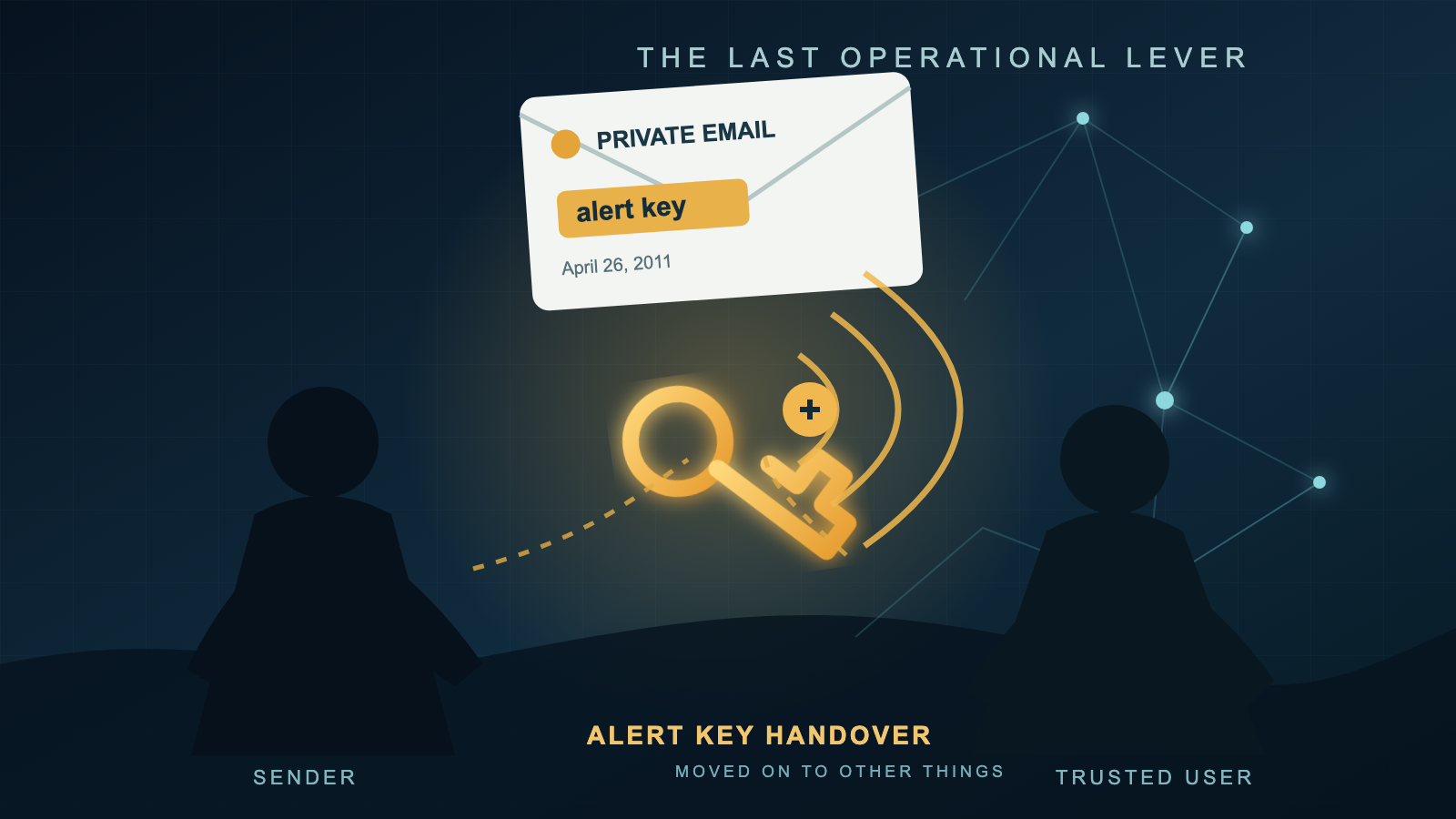
| ”I wish you wouldn’t keep talking about me as a mysterious shadowy figure, the press just turns that into a pirate currency angle” | → Gavin Andresen, 2011-04-26 | 2011-04-26 | Self-perception statement; rejection of the “shadowy figure” frame |
| ”I’ve moved on to other things and will probably be unavailable” | → Gavin Andresen, 2011-04-26 | 2011-04-26 | Final departure announcement |
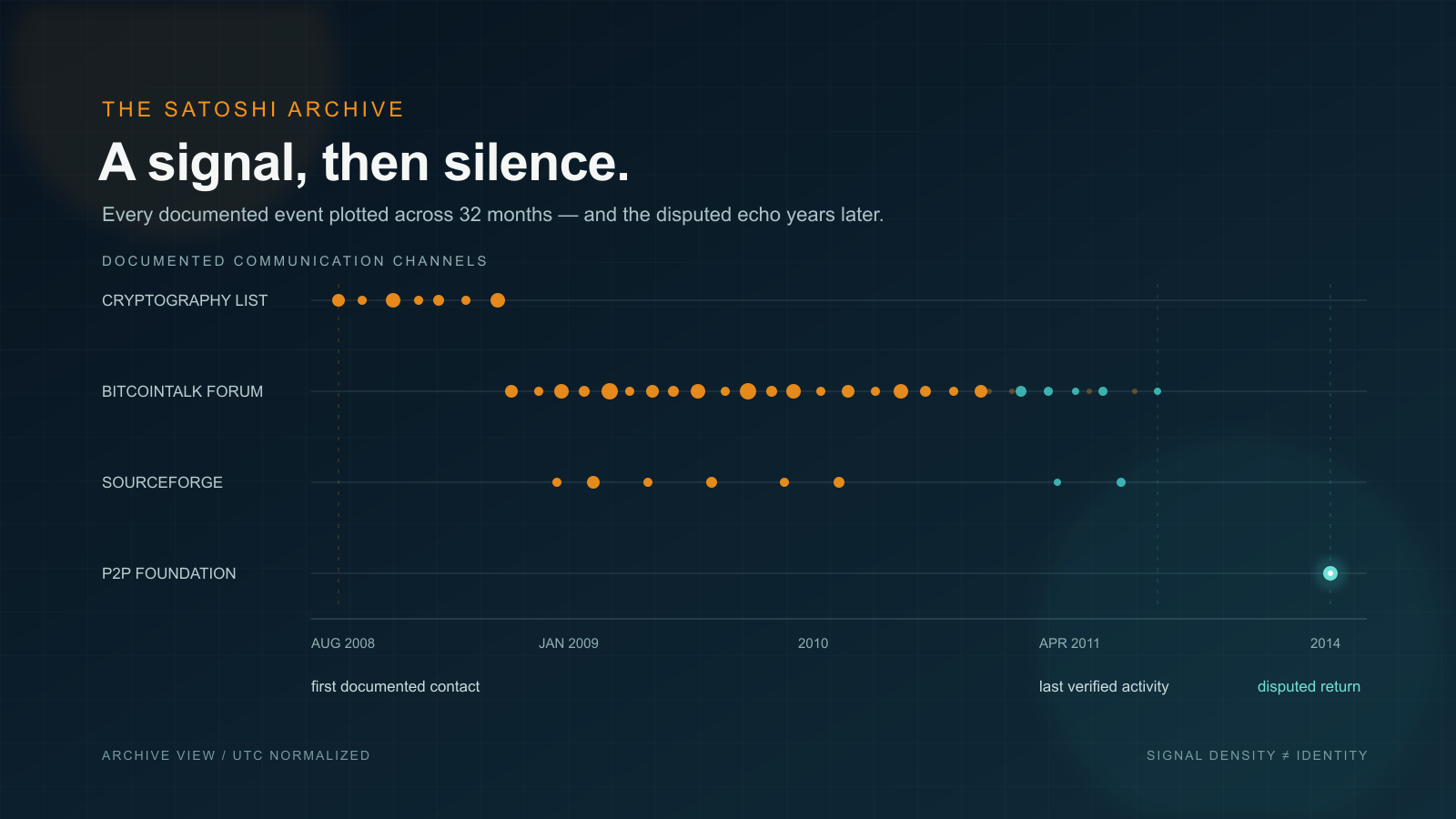
Notably absent: Satoshi’s last known public post on BitcoinTalk (2010-12-12) contains no self-reference to stepping back or succession — it closes on a purely technical note about DoS controls and safe-mode removal. The departure was announced nowhere in public; it surfaces only in the private messages above, four months later.
1.5 Authenticity-disputed
| What Satoshi said | Primary source | Date | Status |
|---|---|---|---|
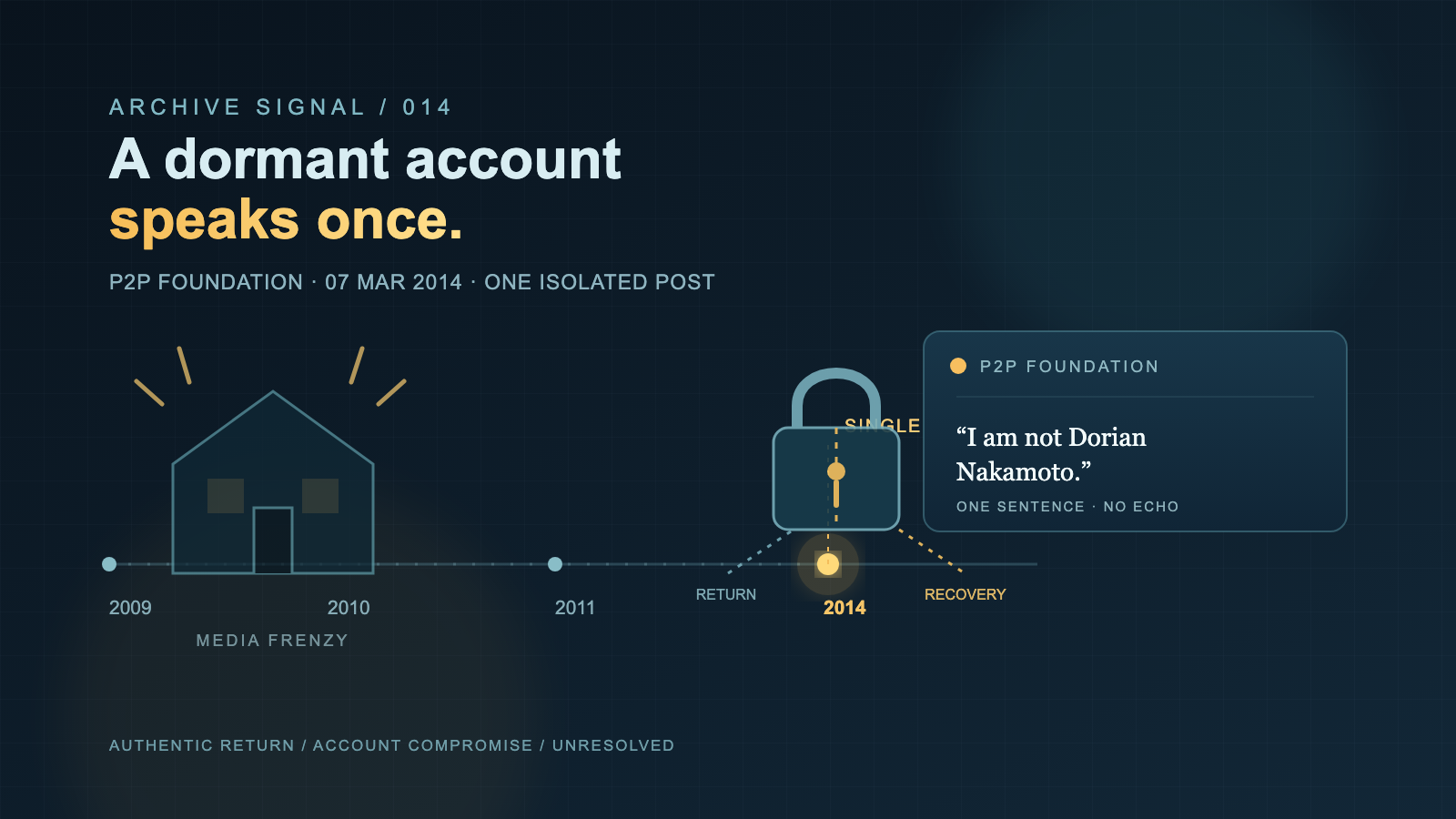
| ”I am not Dorian Nakamoto” | P2P Foundation profile post-Newsweek | 2014-03-07 | Authenticity disputed; the post may not be from the original Satoshi |
1.6 Pre-release-period self-statements (the eleven documented utterances)
The categories above are sorted by what kind of self-disclosure each statement is. This subsection re-sorts a subset of them by when Satoshi said something about the pre-release work — the design and coding effort that ran in private up to the v0.1 release on January 8, 2009. Eleven documented utterances bear on this period: seven made during the work (Aug 2008 – Jul 2009), four made retrospectively (Jun 2010 – Jan 2011), and the two earliest also fix the chronological frame for the cypherpunk-lineage-knowledge question. Listed chronologically:
| # | Date (UTC) | Recipient or venue | Verbatim phrase relevant to timing or order | What this directly establishes (utterance fact, not interpretation) |
|---|---|---|---|---|
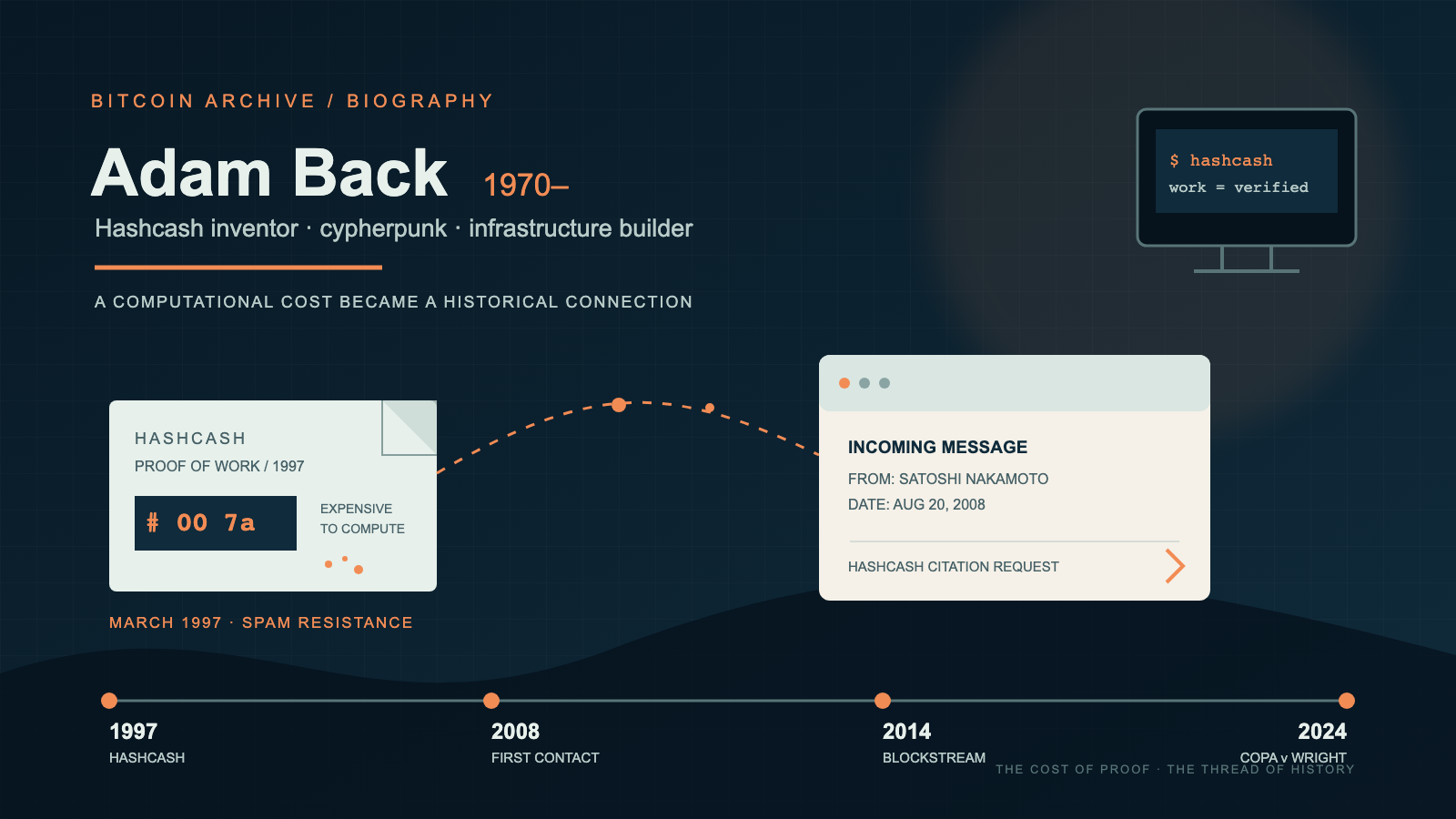
| D1 | 2008-08-20 | → Adam Back | ”I’m getting ready to release a paper that references your Hashcash paper” + “I’m also nearly finished with a C++ implementation to release as open source” | Wording on Aug 20, 2008: paper-release preparation under way; C++ implementation described as “nearly finished” |
| D2 | 2008-08-21 | → Adam Back | ”Thanks, I wasn’t aware of the b-money page, but my ideas start from exactly that point” | Knowledge state on Aug 21, 2008: b-money unknown until Back’s referral; design starting point described as “exactly that point” |
| D3 | 2008-08-22 | → Wei Dai | ”I’m getting ready to release a paper that expands on your ideas into a complete working system” | Wording on Aug 22, 2008: the project described as a “complete working system” |
| D4 | 2008-10-31 | cryptography mailing list (opening post) | “I’ve been working on a new electronic cash system that’s fully peer-to-peer, with no trusted third party” | The first public announcement uses the present-perfect “I’ve been working on” — implies prior ongoing work but states no duration |
| D5 | 2008-11-09 | → Hal Finney | ”I actually did this kind of backwards. I had to write all the code before I could convince myself that I could solve every problem, then I wrote the paper.” | Work order: code first, then paper |
| D6 | 2008-11-17 | cryptography mailing list (to James A. Donald) | “I believe I’ve worked through all those little details over the last year and a half while coding it” | Phrase used: “the last year and a half while coding it” — names the coding span as “a year and a half” |
| D7 | 2009-07-21 | → Martti Malmi | ”need a break from it after 18 months development” | Phrase used: “after 18 months development” — names the period as “18 months” (scope vs. coding period left open by the phrasing) |
| D8 | 2010-06-17 | BitcoinTalk reply | ”The design supports a tremendous variety of possible transaction types that I designed years ago” | Phrase used: design happened “years ago” — places transaction-type design work earlier than the speaking moment |
| D9 | 2010-06-18 | BitcoinTalk reply to Laszlo Hanyecz | ”Since 2007. At some point I became convinced there was a way to do this without any trust required at all and couldn’t resist to keep thinking about it. Much more of the work was designing than coding.” | Answer to “how long have you been working on this design?”: “Since 2007.” Indicates that within the overall work, design judgment and thinking carried more weight than coding |
| D10 | 2010-07-18 | BitcoinTalk reply | ”When I wrote it more than 2 years ago, there were screaming hot SHA1 implementations but minimal attention to SHA256” | Phrase used: “more than 2 years ago” — places one specific implementation choice (the SHA-256 routine in Bitcoin) before mid-2008 |
| D11 | 2011-01-10 | → Mike Hearn | ”I must admit, this project was 2 years of development before release” | Phrase used: “2 years of development before release” — names the period as “2 years” |
These eleven statements bear on three separate things:
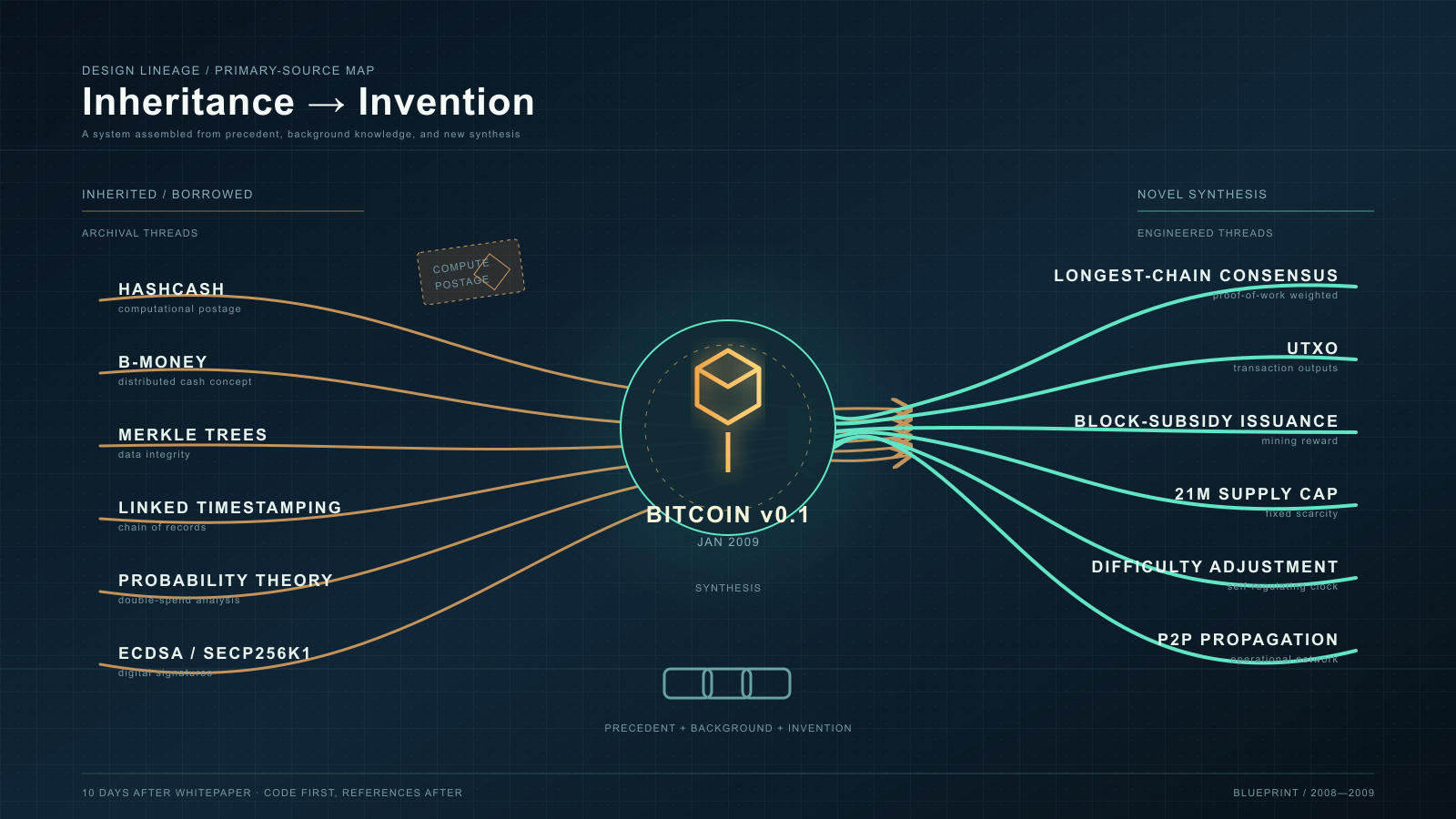
- Work order. D5 is the only self-statement of the code-first-then-paper sequence: “I had to write all the code before I could convince myself that I could solve every problem, then I wrote the paper.” This is reinforced in the same email by “I think I will be able to release the code sooner than I could write a detailed spec.” Satoshi did not describe a discrete pre-coding design phase; the documented order is code → paper. This same D5 utterance opens the design-lineage analysis, which uses it to argue that Bitcoin’s eight whitepaper references were assembled after the implementation, not before it.
- Duration. D6 and D7 name “year and a half” and “18 months” near-contemporaneously; D11 names “2 years” retrospectively. The most parsimonious reading is that these describe the same pre-release work at different scopes and granularities — the contemporaneous coding-window framing (~18 months from mid-2007 to v0.1) and the later approximately-2-year retrospective, with the “2 years” likely rounded from the lived-through coding span plus the additional months Satoshi was thinking about the design before opening an editor.
- D9 within the work. “Much more of the work was designing than coding” describes the share of effort within the work — thinking through problems, deciding the architecture, debugging the model — not a discrete design phase preceding implementation. The D5 work order constrains this: the paper (the formal artifact of the design) was written after the code was substantially complete.
What none of D1–D11 establishes: a calendar start date with month precision, a calendar end date for “design” (vs. coding), a motivation beyond the project-level “instead of trust” framing already in the whitepaper, a single-developer-vs-team claim, or a geographic location. Each of those is treated in adjacent analyses, not in the utterances themselves.
2. Categorical reading
2.1 Basic identity claims (all on one profile, all unverifiable independently)
The three claims that locate Satoshi as a person — Japanese, born April 5, 1975, living in Japan — appear together on a single artifact: the P2P Foundation profile. They appear nowhere else in the documented record. The widespread consensus that this set is fictitious rests on three independent counter-observations:
- Language: Satoshi’s English shows consistent British/Commonwealth conventions (favouring “favour,” “colour”; “maths” rather than “math”), inconsistent with native-Japanese composition.
- Posting timestamps: Statistical analyses (most notably by Doncho Karaivanov at Chain Bulletin) place Satoshi’s active hours far outside what would be natural for someone in Japan time. A separate posting-timestamp analysis — Alyssa Blackburn’s activity-window study cited in the Finding Satoshi documentary entry — narrows this further to a specific 6am–10pm PST window said to fit a US-based Finney + Sassaman pairing; this inventory does not adjudicate between the two readings. It also does not adjudicate a third: this archive’s own code analysis reads Satoshi’s commit-time gaps as EST/CST rather than Chain Bulletin’s GMT — a disagreement between two direct studies of Satoshi’s own timestamps that the nationality question analysis treats as the load-bearing finding, not a footnote.
- Behavioral pattern: The profile fields are the only identity-locating claims in the entire corpus. A person living a normal life in the claimed country and age bracket would typically leak more incidental detail across years of correspondence; Satoshi did not.
The profile claims are best read as declared identity material that the rest of the record does not confirm — not as “Satoshi’s actual biography.”
2.2 Development-process self-disclosures
These are the most evidentially valuable self-references because they are casual asides in technical conversation, not formal identity declarations:
- The “year and a half” timeline (cryptography ML 2008-11-17 + Malmi 2009-07-21) names an approximately 18-month coding span running from mid-2007 to roughly the v0.1 release in January 2009. Satoshi himself documented the order of the work: “I had to write all the code before I could convince myself that I could solve every problem, then I wrote the paper” (to Hal Finney, November 9, 2008) — the paper and detailed specification came after the code was substantially complete. The later “Since 2007” / “2 years of development before release” framings (Hanyecz 2010-06-18; Hearn 2011-01-10) describe the same pre-release work at wider scopes — the approximately-2-year retrospective rounds the lived-through coding span plus the months Satoshi was thinking through the problem before opening an editor — not a separate pre-coding design phase.
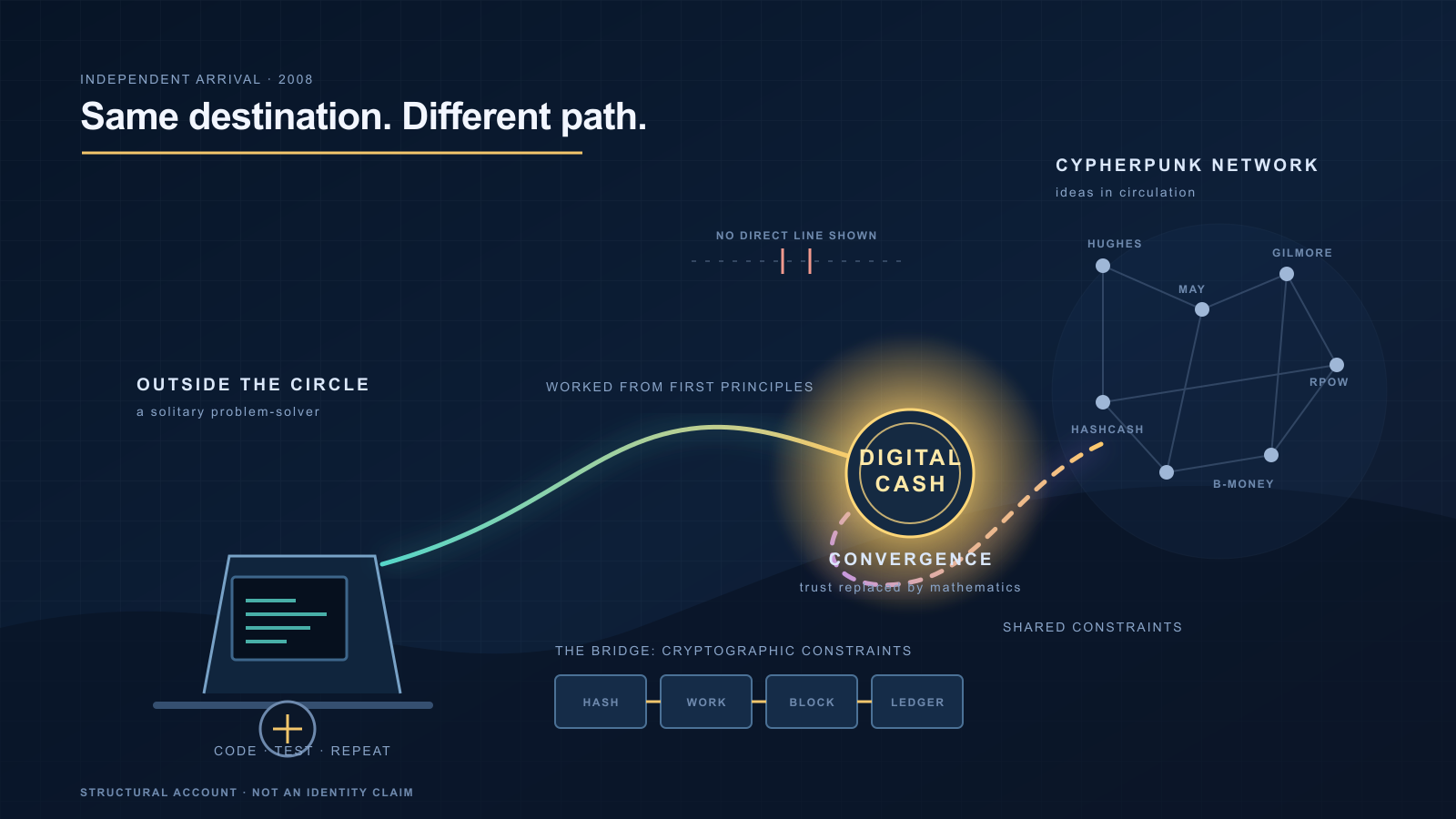
- The “I wasn’t aware of the b-money page” disclosure (Adam Back 2008-08-21) bounds Satoshi’s exposure to the cypherpunk technical lineage during development — analyzed in detail in the cypherpunk independent-arrival entry.
- The first-person authorship statements (“I’m getting ready to release a paper…” to Back; “I’ve developed… Bitcoin” on P2P Foundation) consistently attribute the work to a single individual, not a team.
2.3 Operational state and expertise self-disclosures
- The “from where I am” disclosure (Hal Finney 2009-01-10) is operational rather than identity-locating — analyzed in the launch-environment entry.
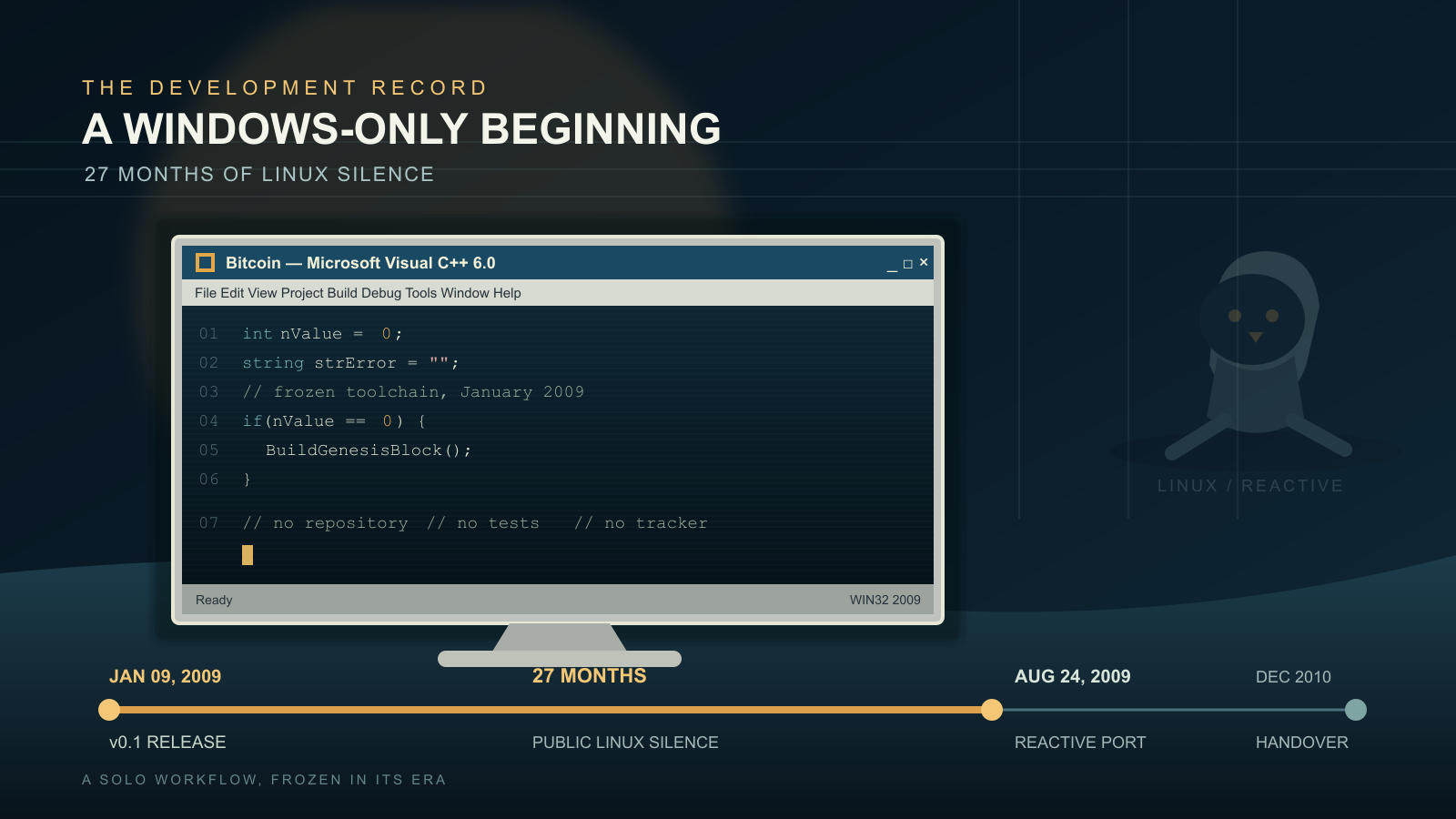
- The Linux-expertise self-acknowledgments (the December 2009 forum “less expertise” remark and the December 2010 Gavin email comparing himself to Gavin’s Linux skill) corroborate the code analysis finding of a Windows-centered development environment — these same two self-statements are the central Phase-3 evidence in the dedicated Windows-only development-environment analysis.
- The “need a break from it after 18 months development” disclosure (Malmi 2009-07-21) is the only explicit fatigue self-statement in the corpus; in retrospect it foreshadows the 2011 departure. The same email is the entry for the bootstrap-application proposal it triggered, which led directly to Bitcoin’s first exchange.
2.4 Motivational statements (notably sparse)
The public record contains very few self-references about why Satoshi built Bitcoin. The closest are the P2P Foundation introduction’s anti-trust framing (“the central bank must be trusted not to debase the currency”) and scattered BitcoinTalk remarks about specific design tradeoffs.
One more sits in the regression-theorem thread: right after asking the reader to imagine a base metal as scarce as gold but transmissible over a communications channel, Satoshi added the parenthetical “(I would definitely want some)” — one of the few first-person moments he put himself on the demand side of his own creation’s scarcity, though it lands as an aside in an economics argument, not a statement of motive. There is no broader self-authored manifesto.
This sparseness is itself a notable observation: in an age of vocal cypherpunk and crypto-anarchist manifestos, Satoshi’s project embodied a clear philosophy but Satoshi’s self-described motivation was minimal. Contrast with Wei Dai’s later 2014 retrospective speculation about Satoshi’s motives — that reading is by Dai, not by Satoshi.
2.5 Departure statements
The departure trajectory spans seven months, but almost none of it played out where the public could see it. The earliest documented signal is the September 2010 private message to Gavin Andresen (“working on other projects”). Satoshi’s last known public statement — the December 12, 2010 BitcoinTalk post — closes on a purely technical note about DoS controls and safe-mode removal, with no announcement of departure or succession. The actual farewells came four months later, in private email only: Hearn 2011-04-23, Gavin 2011-04-26.
The 2011 sequence itself is consistent and brief:
- An assertion of completion: leadership transferred, project in good hands.
- A specific request: do not frame me as “a mysterious shadowy figure.”
- A forward-looking statement: “moved on to other things and will probably be unavailable.”
The disputed 2014 P2P Foundation post is the single ambiguous addition: brief, contextually responsive (to the Newsweek Dorian story), and authentically Satoshi only if the original profile credentials were still in use.
3. What this inventory establishes — and what it does not
Established by Satoshi’s own statements:
- Implementation-work timeline: roughly mid-2007 to August 2008 (the coding window inside the approximately 2-year pre-release work Satoshi later put at “Since 2007” / “2 years of development before release”; the paper was written after the code, per D5)
- Knowledge boundary at development time: knew Hashcash, did not know b-money
- Operational state during launch week: location-contingent connection constraint
- Expertise profile: more comfortable on Windows than Linux
- Psychological state at departure: ready to step back, uncomfortable with personal-attention framing
- Stated identity material: Japanese, born 1975-04-05, in Japan (sourced from the profile)
Not established by Satoshi’s own statements alone:
- Geographic location (the profile claim does not survive timezone analysis)
- Native language (the profile implies Japanese; the prose suggests Commonwealth English)
- Identity, age, real biography (the profile is generally read as designed to mislead)
- Motivation in detail (Satoshi gave a high-level anti-trust frame and very little more)
- Why the disappearance (only that it happened)
The asymmetry is structural: Satoshi was generous with technical and operational self-disclosure and minimal with biographical or motivational self-disclosure. This is not random. It is the disclosure pattern of someone protecting an identity while collaboratively building a system. Jeff Garzik’s firsthand account of working alongside Satoshi corroborates the same pattern from a collaborator’s vantage point: Satoshi would discuss nothing but Bitcoin and never let slip any personal detail.
4. Convergence and divergence with the documented behavioral record
The behavioral record (writing style, coding style, posting times, tooling choices, anonymization practices) constitutes an independent source. The following table summarizes where it converges with Satoshi’s self-statements and where it diverges:
| Self-statement | Behavioral record | Verdict |
|---|---|---|
| ”Japanese, in Japan, born 1975” | English style is Commonwealth; timestamps inconsistent with Japan timezone | Diverges |
| ”Year and a half of coding” | Code archaeology on v0.1 is consistent with extended solo development | Converges |
| ”I wasn’t aware of b-money” | Wei Dai 2014: not previously active in cypherpunks community | Converges |
| ”From where I am [I can’t receive incoming connections]“ | v0.1.2 release-week debugging activity consistent with operational pressure | Converges (analyzed in launch-environment) |
| “Less Linux expertise” | v0.1 Windows-only, Hungarian notation typical of MS Windows C++ shops | Converges |
| ”Moved on to other things” | No verified post-2011 communication | Converges |
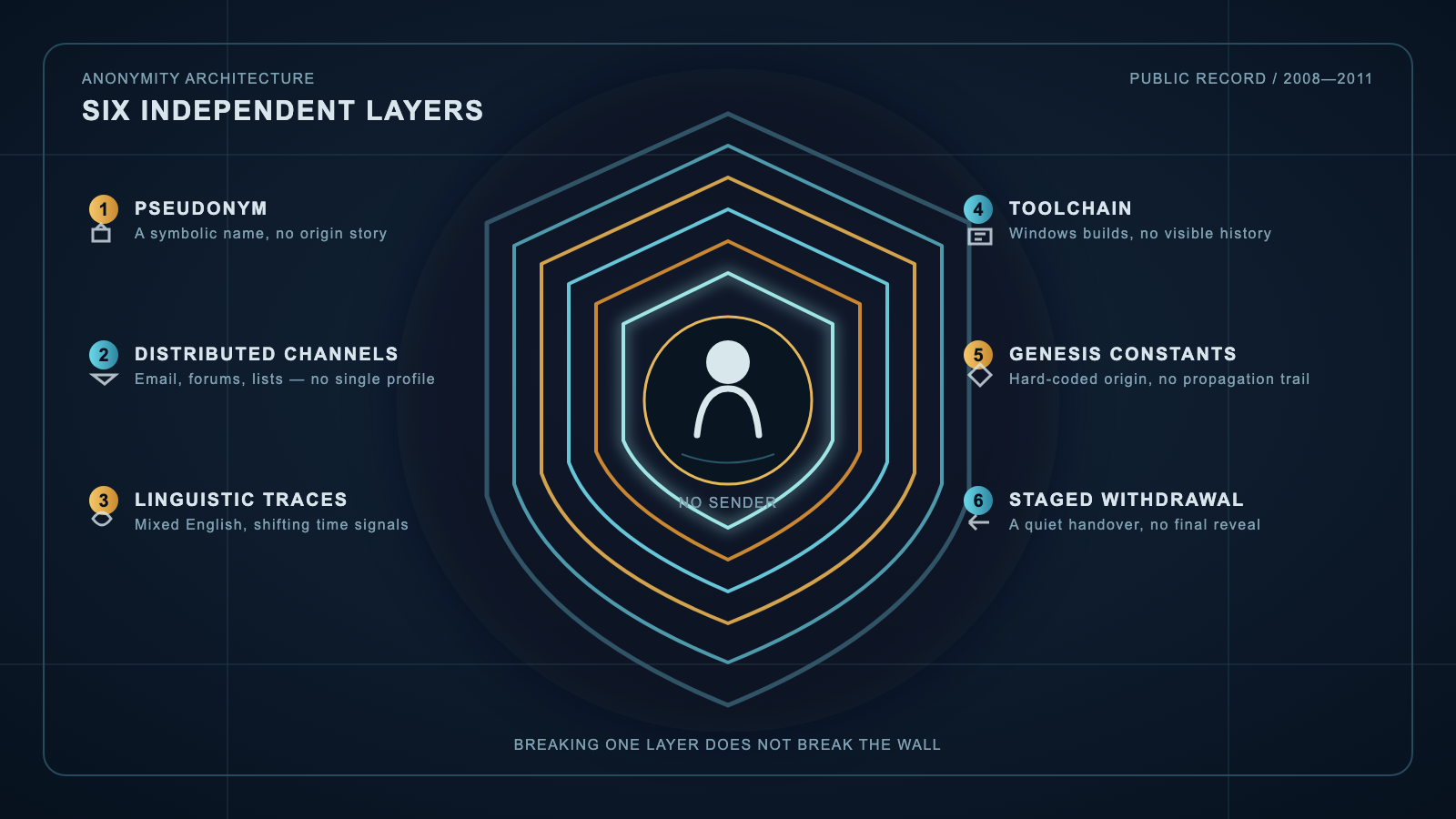
| ”Not a mysterious shadowy figure” | Behavior was consistent with deliberate strong anonymization (Tor, anonymous mail relay, no IP-traceable metadata; full layered account in anonymity-architecture) | Diverges — the behavior is exactly what produces a mysterious-figure perception, regardless of preference |
The systematic pattern: operational and technical self-statements converge with the behavioral record. Identity-locating self-statements diverge. The two sources tell consistent stories about Satoshi the developer and incompatible stories about Satoshi the person.
5. Limits
- The inventory is bounded by what is published. Many private emails between Satoshi and others (especially Mike Hearn and Gavin Andresen) remain partially or fully unreleased. New self-statements may emerge.
- “Authenticity disputed” entries cannot be cleanly assigned. The 2014 Dorian rebuttal (#16) is the canonical case: if the original credentials were re-used by Satoshi, it is a self-statement; if they were obtained or guessed, it is not.
- Casual asides may be over-read. Some entries here (e.g., #11 about Linux expertise) are responsive remarks in a technical thread, not deliberate identity disclosures. Treating them as biographical evidence requires care.
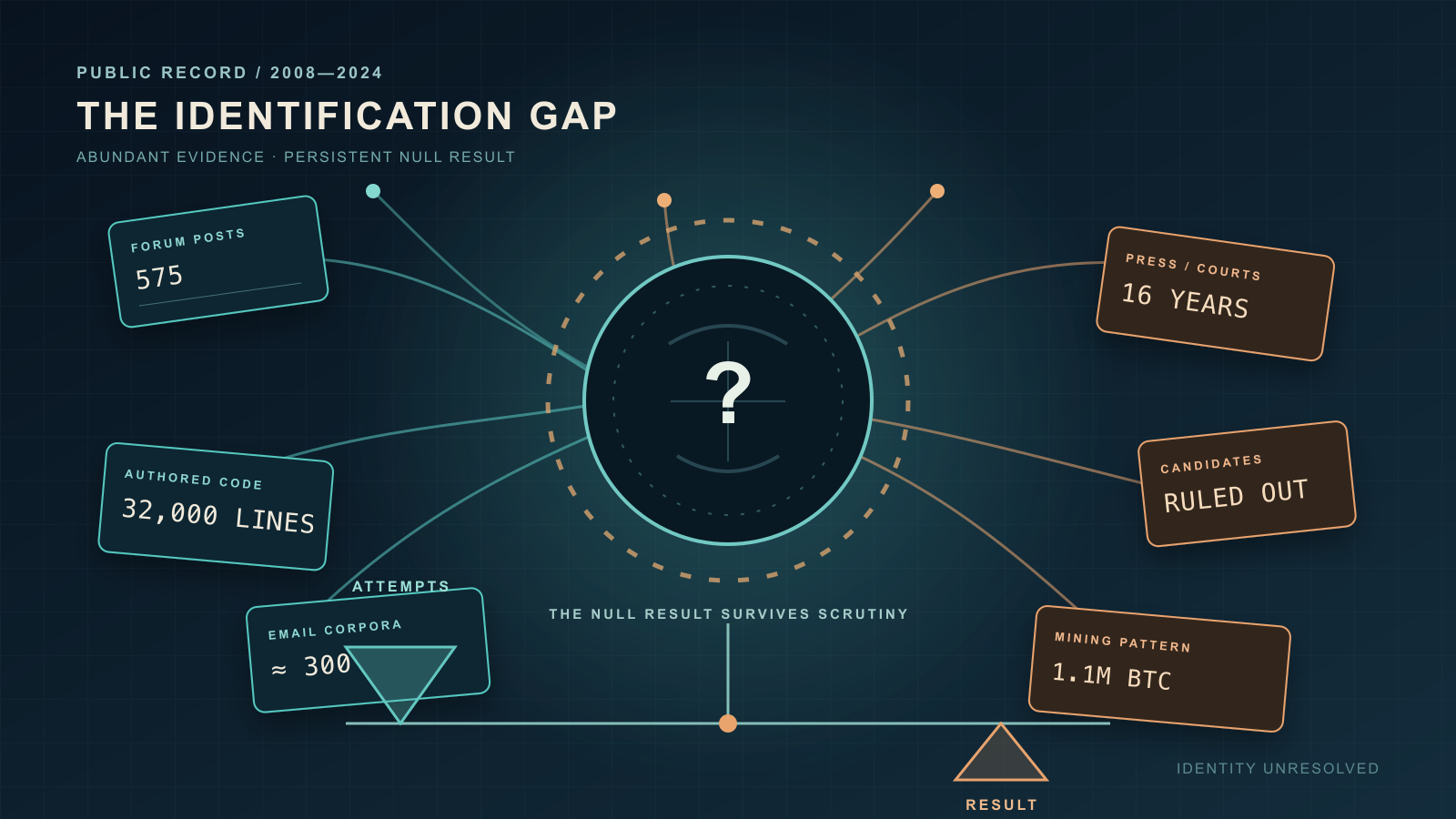
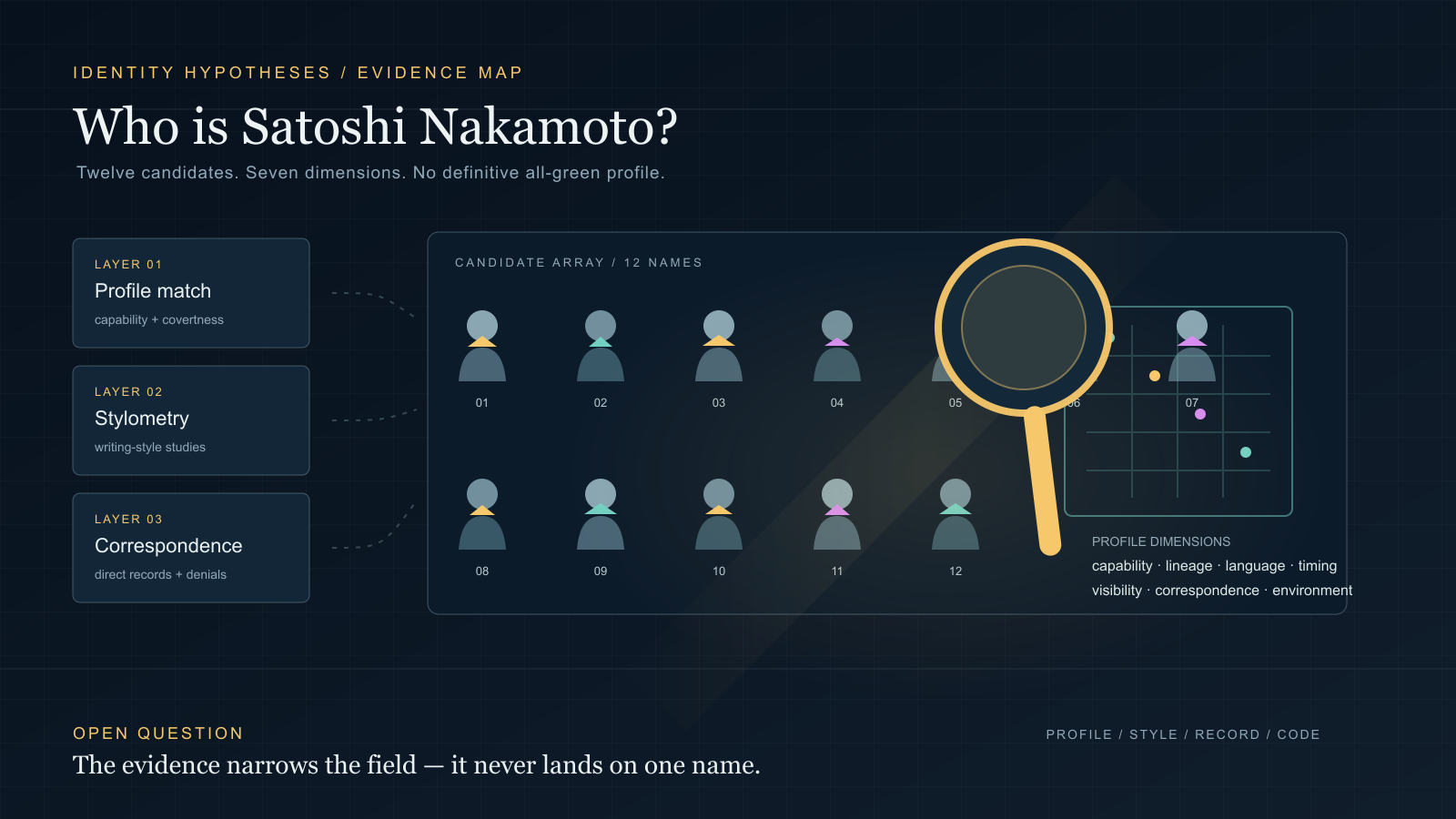
- No identity hypothesis follows. The entry does not narrow Satoshi’s actual identity. It clarifies what Satoshi said and how those statements relate to what the record shows. Choosing among identity hypotheses requires evidence outside this scope — the comparison across named candidates is in this archive’s Satoshi-identity hypotheses overview, which draws on several of the self-statements catalogued above.
Read together, the self-statements draw a developer in sharp focus and a person out of it. I do not take that split for an accident of what survived; it is the shape of a pseudonym built by someone who was generous about the system and silent about the man. What he did say is catalogued above. What he declined to answer is the other half of the portrait, in Satoshi’s non-technical silence.