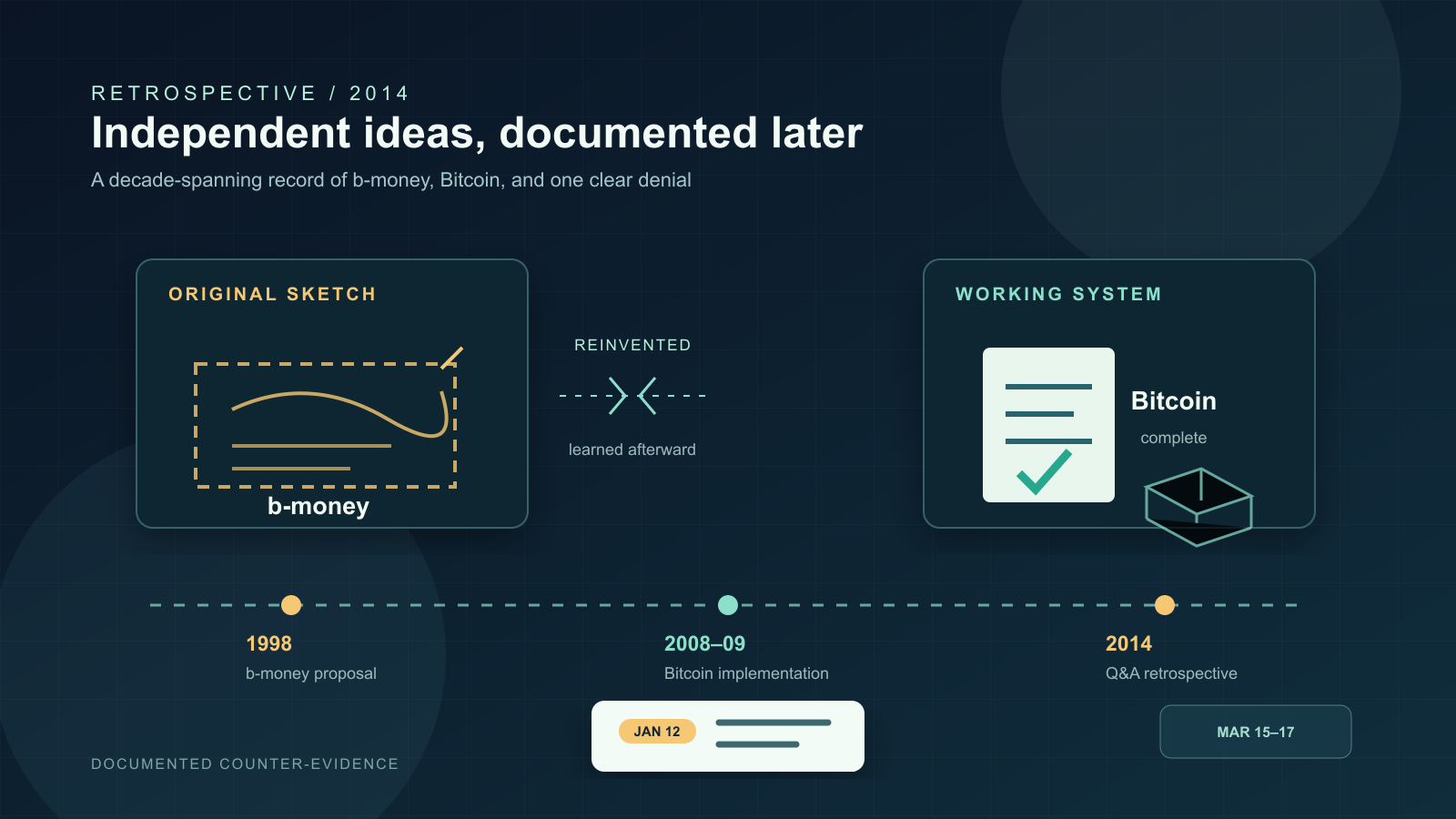
From LessWrong “Ask Any LessWronger Anything” (AALWA) thread, January 12, 2014:
Wei Dai — creator of the b-money proposal (1998), cited as reference [1] in the Bitcoin whitepaper — shared his reflections on Satoshi Nakamoto:
On independent invention, Dai recounted:
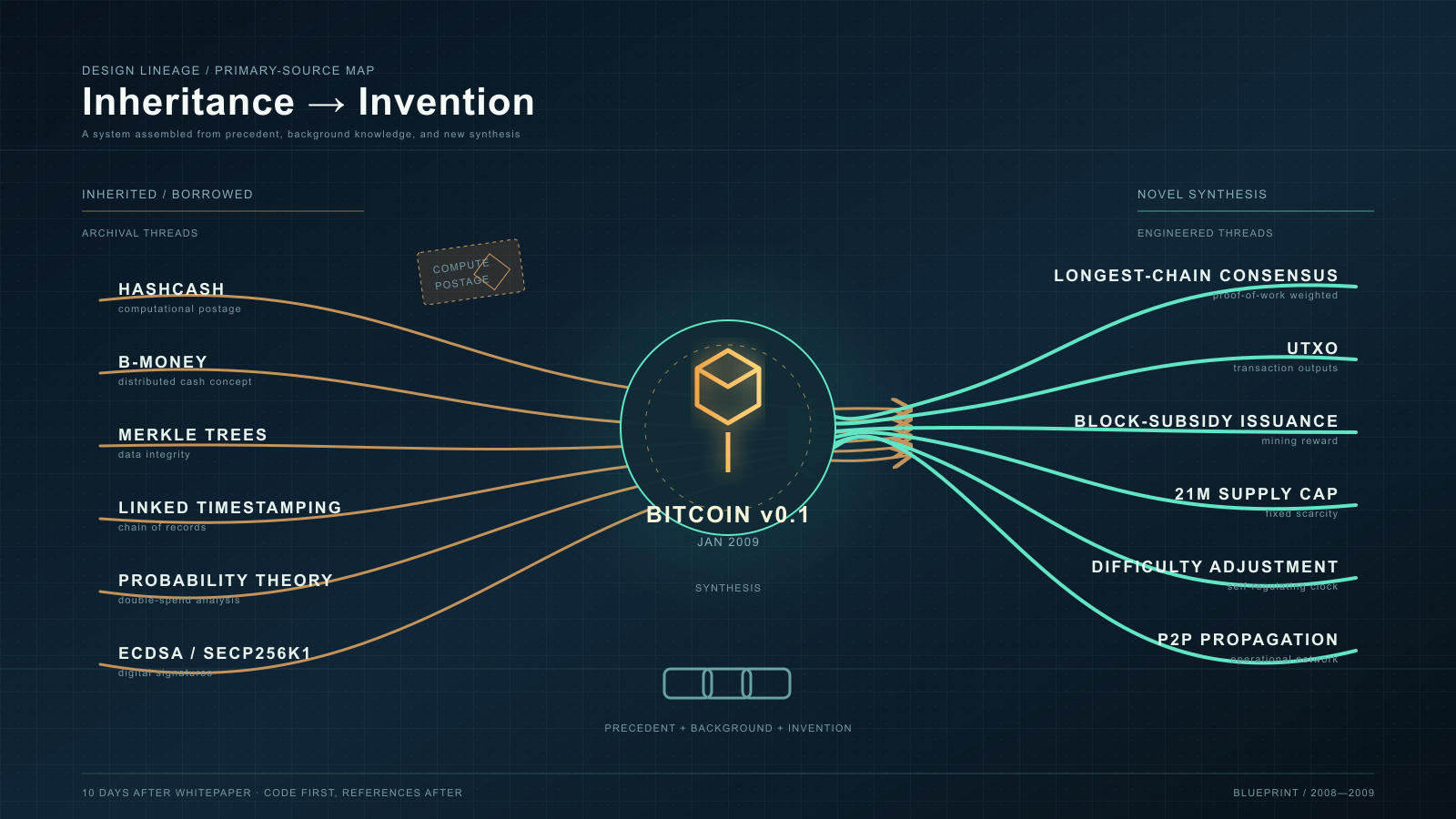
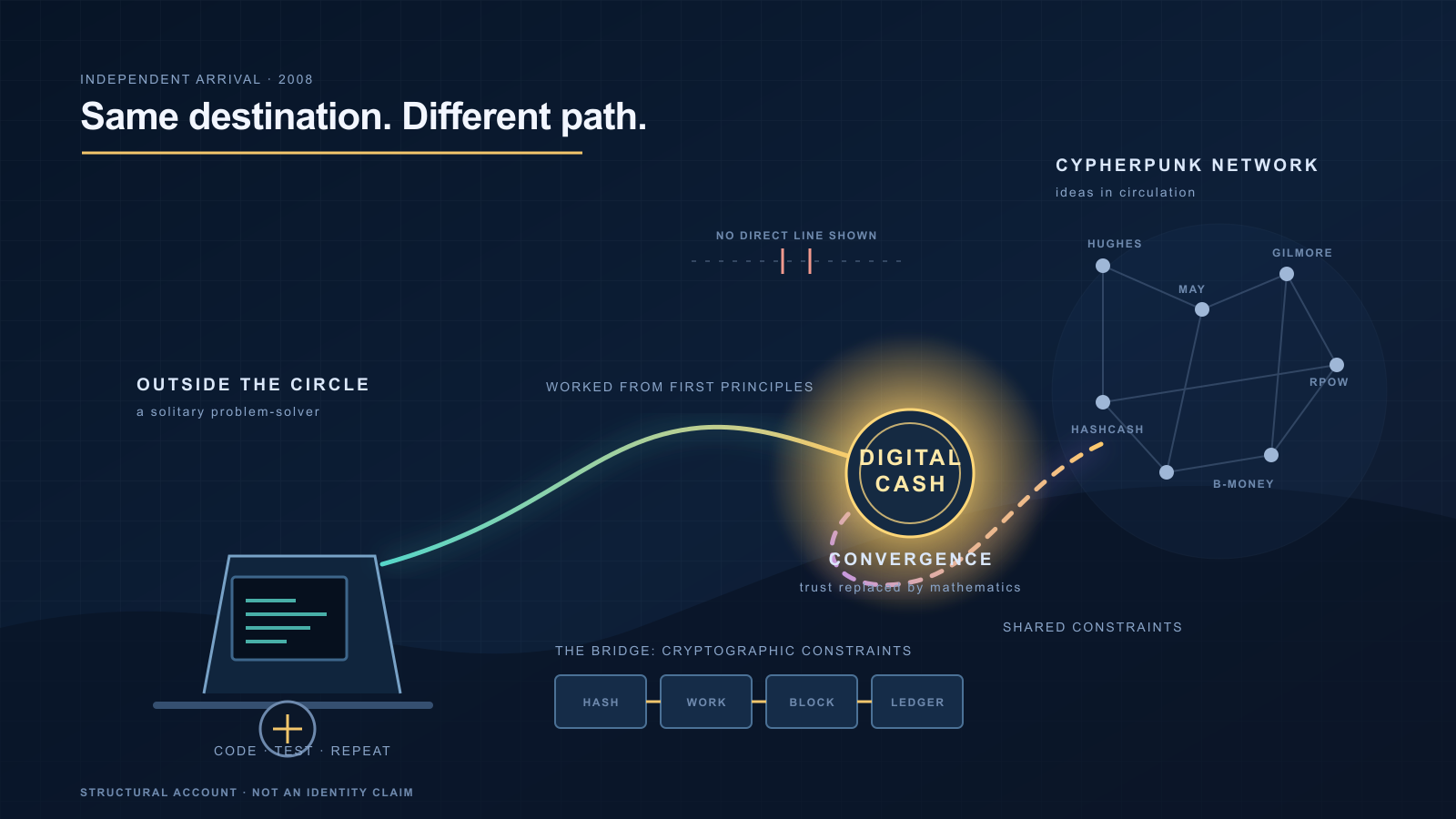
“My understanding is that the creator of Bitcoin, who goes by the name Satoshi Nakamoto, didn’t even read my article before reinventing the idea himself. He learned about it afterward and credited me in his paper.”
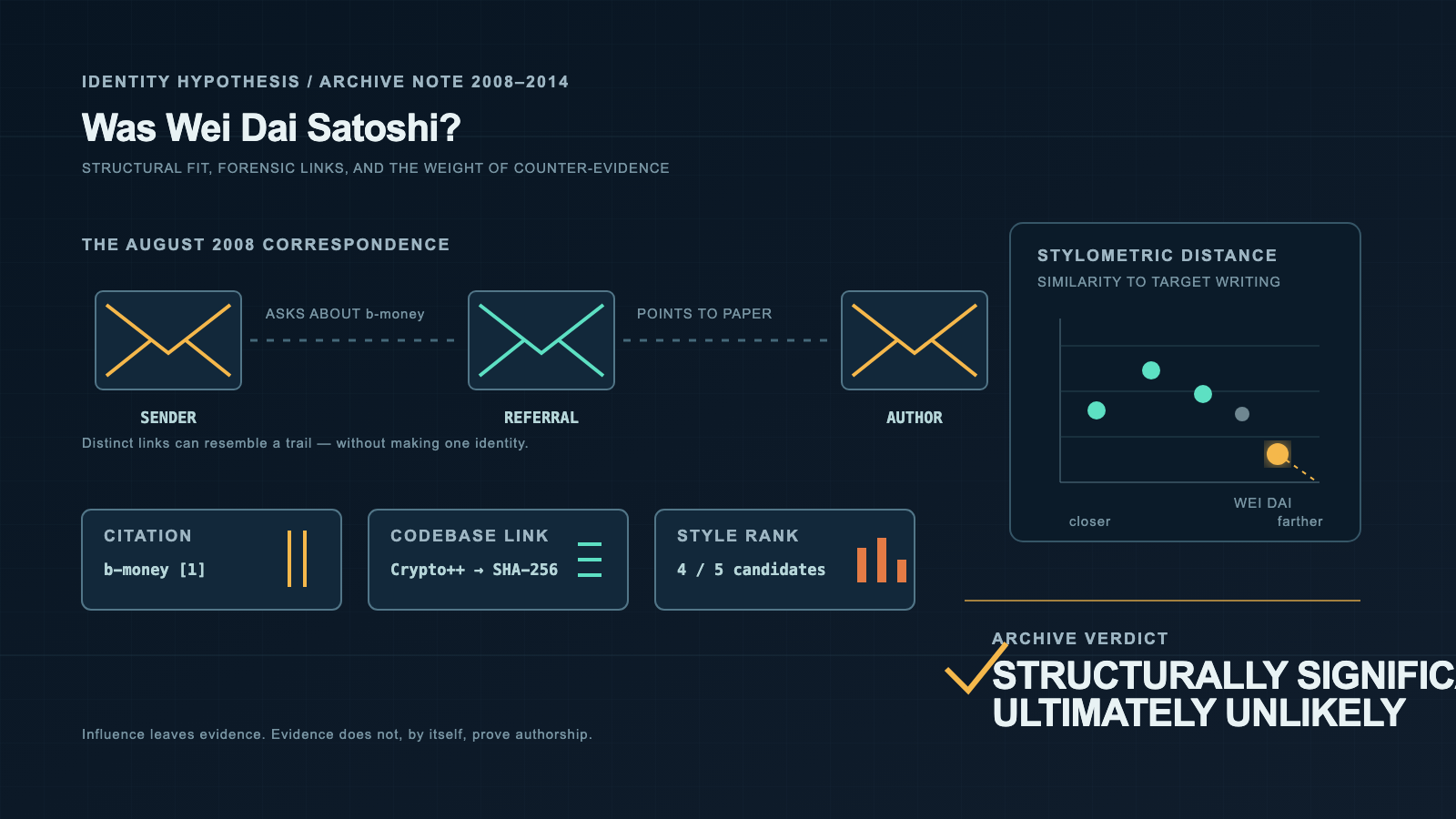
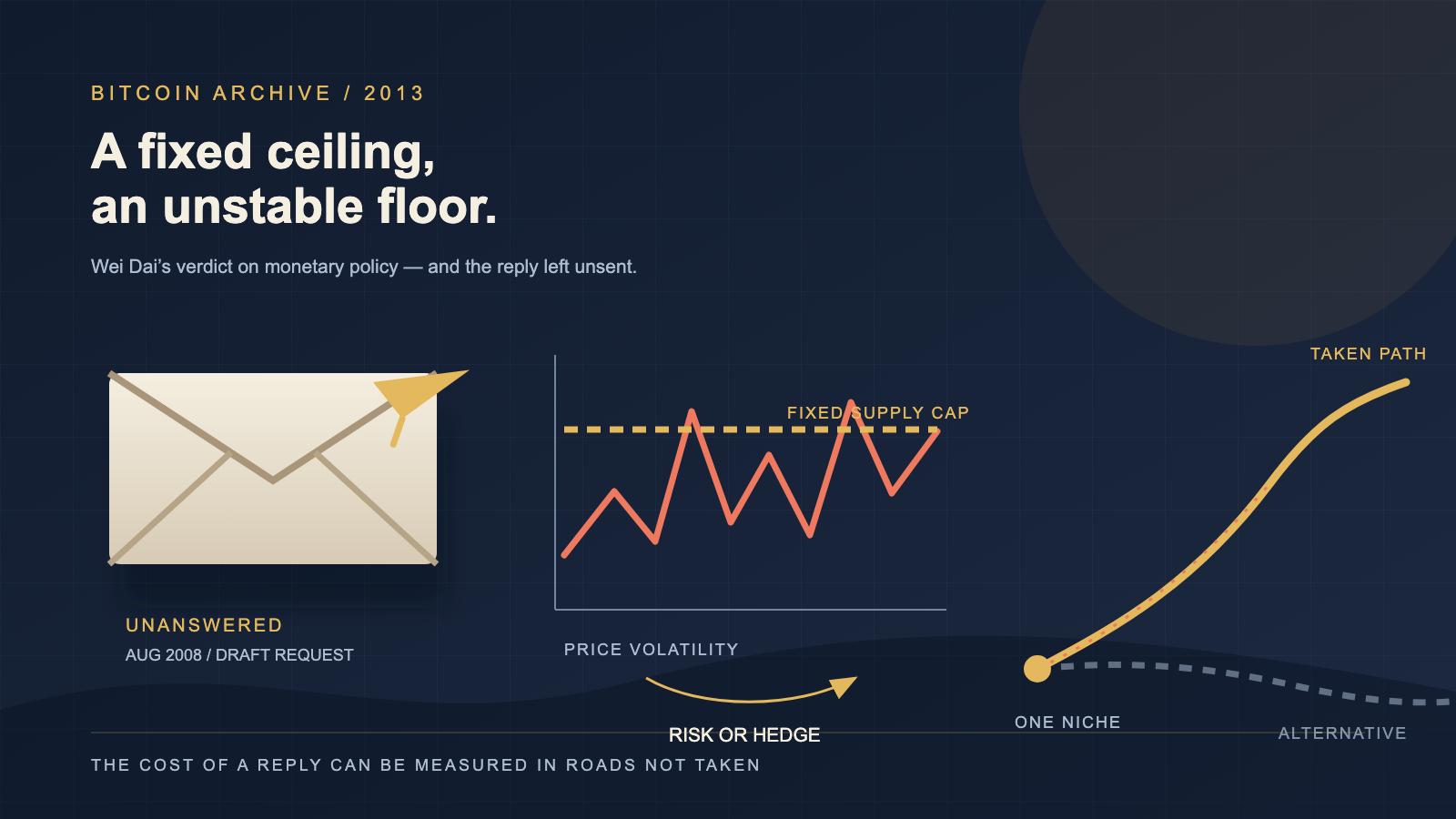
Dai’s own account of that exchange — that he never answered Satoshi’s August 2008 email asking for comments on the whitepaper draft, a lapse he later called partly his own fault — appears in a separate LessWrong comment from the previous year; see Wei Dai’s critique of Bitcoin’s monetary policy.
On Satoshi’s motivation, Dai read it as conviction over profit:
“I think he is not motivated mainly to personally make money, but to change the world and to solve an interesting technical problem.”
He noted that if Satoshi were primarily motivated by money, “he would have sold at least some of his mined Bitcoins in order to spend or to diversify.”
Wei Dai also expressed that Satoshi “might have been motivated more by a distrust of financial institutions and government monetary authorities and wanted to create a monetary system that didn’t have to depend on such trust.”
From the same AALWA thread, March 15, 2014:
In response to a question about why he never implemented b-money, Dai gave several reasons.
Part of it was that b-money was never a finished design:
“Part of it was because b-money wasn’t a complete practical design yet.”
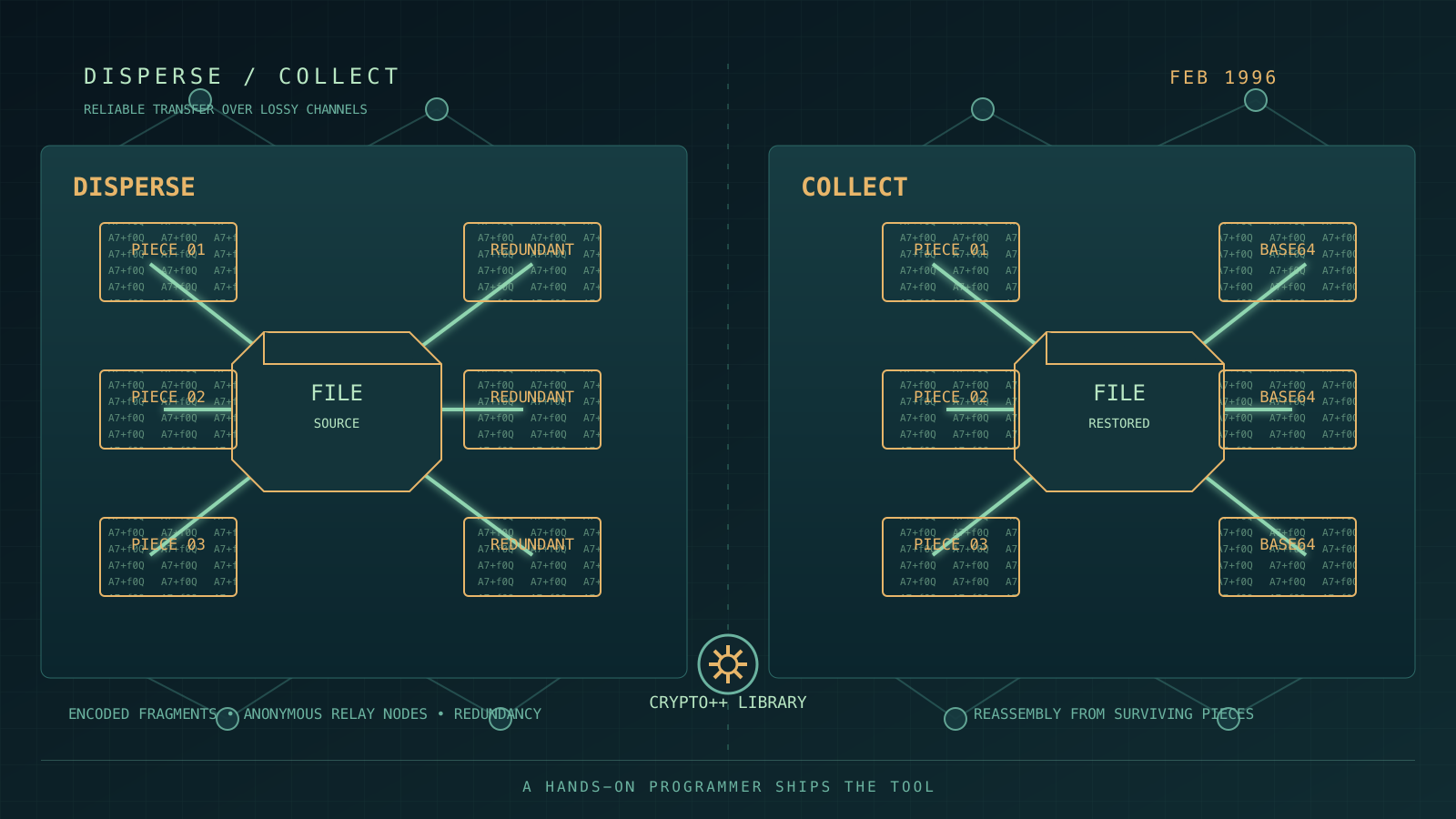
By the time he wrote it up, he had also soured on crypto-anarchy — not a lack of the coding ability he had already demonstrated by releasing Disperse/Collect from his own Crypto++ library in 1996:
“I didn’t continue to work on the design because I had actually grown somewhat disillusioned with cryptoanarchy by the time I finished writing up b-money.”
And he had not foreseen the demand such a system could attract:
“I didn’t foresee that a system like it, once implemented, could attract so much attention and use beyond a small group of hardcore cypherpunks.”
From the same thread, March 16, 2014:
On Satoshi’s likely background, Dai offered a guess:
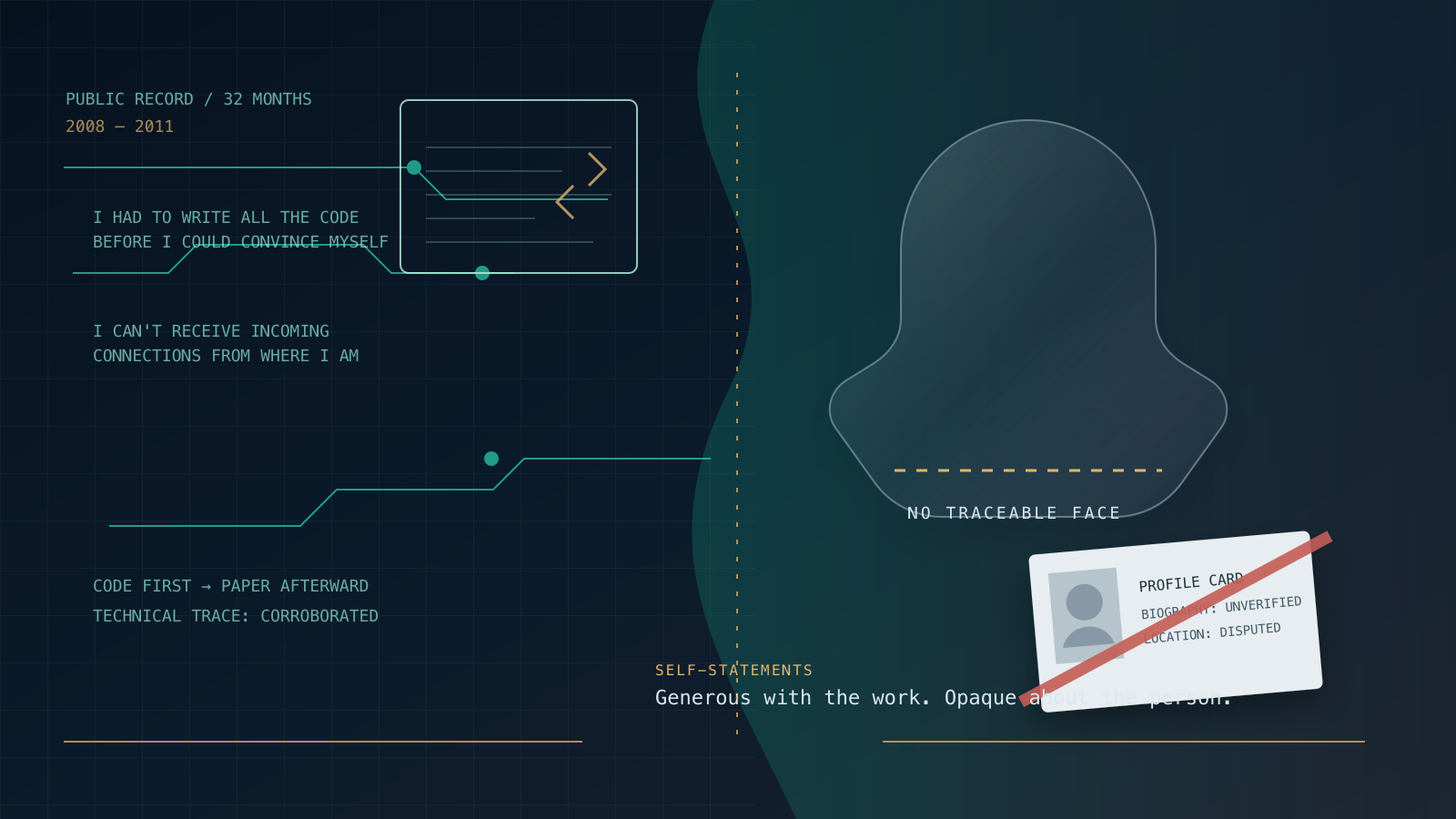
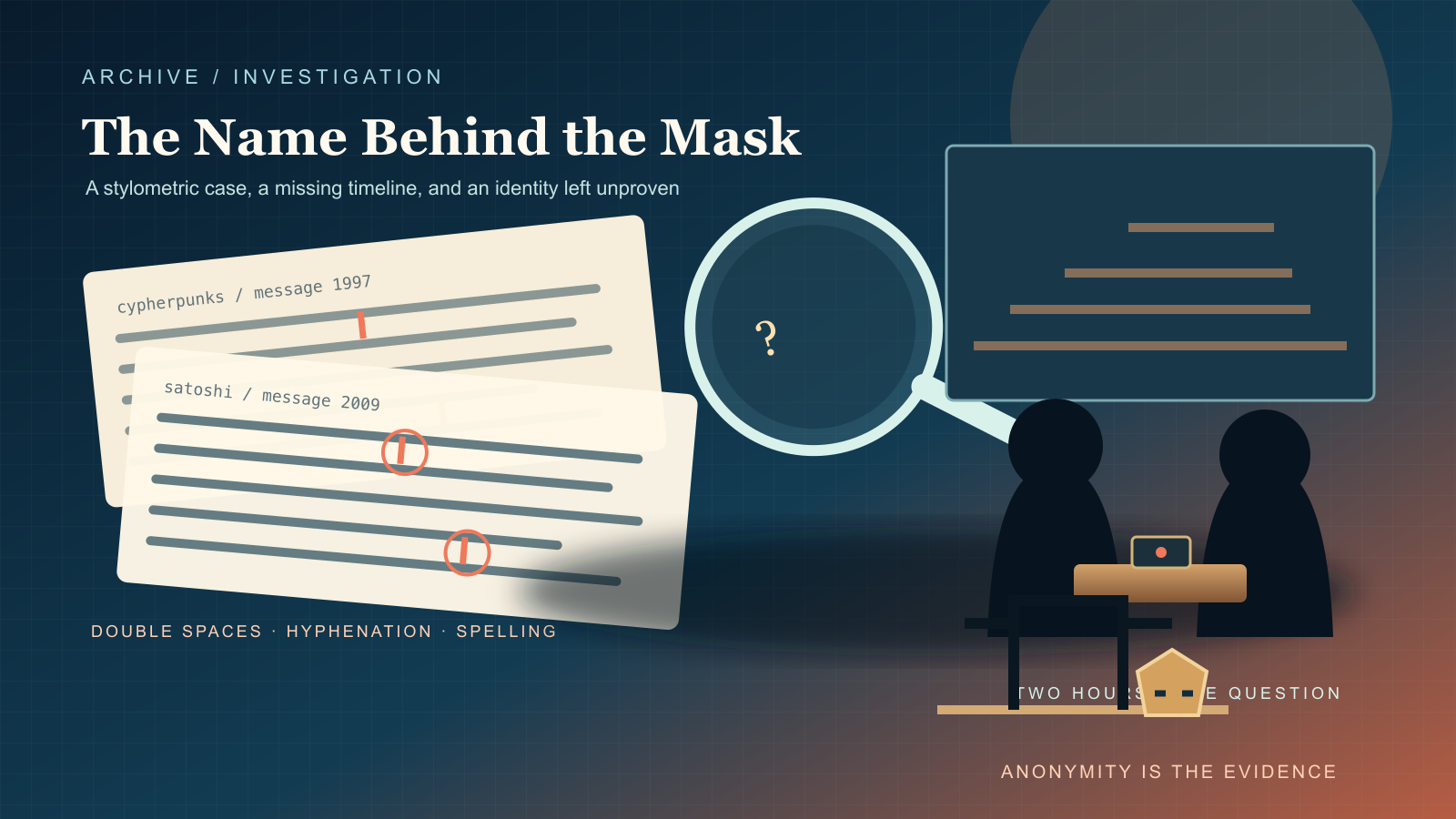
“My guess is that he’s not anyone who was previously active in the academic cryptography or cypherpunks communities, because otherwise he probably would have been identified by now based on his writing and coding styles.”
From the same thread, March 17, 2014:
On Bitcoin’s unexpected success, Dai admitted he was still at a loss:
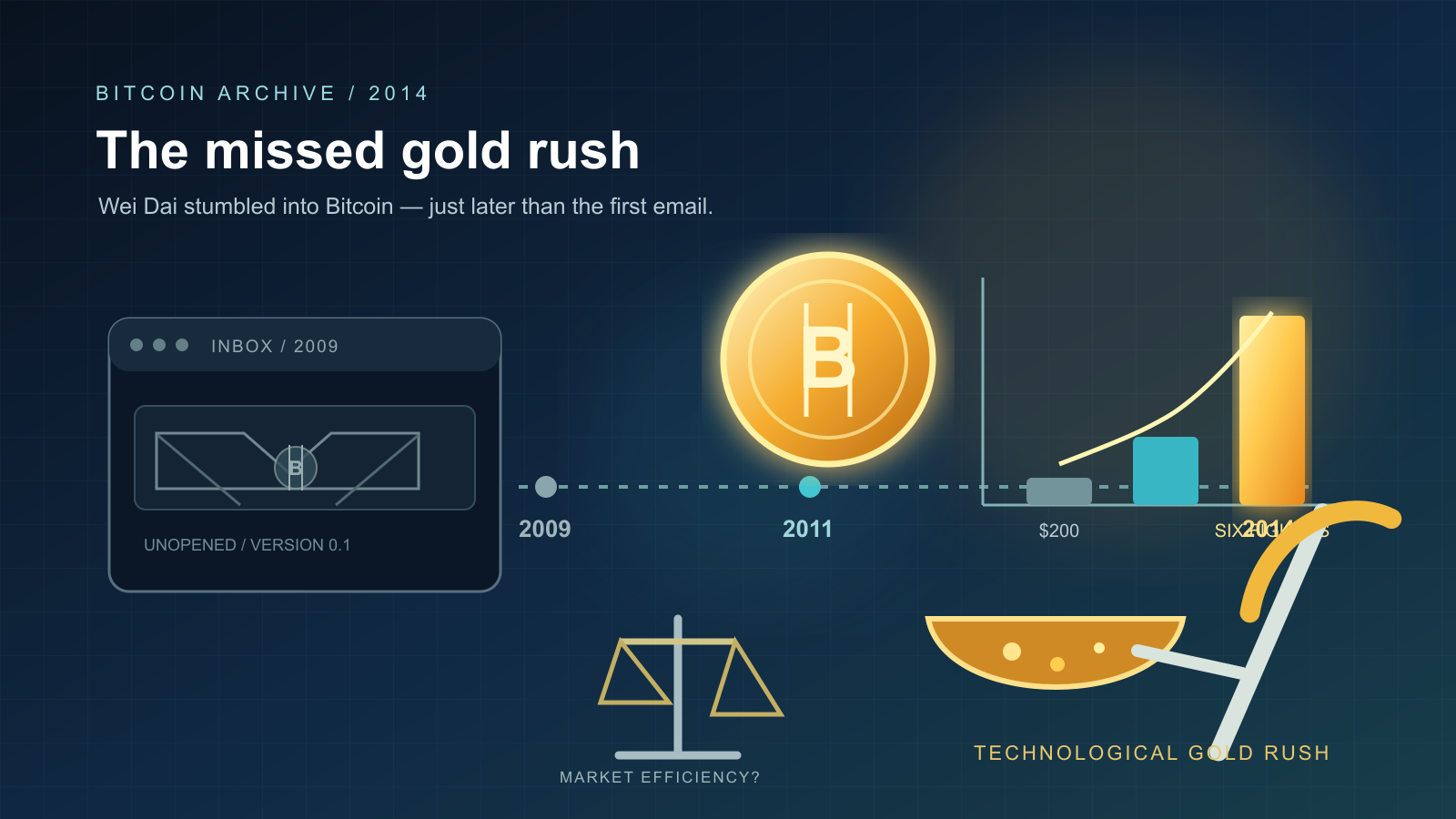
“To be honest I didn’t initially expect Bitcoin to make as much impact as it has, and I’m still at a bit of a loss to explain why it has succeeded to the extent that it has.”
On what Bitcoin changed in his own views, Dai found little had shifted:
“My views haven’t changed very much, since the main surprise of Bitcoin to me is that people find such a system useful for reasons other than crypto-anarchy.”
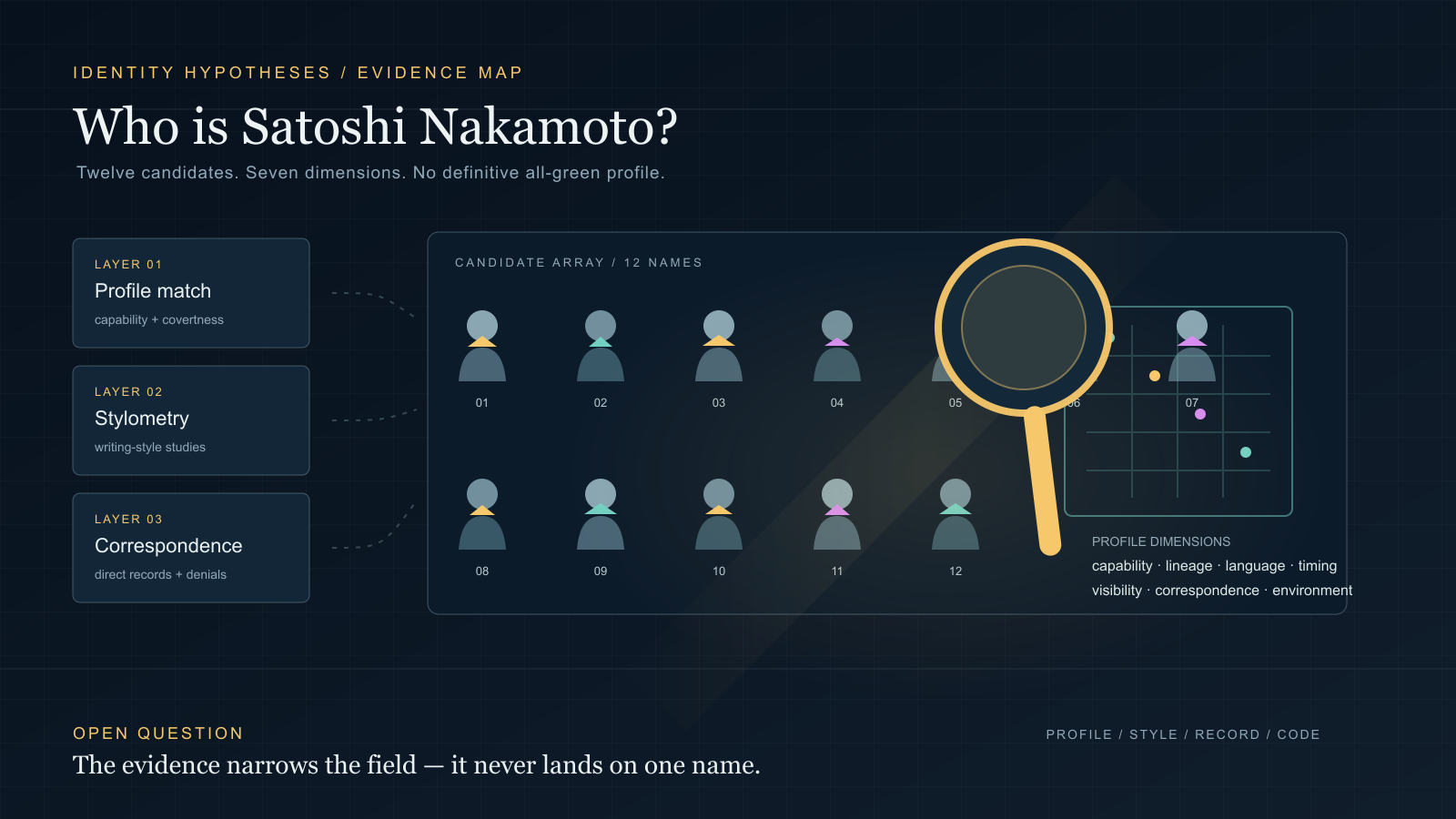
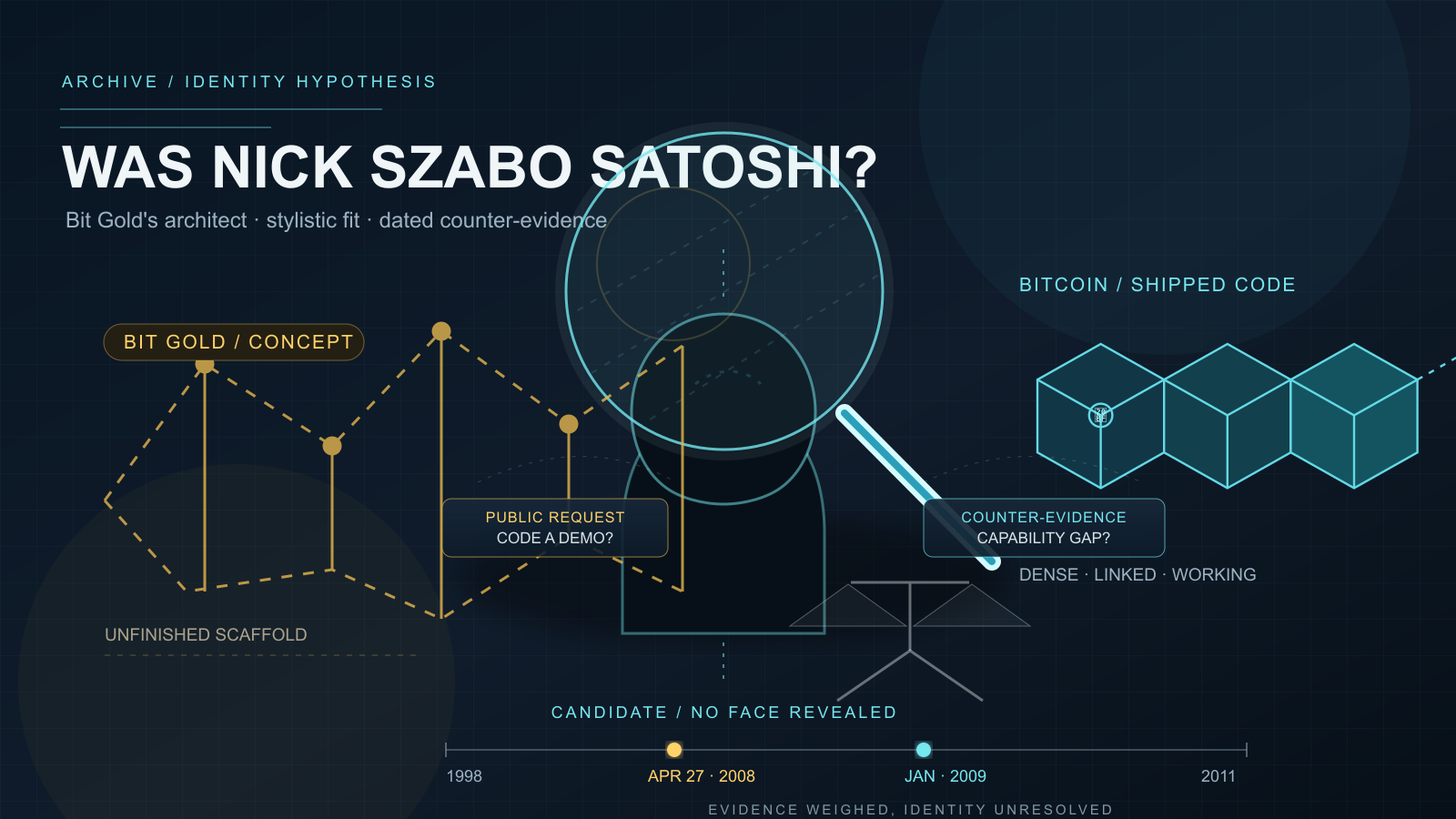
This 2014 retrospective is treated as principal counter-evidence in the Wei Dai identity hypothesis. The hypothesis returns to Wei Dai’s “my guess is that he’s not anyone who was previously active” answer across multiple sections — the §1 framing, the §2 counter-evidence table, a dedicated §2.3 subsection quoting the LessWrong reply in full, §2.6 weighing the denial pattern, and §4 limits — using the retrospective as the documented public statement the hypothesis must explain away.
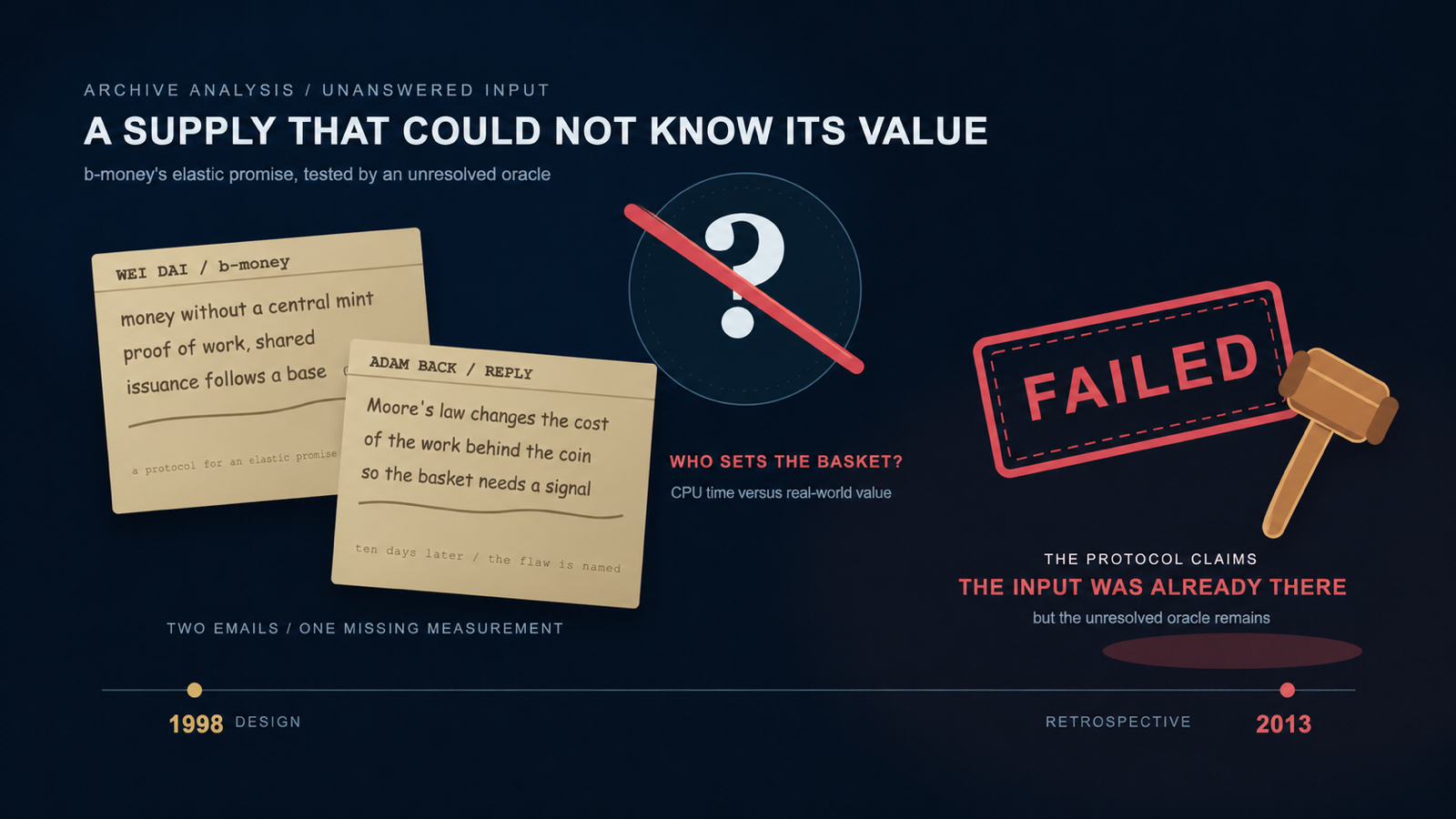
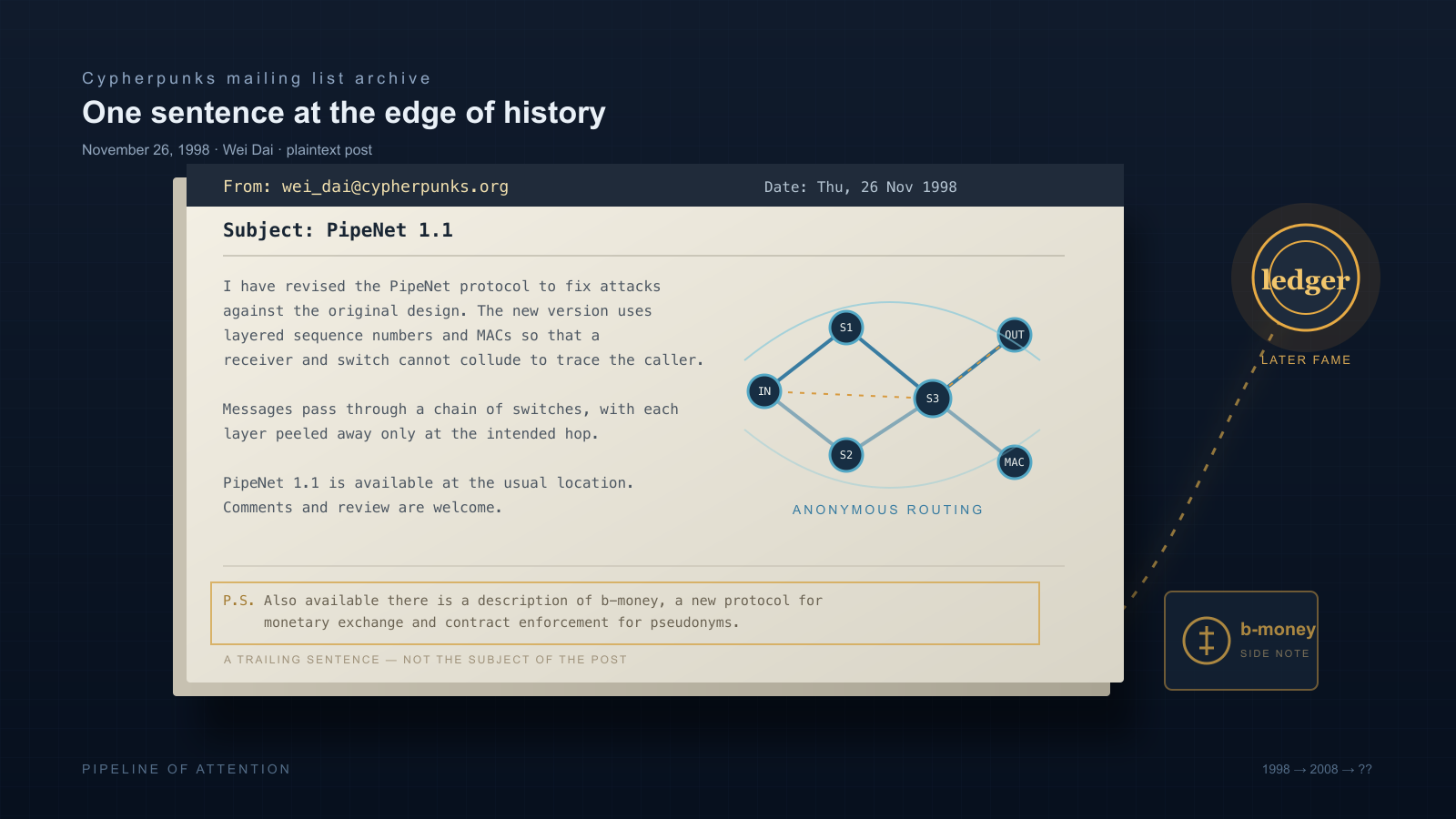
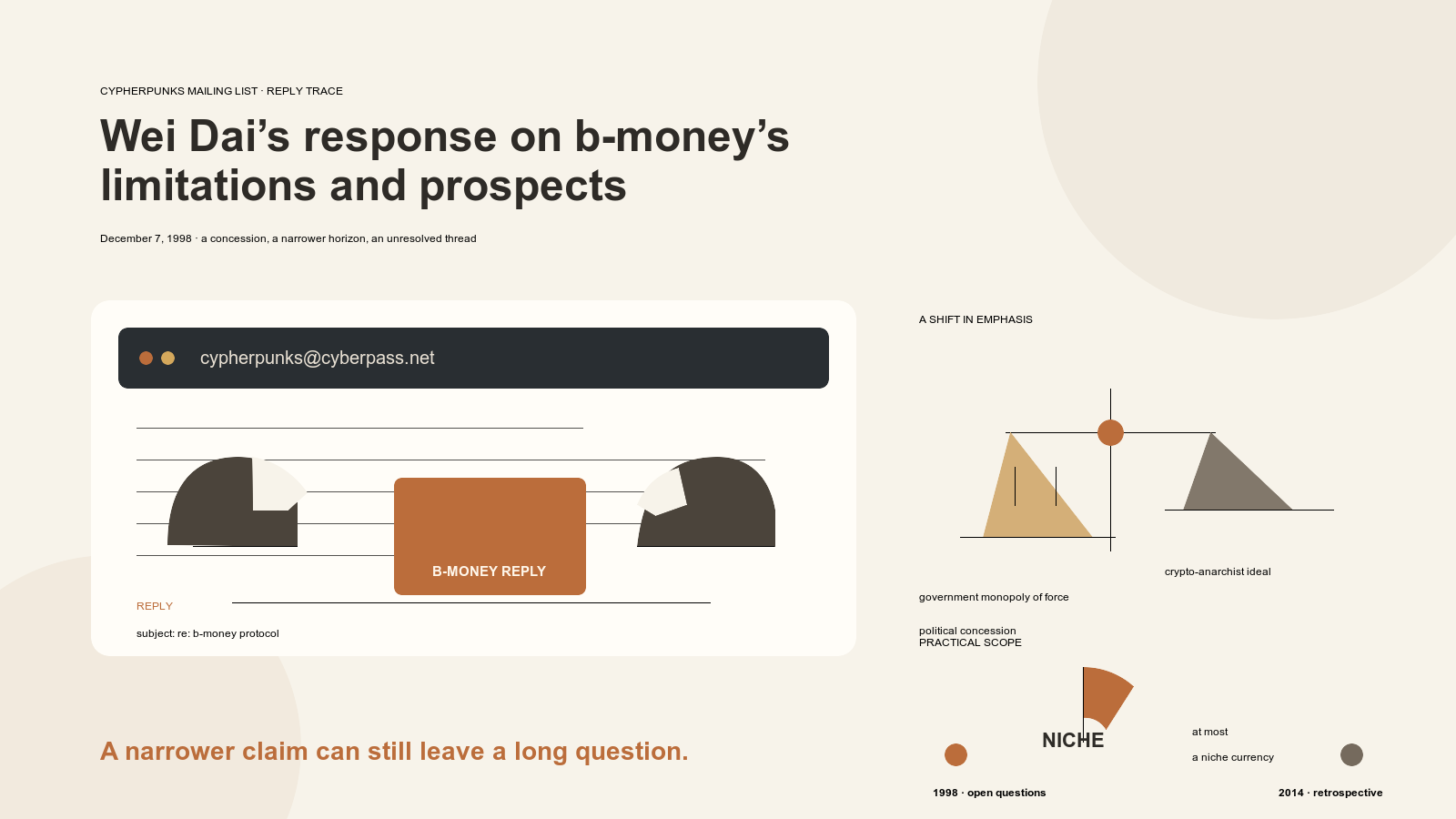
The disillusionment Dai describes here was not new in 2014: he had already signalled it in his December 7, 1998 reply on b-money’s limits, judging the proposal a niche mechanism and leaning toward seeing the state monopoly on force as a net benefit.
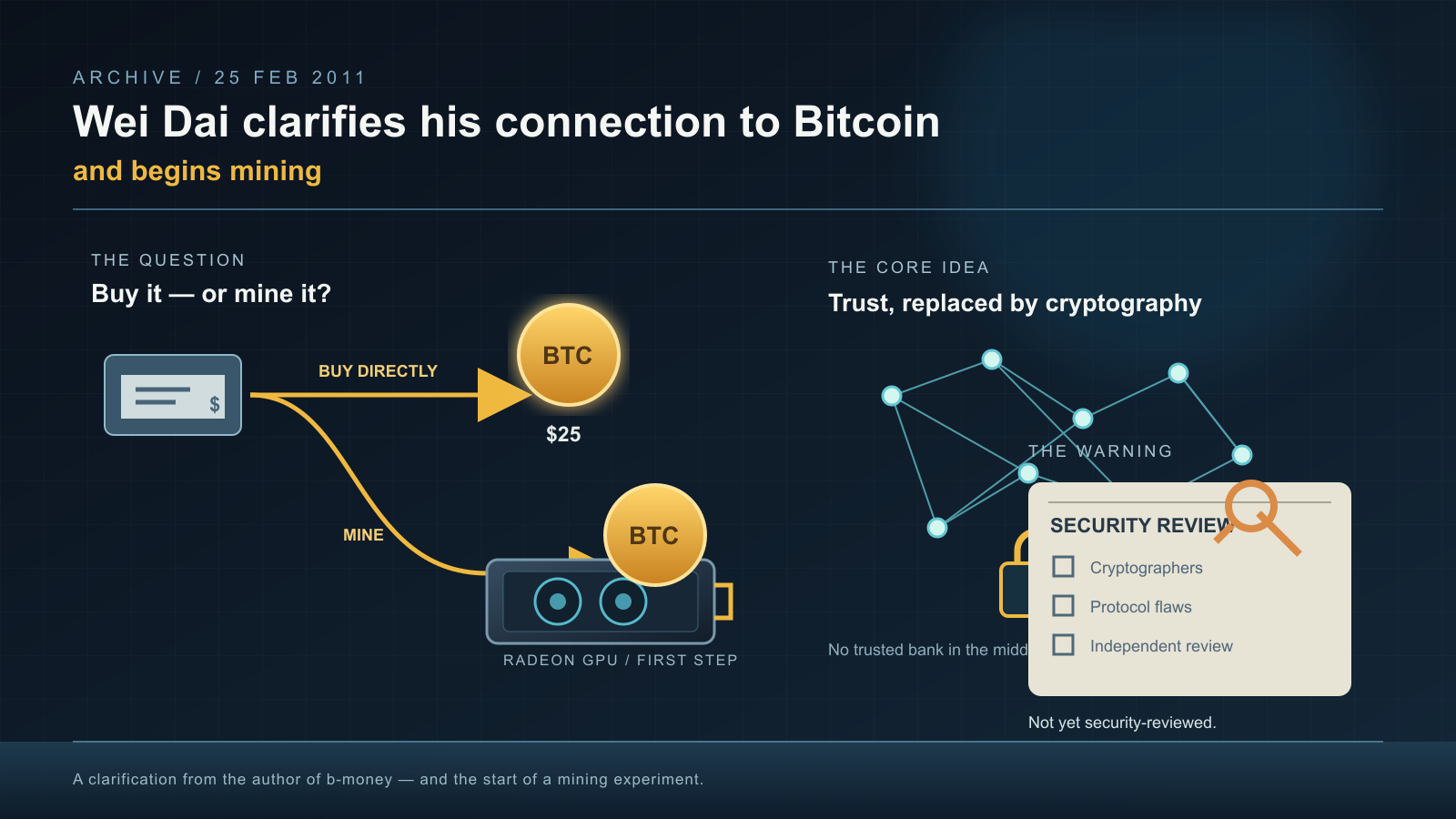
Dai’s public account of his own Bitcoin involvement unfolded across a handful of these scattered posts. Three years before this retrospective, he had already surfaced briefly on LessWrong to clarify that he had not created Bitcoin and disclose that he had begun mining it, while cautioning that the protocol’s security had not yet been reviewed by other cryptographers. Six months after this AALWA thread, he went further, revealing in a July 2014 post that Satoshi had personally emailed him about Bitcoin’s release in early 2009 — contact he had let pass unanswered.
His full background — b-money, the Crypto++ dependency, and Satoshi’s pre-launch outreach — is compiled in the Wei Dai biography. Satoshi’s own biography collects this retrospective alongside Gavin Andresen’s and Jeff Garzik’s as three collaborator vantage points on the same subject.
The Peter Todd identity hypothesis draws on this same identifiability argument from a different angle, weighing whether Todd’s own lack of documented cypherpunk-mailing-list presence pre-2012 is consistent with the “not visibly active” reading Dai’s reply here supports.