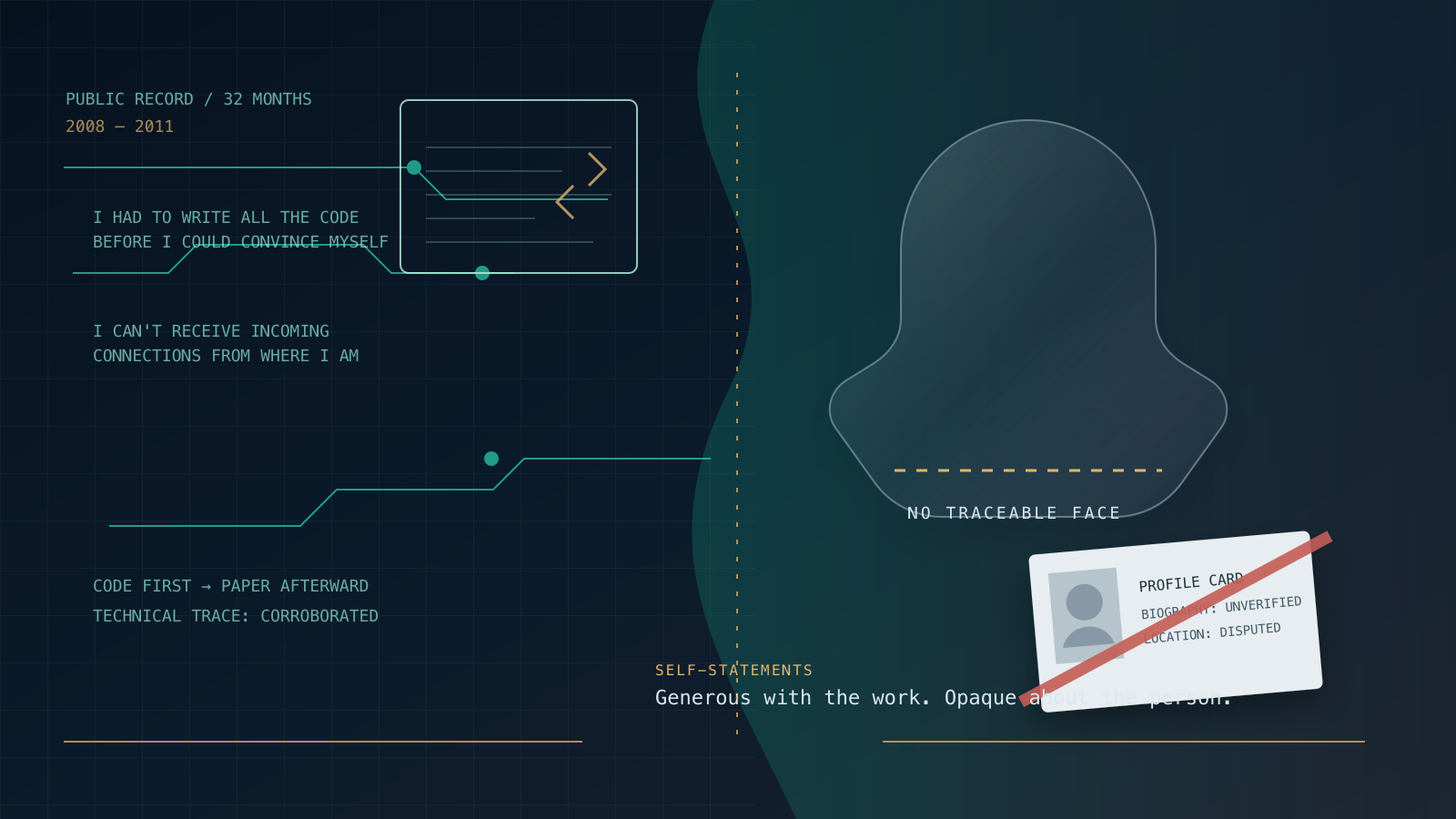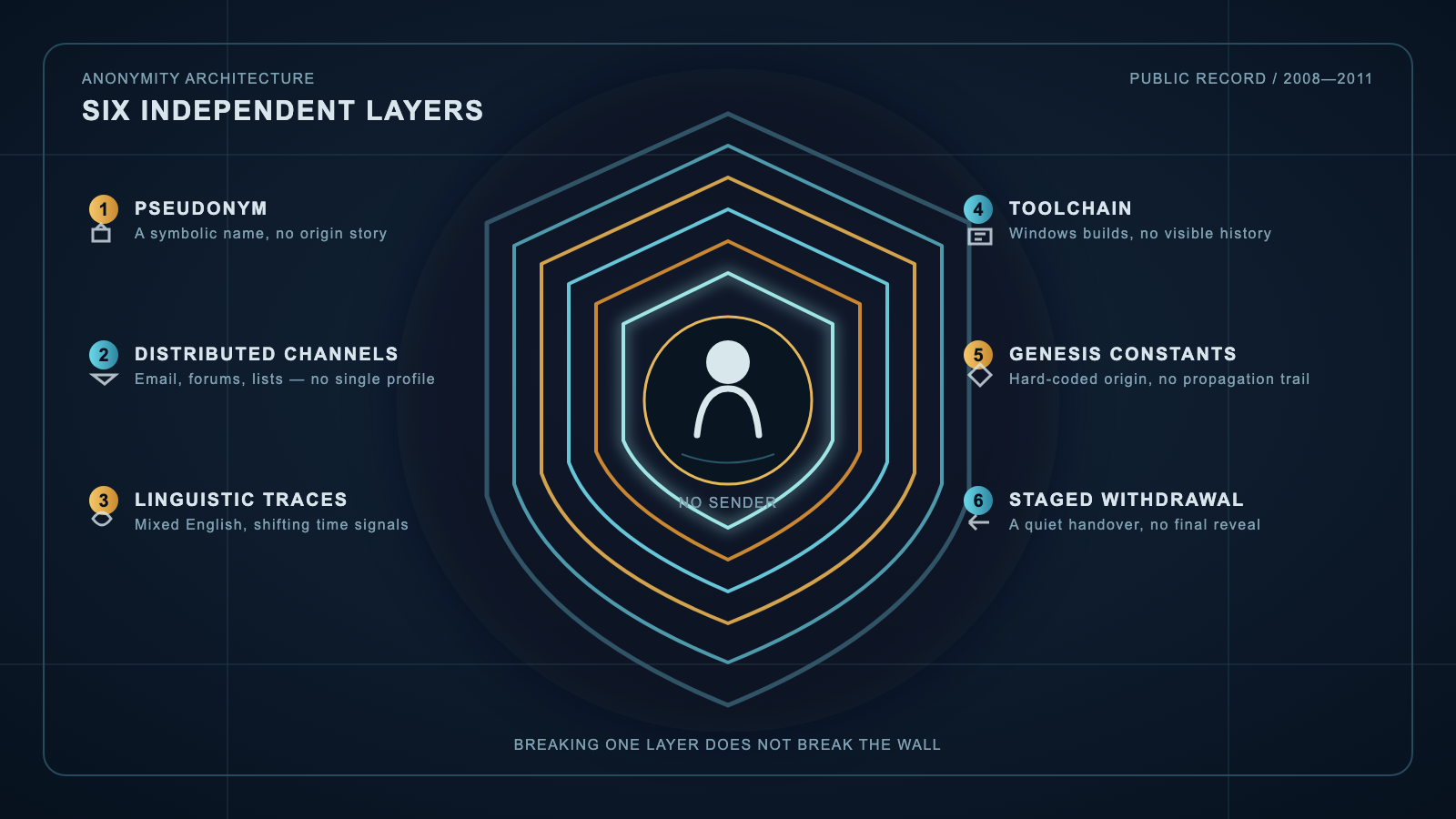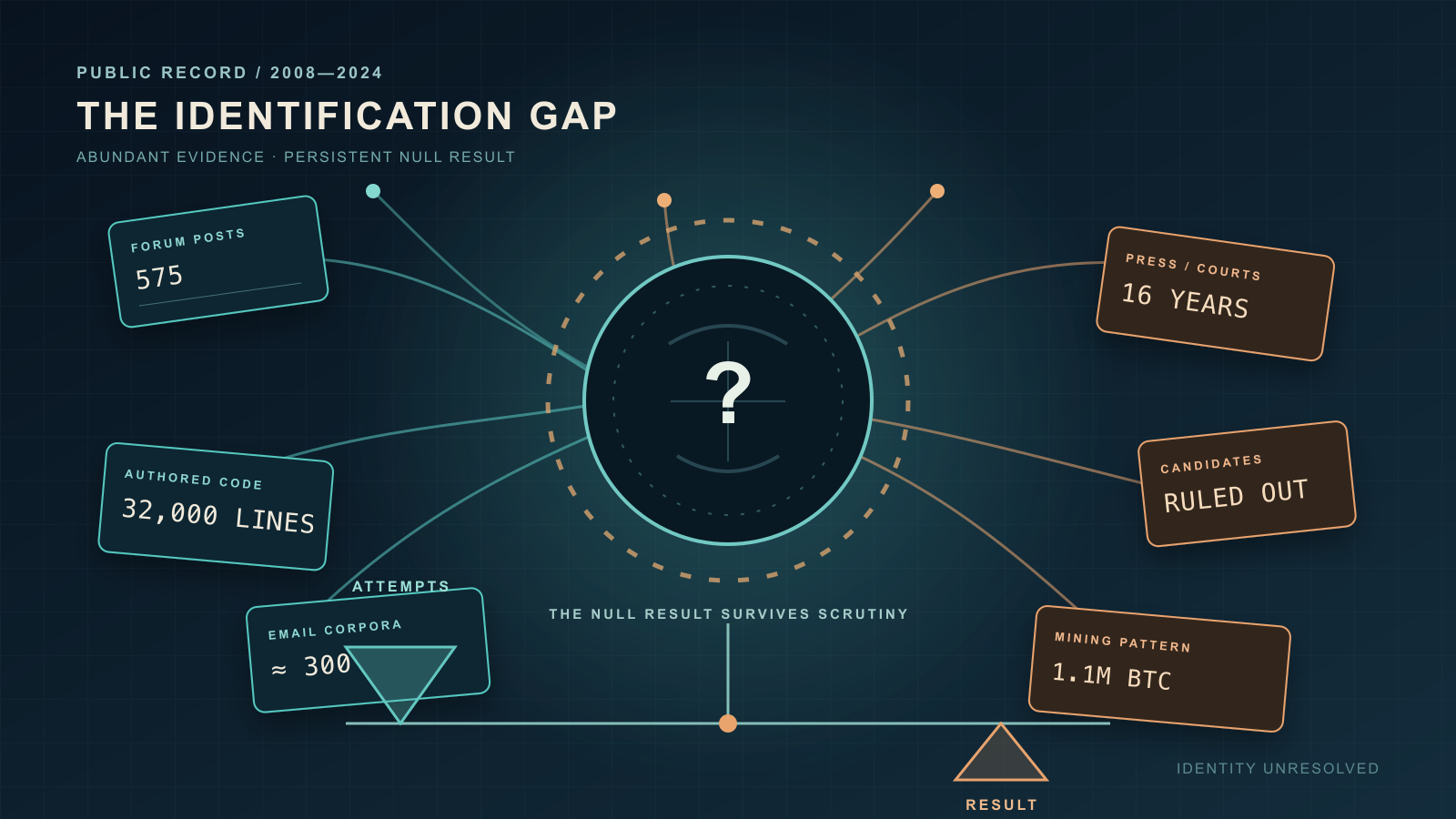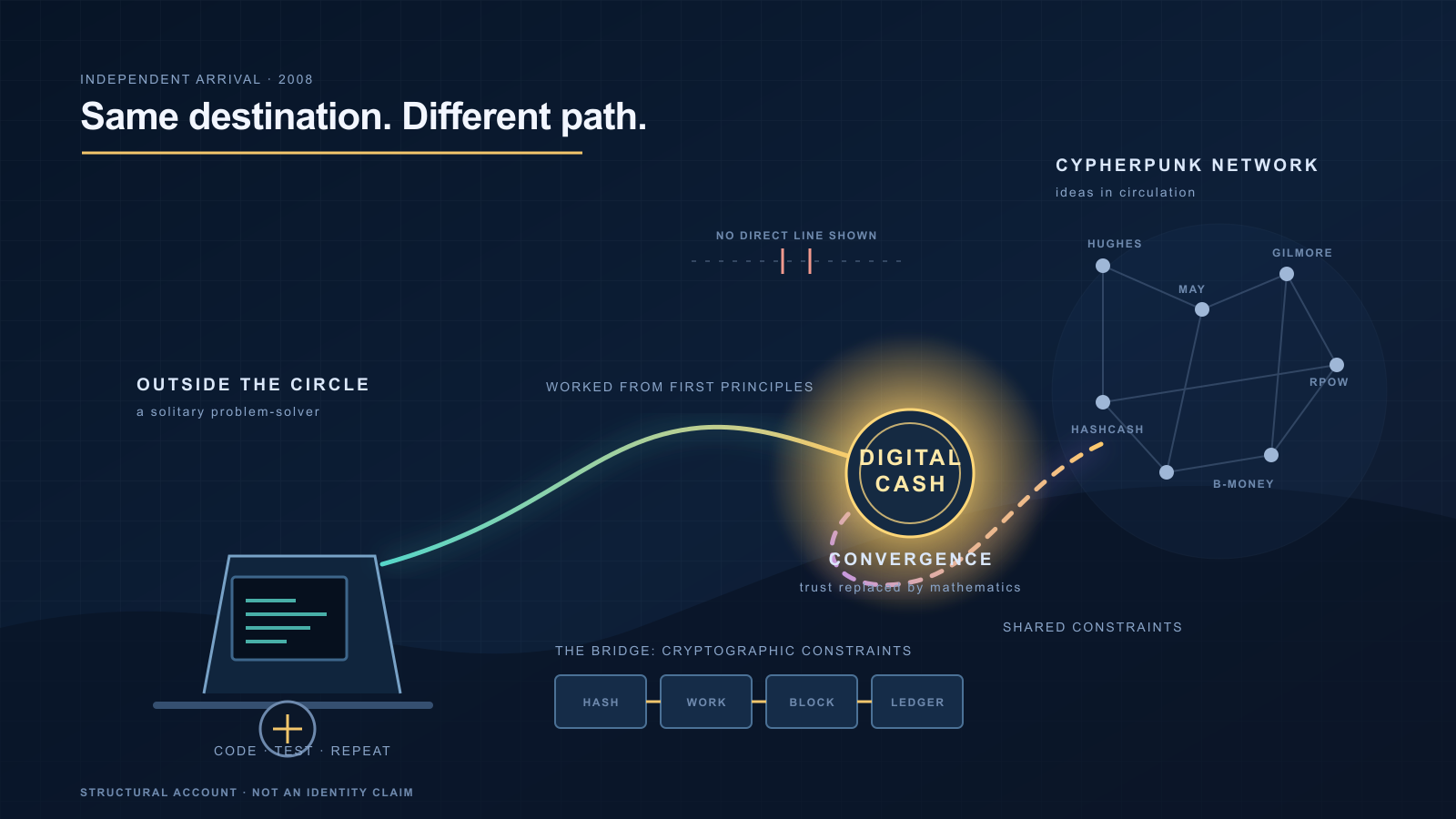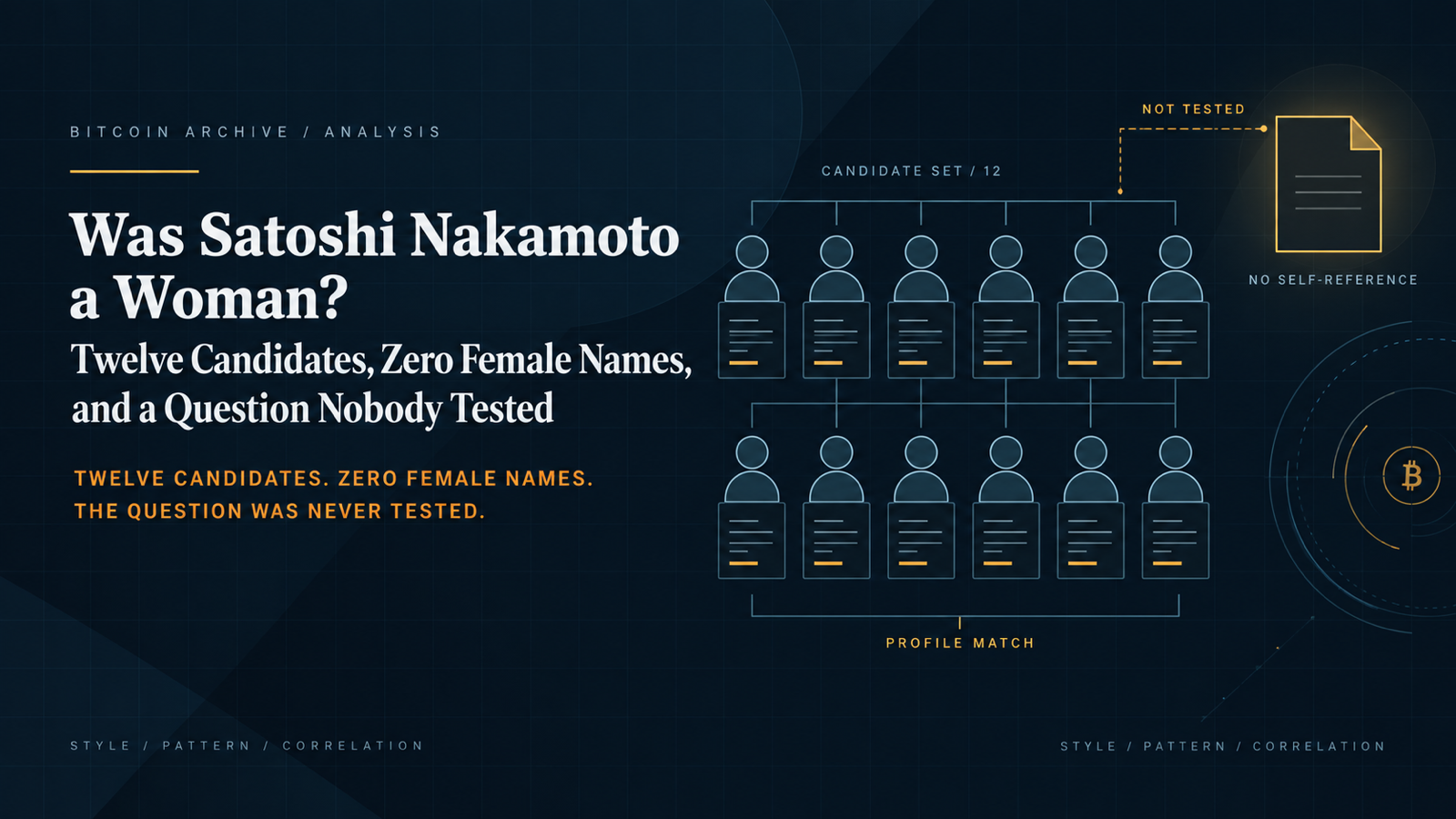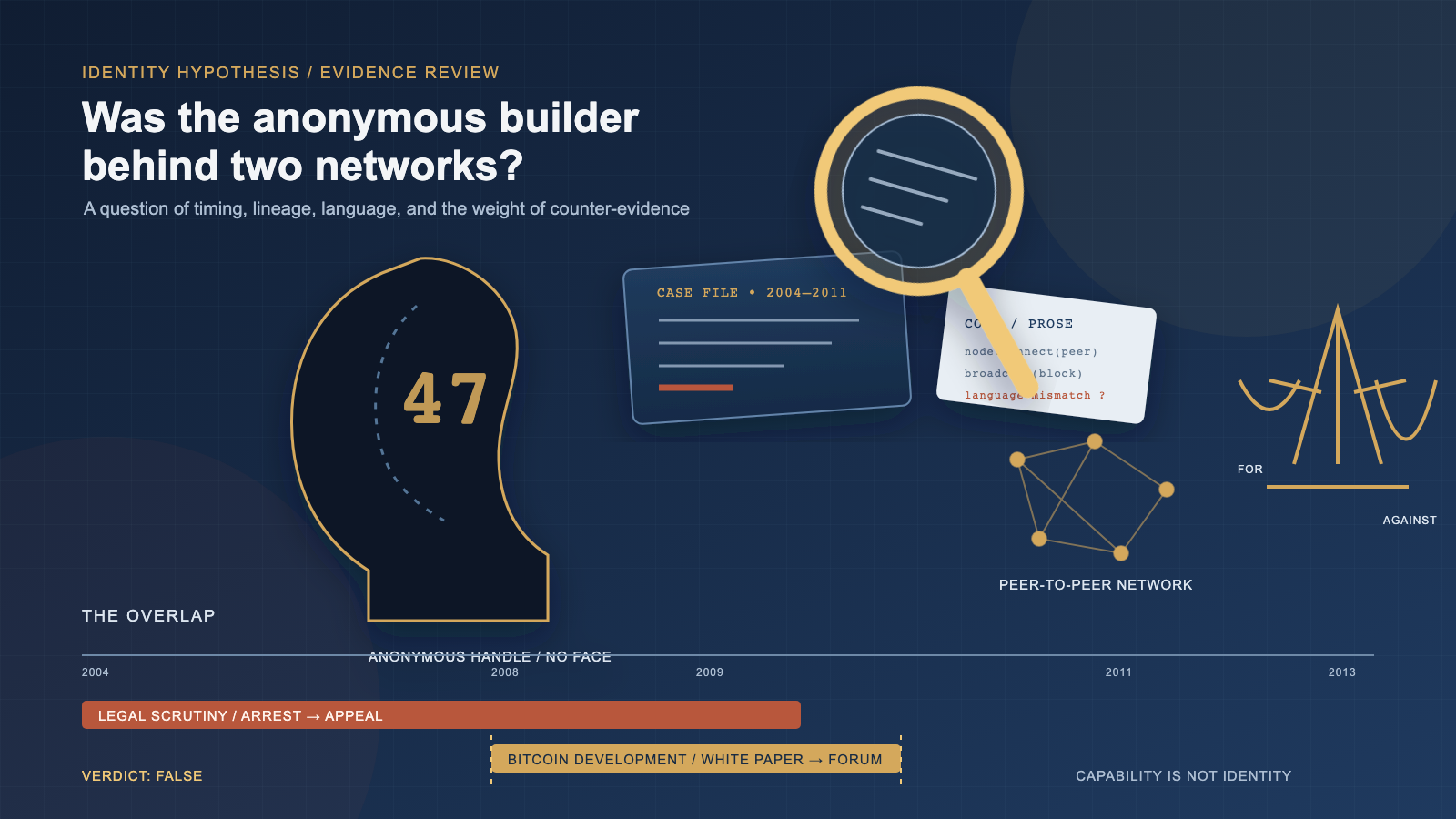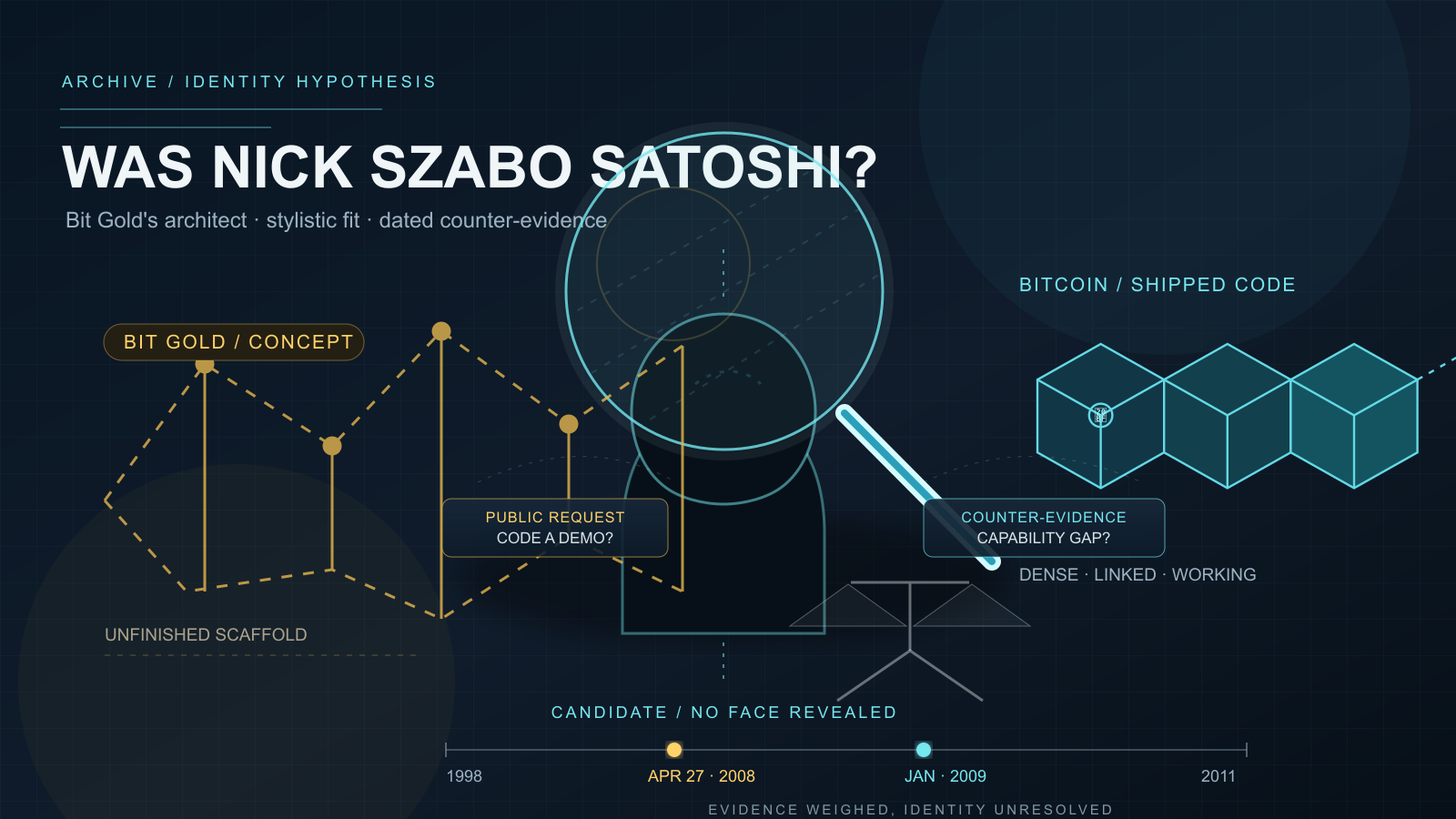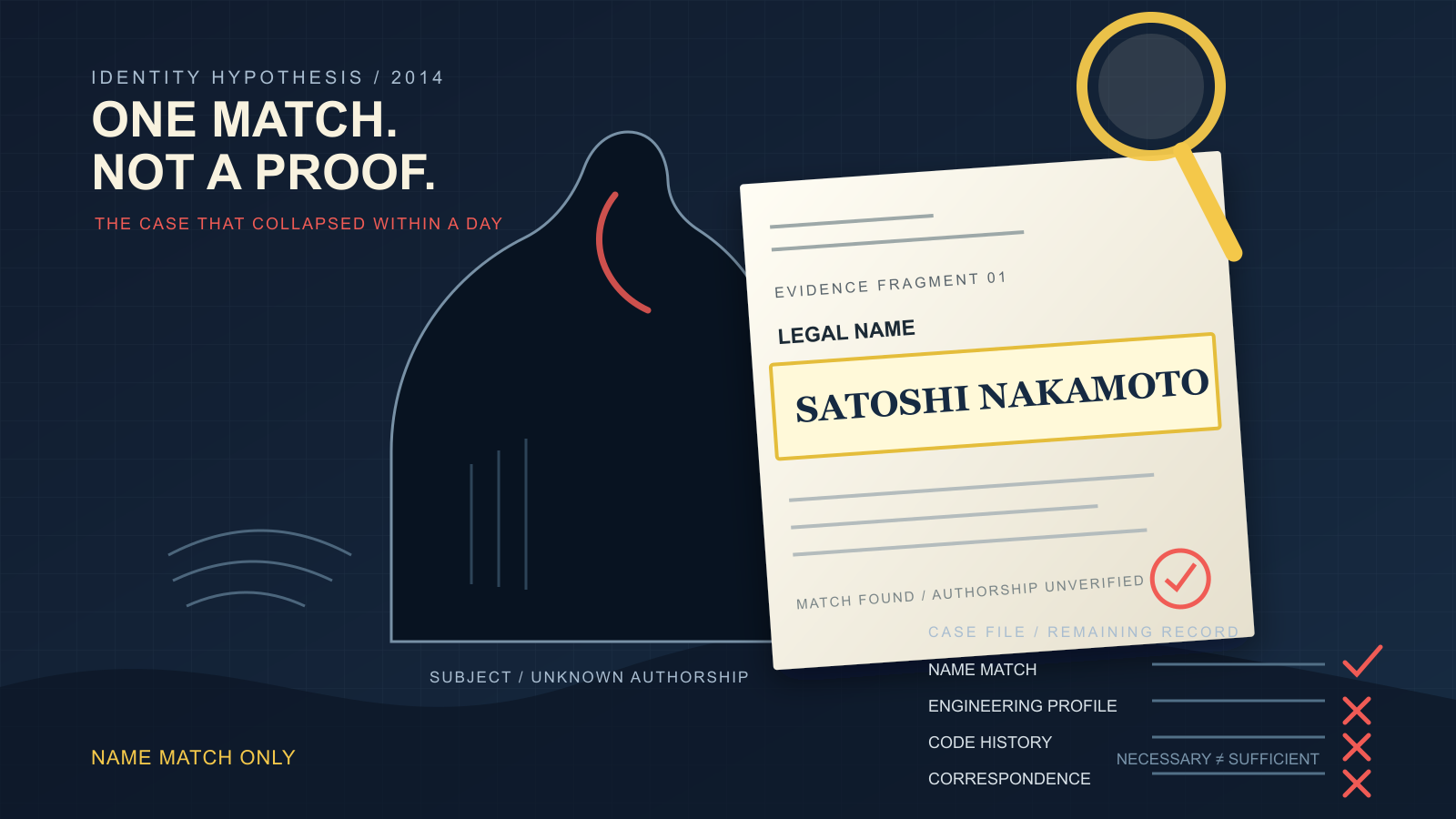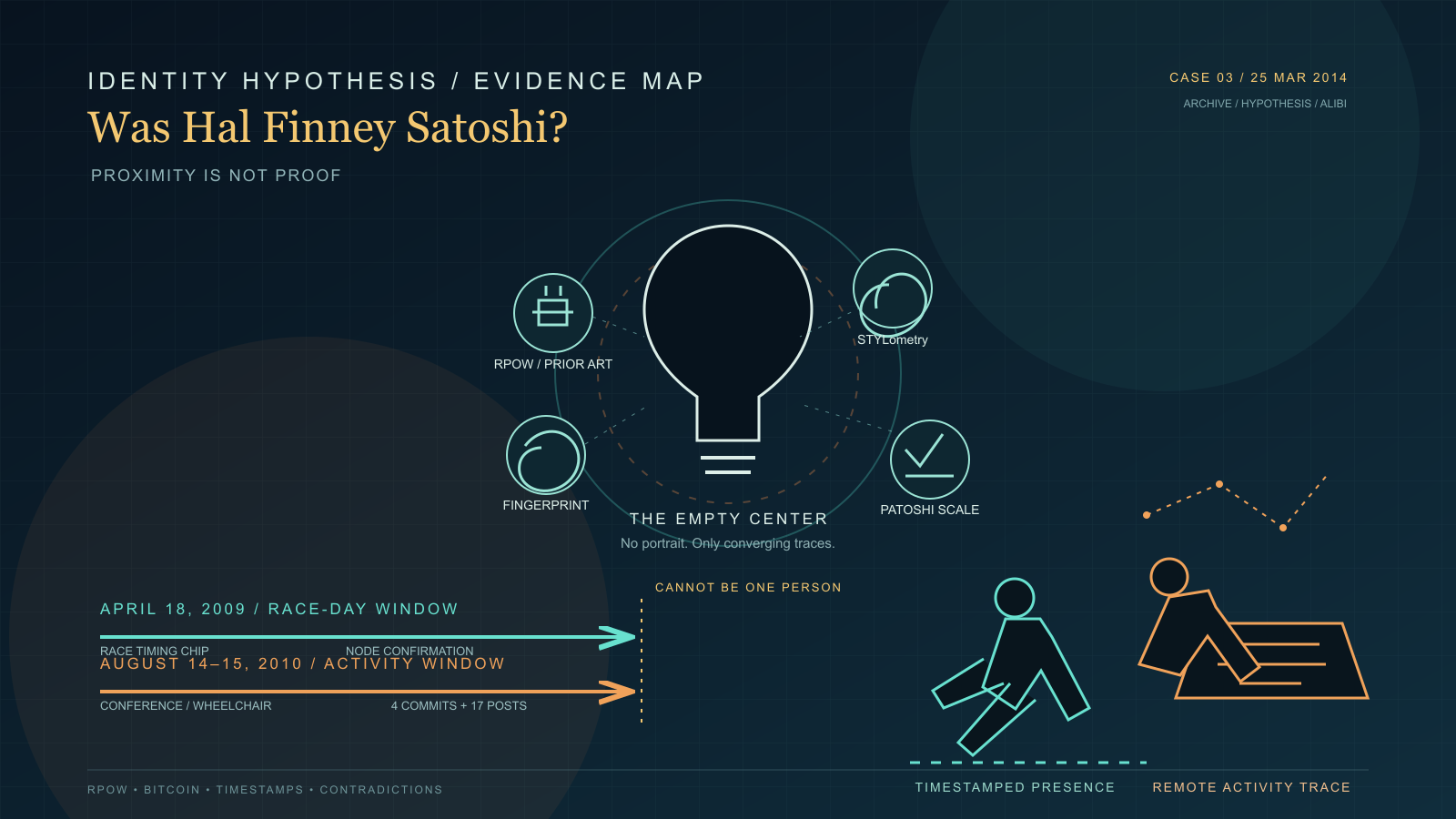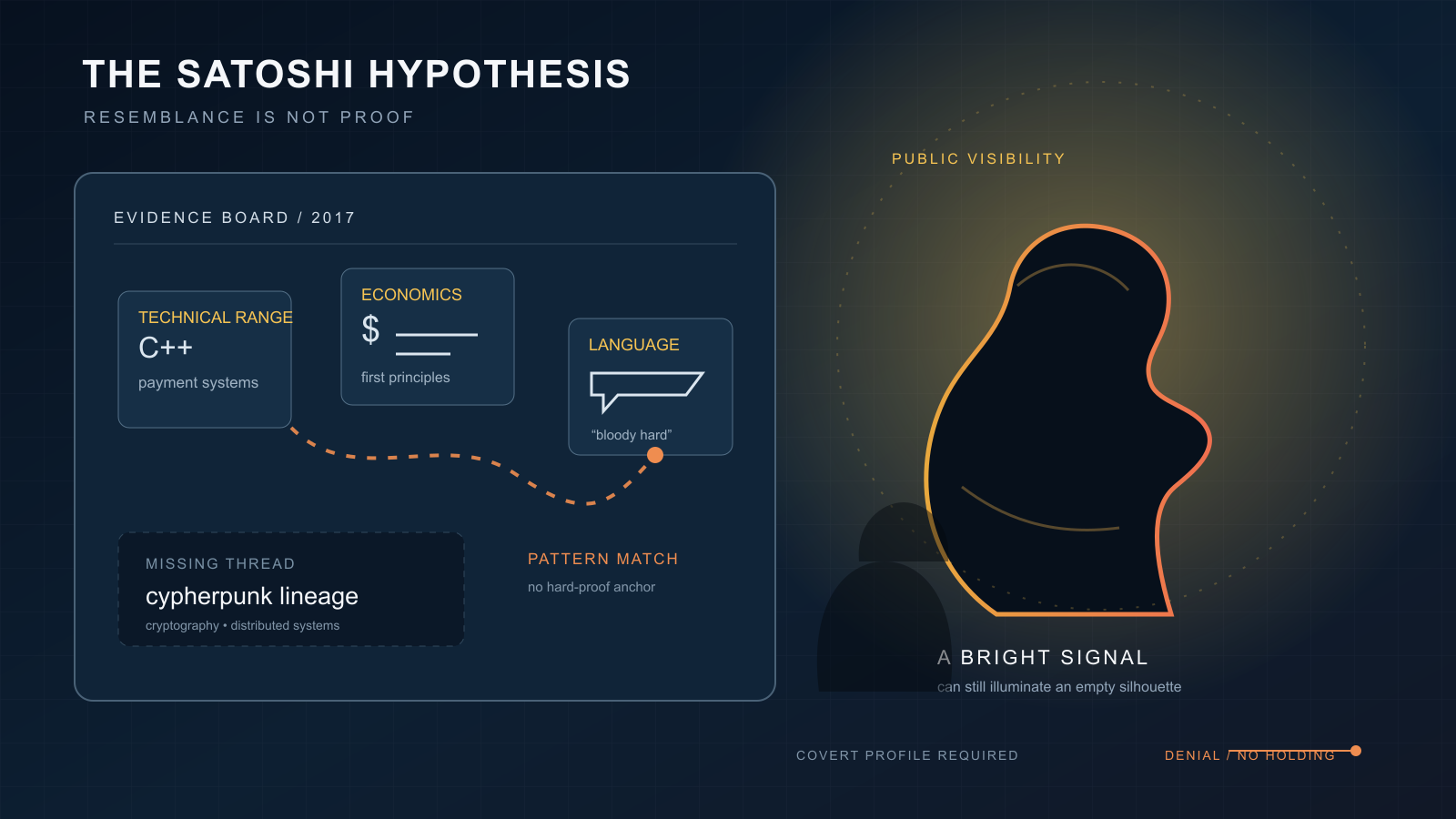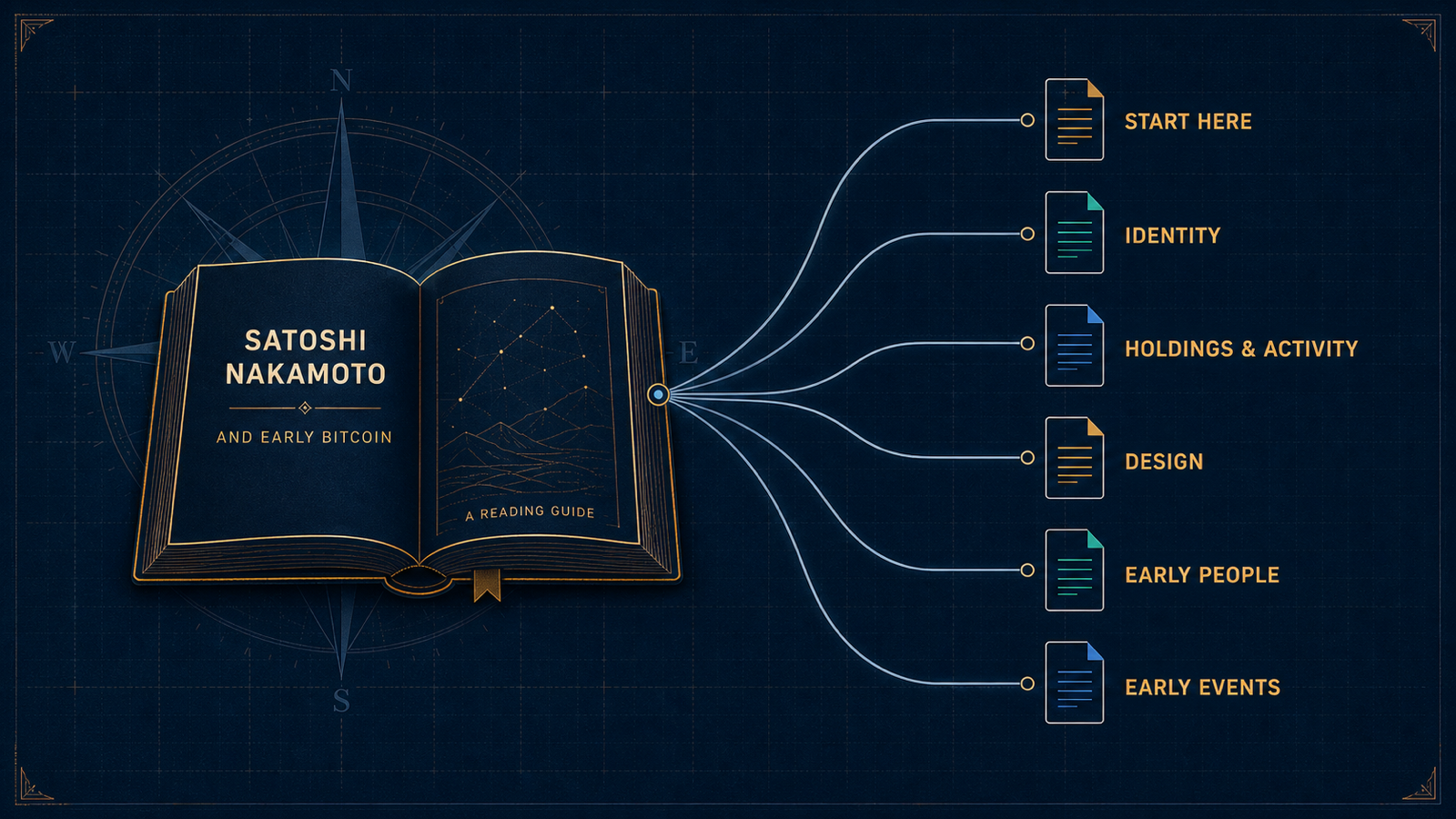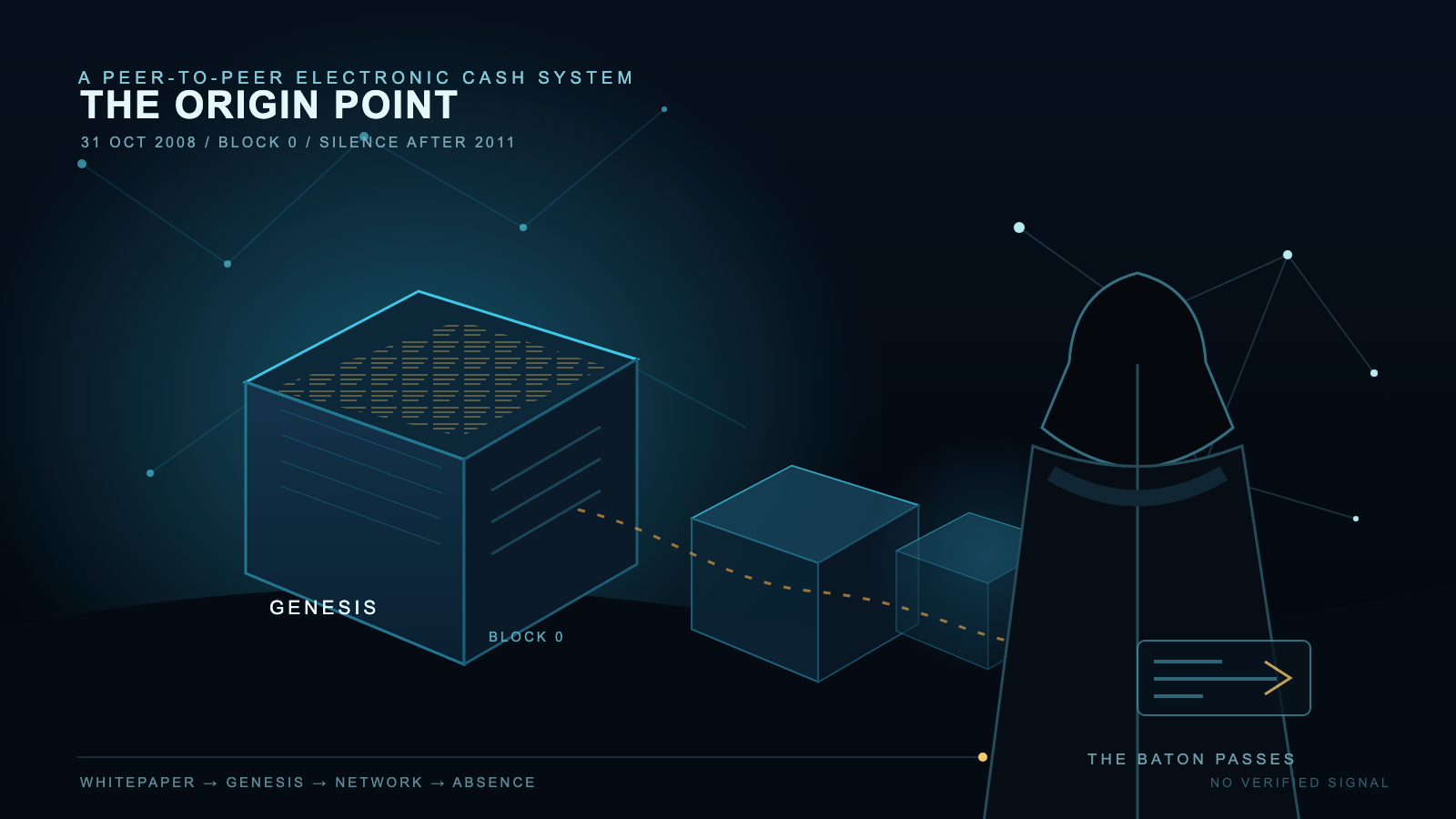
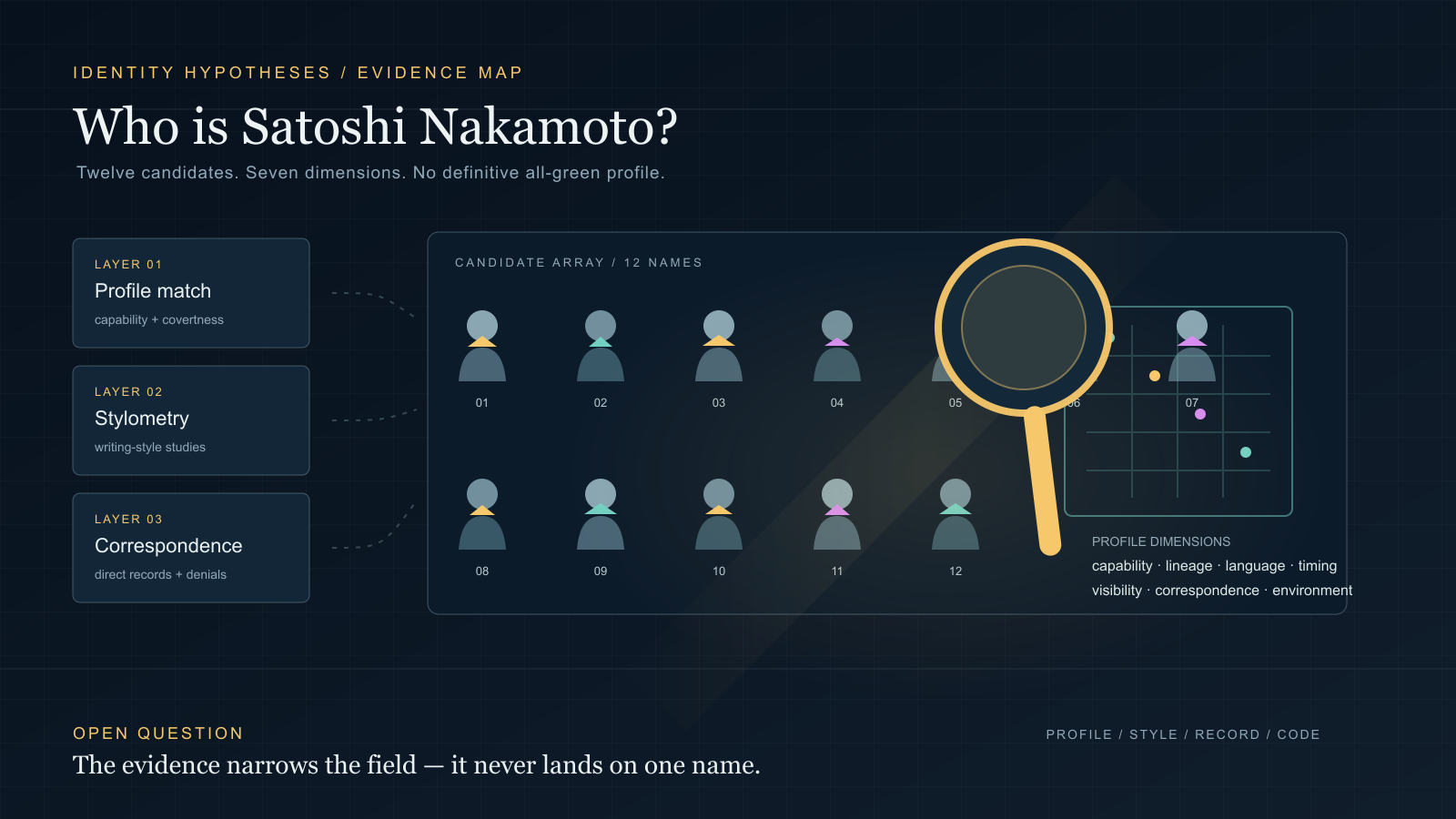
Who was Satoshi Nakamoto? Where did he come from, and where did the person behind that name go after bringing Bitcoin into the world? On Halloween night, the record began with a nine-page whitepaper and an unknown name; it left behind code, a chain of conversations, and then silence. Around that absence, twelve names have been proposed. A name can suggest a story; only the record can test it. Four traces matter here: intellectual lineage, language, direct contact, and the system that was built.
The comparison starts from the documented public-record outline of Satoshi:
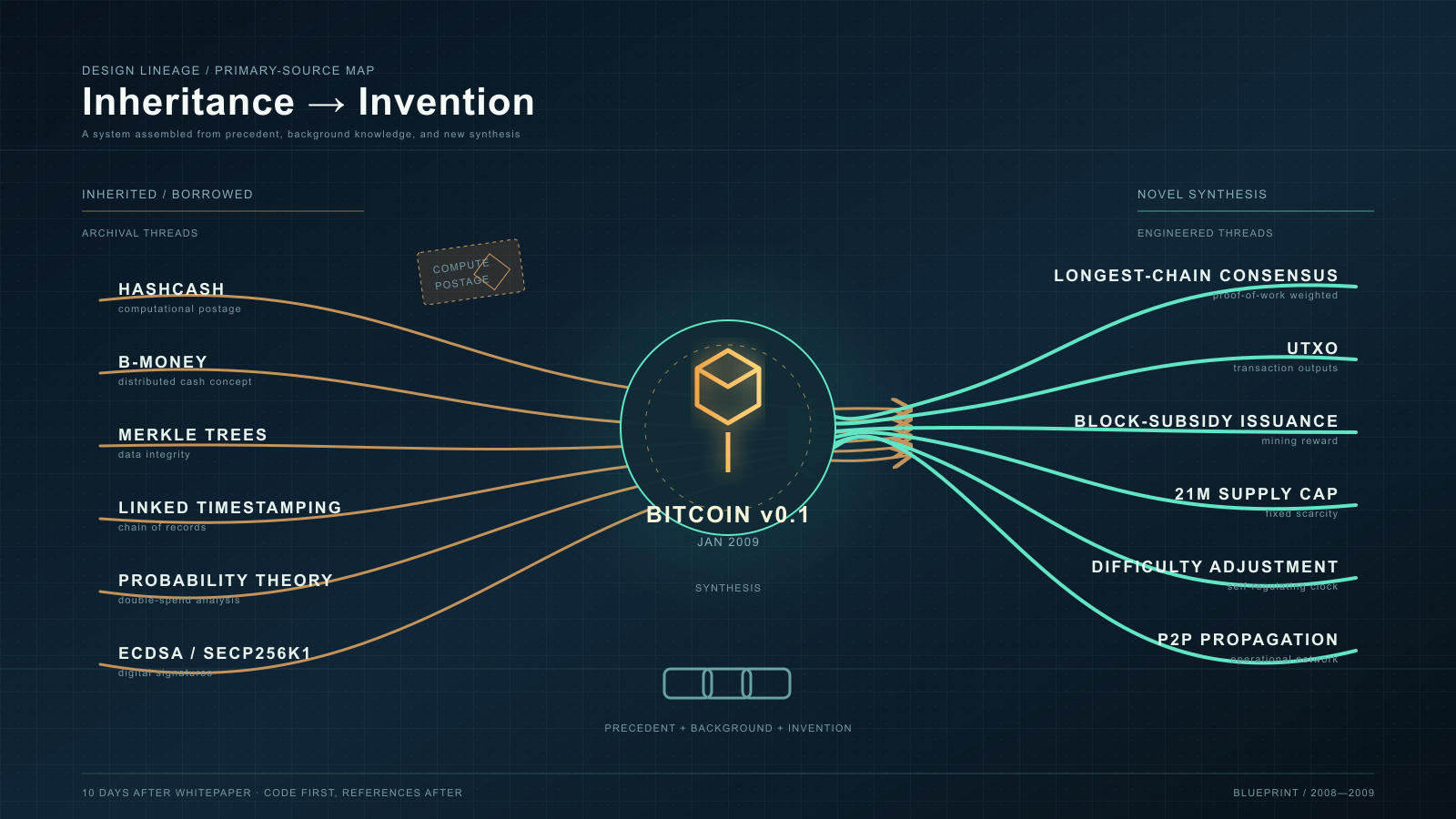
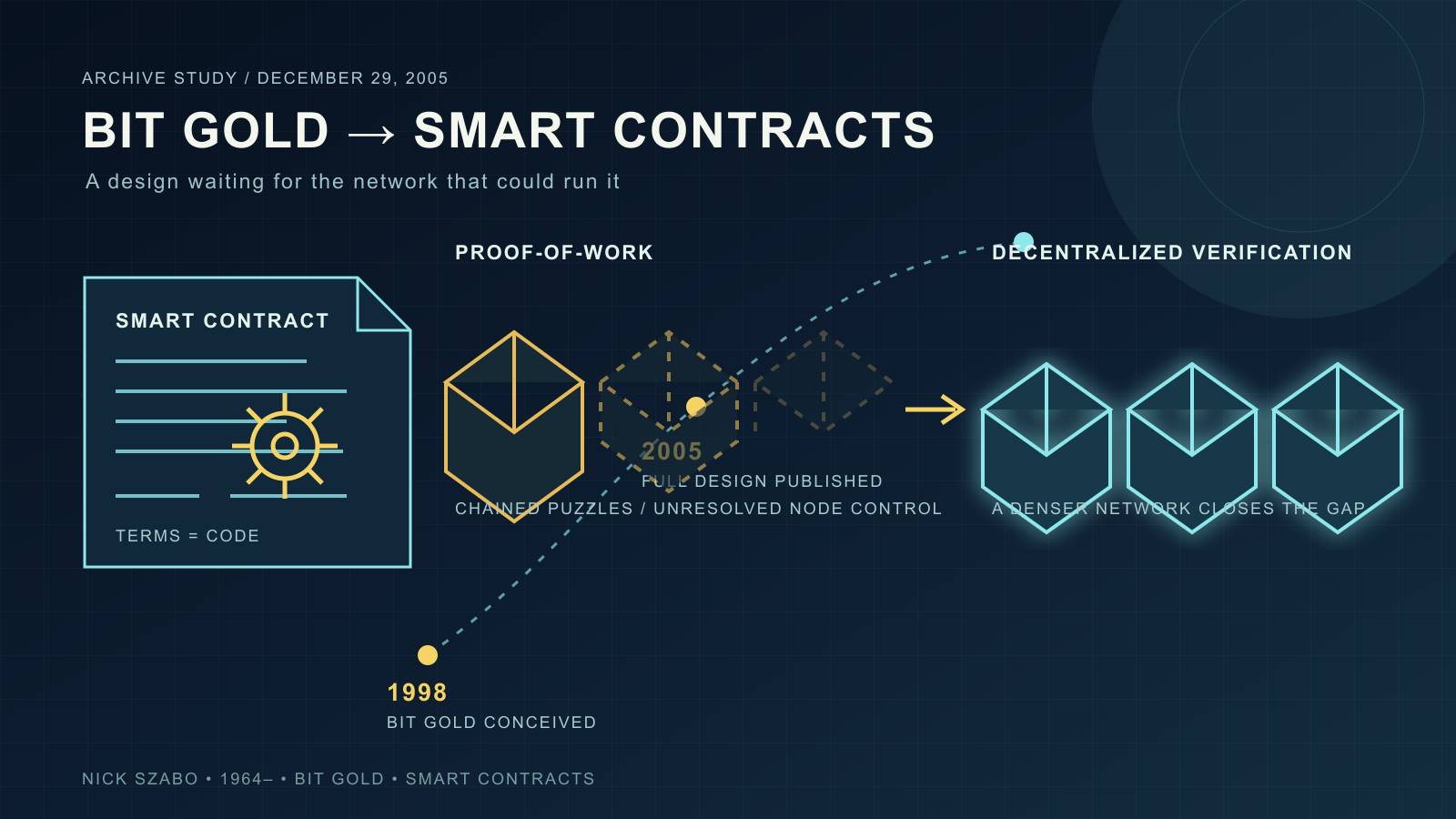
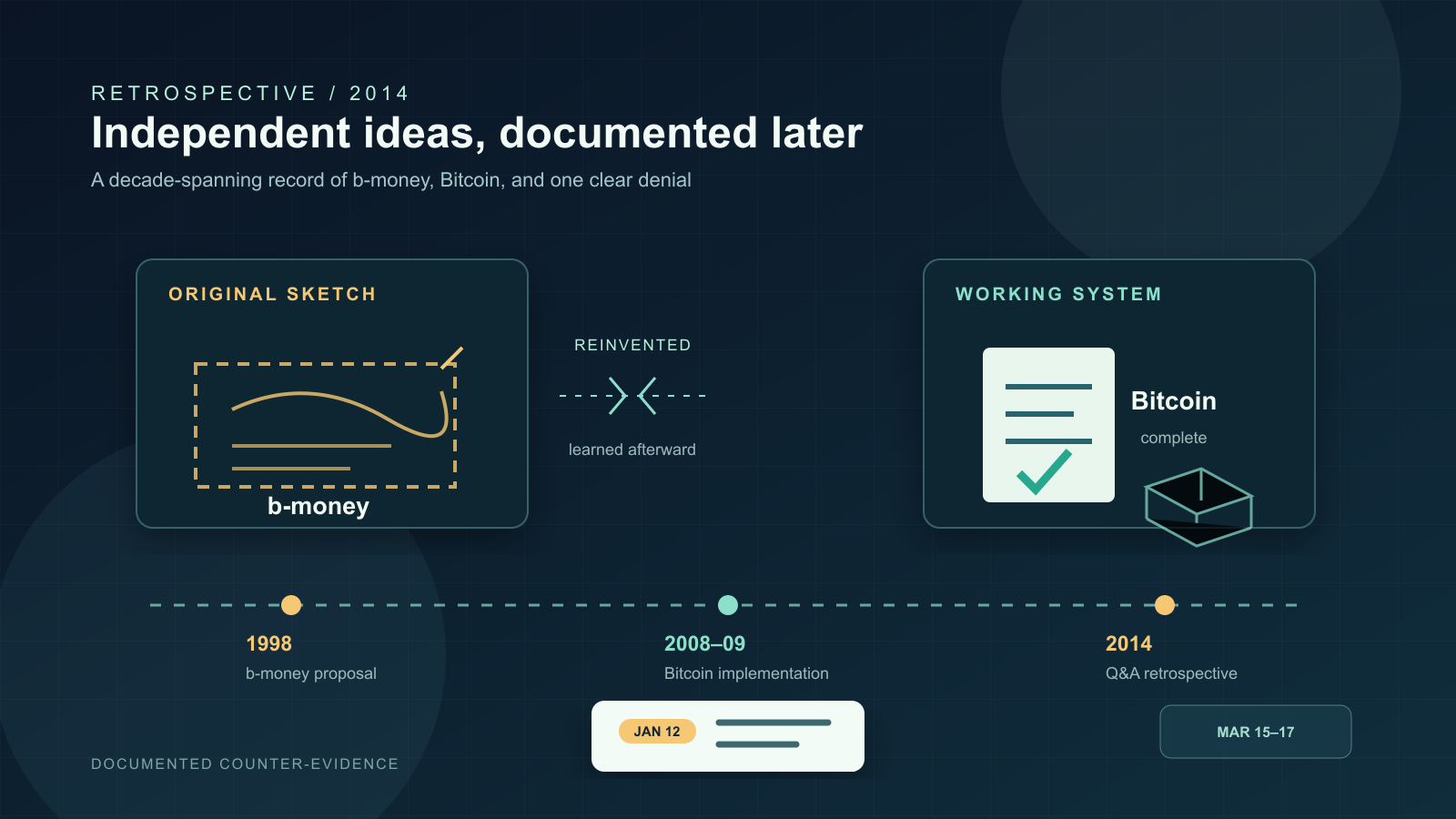
- the whitepaper’s explicit citation of Hashcash and b-money;
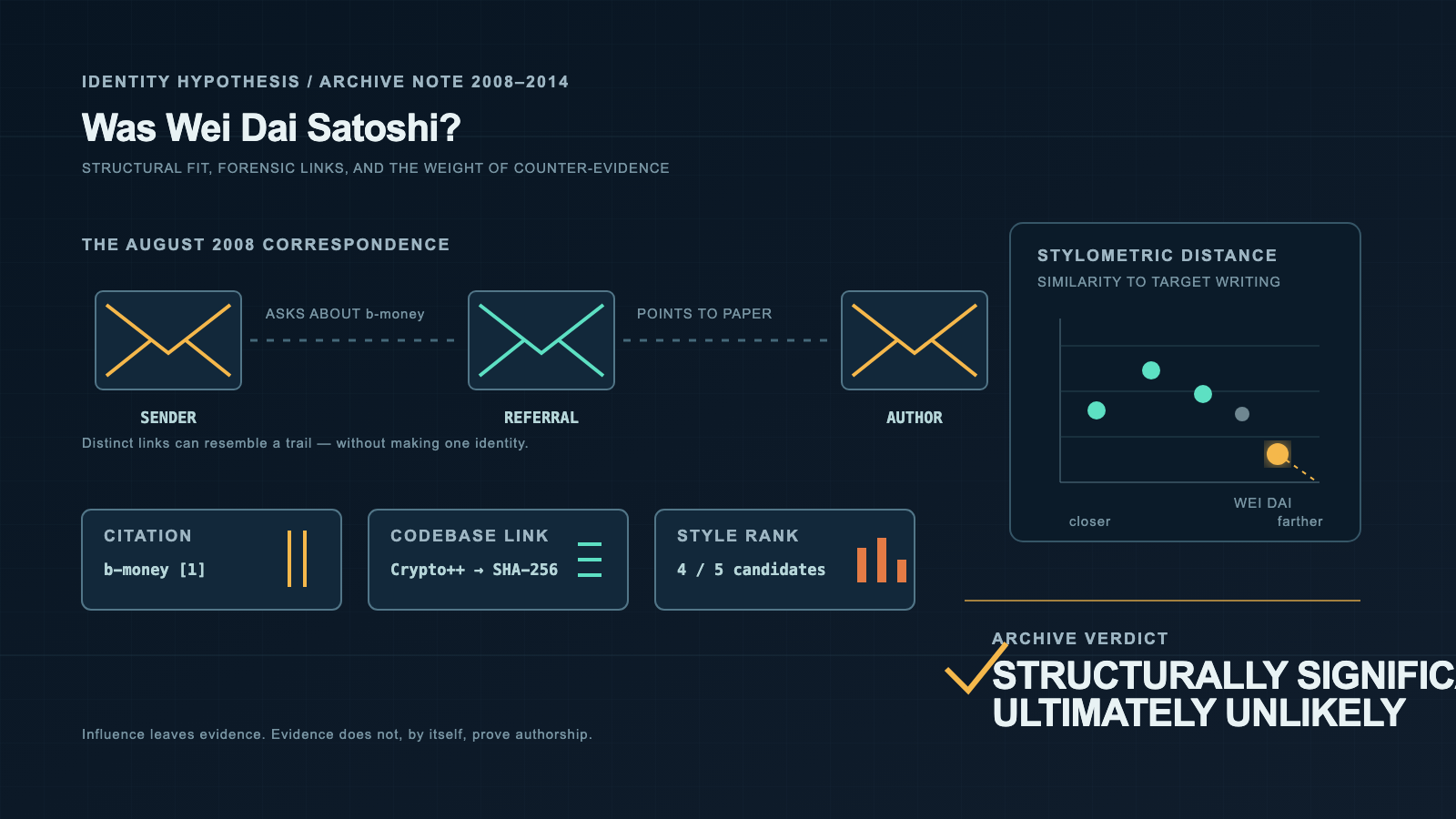
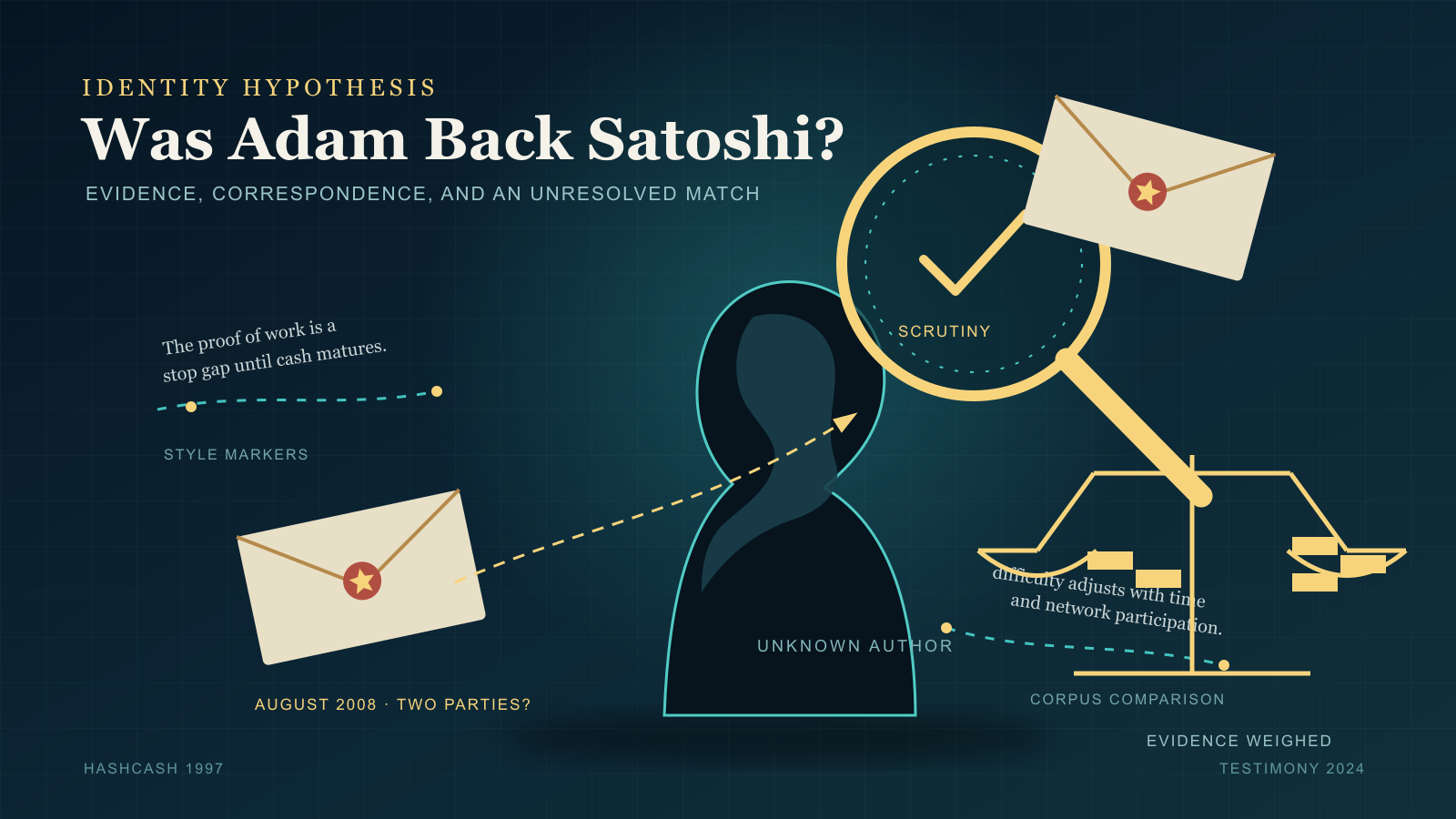
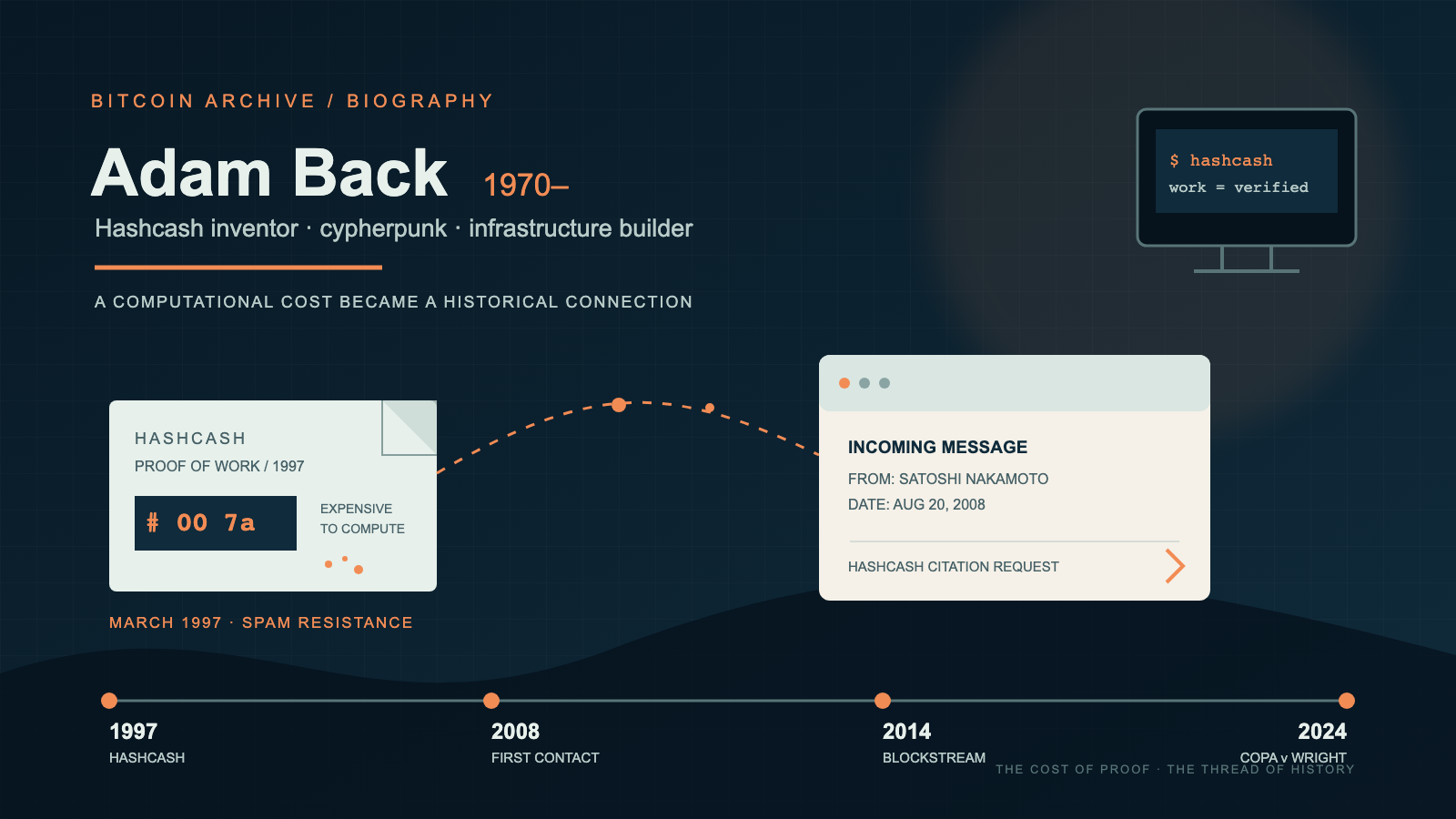
- the August 2008 pre-launch correspondence with Adam Back and Wei Dai;
- Wei Dai’s 2014 identifiability argument that Satoshi was not a publicly active cypherpunk during the 2007–2008 development window (consistent with the cypherpunk-independent-arrival analysis);
- the 19,901-line v0.1 C++ codebase;
- the near-native English register;
- the approximately 18-month intensive coding window from mid-2007 through the v0.1 release in January 2009 (implementation work substantially complete by August 2008; whitepaper written after the code was substantially complete, per Satoshi to Hal Finney on November 9, 2008), within the approximately 2-year pre-release work Satoshi later put at “Since 2007” / “2 years of development before release”;
- the April 2011 withdrawal.
The four structural layers are not interchangeable; each narrows the candidate space differently.
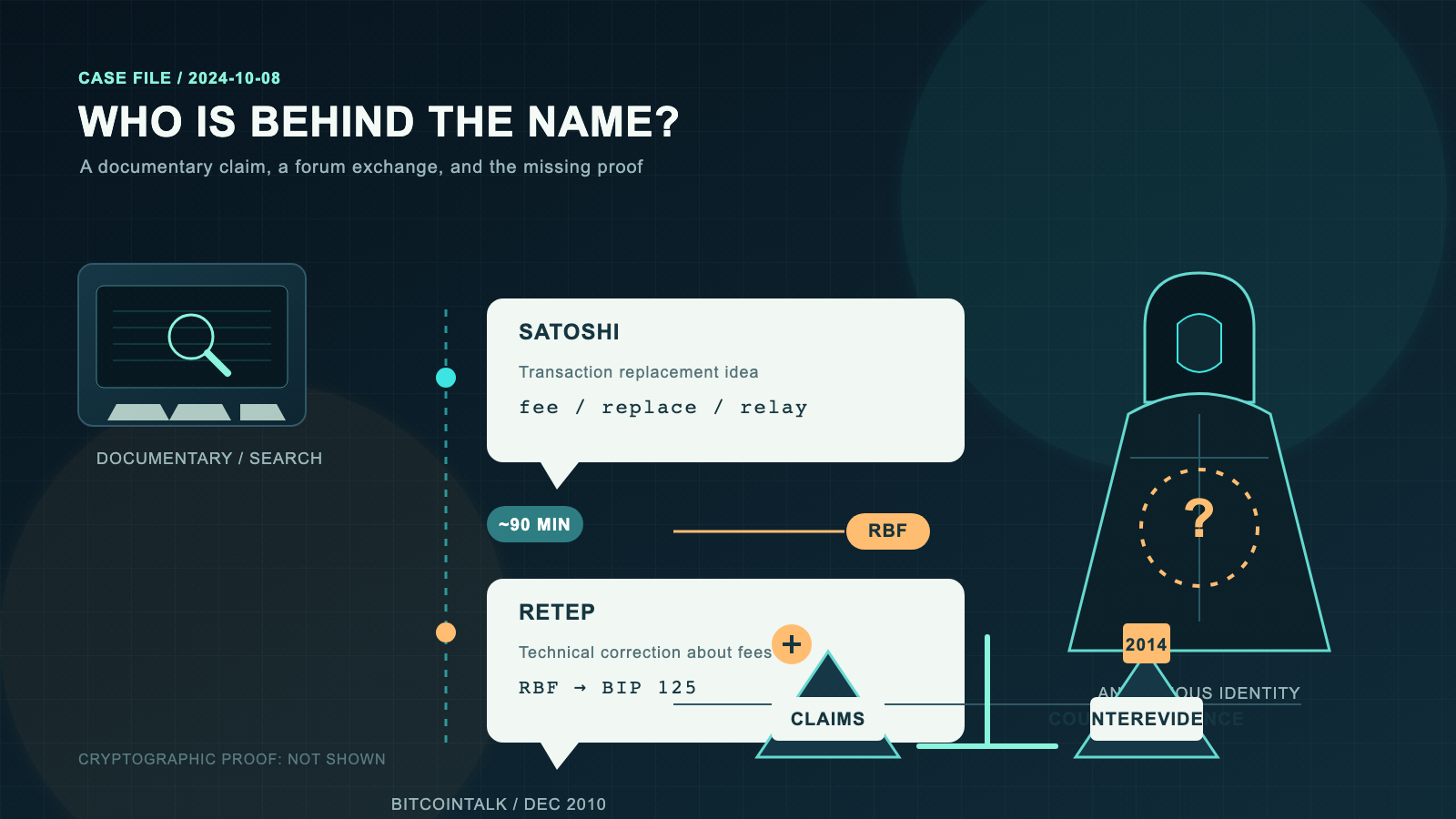
The 2024-2026 identification wave. Four major-press / documentary identifications have appeared since late 2024, each resting on a different evidence base: the HBO Money Electric documentary on Peter Todd (October 2024, forum-post-timing argument); the NYT Carreyrou investigation of Adam Back (April 2026, stylometric, single candidate); the Finding Satoshi multi-person reading (April 2026, activity-window + family testimony — the co-authorship naming, argument, and counter-evidence are in §8.1); and the Murphy v DHS FOIA action (April 2025, government-record subpoena route, a different evidence channel — argument and counter-evidence in §8.2). None has produced cryptographic confirmation.
1. Candidates
The twelve named candidates fall into three groups by how they entered Satoshi-identity discourse:
- A. Cypherpunks Satoshi explicitly cited — Adam Back, Wei Dai
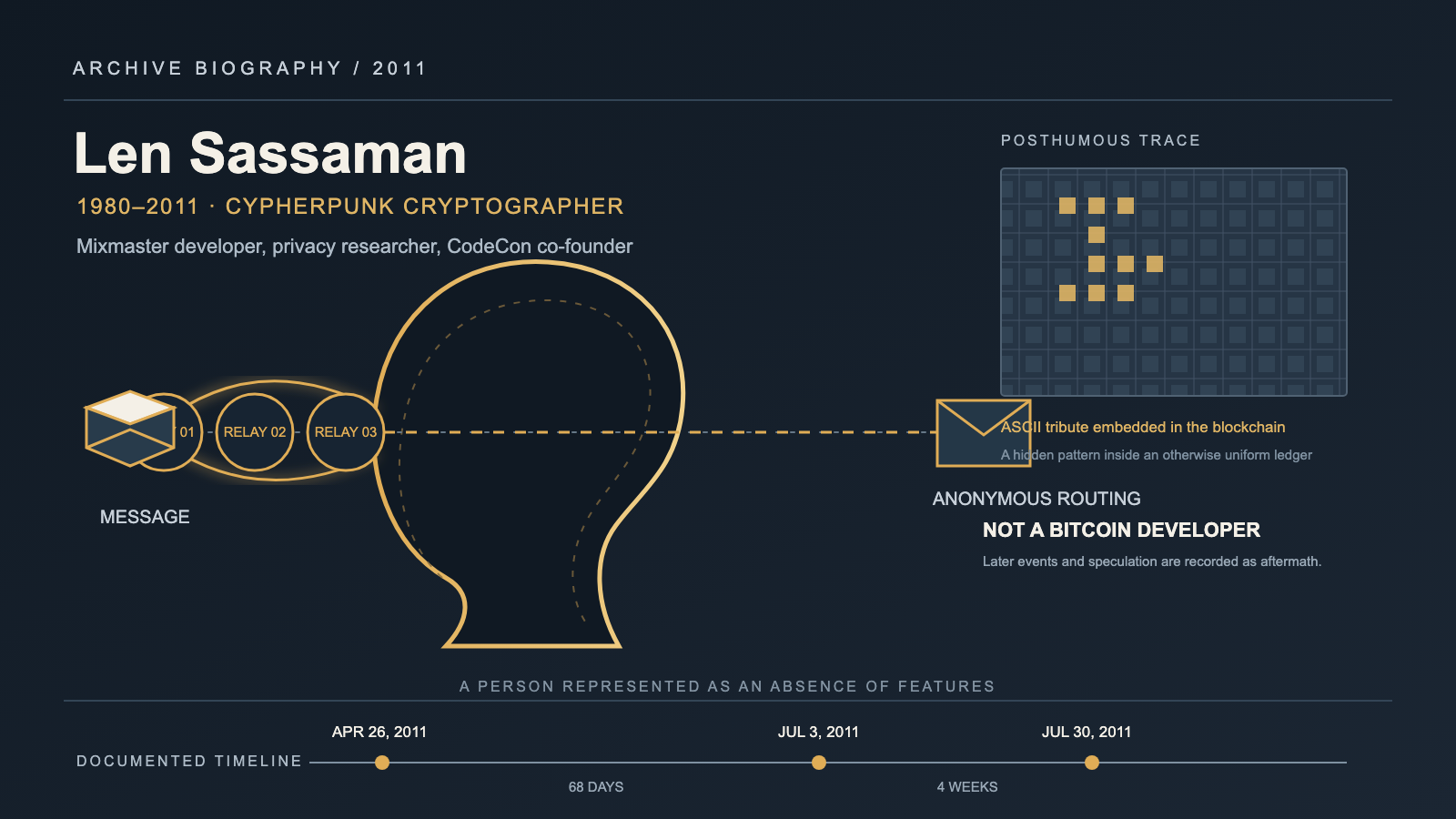
- B. Cypherpunks with capability fit — Hal Finney, Nick Szabo, Len Sassaman
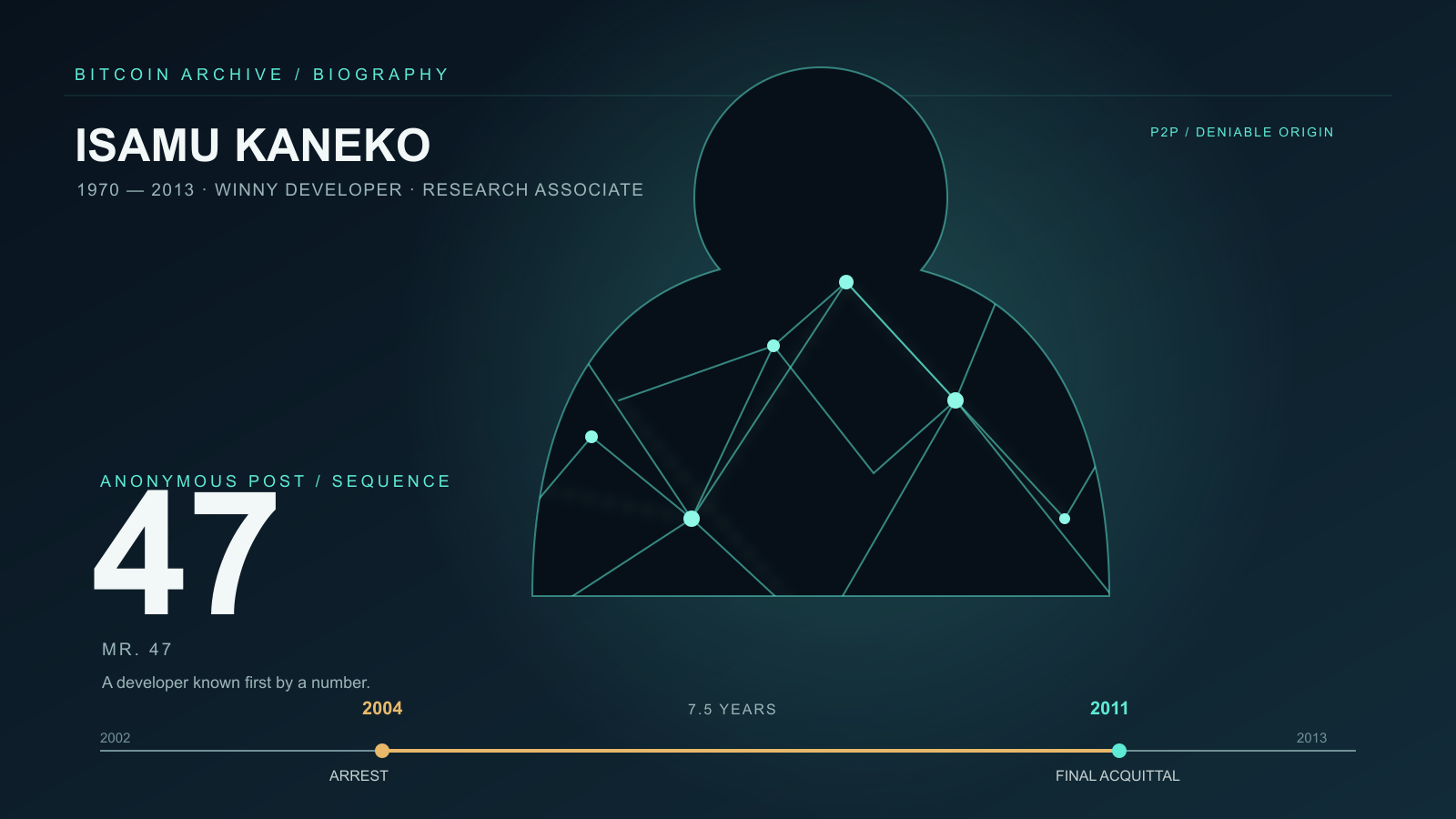
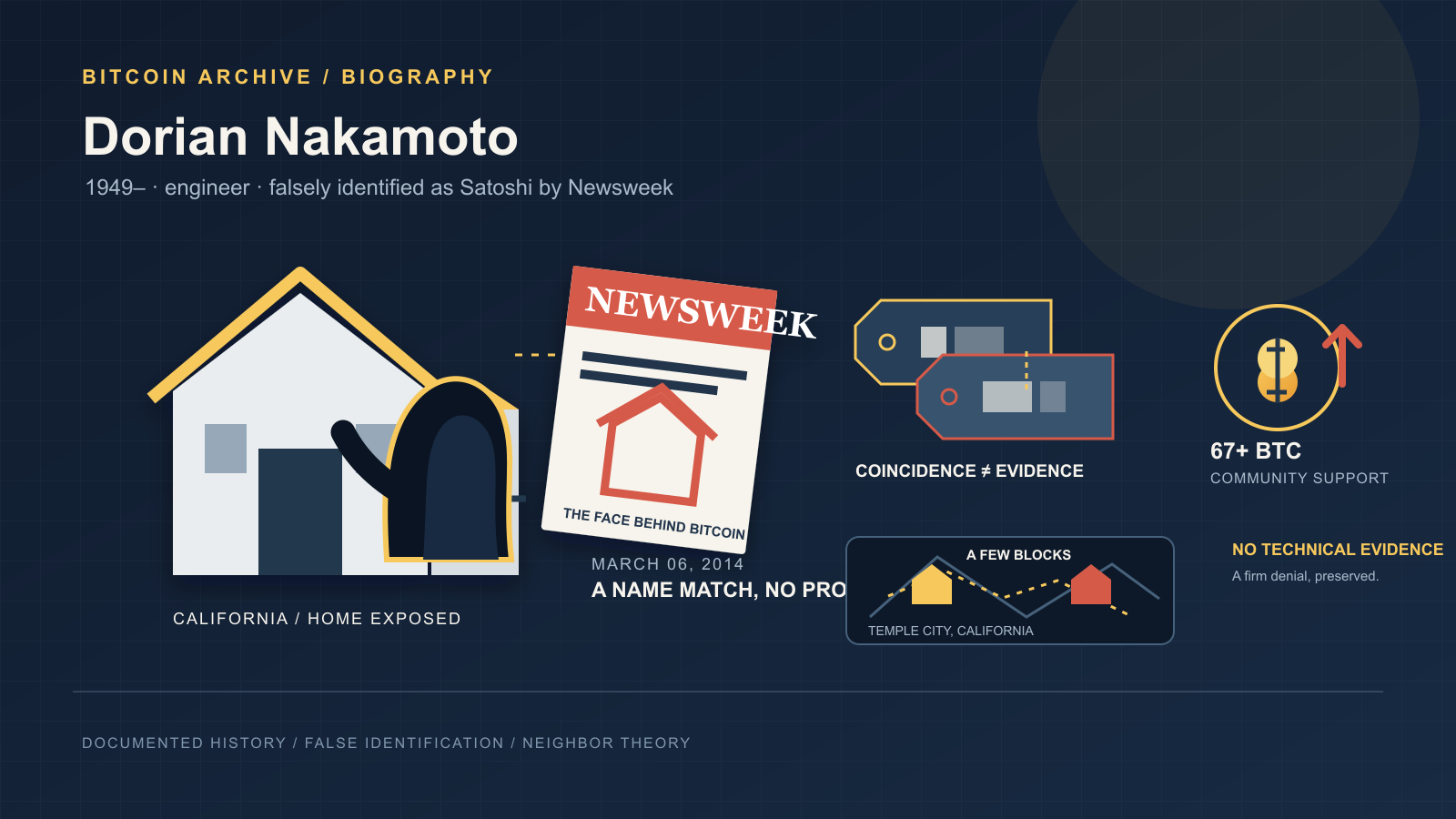
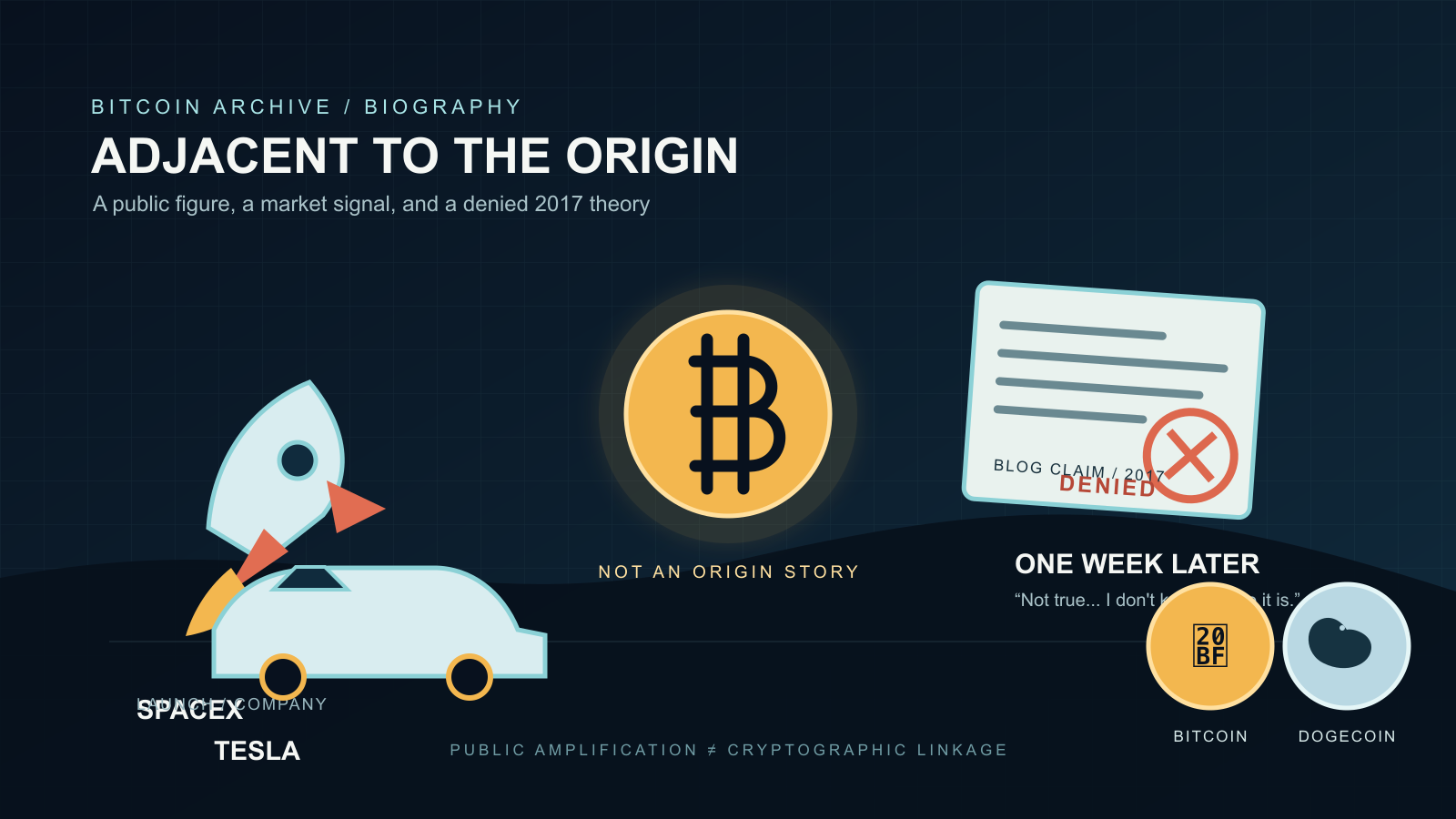
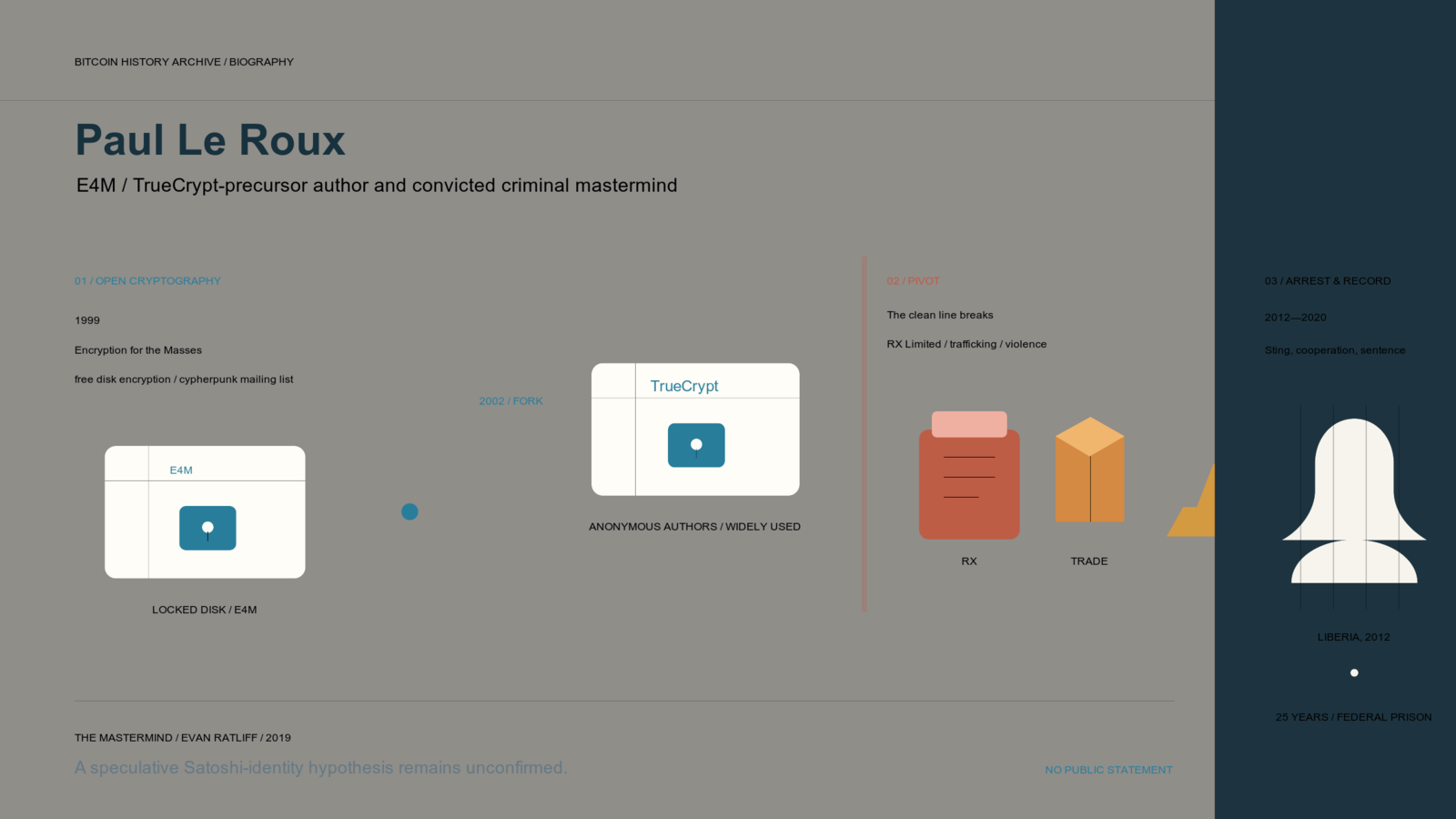
- C. Third-party discovery, self-claim, or name-match — Dorian Prentice Satoshi Nakamoto, Craig Wright, Peter Todd, Isamu Kaneko, Paul Le Roux, Elon Musk, James A. Donald
Per-candidate background is in each biography (linked from the §2.1 table), and external status is in the §2.1 table’s External status column. Each candidate has a dedicated hypothesis entry, linked from the table’s Entry column, where the case is argued in full. The four layers (§2 — §5) compare the candidates against Satoshi’s documented public-record outline along independent axes. Cross-cutting observations across the four layers are in §6; combined limits in §7.
2. Layer 1 — Profile match
2.1 Comparison table
| Candidate | Entry | Cypherpunk fora | BTC lineage | Implementation | Monetary design | English level | Timing | Low visibility | External status |
|---|---|---|---|---|---|---|---|---|---|
| Adam Back | Identity | Self-denied (NYT 2026 investigation) | |||||||
| Wei Dai | Identity | Self-denied; pre-launch correspondence reads third-party | |||||||
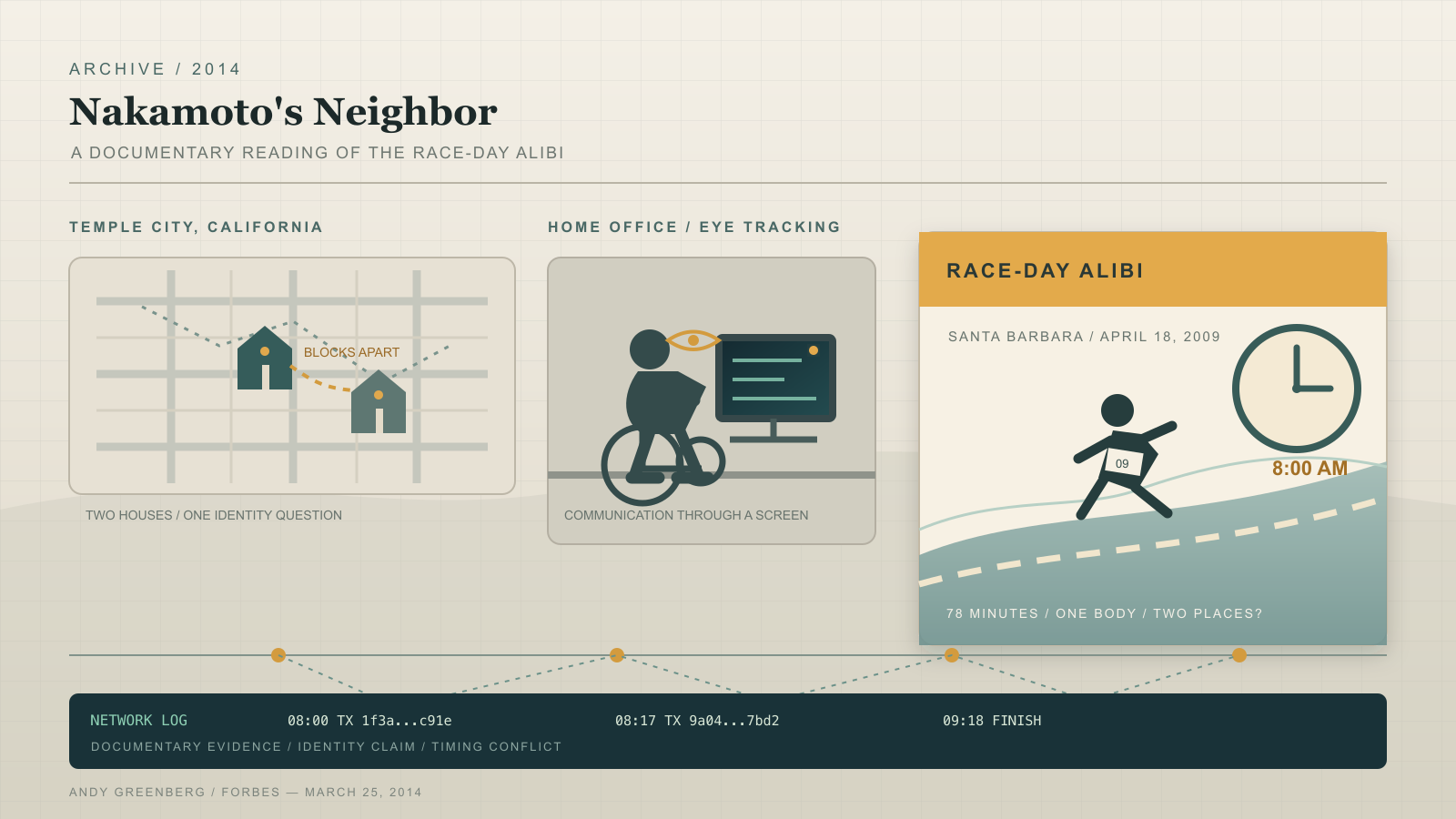
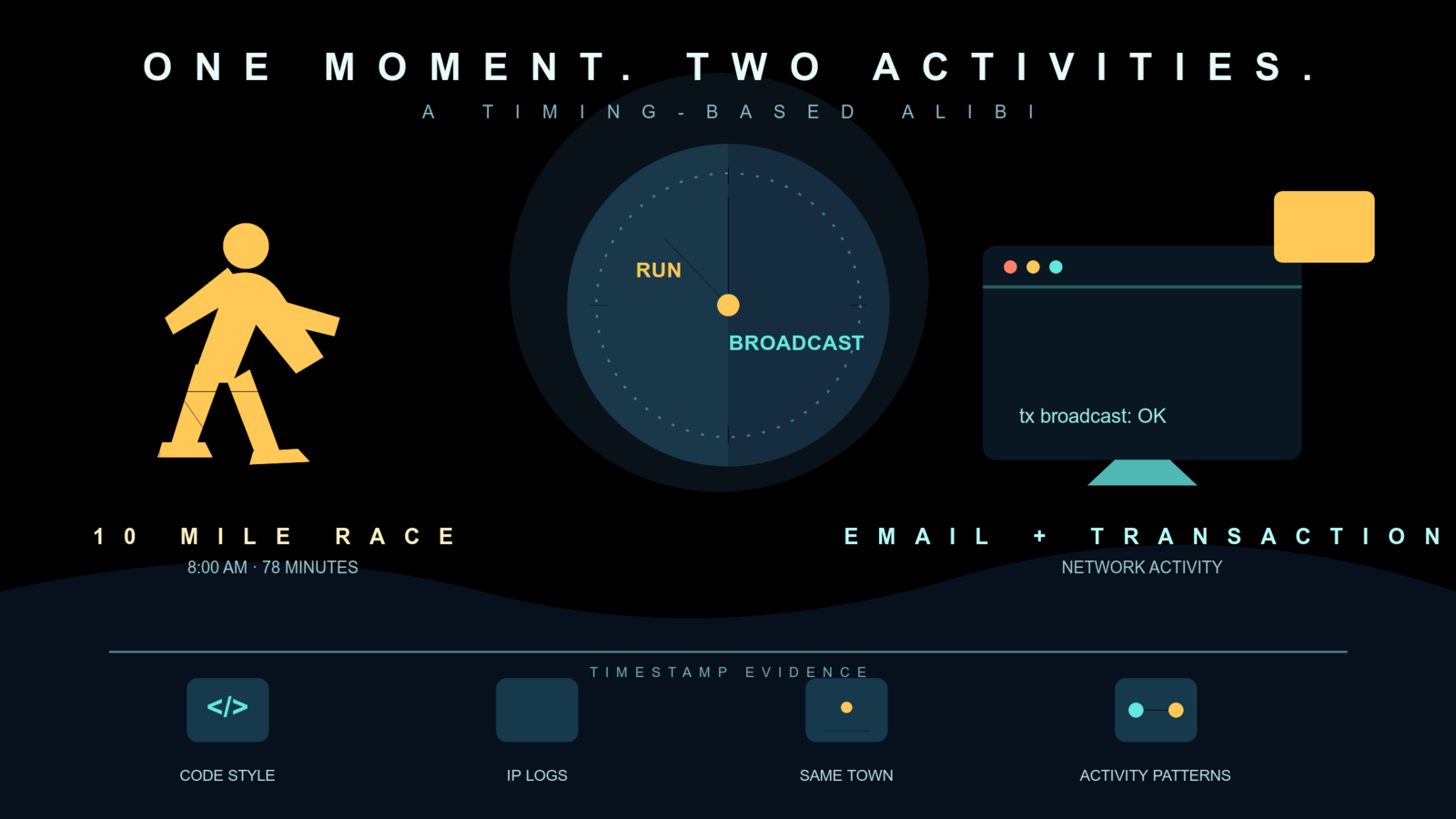
| Hal Finney | Identity | Self-denied; Patoshi mismatch; race-day alibi | |||||||
| James A. Donald | Identity | Satoshi treated him as third party; Wallace excluded | |||||||
| Peter Todd | Identity | Self-denied (HBO 2024 doc) | |||||||
| Nick Szabo | Identity | Self-denied | |||||||
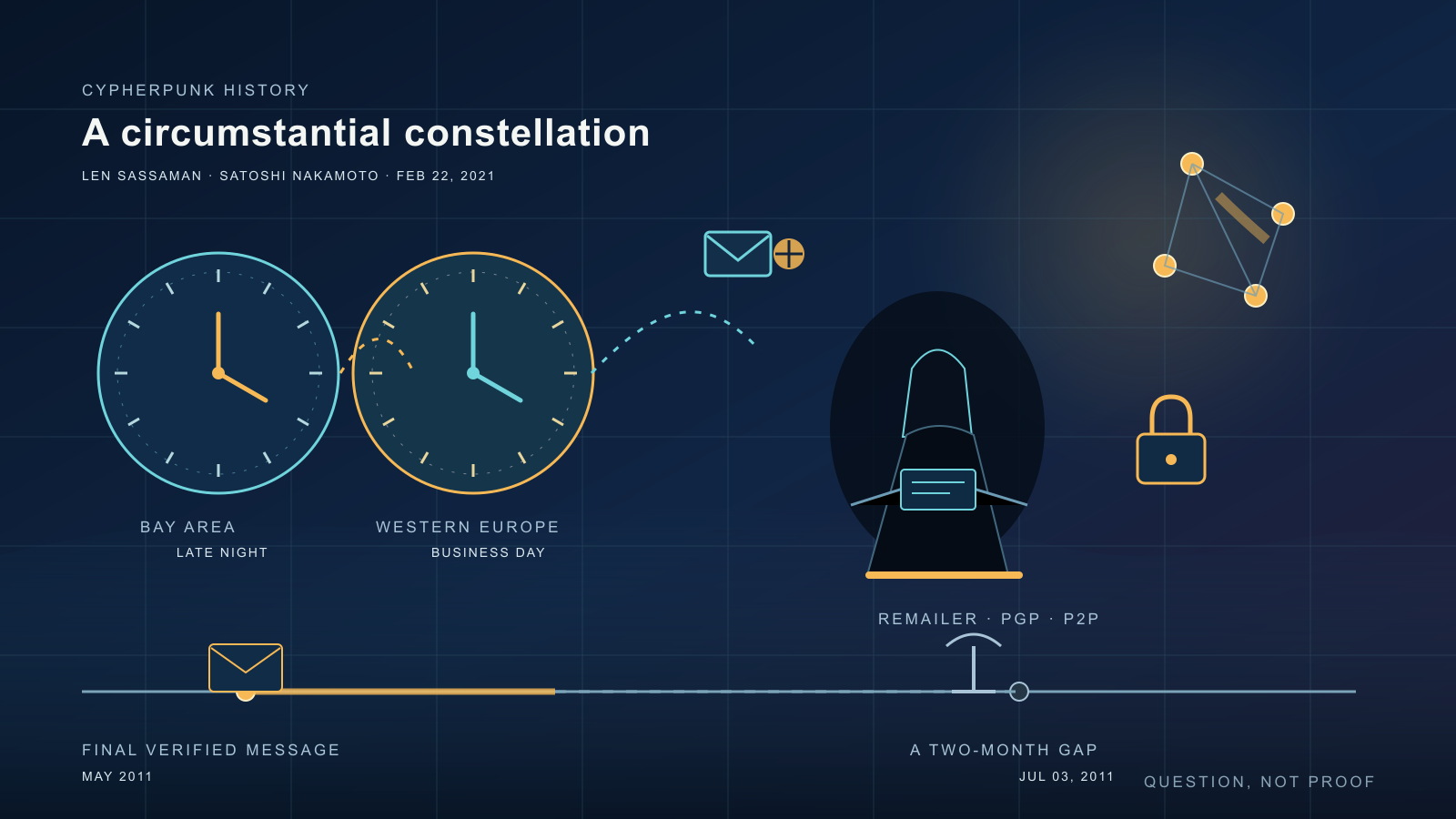
| Len Sassaman | Identity | Open | |||||||
| Dorian Nakamoto | Identity | Self-denied; p2pfoundation return | |||||||
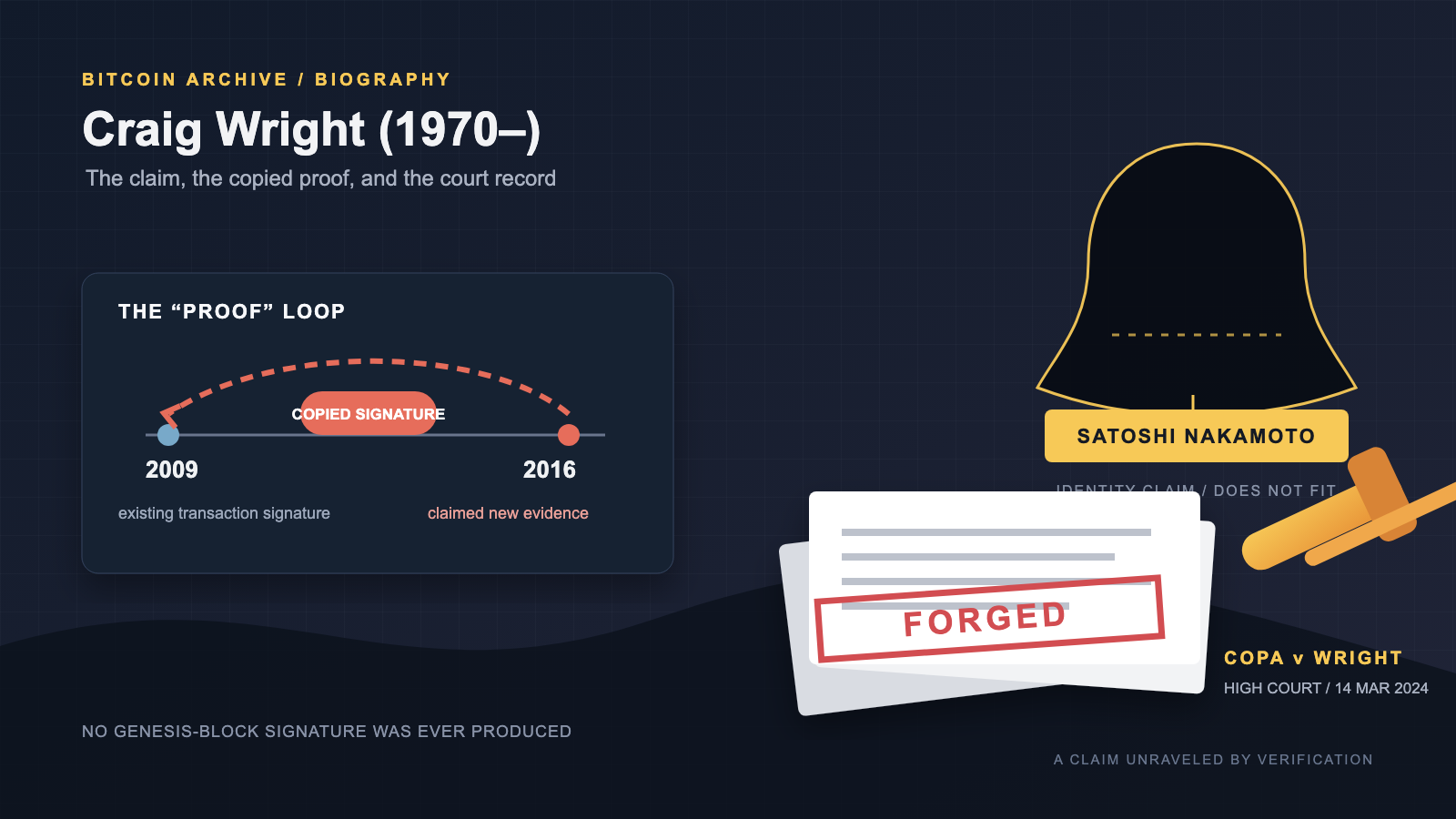
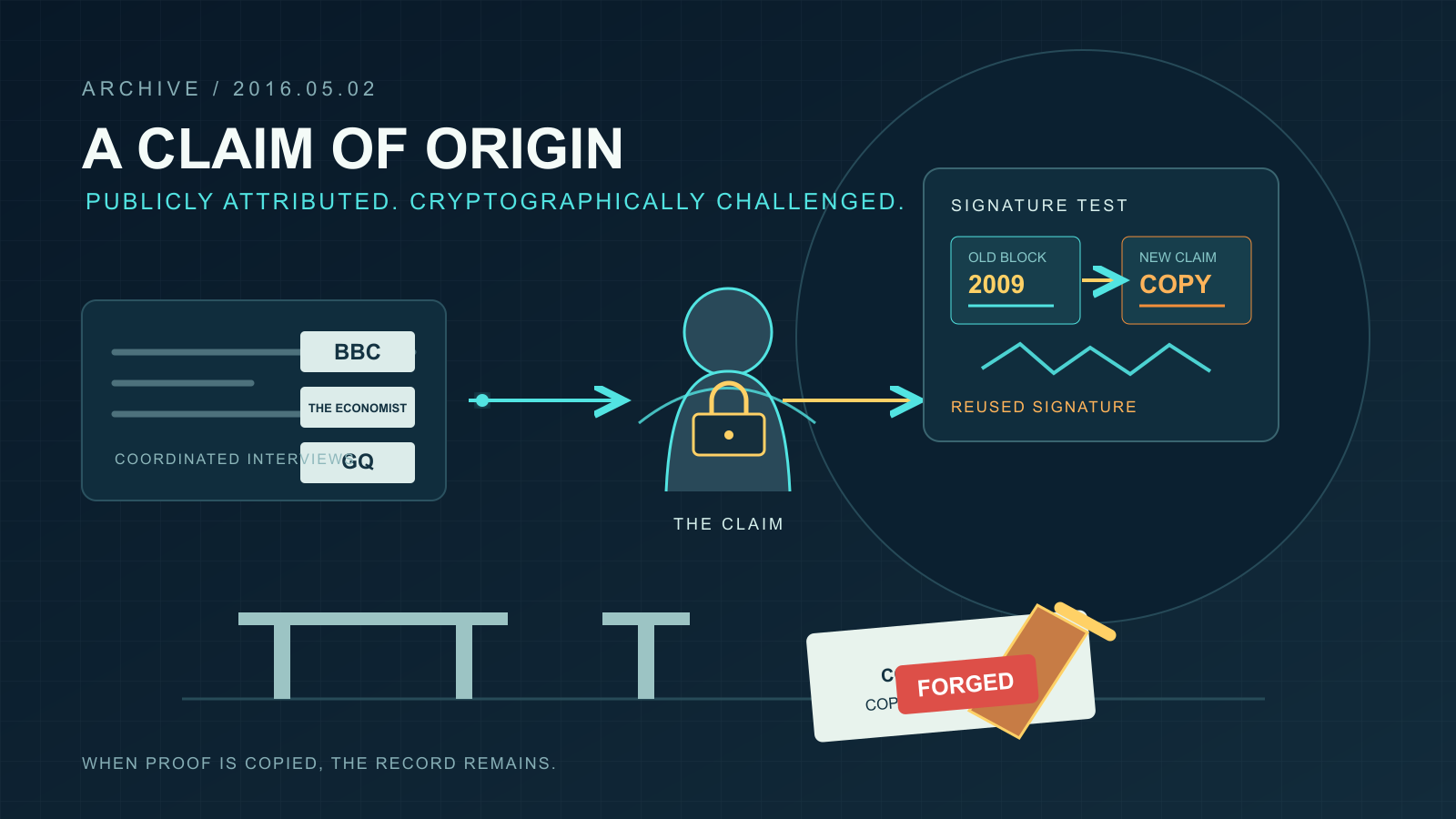
| Craig Wright | Identity | COPA v Wright (2024) ruled against | |||||||
| Paul Le Roux | Identity | Open (incarcerated 2012–) | |||||||
| Elon Musk | Identity | Self-denied (2017) | |||||||
| Isamu Kaneko | Identity | Open |
Color meaning (this table only): matches Satoshi’s documented profile; does not; mixed or partial fit. Per-dimension criteria are in §2.2. Section §5 reuses the same three glyphs on a separately-defined Phase 1 alignment scale; the two scales are not interchangeable (see §5.3 for §5’s legend and §7 for the overall caveat).
How to read the table:
- The dimensions split into two groups that pull against each other (background-and-capability vs covertness). Counting across all columns and treating the total as a single Satoshi-likeness score is misleading. See §2.2.
- Profile-comparison is necessary but not sufficient. The External status column shows external evidence (self-denials, court rulings, technical disproofs) that can rule out a candidate independently of the profile comparison.
- Cell color assignments reflect this entry’s reading of the public record; each candidate’s dedicated hypothesis entry (linked in the Entry column) argues the profile in full.
2.2 Methodology
Profile-match dimensions. The seven dimensions in §2.1 are derived from the public-record outline of Satoshi:
- Cypherpunk forum participation: documented presence in the cypherpunks mailing list, metzdowd Cryptography List, or related fora. Wei Dai’s 2014 identifiability argument (in his LessWrong AALWA thread) suggests Satoshi was not visibly active in these fora during the 2007–2008 development period.
- Bitcoin-adjacent intellectual lineage: documented work in or extended citation of Hashcash, b-money, Bit Gold, RPOW, or related digital-cash / proof-of-work proposals (the per-component analysis of which of these Bitcoin actually reuses, borrows, or synthesizes is in the Bitcoin design-lineage analysis).
- Implementation capability: documented lifetime track record of shipping software at a scale comparable to Bitcoin v0.1’s 19,901-line C++ codebase — cryptographic libraries, P2P systems, anonymity networks, or complete shipping applications of similar size and engineering complexity. The dimension is specifically about Bitcoin-source-level capability, not general programming literacy. Lifetime rather than strictly pre-2008: Satoshi-as-pseudonym hides any pre-2008 implementation work the actual person had done, so demonstrated post-launch capability (in Bitcoin Core, related cryptographic projects, or major engineering positions) counts as evidence of the underlying capability. The dimension distinguishes candidates with a documented multi-thousand-line shipping record from theorists, scholars, or small-scale contributors.
- Monetary system design: documented thinking about digital-cash / monetary-system mechanisms — proof-of-work tokens, scarcity mechanisms, fee markets, mining incentives, distributed issuance schemes. Bitcoin v0.1 required not only cryptographic and distributed-systems engineering (covered by Implementation) but also coherent thinking about monetary mechanism design; this dimension separates that aspect. A theorist who designed a monetary mechanism without shipping code (Szabo with Bit Gold, for example) scores here even with on Implementation; an implementer with no monetary-system work in their record (Sassaman with Mixmaster, Le Roux with E4M, Kaneko with Winny) scores the inverse.
- Near-native English register: idiom, register-shift, and literary fluency comparable to Satoshi’s white paper, BitcoinTalk posts, and email correspondence.
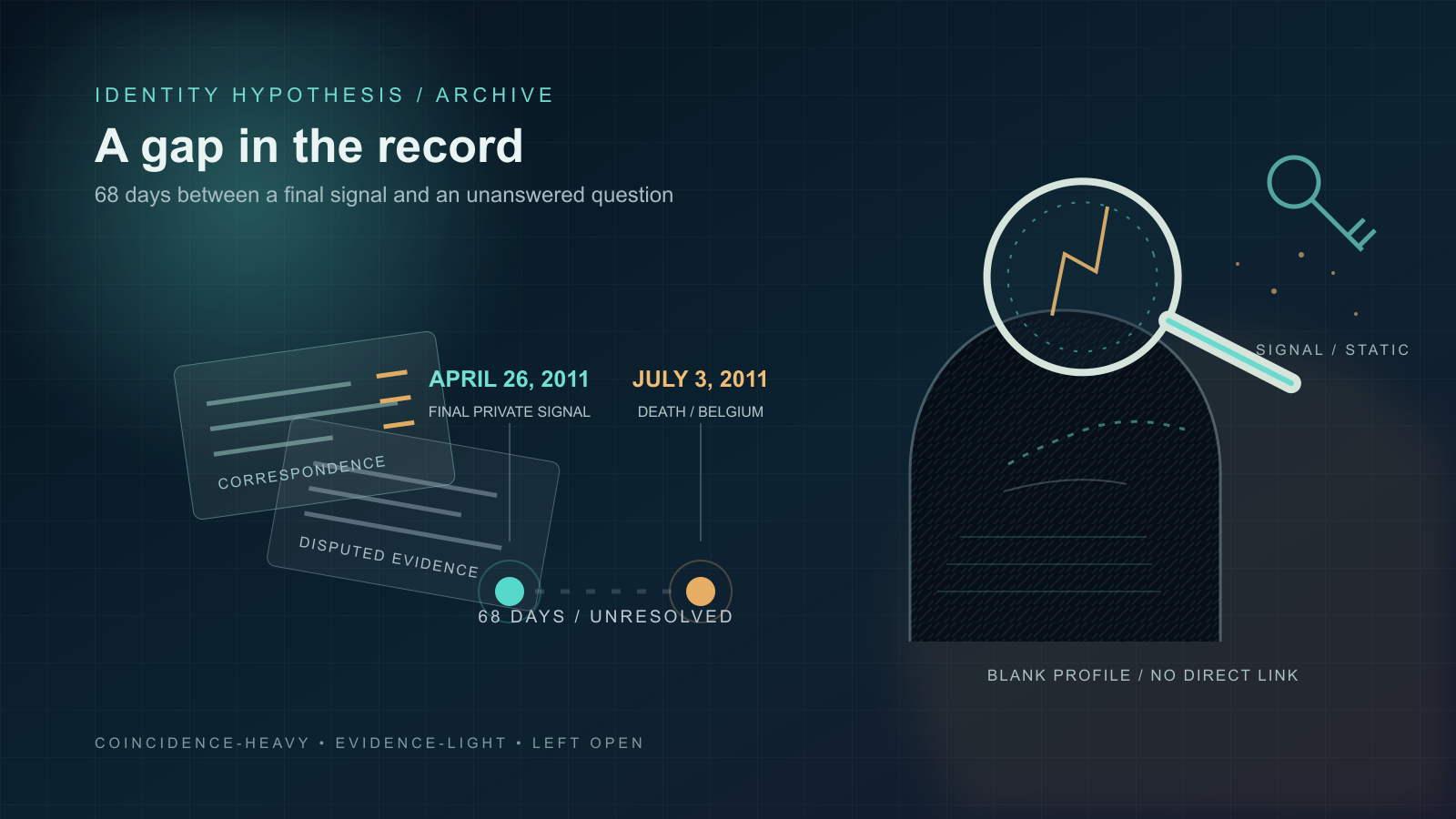
- Tight timing vs Satoshi’s silence: closeness of a documented major life event (death, retirement, etc.) to Satoshi’s last known correspondence (April 26, 2011 email to Gavin Andresen). This anchor brackets the disputed 2014 P2P Foundation activity, which is treated as a separate cross-cutting question in §6.
- Low public visibility during 2007–2008 development: degree to which the candidate could plausibly have undertaken the approximately 2-year pre-release effort (about 18 months of intensive coding from mid-2007, within the pre-release work Satoshi later put at “Since 2007” / “2 years of development before release”) without leaving public traces in their documented activity.
Two-group structure. The seven dimensions split into two groups that pull against each other:
- Background and capability — Cypherpunk fora, BTC lineage, Implementation, Monetary design, English level. here means the candidate had what Bitcoin’s design required: cypherpunk-style intellectual milieu, digital-cash thinking, code-shipping ability at the relevant scale, and a near-native English register.
- Covertness — Timing, Low visibility. here means the candidate’s documented profile fits Wei Dai’s 2014 identifiability argument that Satoshi was not a publicly active cypherpunk during the 2007–2008 development window, and that some life event aligns with Satoshi’s April 2011 silence.
The more visibly active a candidate was as a cypherpunk thinker (group 1), the less plausibly they could also have been hidden enough to escape identification (group 2). Reading the comparison requires holding the two groups separately rather than summing green counts. An “all-” candidate is structurally rare: someone simultaneously deeply embedded in cypherpunk capability and completely invisible during the development window.
Profile-match is necessary but not sufficient. Profile-match alone never decides a hypothesis. The External status column (self-denials, court rulings, technical disproofs) operates independently and is in some cases decisive. Cross-cutting observations on how profile-match and external status combine for individual candidates are in §6.
2.3 Capability vs covertness map
Each candidate plotted in the 2D space of capability score (x-axis) vs covertness score (y-axis). Coordinates are approximate visual placements, not exact averages of the §2.1 cells — pure averages ( = 1, = 0.5, = 0) put several candidates on the chart boundary (Wei Dai’s capability = 1.0; Hal Finney’s and Kaneko’s covertness = 0) or on top of each other (Le Roux and Todd both at [0.5, 0.5]), where labels would overlap the axis titles or each other. Each point is nudged inward by ≈ 0.02 – 0.12 so the labels stay readable; the relative ordering (who is right of whom, who is above whom) matches the table.
The map makes the §6 cross-cutting observations spatial: most cypherpunk-cited candidates (Adam Back, Wei Dai, Hal Finney, Szabo) cluster in the high-capability strip, mostly at low covertness; Sassaman is the only candidate sitting in the high-capability + high-covertness quadrant; Wright, Dorian Nakamoto, and Kaneko sit in the low-capability regions.
Candidate profiles, capability vs covertness
The cluster pattern is the same observation §6 makes in prose: capability and covertness pull against each other, so the high-capability + high-covertness quadrant is structurally hard to populate. Sassaman is in that quadrant because of specialty-separation (visible in anonymity research, invisible in digital-cash); Wei Dai approaches it through specialty-shift (mailing-list active 1990s, Crypto++ maintenance during 2007 - 2008). Most candidates pay the trade-off more directly.
3. Layer 2 — Stylometric attribution
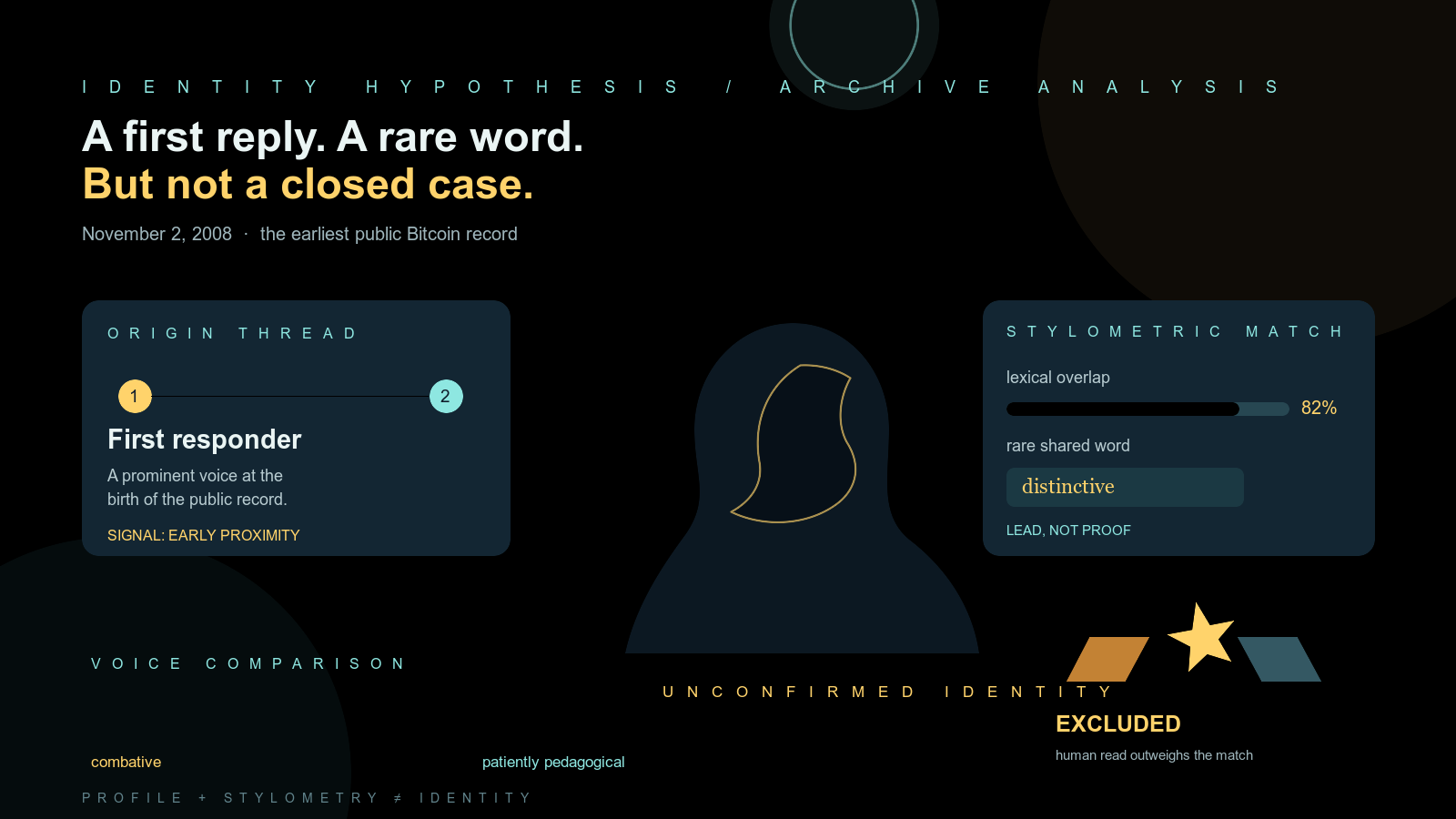
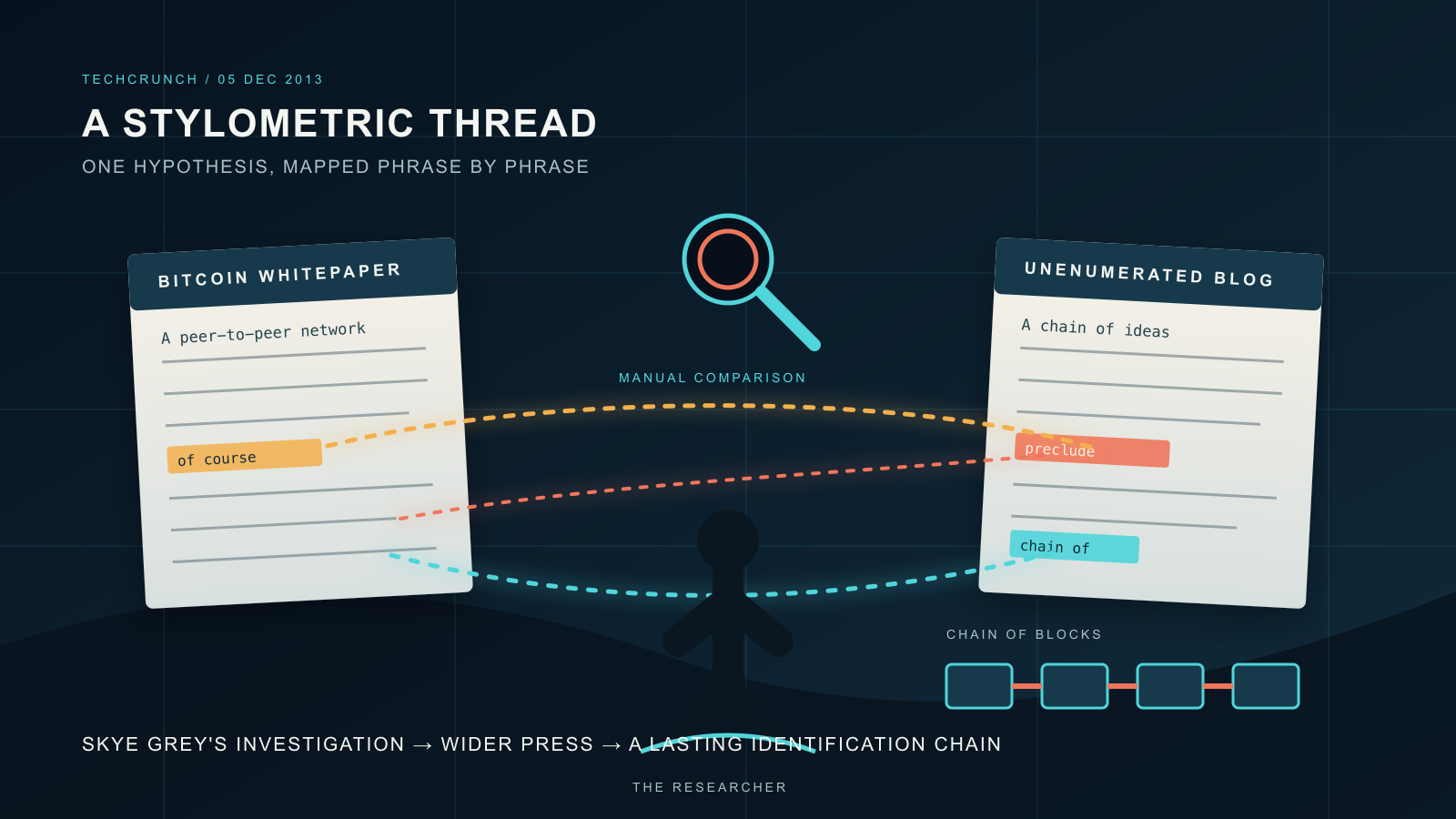
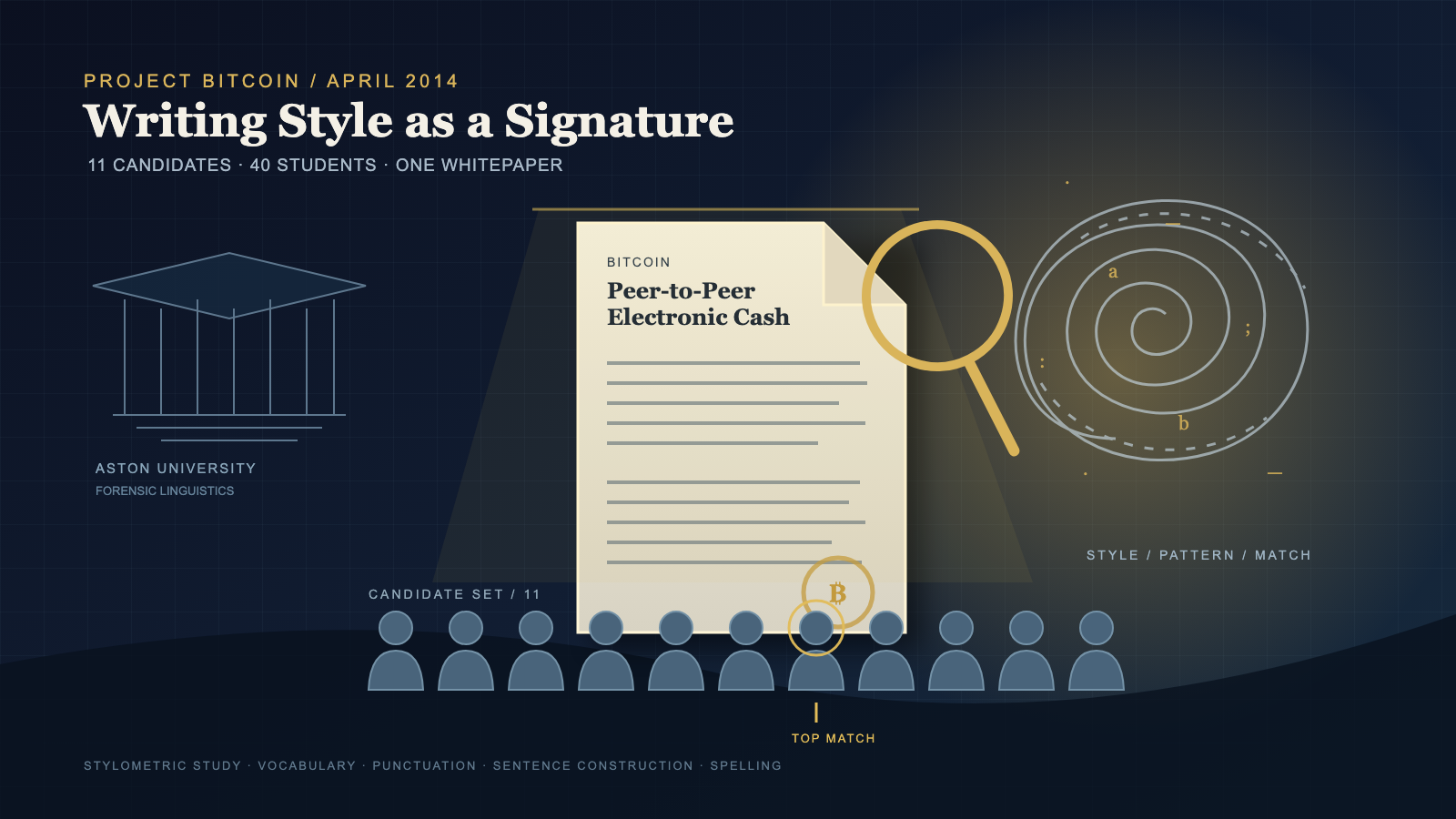
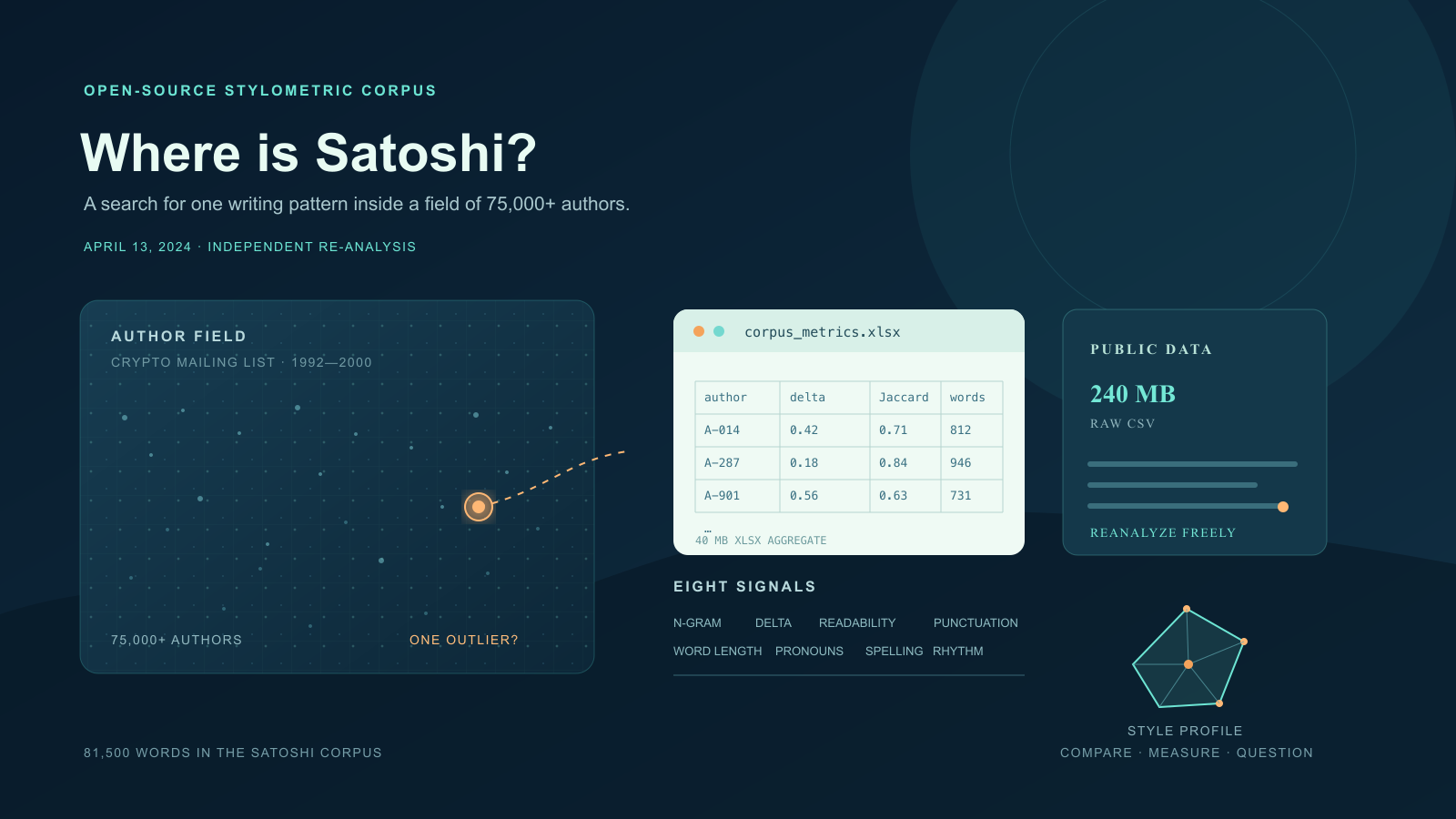
Stylometric Satoshi-identification work is a separate methodological tradition from the structural profile match in §2. The four most-cited investigations have produced different leading candidates depending on candidate-pool design, distance metric, and corpus boundaries. The §2 profile match describes preconditions; the stylometric record below describes results — the two layers are not interchangeable.
3.1 Comparison table
| Candidate | Skye Grey 2013 (single-hypothesis) | Aston 2014 (11 candidates) | van Dorst 2024 (75,000+) / reanalysis | Cafiero / Carreyrou NYT 2026 (12; broader pool 620) |
|---|---|---|---|---|
| Adam Back | — | rank not published | 3rd 🥉 | 1st 🥇 |
| Wei Dai | — | rank not published | 4th | rank not published |
| Hal Finney | — | rank not published | 2nd 🥈 | 2nd 🥈 |
| Nick Szabo | 1st 🥇 | 1st 🥇 | 1st 🥇 | rank not published |
| Len Sassaman | — | not in candidate set | 5th | not in candidate set |
3.2 Reading the table
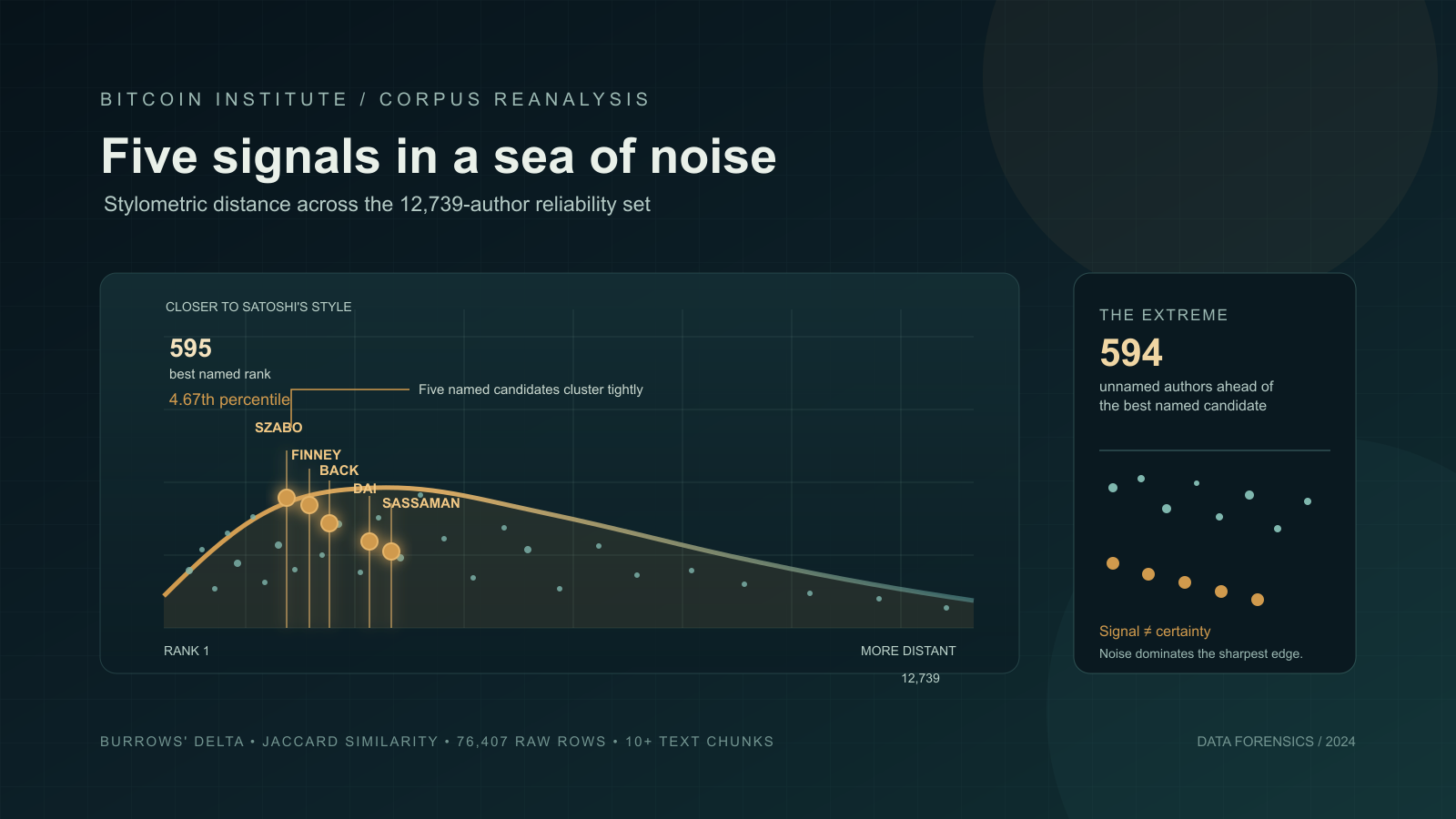
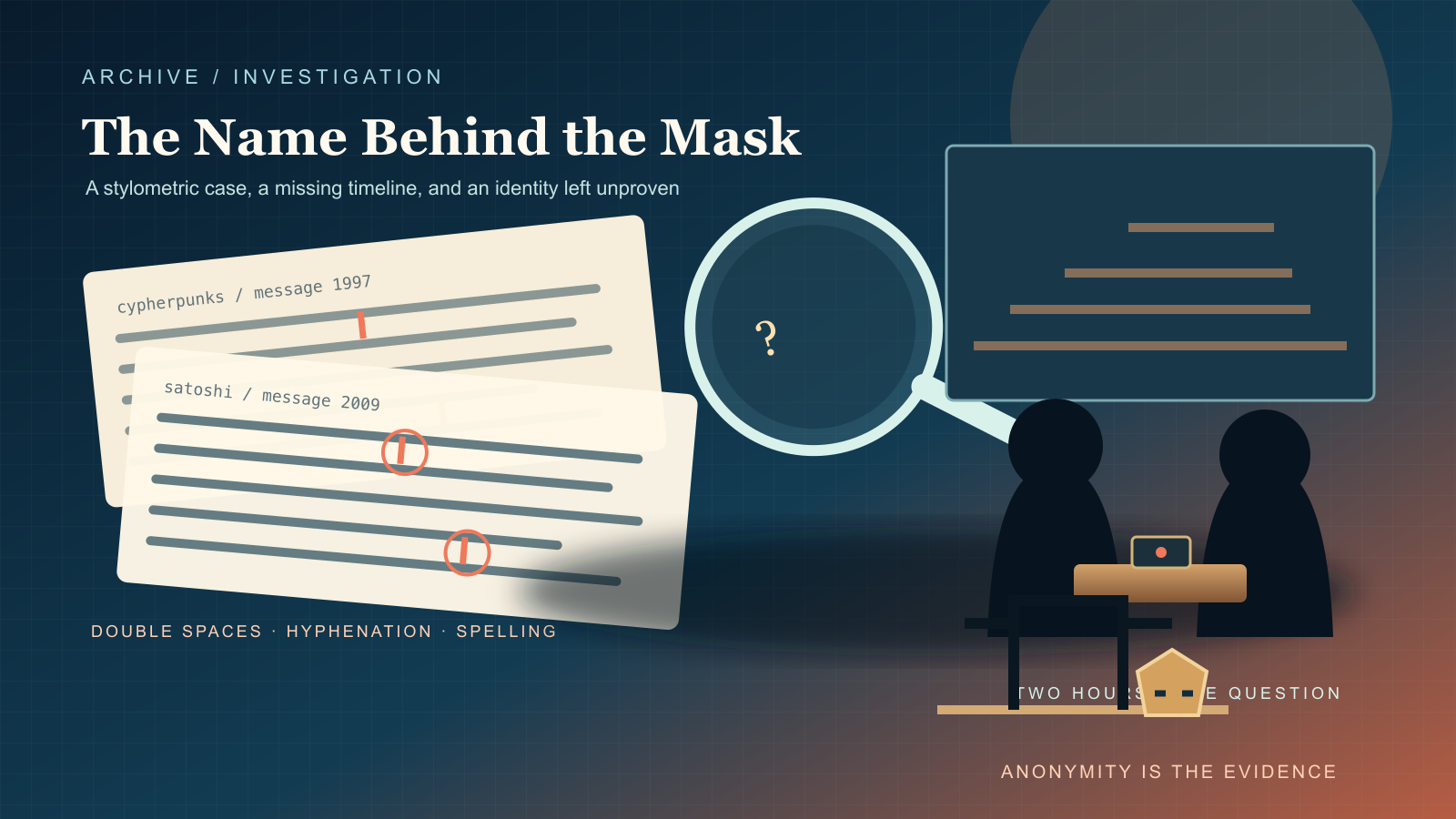
Reading the stylometric layer: Szabo emerges as the candidate most often ranked first — three of the four investigations place Szabo highest among the named candidates: Skye Grey 2013 (named), Aston 2014 (named), and the Bitcoin Institute reanalysis of van Dorst’s published data (Szabo top of 5). Cafiero / Carreyrou 2026 is the outlier in naming Adam Back, with Cafiero describing that result as inconclusive (Hal Finney near tie). The convergence is partial, however: van Dorst’s full 75,000-author corpus contains 594 unnamed authors closer to Satoshi than Szabo, and van Dorst himself declines to name a leading candidate.
4. Layer 3 — Direct correspondence
How much each candidate actually exchanged words with Satoshi is an observable fact independent of capability profile and stylometric distance. Tabulating the archive’s documented communication per candidate makes the contrast clear: five candidates have some form of documented exchange (one of them only as a single reply in a Satoshi-started thread), and seven candidates have no record of direct contact with Satoshi at all.
4.1 Documented correspondence timeline
Documented direct correspondence between named candidates and Satoshi (archive coverage)
4.2 By type of contact
Broken down by type of contact, the structure differs:
| Type | Candidates | Character |
|---|---|---|
| Private email exchange | Adam Back, Wei Dai | Satoshi reached out as a third party shortly before the whitepaper, citing prior-art lineage |
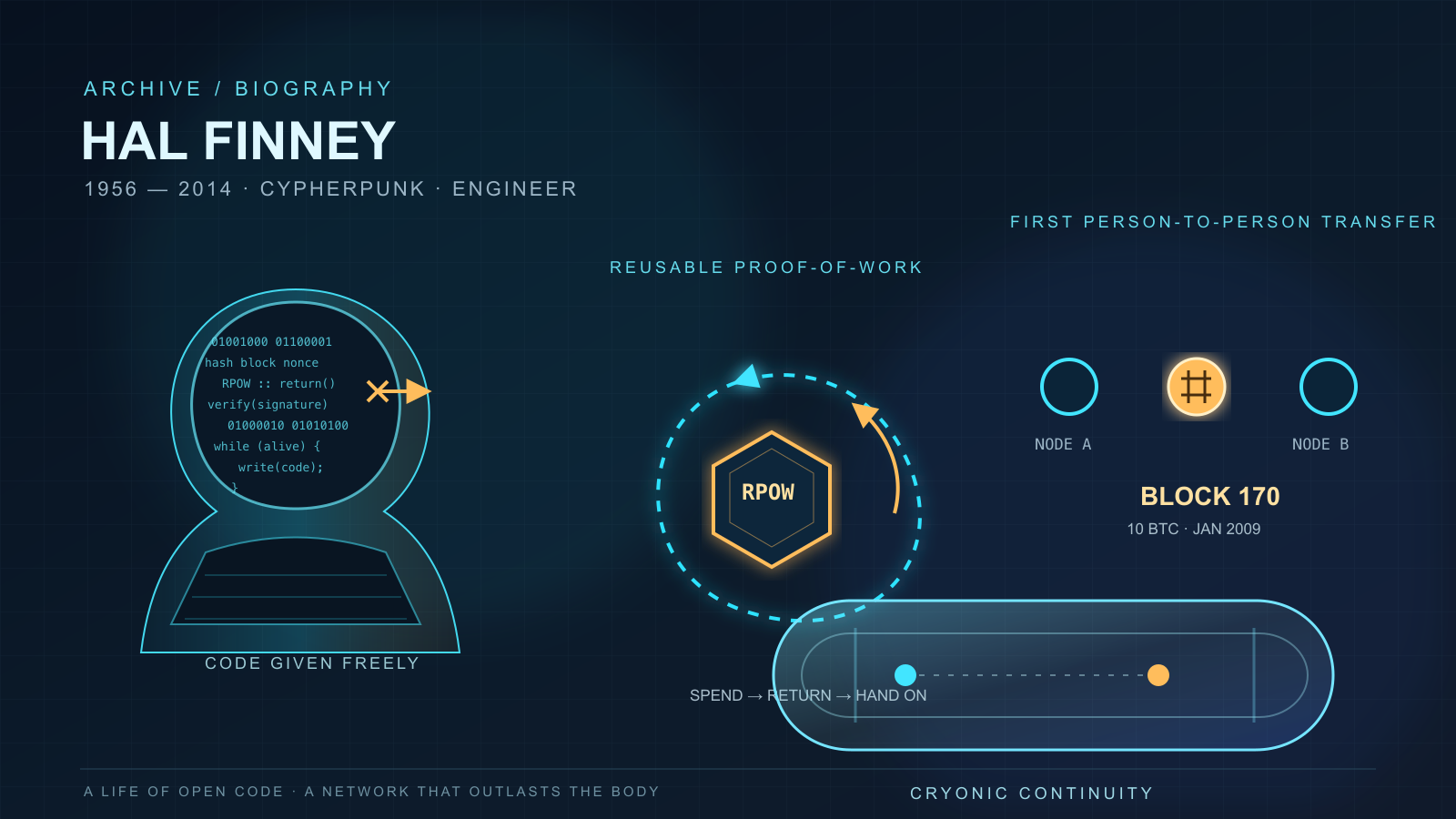
| Email + public discourse | Hal Finney | Sustained technical engagement as the RPOW author, across private email, the cryptography mailing list, and BitcoinTalk |
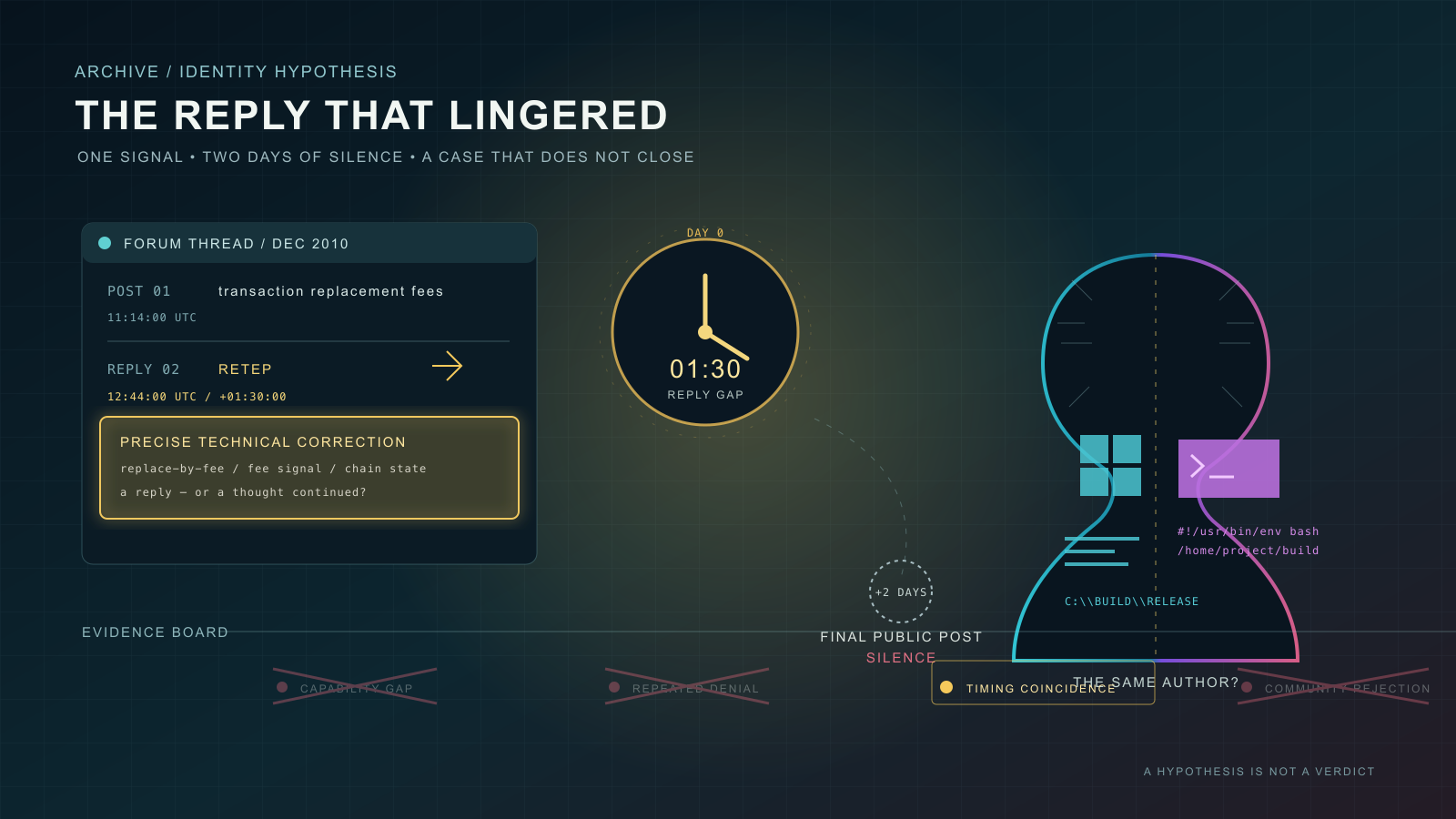
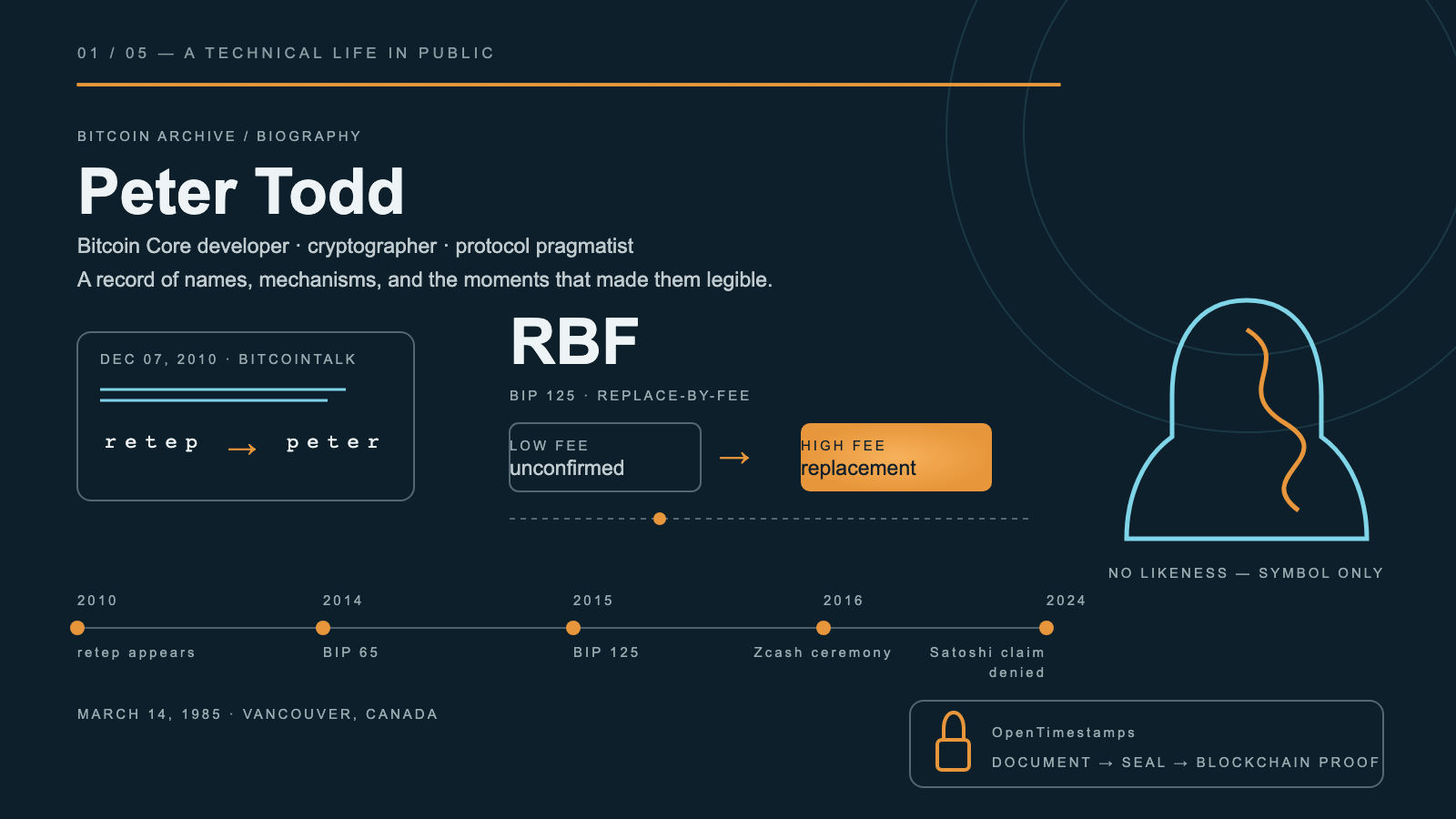
| Reply in a Satoshi-started forum thread | Peter Todd | One reply by the retep account in a Satoshi proposal thread. Not “direct contact” in the private sense, but cited as identification evidence by the HBO documentary |
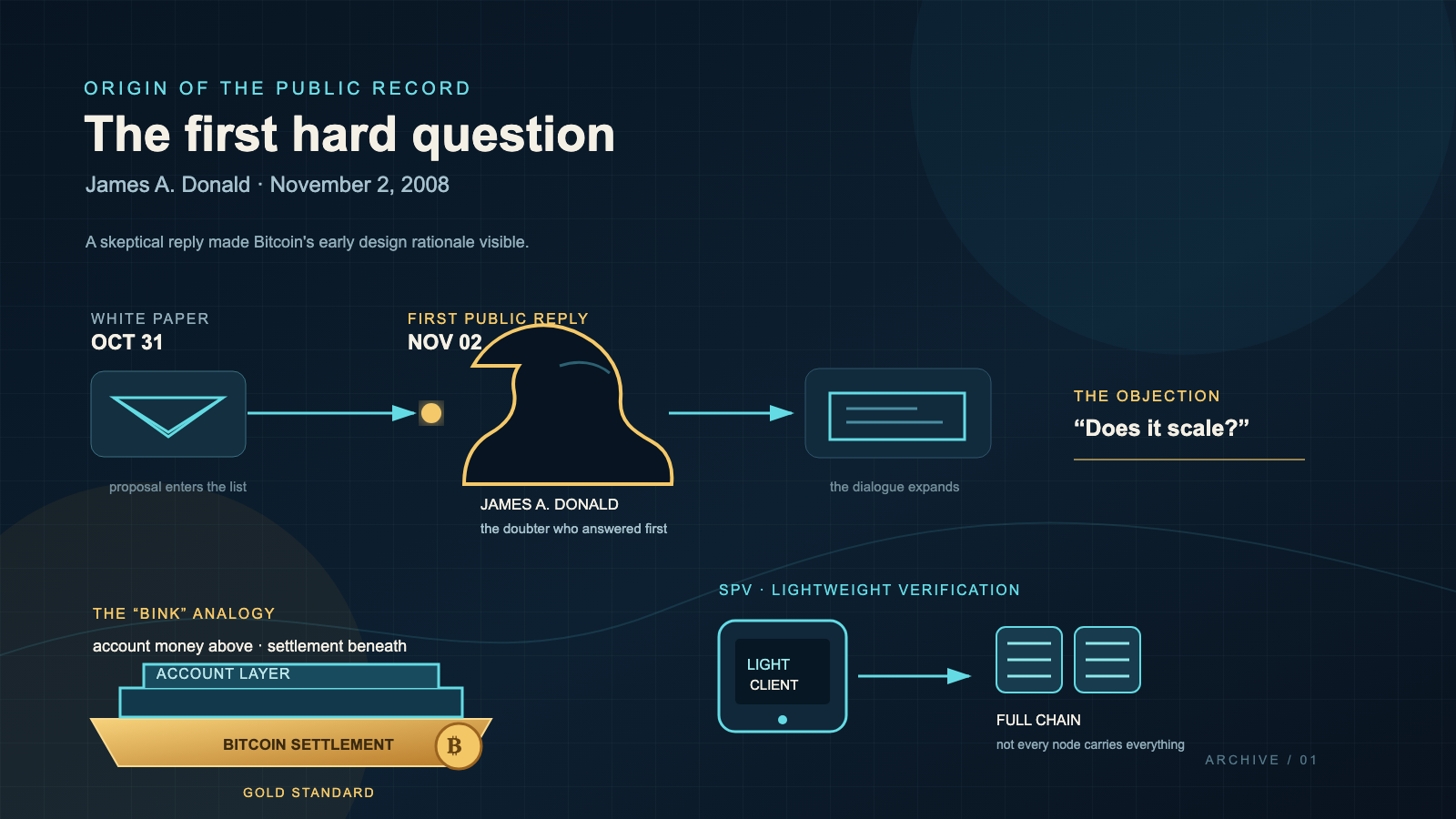
| Public mailing-list exchange | James A. Donald | First to answer the whitepaper announcement; Satoshi replied to his scaling objection point by point on the cryptography list — a public back-and-forth in which Satoshi addressed him as an outside questioner |
| No record of direct contact | Nick Szabo, Len Sassaman, Isamu Kaneko, Dorian Nakamoto, Craig Wright, Paul Le Roux, Elon Musk | Satoshi’s pre-launch outreach traced the prior-art lineage via Adam Back → Wei Dai only and reached none of these seven |
4.3 Reading the table
Reading the direct-correspondence layer: the presence or absence of correspondence is double-edged for hypothesis evaluation:
- Contact can also serve as evidence that Satoshi treated them as third parties — Satoshi’s pre-launch emails to Back and Wei Dai, and his public answers to James A. Donald’s scaling objection, function as central counter-evidence in those hypotheses (see Satoshi identification asymmetry §2).
- No contact splits into two readings — successful concealment or non-overlap of activity. Szabo was active in public discourse but had no direct exchange with Satoshi; Sassaman and Kaneko were active in adjacent but non-overlapping technical fields; Dorian, Wright, and Le Roux are name-match or self-claim with no operational presence. Even the correspondence that does exist is filtered: a documented behavioural pattern shows Satoshi routinely declining to answer the non-technical, identity-adjacent parts of messages he did reply to — the same identity-protective posture as the concealment reading, operating one layer up from the correspondence itself.
Combined with the §2 profile match and the §3 stylometric layer, correspondence functions as a third structural layer that locates each candidate’s position in the candidate space.
5. Layer 4 — Development environment
5.1 Satoshi’s three-phase OS-tooling profile
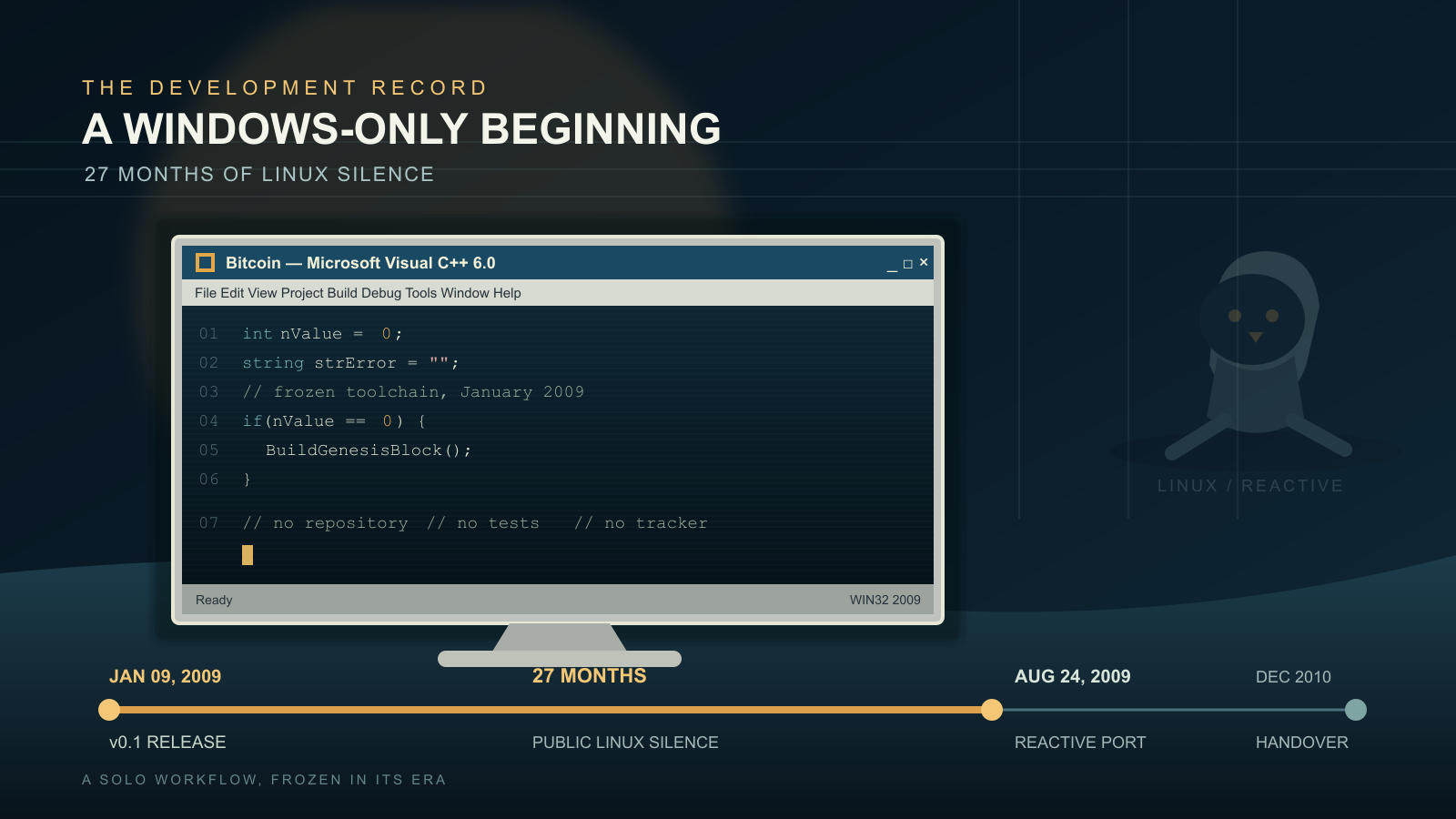
Bitcoin v0.1 was released as a Windows-only .rar archive built with Visual C++ 6.0 SP6 and MinGW GCC 3.4.5, used Hungarian-notation identifiers (nValue, strError, vtx), and depended on wxWidgets, Boost, OpenSSL, and Berkeley DB. The full forensic trace is in the Satoshi Windows development environment analysis, which also documents a three-phase trajectory of Satoshi’s OS-tooling profile:
| Phase | Period | OS profile |
|---|---|---|
| Phase 1 (~27 months) | mid-2007 → 2009-08-23 | Windows-only; no Linux trace in the development environment |
| Phase 2 (~16 months) | 2009-08-24 → 2010-12-02 | Reactive Linux support driven by Martti Malmi’s port |
| Phase 3 (~5 months) | 2010-12-03 → 2011-04-26 | Self-statement “Gavin is much more Linux capable than me” |
The most diagnostic comparison is against Phase 1, when the entire architecture and the 19,901-line v0.1 codebase were produced. Each candidate’s documented development-environment profile can be aligned against this baseline.
5.2 Comparison table
| Candidate | Phase 1 alignment | Primary OS | Primary languages | Documented shipping codebase |
|---|---|---|---|---|
| Adam Back | Mixed — language overlap, OS not established | Not in archive record (Microsoft work history) | Perl (compact-code reputation); C / C++ | Hashcash specification + small reference implementations |
| Wei Dai | High — Windows-MSVC overlap; multi-thousand-line C++ cryptographic-library shipping record | Windows (Microsoft work history; MSVC primary) | C++ | Crypto++ — multi-platform C++ class library, originally Windows-MSVC-rooted |
| Hal Finney | Misalignment — Mac primary; published code uses snake_case + tabs vs Satoshi’s spaces + Hungarian-notation camelCase | Mac (long-term, documented) | C / C++ | PGP 2.0, RPOW |
| James A. Donald | No documented shipping codebase at v0.1 scale | Not in archive record | Not in archive record | jim.com writing on cryptography and economics; no documented shipping codebase |
| Peter Todd | Misalignment — Linux uniformly, no Windows trace | Linux (2008–2011 GitHub repositories uniformly Linux: FHS paths, Unix shebangs, PyGTK) | C / Python | Linux-native hardware / firmware tooling |
| Nick Szabo | Misalignment — no documented C++ shipping at v0.1 scale | Not in archive record | No shipping C++ record | Bit Gold proposal (paper only); explicitly asked for implementation help in April 2008 |
| Len Sassaman | Misalignment — Unix-primary, no documented Windows-first development | Unix / Linux primary (Mixmaster maintainer; KU Leuven research environment) | C | Mixmaster (C; *BSD / Linux primary, Windows port available) |
| Dorian Nakamoto | Misalignment — no documented C++ shipping | Not in archive record (classified defense-systems engineering) | Physics / electronics background | No public codebase |
| Craig Wright | — Not applicable (COPA v Wright 2024 ruling) | — | — | — |
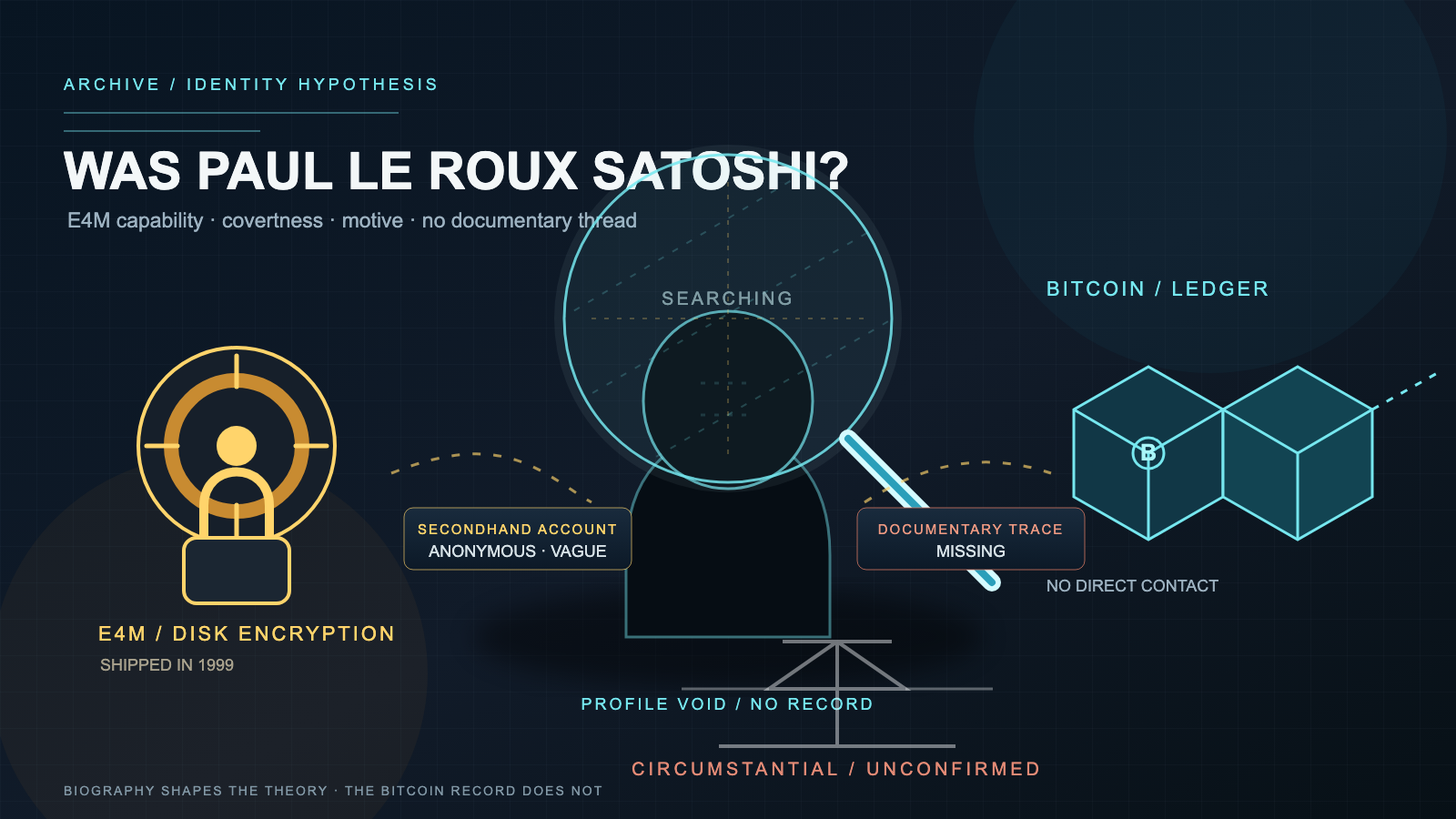
| Paul Le Roux | Surface alignment — Windows + C++ + cryptographic shipping, but the public shipping record stops in 1999 | Windows NT / 9x | C++ | E4M (Windows-only disk encryption, first released December 1998; later built into TrueCrypt) |
| Elon Musk | No cypherpunk or cryptographic shipping record | Not in archive record | Commercial software | No Bitcoin-relevant codebase |
| Isamu Kaneko | Partial — OS / language match, but Winny source uses Japanese identifiers and comments; Bitcoin v0.1 source is English-only | Windows | C++ | Winny (Windows P2P, C++) |
5.3 Reading and color meaning
Color meaning (this table only — Phase 1 alignment column): high alignment with Phase 1’s Windows + MSVC + C++ shipping profile; partial, surface-level, or mixed; documented misalignment, or no shipping codebase at v0.1 scale. This scale is separate from §2’s profile-match scale even though the same glyphs are used; the overall caveat is in §7.
Reading the development-environment layer:
- Two candidates align with Phase 1’s Windows + MSVC + C++ shipping profile. Wei Dai shipping Crypto++ — a C++ cryptographic class library originally rooted in Windows-MSVC — is the most direct overlap with Bitcoin v0.1’s cryptographic-library dependency pattern. Paul Le Roux shipped E4M (Windows-only C++ disk encryption) in December 1998, but his public shipping record stops in 1999.
- Three candidates show direct OS misalignment with Phase 1. Hal Finney (long-term Mac, snake_case + tabs), Peter Todd (Linux-only GitHub trail), and Len Sassaman (Unix-primary tooling) each have a documented primary environment outside Windows.
- Five candidates have no documented shipping codebase at v0.1 scale. Nick Szabo asked for implementation help in April 2008; Dorian Nakamoto’s classified defense work produced no public code; Craig Wright’s claimed evidence was found fabricated by the UK High Court; Elon Musk has no cryptographic shipping record; and James A. Donald is a commentator with no documented shipping codebase.
- Adam Back’s personal OS is not in the archive record. Hashcash spans Perl and C / C++ reference implementations, but the scale gap between those reference implementations and Bitcoin v0.1’s 19,901-line C++ codebase is wider than for candidates with Crypto++- or E4M-scale shipping records.
- Isamu Kaneko’s Winny matches Windows + C++ at the platform level, but Winny’s source contains Japanese identifiers and comments — a register Bitcoin v0.1 does not exhibit.
5.4 Limits of this layer
- A candidate could have developed Bitcoin on Windows-MSVC without that environment being represented in their public codebase — absence of evidence is not evidence of absence.
- Bitcoin v0.1’s Windows-only release could in principle have been an intentional misdirection by a developer whose primary environment was Mac or Linux.
- Phase 2 and Phase 3 show Satoshi’s OS profile shifting toward Linux capability, so a candidate whose primary OS was Linux (Peter Todd, Len Sassaman) is more consistent with Phase 3 than with Phase 1 — but Phase 1 is the construction period and the more diagnostic comparison.
6. Cross-cutting observations
Each observation below is anchored in one or more of the four layers (§2 profile match, §3 stylometric, §4 direct correspondence, §5 development environment).
- Wei Dai is the candidate closest to “all-” in §2 — and external status still rules him out. Six of seven dimensions are ; only Timing is . After the 1998 b-money proposal, his mailing-list posting frequency dropped and during 2007–2008 he focused on Crypto++ maintenance, naturally placing him in the “invisible” zone. However, he has self-denied, and the August 2008 pre-launch correspondence reads as Wei Dai receiving Satoshi’s proposal as a third party (the same argument that applies to Adam Back). Profile-match alone, even at near-maximum, does not decide.
- Sassaman is the only externally-open high-scorer in §2 — and his pattern is a specialty-separation byproduct. His 2007–2008 public activity was in the anonymity-research specialty (Mixmaster, KU Leuven, 24C3 and Black Hat 2007), adjacent to but distinct from Bitcoin’s digital-cash specialty. He could be visible in his own field while remaining invisible in Bitcoin’s. Most candidates do not get this specialty-separation benefit and pay the capability-vs-covertness trade-off more directly.
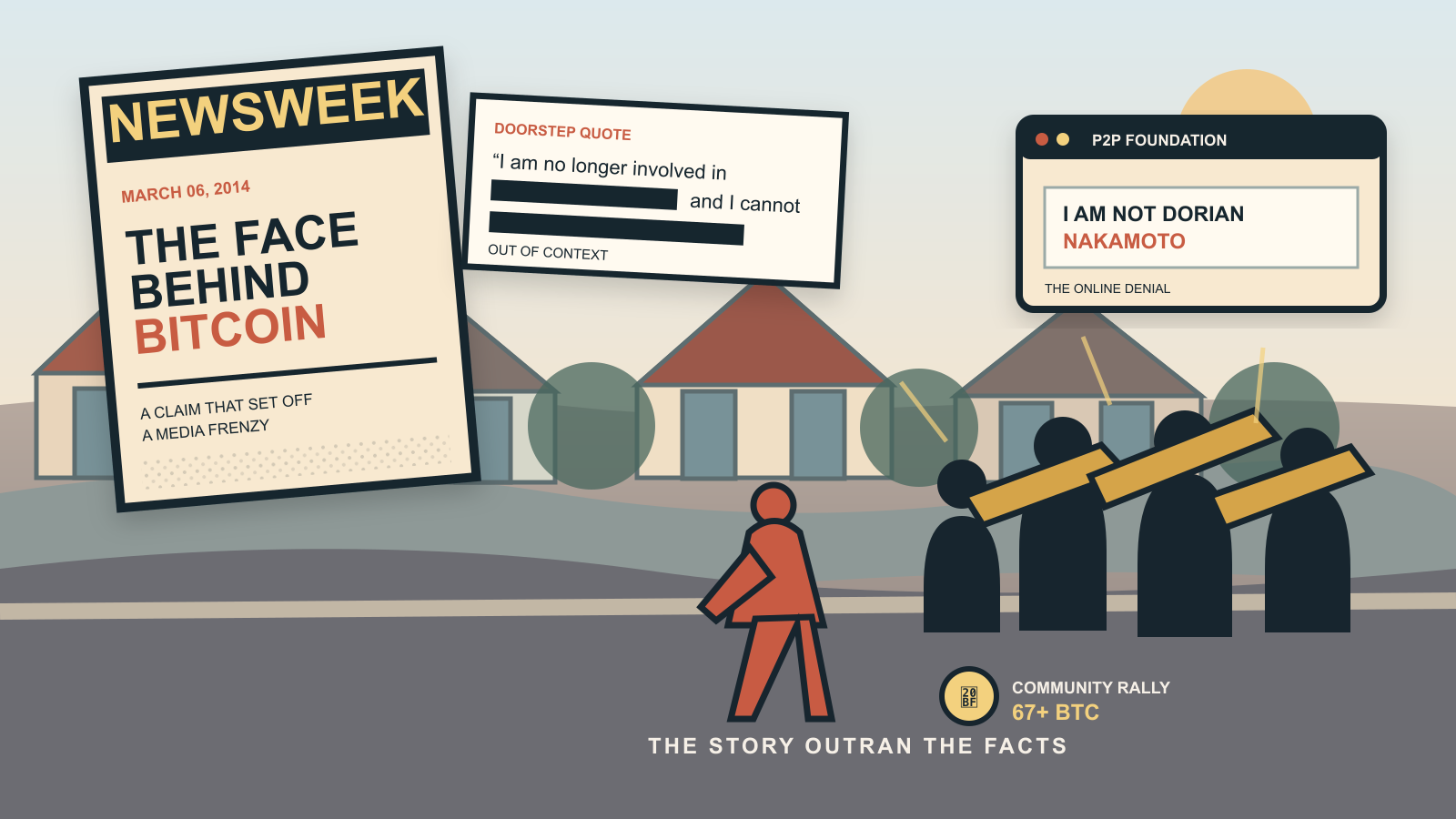
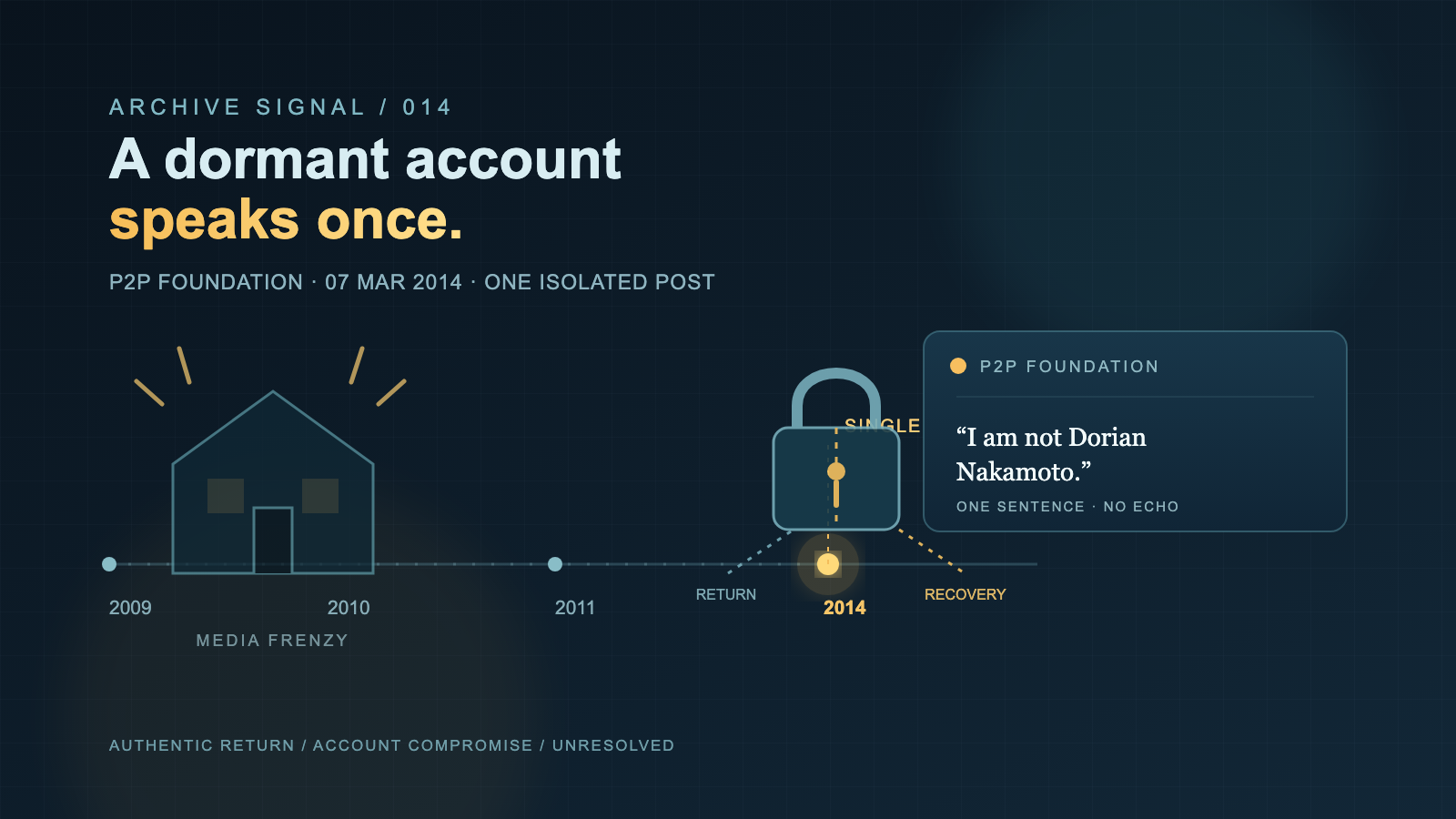
- Name-match (Dorian) and self-claim (Wright) have both been publicly refuted. Group C’s two highest-profile claims share a structural pattern: both relied on a single line of evidence (name or self-claim) without underlying technical or intellectual fit. The Newsweek identification was demolished by Dorian’s repeated denial (with lawyer and AP interview), the p2pfoundation account post “I am not Dorian Nakamoto,” and broad criticism of the journalistic methodology. The Wright self-claim was demolished by the COPA v Wright ruling. Group C candidates who remain open (Le Roux, Kaneko) do so on capability + covertness arguments rather than identification-by-claim.
- Multi-layer convergence is partial. Wei Dai is the candidate most consistent across §2 (six of seven ) and §5 (Crypto++ as Windows-MSVC C++ shipping). Hal Finney shows the sharpest cross-layer mismatch: §2’s profile-match dimensions are mostly , but §5 records direct OS misalignment (long-term Mac, snake_case + tabs). Most candidates score similarly across multiple layers because the layers measure correlated capability proxies; where they diverge (Finney, Sassaman, Todd) the divergence is structural, not noise. Convergence across layers does not by itself establish identification — each layer is necessary but not sufficient — but cross-layer mismatch is informative.
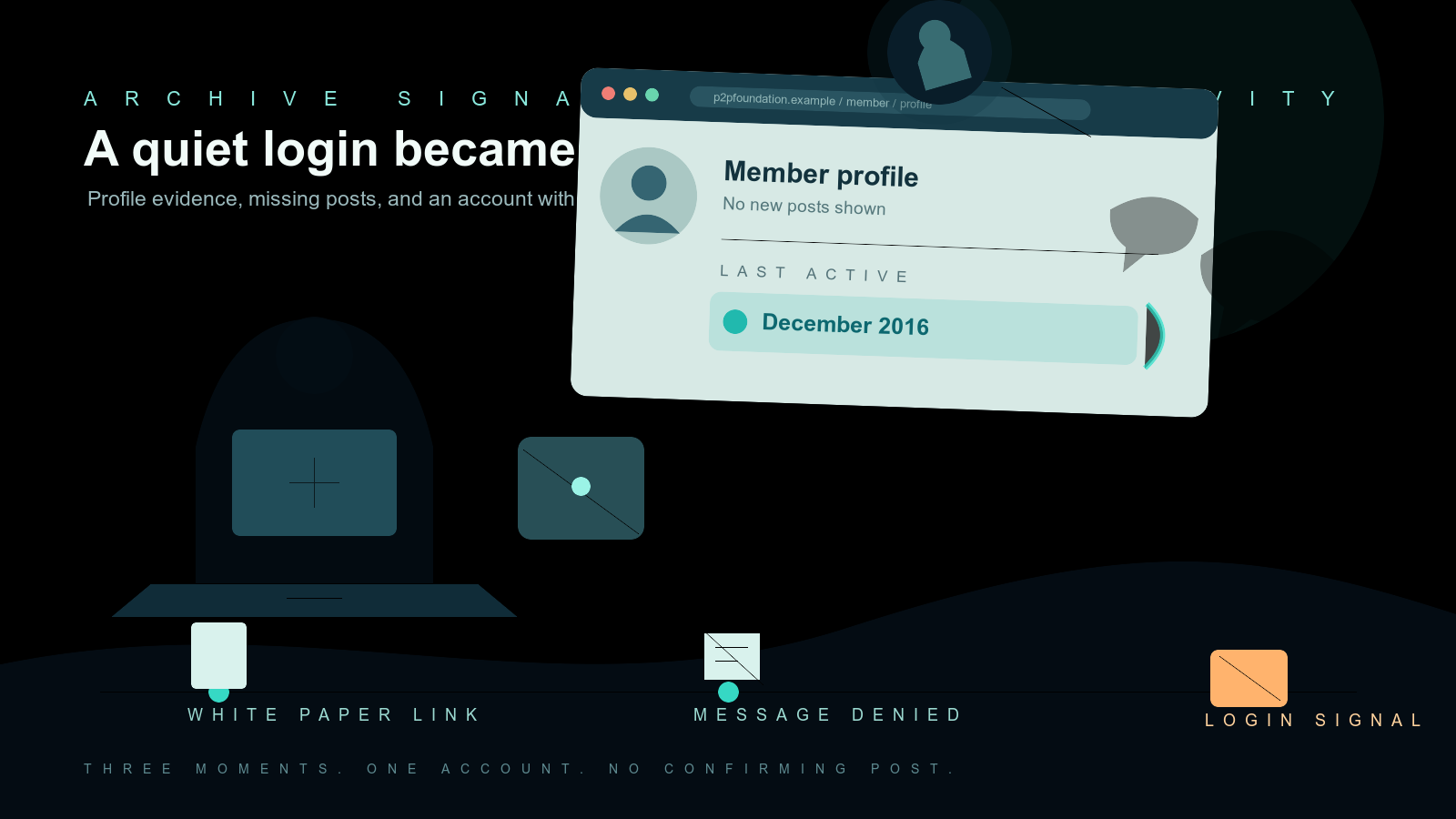
- Post-2011 Satoshi-account activity bears on every pre-2014 timing fit. The Timing dimension anchors on the April 26, 2011 email, but a Satoshi-account post denying the Dorian Nakamoto identification appeared in March 2014, and P2P Foundation founder Michel Bauwens recalled private Satoshi email in the same period. If that activity is genuine, it places the author alive three years past Sassaman’s 2011 death and eight months past Kaneko’s 2013 death — directly contradicting Sassaman’s timing fit (Kaneko’s Timing dimension in §2.1 already reads , no fit to contradict); its authenticity is disputed (the account lacked two-factor authentication, and a December 2016 login left no post), so it constrains rather than decides. It reaches exactly the candidates whose qualifying life event precedes 2014 — Sassaman and Kaneko — and not Finney, who died in August 2014, after the post.
7. Overall limits
- This entry does not present new evidence. It compiles publicly available material into one comparison.
- Each of the four layers is necessary but not sufficient; external status is in some cases decisive.
- The color-coded labels in §2 and §5 are not interchangeable, even though both tables use / / . §2’s scale measures match against the seven profile dimensions; §5’s scale measures alignment against Phase 1’s Windows-MSVC-C++ shipping profile. Read each table with its own section’s legend. In both cases the labels are qualitative summaries, not numerical scores. They visualize judgments stated elsewhere (in the individual hypothesis entries). Different qualified readers may place individual cells differently.
- The four layers (§2 profile match, §3 stylometric, §4 direct correspondence, §5 development environment) are not interchangeable. Each narrows the candidate space differently. A candidate ruled out by one layer is not necessarily ruled out by another, and convergence across layers does not establish identification. See §6 for the multi-layer convergence observation.
- This entry assumes the public record is the relevant evidence base. Hypotheses based on private channels, claimed unverifiable communications, or unsourced personal recollection are not addressed here.
- The set of named candidates is not closed. Hypotheses involving other named persons or groups exist in public discourse; this entry covers the twelve most-discussed.
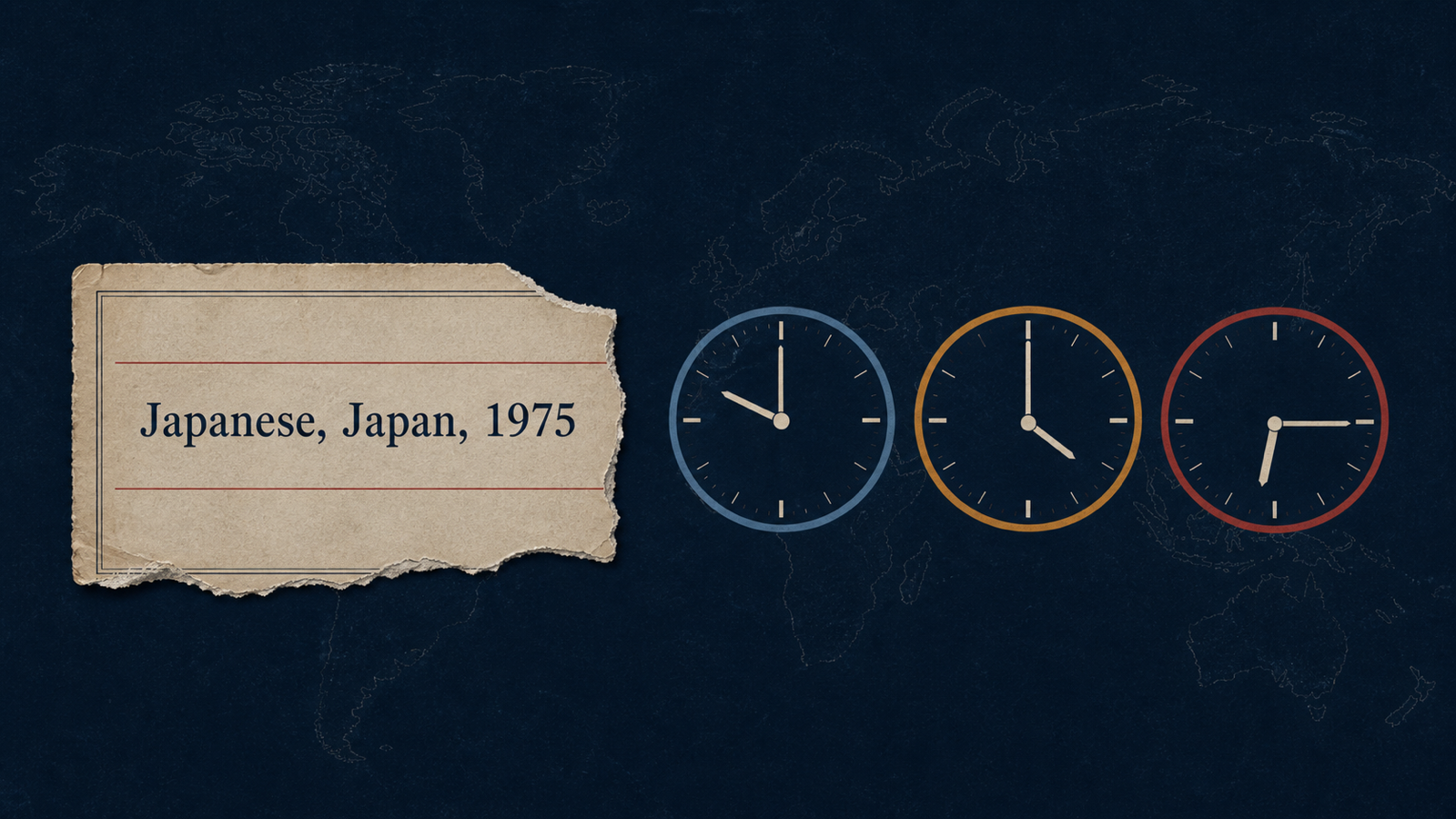
- The Japanese form of the “Satoshi Nakamoto” pseudonym bears on the identity question independently of any single candidate; it is treated in the techno-orientalist signature analysis. Whether Satoshi actually was Japanese is treated in the nationality question analysis, which narrows the English level dimension in §2.1 to its own dedicated argument and checks Isamu Kaneko’s candidacy against that question.
8. Hypotheses beyond a single candidate
§2–§5 treat hypotheses that name a single individual. But “Satoshi was a single person” is itself a hypothesis, and public discourse holds readings beyond the single-candidate frame. This section treats them under the same record discipline (primary sources, sourced claims). As with the named candidates, the set of forms here is not closed.
8.1 Multiple-person theory
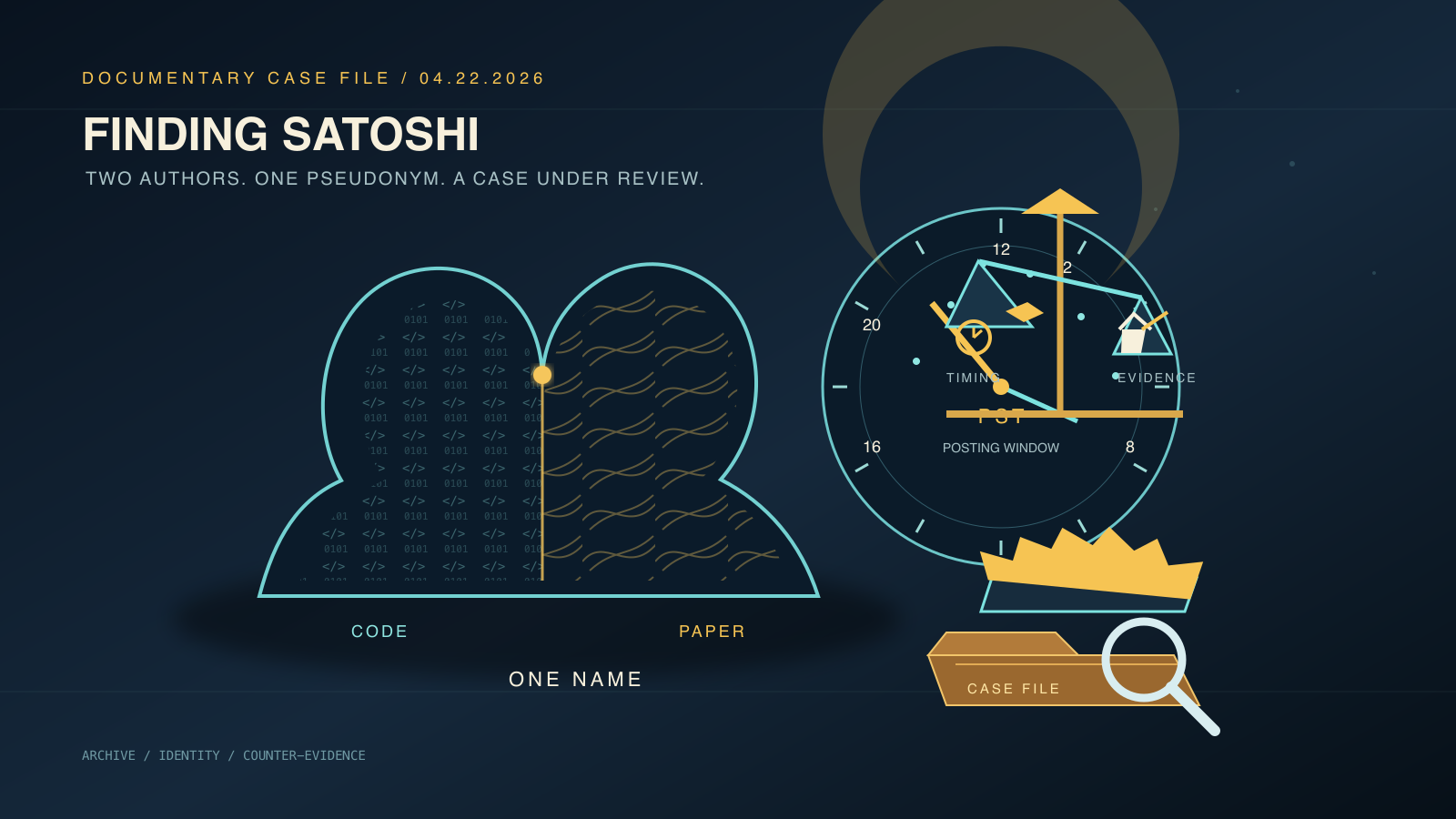
The April 2026 documentary Finding Satoshi presents Satoshi Nakamoto as a collaboration between Hal Finney (the implementation) and Len Sassaman (drafting the whitepaper), drawing on activity-time analysis, family testimony, and a motive reading from a former FBI profiler. Finney and Sassaman are treated as separate single candidates in §2–§5; this reading binds them into one co-authorship hypothesis. The counter-evidence overlaps with the single-candidate entries — Jameson Lopp and Adam Back point to the timing conflict with Finney’s April 18, 2009 race-day alibi, the mismatch between Sassaman’s KU Leuven tenure and the proposed activity window, and the absence of Patoshi-scale balances in either estate. The co-authorship reading carries the added burden of explaining a Finney–Sassaman collaboration that left no documentary trace.
8.2 Organization / government-agency theory
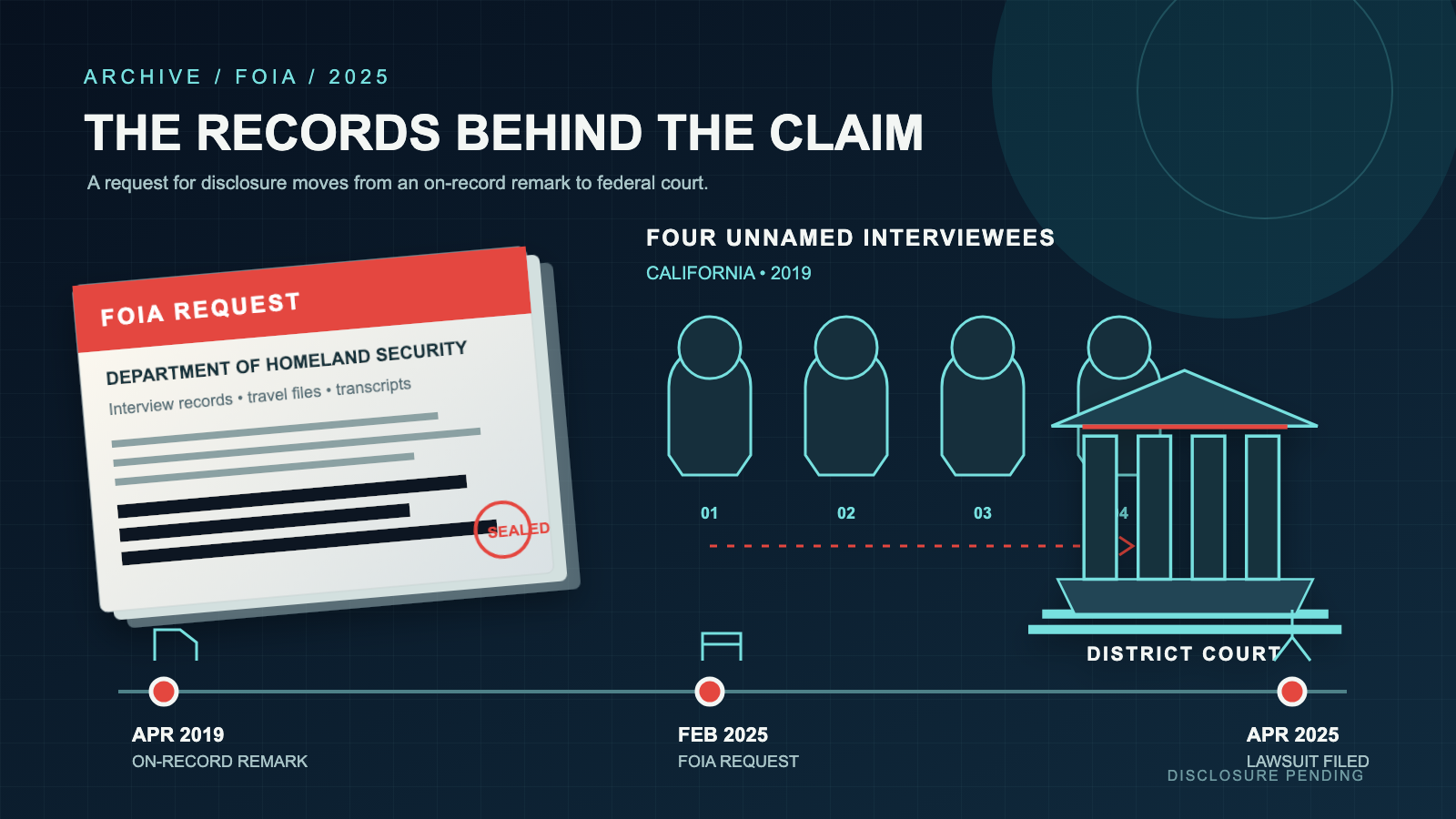
The Murphy v DHS FOIA lawsuit (April 2025) seeks internal records behind a 2019 on-stage statement by DHS special agent Rana Saoud that DHS agents had traveled to California and met “the four people behind the creation of Bitcoin.” The four are unidentified in public reporting; if the records are released, they could establish the facts of the 2019 meeting without recourse to stylometric inference.
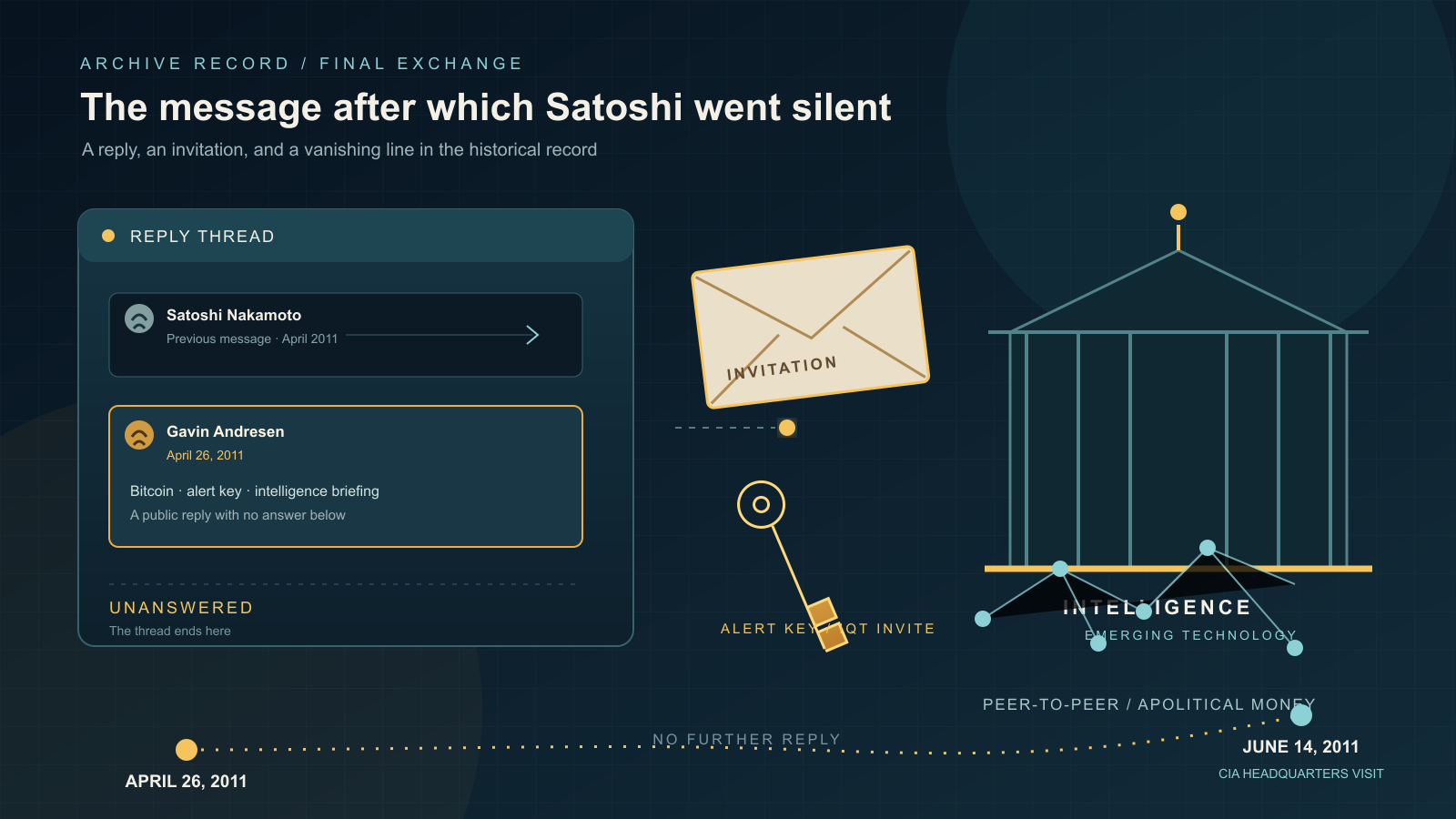
As related context, Satoshi disappeared shortly after Gavin Andresen, replying to Satoshi’s final email (April 26, 2011), disclosed an invitation from In-Q-Tel (the CIA-linked strategic investment firm) to present Bitcoin — a sequence often cited in government-involvement discussion.
8.3 Other forms
Readings that fit neither a single individual, multiple people, nor an organization — such as the pseudonym being a construct rather than one person — also circulate in public discourse. This archive holds no dedicated treatment of them at present.
The silence around Satoshi is not an empty page. It is a field of partial matches: one name fits the lineage, another the code, another the timing, while direct records open cracks in each neat answer. The mystery survives not because every theory is equally strong, but because no theory crosses the whole record.