
Who Is Satoshi Nakamoto: 12 Geniuses and the Mystery of the Century
Recurring Satoshi candidates aligned across four independent layers — profile match, stylometric attribution, direct correspondence, and development environment.
Winny developer, University of Tokyo research associate, Japan-domestic Satoshi-identity candidate
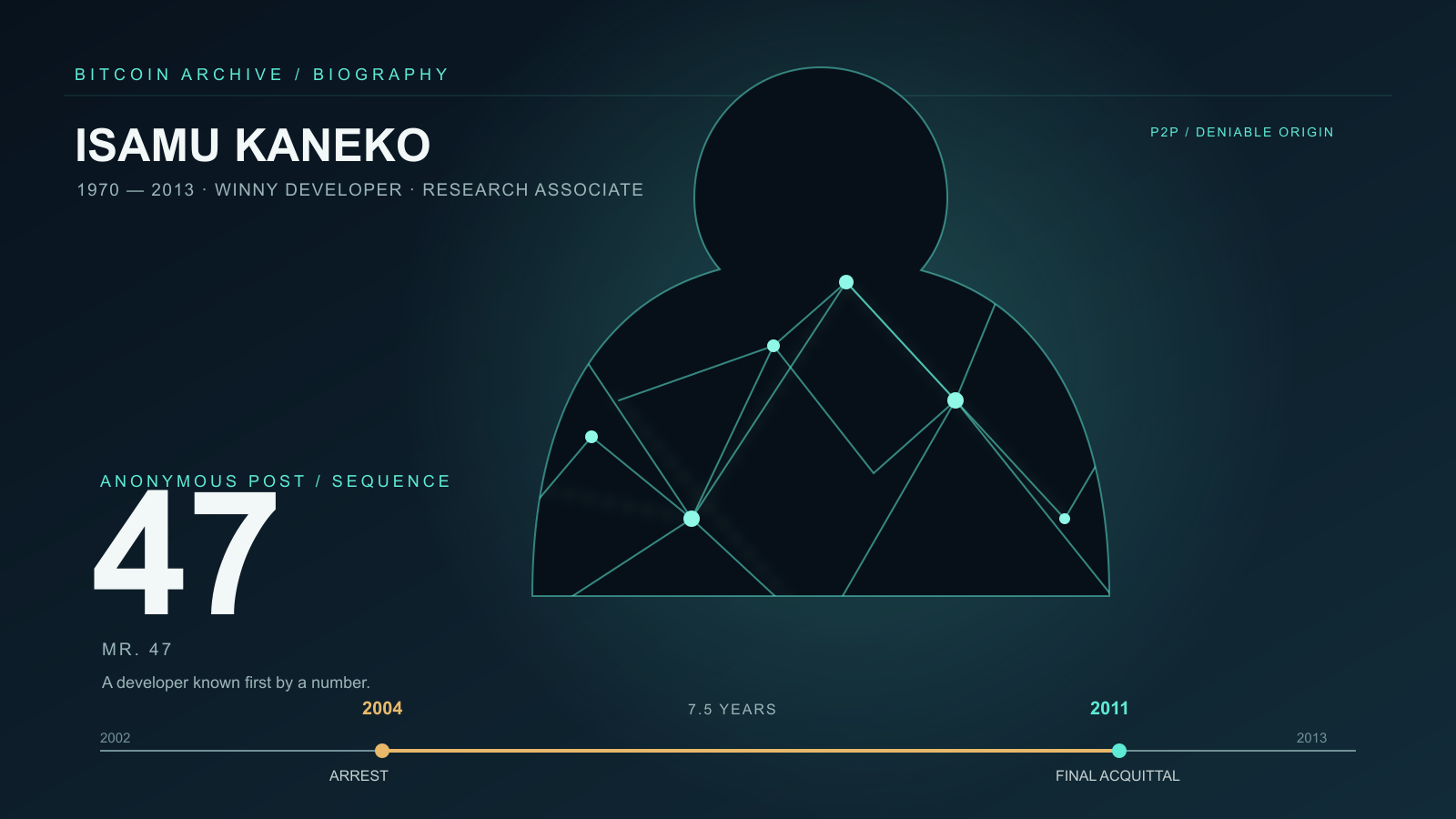
In May 2002, a Tokyo University research associate named Isamu Kaneko released Winny — a P2P file-sharing client — on the 2channel forum. Two years later, on May 10, 2004, the Kyoto Prefectural Police arrested him on contributory copyright-infringement charges; Japan’s Supreme Court would not finalize his acquittal until December 19, 2011, seven and a half years later. He died of a myocardial infarction on July 6, 2013, at age 42. He is in this archive primarily because of the posthumous Japan-domestic Satoshi-identity hypothesis that connects his name to Satoshi Nakamoto — a hypothesis essentially unknown in English-language Bitcoin discourse.
While serving as a research associate in the Graduate School of Information Science and Technology at the University of Tokyo, Kaneko released a P2P file-sharing system called Winny on the 2channel forum in May 2002. Winny used a routing scheme designed to make the origin of each shared file deniable, and grew at peak to a network of millions of Japanese users. Its design drew on Freenet, Gnutella, and the anonymous-routing literature.
Kaneko posted his development announcement anonymously to the 2channel download-software board and continued to develop the software in dialogue with users on that thread. His first post on the thread carried sequence number 47, which the users adopted as his handle — from that point until his real name was disclosed, he was known to the Winny community as 「47 氏」 (“Mr. 47”).
The opening post on the thread (thread log archive):
「暇なんで freenet みたいだけど 2chネラー向きのファイル共有ソフトつーのを作ってみるわ。もちろん Windows ネイティブな。少しまちなー。」
(Loosely: “Got some free time so I’m going to try making a file-sharing app like Freenet but oriented to 2channel users. Windows-native, of course. Hang on a bit.”)
The closing phrase 「少しまちなー」 (“hang on a bit”) recurs across Mr. 47’s later posts in the same thread — a recognizable tic that gave the anonymous handle a stable voice through the development cycle.
In May 2004, Kyoto Prefectural Police arrested Kaneko on charges of aiding copyright infringement. The prosecution argued that by developing and distributing Winny he had aided the infringement carried out by users who shared copyrighted content using it.
| Date | Event |
|---|---|
| May 10, 2004 | Arrested by Kyoto Prefectural Police |
| Dec 13, 2006 | Kyoto District Court rules guilty (fine of 1.5 million yen) |
| Oct 8, 2009 | Osaka High Court reverses to acquittal |
| Dec 19, 2011 | Supreme Court rejects prosecution appeal; acquittal final |
The trial is widely cited in Japanese tech-policy discussion as a landmark precedent on the criminal liability of tool developers.
Following the final acquittal, Kaneko returned to commercial software development. In 2012 he joined Dreamboat Inc. and contributed to SAMURAI, a content-distribution platform.
Kaneko died of myocardial infarction on July 6, 2013, at the age of 42.
All of the archive’s Bitcoin-relevant context for Kaneko is posthumous. In Japanese-language venues — particularly 2channel / 5channel derivative threads and Japanese technical media — Kaneko has recurringly been discussed as a possible Satoshi-identity candidate. The arguments cite the fit of “Satoshi Nakamoto” as a Japanese name, the P2P-protocol capability demonstrated by Winny, his Japanese-English bilingual ability as a Tokyo University research associate, and his anti-establishment stance during the Winny trial.
The principal counter-evidence: (a) the social scrutiny he was under as a defendant on appeal during the 2007–2008 Bitcoin development window, (b) the absence of any documented presence in Bitcoin’s intellectual lineage (Hashcash, b-money, Bit Gold), (c) the absence of any Japanese-language trace in Bitcoin v0.1 source, (d) the divergence between Satoshi’s English register and Kaneko’s documented academic English, and (e) the roughly two-year interval between Satoshi’s last known email (April 2011) and Kaneko’s death (July 2013), during which Kaneko engaged in further public technical work including commercial software development.
For the full hypothesis treatment, see the Isamu Kaneko = Satoshi hypothesis entry.
2 entries
Recurring Satoshi candidates aligned across four independent layers — profile match, stylometric attribution, direct correspondence, and development environment.
The Japanese-language hypothesis that Isamu Kaneko (Winny P2P developer, prosecuted from 2004, died July 2013) was Satoshi. Counter: criminal-case scrutiny, English-register difference.