
Who Is Satoshi Nakamoto: 12 Geniuses and the Mystery of the Century
Recurring Satoshi candidates aligned across four independent layers — profile match, stylometric attribution, direct correspondence, and development environment.
Japanese-American engineer falsely identified as Satoshi by Newsweek
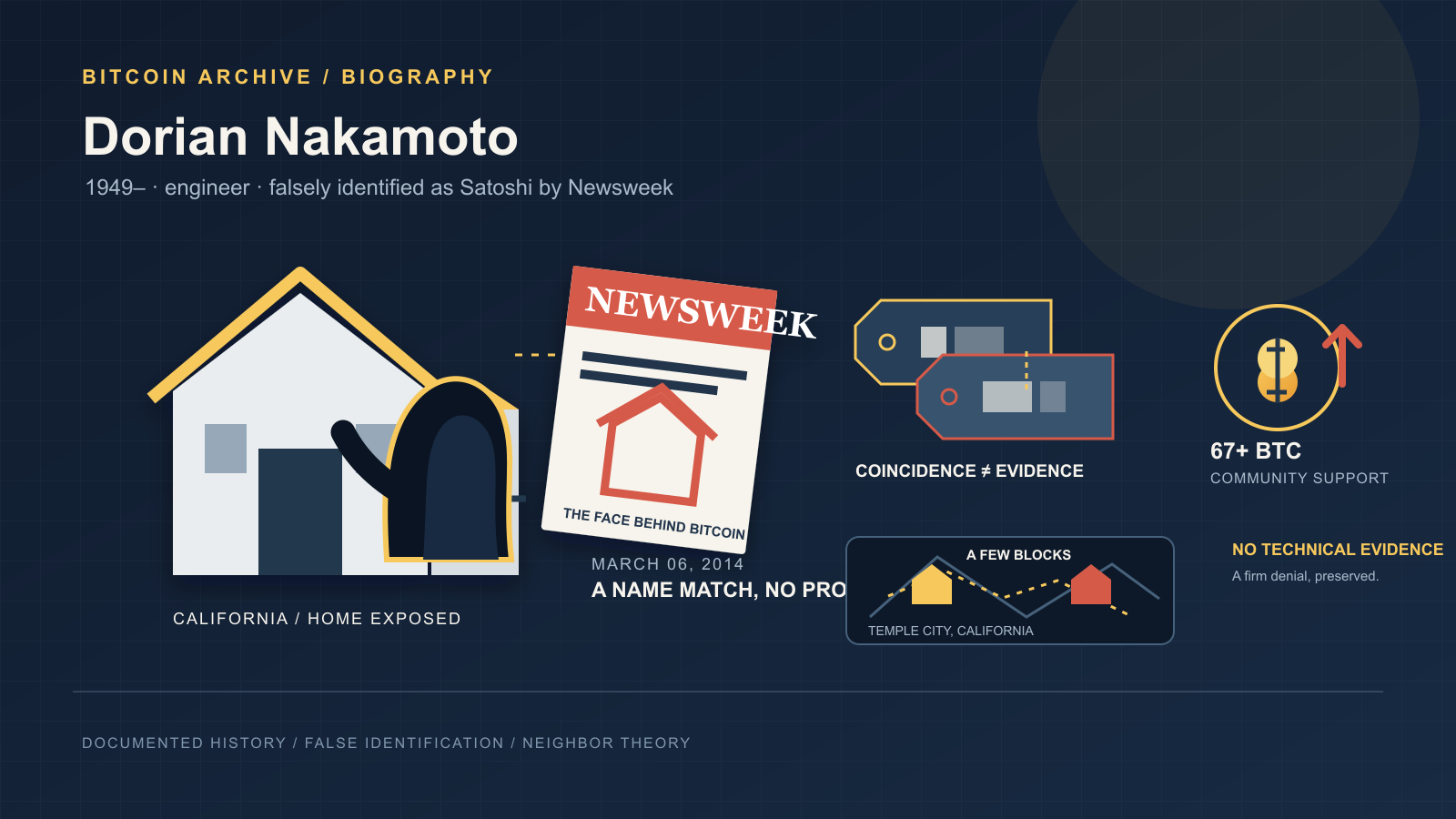
On March 6, 2014, Newsweek published “The Face Behind Bitcoin” — a cover story claiming the magazine had found Satoshi Nakamoto. The man it named, Dorian Prentice Satoshi Nakamoto, was a 64-year-old Japanese-American engineer in Temple City, California, with no documented connection to cryptography or Bitcoin. The next day, the long-dormant Satoshi P2P Foundation account briefly returned to post a single line:
“I am not Dorian Nakamoto.”
Dorian Nakamoto himself firmly and repeatedly denied any involvement with Bitcoin. The Newsweek identification rested on three threads: that his birth name was literally “Satoshi Nakamoto,” that his career had been in classified-adjacent engineering, and a brief doorstep quote — “I am no longer involved in that and I cannot discuss it” — which Nakamoto said referred to his prior classified work, not Bitcoin. After Newsweek published his street address and a photograph of his house, the Bitcoin community raised over 67 BTC in donations for him.
Born July 1949 in Beppu, Japan, Dorian Nakamoto emigrated with his family to California at age ten (1959) and earned a bachelor’s degree in physics from California State Polytechnic University, Pomona. His professional career included engineering work for Hughes Aircraft, RCA, the Federal Aviation Administration, and other defense and aerospace contractors, some of it under classified contracts. He has lived for many years in Temple City, California — a small suburb in the San Gabriel Valley.
Whether the March 7, 2014 “I am not Dorian Nakamoto” post genuinely came from Satoshi remains debated. The same long-dormant Satoshi P2P Foundation account showed unexplained login activity again in late 2016, leaving open the possibility that the account was compromised rather than reactivated by Satoshi.
Dorian Nakamoto’s address in Temple City placed him a few blocks from Hal Finney, who had lived in the same town for nearly a decade. This geographic coincidence became the central thread of Andy Greenberg’s March 25, 2014 Forbes feature “Nakamoto’s Neighbor”, which proposed that Hal Finney may have constructed the “Satoshi Nakamoto” pseudonym from the name of a real person living a few blocks away. In Greenberg’s reporting on his visit, the Finney household denied any awareness of or connection on Hal’s part to Dorian Nakamoto — answered by Hal himself via eye-controlled communication, with Fran interpreting; no separate on-record statement from Fran specifically about the Dorian question has been published.
Dorian Nakamoto’s candidacy as Satoshi rests on the name match alone — there is no technical evidence connecting him to the Bitcoin codebase, no cypherpunk credentials, no documented programming work at Bitcoin v0.1 scale, and no monetary-system design history. The full case Newsweek made and the counter-evidence are laid out in the Dorian Nakamoto = Satoshi hypothesis; the identity-hypotheses overview places him among the named candidates.
6 entries
Recurring Satoshi candidates aligned across four independent layers — profile match, stylometric attribution, direct correspondence, and development environment.
The 2014 Newsweek cover story naming Dorian Nakamoto as Satoshi on his birth name alone. He denied it, the Satoshi account posted 'I am not Dorian Nakamoto,' and no technical link exists.
Newsweek publishes 'The Face Behind Bitcoin,' identifying Dorian Prentice Satoshi Nakamoto, a 64-year-old Japanese-American man living in Temple City, California, as Bitcoin's creator.
About 24 hours after Newsweek named Dorian Nakamoto as Bitcoin's creator, Satoshi's dormant P2P Foundation account posted a one-sentence denial. The post's authenticity has been debated since.
March 25, 2014 Forbes feature by Andy Greenberg visiting Hal and Fran Finney in Temple City, examining the Hal-as-Satoshi geographic theory and publishing the April 18, 2009 race-day alibi photos.
On April 8, 2026, the New York Times published John Carreyrou's investigation naming Adam Back as the most likely Satoshi based on stylometric analysis. Back denied the identification.