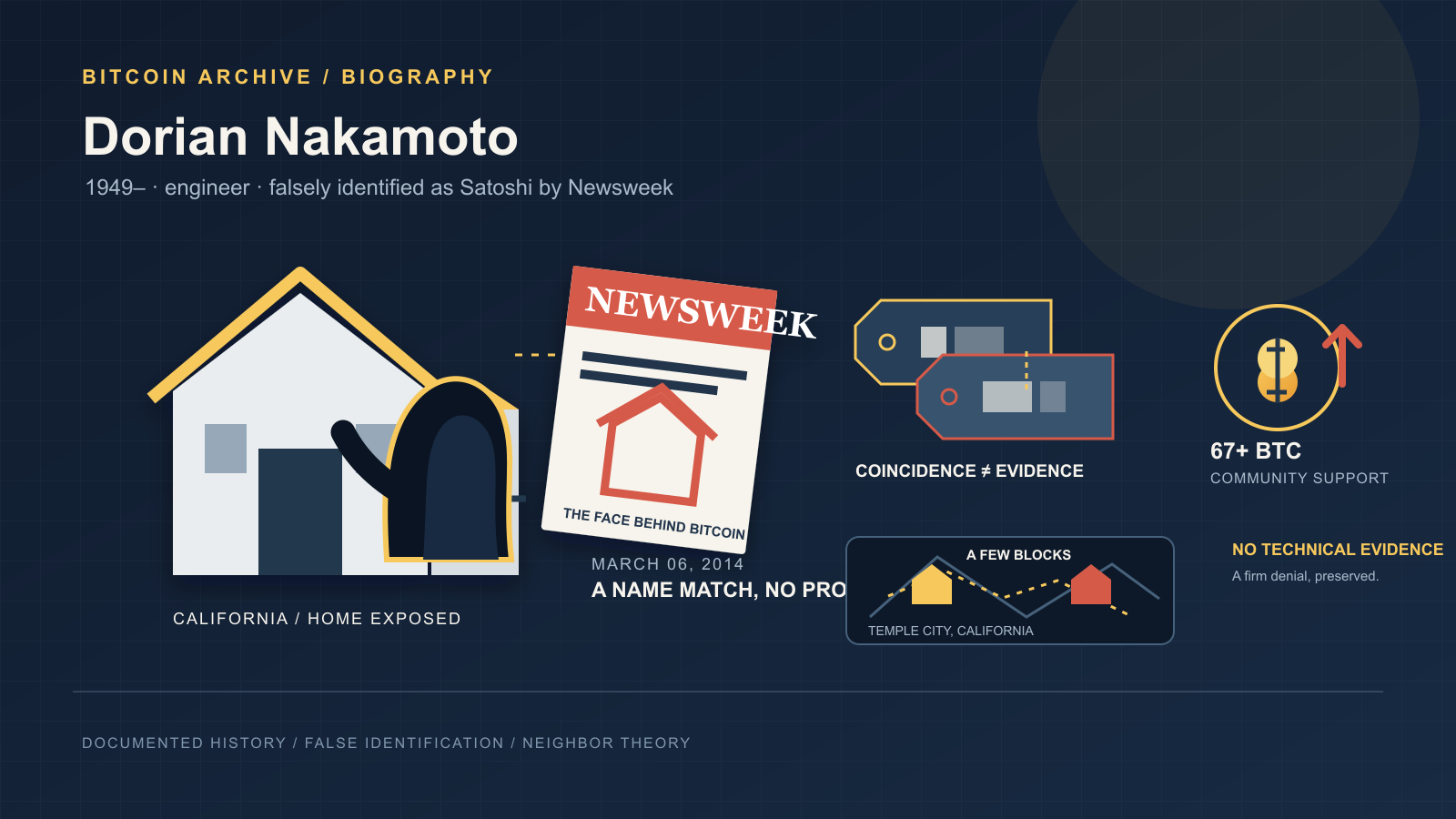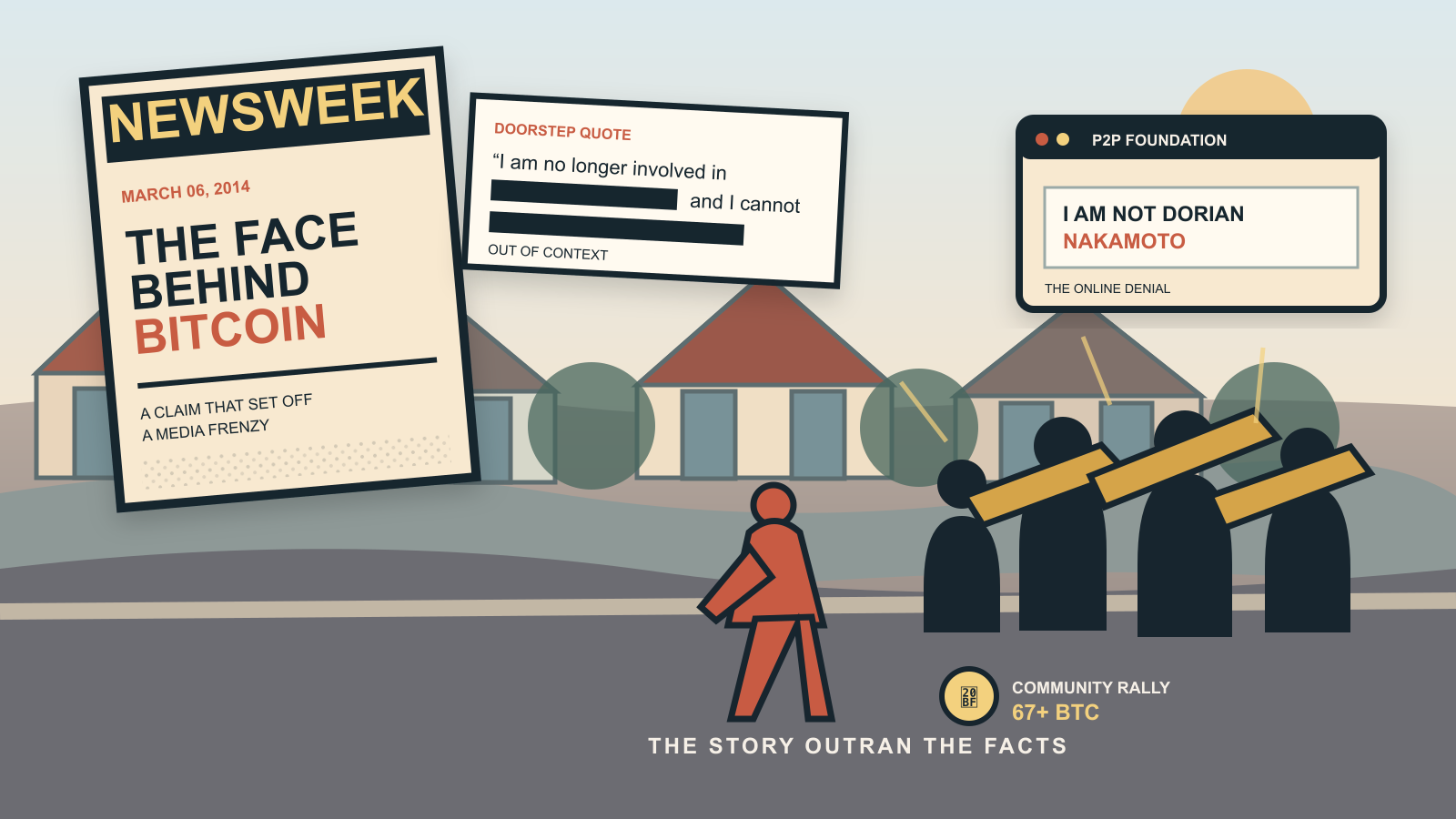
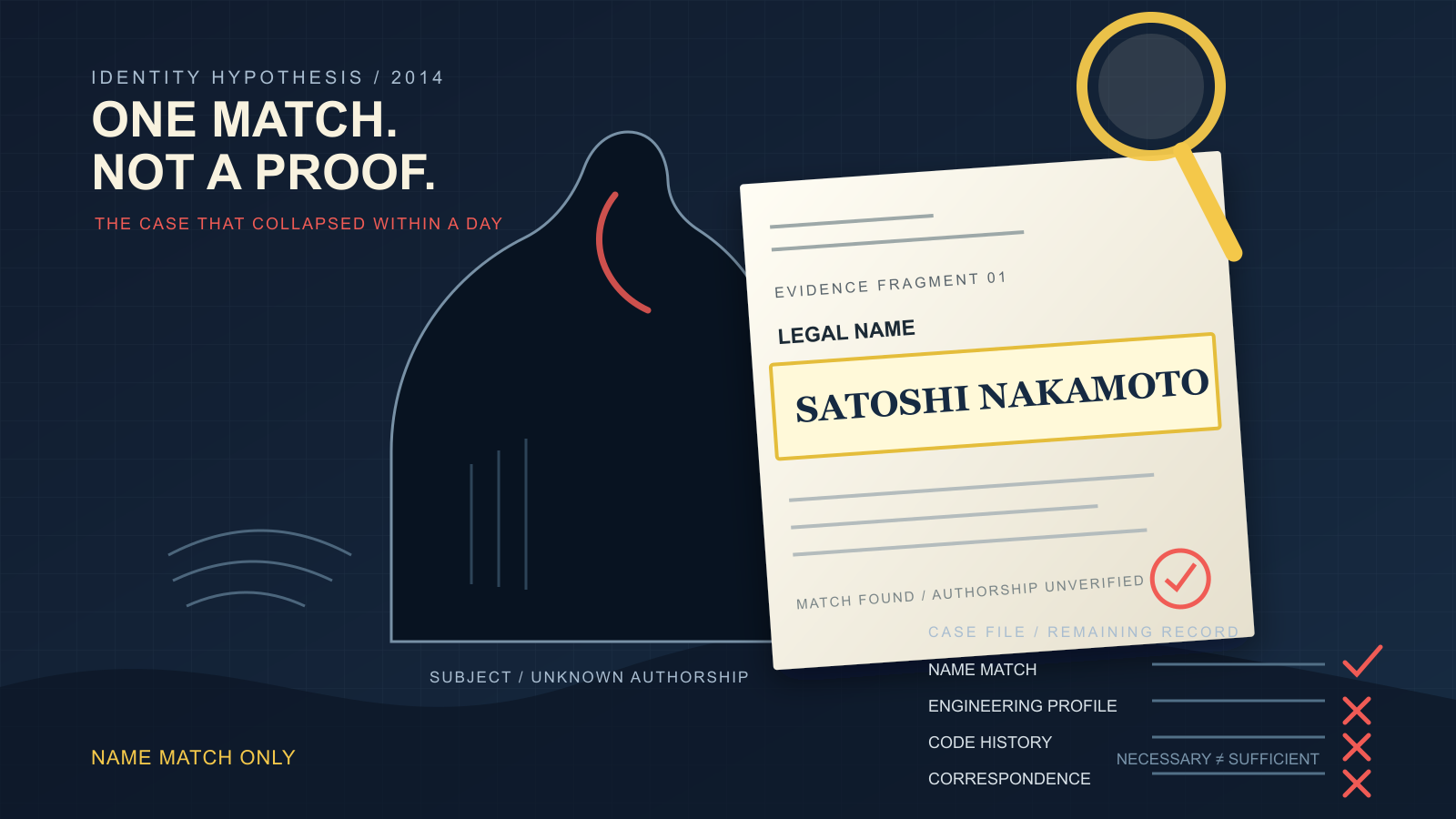
On March 6, 2014, Newsweek’s cover story “The Face Behind Bitcoin” announced that the magazine had found Satoshi Nakamoto, and named a 64-year-old engineer in Temple City, California: Dorian Prentice Satoshi Nakamoto. The identification rested on a single load-bearing fact — the man’s birth name was, literally, Satoshi Nakamoto — and it came apart within a day. His life and the timeline are in the Dorian Nakamoto biography.
1. The evidence
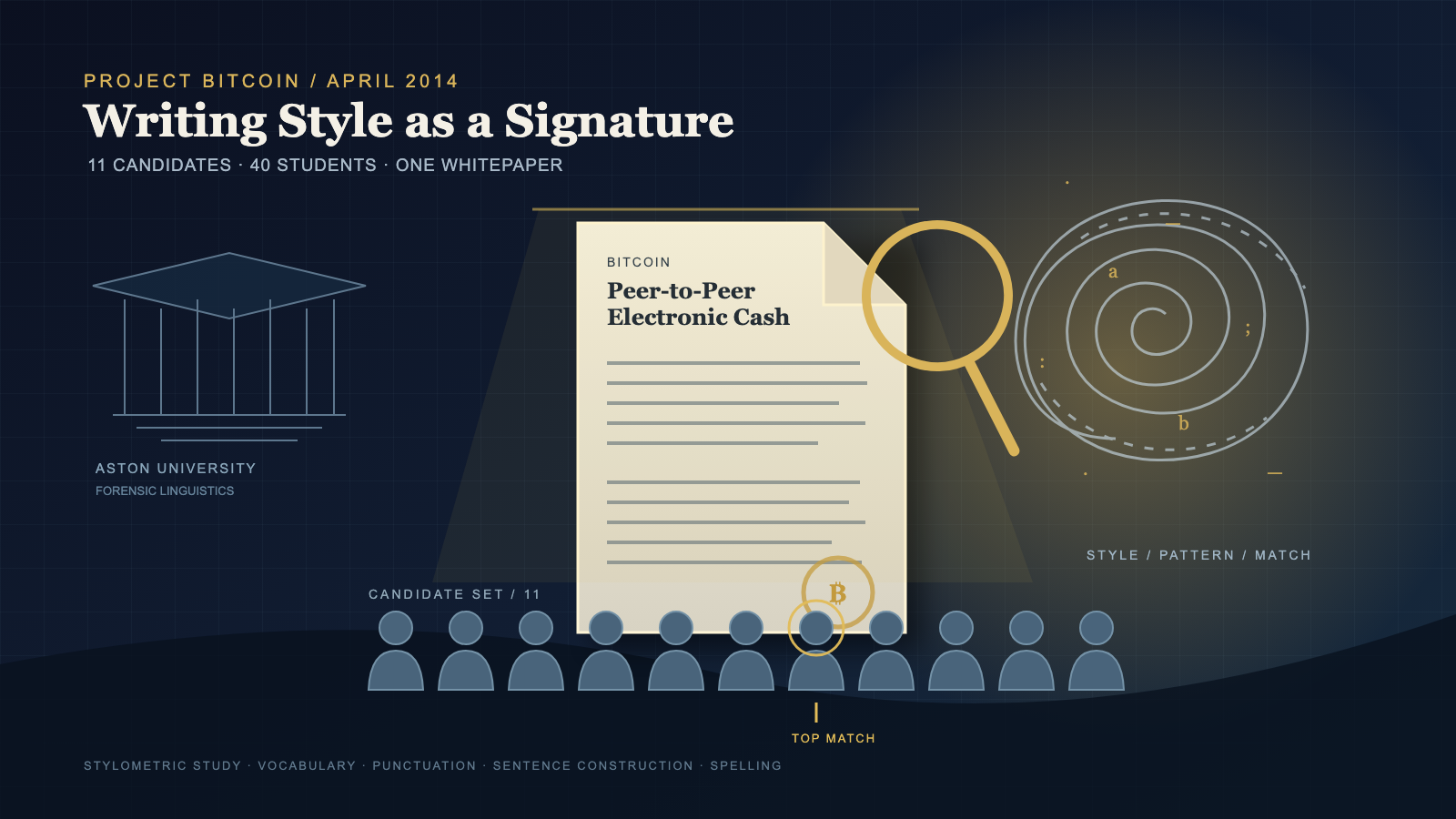
Bitcoin’s “Satoshi Nakamoto” was not a pseudonym at all — it was the real name of a private individual living in the San Gabriel Valley, a man whose engineering career had run through classified-adjacent defense and aerospace work, and who, approached on his doorstep, appeared to acknowledge a past involvement he would not discuss. Newsweek reporter Leah McGrath Goodman articulated the identification. Unlike the other named-candidate hypotheses, this one entered the record not from a forum or a stylometric study but from a national-magazine cover story, which is what gave it its reach — though the same Newsweek piece later pulled him into the 11-candidate pool of a stylometric study his own candidacy never originated from.
1.1 The literal name
This is the only distinguishing piece of evidence, and the entire case leans on it: the candidate’s birth name was Satoshi Nakamoto, the exact string used to sign the white paper and the early Bitcoin correspondence.
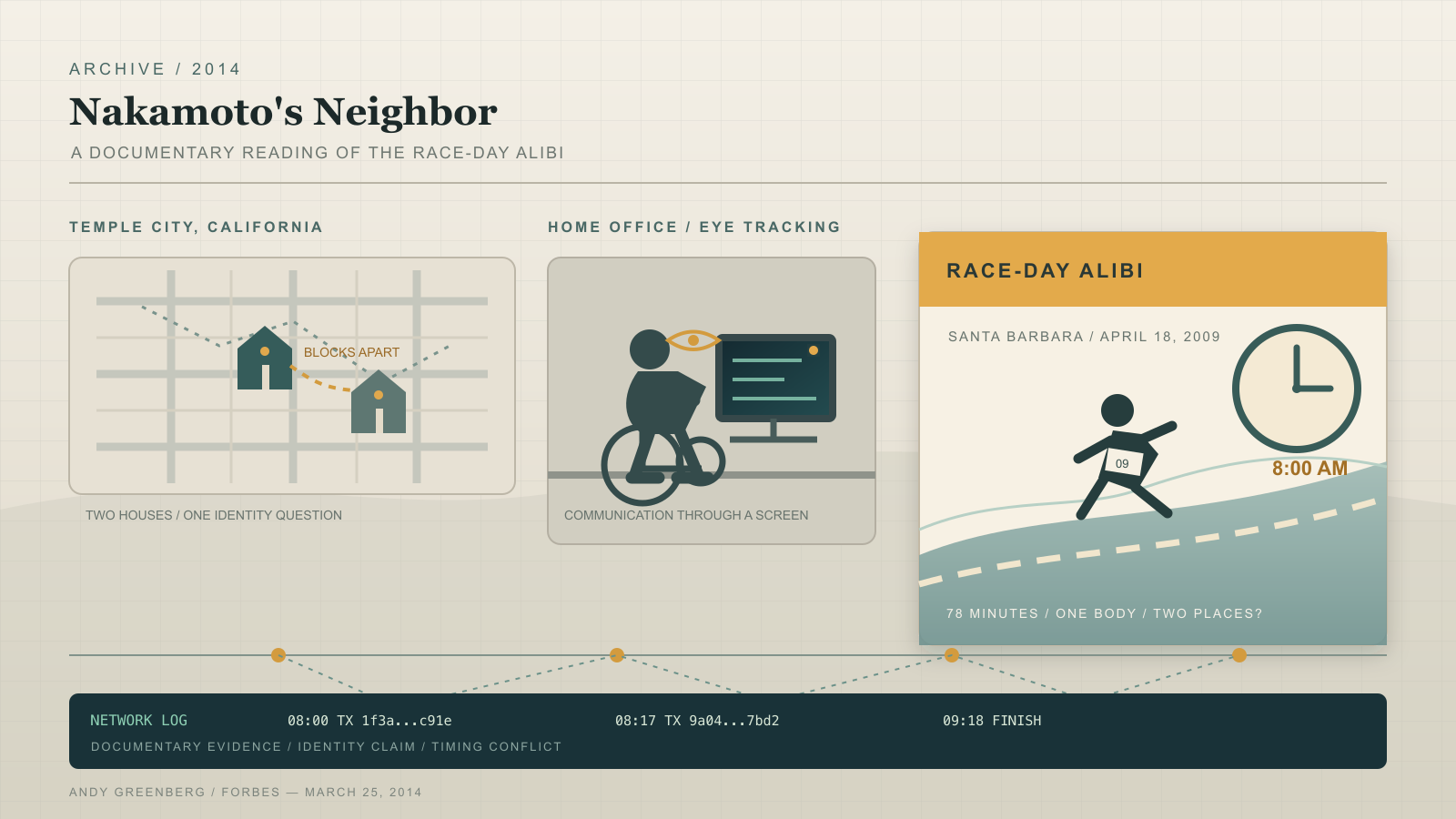
The objection: a name match is not evidence of authorship. The pseudonym’s form is consistent with a real Japanese name, but it is equally consistent with a deliberate choice by an author of any nationality — the reading the techno-orientalist signature analysis treats independently of any single candidate. The name’s evidentiary weight cuts the other way as readily: Andy Greenberg’s “Nakamoto’s Neighbor” proposed that the name could have been borrowed — that Hal Finney, who lived a few blocks from Dorian Nakamoto in the same small town, might have constructed the pseudonym from a real neighbor’s name. Under that reading the name match implicates Dorian Nakamoto in nothing at all.
1.2 The engineering career
Newsweek emphasized that Nakamoto had worked as an engineer for Hughes Aircraft, RCA, and the Federal Aviation Administration, some of it under classified defense contracts — a profile the story framed as consistent with the secrecy and technical depth Bitcoin’s creator would need.
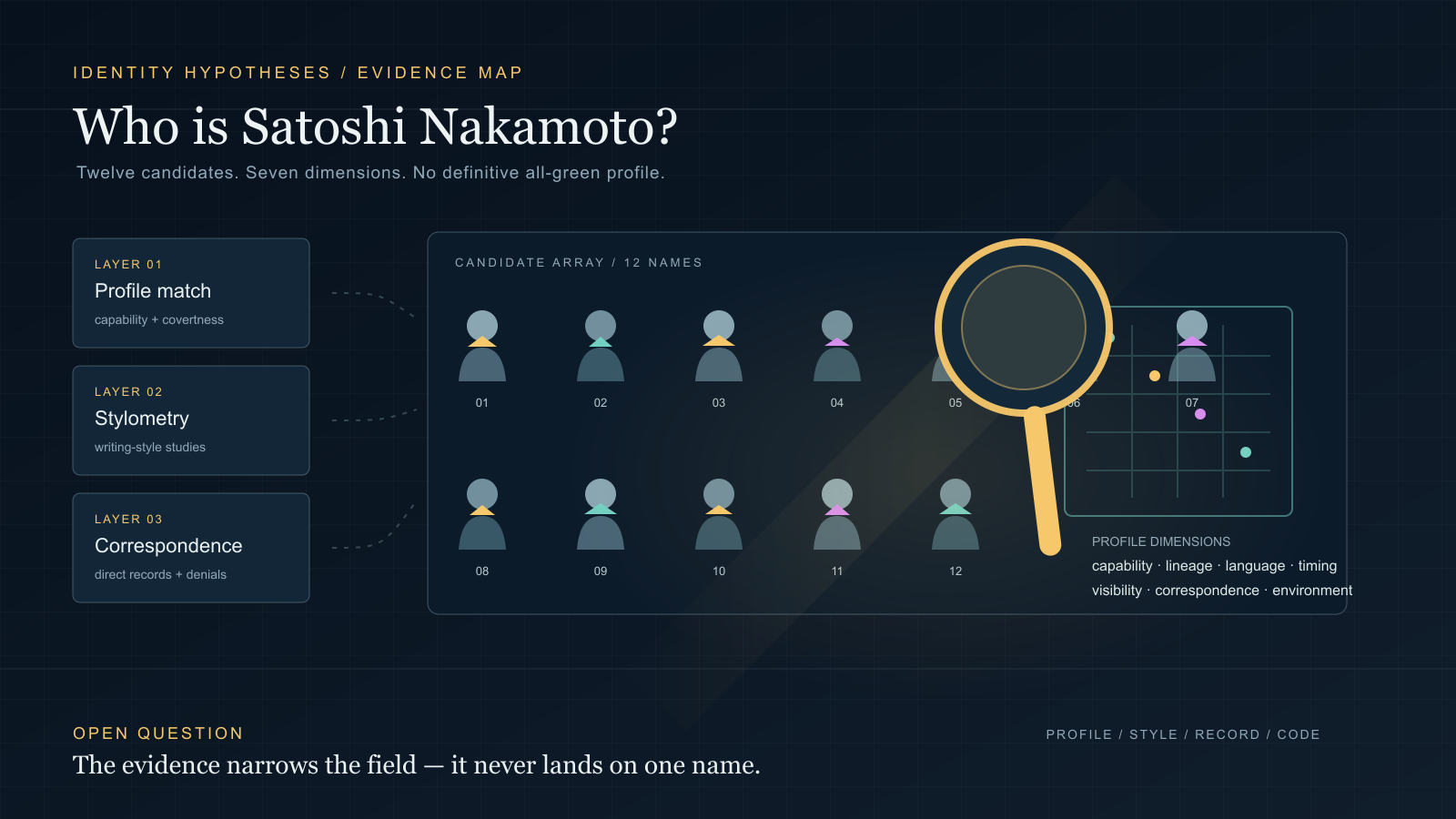
The objection: classified defense-systems and aerospace engineering is not the specific capability Bitcoin v0.1 demonstrates. There is no documented C++ shipping record at the scale of the 19,901-line v0.1 codebase, no monetary-system or digital-cash design work, and no presence in the cypherpunk and cryptography fora out of which Bitcoin’s cited intellectual lineage (Hashcash, b-money) is documented. On the four-layer comparison in the identity-hypotheses overview, the capability dimensions are blank rather than weak.
1.3 The doorstep quote
When Goodman approached him at his home, Nakamoto said: “I am no longer involved in that and I cannot discuss it” — which the story read as a tacit acknowledgment.
The objection: Nakamoto stated, immediately and consistently afterward, that the remark referred to his prior classified engineering work, not to Bitcoin, and that he had not heard of Bitcoin before the reporter’s approach. In a detailed Associated Press interview and through a retained lawyer, he reaffirmed that denial. A single ambiguous sentence, later explained by the speaker, carries little weight against an authorship claim.
2. The counter-evidence
| Counter-evidence | Central observation | Strength assessment |
|---|---|---|
| §2.1 Repeated self-denial | Nakamoto denied any Bitcoin involvement immediately, in an AP interview, and through a lawyer | Direct, on-record, and never retracted — but self-denial alone is not dispositive (see the overview’s cross-cutting note) |
| §2.2 The “I am not Dorian Nakamoto” post | The long-dormant Satoshi P2P Foundation account broke five years of silence to deny the identification | Strong if genuine; the account’s authenticity in 2014 is itself disputed |
| §2.3 No documentary fit | No technical, cypherpunk, coding, or monetary-design connection of any kind | Decisive on the profile question — the candidacy is name-match-only |
| §2.4 The misread quote | The doorstep remark referred to classified work, per the speaker | Removes the one piece of apparent corroboration the story had |
2.1 Repeated self-denial
Dorian Nakamoto denied any connection to Bitcoin firmly and repeatedly — at his home, in a detailed Associated Press interview, and through a lawyer he retained after Newsweek published his street address and a photograph of his house. The denial has never been qualified or withdrawn. Self-denial is not decisive on its own (the Satoshi-identification asymmetry analysis notes that a guilty author would deny exactly as a wrongly-named bystander does), which is why it sits alongside, not above, the documentary counter-evidence below.
2.2 The “I am not Dorian Nakamoto” post
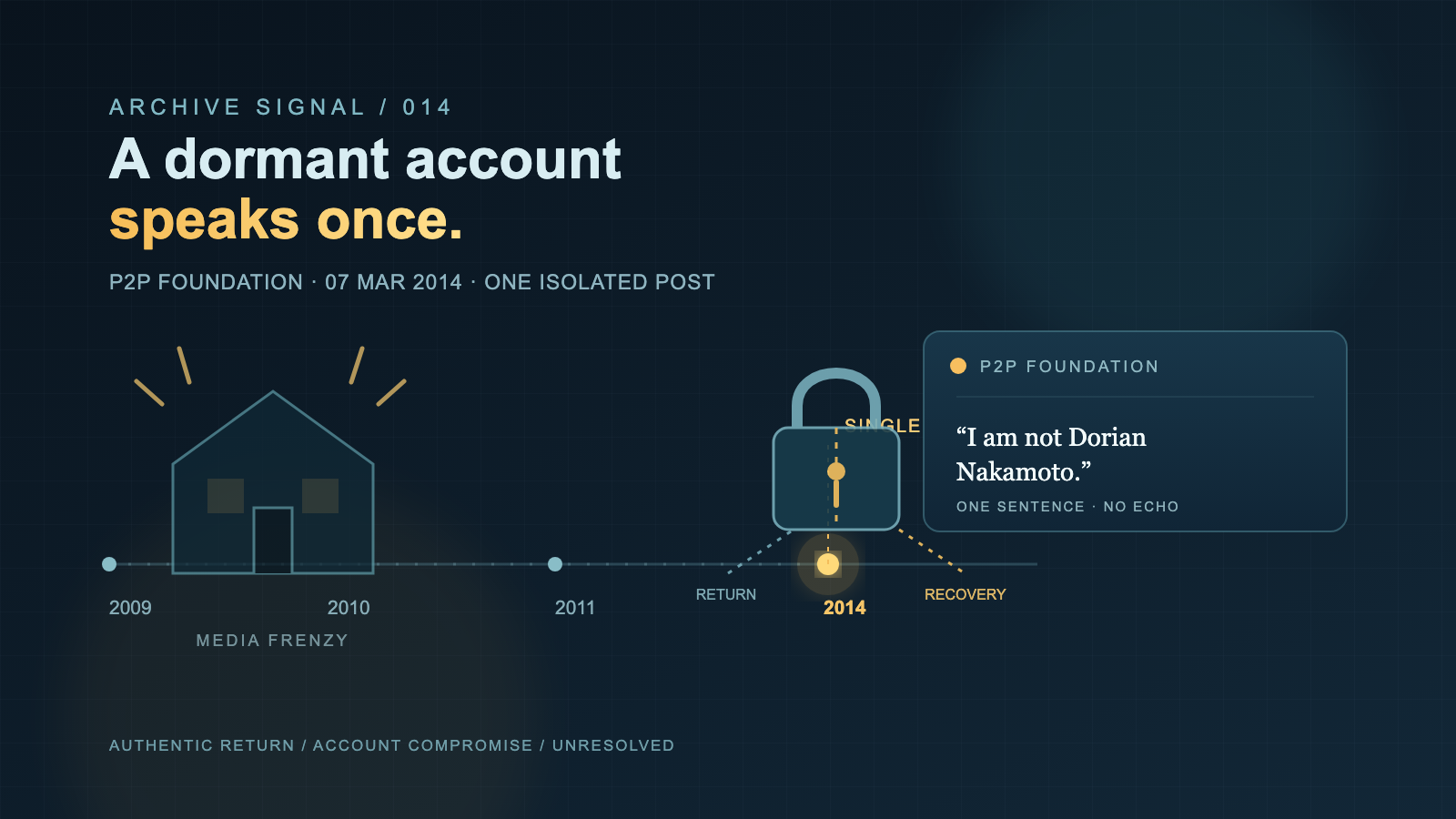
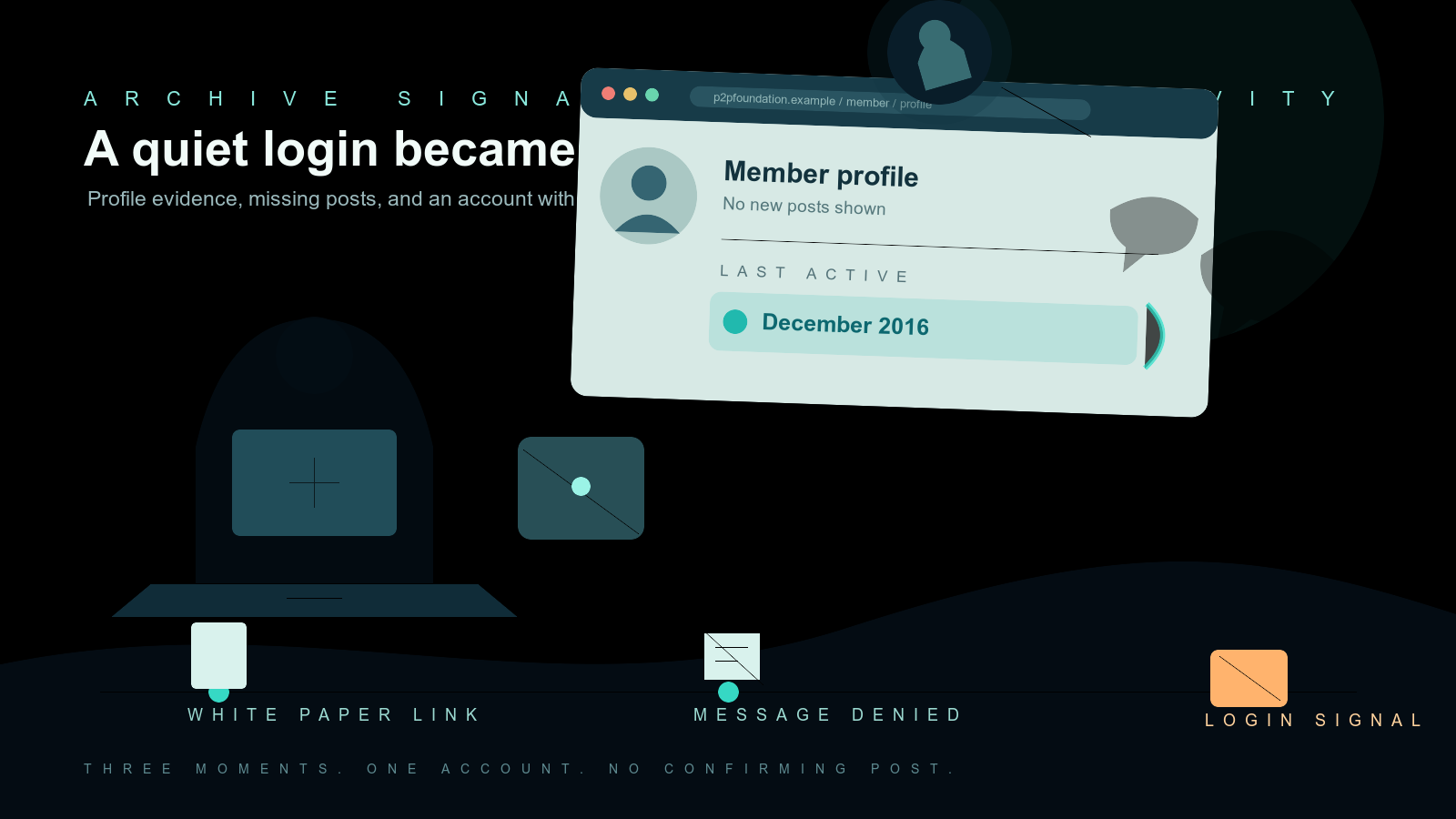
On March 7, 2014 — about a day after the Newsweek story — the long-dormant Satoshi P2P Foundation account briefly returned to post a single line: “I am not Dorian Nakamoto.” It was the account’s only activity between the February 2009 v0.1 announcement and the present. Whether the post genuinely came from Satoshi is itself debated: the satoshin@gmx.com account was confirmed compromised in September 2014, and the same P2P Foundation account showed unexplained login activity again in December 2016 without posting. If the post is genuine, it is a direct denial from the author himself; if it is a compromise, it says nothing. Either way it does not support the identification.
2.3 No documentary fit
The candidacy rests on the name match alone. There is no technical evidence connecting Dorian Nakamoto to the Bitcoin codebase, no cypherpunk or cryptography-community credentials, no documented programming work at Bitcoin v0.1 scale, and no monetary-system design history. Across all four structural layers the overview uses to compare candidates — profile match, stylometric attribution, direct correspondence, and development environment — the record holds nothing to place him at a single point rather than to leave him outside the frame entirely.
2.4 The misread quote
The one piece of apparent corroboration the Newsweek story carried — the doorstep remark — was, on the speaker’s own account, about his classified engineering work and not about Bitcoin. With that sentence reattributed to its actual subject, the story’s positive case reduces to the name match of §1.1.
3. Within the broader documentary record
Name match is the weakest discriminator in the candidate landscape: it is the one kind of evidence that can be satisfied by coincidence, and the overview treats profile fit in general as necessary but not sufficient. The Dorian Nakamoto case is the clearest illustration of why — the candidacy meets a single surface criterion (the name) and nothing else, and that single criterion is one a wholly uninvolved person can satisfy by birth.
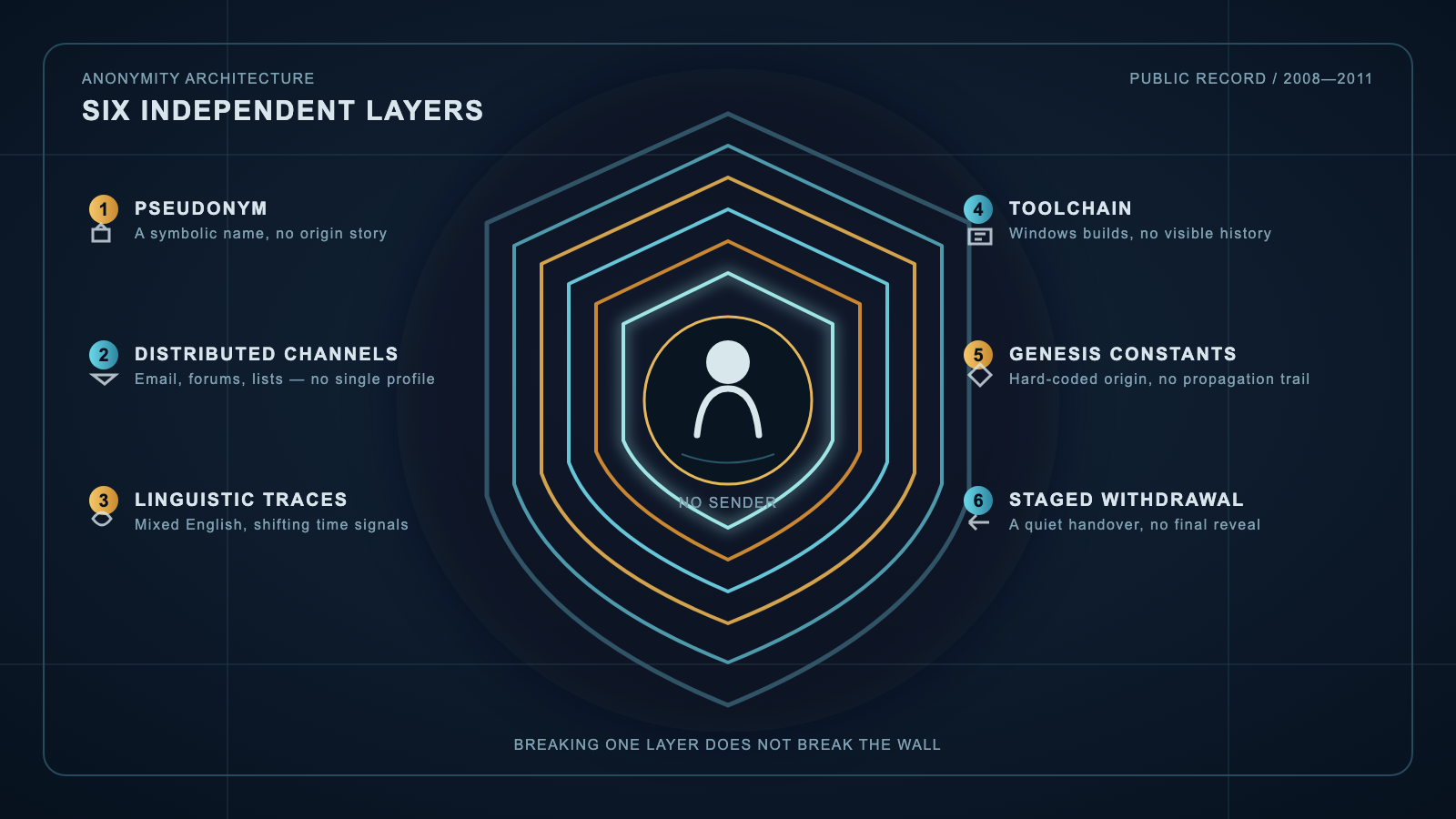
The techno-orientalist signature analysis treats the pseudonym’s Japanese form independently of any specific identity hypothesis, and applies equally whether the name was a real person’s, a deliberate construction, or a borrowed one. The “Nakamoto’s Neighbor” reframing belongs to that independent question: it turns the name into a possible thread in the separate Hal Finney hypothesis, not into support for Dorian Nakamoto’s authorship. The anonymity-architecture entry groups this name-match failure with Craig Wright’s self-claim as the two candidates who fail multiple layers of its six-layer structure at once, rather than the single-layer misses that leave other candidates partly plausible — Wright’s own entry calls the pairing its structural inverse: an external name attaching to an unwilling subject here, an internal assertion by a willing one there, each reducible to a single thread of evidence and each publicly refuted. For the full candidate comparison, see the Satoshi-identity hypotheses overview.
4. Limits of this entry
- This entry does not present new evidence. It compiles publicly available material.
- Full biographical detail — Nakamoto’s life, career, the donation drive the Bitcoin community raised for him, and the geographic-coincidence reporting — is in the Dorian Nakamoto biography.
The identity-hypotheses overview places Dorian Nakamoto in Group C of its necessary-but-not-sufficient evaluation.
The story had one fact, and the fact was a name. Bitcoin’s founder signed a name that a real person was born with, and that coincidence tells me nothing about either of them, except that the record does not end where a magazine cover says it does.