Bitcoin Institute
Who Is Satoshi Nakamoto?
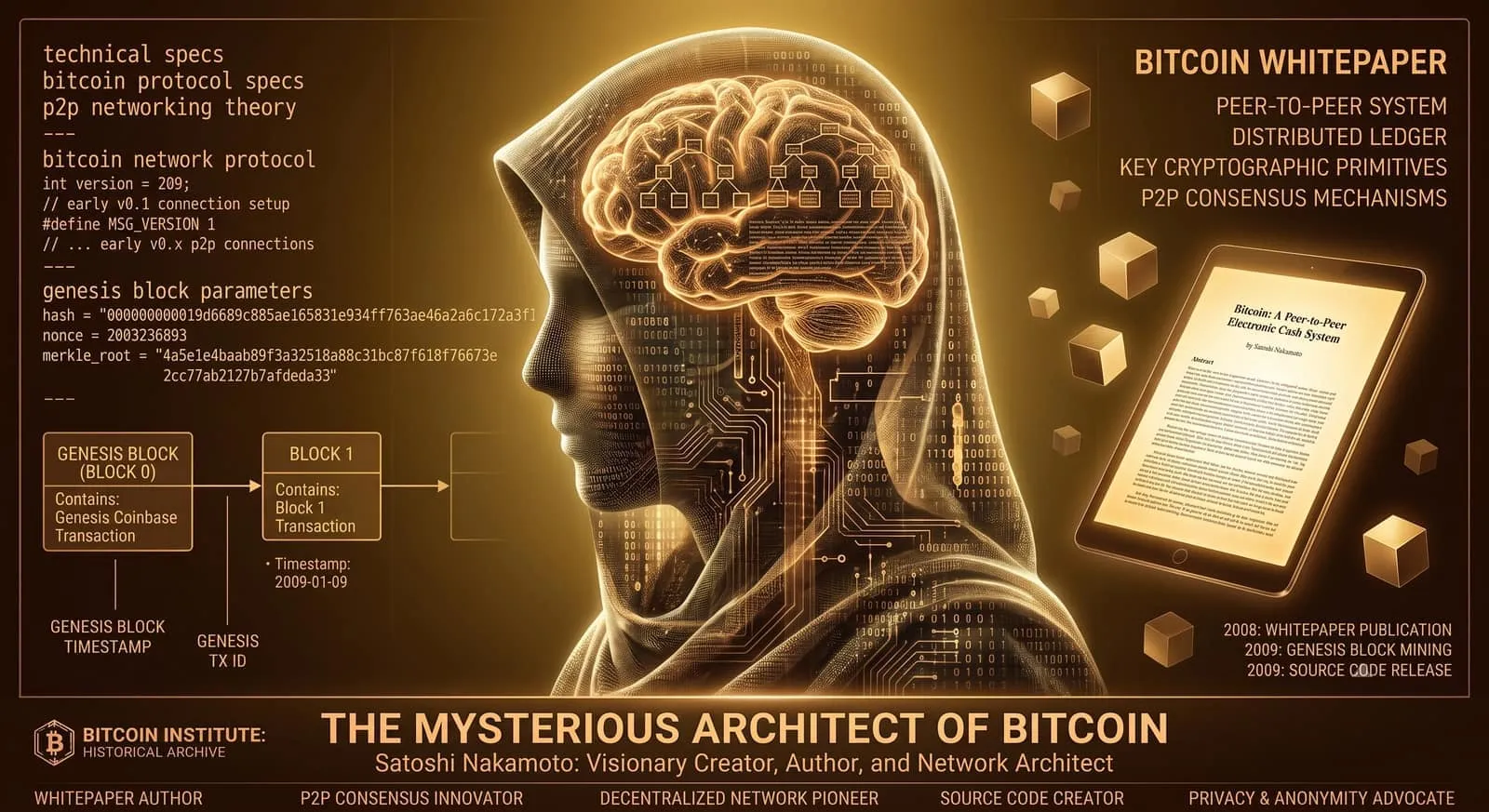
He vanished without revealing who he was or why he left. What remains is more than 3,000 records, left by him and by the people around him.
Where to begin
Six moments that trace the arc of Satoshi's documented activity. Have a specific question instead? See the FAQ.
Analyses by Bitcoin Institute
View All →Editorial readings of source code, primary records, and Satoshi's footprint.

Dossiers
View All →Editorial selection — the people behind the archive, facts only.
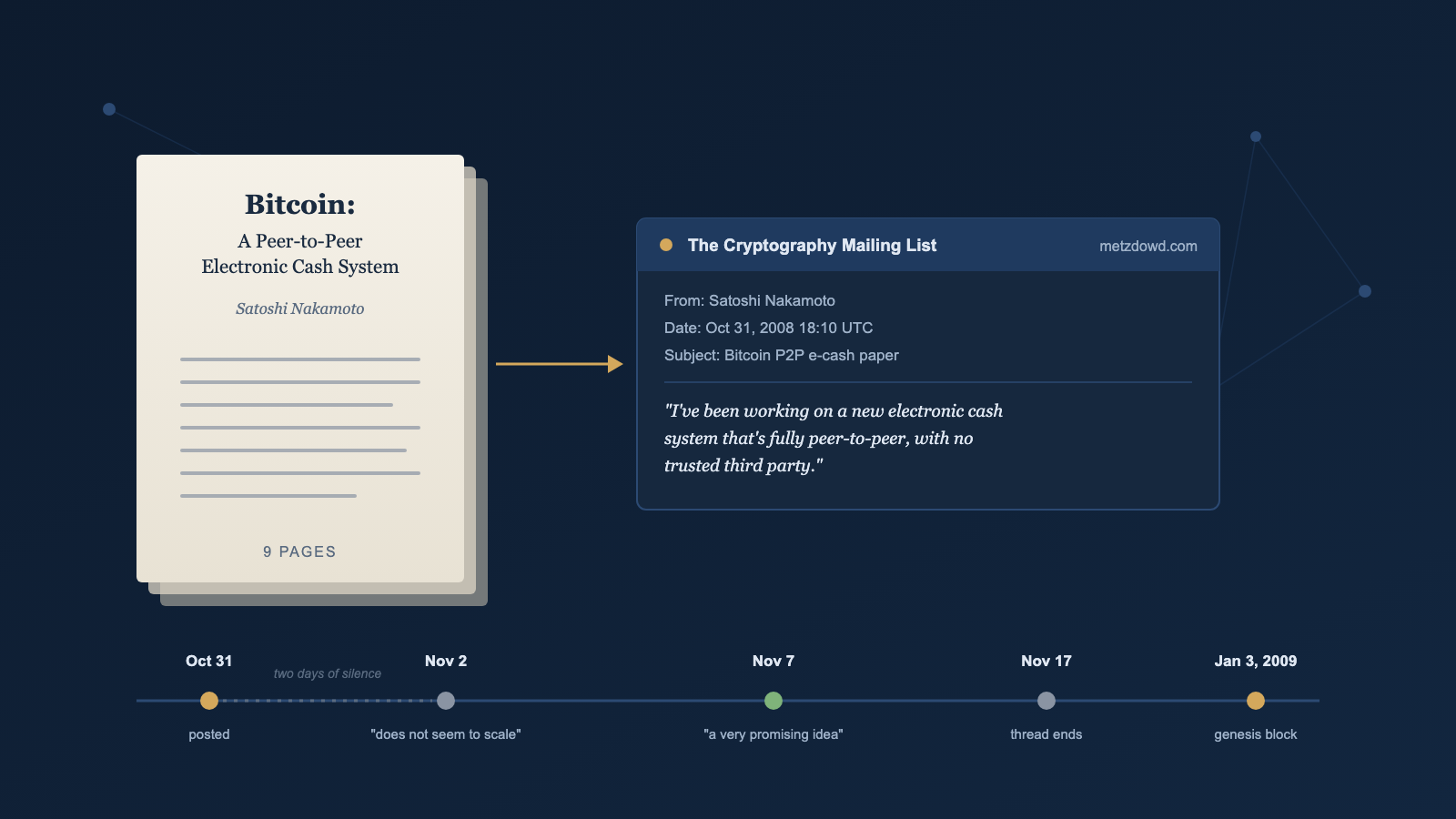
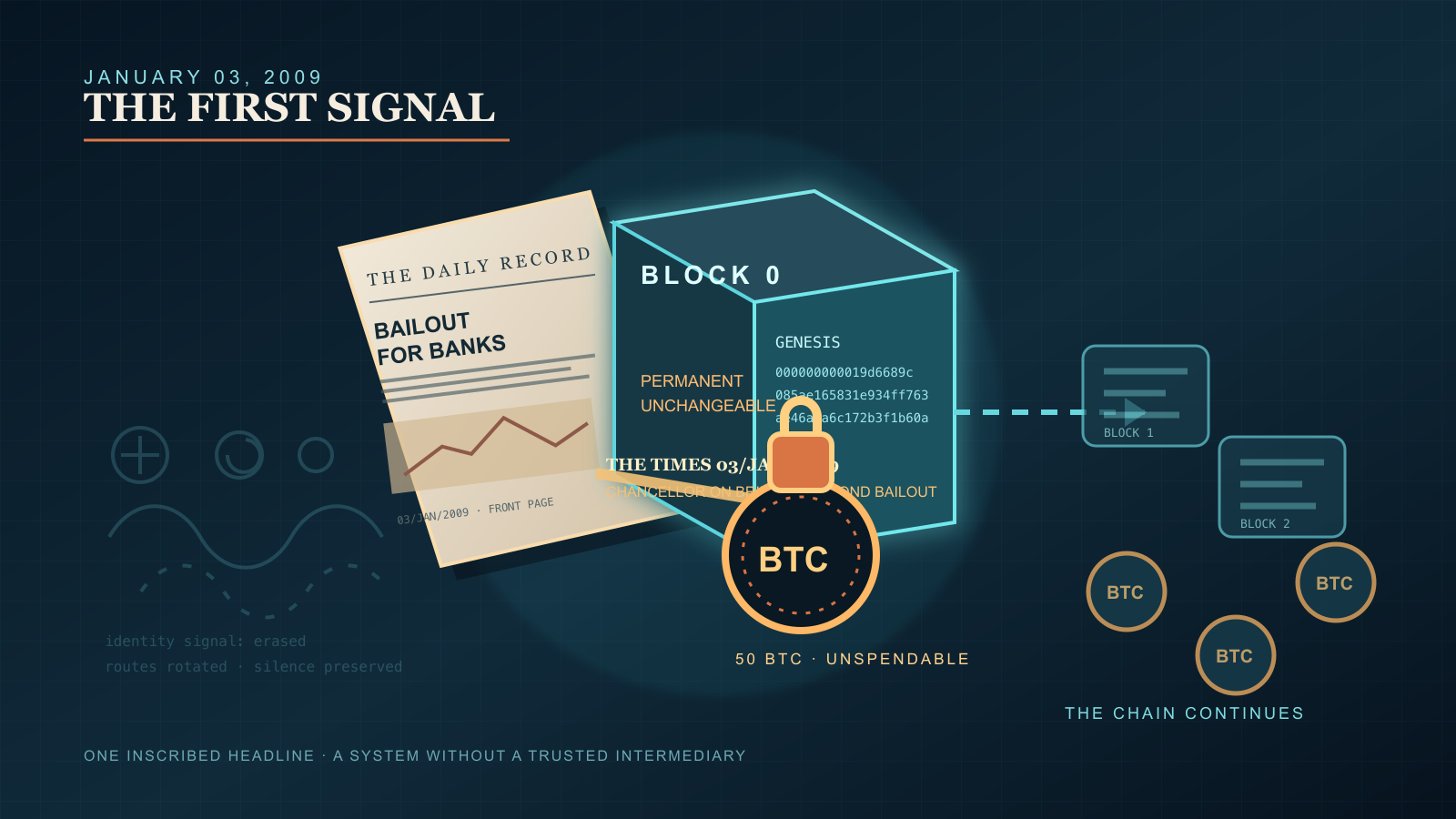
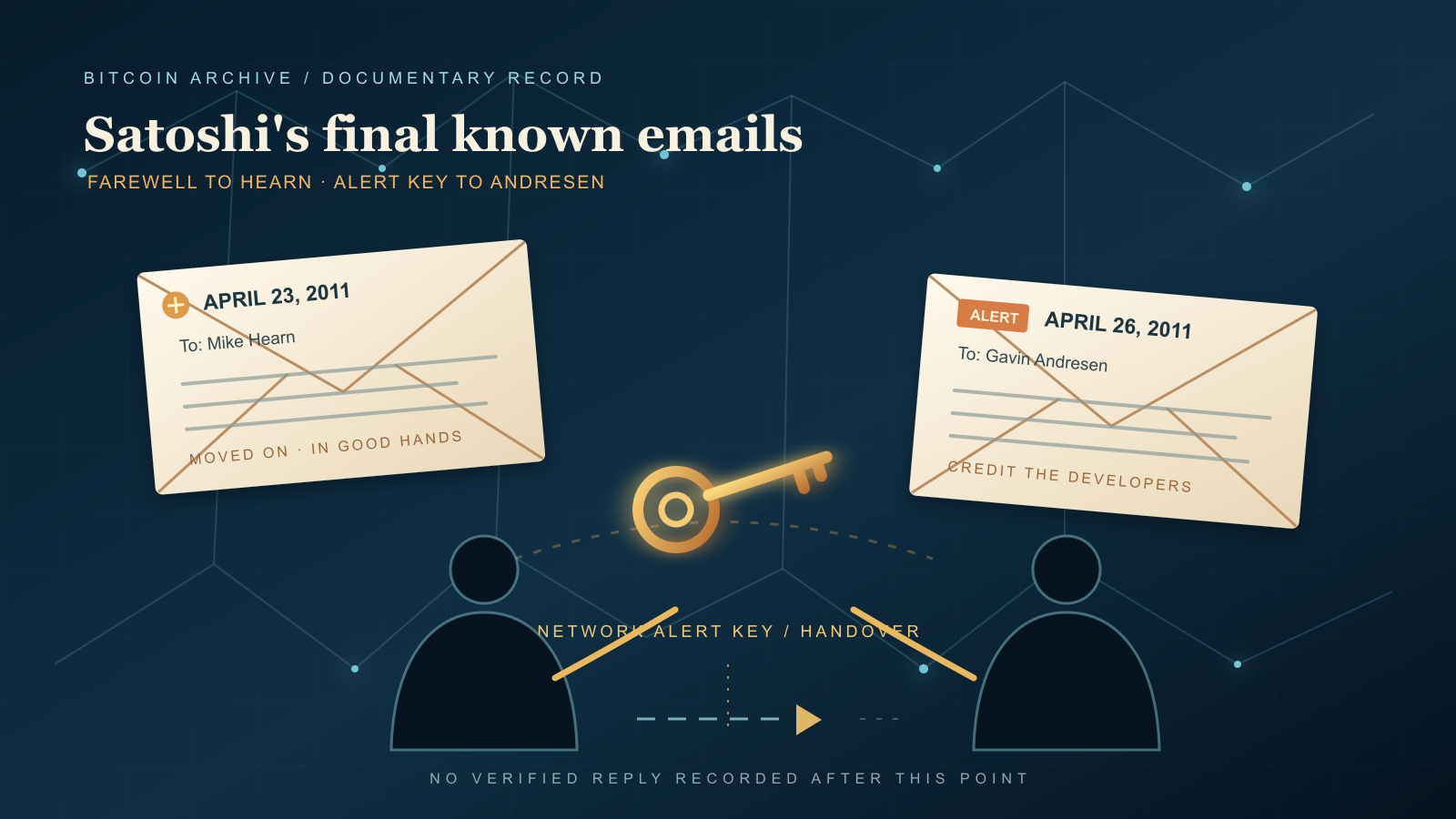
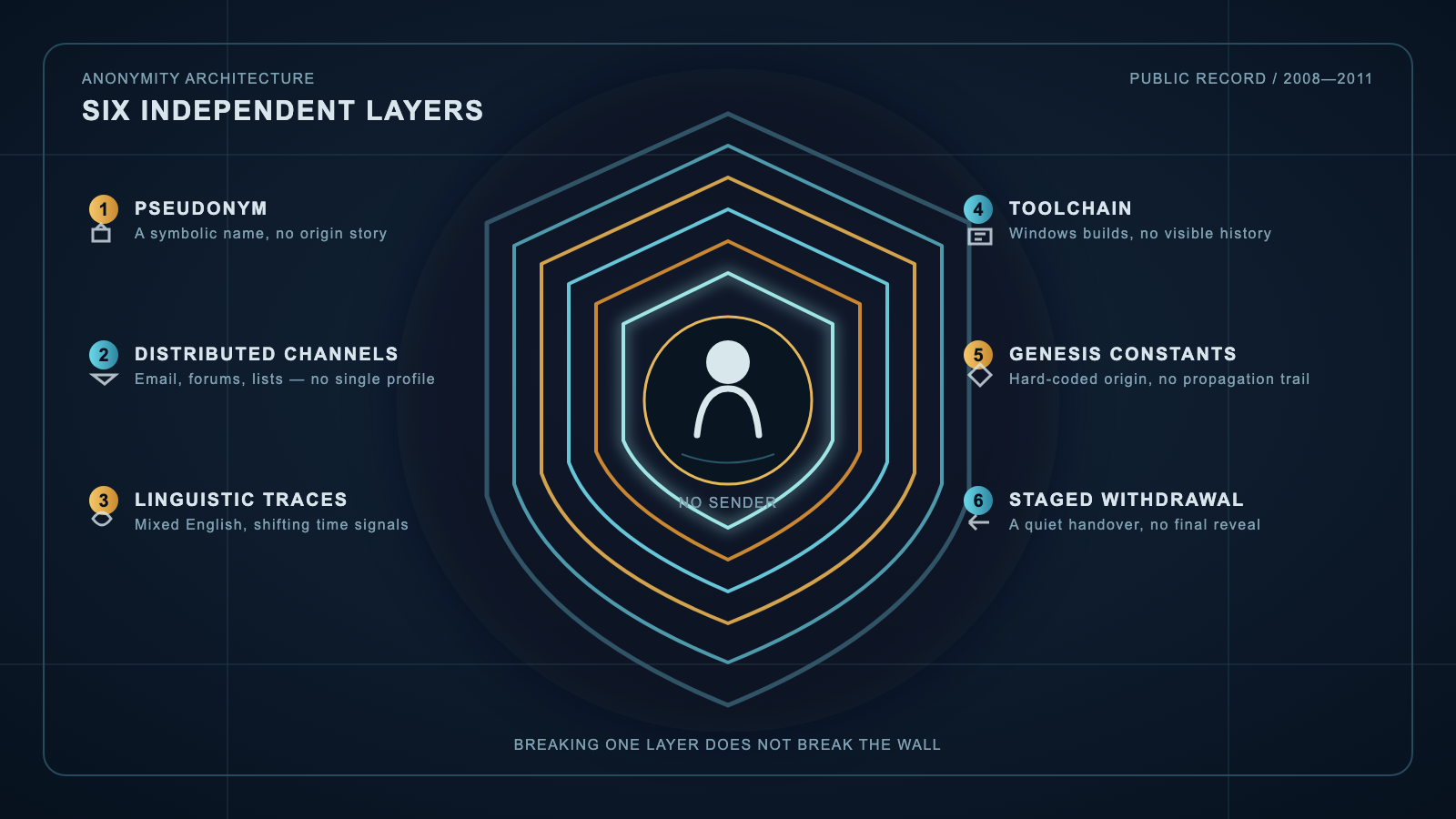
On October 31, 2008, he posted a nine-page paper to a cryptography mailing list. On January 3, 2009, he launched Bitcoin by embedding "The Times 03/Jan/2009 Chancellor on brink of second bailout for banks" into the genesis block. He mined roughly 1.1 million BTC and never spent a single one. In April 2011, after a final email to Gavin, he vanished. Identity unknown. The name may not even be real.
“I've moved on to other things. It's in good hands with Gavin and everyone.” — Email to Mike Hearn, 2011-04-23
 Hal Finney The First User
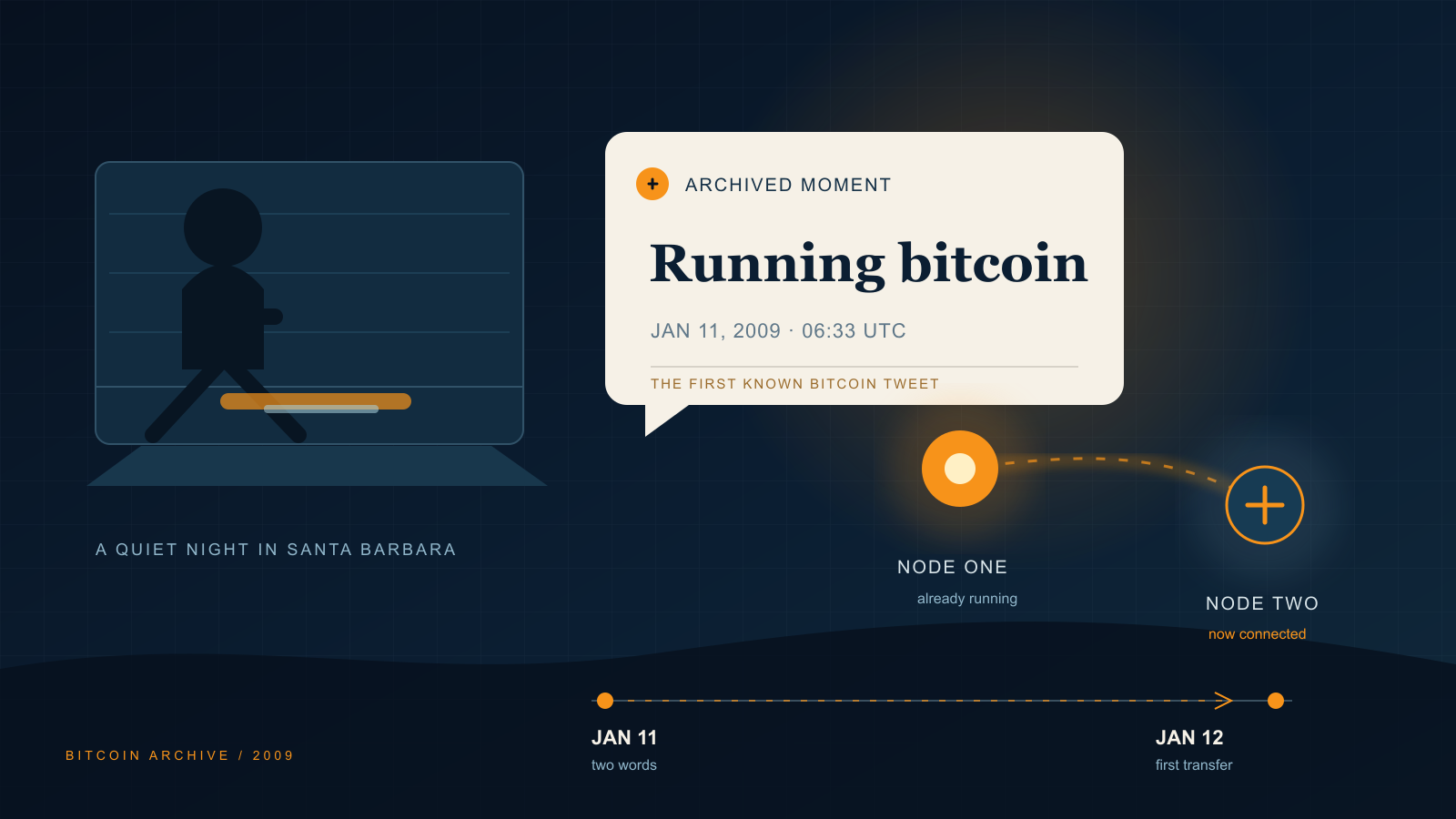
 Inventor of RPOW (Reusable Proofs of Work). On January 11, 2009, he tweeted just "Running bitcoin" — becoming the first known person besides Satoshi to run the software. The next day, he received the first person-to-person Bitcoin transaction (10 BTC from Satoshi). After his ALS diagnosis, he kept writing code using eye-tracking software. He died in 2014. His body is cryogenically preserved at the Alcor Life Extension Foundation.
“Running bitcoin” — Twitter, 2009-01-11
 Martti Malmi Satoshi's Right-Hand Undergraduate
 A Helsinki undergraduate who emailed Satoshi in 2009 — and proceeded to exchange 260 emails, launch bitcoin.org, and run the forum that became Bitcointalk. He kept the Satoshi correspondence private for thirteen years. In 2024, he released all of it as evidence in COPA v. Wright.
“I would like to help with Bitcoin, if there's something I can do.” — First email to Satoshi, 2009-05-02
 Gavin Andresen The Designated Successor
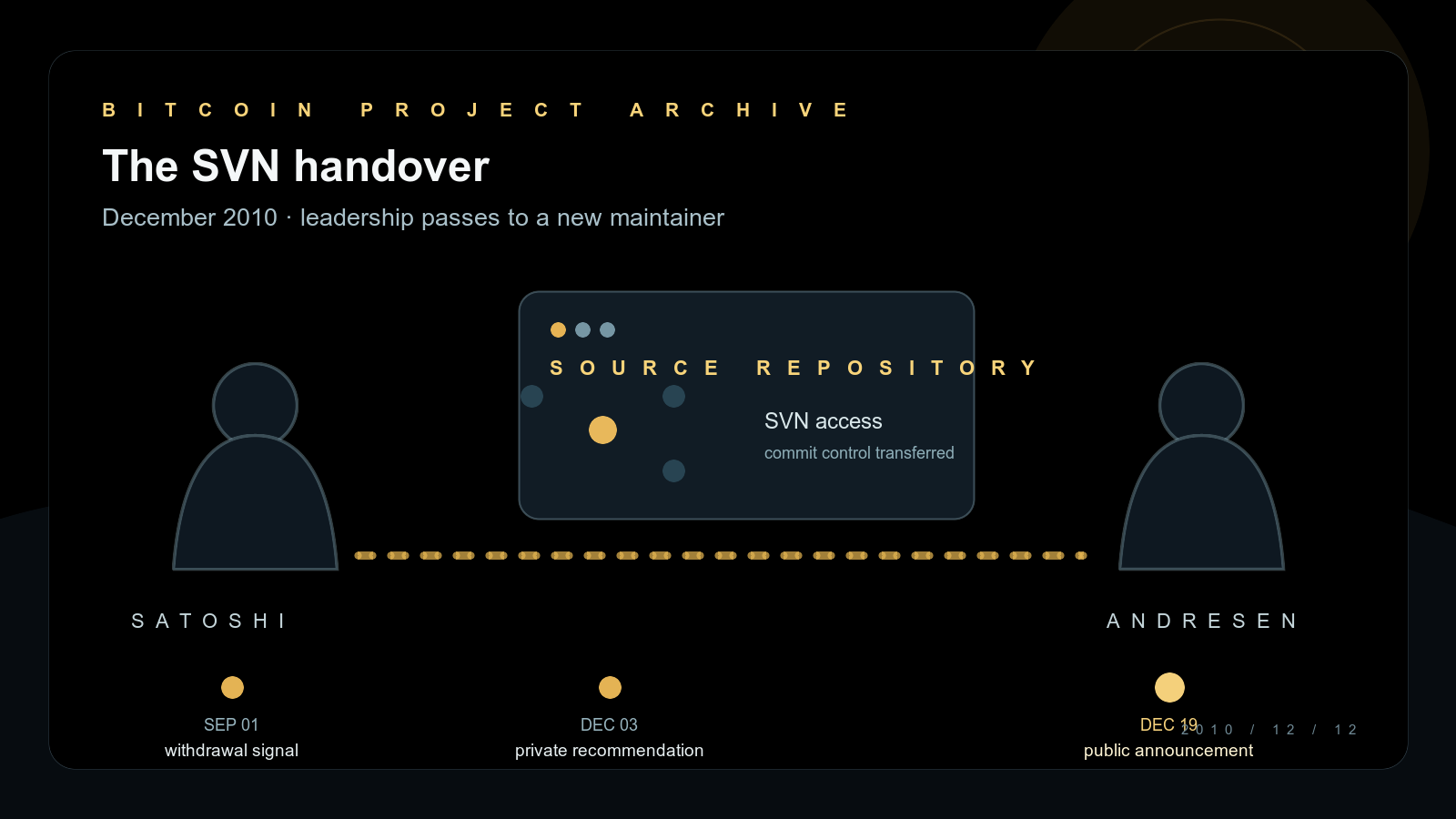
 A pragmatist who said he wanted to be remembered as "a good person," not "a great person." In 2011 he gave a talk at CIA headquarters. That same year, just before vanishing, Satoshi handed him the keys to the project. In 2016, Gavin publicly vouched for Craig Wright as Satoshi, and lost the community's trust overnight. In 2023, he called it a mistake.
“My talk at the CIA went well today. The hallways there are REALLY wide, and full of interesting stuff.” — After his CIA talk, 2011
 Laszlo Hanyecz The Pizza Guy
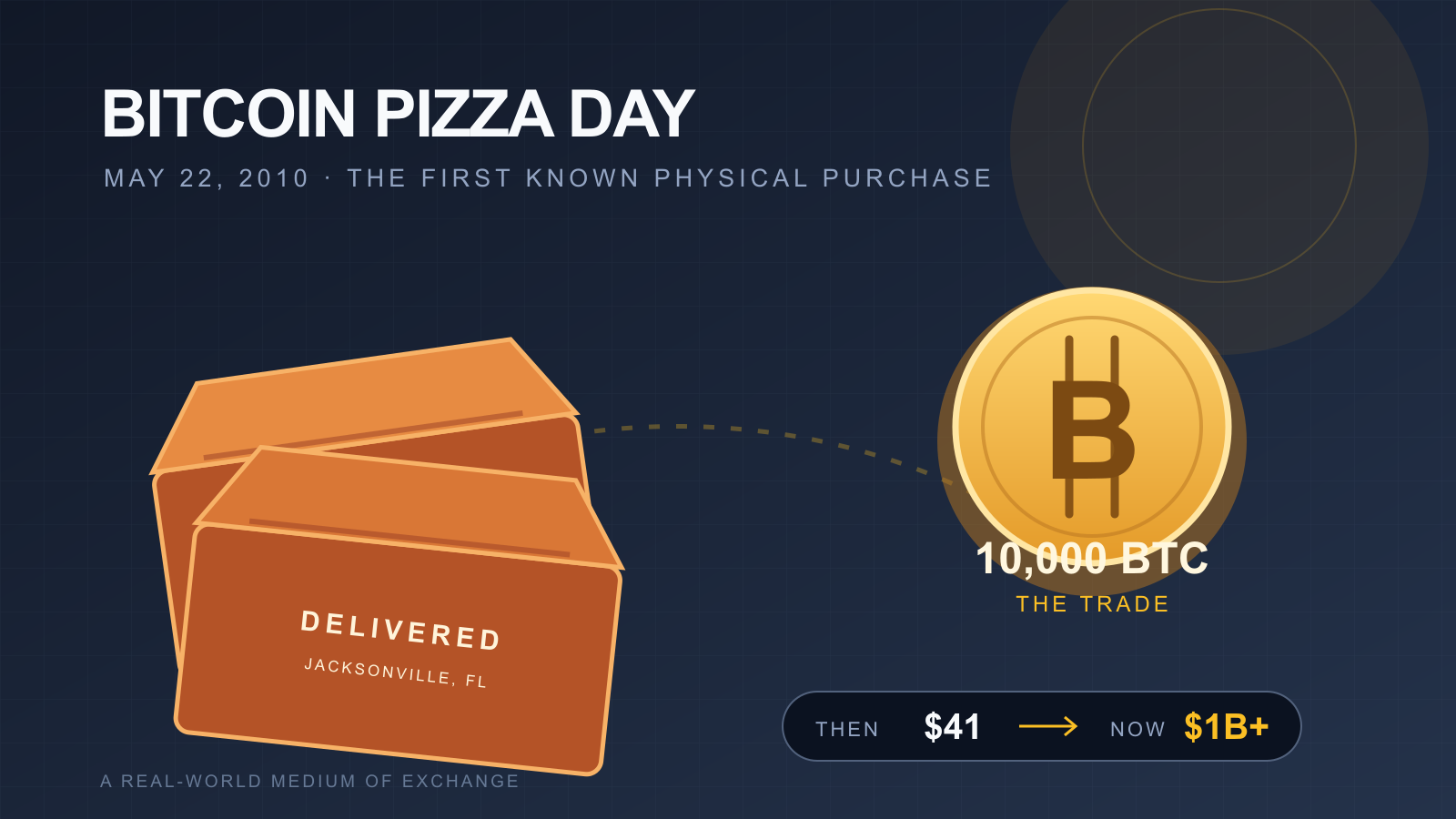
 On May 22, 2010, he bought two Papa John's pizzas for 10,000 BTC — the first known real-world purchase made with Bitcoin. Over that summer he reportedly spent some 79,000 BTC on pizza. He was also a pioneer of GPU mining. The world remembers him only as the pizza guy.
“You know, I don't regret it. I think that it's great that I got to be part of the early history of Bitcoin in that way.” — Cointelegraph interview
 Adam Back Father of Hashcash
 Inventor of Hashcash (1997), the proof-of-work scheme that Bitcoin mining is built on, and the first known person Satoshi ever emailed. He didn't bother reading the attached paper at the time. He would not actively engage with Bitcoin until 2013 — five years after the inventor reached out to him personally.
“Probably my biggest mistake.” — Cointelegraph interview
 Wei Dai Designer of b-money
 Posted the b-money proposal to the cypherpunks mailing list in 1998 — cited as reference [1] in the Bitcoin whitepaper. Worked at Microsoft. Ethereum's smallest unit, the "wei," is named after him. He almost never appears in public.
“I'm actually more interested in Satoshi's creation... It appears to be the author wasn't aware of my ideas at the time.” — LessWrong, 2013
 Nick Szabo Architect of Bit Gold
 Designed "bit gold" in 1998 and coined the term "smart contract." His work is the closest conceptual predecessor to Bitcoin — but he never shipped any code for it. The "Satoshi is Szabo" theory refuses to die, despite his consistent denials.
“Nearly everybody who heard the general idea thought it was a very bad idea.” — On bit gold, Unenumerated blog, 2011
 Mike Hearn The Departed Implementer
 He left a senior engineering job at Google to work on Bitcoin full time. On April 23, 2011, he was one of the last people to receive a private email from Satoshi: "I've moved on to other things." In January 2016, after the block size wars, he declared Bitcoin had failed, sold every coin he owned, and walked away.
“Bitcoin has failed.” — "The resolution of the Bitcoin experiment," 2016-01-14
 Peter Todd The Denier
 He joined the project in December 2010, days after replying to one of Satoshi's BitcoinTalk posts. His fingerprints are on RBF, OP_RETURN, and OpenTimestamps. In October 2024, the HBO documentary "Money Electric" identified him as Satoshi. He replied with sarcasm.
“Of course I'm Satoshi, and I'm Craig Wright.” — Responding to HBO "Money Electric," 2024
 Craig Wright The Pretender
 The man who announced "I am Satoshi" in 2016. On March 14, 2024, Justice Mellor of the UK High Court ruled in COPA v. Wright that Wright is not the author of the whitepaper, is not the person who used the Satoshi Nakamoto pseudonym, and did not create Bitcoin. The judge found "deliberate and extensive forgery of documents."
“Dr Wright is not the author of the Bitcoin White Paper. Dr Wright is not Satoshi Nakamoto.” — Justice Mellor, COPA v. Wright ruling, 2024-03-14
 Cøbra The Anonymous Custodian
 The anonymous custodian of bitcoin.org, who inherited it from Martti Malmi. Real name, nationality, and age all unknown. In 2021, when Craig Wright sued him over the whitepaper's hosting, Cøbra chose to lose by default rather than appear in court and reveal his identity. The takedown order was issued; the whitepaper is still up.
“A system where 'justice' depends on who's got the bigger wallet.” — Tweeted after the takedown order, 2021-06-28
Figure Network
View All →Drag nodes to rearrange. Scroll to zoom. Hover for details. Click to visit.
Top Figures
View All →Ranked by number of entries
Top Sources
View All →Ranked by number of entries