
Who Is Satoshi Nakamoto: 12 Geniuses and the Mystery of the Century
Recurring Satoshi candidates aligned across four independent layers — profile match, stylometric attribution, direct correspondence, and development environment.
Cryptographer who was the first to respond to the Bitcoin white paper
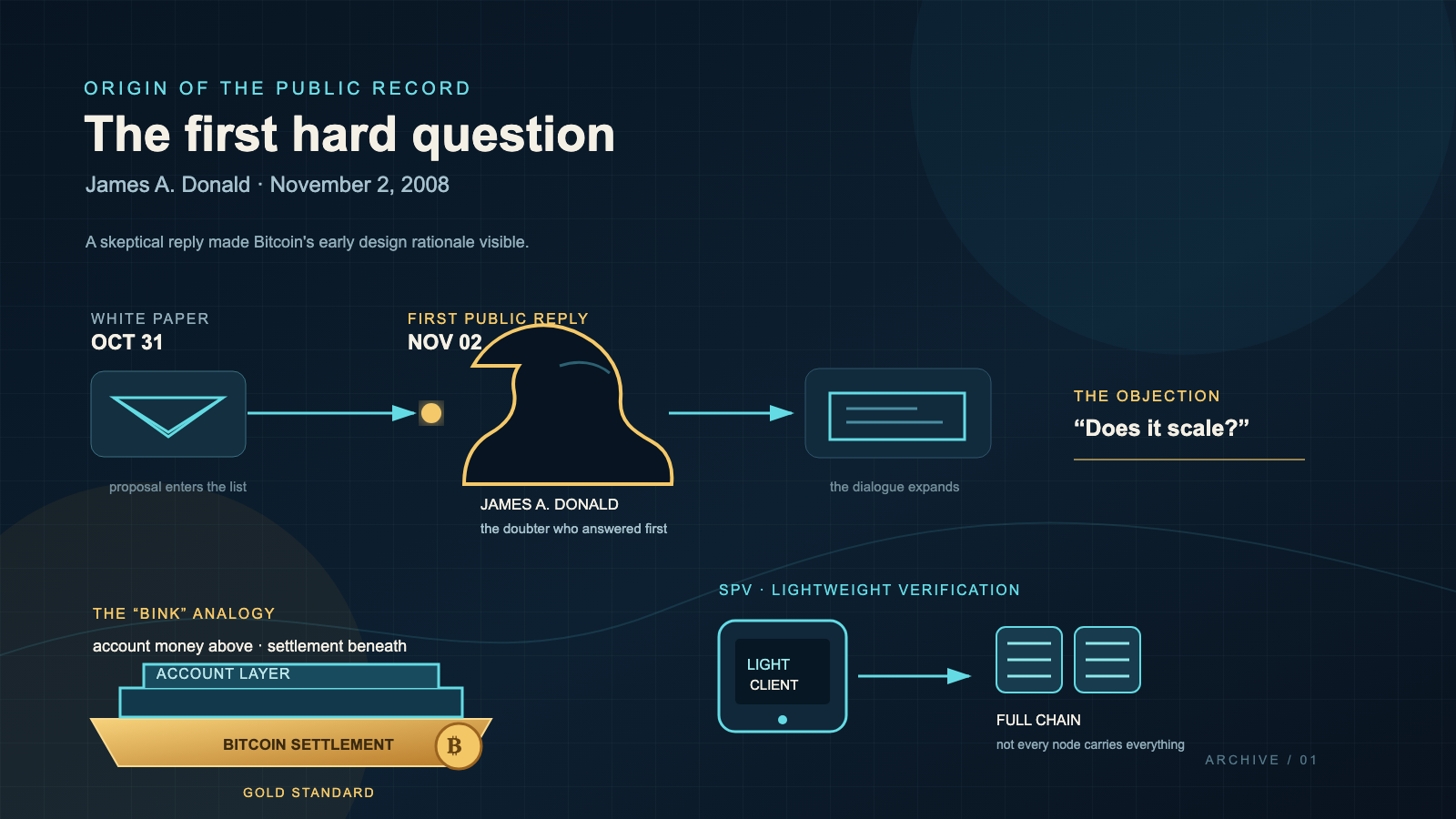
Two days after Satoshi Nakamoto posted the Bitcoin whitepaper to the cryptography mailing list on October 31, 2008, James A. Donald became the first person to publicly respond:
“We very, very much need such a system, but the way I understand your proposal, it does not seem to scale to the required size.”
His skepticism pulled some of Satoshi’s most detailed early architectural explanations into the public record — simplified payment verification, the trust and double-spend model. Donald is a cryptographer and libertarian commentator long active in the cypherpunk community; he maintained the website jim.com on cryptography, political philosophy, and economics.
Donald argued in his November 2 reply that the system would require every node to process every transaction, making it impractical for widespread use.
Across November 2008, Satoshi answered the scaling objection point by point: not every node need process every transaction — simplified payment verification would let lightweight clients confirm payments without storing the full chain. Days later, in a November 9 message, Donald coined a name for a bitcoin bank — a “bink” — and cast bitcoins as a settlement layer beneath account money, the way gold sat beneath the gold standard; it anticipated the exchanges and custodians that would later dominate. Pressed on trust and double-spending, Satoshi spelled out the model in unusual detail.
Donald’s critical engagement with the white paper forced Satoshi to articulate Bitcoin’s scalability model and trust assumptions in a public forum. He stayed skeptical of Bitcoin’s feasibility — but a doubter asking the first hard questions is exactly why some of Bitcoin’s earliest design rationale sits in the public record at all.
Donald’s place at the origin of the public record, his cypherpunk profile, and a stylometric match have made him a recurring Satoshi candidate — the leading lead Benjamin Wallace pursued in The Mysterious Mr. Nakamoto (2025) before excluding him in person. The case for and against — including Satoshi answering him as a third party, and Wallace’s character-based exclusion — is laid out in the James A. Donald = Satoshi hypothesis; the identity-hypotheses overview places him among the named candidates.
3 entries
Recurring Satoshi candidates aligned across four independent layers — profile match, stylometric attribution, direct correspondence, and development environment.
The hypothesis that James A. Donald — first to respond to the Bitcoin white paper — was Satoshi. A stylometric lead drew Benjamin Wallace to him, who then excluded Donald in person on character.
James A. Donald responds to Satoshi's Bitcoin announcement, raising the question of how the system scales and how nodes agree on a single transaction history.