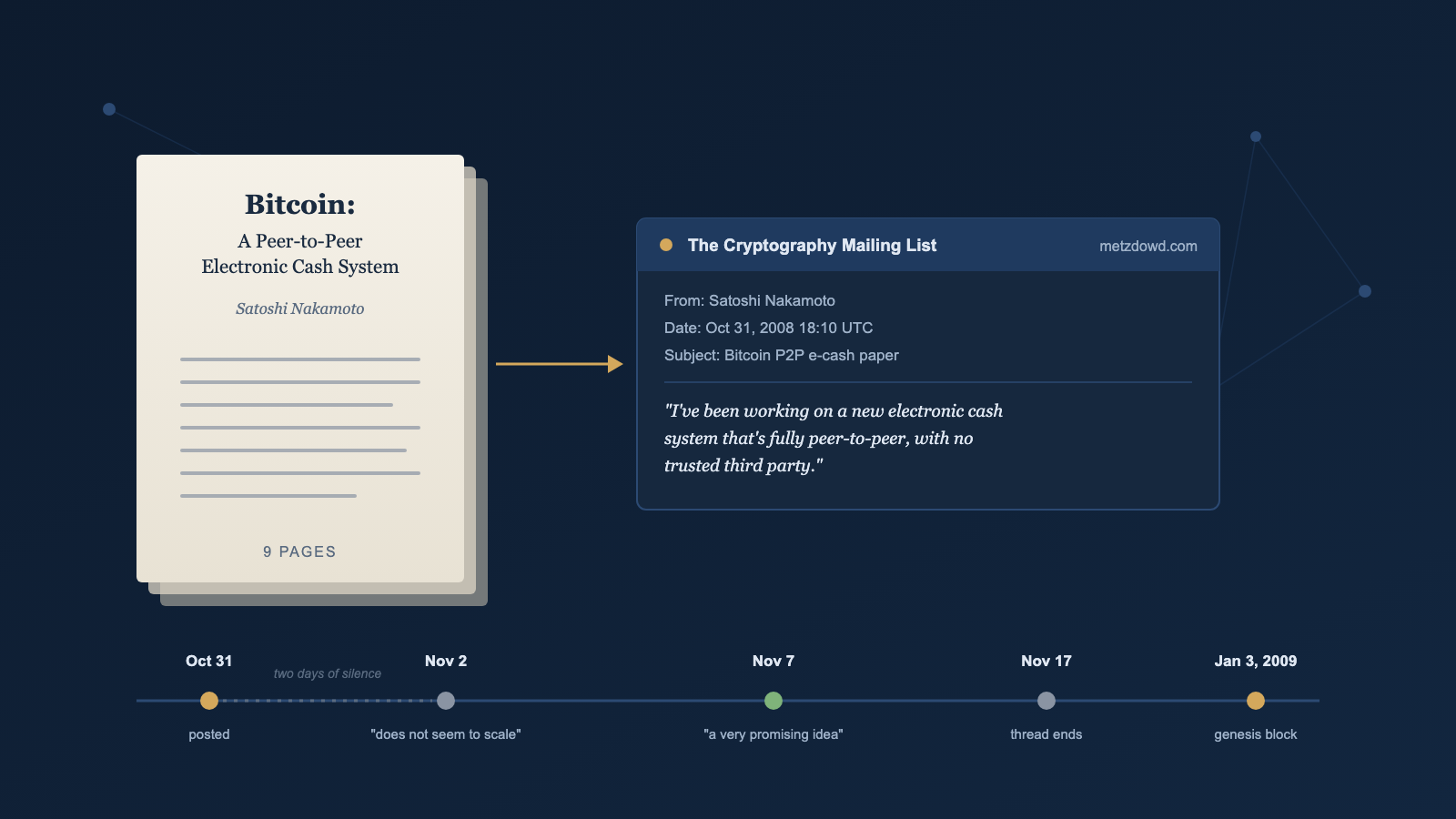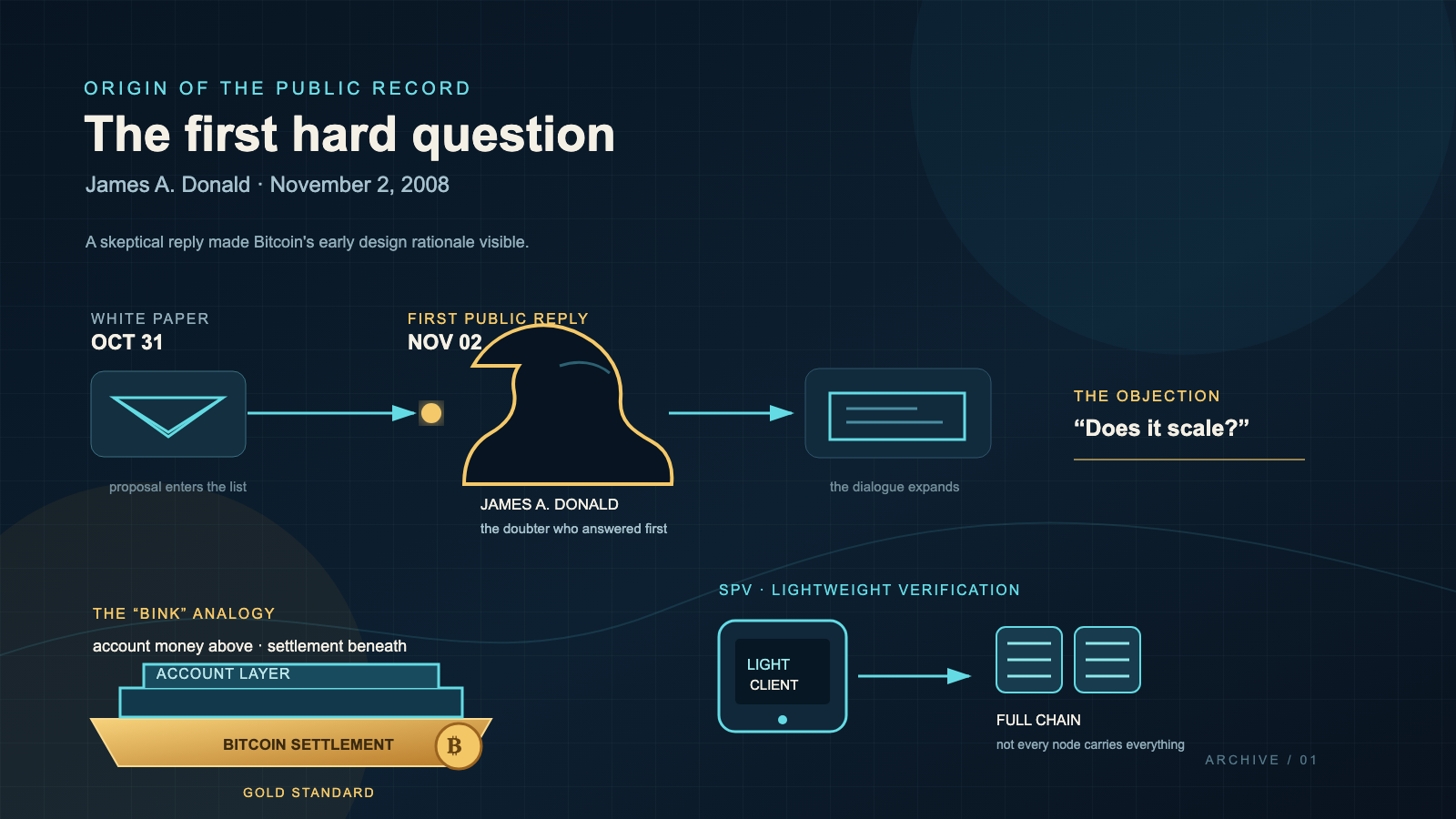
On November 2, 2008, James A. Donald became the first person to publicly answer Satoshi’s white-paper announcement on the cryptography mailing list — “We very, very much need such a system, but the way I understand your proposal, it does not seem to scale to the required size.” That position, at the very origin of the public Bitcoin record, plus his standing as a long-time cypherpunk, and later a stylometric match, made him a candidate. His documented role is in the James A. Donald biography.
1. The evidence
Donald — a cryptographer and anarcho-capitalist writer who ran the website jim.com and was long active in cypherpunk circles — was the person behind the Satoshi pseudonym, present from the earliest days of the public record as his own first respondent. The identification was articulated publicly by Gerald Votta in 2021 and became the leading lead in Benjamin Wallace’s fifteen-year investigation, published as The Mysterious Mr. Nakamoto (2025).
1.1 The first responder
Donald was not a third-party Satoshi reached out to; he stepped forward on his own, two days after the announcement, with the sharpest early technical objection. That immediacy and engagement read as the author hiding in plain sight, posing as his own interlocutor.
The objection: being first to reply is a fact about attention, not authorship. The cryptography mailing list was a small expert venue; a long-active cypherpunk replying quickly to a digital-cash paper is expected, not anomalous.
1.2 The stylometric lead
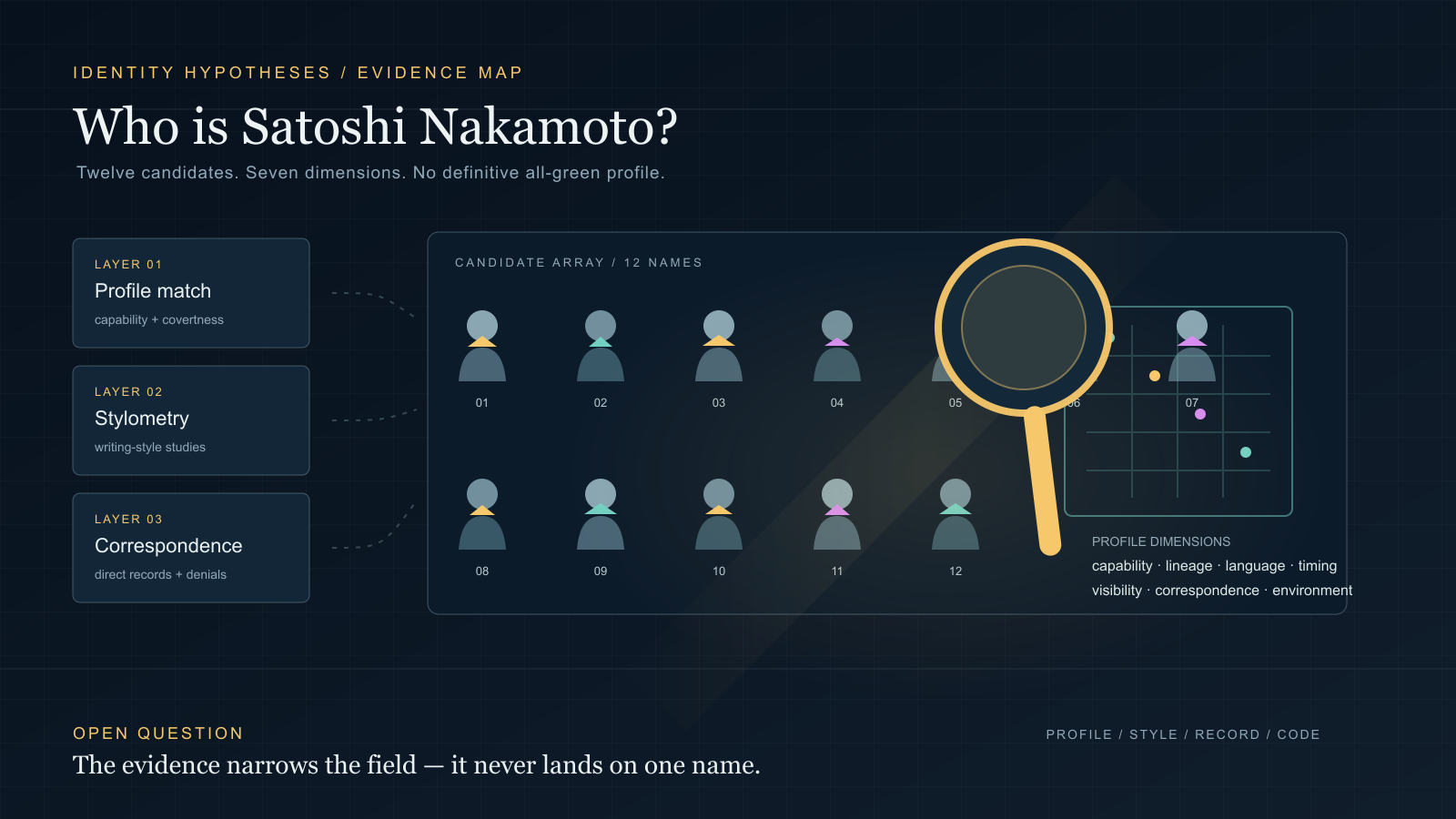
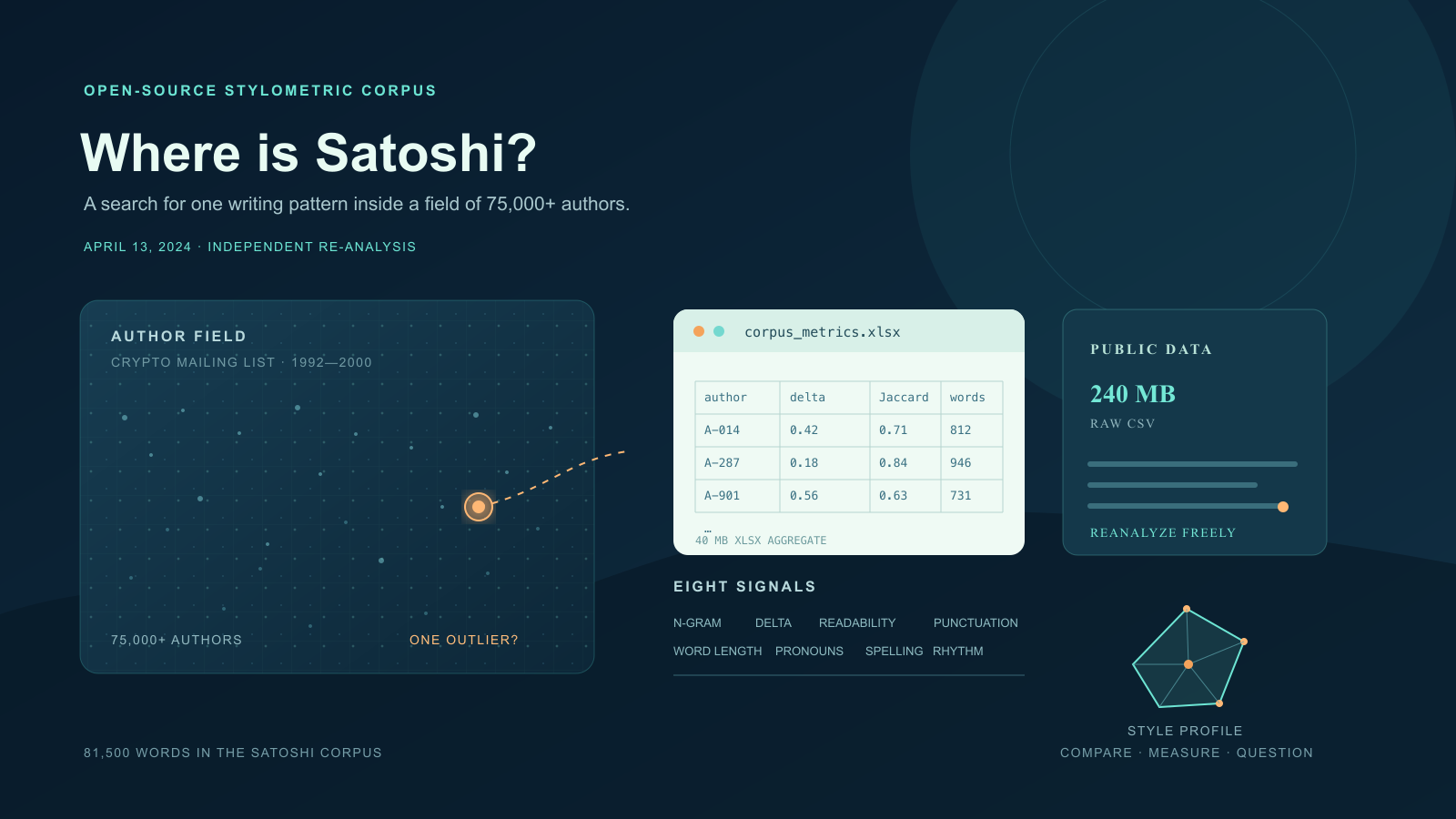
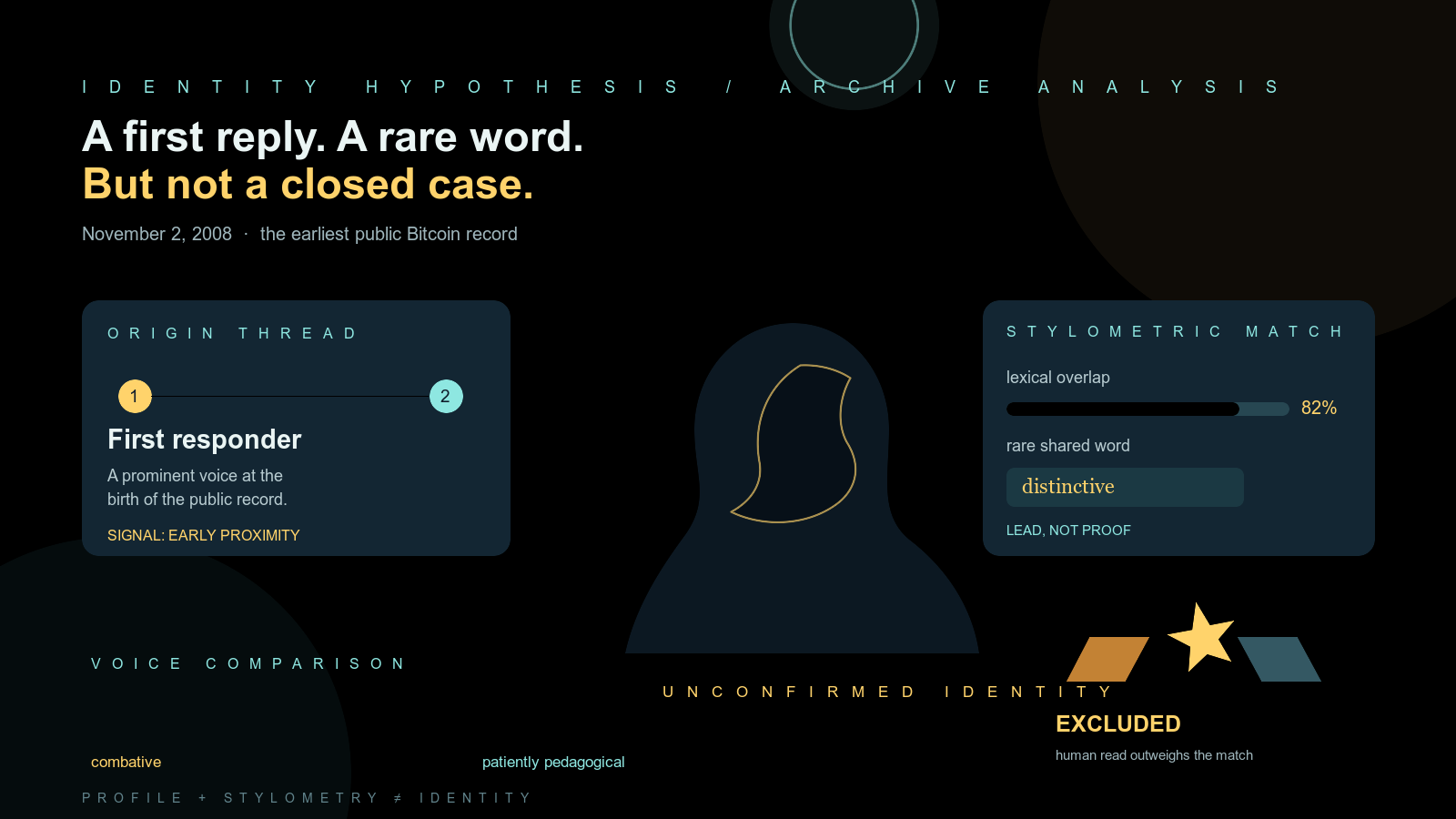
A stylometric comparison flagged a rare shared word and other lexical overlaps between Donald’s writing and Satoshi’s — the thread that pulled Donald to the top of Wallace’s list.
The objection: a rare-word coincidence is a lead, not a conclusion, and it is exactly the kind of single-feature signal the broader stylometric record warns against — van Dorst’s corpus finds hundreds of authors close to Satoshi on aggregate measures, and the named-candidate stylometric studies have most often pointed elsewhere (Szabo, Back, Finney).
1.3 The cypherpunk-libertarian profile
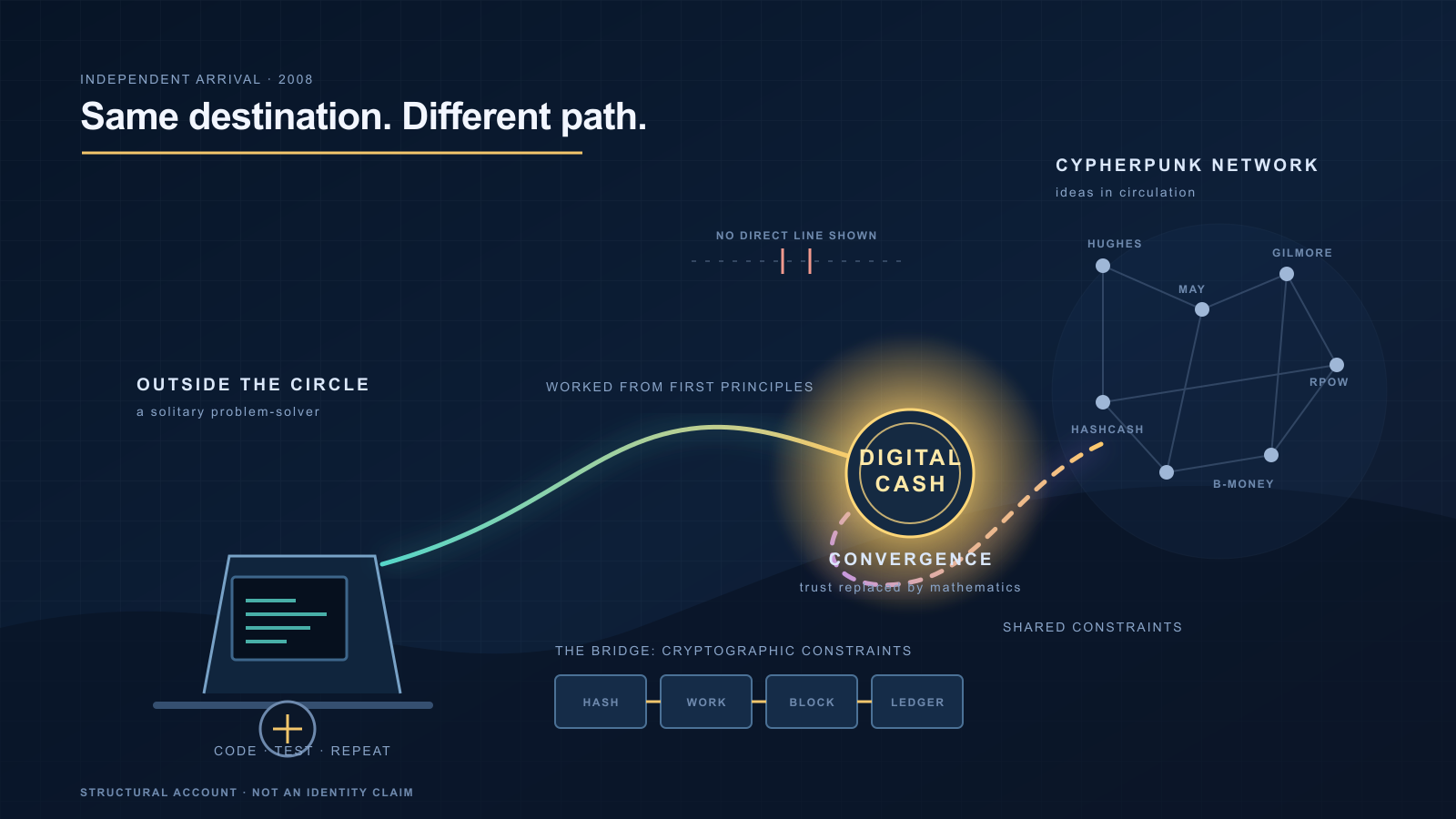
Donald’s jim.com writing on cryptography, money, and anarcho-capitalist political philosophy fits the ideological milieu the cypherpunk independent-arrival analysis reads in Satoshi.
The objection: this places Donald inside a population, not at a point — it is the same broad fit that applies to many capable cypherpunks of the period, and it does not include the specific Hashcash / b-money digital-cash lineage or a v0.1-scale shipping record.
2. The counter-evidence
| Counter-evidence | Central observation | Strength assessment |
|---|---|---|
| §2.1 Satoshi answered him as a third party | Satoshi addressed Donald as an outside questioner, explaining the design to him | The central counter — the same third-party-correspondence argument that weighs against Adam Back and Wei Dai |
| §2.2 Distinct prose | Donald’s writing register differs from Satoshi’s beyond the flagged overlap | Weakens the stylometric lead from within |
| §2.3 Wallace’s in-person exclusion | After meeting Donald, Wallace judged the emotional texture wrong for Satoshi | A human recognition the stylometry could not make — the case’s most telling moment |
2.1 Satoshi answered him as a third party
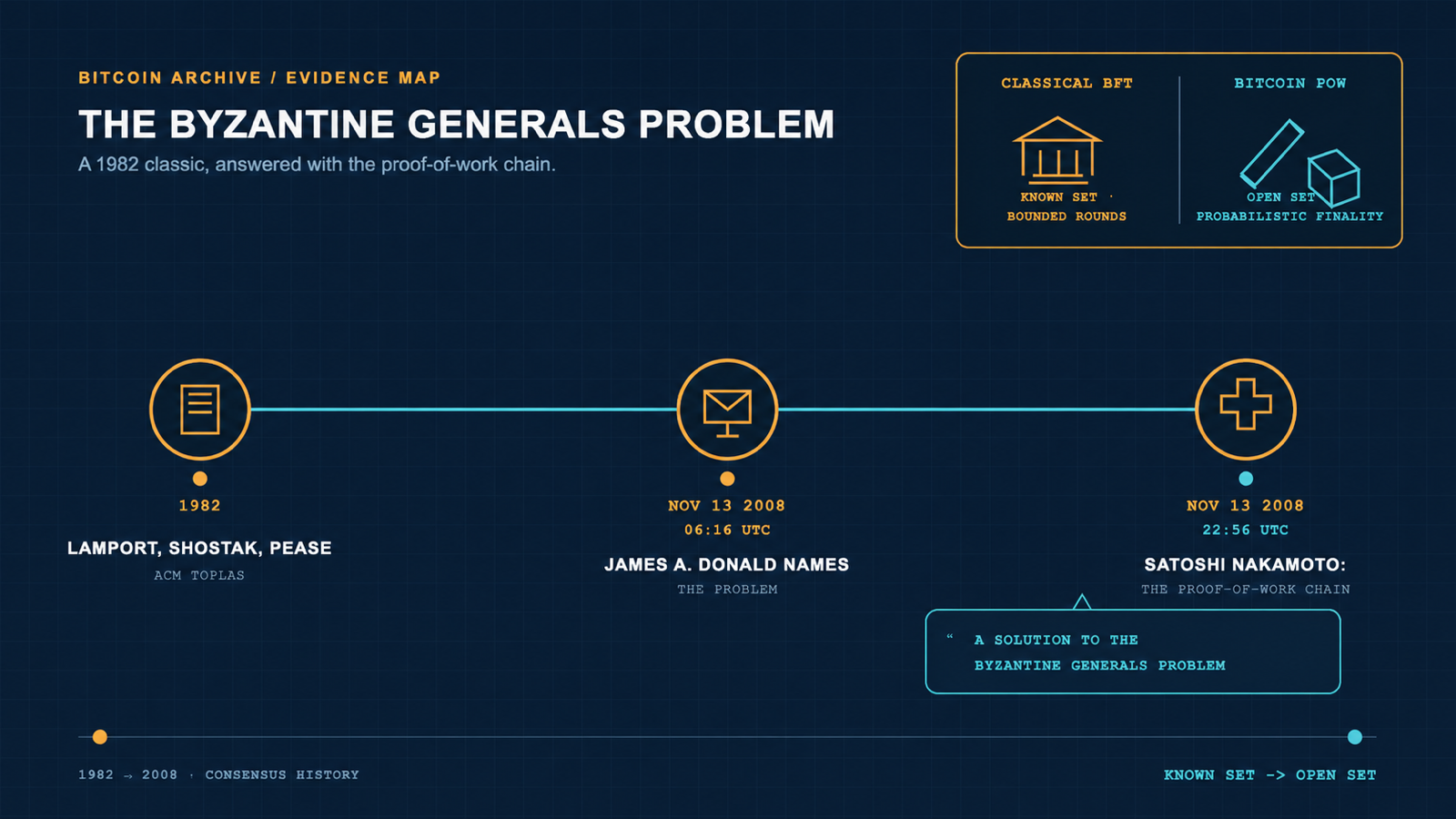
The strongest counter is in the exchange itself: across November 2008 Satoshi answered Donald’s scaling objection point by point — simplified payment verification, the trust and double-spend model — addressing him as an outside questioner to be persuaded, not as a persona. The correspondence continued past the scaling thread: on November 13, Donald named the difficulty he had been pressing Satoshi on as the Byzantine Generals Problem, and Satoshi answered the same day claiming a solution — a second documented round of the same outside-questioner dynamic. This is the identification-asymmetry argument that bears on Adam Back and Wei Dai with equal force: a documented correspondence in which Satoshi explains himself to the candidate is evidence the candidate is a third party.
2.2 Distinct prose
Beyond the single rare-word overlap, Donald’s documented writing — combative, doctrinaire, anarcho-capitalist — does not read across its range like Satoshi’s, whose register shifts from the academic to the casual to the patiently pedagogical. A lexical coincidence is real but narrow; it does not survive a wider comparison of voice.
2.3 Wallace’s in-person exclusion
This is the case’s most distinctive feature, and the reason it belongs in the record. Wallace’s stylometric lead pointed to Donald strongly enough that he traveled to meet him in person. He came away excluding him — not on a new datum, but on a reading no algorithm produced: Satoshi’s writing carries warmth, curiosity, and enthusiasm, the texture of an engaged and even genial person, and Donald in person read as flat and emotionally sparse, a different human register. The exclusion is a recognition, not an inference — the kind of judgment that is signed by the observer’s own sensibility, where another investigator meeting the same man might read him differently. It is the sharpest illustration in the candidate landscape of why profile and stylometric match are necessary but not sufficient: the machine ranked Donald near the top, and a person who met him set him aside.
3. Within the broader documentary record
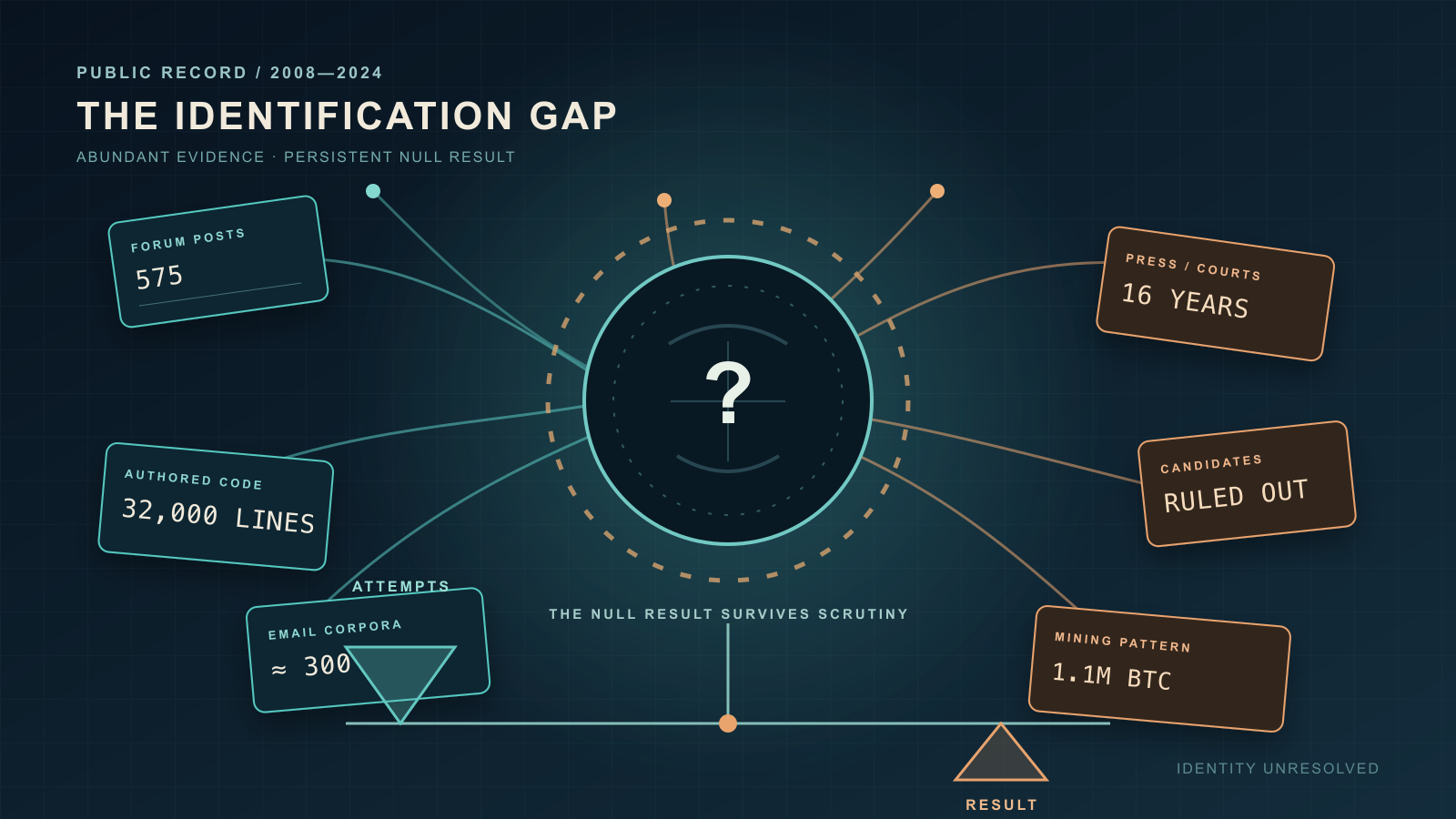
Donald sits at the productive tension between Bitcoin Institute’s stylometric layer and everything the stylometry cannot settle. A rare-word signal and an early presence put him on the list; the documented third-party correspondence, the wider divergence of voice, and a journalist’s in-person read take him off it. The case is a reminder that the four comparison layers narrow the space but do not close it, and that the last step — recognizing a person rather than scoring a profile — is one the public record cannot perform on the reader’s behalf. For the full candidate comparison, see the Satoshi-identity hypotheses overview.
4. Limits of this entry
- This entry does not present new evidence. It compiles publicly available material.
- The stylometric “rare word” is reported via secondary accounts (Votta 2021, Wallace 2025); this entry does not reproduce the specific term, which is not reliably fixed in the public record here. Donald’s documented historical role — first responder and scaling interlocutor — is in the James A. Donald biography.
Donald’s case falls under Group C of the necessary-but-not-sufficient framework that the Satoshi-identity hypotheses overview applies across all candidates.
The record can rank a candidate; it cannot recognise one. In Donald’s case the last step was taken by a single reader across a table, and it is the one step here that neither I nor anyone else can check.