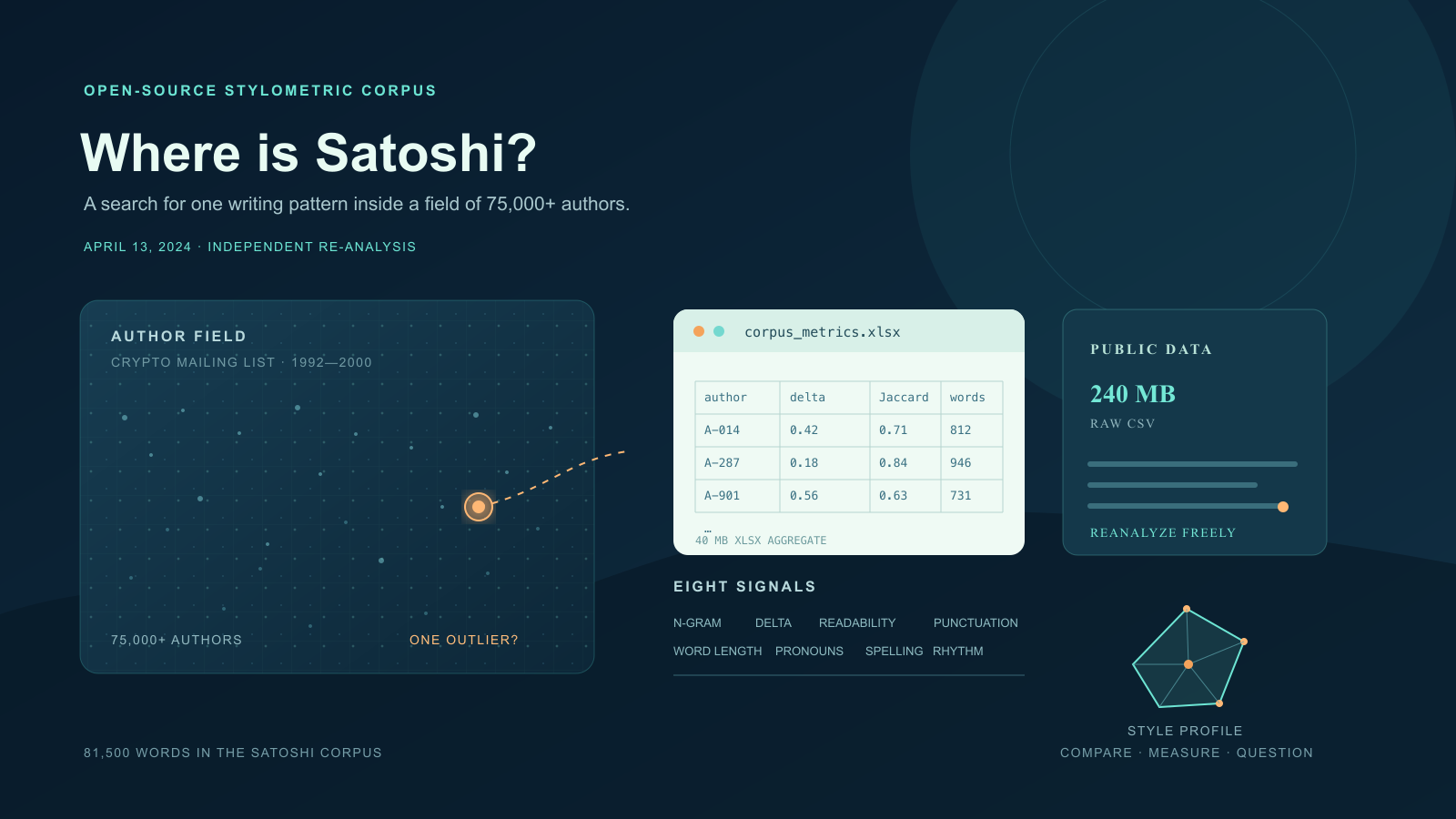
On April 13, 2024, Bas van Dorst released “Where is Satoshi?” — a large-scale, open-source stylometric comparison of Satoshi Nakamoto’s writing corpus against more than 75,000 cryptography mailing-list authors and over 70,000 Reddit /r/Bitcoin commenters. The project is, by corpus size and by data-release transparency, the most rigorous numerical multi-candidate stylometric resource on Satoshi authorship in the public record.
Corpus
- Mailing-list corpus: 500,000+ posts across 10+ cryptography-related mailing lists, covering 75,000+ authors writing between 1992 and 2000.
- Reddit corpus: 7,500,000+ comments from /r/Bitcoin, covering 70,000+ authors between 2005 and 2019.
- Satoshi corpus: 81,500 words across the Bitcoin whitepaper, the BitcoinTalk forum posts, private email correspondence, and code comments from the v0.1 source release.
Stylometric metrics
For every (author, time-window) pair the project computes:
| Metric | What it measures |
|---|---|
| N-gram analysis (1/2/3-gram) | Vocabulary and phrase patterns |
| Burrows’ Delta | Standard stylometric distance metric in computational stylometry |
| Jaccard similarity | Set-overlap measure across vocabulary |
| Five readability indices | Flesch, Gunning Fog, Dale-Chall, Coleman, SMOG |
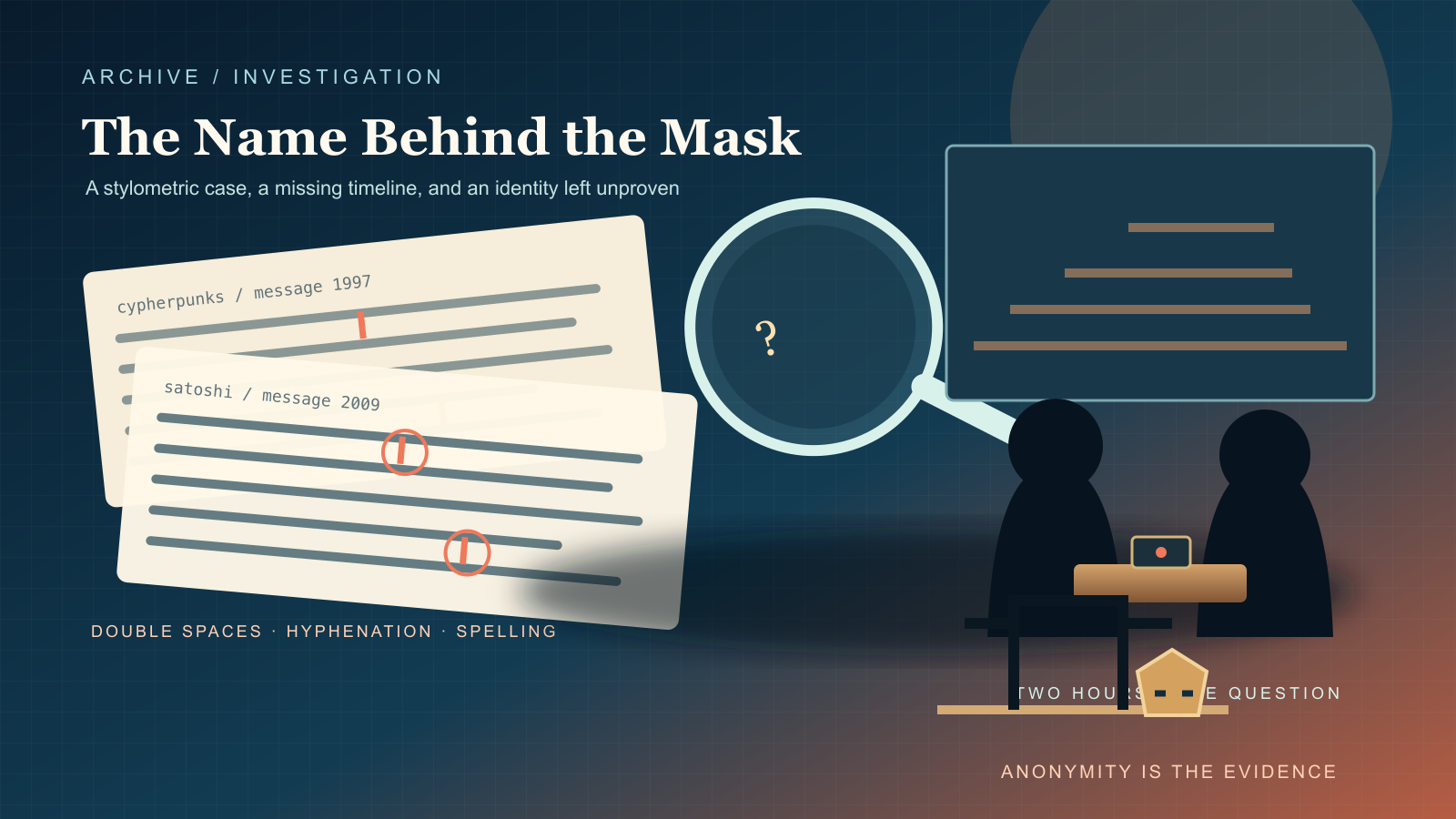
| Punctuation patterns | Hyphenation conventions, double-spacing-after-period (later highlighted in the Carreyrou NYT investigation) |
| Word-length frequency distributions | Lexical-length signature |
| Personal pronoun usage | First-person singular vs. plural, presence/absence patterns |
| British vs. American spelling variants | Including the British-spelling tells in Satoshi’s writing that have driven multiple identification hypotheses |
Data release
The complete numerical output is released as downloadable spreadsheets:
XLSXaggregate: 40 MB.CSVraw per-chunk: 240 MB.
This is the largest publicly-released numerical dataset of Satoshi-vs-candidates stylometric comparison. It is the only resource in the field that allows independent re-analysis: a researcher with a different distance metric or a different candidate-pruning strategy can run their own ranking against the same underlying numbers.
Author’s framing
Van Dorst explicitly refrains from naming a leading candidate:
Yes, I have a short-list of suspects. No, I’m not going to drop names here because I’m not 100% sure.
He is also transparent about personal interest:
There is no personal interest in Satoshi’s real identity. I sold my stake in 2012, way before the hype started.
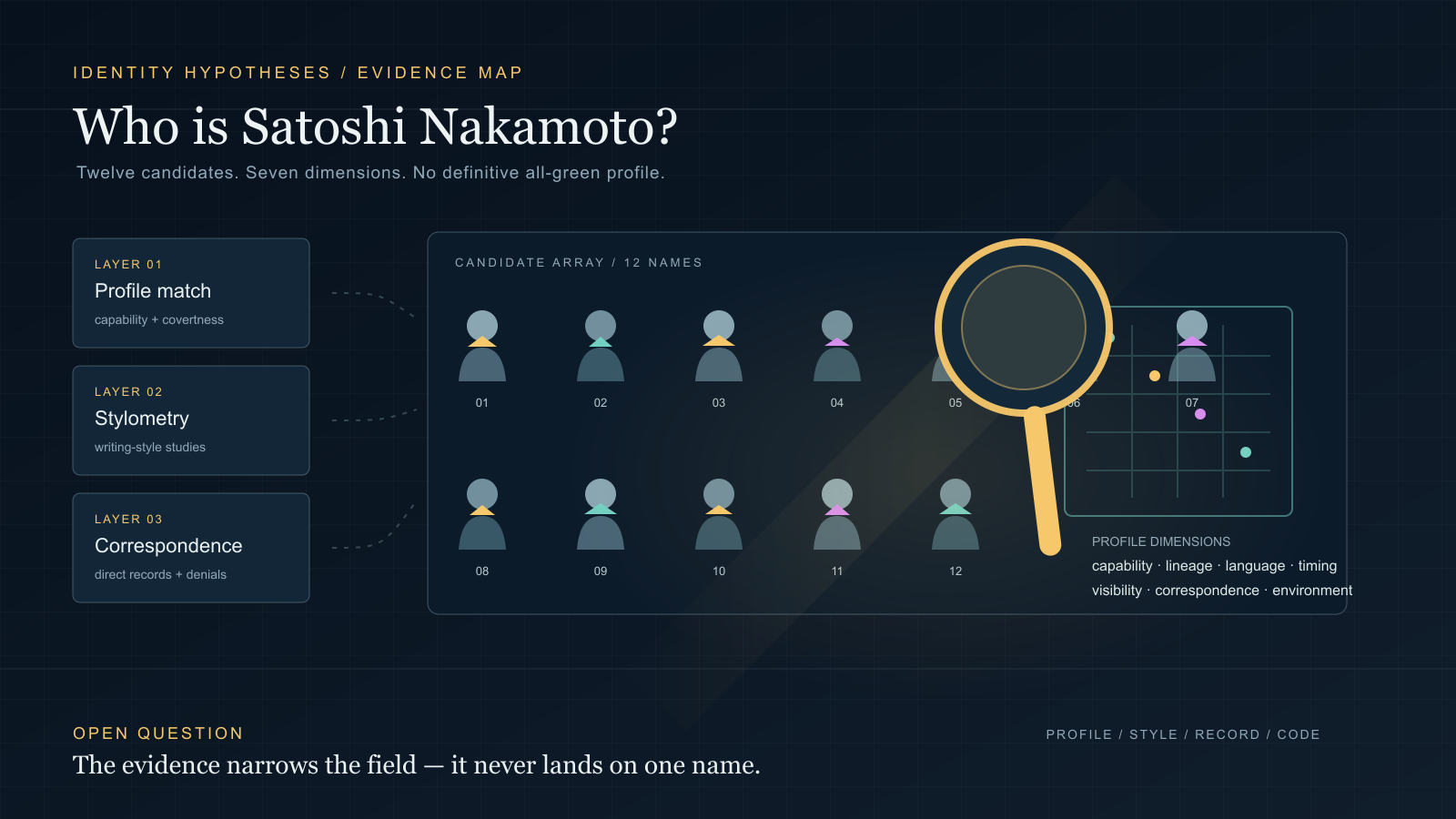
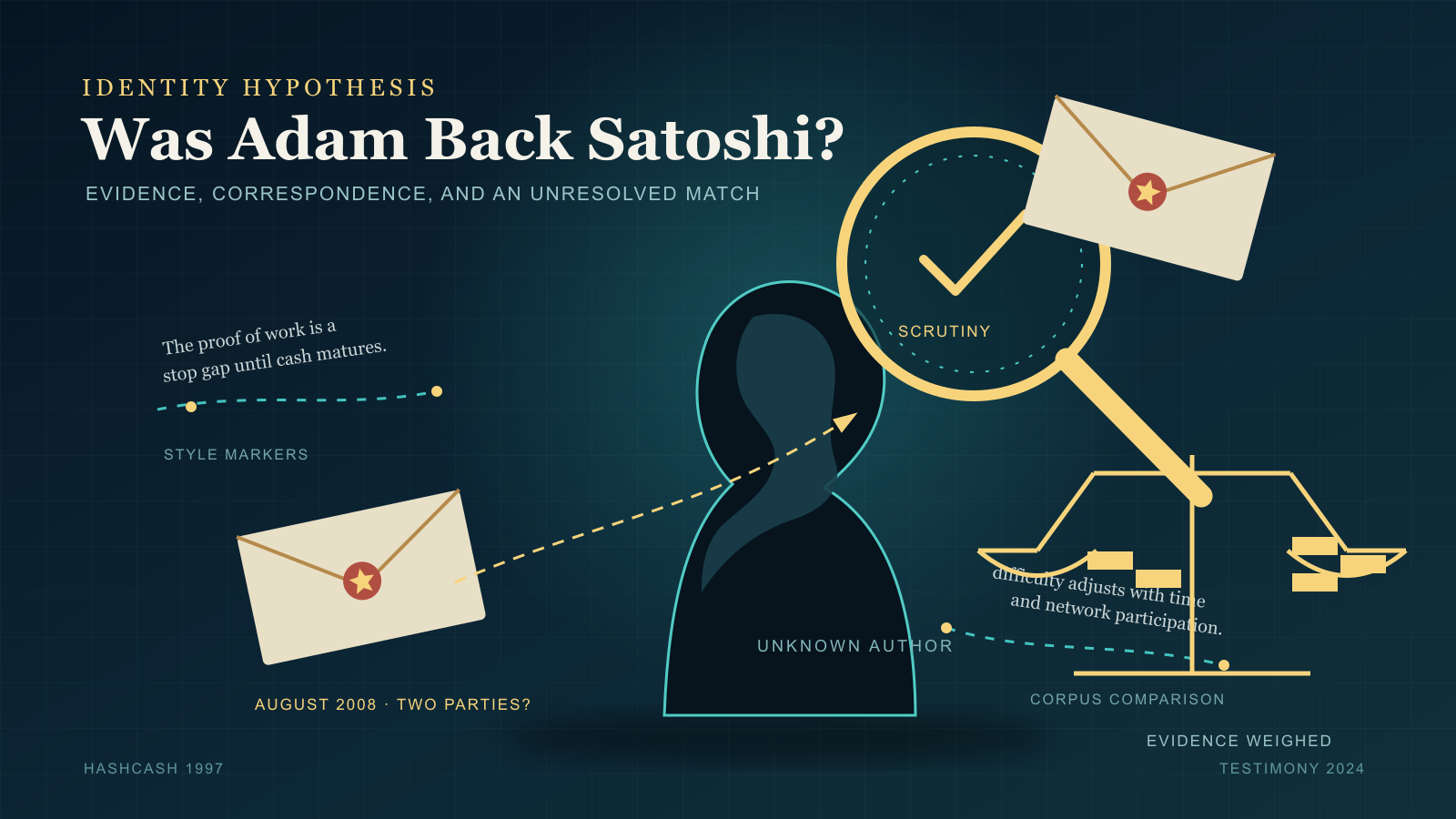
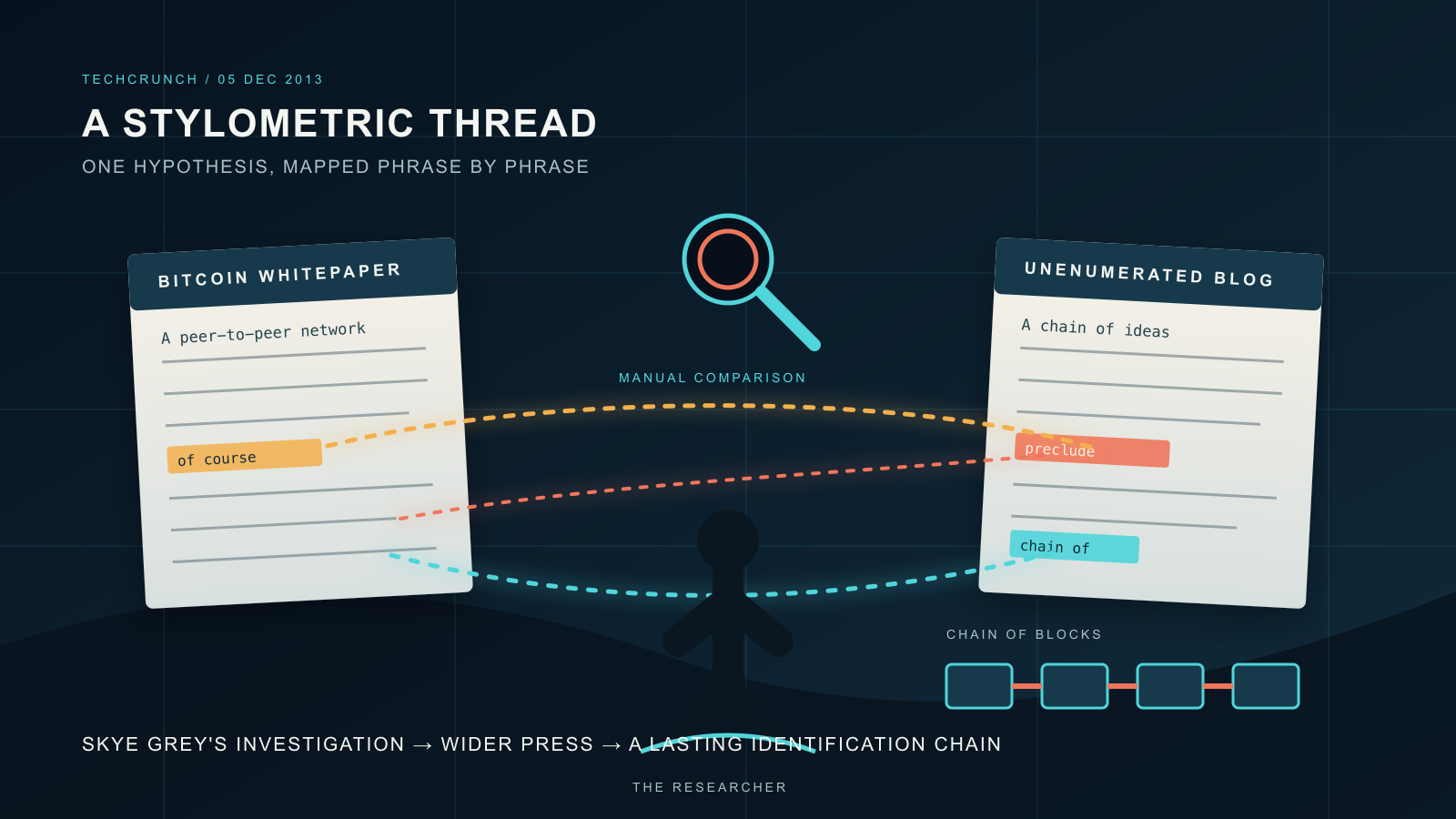
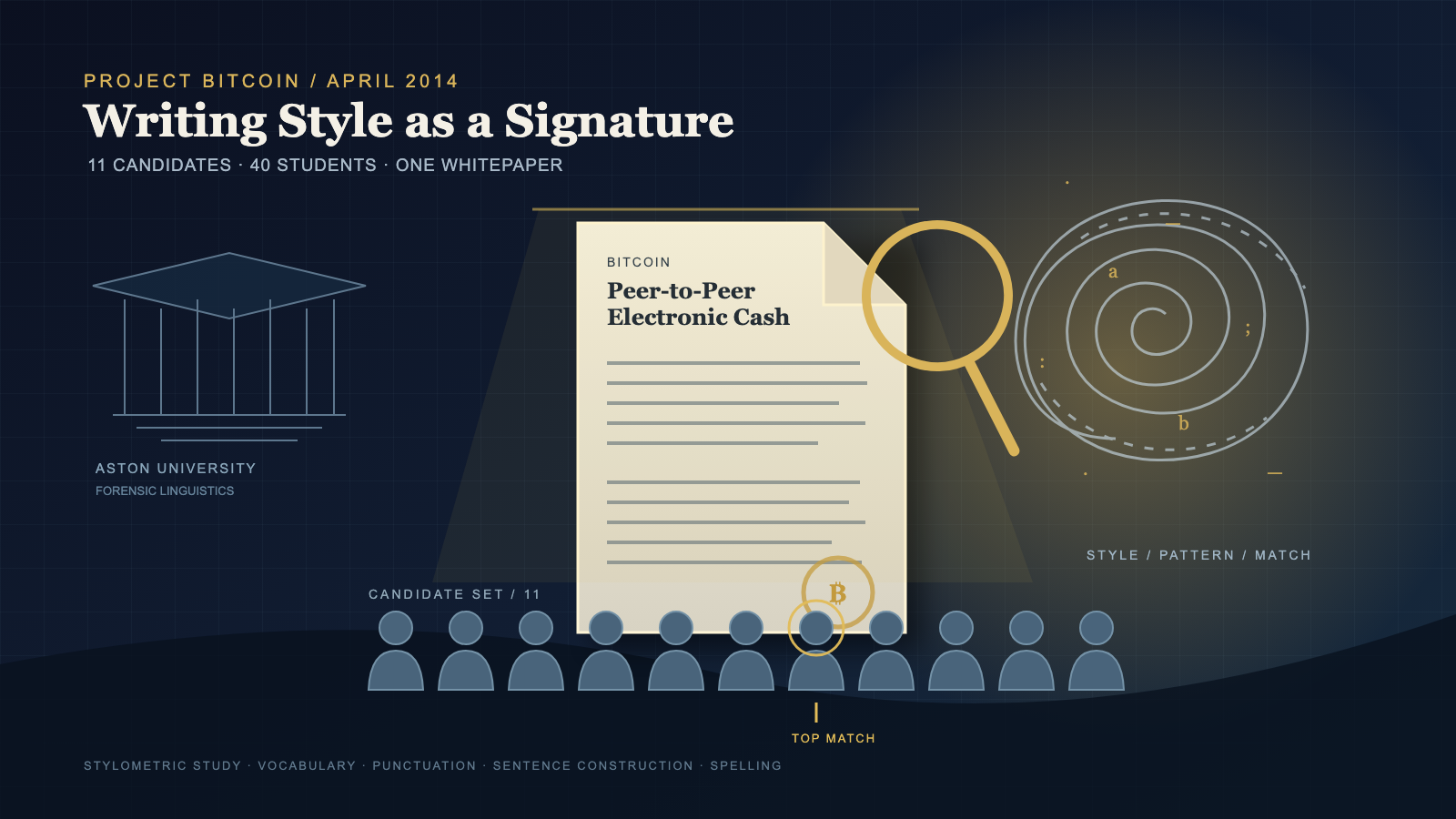
The combination — large dataset, full numerical release, no identification push — is methodologically more rigorous than the narrative-driven stylometric pieces that have named specific candidates (Skye Grey 2013 for Szabo, the Aston University 2014 study for Szabo, Cafiero’s analysis in Carreyrou’s 2026 NYT investigation for Adam Back).
Methodological caveats stated by the author
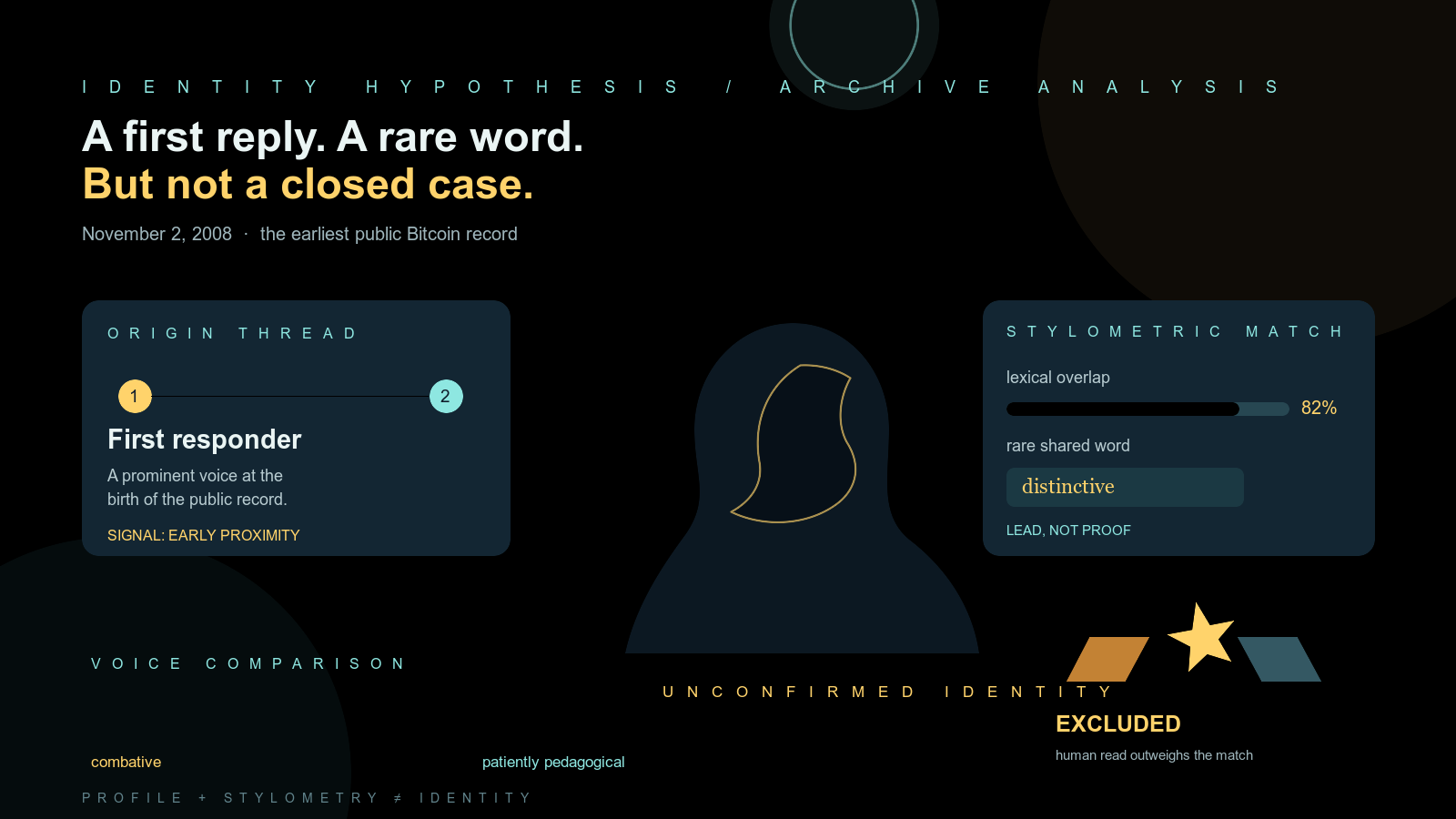
- “High correlation only shows similar language patterns → high correlation does not imply causation.” Two authors writing about the same technical subject in the same era will share vocabulary and sentence structures regardless of whether they are the same person.
- N-gram analysis is complicated by terminology emerging only after Bitcoin’s 2009 release. Comparisons to post-2010 writing on cryptocurrency topics can be confounded by Bitcoin-specific vocabulary that any informed writer will have adopted.
- Email-thread reply extraction may inadvertently include quoted text from earlier replies, misattributing language to the wrong author.
- The last data chunk in any time-windowed analysis is often incomplete, potentially skewing aggregated results.
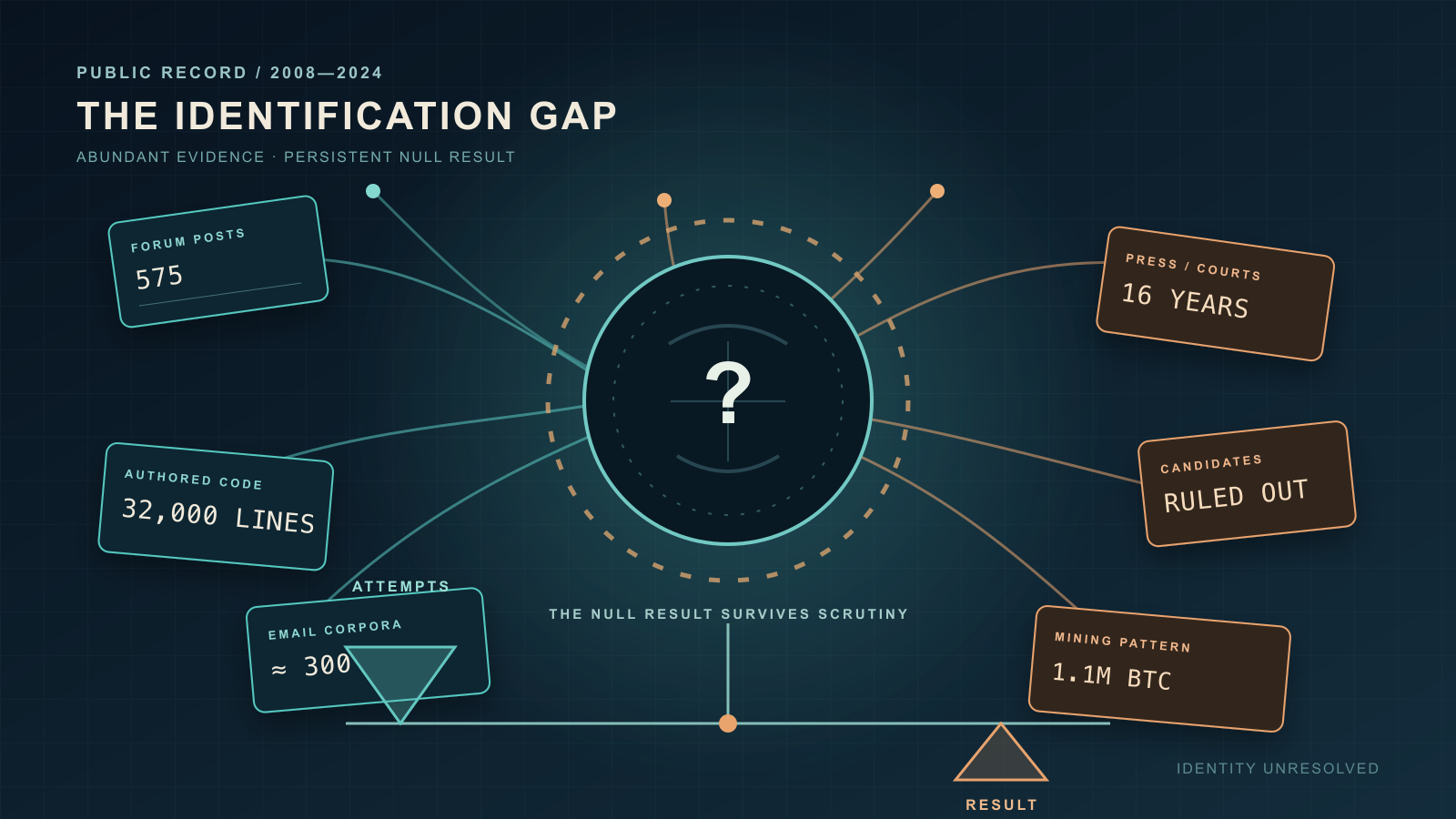
These caveats are the same structural limitations that constrain all stylometric Satoshi-identification work; the project’s value is in stating them explicitly and providing the raw numerical data that lets a critic test them.
Position in the stylometric record
Cross-referencing this corpus against the named-candidate stylometric tradition:
| Study | Year | Candidate scope | Top match | Numerical data public |
|---|---|---|---|---|
| Skye Grey | 2013 | Szabo (single-hypothesis) | Szabo | No (narrative phrase list) |
| Aston University | 2014 | 11 candidates | Szabo | No (results in press releases only) |
| Cafiero / Carreyrou NYT | 2026 | 12 candidates (focus); 620 (broader) | Adam Back (Hal Finney near tie) | No (results summarized in NYT article) |
| Wallace, The Mysterious Mr. Nakamoto | 2025 | Narrative case built around one candidate | James A. Donald — stylometric top match, then excluded by the author on an in-person read no dataset produced | No (narrative case in book) |
| van Dorst | 2024 | 75,000+ | Not named publicly (Szabo top of 5 named candidates per Bitcoin Institute reanalysis) | Yes — 280 MB CSV/XLSX |
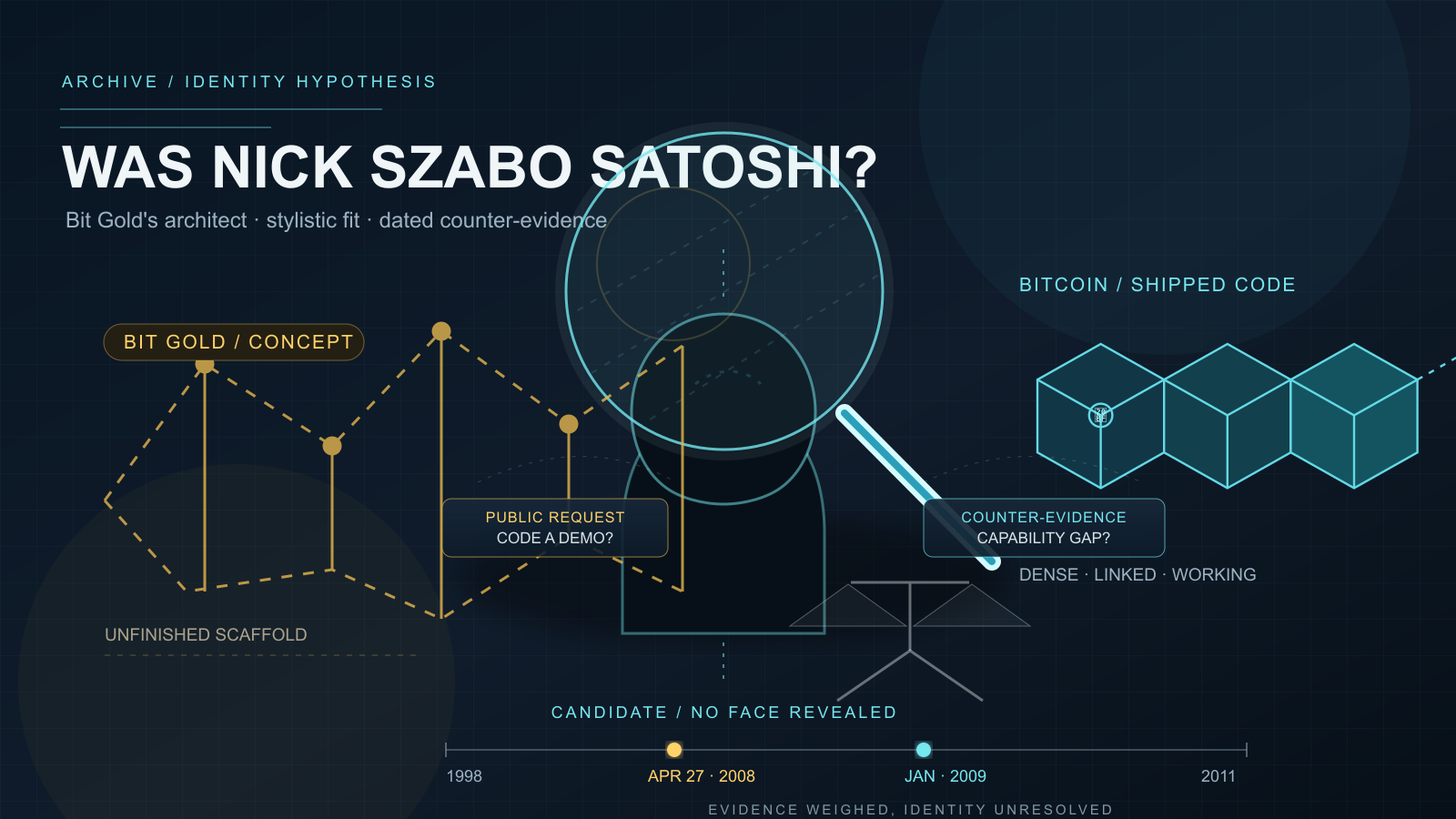
Van Dorst declines to publicly name a candidate while the narrative-driven studies do. Read alongside the Bitcoin Institute reanalysis, the named-candidate studies mostly converge on Szabo (3 of 5) with Cafiero / Carreyrou’s Adam Back and Wallace’s since-retracted James A. Donald as the two outliers. These two facts are themselves a methodological observation: stylometric Satoshi identification is sensitive to corpus selection, distance metric, and candidate pre-selection, but the most persistent signal across methods places Szabo highest among the named candidates. Wallace’s retraction is also the one case in this table where the stylometric signal itself was not the reason a candidate got dropped.
Per-candidate values from this corpus (Bitcoin Institute reanalysis)
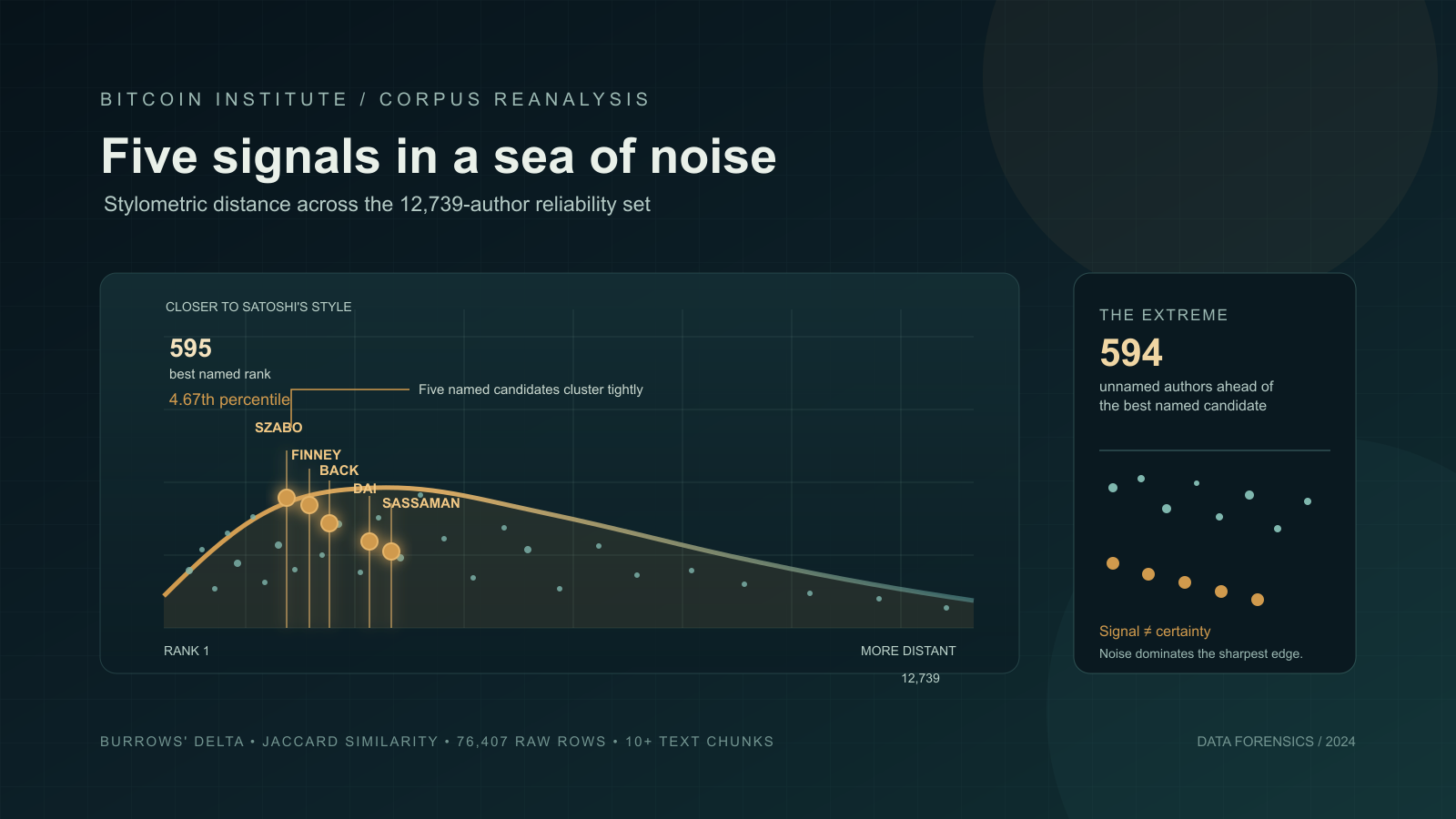
Although van Dorst declines to publish a ranking, the underlying numerical data is downloadable and the named identity-hypothesis candidates can be located in it. The Bitcoin Institute reanalysis (May 2026) extracts Burrows’ Delta values for the five most-cited Satoshi-identity named candidates from the published comparison.xlsx, ranks each against the 12,739 authors in the corpus with at least 10 chunks of writing, and reads van Dorst’s “I’m not 100% sure” caveat against the data: Nick Szabo leads the named group at top 4.67%, Hal Finney and Adam Back follow within 0.85 standard deviations, and 594 unnamed authors rank closer than Szabo — most of the corpus’ apparent top matches turn out on inspection to be noise (e-commerce accounts, anonymous remailer relays, disposable accounts) rather than signal. See the analysis entry for the per-candidate table, the corpus’ top-20 noise discussion, and the four-reading interpretation of why van Dorst’s silence on names is the data-honest position.
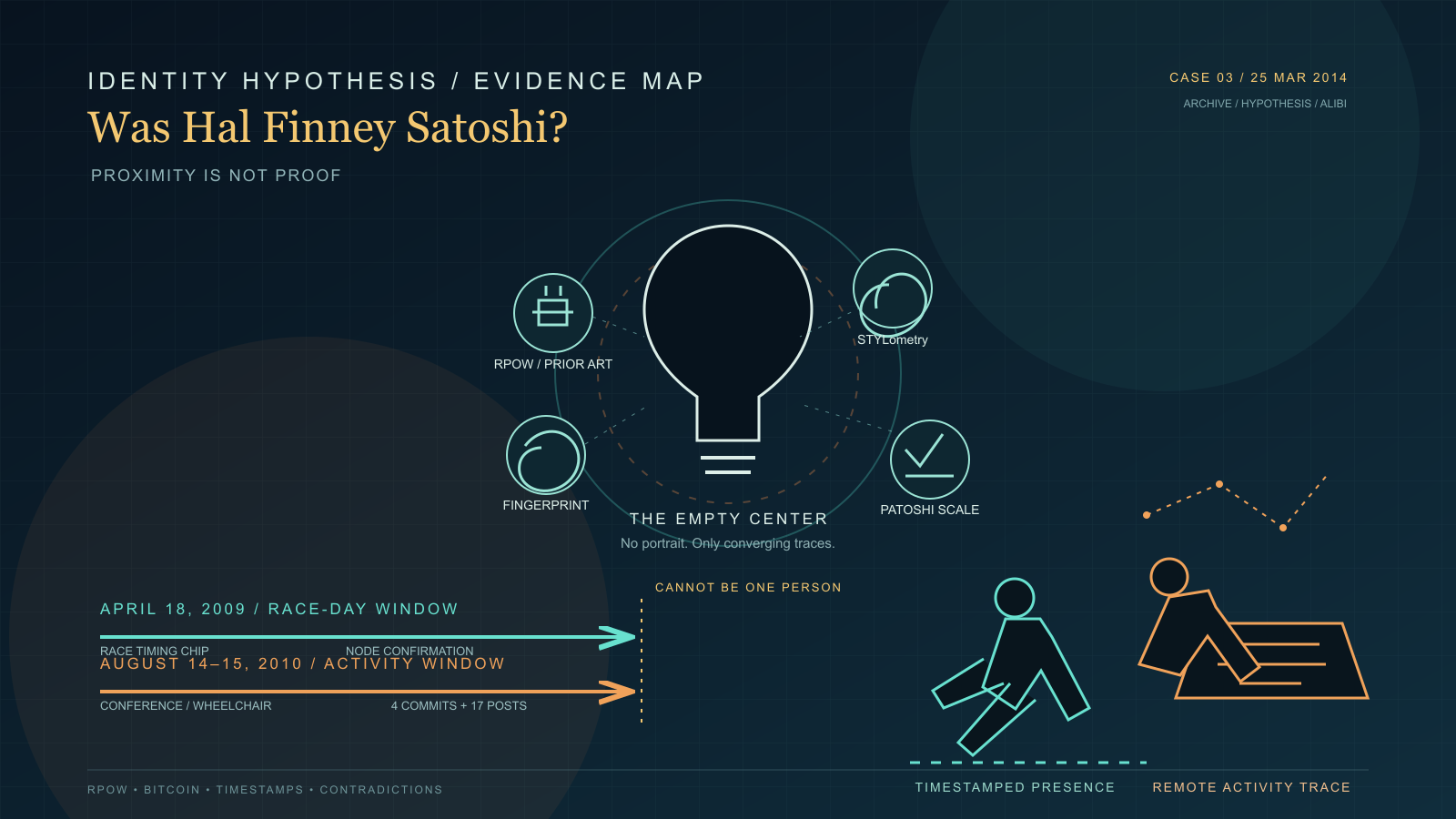
The broader case for and against the Finney identity hypothesis — including his specific percentile in this corpus — is treated in the Hal Finney Satoshi-identity hypothesis entry.
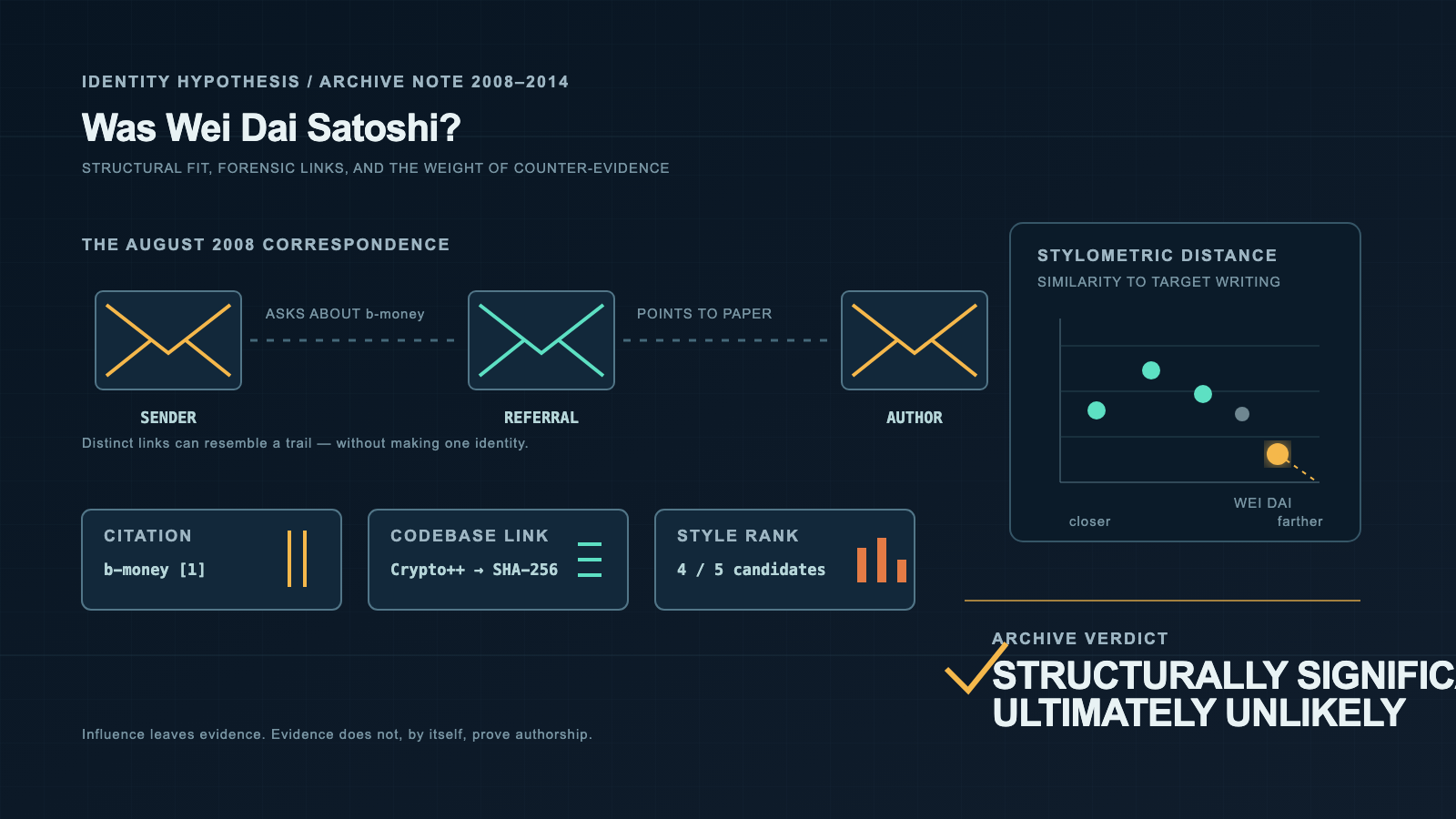
For the analytical treatment of stylometric methods in Satoshi identification more broadly, see the relevant identity-hypothesis entries: Nick Szabo, Adam Back, Wei Dai, and the identity-hypotheses overview.
Two later readings are built on this corpus. The 2026 reanalysis of named candidates extracts the five named identity-hypothesis candidates and ranks them within the 12,739-author distribution derived from it. The identification-asymmetry analysis counts it as the 2024 technical attempt in its timeline.