On December 1, 2013, an anonymous blogger writing under the handle “Skye Grey” published an article titled “Satoshi Nakamoto is (probably) Nick Szabo” on the LikeInAMirror.wordpress.com blog. On December 5, 2013, TechCrunch’s John Biggs reported the investigation under the headline “Who Is The Real Satoshi Nakamoto? One Researcher May Have Found The Answer”, introducing the hypothesis to the broader cryptocurrency and technology press.
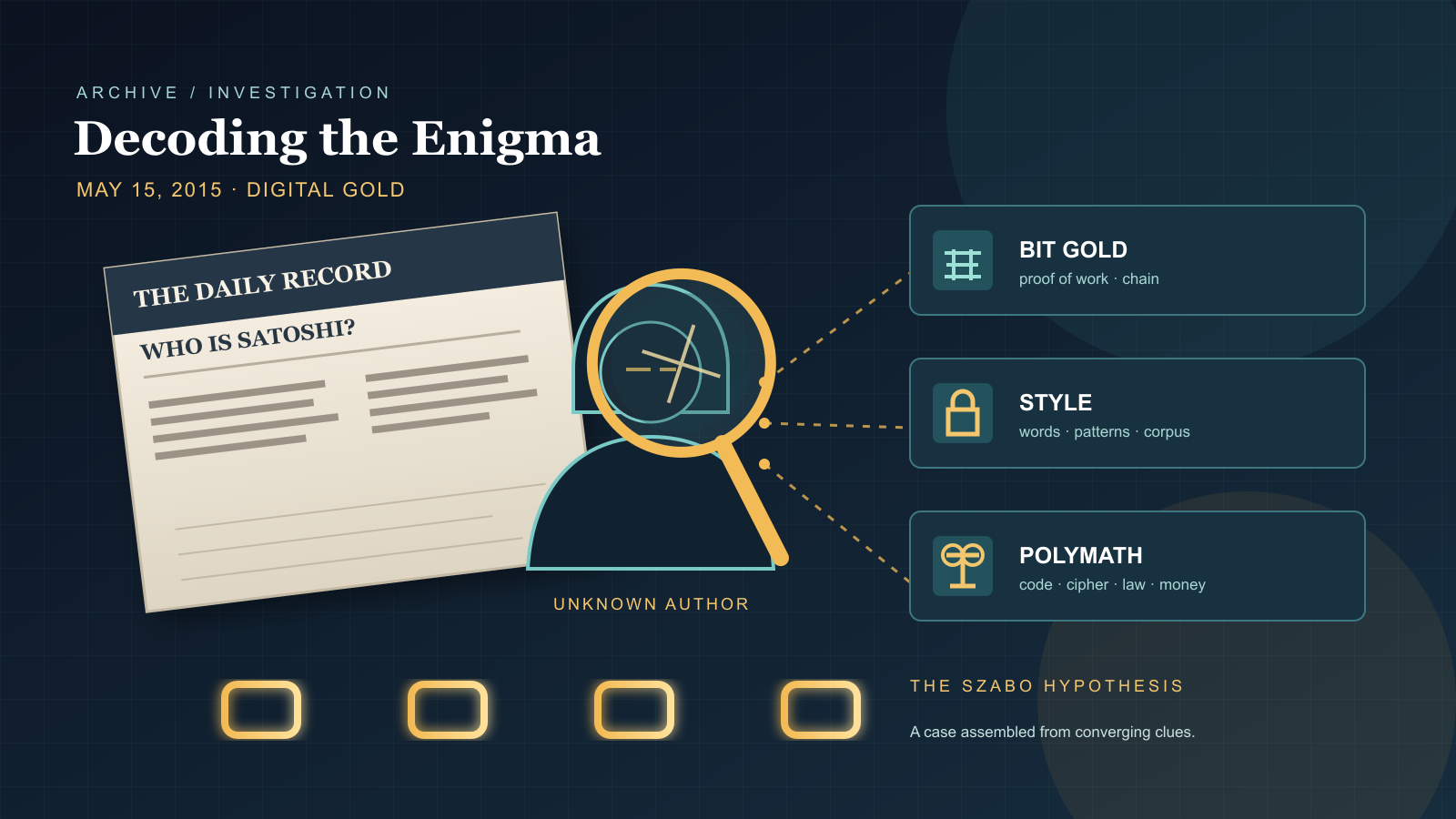
This is the foundational stylometric event in the Szabo-as-Satoshi hypothesis record. Every subsequent mainstream identification of Nick Szabo as Satoshi Nakamoto — the April 2014 Aston University forensic-linguistic study, the May 2015 New York Times investigation by Nathaniel Popper and his book Digital Gold, the October 2018 Jeff John Roberts / Fortune feature — traces back to or amplifies Skye Grey’s original December 2013 analysis.
The Skye Grey methodology
Skye Grey performed a manual stylistic comparison between two corpora:
- The Bitcoin whitepaper and Satoshi’s BitcoinTalk and mailing-list posts (2008–2010).
- Szabo’s Unenumerated blog and earlier mailing-list writing.
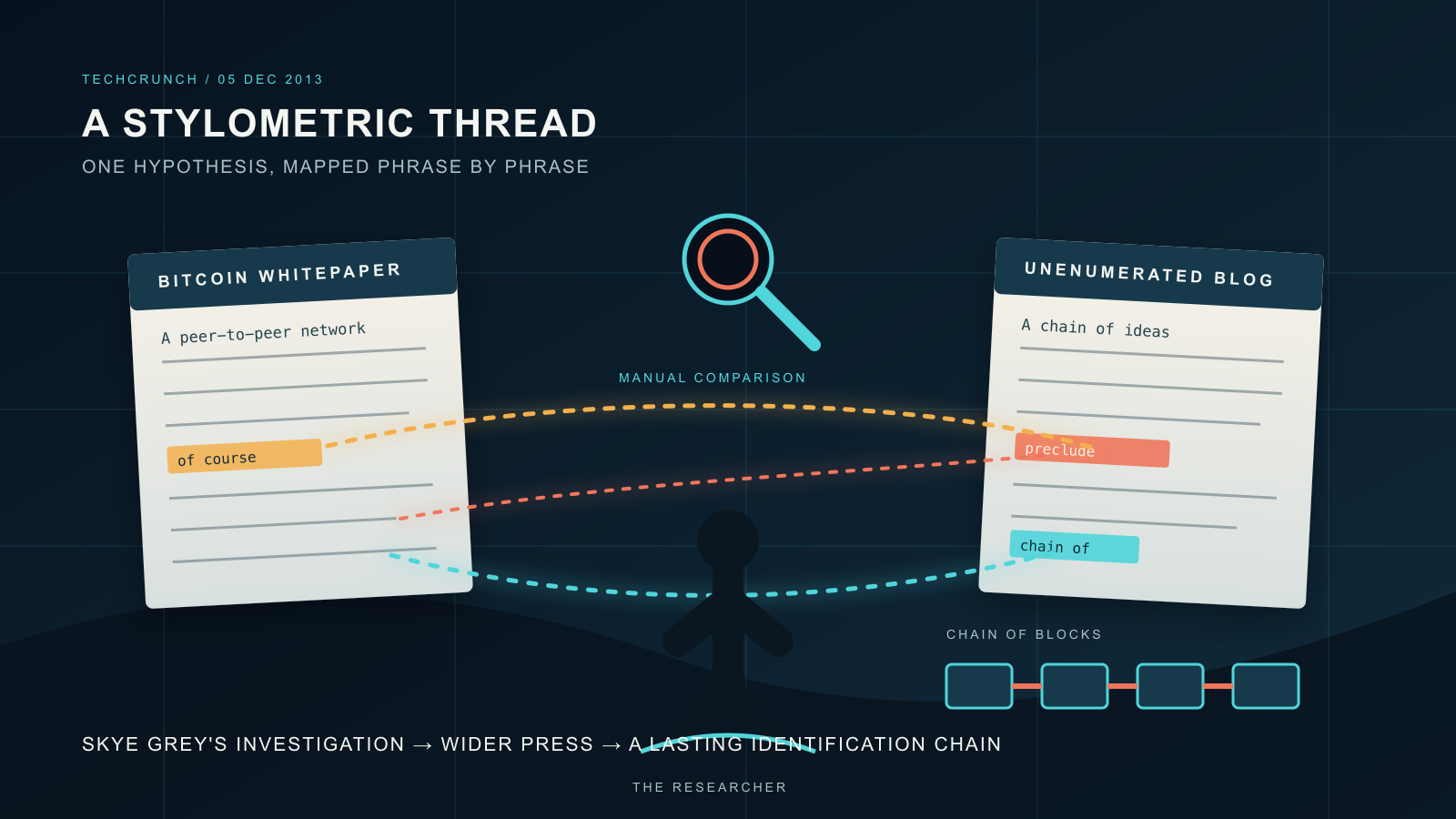
The analysis catalogued recurring phrasings, sentence-construction patterns, and vocabulary preferences shared between the two corpora. Among the markers highlighted:
- “of course” used as a sentence-starting concession structure.
- “preclude” as a relatively unusual technical-formal verb appearing in both corpora.
- “chain of” as a noun-phrase construction (anticipating “chain of blocks” / “chain of digital signatures” in the Bitcoin whitepaper, paralleling similar structures in Bit Gold and Szabo’s broader writing on cryptographic primitives).
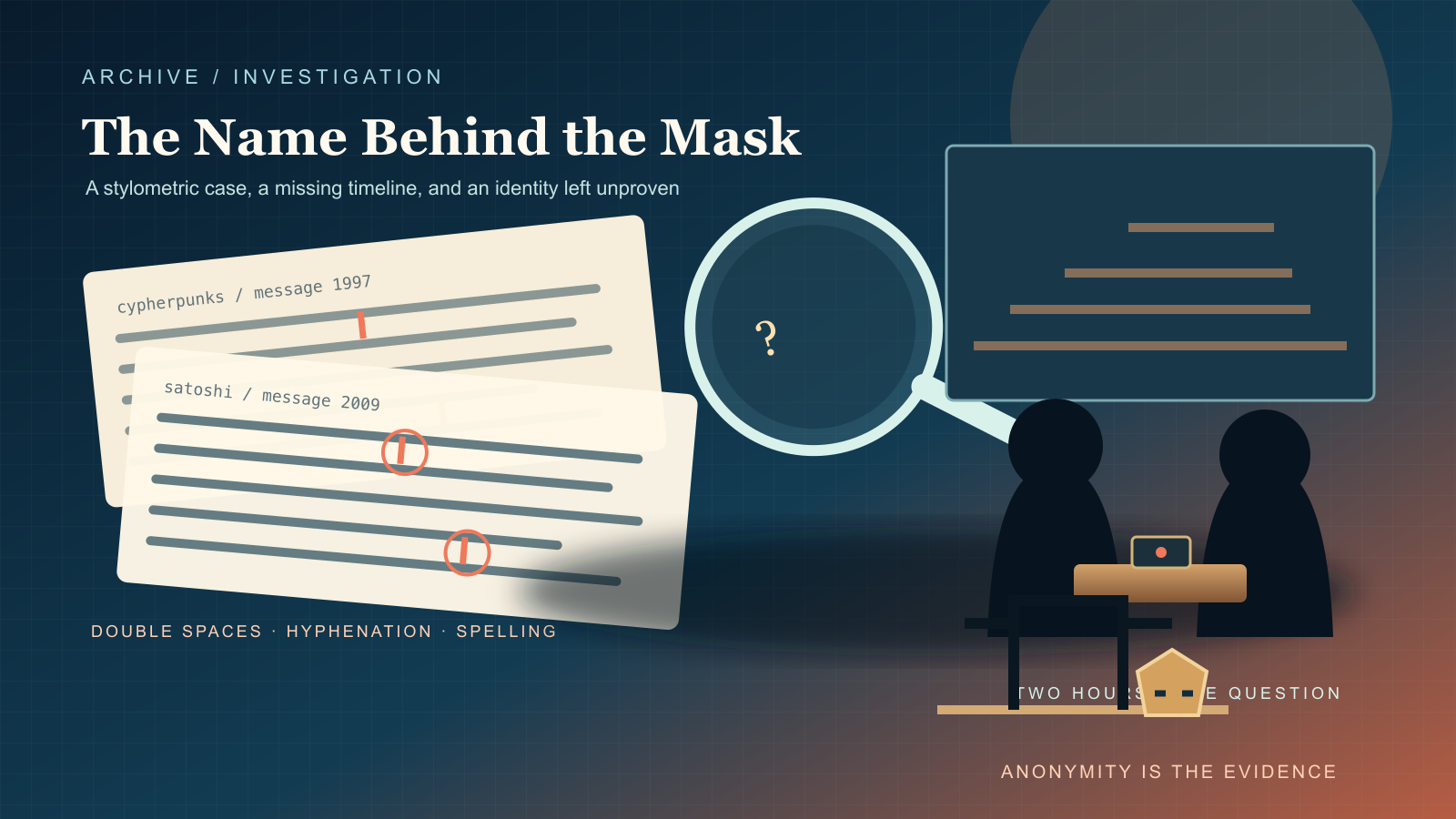
- A pattern of comma usage and double-spacing after periods.
- Roughly seventy additional vocabulary and phrasing markers compiled across the two corpora.
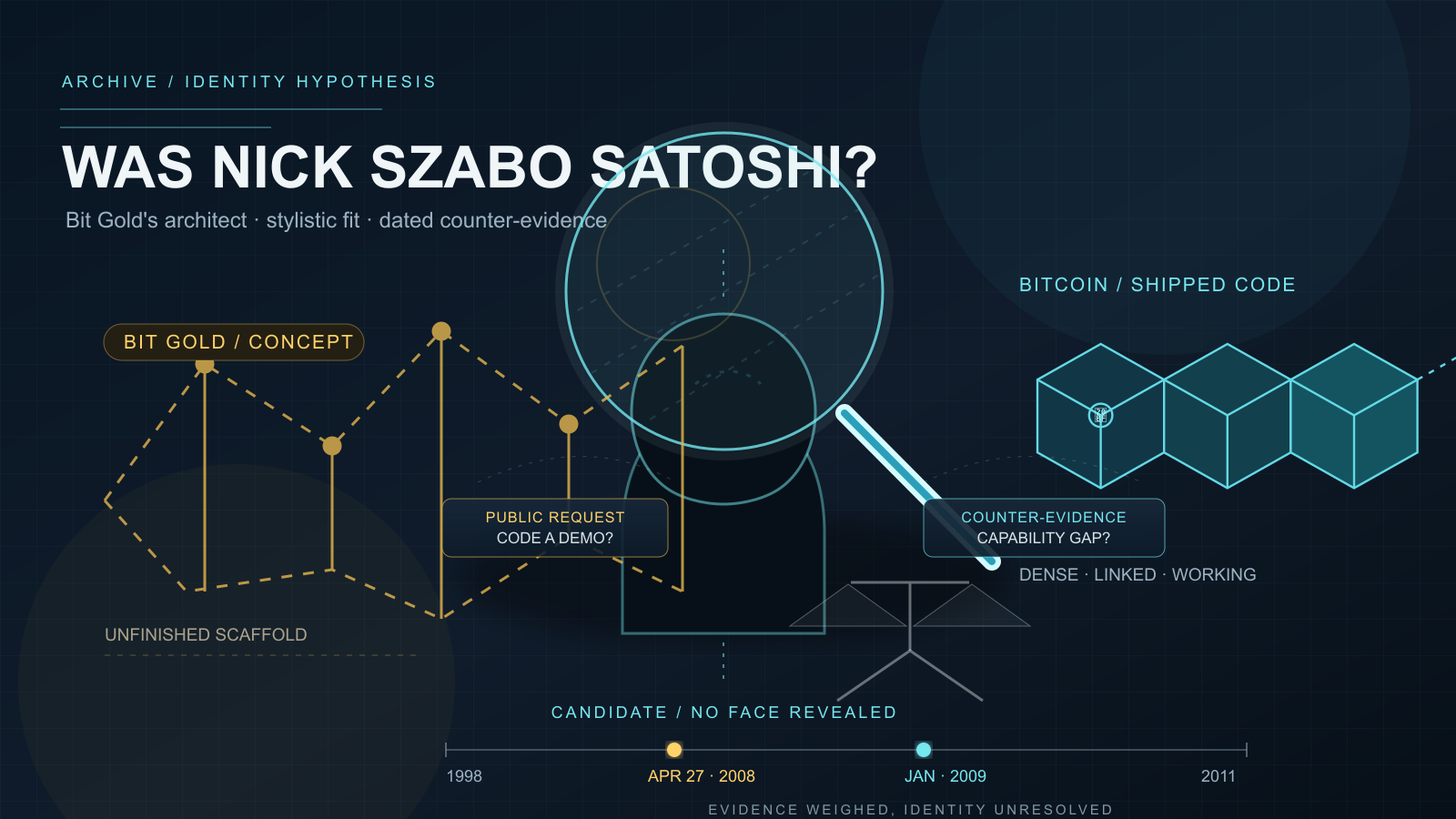
The article paired these stylistic findings with the prior conceptual case: Szabo’s Bit Gold proposal (conceived in 1998, fully published December 29, 2005 on Unenumerated) was the closest published precursor to Bitcoin’s architecture, and Szabo’s April 2008 Unenumerated blog comment asking for help to implement Bit Gold placed Szabo, six months before the Bitcoin whitepaper, working actively in the same problem space.
TechCrunch reception
John Biggs’s TechCrunch piece treated the investigation as the most rigorous Satoshi-identification effort to date. The headline framed Skye Grey as “one researcher” who “may have found the answer” — adopting the analysis’s framing without endorsing it as conclusive. The piece introduced the hypothesis to a much wider readership than the LikeInAMirror blog itself reached.
Szabo’s response
Szabo did not respond publicly to the Skye Grey article at the time of publication. He later denied the identification in a July 2014 email to Dominic Frisby and to Popper in 2014 and 2015. His third-person framing of Bit Gold in the May 2011 Unenumerated post “Bitcoin, what took ye so long?” predates all of them, and his position has not changed.
Skye Grey’s identity
Skye Grey writes under a pseudonym and has not publicly identified themselves. The LikeInAMirror.wordpress.com blog has produced very little additional content since the December 2013 article. The pseudonymous status of the original investigator has not affected the article’s citation footprint — every subsequent mainstream-press identification of Szabo as Satoshi has cited the Skye Grey analysis as the originating stylometric source.
Methodological framing
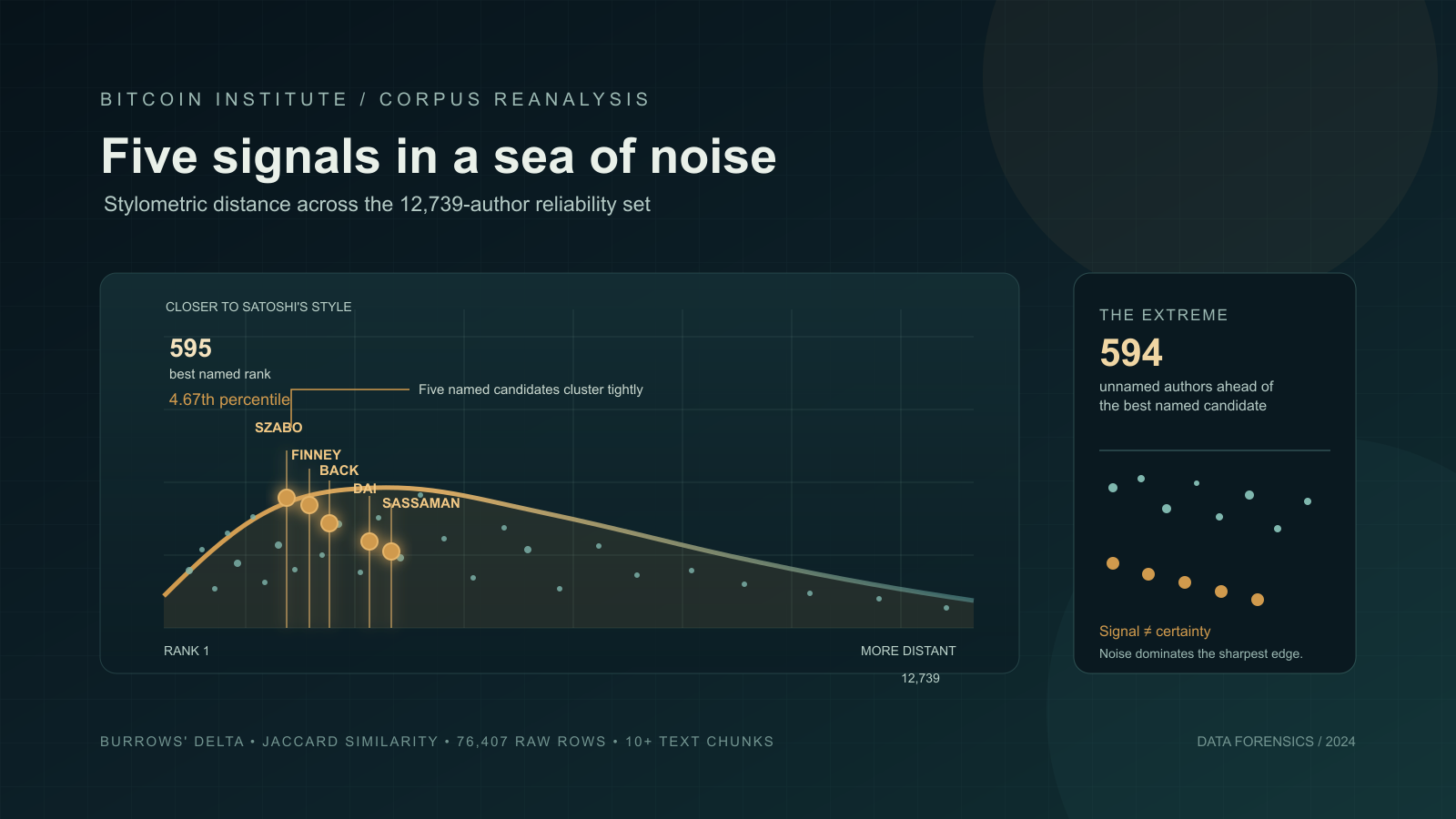
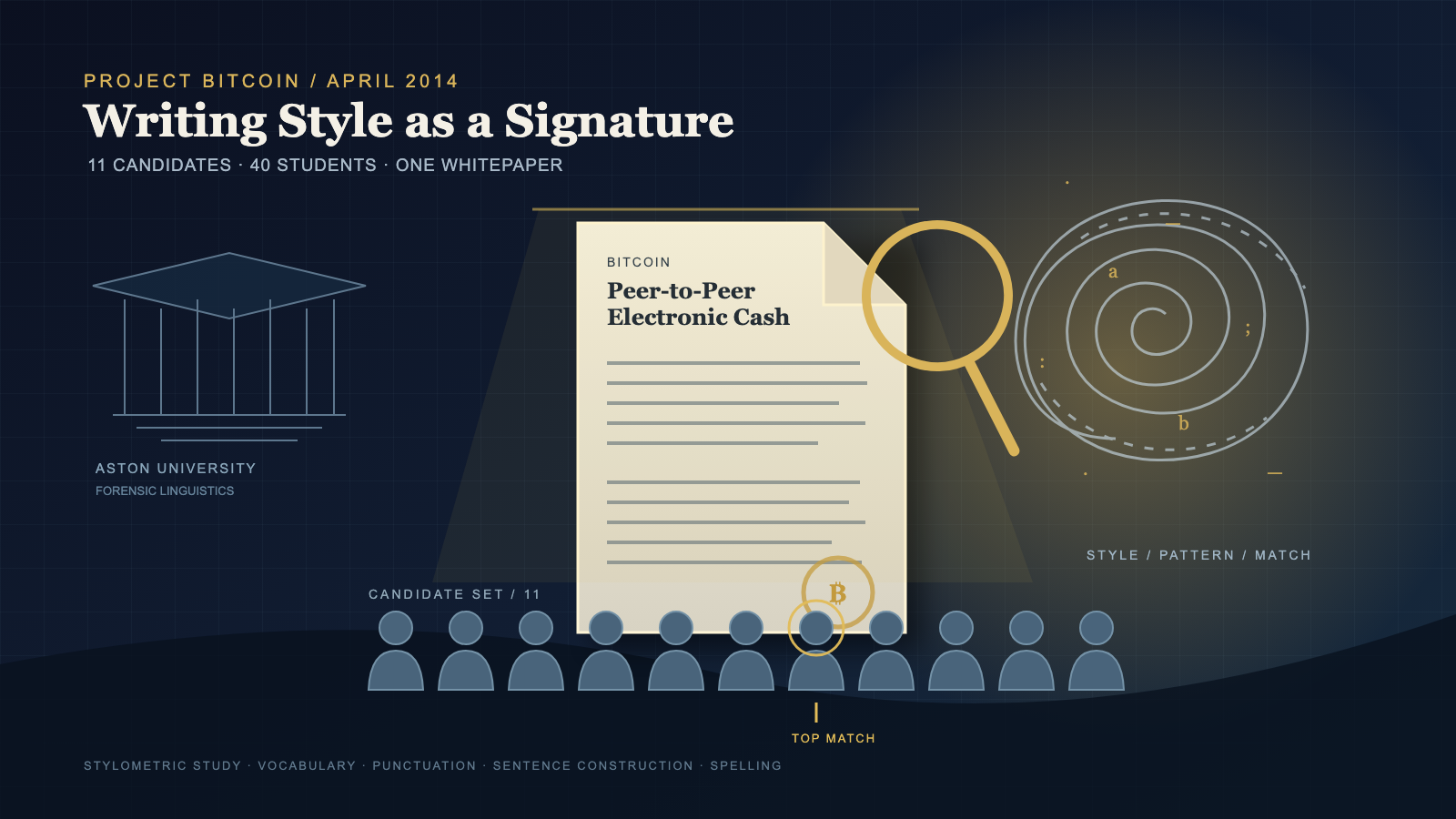
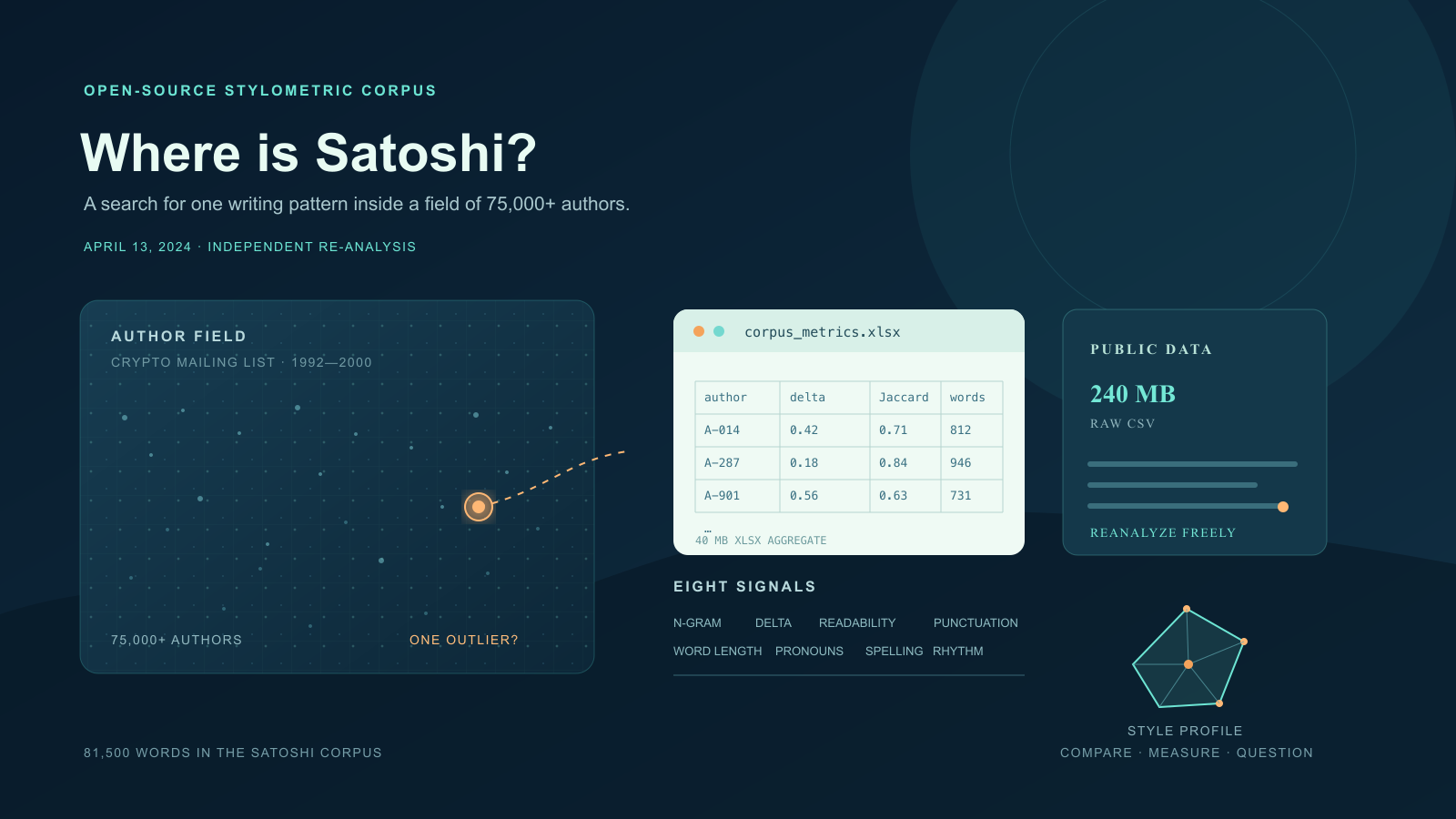
Skye Grey’s analysis is manual stylometry: human-judged phrase and pattern matching, not algorithmic statistical fingerprinting. The April 2014 Aston University forensic-linguistic study — which independently ranked Szabo as the closest match among 11 candidates — applied more formal stylometric methods and reached a similar conclusion. Bas van Dorst’s April 2024 ‘Where is Satoshi?’ open-source corpus extended the comparison to 75,000+ mailing-list authors and 7.5M+ Reddit comments, releasing the full numerical dataset, and the author explicitly declined to name a leading candidate. The 2026 John Carreyrou / NYT investigation used algorithmic large-population stylometric comparison against 620 cypherpunk-mailing-list writers and named Adam Back instead; the separately commissioned independent linguistic review by Florian Cafiero examined 12 candidates and described the result as inconclusive.
Across these four investigations, Szabo emerges as the candidate most often ranked first: Skye Grey 2013 named Szabo, Aston 2014 named Szabo, and the Bitcoin Institute reanalysis of van Dorst’s published data places Szabo highest of the five most-cited candidates. Cafiero / Carreyrou 2026 is the outlier in naming Adam Back — and Cafiero himself described that result as inconclusive, with Hal Finney in a near-tie. However, the convergence among named candidates is partial: van Dorst’s full 75,000-author corpus has 594 unnamed authors closer to Satoshi than Szabo. Stylometric attribution narrows the candidate space without uniquely identifying a person.
For the analytical treatment of the Nick Szabo = Satoshi hypothesis (Skye Grey’s stylometric evidence weighed against the April 2008 implementation request, the May 2011 third-person framing, the continuous Unenumerated visibility throughout 2007–2008, and Szabo’s repeated denials), see the Nick Szabo = Satoshi identity hypothesis entry.
The Nick Szabo identity hypothesis builds its stylometric case on Skye Grey’s findings — the first quantitative argument of its kind, and the one its counter-evidence has to displace.