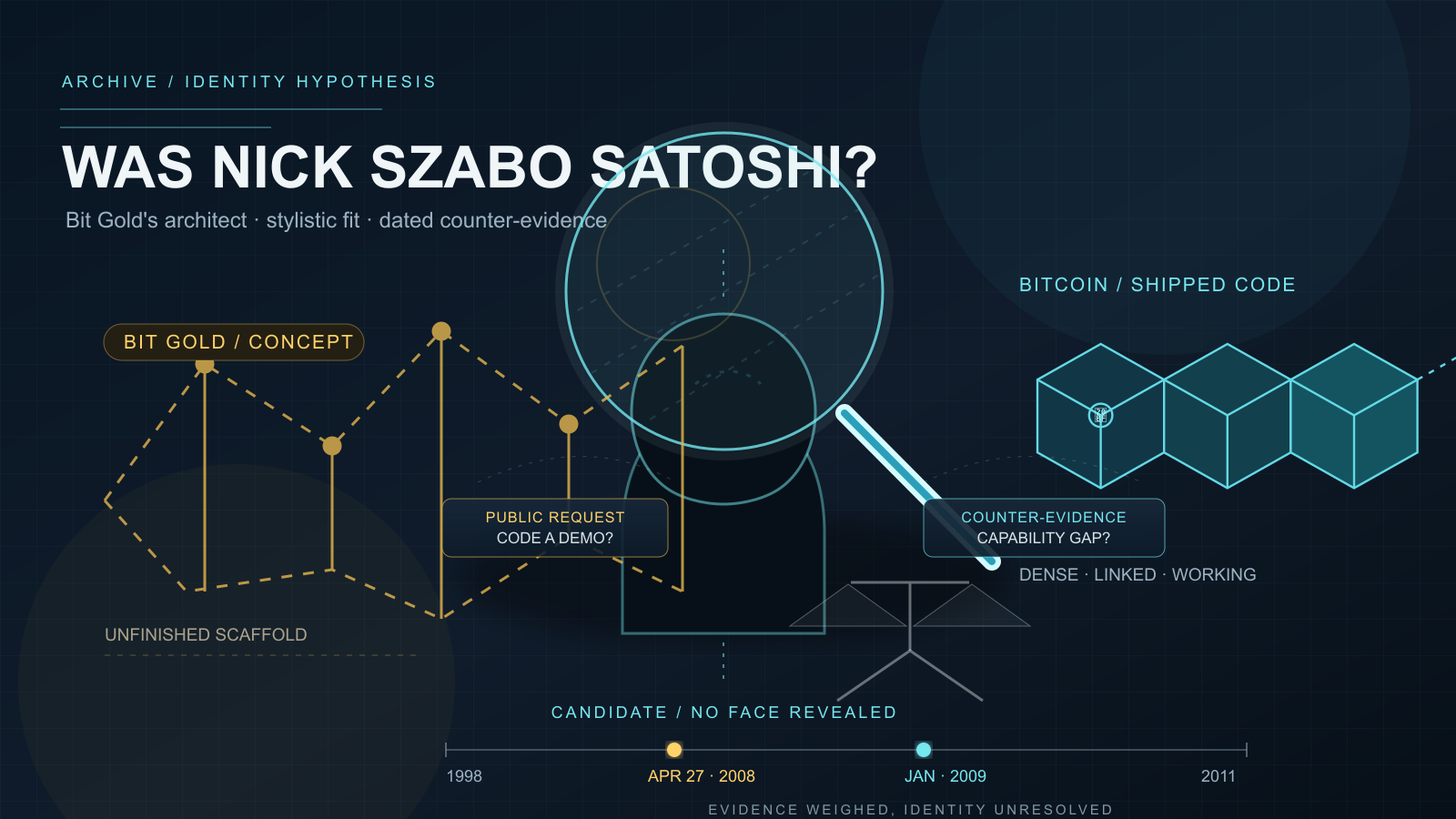
On April 10, 2008, Nick Szabo wrote on his blog: “…it would greatly benefit from a demonstration, an experimental market (with e.g. a trusted third party substituted for the complex security that would be needed for a real system). Anybody want to help me code one up?” Four months later, Satoshi Nakamoto sent his first known Bitcoin email to Adam Back. In May 2011 Szabo wrote that “Nakamoto improved a significant security shortcoming that my design had”. The Szabo-as-Satoshi claim sits on those three points — the Bit Gold conceptual proximity (1998 conceived, 2005 published, 1994 “smart contracts” terminology), the April 2008 implementation request a few months before Satoshi’s first known activity, and the prolific Unenumerated writing throughout the design window — reinforced by stylometric analyses since 2013.
1. The evidence
Szabo is the person behind the Satoshi Nakamoto pseudonym. His continuously documented public-record interactions with Bitcoin — the April 2008 Unenumerated comment asking for help implementing Bit Gold and the May 2011 blog post acknowledging “Nakamoto improved a significant security shortcoming that my design had” alike — were stagecraft to maintain the pseudonym. He operated as Satoshi from the development phase (mid-2007 onward) through the 2011 withdrawal, while running his Unenumerated blog and public scholarship as a public-record decoy.
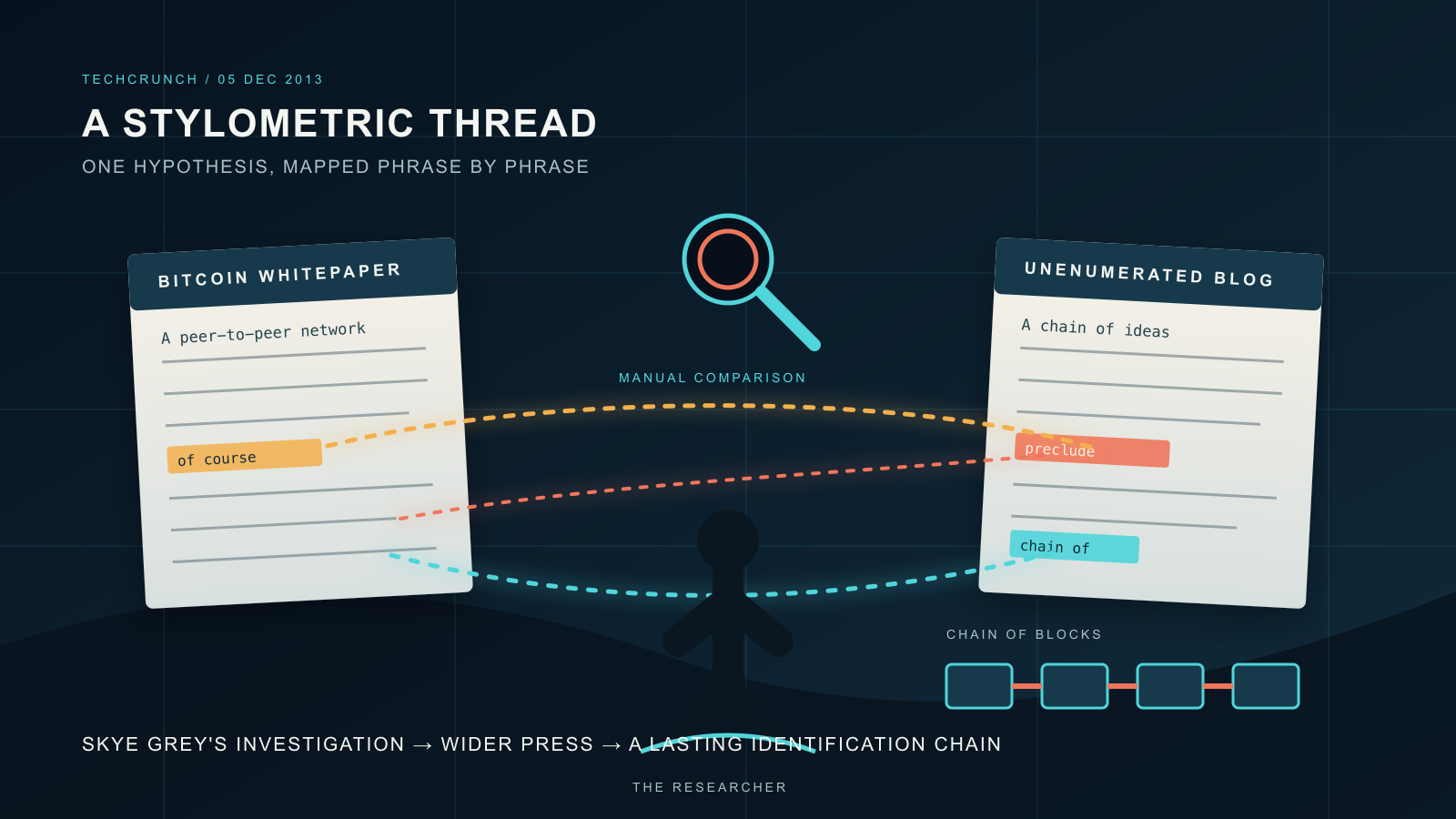
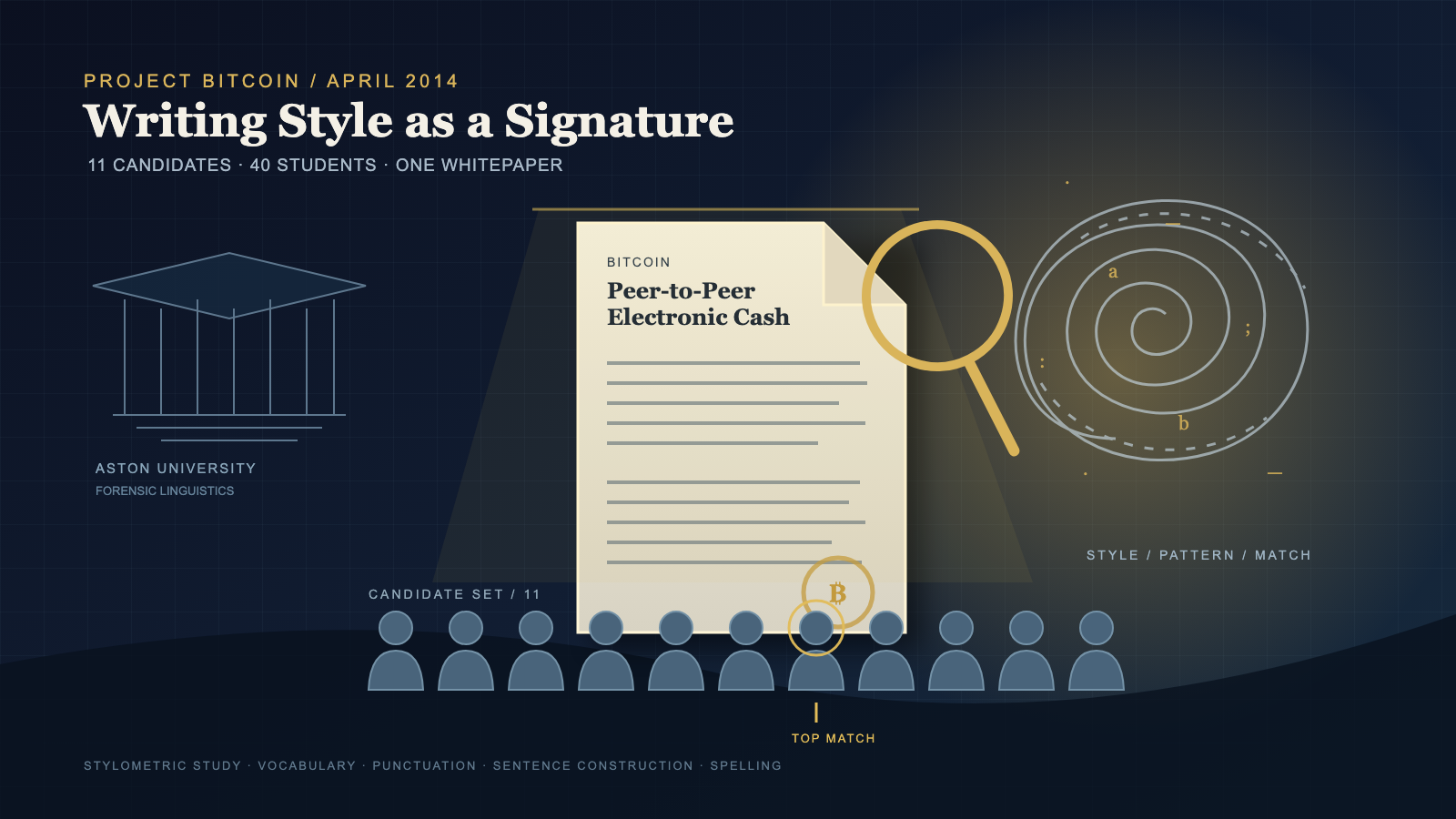
The earliest prominent stylometric articulation is the December 2013 LikeInAMirror.com article “Satoshi Nakamoto is (probably) Nick Szabo” by pseudonymous blogger Skye Grey, given mainstream coverage by TechCrunch on December 5, 2013. It was reinforced by an April 2014 forensic-linguistic study at Aston University reported by CoinDesk and ScienceDaily.
1.1 Bit Gold’s conceptual proximity to Bitcoin
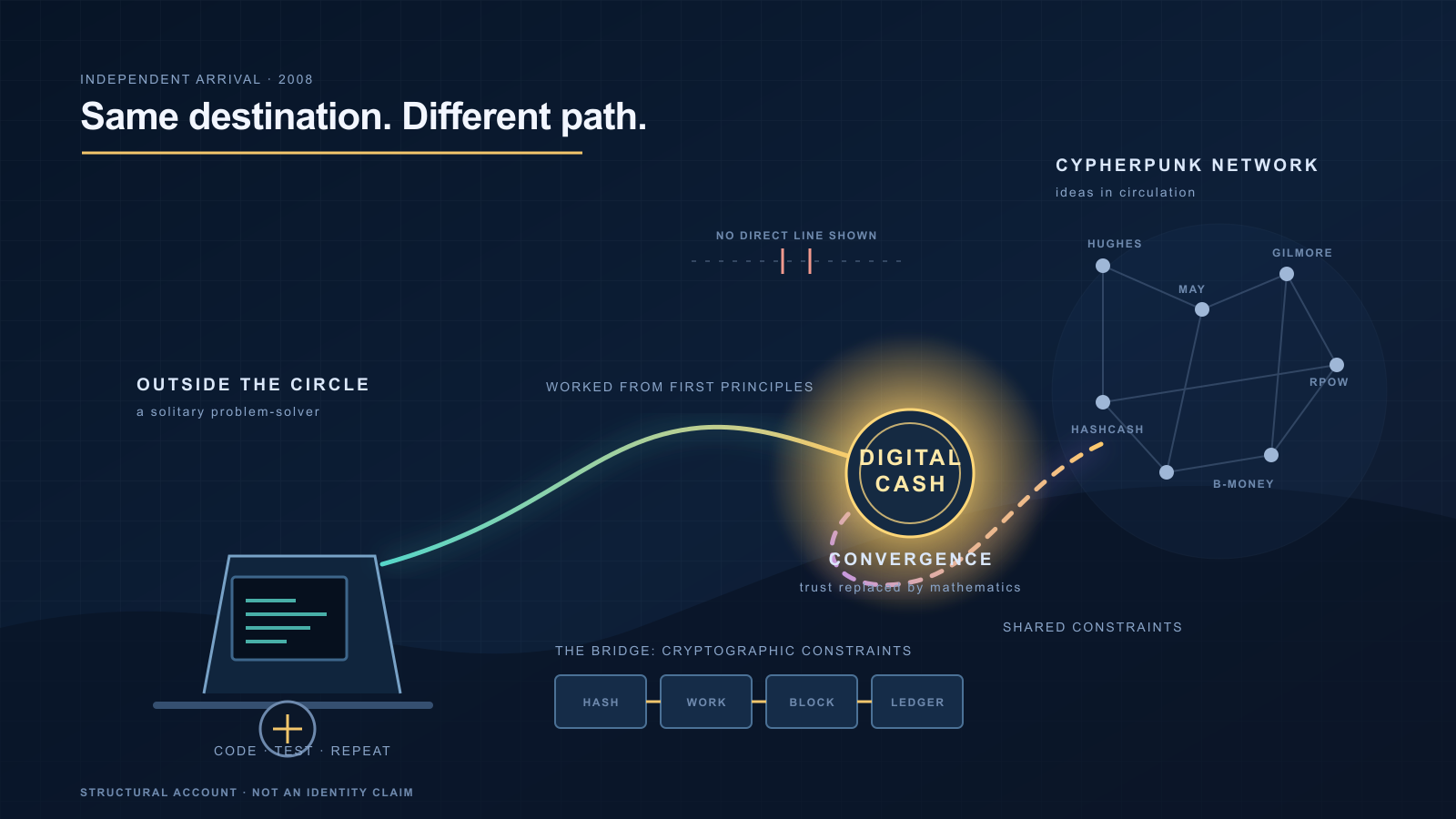
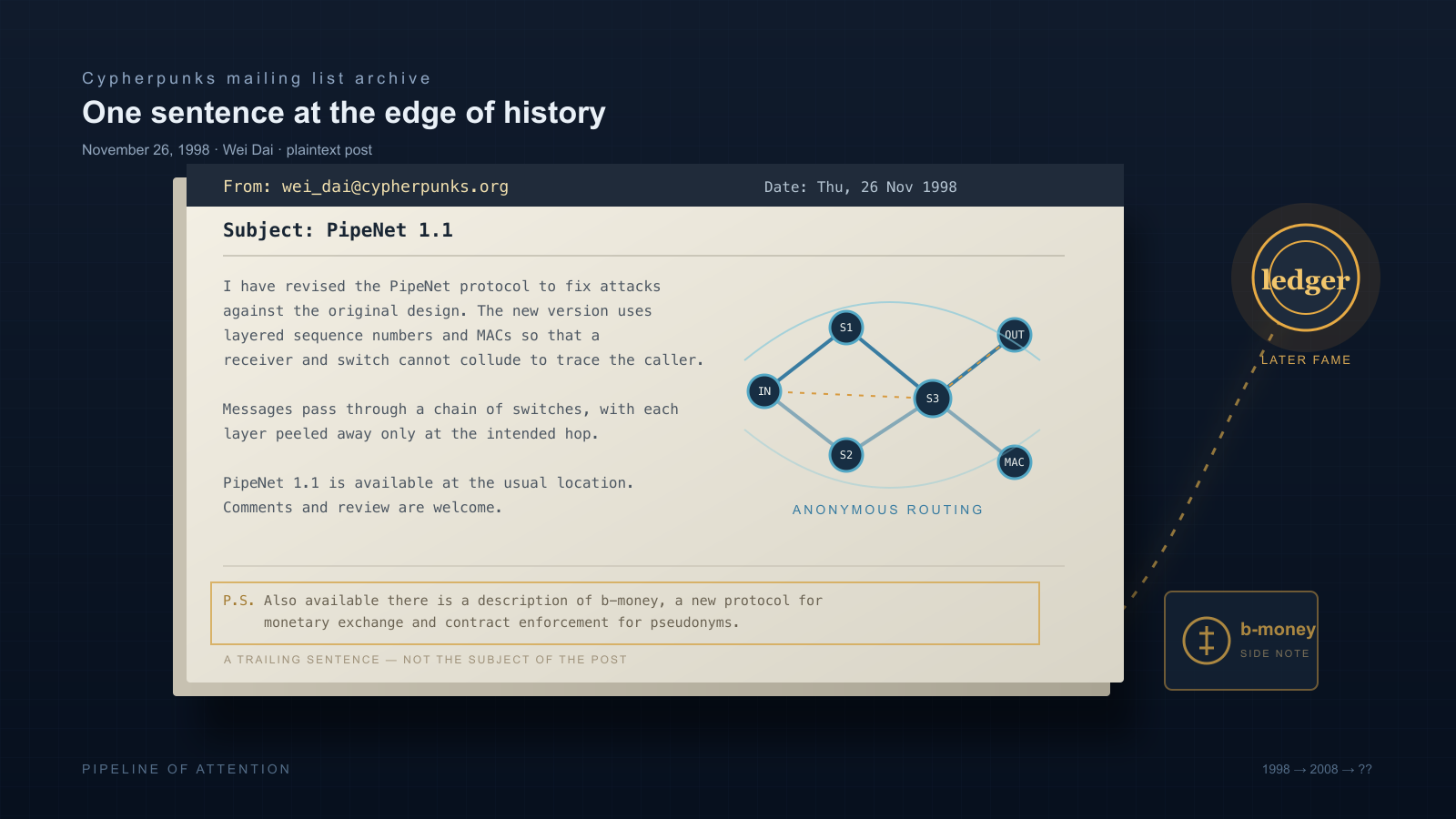
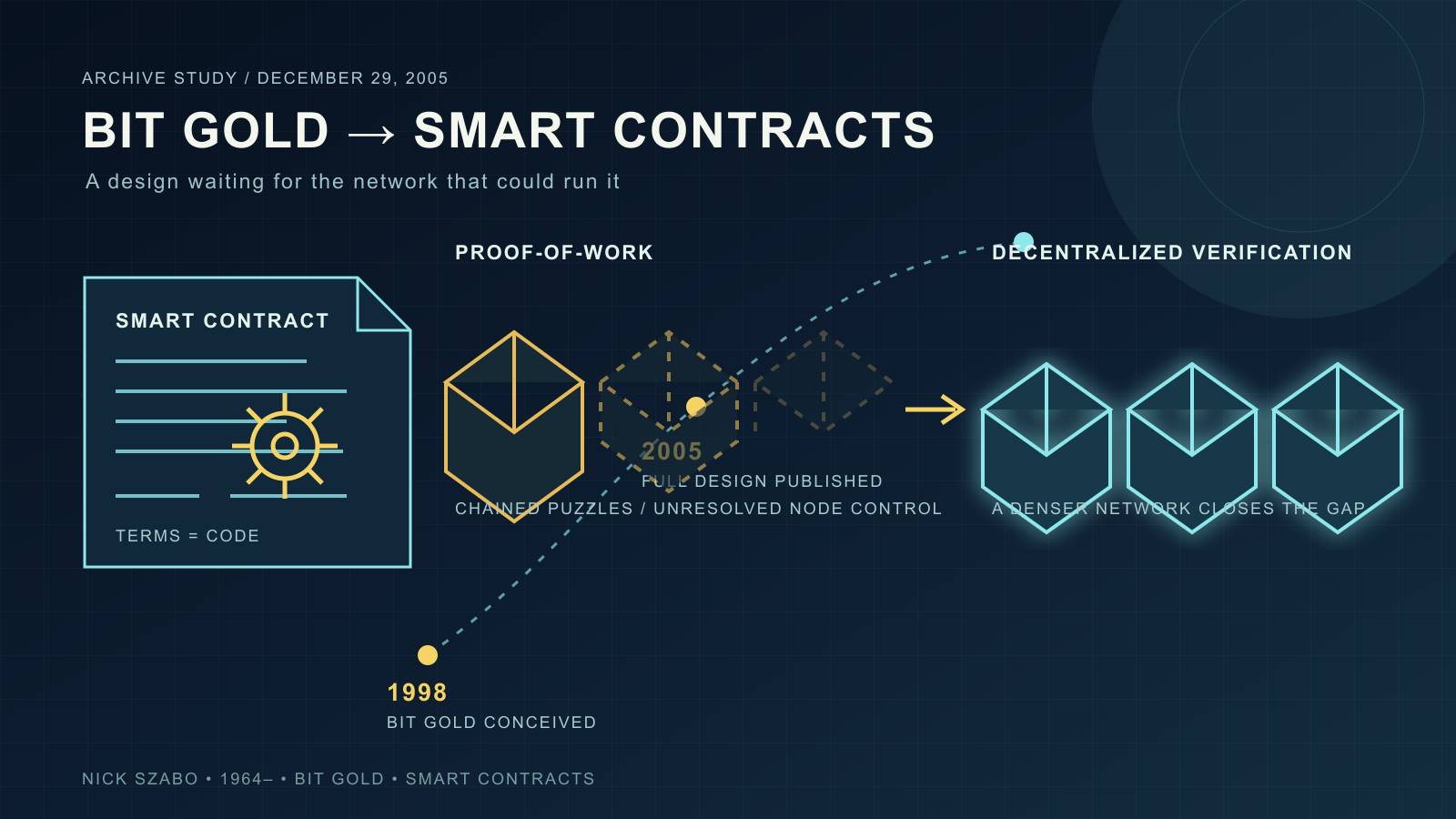
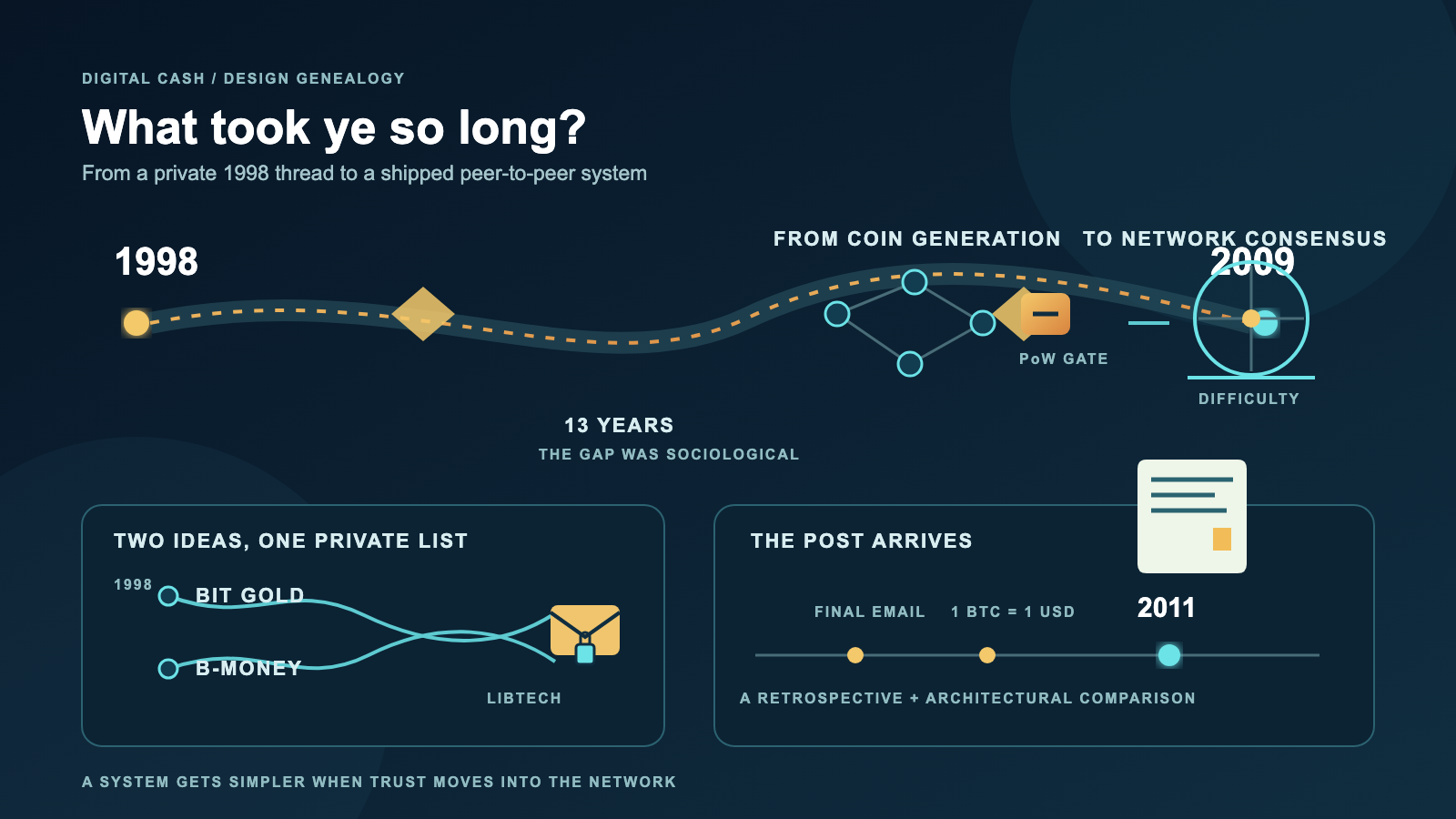
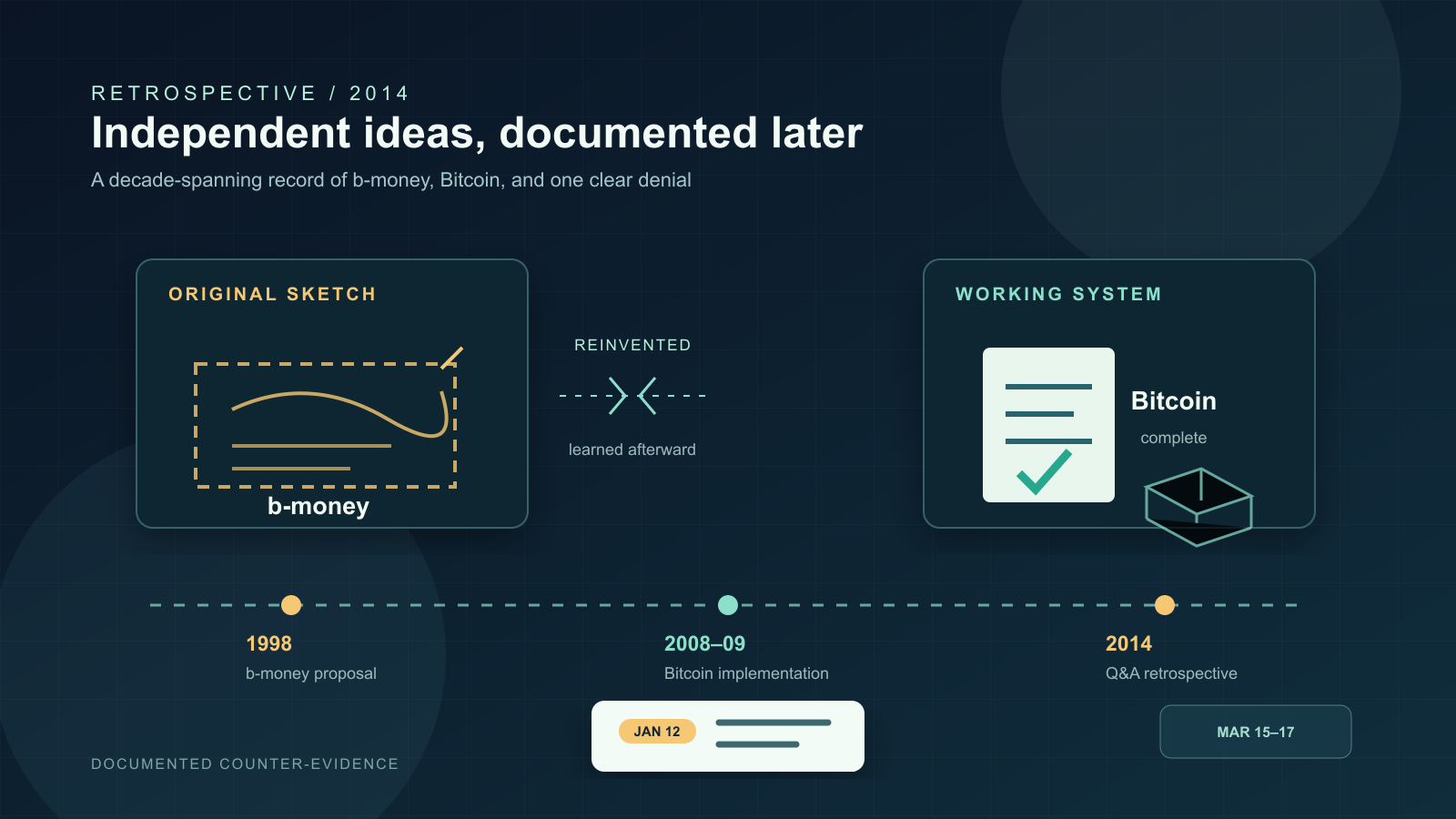
Bit Gold is the closest pre-Bitcoin design to Bitcoin’s mechanism conceptually. Both reuse proof-of-work as the source of digital scarcity, both chain solved puzzles into a verifiable history, both attempt to substitute decentralized verification for a trusted issuer, and both situate the design within an explicit anti-trust monetary frame. Szabo published the Bit Gold concept on his Unenumerated blog on December 29, 2005, but reports that he conceived it in 1998 — the same year Wei Dai independently produced b-money, via a private mailing list (libtech) that Szabo and Dai both participated in.
The evidence: among all pre-Bitcoin proposals, Bit Gold maps onto Bitcoin’s design space most tightly. The forensic-fit reading is that the person who conceived Bit Gold is the natural candidate for the person who built Bitcoin.
The objection: forensic fit on a single dimension does not select uniquely. The whitepaper cites Hashcash and b-money but does not cite Bit Gold — which is the awkward fact for the Szabo-as-Satoshi reading, since Szabo would not need to omit citing himself but would have an incentive to cite Bit Gold as a self-misdirection. The omission cuts either way and does not by itself decide.
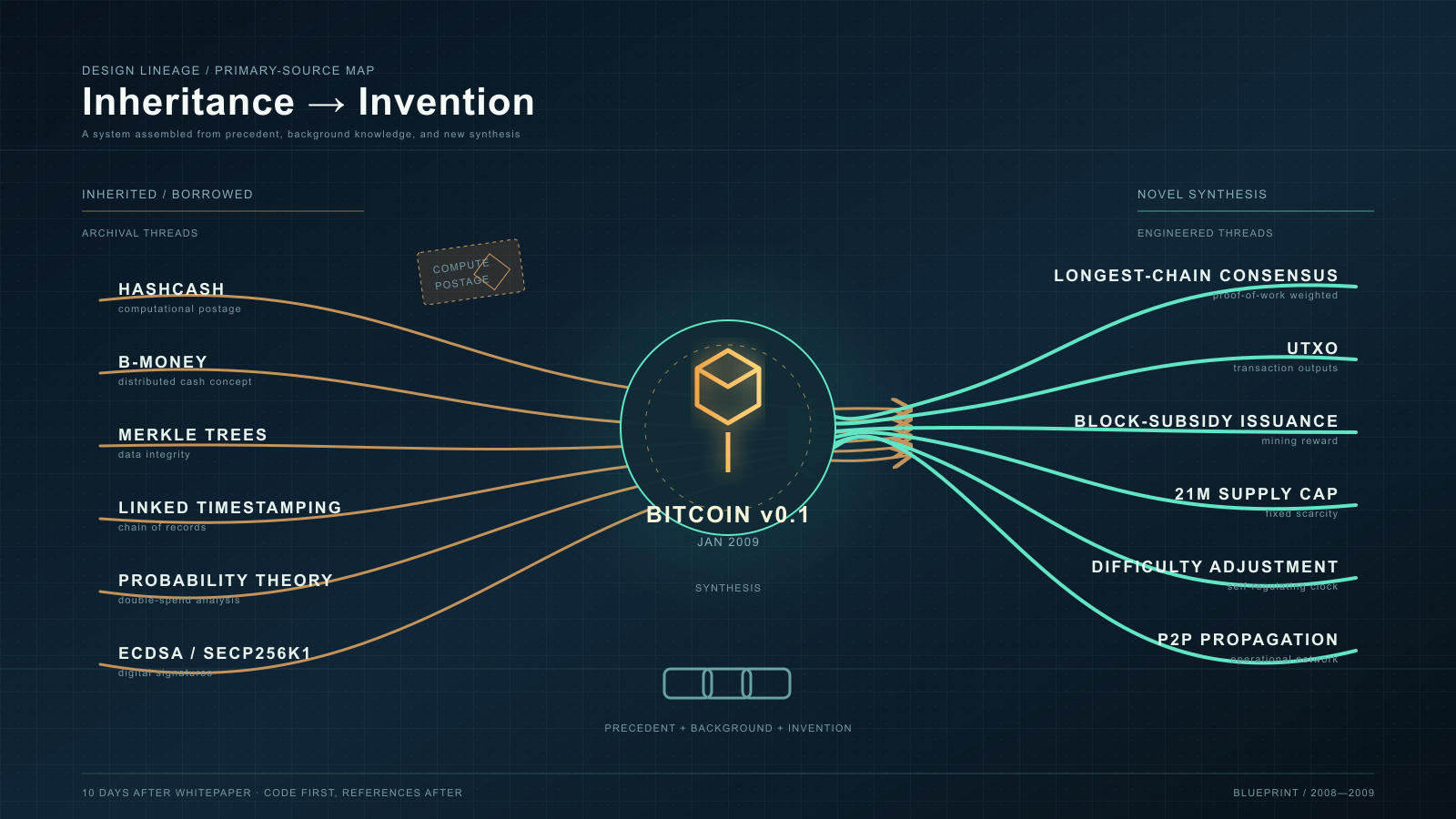
Component-level comparison. What Bit Gold contains and what Bitcoin v0.1 added:
Legend: ✅ originated by this design · 🔄 reused (originated elsewhere) · ❌ not present.
| Bitcoin component | Bit Gold (1998 / 2005) | Bitcoin (2009) | Borrowed from |
|---|---|---|---|
| Proof of work | 🔄 | 🔄 | Hashcash (Adam Back) |
| Chained PoW (linked solved puzzles) | 🔄 | 🔄 | Haber-Stornetta linking |
| Decentralized timestamping | 🔄 | 🔄 | Haber-Stornetta (1991) |
| Anti-trust monetary framing | 🔄 | 🔄 | Hayek / cypherpunk milieu |
| Longest-chain consensus rule | ❌ | ✅ | — |
| UTXO model | ❌ | ✅ | — |
| Difficulty adjustment | ❌ | ✅ | — |
| 21-million supply cap | ❌ | ✅ | — |
| Mining-reward block-subsidy issuance | ❌ | ✅ | — |
| ECDSA-based transactions | ❌ | 🔄 | ECDSA / secp256k1 (SEC standard) |
| Operational P2P network | ❌ | ✅ | — |
| Working implementation | ❌ — concept never built | ✅ — 19,901 lines of C++ | — |
The conceptual overlap (top section of the table) is what the forensic-fit argument rests on, but the reuse markers (🔄) qualify it. Those top rows are reused by both designs from common ancestors: proof-of-work from Hashcash, linked timestamping and chain-ordering from Haber-Stornetta, the anti-trust frame from Hayek and the cypherpunk milieu. Bitcoin design lineage catalogs them as reused rather than invented, not as components Bitcoin took from Bit Gold. Bit Gold carries no ✅ in the table at all: what is distinctly Szabo’s is the synthesis of chaining proof-of-work into scarce, ownership-tracked units (his “unforgeable costliness”), and that synthesis stayed on paper; Bit Gold was never implemented. What Bitcoin shipped is a different synthesis: the ✅ bottom rows (longest-chain consensus and the rest), all Satoshi’s novel contributions, not Bit Gold’s design.
A reception-side trace of that conceptual proximity survives in the whitepaper’s first days on the cryptography mailing list, where the earliest responders reflexively reached for Bit Gold’s name: James A. Donald wrote of “who owns what bitgold coins,” and Hal Finney, who proposed Bitcoin “could be an implementation” of Bit Gold, mentioned “a sourceforge project set up for bitgold”. But the name they were merging labels a shared framing, not a Szabo-specific design, and the conflation came from third parties reacting to Satoshi’s announcement, not from Szabo.
The objection: counting this overlap as decisive requires treating “conceiving Bit Gold” and “shipping Bitcoin” as the same kind of capability. The §2.5 architectural-gap argument rejects that premise.
1.2 Stylometric analyses and mainstream press coverage (Skye Grey 2013, Aston University 2014, NYT/Popper 2015)
Pseudonymous blogger Skye Grey published “Satoshi Nakamoto is (probably) Nick Szabo” on LikeInAMirror.com in December 2013. The methodology:
- Identify unusual turns of phrase and vocabulary patterns from Satoshi’s writings (whitepaper, BitcoinTalk posts, mailing-list emails).
- Search for those patterns in writings of cryptography researchers active in the relevant period.
- Run textual-similarity metrics on candidate corpora.
Skye Grey’s stated finding: the patterns matched Szabo’s Unenumerated writings strongly enough that, in Skye Grey’s framing, “only 0.1% of cryptography researchers” could have produced Satoshi’s text.
In April 2014, forensic-linguistic researchers at Aston University reported a separate stylometric study — “Project Bitcoin,” led by Dr. Jack Grieve — citing Grey’s earlier work and concluding that Szabo was the most likely author of the Bitcoin whitepaper among the 11 candidates they examined.
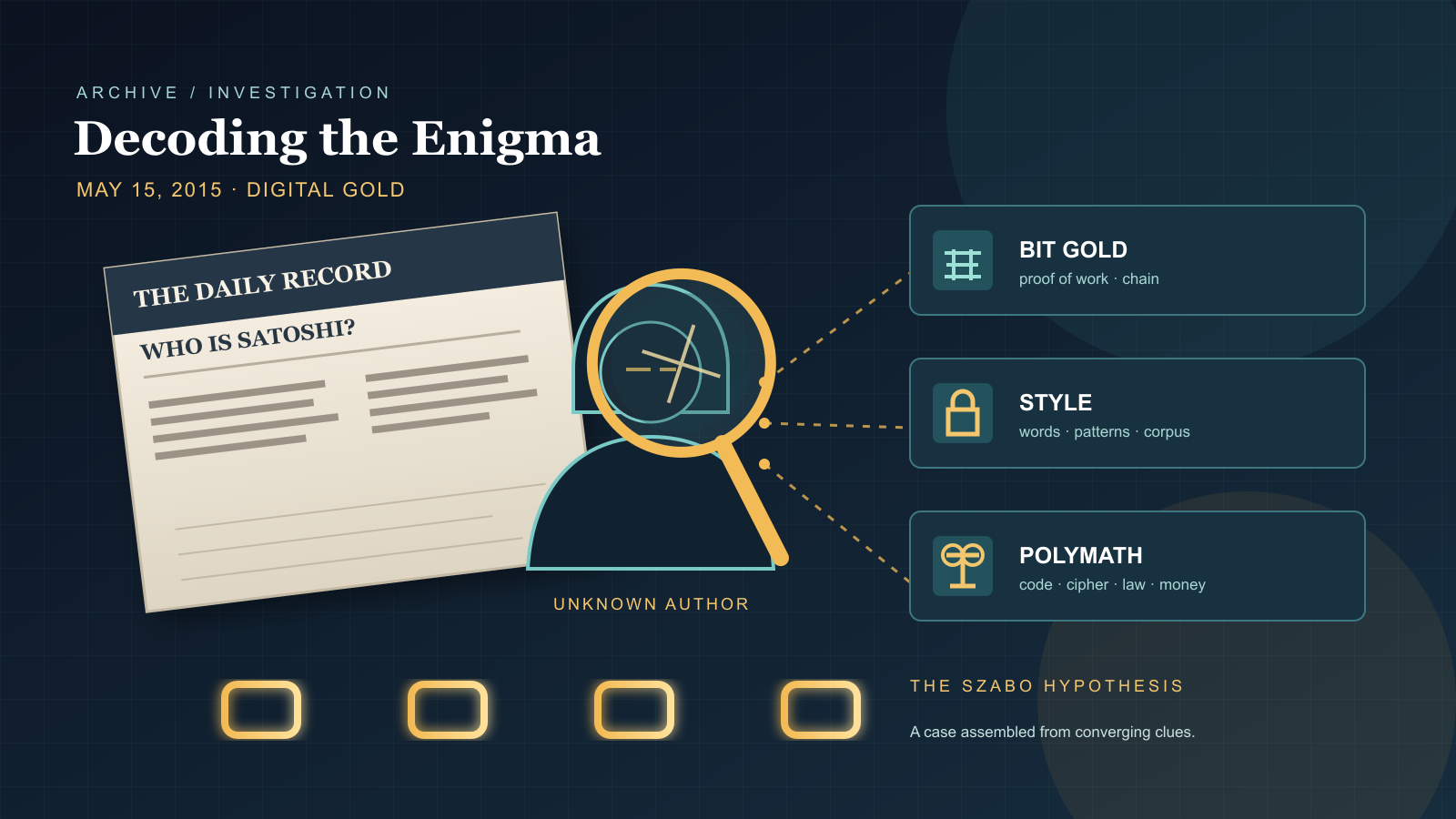
In May 2015, Nathaniel Popper of The New York Times published an excerpt from his book Digital Gold in which he wrote that, across his interviews with early Bitcoin participants, “I encountered a quiet but widely held belief that much of the most convincing evidence pointed to a reclusive American man of Hungarian descent named Nick Szabo.” This brought the hypothesis into the major-press tier — comparable to the role the April 2026 Carreyrou NYT investigation later played for Adam Back. Szabo replied to Popper: “I am not Satoshi.” A year later, when Popper asked again by email, Szabo repeated the denial.
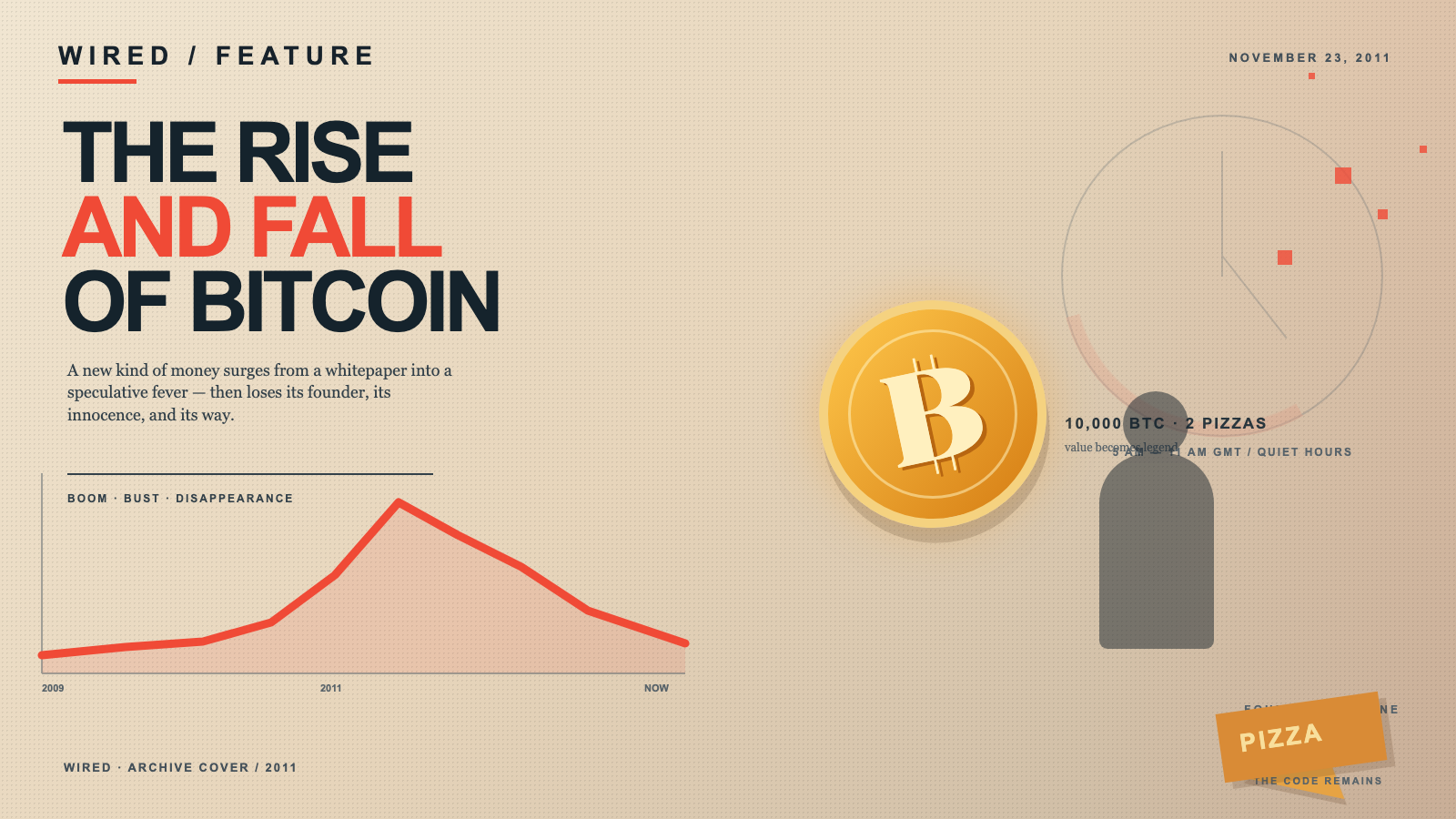
Four years before Popper’s book, a 2011 Wired feature had already quoted Szabo praising the project he would later be accused of secretly authoring — Bitcoin was, in his words, “a great contribution to the world.”
The objection: Skye Grey’s analysis is a self-published blog post by a pseudonymous author, not a peer-reviewed academic paper. Its candidate selection is opportunistic (selecting cryptography researchers known to have written about digital cash) rather than systematic. The Aston University report is more formal but its candidate set is also limited and its methodology contested.
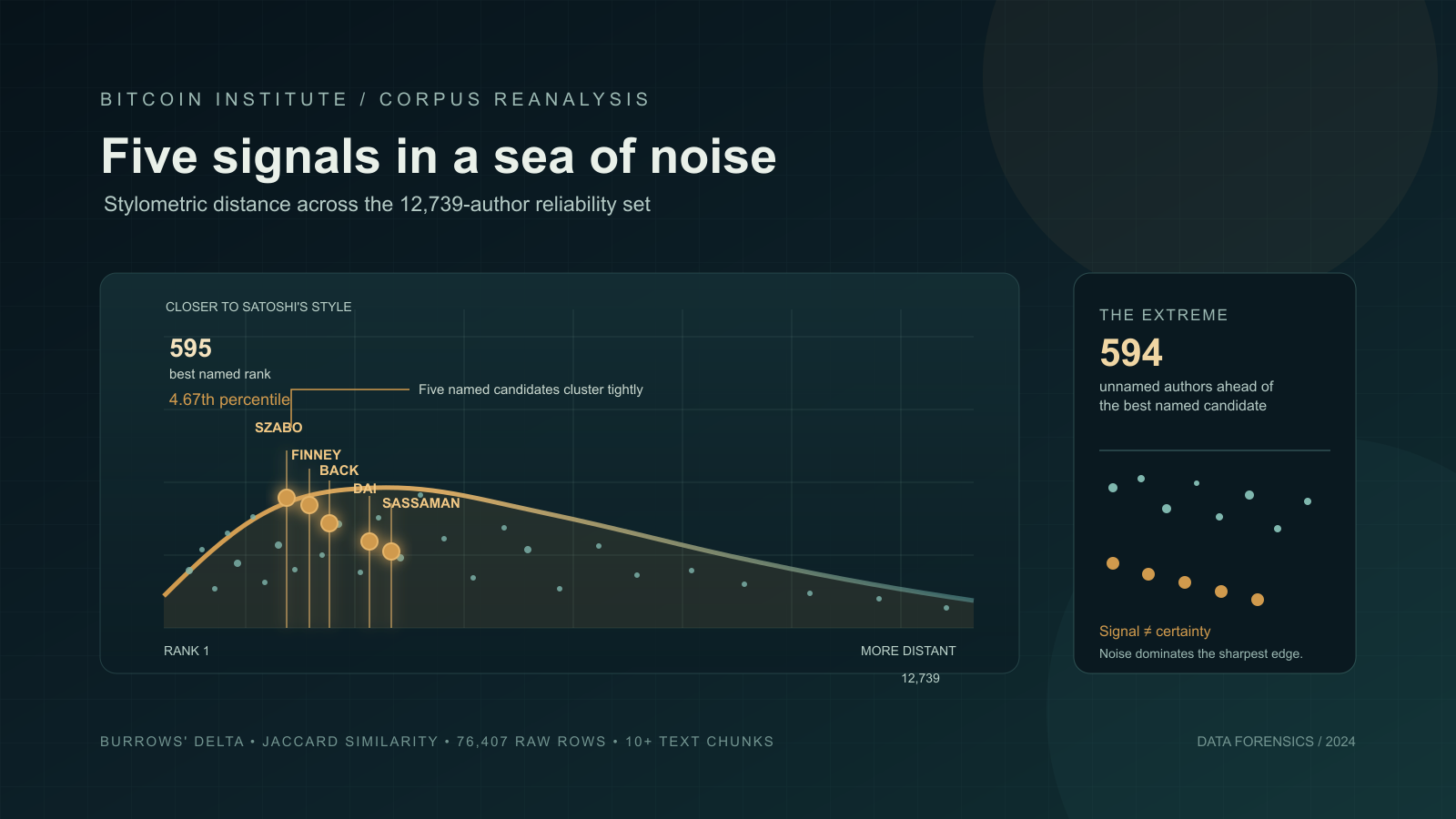
As later critics including David Gerard noted, stylometric analyses on candidate sets defined by topical overlap (writers who wrote about digital cash) inherently confound shared subject-matter vocabulary with shared individual style. The 2026 NYT investigation into Adam Back, with its much larger candidate pool (620 cryptography-mailing-list writers) and explicit treatment of the confirmation-bias risk, illustrates the methodological tension. Bas van Dorst’s 2024 ‘Where is Satoshi?’ open-source corpus takes the opposite design choice — 75,000+ authors with no topical pre-filtering, full numerical data release, and an author who explicitly declines to name a leading candidate — and stands as the methodological contrast against which the candidate-pool-narrow studies (Skye Grey, Aston) are measured.
Stylometric studies summary — Szabo’s result in each of the four most-cited investigations:
| Stylometric study | Szabo’s result |
|---|---|
| Skye Grey 2013 (single-hypothesis test on Szabo) | “Only 0.1% of cryptography researchers” — top match by Skye Grey’s framing |
| Aston University 2014 (11 candidates, Project Bitcoin) | Named top of 11, publicly identified |
| van Dorst 2024 / Bitcoin Institute reanalysis (75,000+) | Rank 595 / 12,739 — top 4.67%, highest of named candidates |
| Cafiero / Carreyrou NYT 2026 (12 candidates) | Rank not published; Adam Back placed top with Hal Finney near tie |
Across the four investigations, Szabo is named top in three (Skye Grey, Aston, Bitcoin Institute reanalysis). The fourth (Cafiero / Carreyrou 2026) places Adam Back top — but Cafiero himself qualified the result as inconclusive, and the NYT investigation’s candidate pool design was the methodological inverse of the broader-corpus reanalysis that places Szabo first.
1.3 Polymath profile fit
Bitcoin v0.1 required an unusual combination of skills: cryptographic protocol design, distributed-systems engineering, monetary-mechanism design, and a writing register that combines technical precision with anti-trust monetary framing. Szabo’s documented record covers all of these:
- Computer science (graduate-level cryptographic-protocol literacy).
- Cryptography (smart contracts, secure property titles, Bit Gold).
- Monetary economics and legal scholarship (extensive Unenumerated writing on the history and structure of money, the gold standard, central-banking critiques).
- Anti-trust / institutional-distrust framing (the Unenumerated blog’s explicit anti-central-banking posture).
The evidence: very few documented persons combine all of these, and Szabo is one of them. The match on the polymath dimension narrows the candidate set substantially.
The objection: profile-match selects a population, not an individual. This evidence applies to several other documented polymath figures with overlapping skill profiles. The candidate set narrows but does not collapse to one person; profile-match is necessary but not sufficient (per the hypotheses overview methodology).
1.4 Cypherpunk credentials and intellectual lineage
Szabo is a long-tenure cypherpunk: documented mailing-list presence in the 1990s — his archived cypherpunks-list posts run from 1993 to 1996 — presence on the libtech private list where Bit Gold was discussed alongside b-money, decades of public writing on the philosophical foundations of digital cash. The whitepaper’s intellectual lineage (Hashcash, b-money, the chained-hash structure, anti-trust framing) overlaps closely with the topical space Szabo has documented his own thinking in.
The objection: this evidence applies broadly to several long-tenure cypherpunks (Adam Back, Wei Dai, Hal Finney, etc.). It narrows the candidate set substantially but does not select Szabo specifically. And as §1.1’s table shows, the shared lineage primitives (proof-of-work, linked timestamping) are themselves common-ancestor inheritance (🔄 on both columns), not Szabo-originated. The register of that presence also matters: his archived posts cluster on digital-cash economics, micropayments, reputation and anonymity systems, and crypto policy — design and argument rather than source code or implementation — consistent with the engineering-output gap detailed in §2.5.
1.5 Circumstantial pattern matches
Four often-cited circumstantial indicators are repeatedly raised by advocates of the claim. None is decisive on its own; their cumulative weight depends on whether the reader treats coincidences as evidence or as coincidences.
-
April 5 birthday coincidence. Szabo was born on April 5, 1964. Satoshi’s P2P Foundation profile listed April 5, 1975 as Satoshi’s birth date — same month and day, 11 years apart. The April 5 date carries additional symbolic load in monetary-policy history: April 5, 1933 was the date Franklin D. Roosevelt signed Executive Order 6102, making private gold ownership illegal in the United States. The anti-statist symbolism of the date aligns with Bitcoin’s anti-trust framing. The objection: Satoshi’s profile is widely read as designed to mislead (see self-statements analysis); a deliberately-chosen symbolic date for the profile does not require Satoshi to actually share that date with one specific candidate. The argument-back: a deliberately-chosen symbolic date that also matches a real candidate’s actual birthday is a coincidence with an additional dimension of fit.
-
Hungarian-descent connection. Szabo’s father was a Hungarian who opposed the communist regime and immigrated to the United States. The first publicly-installed Satoshi Nakamoto statue was placed in Budapest, Hungary (September 2021) — a geography that some hypothesis advocates interpret as a clue, others as coincidence shaped by local Bitcoin-community initiative independent of Szabo’s heritage.
-
The 2017 Tim Ferriss Podcast slip. In the #244 Tim Ferriss Show episode (June 4, 2017, co-hosted by Naval Ravikant), Szabo at one point appeared to begin saying “bitcoin” before correcting himself to “bit gold” — phrased in many transcripts as: “I designed bitcoi…gold with two layers because…” Hypothesis advocates treat this as a Freudian slip revealing self-authorship; skeptics treat it as a normal verbal stumble between two phonologically and semantically adjacent terms a person who designed Bit Gold has every reason to mix up. The audio is on the public record; readers can listen and judge.
-
Bit Gold blog timestamp anomaly. Some commentators have flagged that the original Bit Gold blog post’s date metadata appears to have been modified — variously reported as either backdated (December 2005 → earlier) or forward-dated (some interpretations claim April 2008 → December 2008). The aftermath entry Anybody want to help me code one up? notes this anomaly: “Szabo’s original bit gold blog post was dated December 2005, but the blog’s timestamps were later found to have been modified, complicating the precise chronology.” The hypothesis-advocate reading is that this is evidence of timeline manipulation. The skeptical reading: in August 2008 Szabo publicly announced he was running “reruns” of favorite Unenumerated entries, providing an innocent explanation for republished posts with shifted dates. The evidence is ambiguous and cuts both ways.
2. The counter-evidence
2.1 The April 2008 “Anybody want to help me code one up?” comment
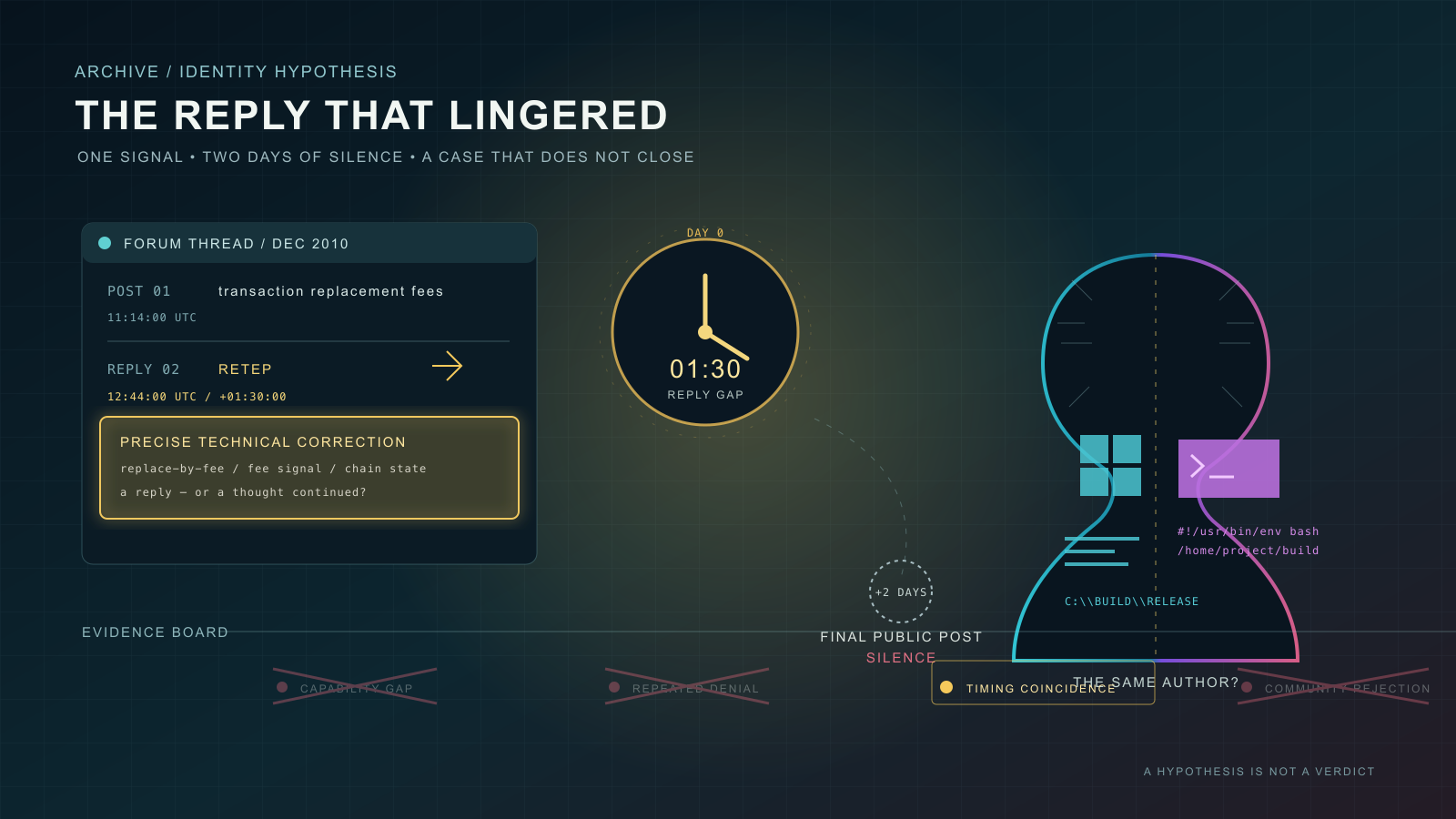
The strongest archive-internal counter-evidence is Szabo’s own April 10, 2008 comment on his Unenumerated blog, where he wrote:
“…it would greatly benefit from a demonstration, an experimental market (with e.g. a trusted third party substituted for the complex security that would be needed for a real system). Anybody want to help me code one up?”
Six months later, Satoshi Nakamoto published the Bitcoin whitepaper, and three months after that shipped a working 19,901-line C++ codebase.
Read normally, the April 2008 comment says: in April 2008, Szabo could not himself implement Bit Gold and was publicly seeking volunteer help to do it. This is a direct capability signal. Szabo is the conceptual originator of Bit Gold; he had been thinking about the design for ten years (1998–2008) without producing an implementation; what he asks for, in plain English, is “help me code one up.” Implementing Bit Gold is a strictly easier engineering task than implementing Bitcoin — Bit Gold has no longest-chain rule, no UTXO model, no difficulty adjustment, no integrated P2P network (per Bitcoin design lineage, all of these are Bitcoin’s novel contributions, not inheritable from Bit Gold). The person who in April 2008 cannot implement the easier predecessor system is not, by ordinary reasoning, the person who in October 2008 publishes the whitepaper for the harder successor system and ships it as a 19,901-line C++ codebase by January 2009. This is the strongest single piece of counter-evidence in the entry: a direct capability admission six months before Bitcoin’s public release.
To save the claim, the comment has to be recast as stagecraft: Szabo asking for help in public while privately months into building Bitcoin under the Satoshi pseudonym. There are two problems with that reading. First, there is no audience for such stagecraft in April 2008: the Bit Gold blog was not a high-traffic venue, the comment received no public response at the time, and stagecraft only functions for an audience that interprets it as cover. Second, the stagecraft requires Szabo to have already developed the implementation skill that the comment publicly disclaims, which inverts the natural interpretation of the comment without any external evidence supporting the inversion. The simpler reading is that the comment is what it appears to be: Szabo, a thinker and writer rather than a shipping engineer, asking for help with an implementation he had not done in a decade and was unlikely to do himself.
The contrast with Satoshi is sharpest here, and it is one of capability and output, not style. Satoshi shipped the harder system and worked code-first — “I had to write all the code before I could convince myself that I could solve every problem, then I wrote the paper” (to Hal Finney, November 9, 2008) — unwilling to trust the design until it ran. Szabo, a decade after conceiving the simpler system and on record that it “would greatly benefit from a demonstration,” had still built none of it and was asking others to code it. One could not finish the paper until the code already ran; the other never shipped the code at all.
2.2 The May 2011 “Bitcoin, what took ye so long?” blog post
The second strongest archive-internal counter-evidence is Szabo’s May 28, 2011 Unenumerated post “Bitcoin, what took ye so long?”. Szabo writes:
“Myself, Wei Dai, and Hal Finney were the only people I know of who liked the idea (or in Dai’s case his related idea) enough to pursue it to any significant extent until Nakamoto (assuming Nakamoto is not really Finney or Dai). Only Finney (RPOW) and Nakamoto were motivated enough to actually implement such a scheme.”
“Nakamoto improved a significant security shortcoming that my design had, namely by requiring a proof-of-work to be a node in the Byzantine-resilient peer-to-peer system to lessen the threat of an untrustworthy party controlling the majority of nodes and thus corrupting a number of important security features.”
Szabo distinguishes himself from Nakamoto, lists himself alongside Wei Dai and Hal Finney as “the only people I know of who liked the idea… until Nakamoto,” and credits Nakamoto with a specific design improvement to Bit Gold. The post is parenthetically explicit about the identity hedge — “assuming Nakamoto is not really Finney or Dai” — but conspicuously does not include Szabo himself in that hedge. If Szabo were Satoshi, the post would constitute a sustained, public, voluntary self-deception covering both the credit (naming Nakamoto as the one who fixed his design’s shortcoming) and the implicit denial (the hedge omits Szabo). The simpler reading: Szabo treats Nakamoto as a different person because Nakamoto is a different person.
2.3 Continuous visible Unenumerated activity during 2007–2008
Wei Dai’s 2014 retrospective on the AALWA thread argues that Satoshi was not “previously active” in the visible cypherpunk community during the development period — a framing that selects against any candidate visibly active in cypherpunk discussion during 2007–2008. Szabo’s Unenumerated blog was actively posting throughout 2007 and 2008 with substantive long-form essays on monetary history, smart contracts, and digital-cash design. This continuous visibility counts against Szabo as a candidate, alongside Adam Back and other visibly-active cypherpunks of the period.
The argument-against-the-objection: Unenumerated could itself have been an elaborate decoy, with Szabo writing publicly on the very topics Bitcoin would address in order to obscure his Bitcoin work. The objection-to-that-objection: this requires assuming Szabo maintained two separate productive output streams (public Unenumerated writing + secret Bitcoin development) on overlapping topics for 18 months without slipping. Possible but adds substantial assumed complexity to the hypothesis.
2.4 Self-denial across multiple statements
Szabo has consistently denied being Satoshi Nakamoto. Documented denials:
| Year | Source | Direct quote / context |
|---|---|---|
| 2014 | Email to Dominic Frisby (after the Bitcoin: The Future of Money? book named Szabo) | “I’m afraid you got it wrong doxing me as Satoshi, but I’m used to it.” |
| 2014 | Multiple denials following the wave of Skye Grey / Aston University coverage | |
| 2015 | NYT / Popper Digital Gold email response | ”I am not Satoshi.” Repeated by email a year later when Popper asked again |
| 2017 | Tim Ferriss Show #244 (co-hosted by Naval Ravikant) | Long-form crypto discussion; consistent framing of Satoshi as a separate person; no claim of Bitcoin authorship |
| ongoing | Wikipedia-cited public statements | Recurring denials |
Self-denial is not by itself dispositive: Wright self-claimed and was demonstrably lying; Dorian Nakamoto self-denied and was demonstrably correct; the value of a denial depends on what surrounds it. Szabo’s denials are surrounded by the May 2011 post’s framing of Nakamoto as a separate person who fixed his design’s shortcoming, the continued Unenumerated activity, the April 2008 implementation-request comment, and the absence of any contradictory action, all of which are internally consistent with Szabo not being Satoshi.
2.5 The architectural gap between Bit Gold and Bitcoin v0.1, and the absence of a C++ shipping record
Bit Gold remained a conceptual proposal. It lacks key Bitcoin v0.1 components: difficulty adjustment, the longest-chain consensus rule, the UTXO model, mining-reward block-subsidy issuance, the 21-million supply cap, and the operational P2P network. The Bitcoin design lineage analysis catalogs these as Bitcoin’s novel contributions, not inheritable from Bit Gold. And as §1.1’s table shows, even the components Bit Gold did contain are mostly common-ancestor primitives (🔄) rather than Szabo’s own. Szabo’s documented work pattern is conceptual writing, not codebase shipping — his April 2008 admission (§2.1) that he had not implemented Bit Gold in a decade is the diagnostic signature of that pattern.
The capability gap is structural, not just probabilistic. Szabo has no documented record of shipping a multi-thousand-line C++ cryptographic codebase under his own name. His public record is essays (Unenumerated blog), conceptual papers (smart contracts 1996, Bit Gold 2005), and legal scholarship — not engineering output at the scale of Bitcoin v0.1. Critics have repeatedly observed that the absence of any C++ project under Szabo’s name argues against him as the Bitcoin author, since Bitcoin v0.1 is a 19,901-line C++ codebase with idiosyncratic style (Hungarian notation, Visual C++ on Windows, custom build chain) that would normally manifest in some prior or parallel codebase.
For Szabo to also be Satoshi, the claim must explain how the same person who in April 2008 was publicly seeking help to implement Bit Gold, and who has no other documented C++ shipping record, produced 19,901 lines of working C++ for Bitcoin v0.1 between mid-2007 and January 2009. By ordinary reasoning, a person who in plain language asks strangers for help to code an easier predecessor system is not the person who covertly ships the harder successor system on the same timeline.
2.6 No documented direct correspondence with Back, Dai, Finney, or Satoshi
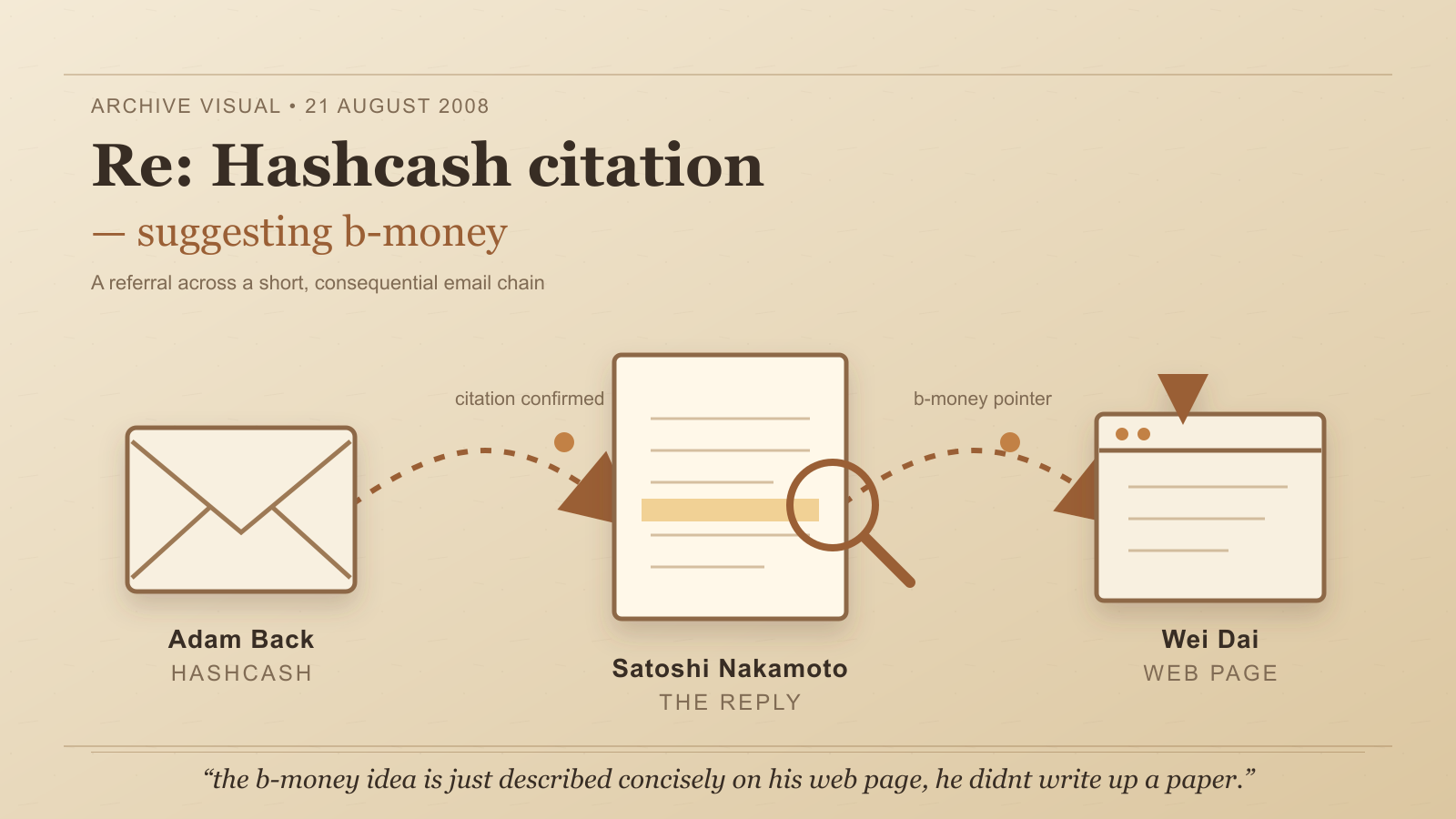
Adam Back, Wei Dai, and Hal Finney each have primary-source correspondence with Satoshi preserved in this archive — Back’s August 2008 Hashcash-citation exchange, Dai’s August 2008 b-money exchange, and Finney’s November 2008 cryptography-mailing-list exchange that first raised the Bit Gold comparison (§1.1). No such record exists for Szabo with any of the three, or with Satoshi directly: no email, letter, or forum exchange between Szabo and Satoshi, Back, Dai, or Finney has surfaced. Szabo’s presence on the libtech list (§1.4) places him in the same private channel as Dai during 1998, but what is documented there is co-presence and topical overlap — design and argument, not a preserved exchange between the two of them. Every link between Szabo and the Bitcoin-adjacent record runs one direction and stays public: Satoshi named Bit Gold, alongside b-money, in a July 2010 forum post — a public mention, not a message to Szabo — and Szabo wrote about Bitcoin on his own blog in May 2011 (§2.2) — a public post, not a reply. For a candidate whose case partly rests on cypherpunk-era proximity to Satoshi’s documented circle (§1.4), the absence of any direct exchange with the three correspondents closest to that circle is a further gap between circumstantial profile and demonstrated connection.
3. Within the broader documentary record
The strongest claim the public record supports about Satoshi himself is that he was structurally outside the visible cypherpunk community during the Bitcoin development period — Wei Dai’s 2014 identifiability argument, plus Satoshi’s own admission of not having known b-money during development, support a “not a visibly active cypherpunk during 2007–2008” reading.
Szabo was visibly active during 2007–2008 (continuous Unenumerated posting). Like Adam Back, this counts as evidence against him under the identifiability argument.
Hal Finney’s early correspondence noted the conceptual similarity between Bitcoin and Bit Gold, and Satoshi himself learned of Wei Dai’s b-money via Adam Back’s referral in August 2008 (per the August 2008 email exchange). No published direct correspondence between Szabo and Satoshi has surfaced — see §2.6 for the broader absence of any documented exchange with Szabo.
For comparison with other named-candidate Satoshi-identity hypotheses, see the Satoshi-identity hypotheses overview and the individual hypothesis entries for Wei Dai and Hal Finney — the same two names Szabo’s own §2.2 post singles out as “the only people I know of who liked the idea… until Nakamoto” — as well as Adam Back, Sassaman, Kaneko, and Todd.
4. Limits of this entry
- This entry does not present new evidence. It compiles publicly available material.
- Skye Grey’s pseudonymous status means the stylometric analysis itself is not subject to the verification a named author’s analysis would be. The 2014 Aston University study is more verifiable but its methodology has been contested by later commentators.
- If new evidence surfaces — direct documentary links, technical fingerprints in the v0.1 code matching Szabo’s other published code, or comments by Szabo contradicting his prior public position — this entry should be updated.
The TechCrunch Skye Grey stylometric report provides the first pillar of the evidence in §1 — the stylometric one. The Szabo case falls under Group B of the necessary-but-not-sufficient framework that the Satoshi-identity hypotheses overview applies across all candidates.
Szabo is the candidate the idea points to and the code points away from. Between a thinker who never shipped and an author who could not finish the paper until the code ran, the record keeps two people, and in everything I have read it has never passed a single message between them.