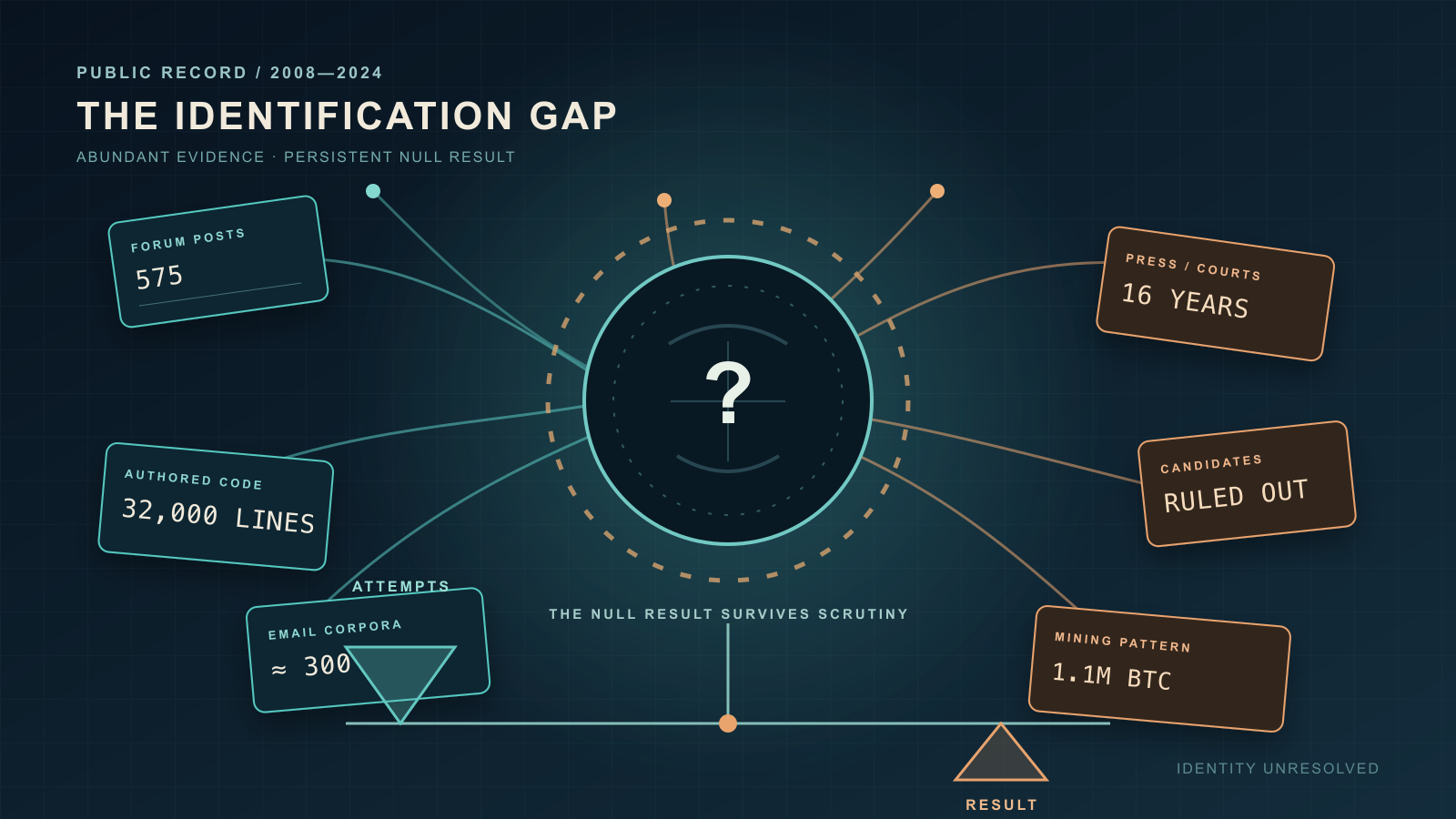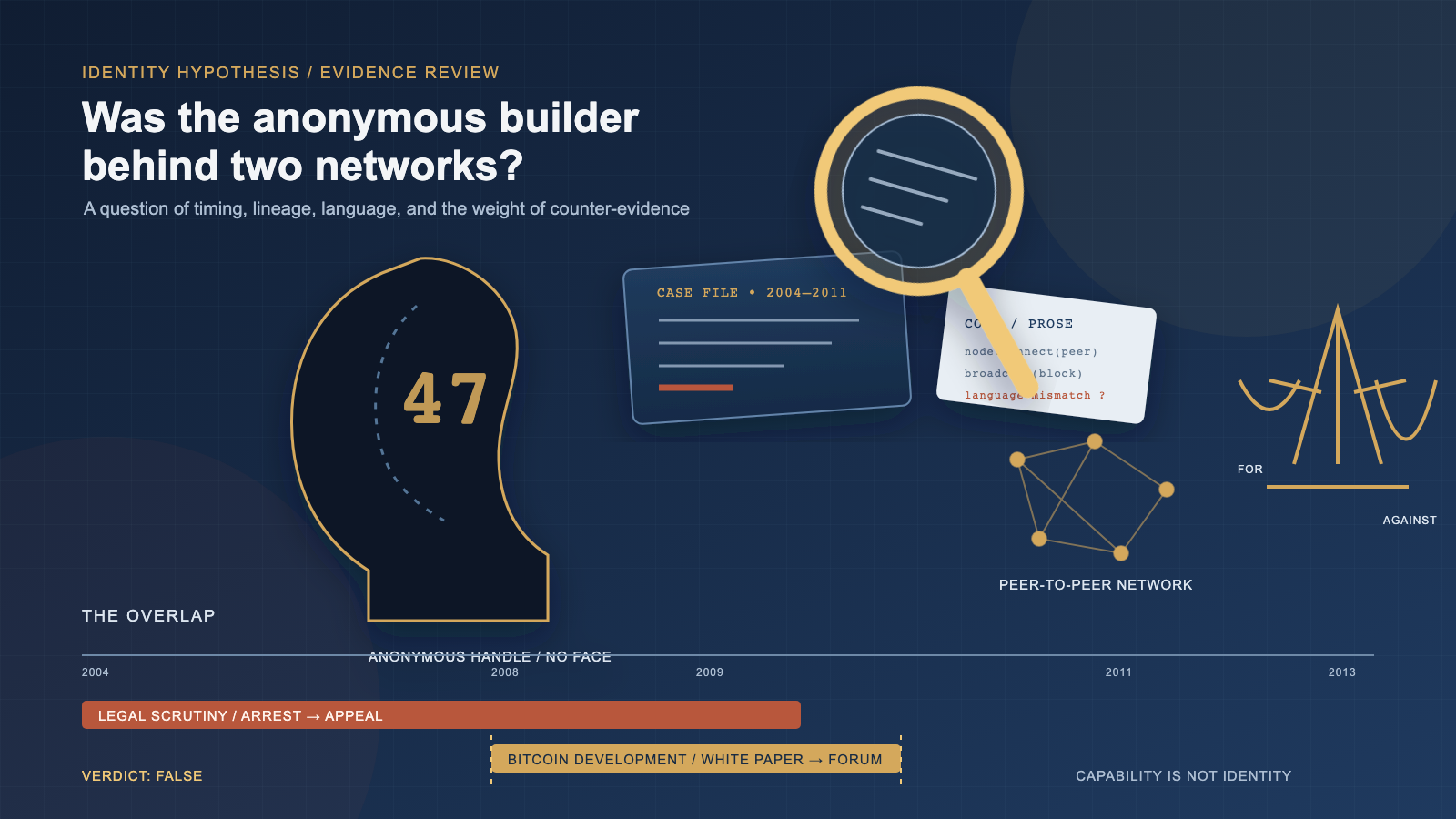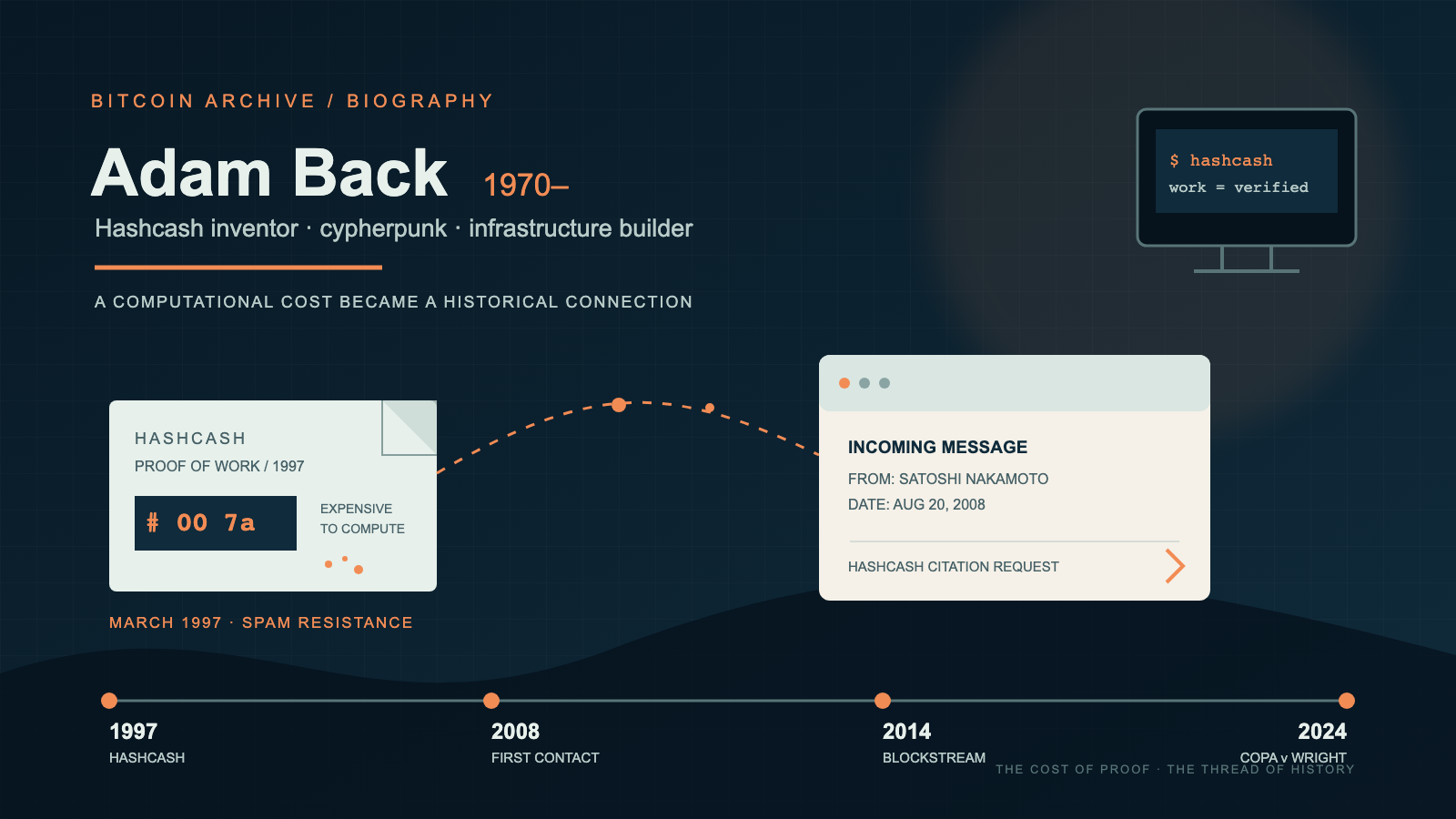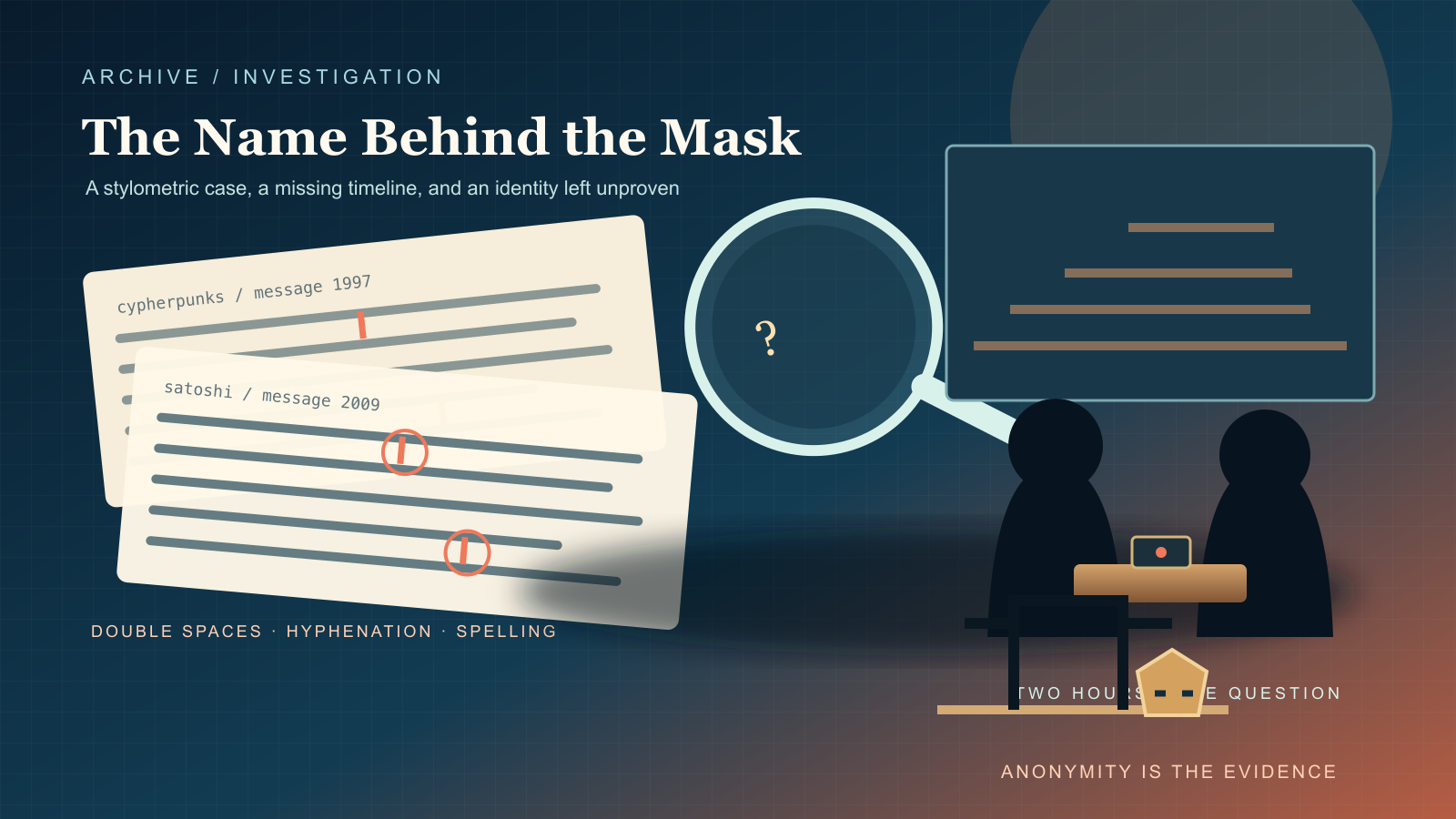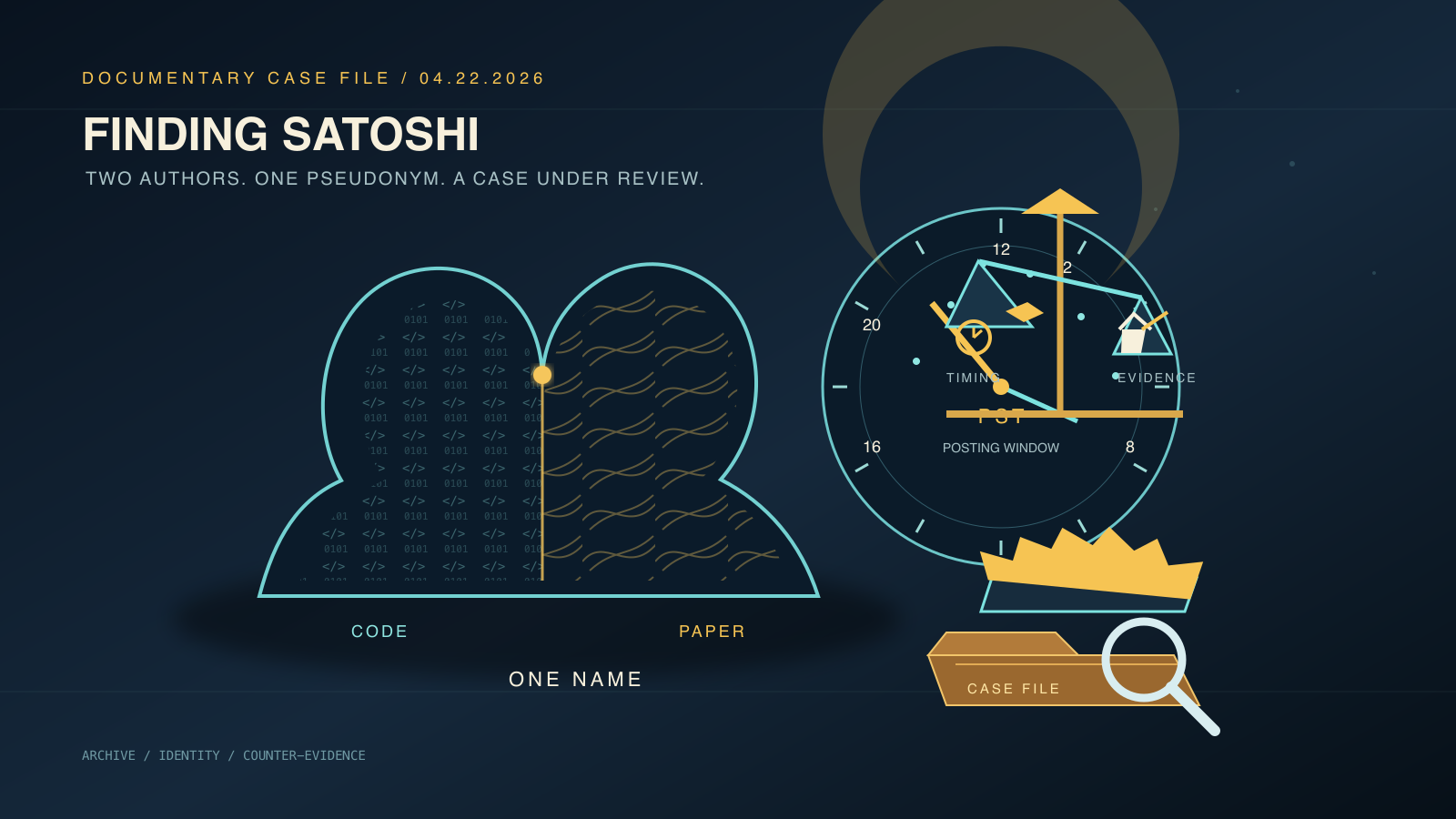
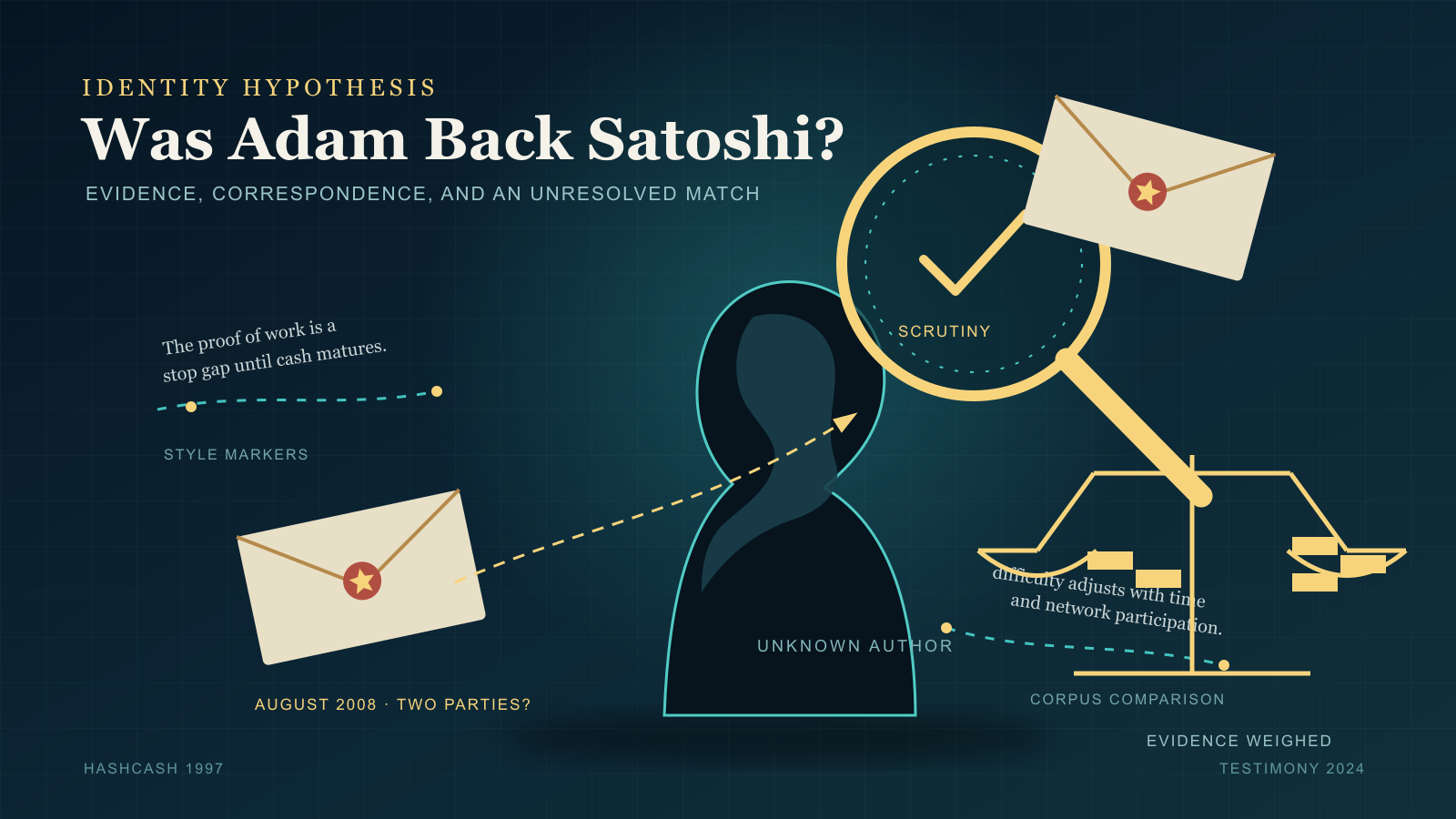
On April 8, 2026, the New York Times published John Carreyrou’s investigation naming Adam Back as the closest stylometric match to Satoshi Nakamoto among 620 cryptography-mailing-list writers who had posted at least 10 messages before Bitcoin’s 2008 launch. The Pulitzer Prize–winning Carreyrou’s stylometric analysis joined a set of other circumstantial markers: Back’s Hashcash invention (1997, cited as reference [6] in the whitepaper), his position as the first known person Satoshi contacted (August 20, 2008), and his subsequent role as CEO of Blockstream.
1. The evidence
Back is the person behind the Satoshi Nakamoto pseudonym. His documented public-record interactions with “Satoshi” — the August 2008 email exchange and the February 2024 COPA v Wright testimony alike — were stagecraft to maintain the pseudonym. He operated as Satoshi from the development phase (mid-2007 onward) through the 2011 withdrawal, and has run Blockstream since 2014 while publicly denying it.
1.1 The 2026 New York Times stylometric investigation
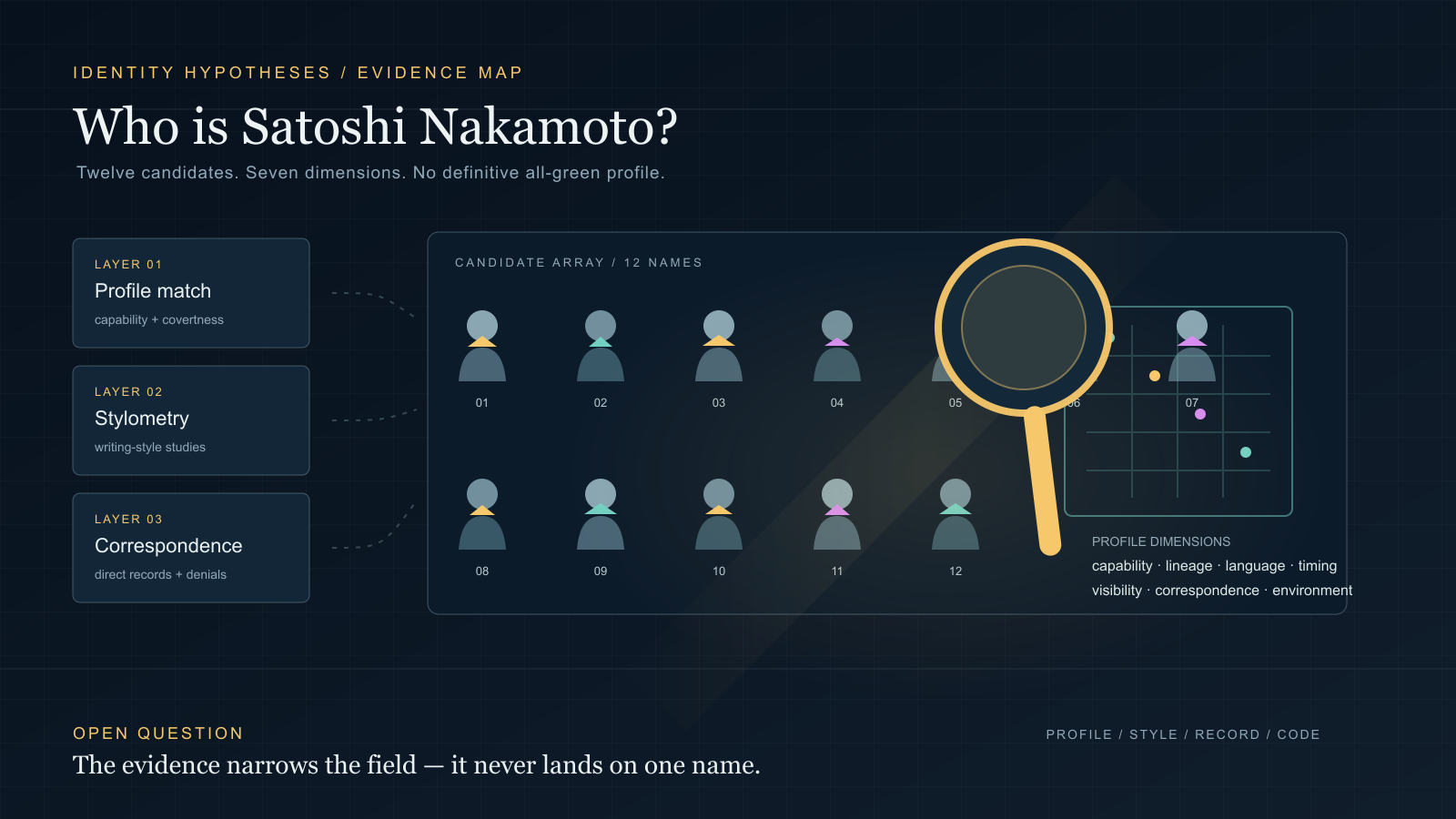
The newest and most prominent piece of evidence is the April 2026 New York Times investigation by John Carreyrou: a stylometric comparison of cypherpunk-mailing-list archives that identified Back as the closest writing-style match to Satoshi among 620 cryptography-mailing-list writers who had posted at least 10 messages before Bitcoin’s 2008 launch. The methodological details — the three stylistic markers (double-spacing, British spellings, hyphenation misuse), the 325 nonstandard-hyphenation comparison, the independent linguistic review by Florian Cafiero, the “conspicuous gap” in Back’s online activity around Bitcoin’s announcement, and Back’s responses — are documented in the aftermath entry.
Two findings decide the weight of this evidence:
- (a) Back ranked highest among 12 candidates in Cafiero’s analysis
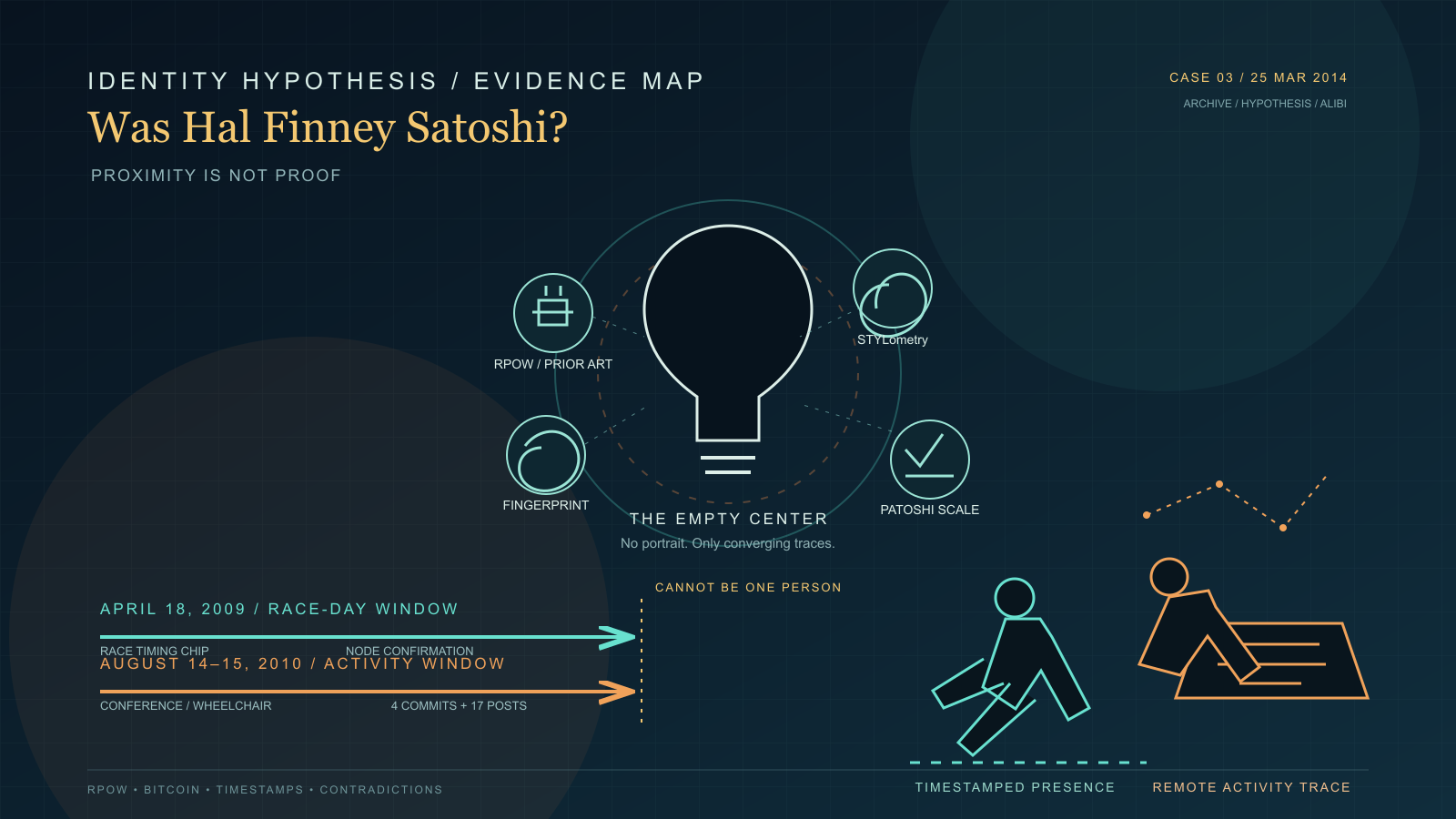
- (b) the analysis was internally described as inconclusive, with Hal Finney nearly tying
The first presses the case; the second limits its reach.
1.2 Hashcash authorship correlation (longstanding)
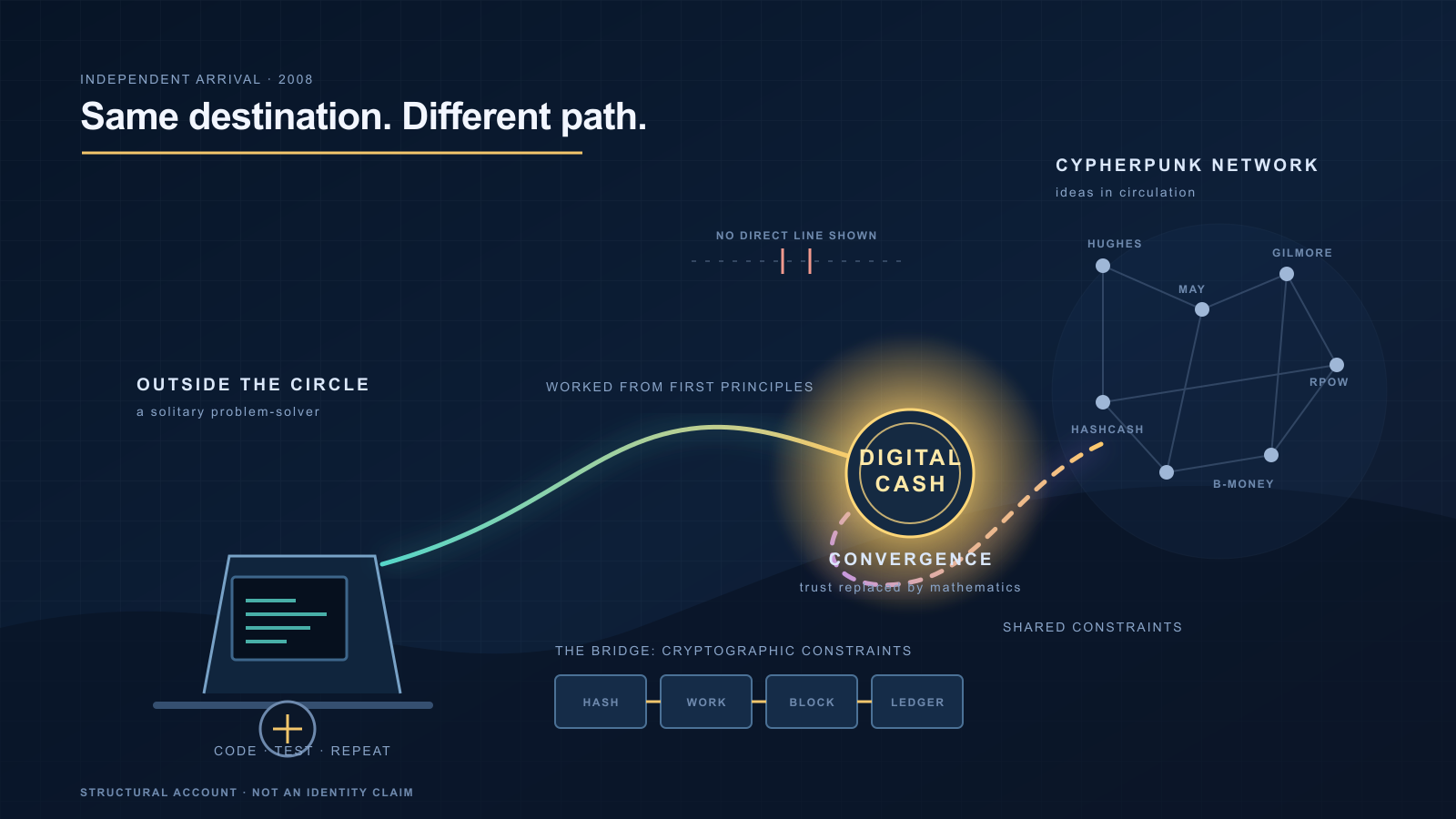
Hashcash is the proof-of-work primitive Bitcoin reuses for mining and consensus, and the Bitcoin whitepaper cites it as a primary precedent. Authorship correlation between the cited primitive and the system reusing it is structurally consistent with the documentary record.
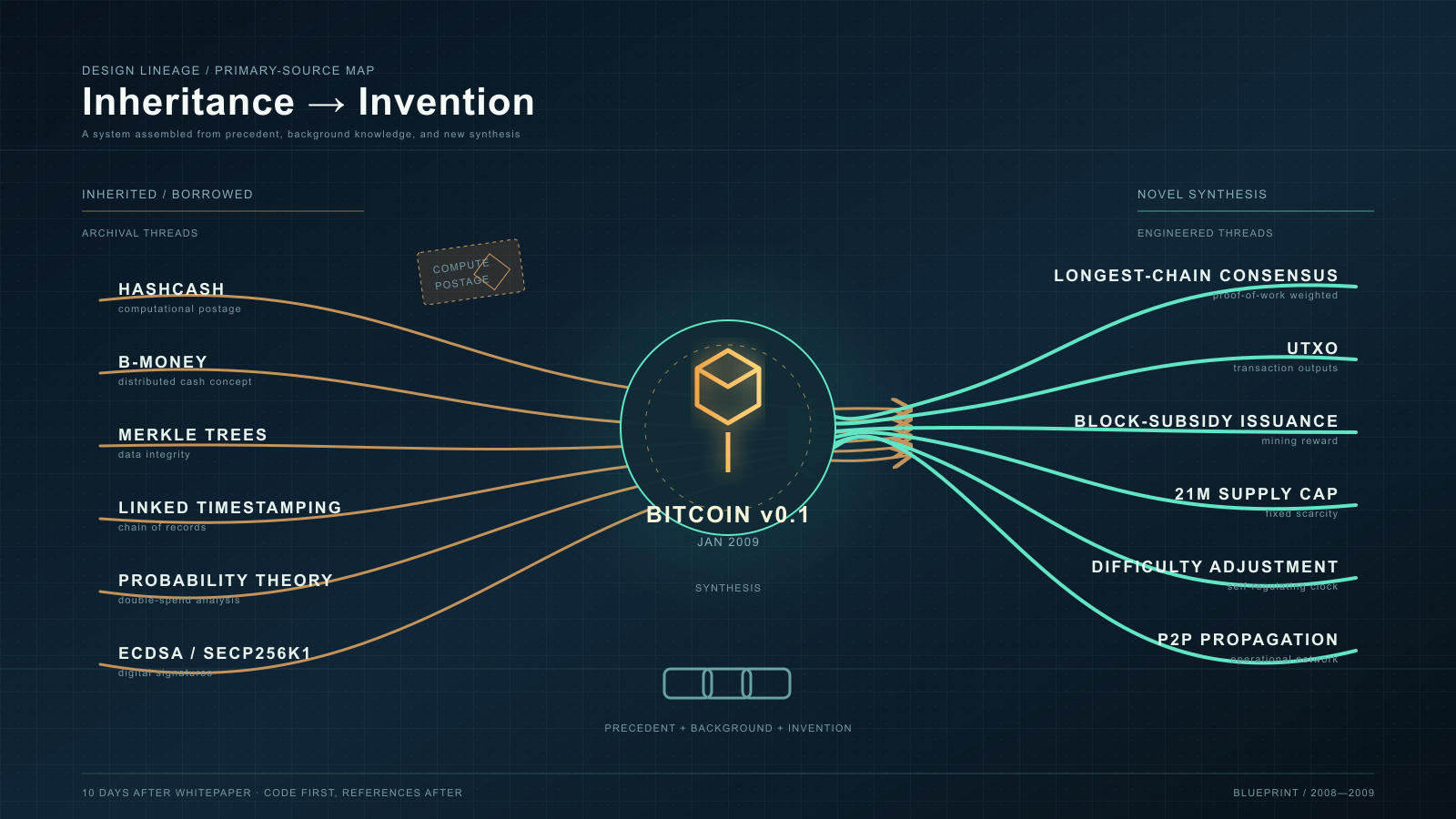
The scope of “Hashcash author = Bitcoin author”. Hashcash itself is narrow. The “cash” in Hashcash is a computational-postage metaphor — Adam Back’s 1997 paper proposed it as an anti-spam denial-of-service counter-measure, not a currency. The system is a self-contained proof-of-work stamp scheme; it has no ledger, no transfers between parties, no consensus mechanism, no monetary supply. What is and is not in Hashcash:
| Bitcoin component | In Hashcash? |
|---|---|
| Proof of work | ✅ yes |
| Blockchain (the ledger) | ❌ no |
| Decentralized consensus | ❌ no |
| UTXO model | ❌ no |
| Mining-reward issuance | ❌ no |
| 21-million monetary cap | ❌ no |
| P2P network propagation | ❌ no |
| Public-key transactions (ECDSA) | ❌ no |
| Difficulty adjustment | ❌ no |
| Block timestamping and chain ordering | ❌ no |
For where each non-Hashcash component actually came from — other whitepaper references, general computer-science knowledge, or novel synthesis — see the Bitcoin design lineage entry. Authoring Hashcash means designing one of Bitcoin’s many components — the spam-deterrence stamp scheme Bitcoin repurposes as the basis for mining. The forensic-fit argument tightens or weakens depending on whether the reader counts that component as the design idea Bitcoin needed or as one of the design ideas Bitcoin needed.
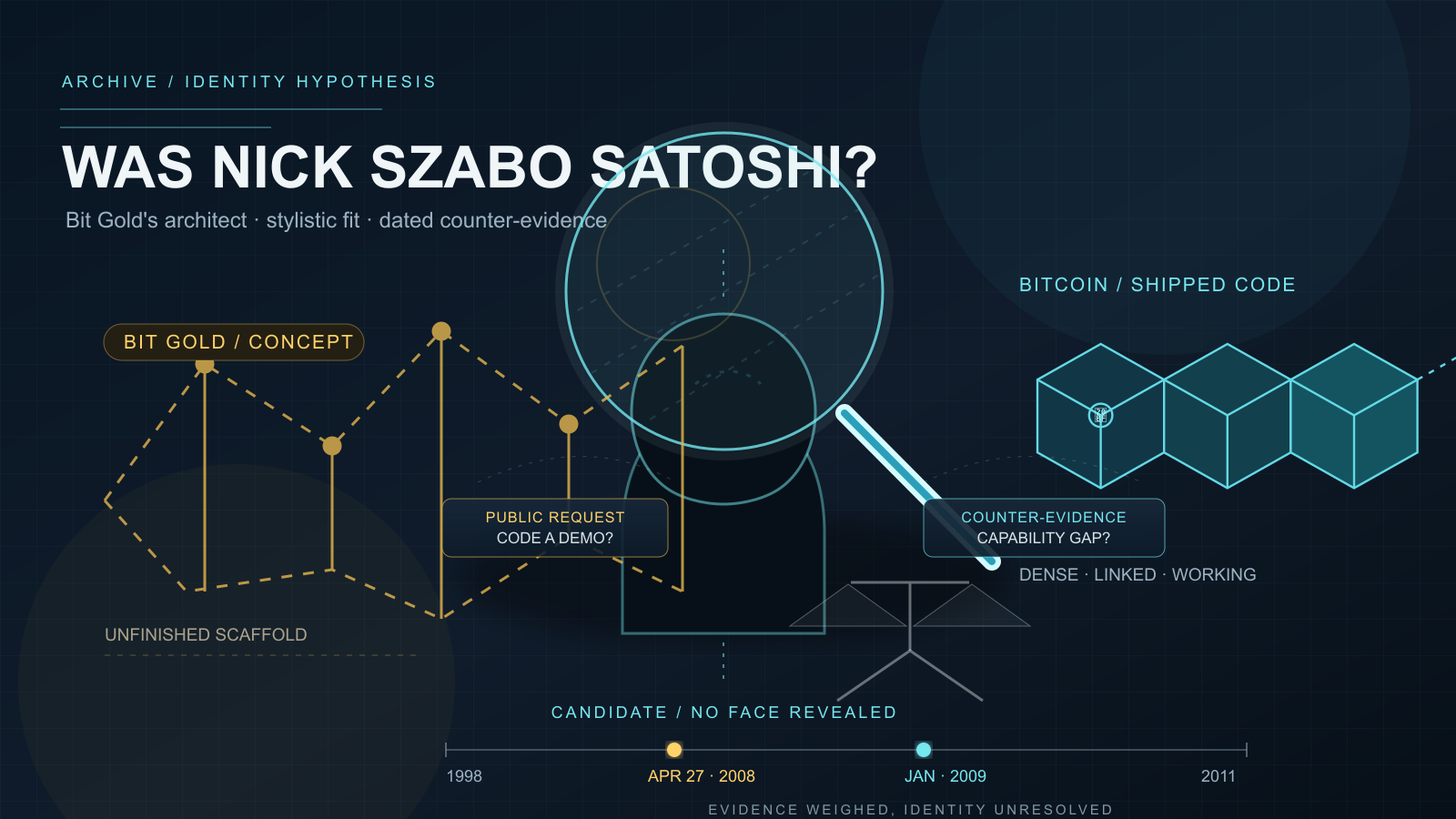
The objection from candidate-set scope: the whitepaper also cites Wei Dai’s b-money. By the same forensic-fit argument, Wei Dai would be a parallel candidate. This evidence selects “the cypherpunks Satoshi explicitly cited” as a candidate set rather than Back uniquely — Wei Dai fits the same profile, and the hypotheses overview groups Back and Wei Dai together as Group A for this reason.
1.3 Cypherpunk credentials, capability, and English level
Back is a long-tenure cypherpunk with documented cryptographic-protocol design experience (Hashcash 1997, prior anonymity-system work), a PhD in computer science from the University of Exeter, and a native British English background — all consistent with what Bitcoin v0.1 demonstrates, and consistent with the British-spelling pattern in Satoshi’s writing that the nationality-question entry reads at length, against a GMT-consistent timestamp study, without landing on Japan.
The objection: this profile applies to many senior cypherpunks of the period. It narrows the candidate set substantially but does not select Back specifically over (for instance) Wei Dai, Hal Finney, or Nick Szabo. Several of those candidates are also accommodated by Cafiero’s “Hal Finney nearly tied” stylometric outcome.
Unlike the working-environment evidence that weighs on other named candidates, this axis does not press the case either way for Back: the archive’s analysis of Satoshi’s 27-month Windows-only development environment notes that Back’s Hashcash shipped as a cross-platform Perl script and that his academic-and-industry background gives him routine exposure to both Unix and Windows — a profile that fits the Windows-only record without being distinctive evidence for it.
1.4 Eleven years of Hashcash’s monetary-category positioning (1997–2008)
A separate line of evidence, distinct from the forensic-fit argument (§1.2) and the credentials profile (§1.3): the specific primary-source record of Back framing Hashcash within the digital-cash conversation, and engaging substantively with monetary-system design, before Bitcoin’s 2008 launch.
Mapping Back’s 1998-12-06 b-money critique to Bitcoin’s design ten years later:
| Back 1998-12-06 issue | Bitcoin’s resolution |
|---|---|
| ❶ Moore’s-Law mint-cost decline → inflation pressure | Difficulty adjustment — re-targeted every 2016 blocks to keep block-time approximately constant against compute-power growth, decoupling mint-rate from hardware-cost decline |
| ❹ Economy-of-scale custom-hardware advantage | Unresolved — surfaced later as the mining-ASIC concentration question in Bitcoin’s operational history |
| ❼ Resource-waste overhead equivalent to circulating value | Live debate — the energy-consumption critique that has continued to attach to Bitcoin’s proof-of-work since launch |
| Central proposal: “to create value you burn CPU time, just like with hashcash” | Bitcoin’s central mechanism — Bitcoin couples a Hashcash-style PoW primitive with a decentralized digital-cash ledger and uses block-subsidy issuance for mint allocation |
Eleven-year arc:
| Year | Primary source | What Back said about Hashcash and money |
|---|---|---|
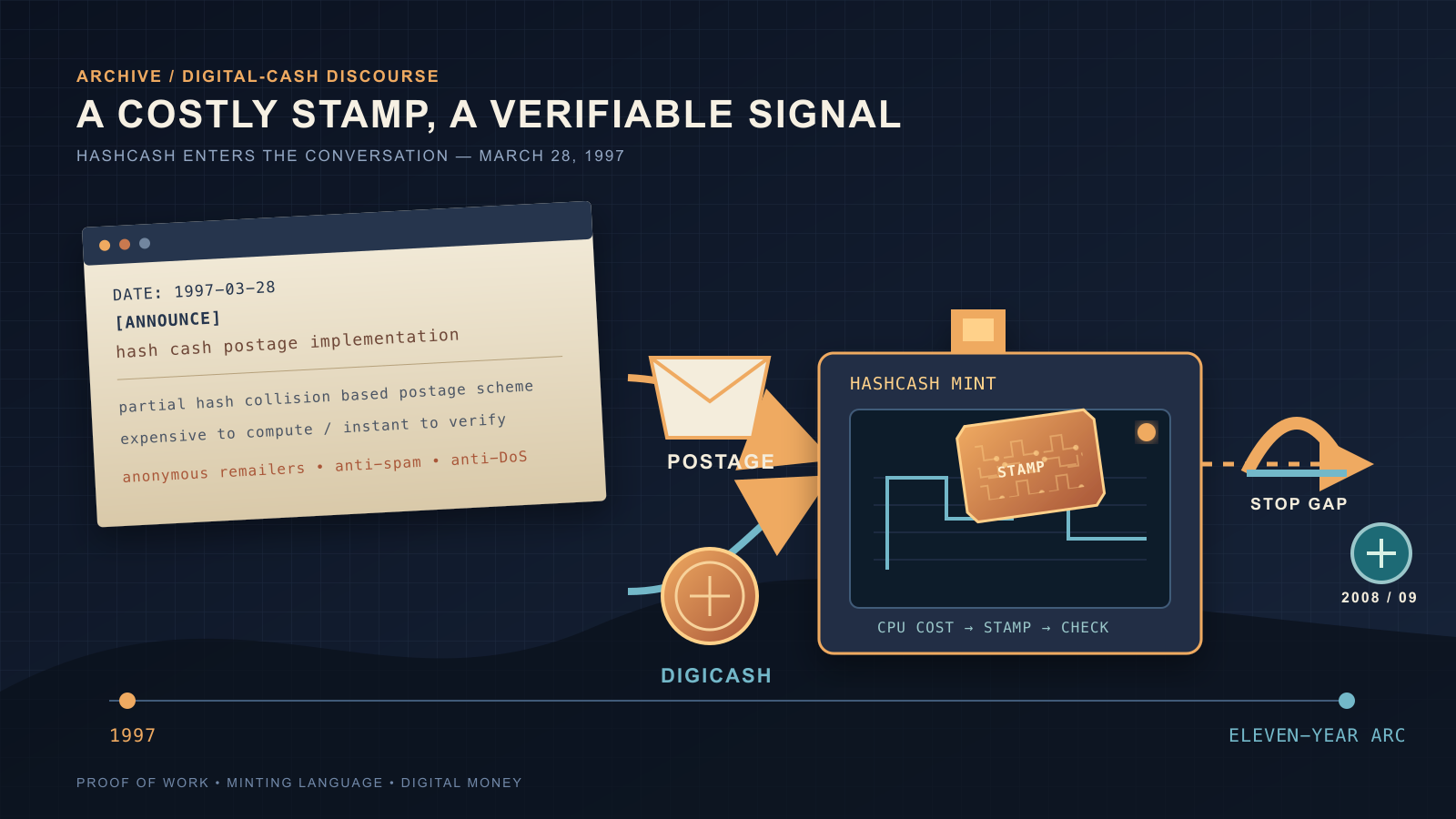
| 1997-03-28 | Hashcash announcement (Cypherpunks list) | Positioned Hashcash as a “stop gap measure until digicash becomes more widely used” in the announcement’s How does this fit in with digicash section |
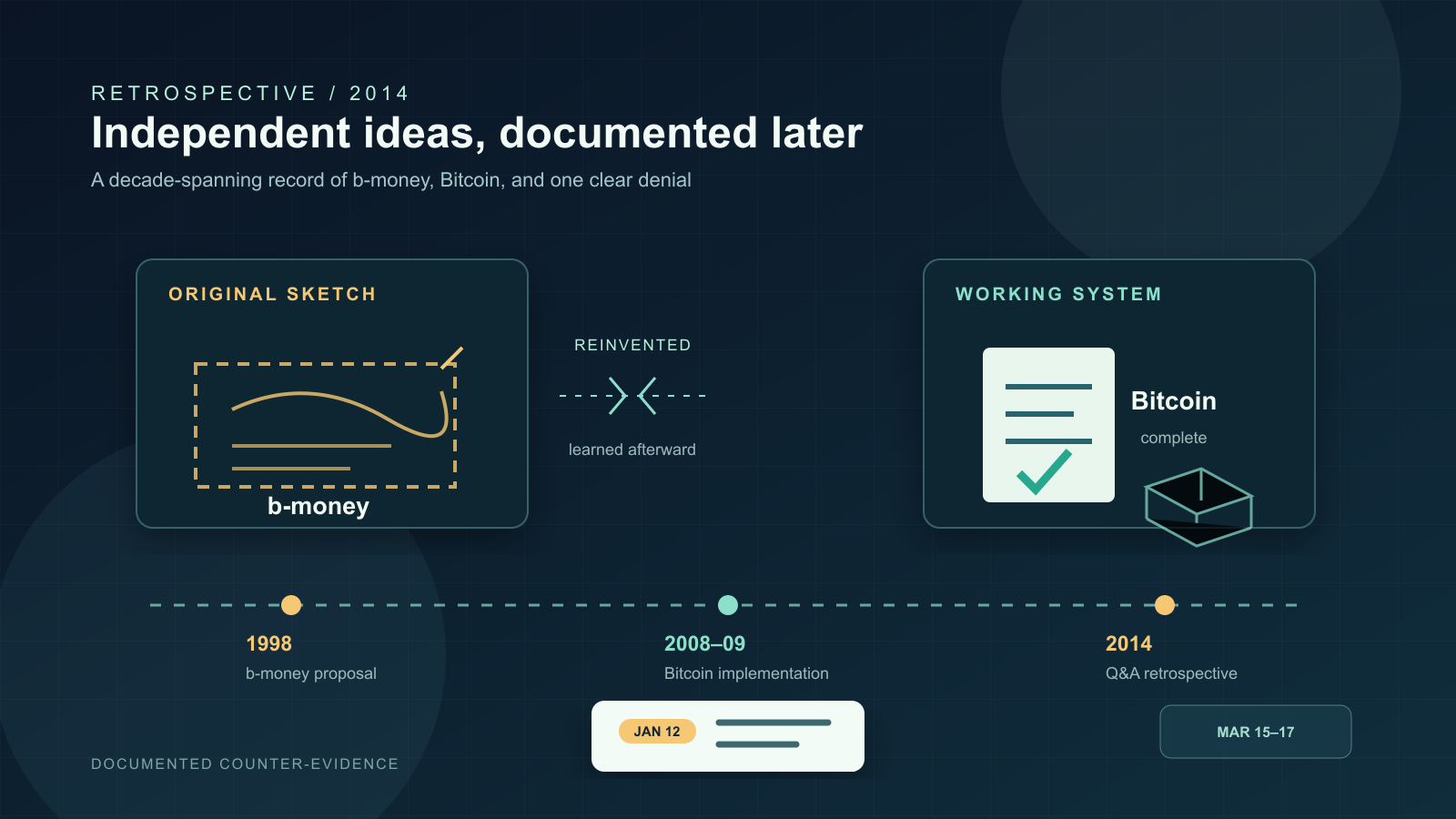
| 1998-12-06 | Cypherpunks-list b-money critique | Identified seven monetary-design issues in b-money; proposed “to create value you burn CPU time, just like with hashcash” |
| 2002-08-01 | Hashcash paper §2 + §7 | ”We use the term mint for the cost-function because of the analogy between creating cost tokens and minting physical money”; §7 enumerates “hashcash as a minting mechanism for Wei Dai’s b-money electronic cash proposal” |
| 2008-08-20 | Satoshi to Adam Back | Satoshi contacted Back about Hashcash citation format for the Bitcoin whitepaper |
In Back’s own retrospective framing, posted on X in April 2026 in response to the NYT investigation:
Quote from: Adam Back on April 08, 2026I was early in laser focus on the positive societal implications of cryptography, online privacy and electronic cash, hence my ~1992 onwards active interest in applied research on ecash.
The strength of this evidence: documented, primary-source-verifiable, decade-long pre-Bitcoin engagement with the exact design space Bitcoin would occupy — proof-of-work as a digital-cash minting mechanism. Back identified Moore’s-Law inflation pressure (issue ❶) ten years before Bitcoin’s difficulty-adjustment algorithm resolved it. Back enumerated “hashcash as a minting mechanism for b-money” in a 2002 paper.
The objection: identifying problems is not the same as solving them. The 1998 critique enumerates seven issues with b-money but proposes resolutions to none of them. The 2002 paper proposes b-money minting as an application but does not implement it. The Hashcash + b-money combination Bitcoin would later realize requires the integrated synthesis — the longest-chain consensus rule, the difficulty-adjustment algorithm that resolves issue ❶, the UTXO model, mining-reward block-subsidy issuance, the 21-million supply cap — which is documented as Satoshi’s contribution in Bitcoin design lineage. Back’s pre-2008 record is of analysis and positioning; Bitcoin v0.1 is of integrated implementation. The same observation applies to other cypherpunks (Wei Dai, Nick Szabo) who proposed conceptual designs without implementing them — capability for analysis does not by itself select the analyst as the implementer.
2. The counter-evidence
2.1 The 2008 emails read as third-party reception
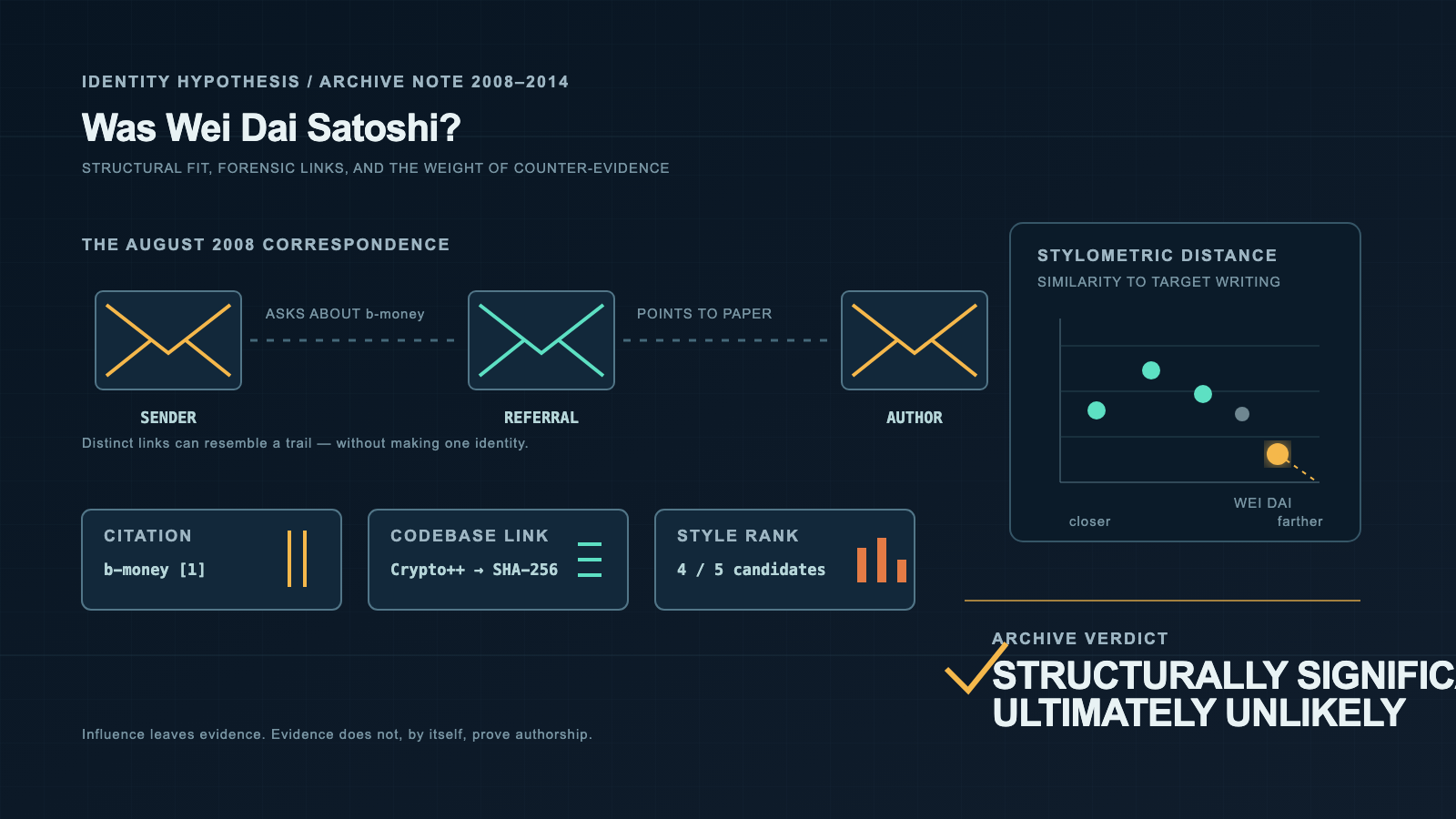
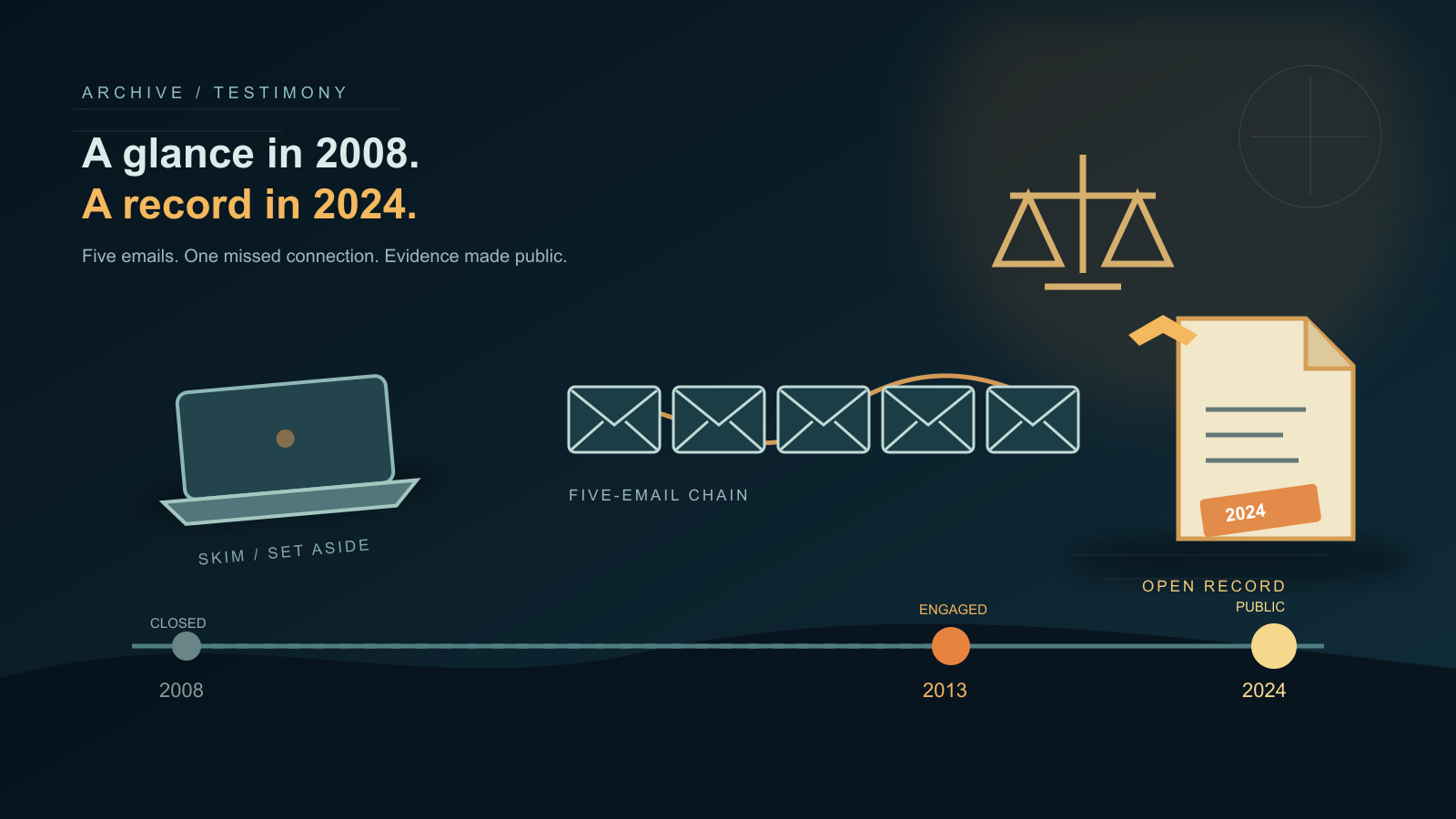
The strongest archive-internal counter-evidence is the structure of the August 20–22, 2008 email exchange itself:
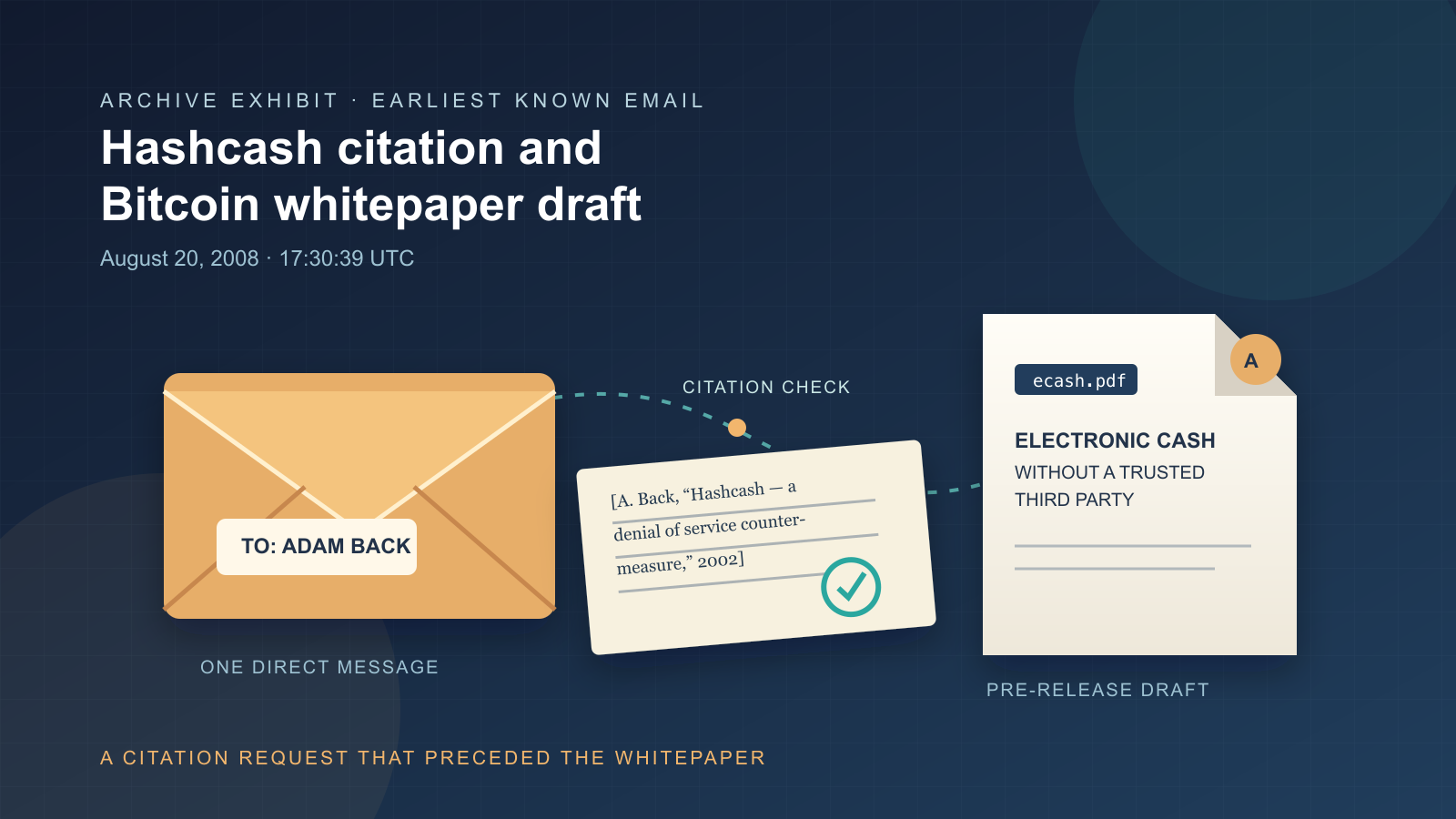
- August 20: Satoshi to Back — described early Bitcoin idea, asked Back about correct Hashcash citation format.
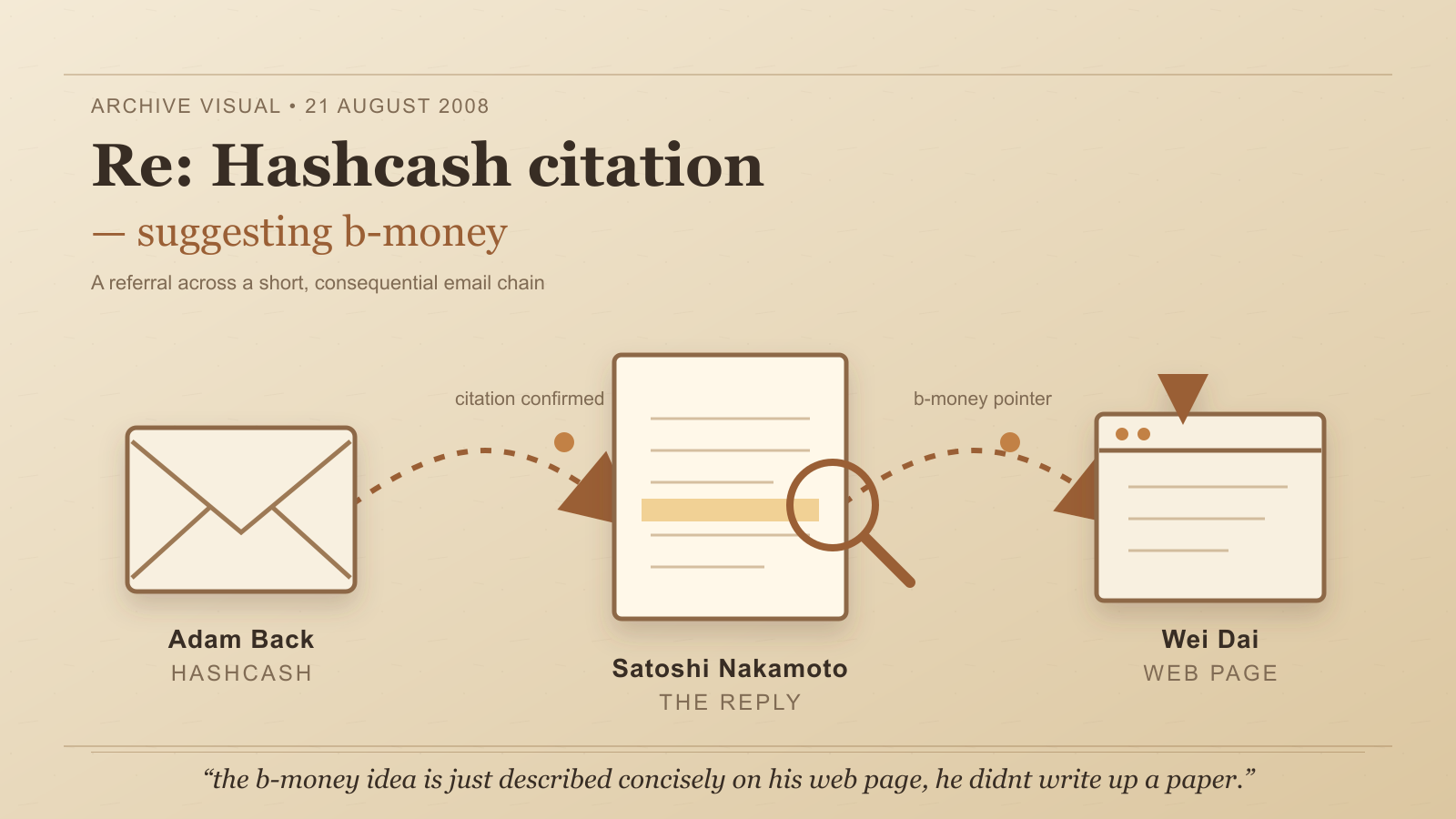
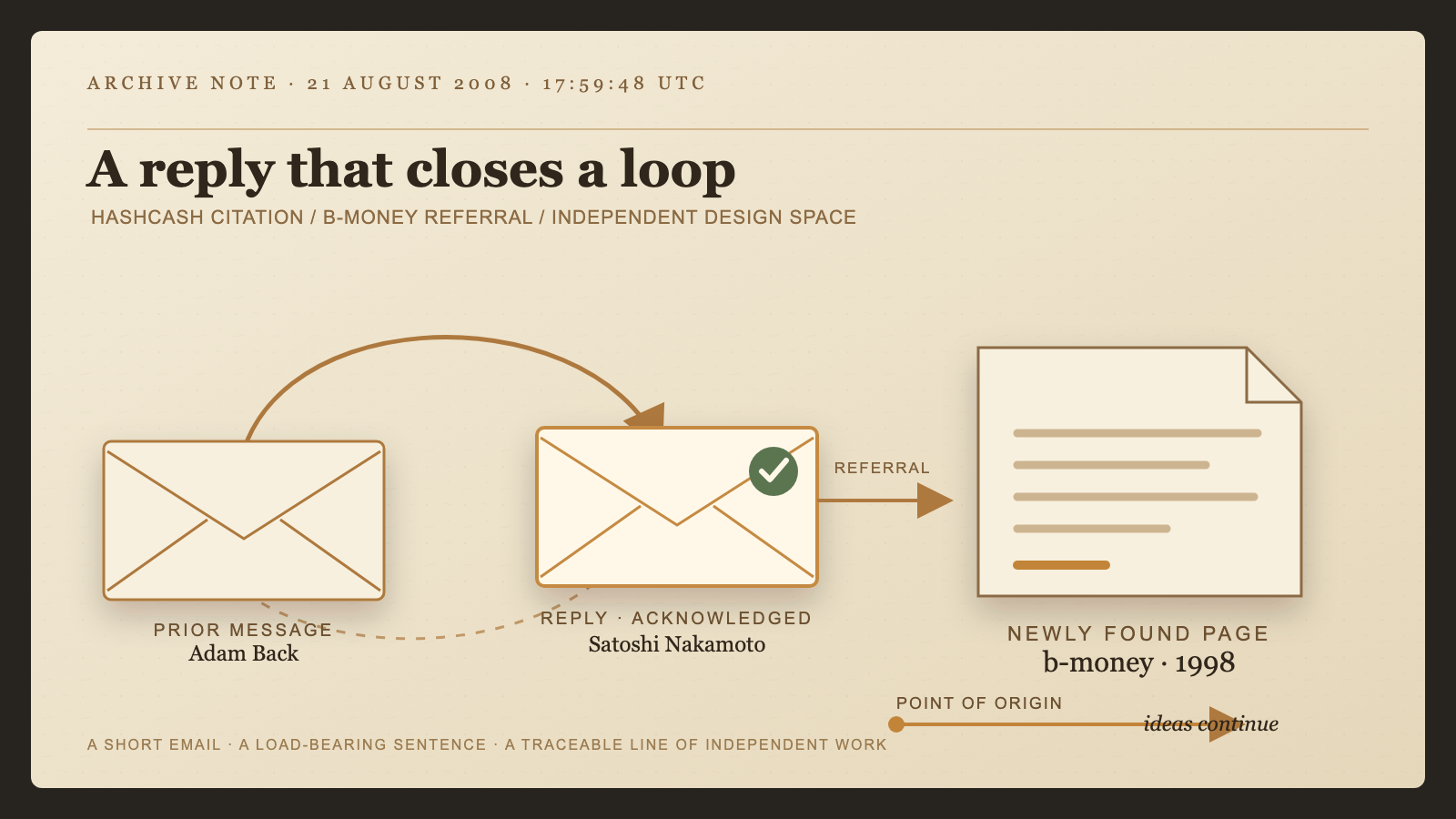
- August 21: Back to Satoshi — provided the requested citation and suggested Satoshi look at Wei Dai’s b-money proposal.
- August 21: Satoshi to Back — replied “I wasn’t aware of the b-money page” and the next day emailed Wei Dai.
If Back were the person behind the Satoshi pseudonym, the structure does not naturally make sense: Back would not need to ask “Back” for citation guidance, and Back would not need to “discover” b-money via his own referral to himself. The simpler reading: the exchange is what it appears to be — Satoshi asking Back for help, Back responding as a third party with relevant pointers, Satoshi following the pointers.
Two further structural observations strengthen the third-party reading:
- The contact was minimal in scope. Satoshi asked Back only about citation format. Back had spent the prior decade publicly engaging with monetary-system design — the 1998-12-06 b-money critique enumerated seven monetary-design issues in b-money (Moore’s-Law inflation pressure, custom-hardware economy of scale, fiat on/off-ramp privacy, resource-waste overhead, etc.) and the 2002 Hashcash paper §7 listed b-money minting as an application — yet Satoshi did not ask Back about any of these issues, nor about the resolution of issue ❶ (which Bitcoin’s difficulty-adjustment algorithm in fact addresses). The exchange treats Back as a citation source, not as a technical collaborator. If the same person is on both sides, it is not obvious why the staging would be limited to citation format rather than including substantive engagement that would make the exchange more convincing as plausible-deniability cover.
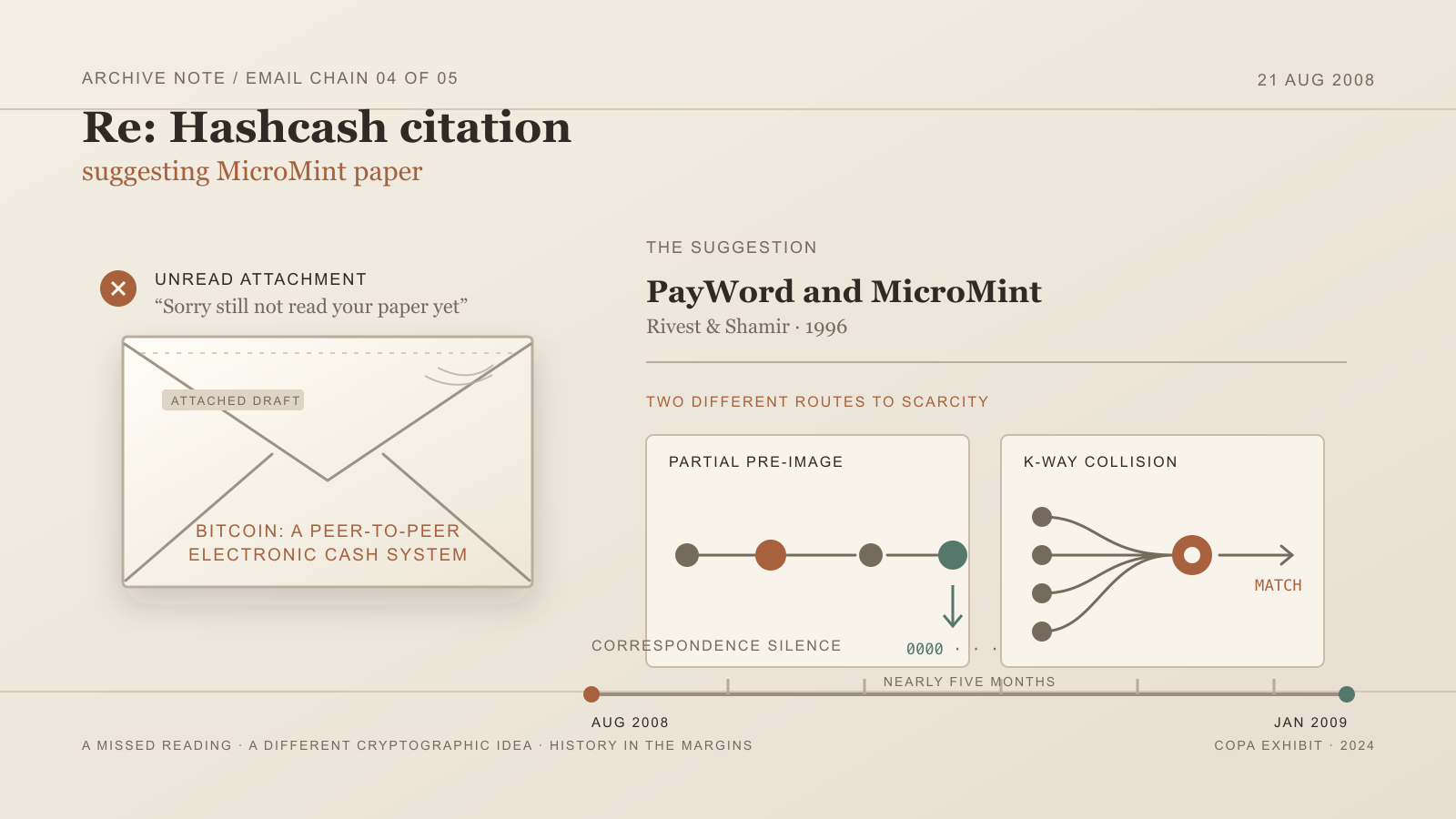
- Back did not read the draft paper Satoshi sent him, and later publicly characterized that as a mistake. The August 20 email linked to the prelaunch draft (
ecash.pdf); in the same exchange Back wrote “Sorry still not read your paper yet,” and he acknowledged later in a Cointelegraph interview that not reading it was “probably my biggest mistake.” Under the staging hypothesis (Back writes both sides; the audience is third-party readers like the COPA court, NYT investigators, and future researchers), the staging needs to look convincing to those third parties. A self-staged exchange would naturally include enthusiastic engagement with the draft, since both that engagement and any subsequent retrospective commentary about it would be under the staging author’s control. The actual record contains the opposite: minimal initial engagement, and a later admission that not engaging was “my biggest mistake” — a public self-criticism of one’s own staged decision that the staging hypothesis cannot easily accommodate. Under the third-party reading, the same behavior is unsurprising — a busy researcher received an unsolicited prepublication draft from someone he did not know, deprioritized it, and later regretted not catching the significance.
2.2 February 2024 COPA v Wright sworn testimony
In February 2024, Back testified in COPA v Wright in London and submitted his complete email correspondence with Satoshi as witness evidence under oath. The testimony was given in a court of law as part of a major intellectual-property trial. Back has consistently and publicly maintained that Satoshi is a separate person from himself across multiple interviews, conference talks, and the legal proceeding.
That same COPA v Wright trial produced the March 2024 ruling against the rival Craig Wright Satoshi claim, documented in the Craig Wright hypothesis entry, which examines the court’s findings that Wright forged evidence to support his own claim.
For the hypothesis to be true, the 2024 testimony would have to have been perjury — a sustained deception in courtroom proceedings under oath, with the additional constraint that the relevant emails between “Satoshi” and “Back” must have been fabricated or self-staged 16 years earlier in anticipation of such a moment.
2.3 Stylometric inconclusiveness and confirmation-bias risk
The 2026 NYT investigation’s own commissioned linguist, Florian Cafiero, described the stylometric result as inconclusive — Hal Finney nearly tied with Back in his analysis. The methodology selects within a candidate set of cypherpunk-list writers who, by definition, share interests, vocabulary, and reference frames with Satoshi.
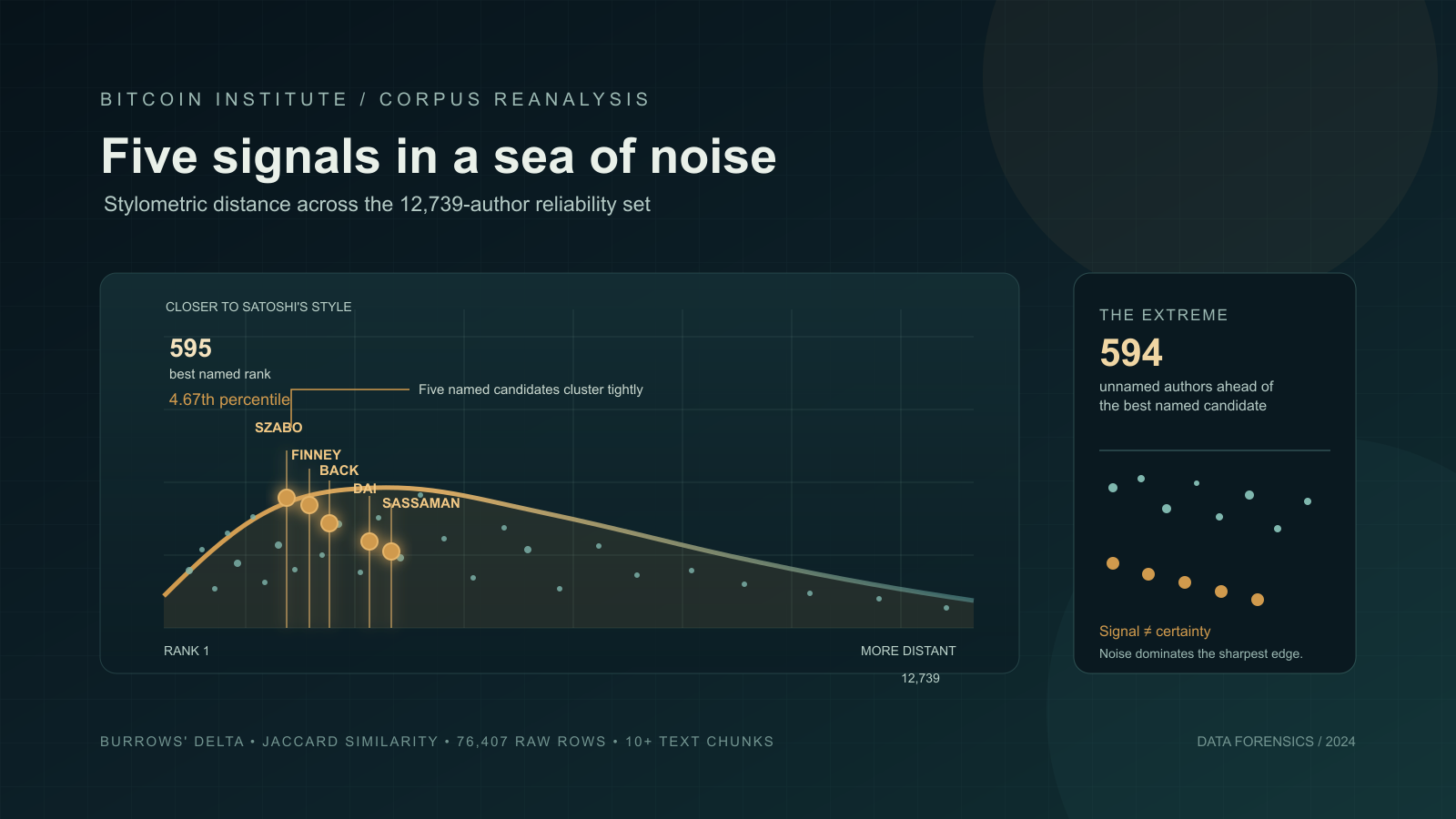
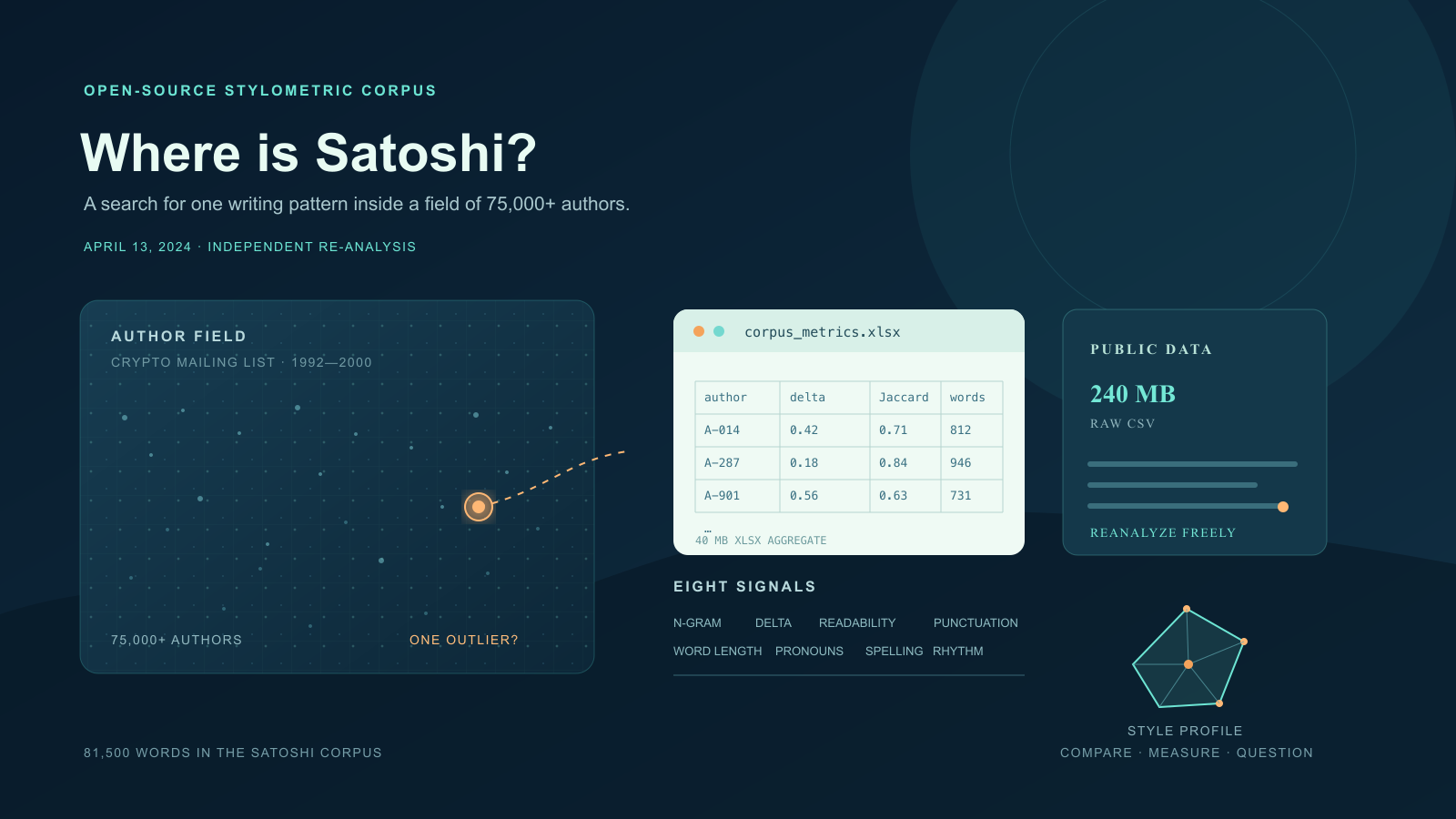
The structural problem is visible in contrast to Bas van Dorst’s 2024 ‘Where is Satoshi?’ open-source corpus, which compares Satoshi against 75,000+ mailing-list authors without pre-selecting for topical overlap. Van Dorst himself declines to publicly name a candidate, but the Bitcoin Institute reanalysis of his published data places Nick Szabo highest among the five most-cited named candidates (Szabo top 4.67%, Hal Finney 6.89%, Adam Back 7.87%, Wei Dai and Sassaman tied at ~23%) — Adam Back is not the closest match in this larger-pool reanalysis. The Cafiero / Carreyrou 2026 result that names Adam Back is therefore an outlier across the four most-cited stylometric investigations: Skye Grey 2013 named Szabo, Aston 2014 named Szabo, the Bitcoin Institute reanalysis of van Dorst’s data places Szabo top of 5, and only Cafiero / Carreyrou names Adam Back (with Cafiero himself qualifying that result as inconclusive). The pool-size argument that motivates the Carreyrou / Cafiero finding — that 620 candidates is rigorous compared to 11 — does not survive the larger-pool reanalysis, which puts other named candidates ahead of Back.
Back’s post-publication interview responses articulate this objection directly: he argues the methodology has “an element of confirmation bias” and that “you are inherently selecting people who are interested in similar things… They’re going to sound similar.”
The “conspicuous gap” claim — that Back went quiet online around Bitcoin’s announcement — is observational rather than directly probative; many cypherpunk-list participants reduced or shifted their public activity around 2008–2009 for reasons unrelated to Bitcoin.
2.4 Back’s case against a high-profile Satoshi
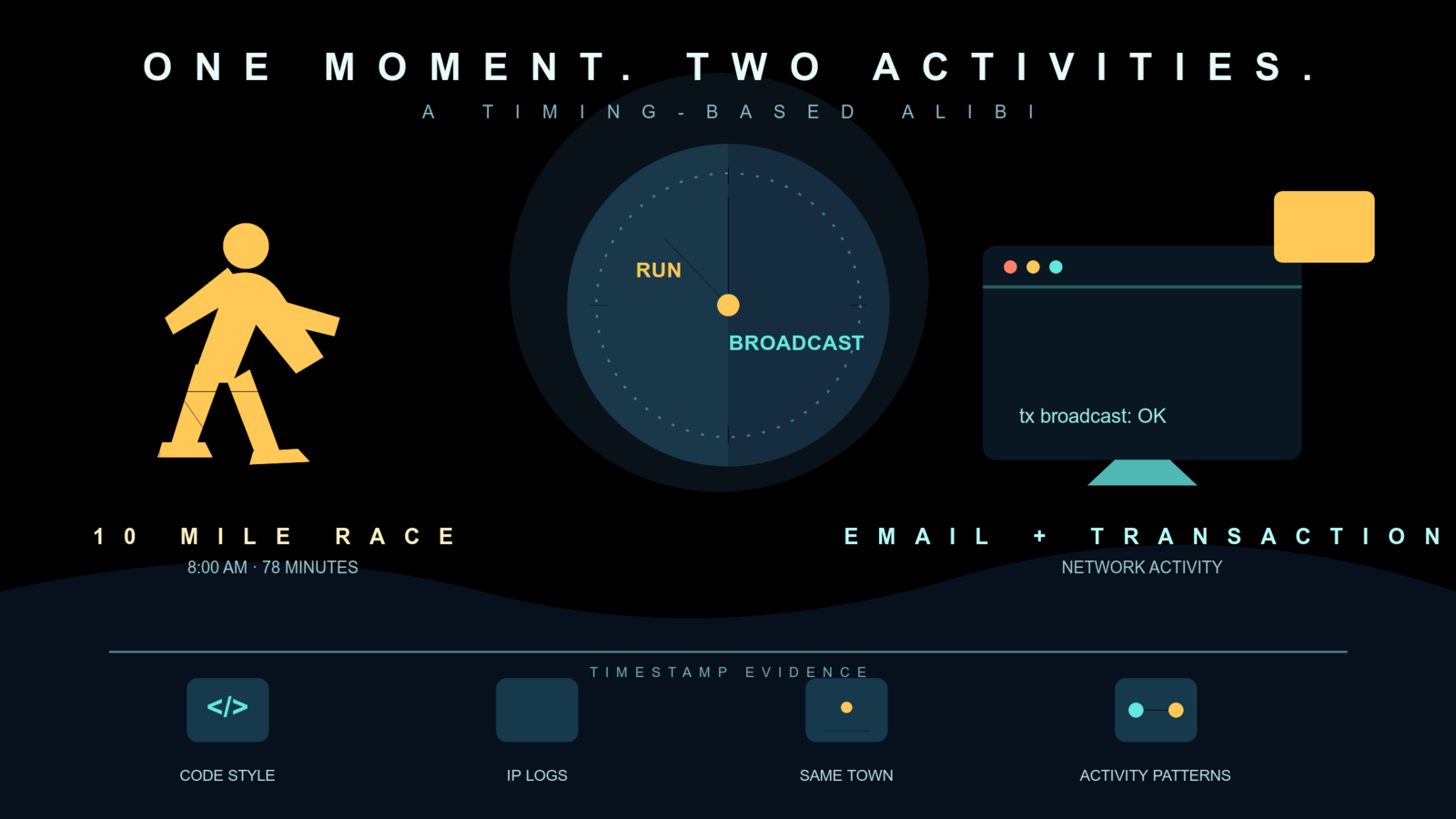
In the same post-publication interviews, Back argued against the idea that any high-public-profile figure could plausibly be Satoshi: that “the most probable situation is that Satoshi is somebody who’s not talking to documentary film crews, to investigative journalists,” and that Satoshi’s continued anonymity is structurally beneficial to Bitcoin because “it helps bitcoin seem more like a discovery and an asset class.” These positions do not by themselves disprove the hypothesis (a person maintaining a pseudonym would be expected to make exactly such arguments), but they constitute Back’s own articulation of why the high-public-visibility identification is inconsistent with what the Satoshi pseudonym was for. Full quotes and context are in the aftermath entry on the NYT investigation. Back made a parallel argument, on the record, against a different multi-candidate theory two weeks later: the Finding Satoshi documentary’s Finney+Sassaman co-creator claim, which he rejected on three specific evidentiary grounds — Sassaman’s KU Leuven timing, Finney’s race-day alibi, and the absence of Patoshi-pattern coins from either family’s holdings.
3. Within the broader documentary record
Wei Dai’s 2014 retrospective on the AALWA thread argues that Satoshi was “not previously active” in the visible cypherpunk community during the development period — a framing that selects against any candidate visibly active in cypherpunk discussion during 2007–2008. Back was visibly active in cypherpunk-list discussions (this is exactly what the NYT stylometric analysis depends on), so the identifiability argument counts against Back as a candidate, alongside Sassaman and other visibly-active cypherpunks of the period.
Satoshi’s own statement to Back in August 2008 — “I wasn’t aware of the b-money page” — independently selects against the Back-as-Satoshi reading. If Back were Satoshi, the email would be a self-deception of no visible benefit to either party.
For comparison with other named-candidate hypotheses, see the Satoshi-identity hypotheses overview and the individual hypothesis entries for Sassaman, Kaneko, and Todd.
4. Limits of this entry
- This entry does not present new evidence. It compiles material from the 2026 NYT investigation, Back’s responses, and existing archive material on the August 2008 email exchange and the 2024 COPA testimony.
- Cafiero’s “Hal Finney nearly tied” outcome is treated as material evidence against the uniqueness of the Back identification (see the Hal Finney = Satoshi hypothesis entry and the documented race-day alibi that argues against Finney specifically).
- If new evidence surfaces — direct documentary links beyond the August 2008 emails, technical fingerprints in Bitcoin v0.1 matching Back’s other published code, or comments by Back contradicting his prior public position — this entry should be updated.
The February 2024 Adam Back retrospective testimony is the sworn-testimony record on which §2.2 builds the load-bearing counter-evidence. The April 2026 NYT Carreyrou investigation is where the evidence in §1 starts, and §2.1 weighs it against the August 2008 email chain.
Back is the candidate I know best from the record and can fit to it worst. Everything that makes him plausible is real, and all of it reads more simply as proximity than as identity. A sworn record, an unread draft, and a public regret for not reading it are hard things to stage. What remains is a nearness so close it keeps being mistaken for the thing itself.