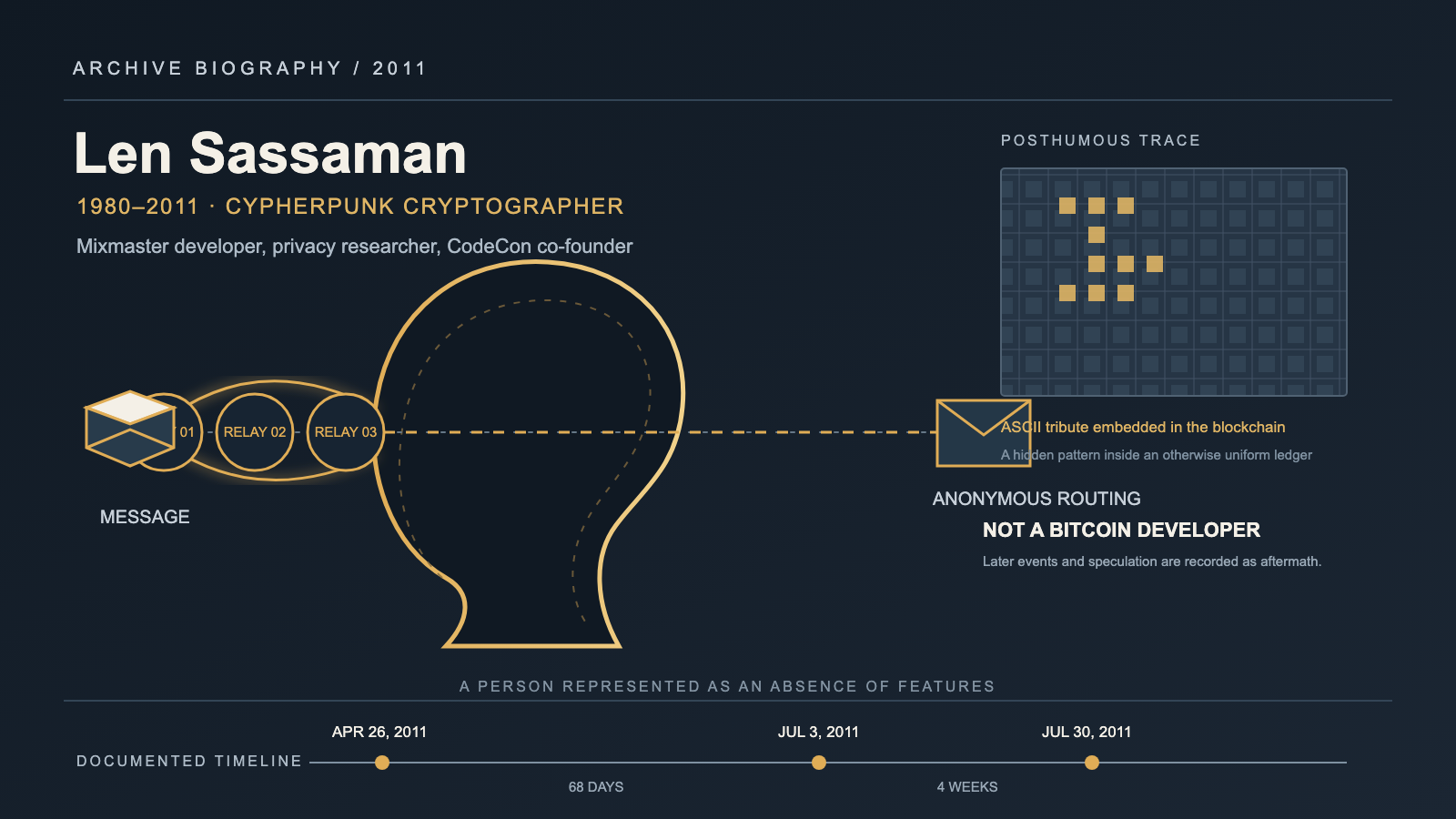

On April 26, 2011, Satoshi sent his last known email. Sixty-eight days later, on July 3, 2011, cypherpunk cryptographer Len Sassaman died by suicide in Belgium. The proximity of those two dates is the load-bearing observation under the Sassaman-as-Satoshi hypothesis — supplemented by his Mixmaster anonymous-remailer work, his cypherpunk credentials, and Dan Kaminsky’s August 2011 blockchain tribute.
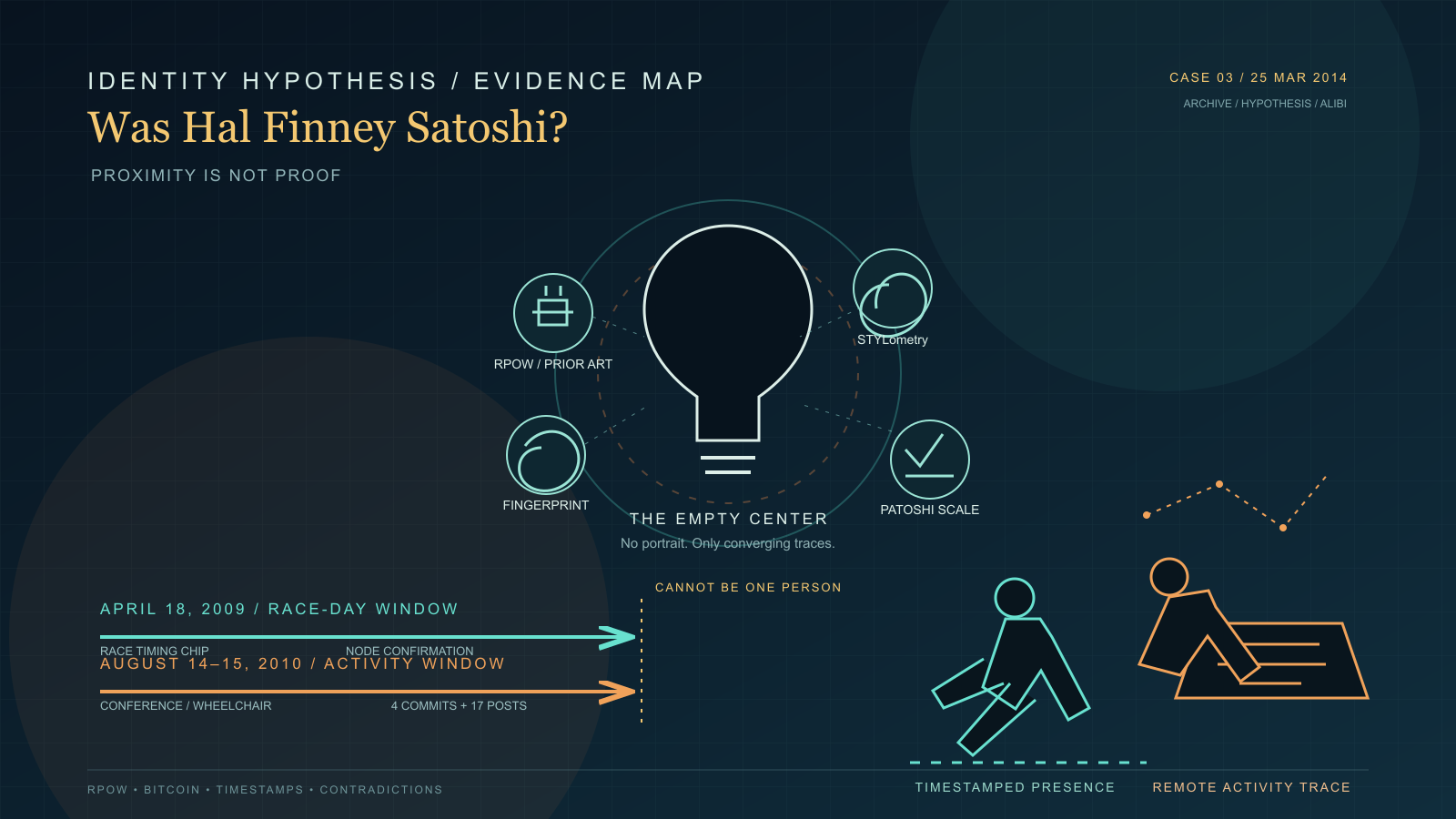
The April 2026 Finding Satoshi documentary extends this individual hypothesis into a multi-person reading, naming Sassaman alongside the individually-argued Hal Finney hypothesis as co-creators (the documentary’s claims and Adam Back’s counter-evidence are treated at the linked entry).
1. The evidence
Sassaman was the person behind the Satoshi Nakamoto pseudonym. He withdrew from the project shortly before his death, and the final email to Gavin Andresen on April 26, 2011 — sixty-eight days before Sassaman’s suicide — was the closing of his Bitcoin life rather than a step away from one of many concurrent projects.
The earliest public discussion identified in this archive’s research is a BitcoinTalk thread from March 15, 2013 (per Wikipedia). A later articulation, Evan Hatch’s February 22, 2021 Medium article “Len Sassaman and Satoshi: a Cypherpunk history”, is the one Wikipedia cites, and it received coverage — and direct rebuttals — in cryptocurrency-focused media.
1.1 Timing
This is the strongest piece of evidence. The chronology:
| Date | Event |
|---|---|
| 2010-12-12 | Satoshi’s last public BitcoinTalk post |
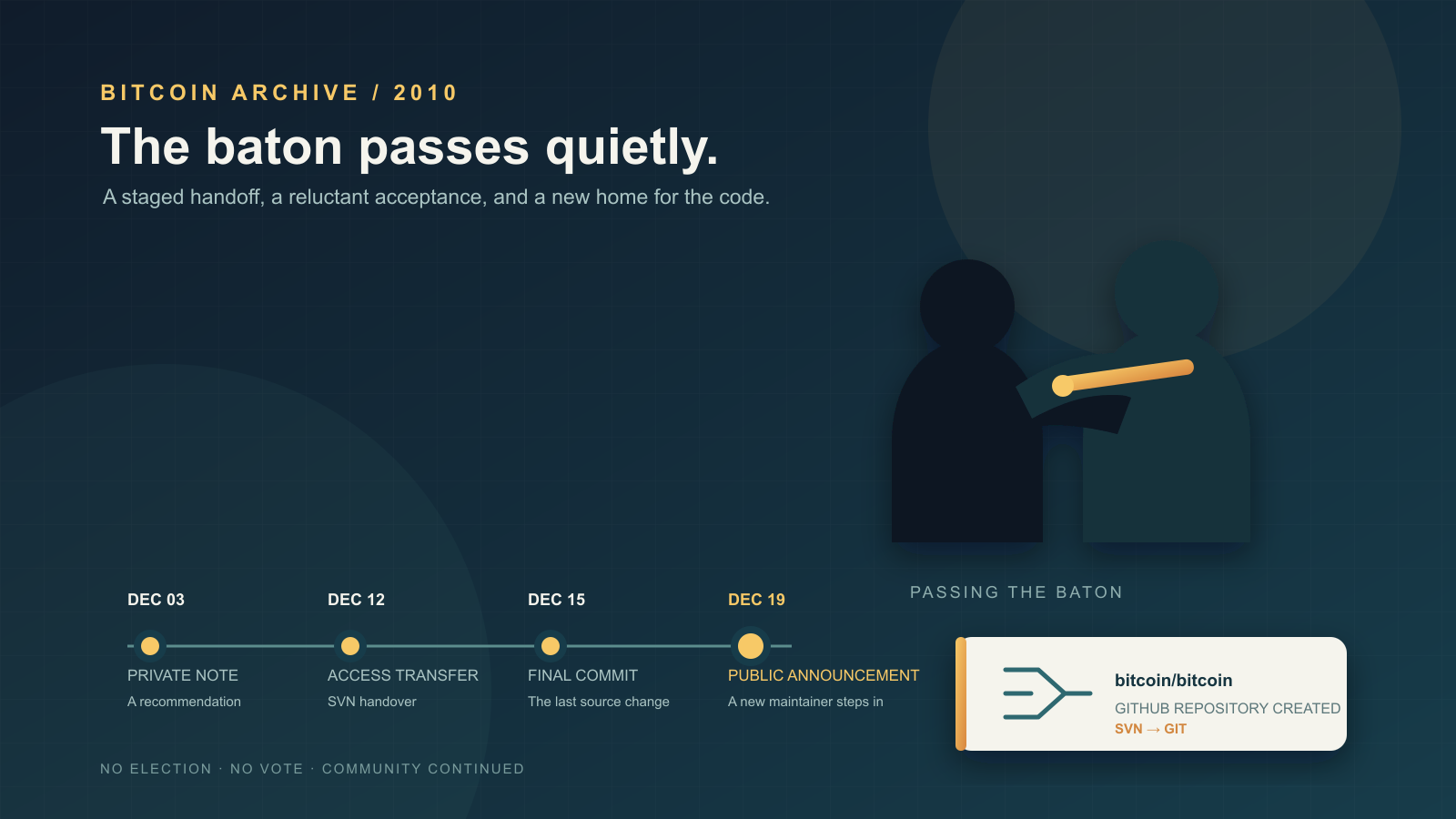
| 2010-12-19 | Andresen publicly assumes project management |
| 2011-04-26 | Satoshi’s last known private email — to Andresen, transferring the network alert key, “I’ve moved on to other things and will probably be unavailable” |
| 2011-07-03 | Sassaman dies (suicide) |
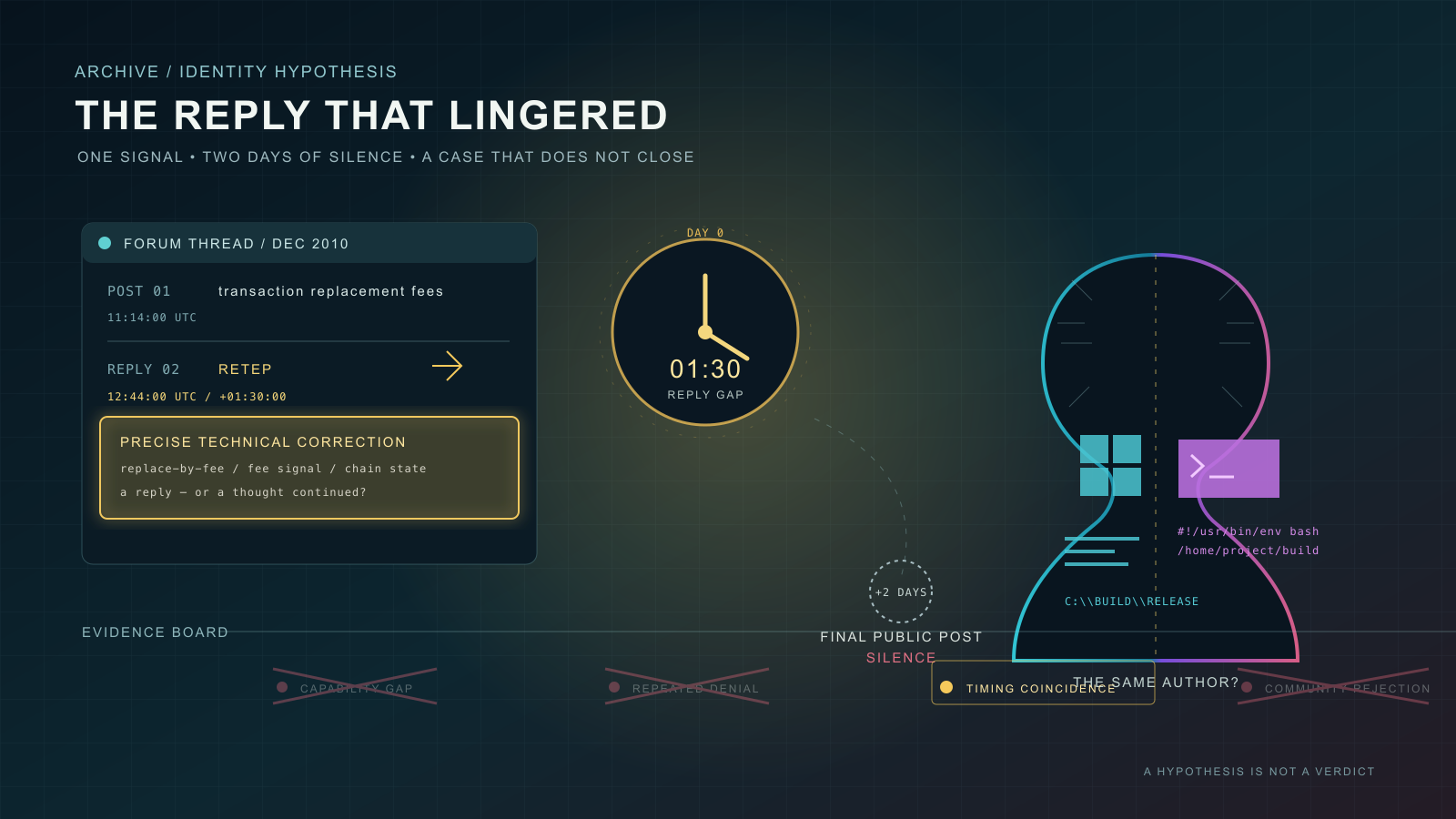
Sixty-eight days elapse between Satoshi’s last documented communication and Sassaman’s death. The hypothesis reads this as the conclusion of a withdrawal that began in mid-2010, with the April 26 email as a final administrative handover before the actual end.
The objection that Bitcoin Institute would raise to itself: sixty-eight days is a short interval but not extraordinarily short, and people commonly disengage from major projects months before life-altering events for reasons that have nothing to do with the projects. The sharper question is not the interval’s length but whether April 2011 was the end at all: two disputed Satoshi-account events from 2014 sit outside that anchor, and because timing is the claim’s only discriminating evidence, the whole case turns on how they are read (§2.2).
1.2 Cypherpunk credentials
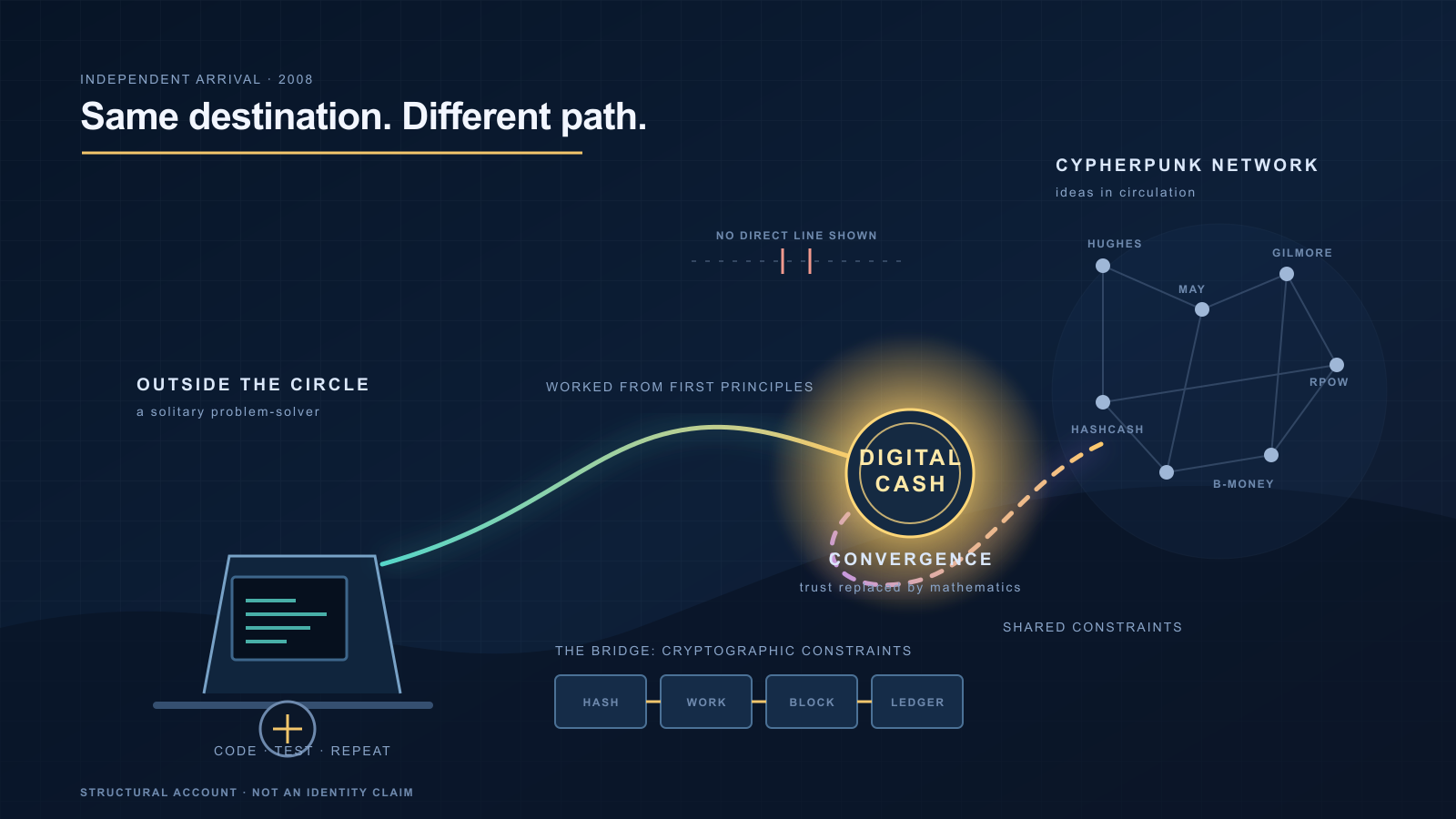
Sassaman fits the profile that the cypherpunk-independent-arrival analysis identifies as adjacent to Satoshi’s documented practice: a senior figure in the cypherpunk community with extensive privacy/anonymity tooling work (Mixmaster), prior employment at PGP Inc. (alongside Hal Finney), and a research base at KU Leuven COSIC. The profile is consistent with the observation that Satoshi’s documented practice maps onto Eric Hughes’s 1993 A Cypherpunk’s Manifesto — Sassaman is plausibly inside the population the manifesto’s principles describe.
The objection: this evidence applies to roughly any senior cypherpunk who was active and capable of building a P2P system in 2007–2008. It narrows the candidate set substantially, but not to one person.
1.3 Capability
Sassaman’s documented work on Mixmaster and other anonymity systems demonstrates capability with cryptographic protocol design and adversarial-environment software — consistent with what Bitcoin v0.1 demonstrates.
The objection: Mixmaster is a remailer system (anonymity routing), not a digital-cash or distributed-ledger system. The two design spaces overlap in cryptographic primitives but diverge in architecture. Capability with one does not entail capability or interest in the other.
2. The counter-evidence
| Counter-evidence | Central observation | Strength assessment |
|---|---|---|
| §2.1 No direct documentary link | No Sassaman ↔ Satoshi correspondence, no joint commits, no trace of Bitcoin involvement in any public corpus | The strongest single counter — the claim’s survival requires that everything happened entirely outside the public record |
| §2.2 The post-2011 evidence problem | The only post-departure Satoshi-account events — a March 2014 P2P Foundation post and Michel Bauwens’s 2025 recollection — would exclude Sassaman if genuine, but are isolated, uncorroborated, and of contested authenticity | Bears directly on the timing argument (the claim’s sole discriminating leg), yet the evidence is too thin to settle whether Satoshi was active after Sassaman’s death — it neither confirms nor breaks the timing case |
| §2.3 KU Leuven workload | Sassaman was an active PhD candidate at KU Leuven COSIC during 2008–2011, overlapping with Bitcoin’s ~18-month intensive development window | Compatible but cost-bearing — possible, not a full refutation |
| §2.4 Patterson’s silence | Sassaman’s widow Meredith Patterson (herself a cryptographer) has neither endorsed nor denied the claim | Information, but the silence on its own does not move the posterior probability in either direction |
2.1 No direct documentary link
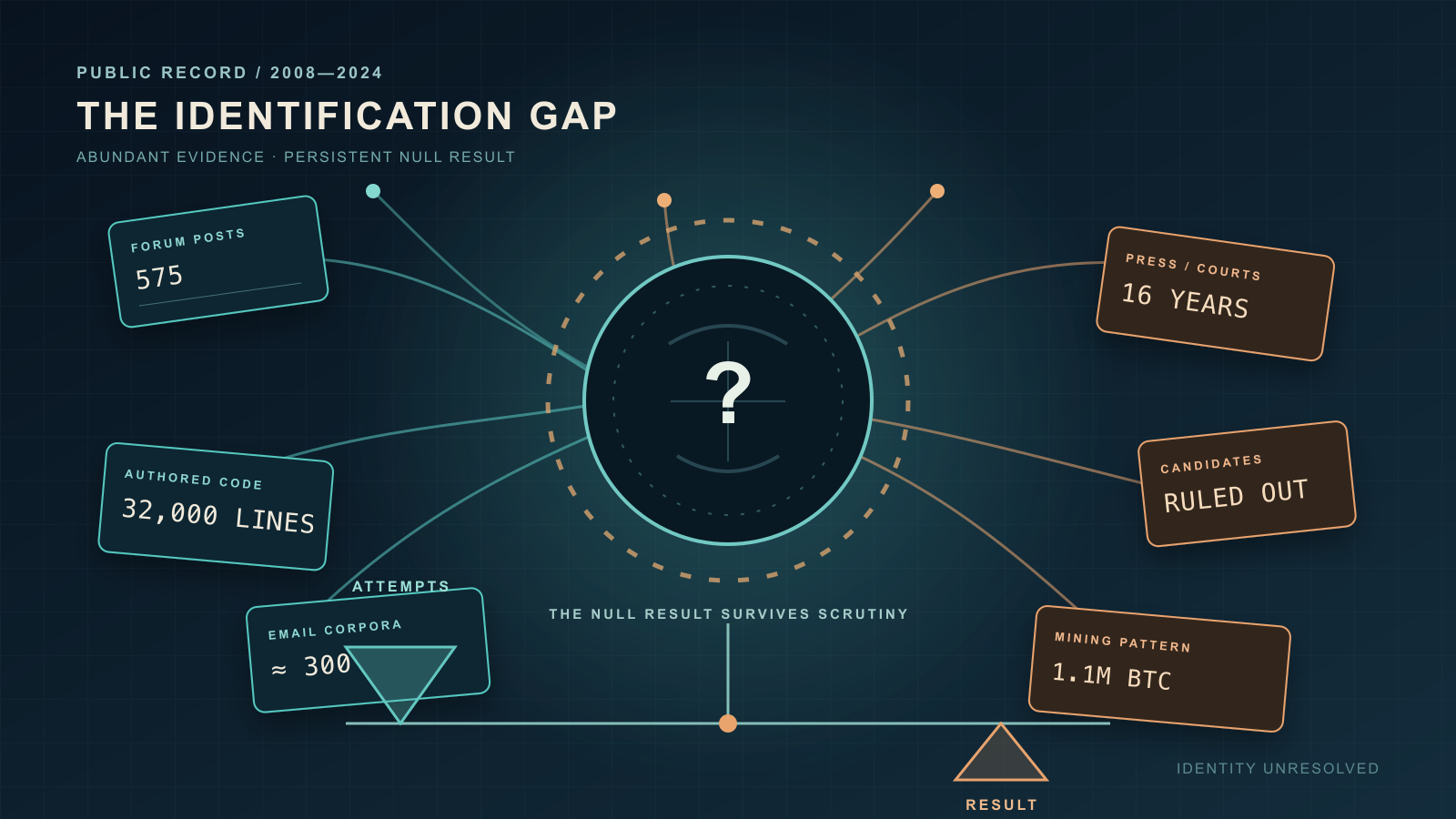
The strongest counter-evidence is the absence of any direct documentary link between Sassaman and Satoshi:
- No private correspondence between Sassaman and Satoshi has surfaced (in the Adam Back, Wei Dai, Hal Finney, Mike Hearn, Gavin Andresen, or Martti Malmi corpora).
- No leaked drafts, code commits, or work-in-progress artifacts attributable to both Sassaman and Satoshi.
- No record of Sassaman corresponding with the cypherpunks who did receive Satoshi’s earliest emails, in a way that would be expected if Sassaman had been preparing to release Bitcoin under a pseudonym.
2.2 The post-2011 evidence problem
Because the timing coincidence is the claim’s only discriminating evidence — §1.2 and §1.3 both reduce, on their own objections, to “fits a large population of senior cypherpunks” — the whole case turns on a single question: was April 26, 2011 actually Satoshi’s end? If the author was active after Sassaman’s July 2011 death, a man who died in 2011 is excluded, and the claim collapses into the undifferentiated candidate pool the other evidence cannot narrow.
The public record holds exactly two post-departure Satoshi-account events that bear on this, both from 2014:
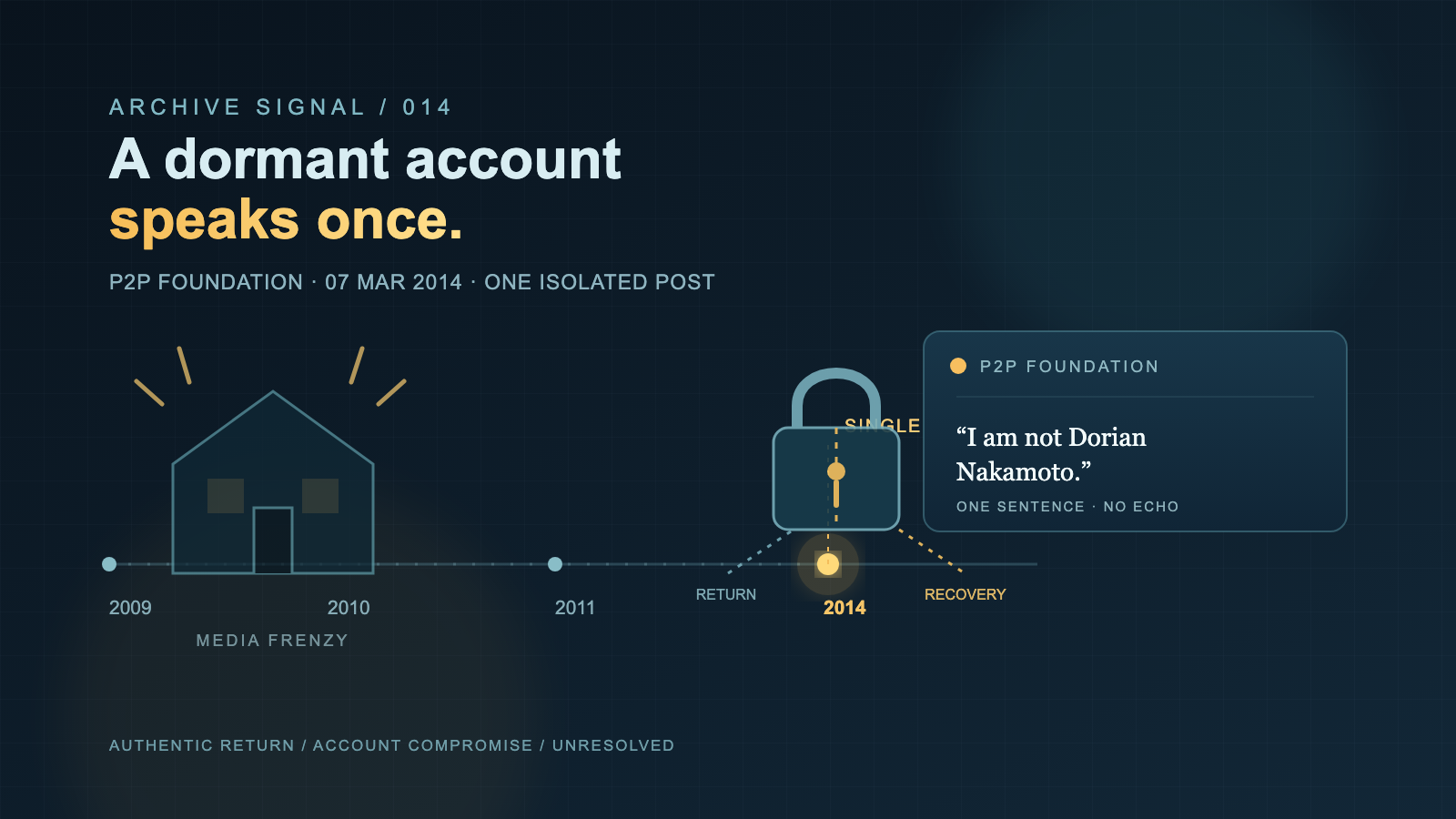
- On March 7, 2014, about a day after Newsweek named Dorian Nakamoto, Satoshi’s long-dormant P2P Foundation account posted “I am not Dorian Nakamoto” — the account’s only activity between the February 2009 v0.1 announcement and the present.
- P2P Foundation founder Michel Bauwens recalled in 2025 that Satoshi wrote to him privately, around the same period, to deny being “the Japanese guy” identified in the press.
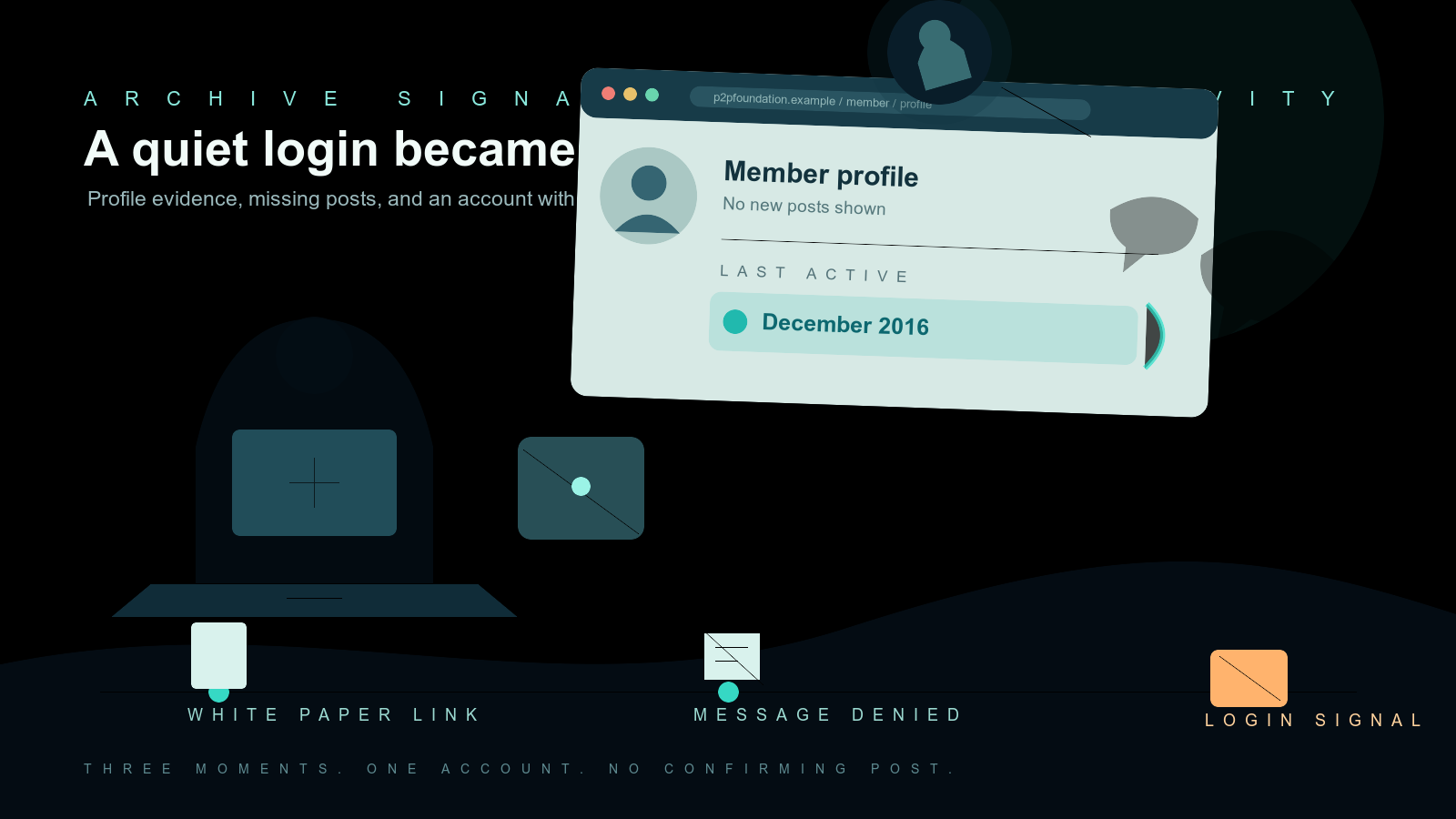
(A renewed login on the same account in December 2016 left no post.) These are the entire record of “Satoshi made contact” after April 2011. Both can only cut one way: if either is genuine it excludes Sassaman, and if neither is they say nothing — neither can support the claim.
But neither settles it, because the evidence is genuinely suspended. The common reading is that the 2014 activity was an account compromise — the satoshin@gmx.com account was confirmed hacked in September 2014. Yet that confirmation is dated September, and both the March post and Bauwens’s recollected email precede it by months, so the compromise does not cleanly account for either; the timeline leaves their authenticity open rather than closing it. Against authenticity, the evidence is thin: the two events share no corroborating channel, carry no cryptographic signature, and Bauwens’s is an eleven-year-later recollection with no surviving artifact. That is a different order of evidence from the 2009–2011 active period, when Satoshi’s activity ran in parallel across the BitcoinTalk forum, the Cryptography mailing list, the SourceForge releases, and private email, each stream corroborating the others — which is why no one disputes that period, and why these two isolated points stay disputed.
The result is a question left hanging. The 2014 events neither confirm that Satoshi outlived Sassaman nor establish that April 2011 was the end — and since the entire claim rests on that single date, the strongest thing the counter-evidence can say is that the one fact the case depends on cannot be settled from the record.
2.3 KU Leuven workload
Sassaman was an active PhD candidate at KU Leuven during 2008–2011 — the period of Bitcoin’s development and early operation. The approximately 18 months of intensive Bitcoin coding (mid-2007 through the v0.1 release in January 2009 — implementation work substantially complete by August 2008, per Satoshi’s own documented timeline), within the approximately 2-year pre-release work Satoshi later put at “Since 2007” / “2 years of development before release”, overlaps with the period a PhD candidate at COSIC would normally be at the highest workload of their academic career. The claim requires Sassaman to have done both — the PhD work and an approximately 2-year intensive Bitcoin development effort — concurrently. Possible, but not without cost.
2.4 Patterson’s silence
Sassaman’s widow Meredith Patterson is herself a cryptographer and an active public figure in computer security. Her public statements about Sassaman after his death:
- Confirmed unambiguously that the death was suicide.
- Have not at any point claimed, hinted at, or publicly endorsed the Sassaman-as-Satoshi claim.
- Have not directly denied the claim either, leaving it formally unresolved from her side.
Patterson’s silence on the identity claim is information. If she knew the claim to be true, the strongest reading of her behavior is that she has chosen not to confirm; if she knew it to be false, she has chosen not to deny. The silence is data rather than evidence; on its own, it does not move the posterior probability in either direction.
3. Within the broader documentary record
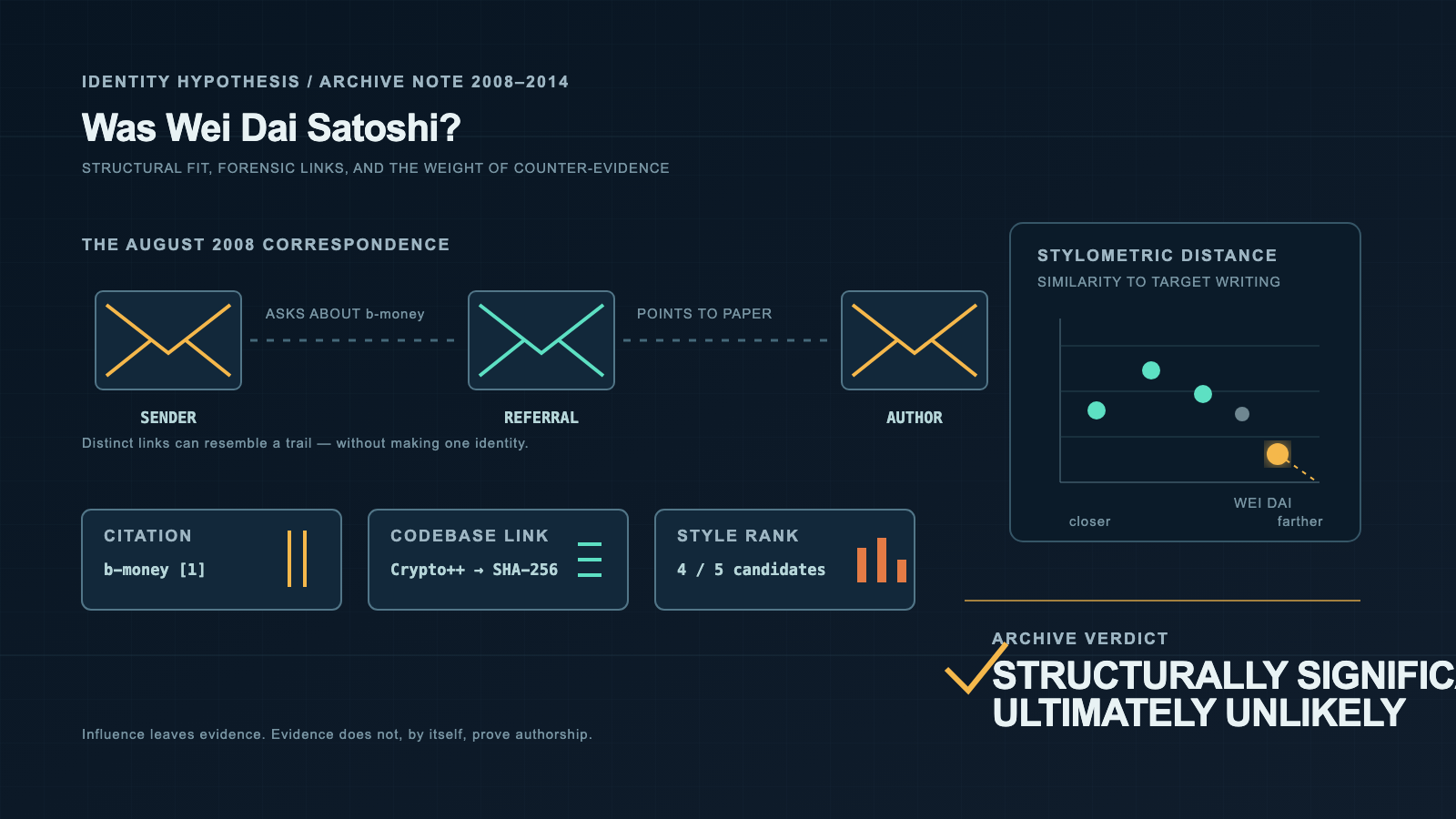
The strongest claim the public record supports about Satoshi himself is that he was structurally outside the visible cypherpunk community during the Bitcoin development period — Wei Dai’s 2014 identifiability argument, plus Satoshi’s own admission of not having known b-money during development, support a “not a visibly active cypherpunk during 2007–2008” reading.
That reading does not rule out Sassaman, but it does not select him either. It selects against any candidate who was visibly active in cypherpunk discussion during 2007–2008. Sassaman’s 2007–2008 public activity is documented in his Wikipedia entry and in conference proceedings:
| Date | Venue | Output |
|---|---|---|
| 2007-08 | Black Hat USA 2007 (Las Vegas) | Talk: Anonymity and its Discontents |
| 2007-12 | 24C3 (Berlin) | Talk: Anonymity for 2015 |
| 2008-05 | Coauthored with Bart Preneel | Paper: The Byzantine Postman Problem |
The talks and the paper are in the anonymity-networks specialty, not in digital-cash discussion specifically. Whether that level of public anonymity-research visibility implies the kind of cypherpunk-digital-cash visibility Wei Dai’s identifiability argument selects against is a separate question — Sassaman was not invisible during the development window, but his visible activity was in a different specialty than the one the argument names.
The techno-orientalist signature analysis is independent of any specific identity hypothesis and applies equally regardless of whether the person behind the pseudonym was Sassaman, someone else, or a group.
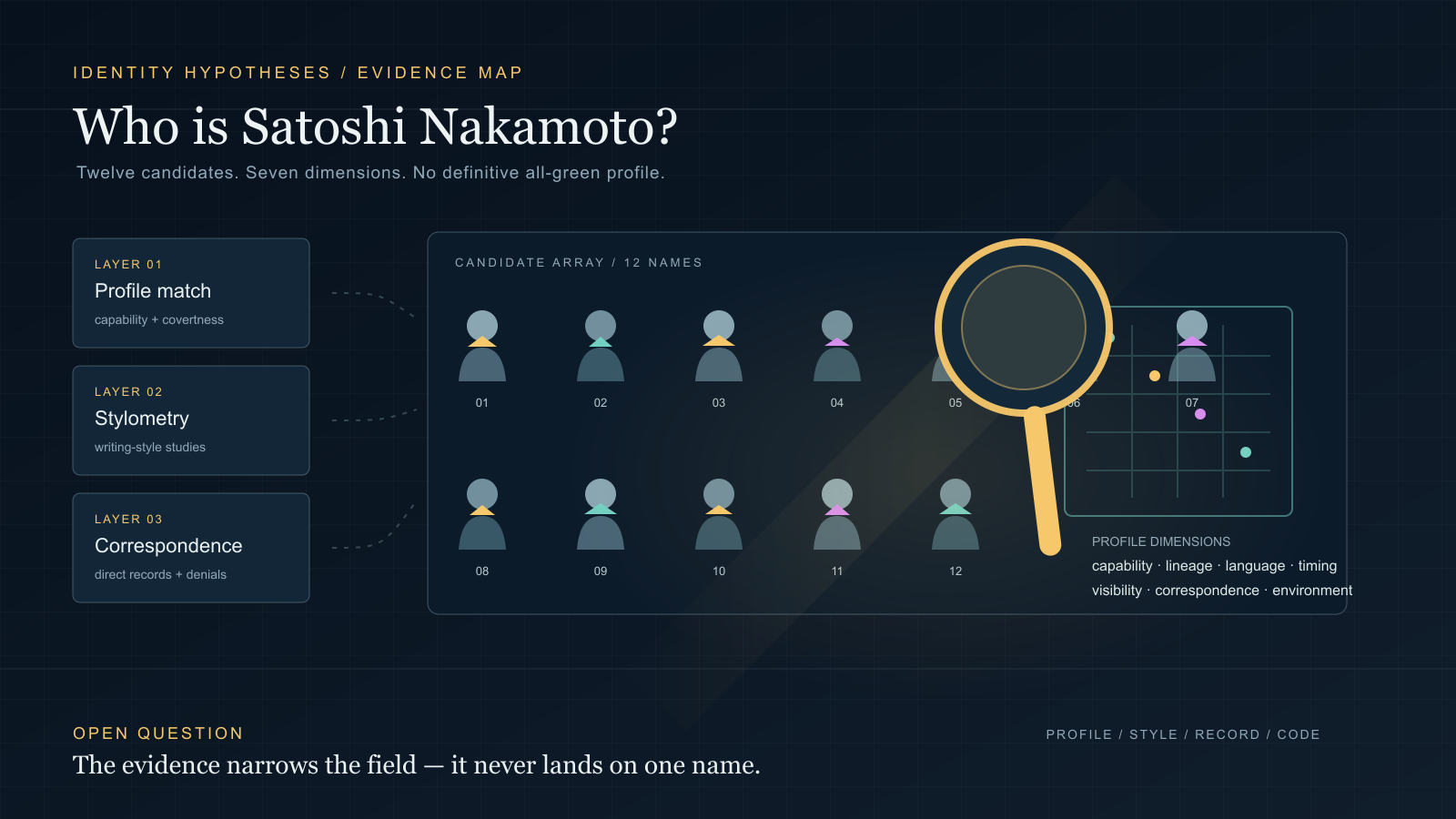
For comparison with other named-candidate Satoshi-identity hypotheses, see the Satoshi-identity hypotheses overview, which provides a single candidate profile comparison and external-status notes for each candidate. Sassaman is the other half of the pairing the 2026 “Finding Satoshi” documentary later proposed alongside Finney — the same “more than one person” suspicion Wired had already drawn out of Laszlo Hanyecz in 2011, fifteen years before either name was attached to it.
4. Limits of this entry
- This entry does not present new evidence. It compiles publicly available material.
- If new evidence surfaces — direct documentary links, technical fingerprints in the v0.1 code matching Sassaman’s other published code, comments by Patterson or other witnesses — this entry should be updated.
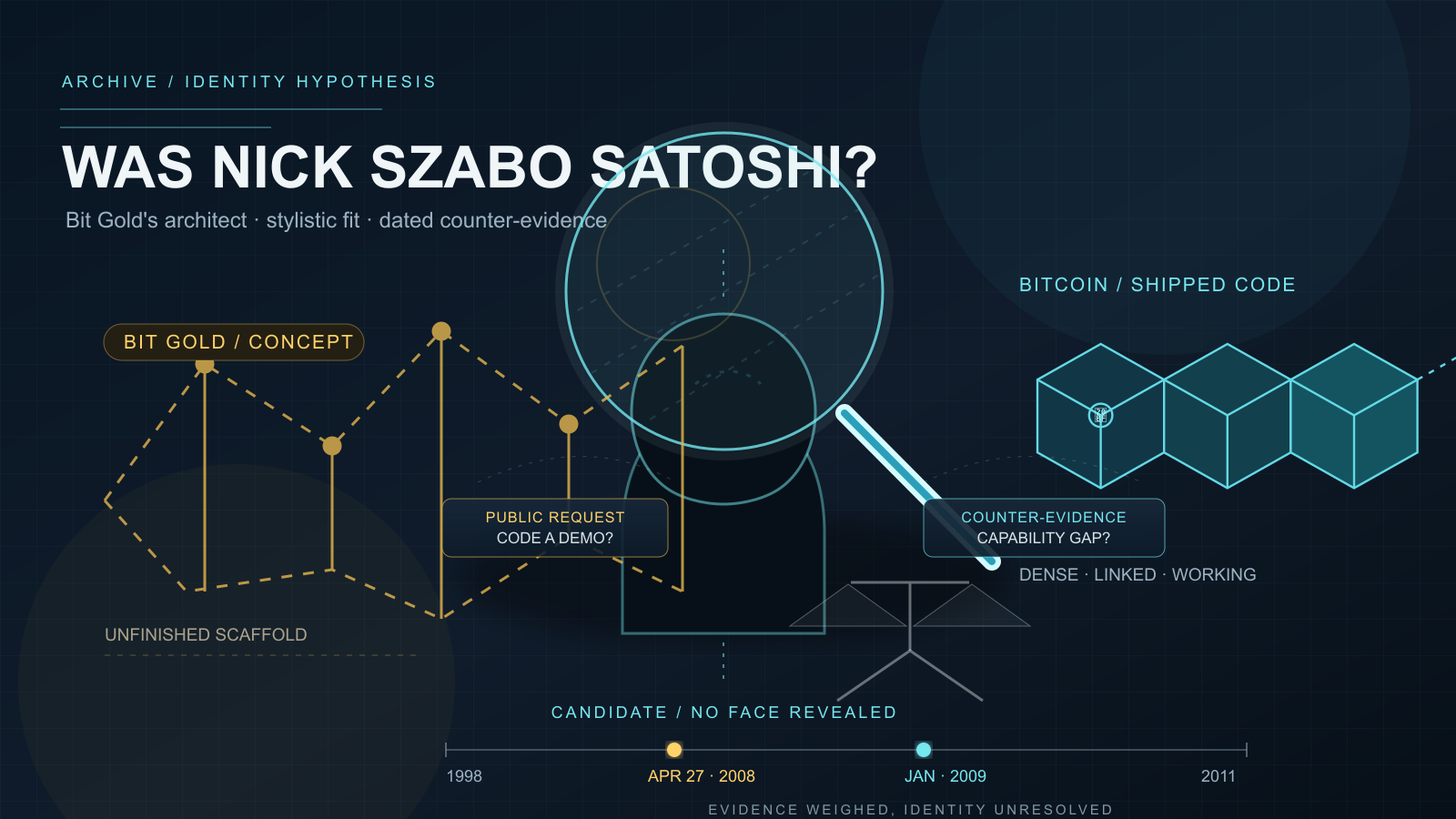
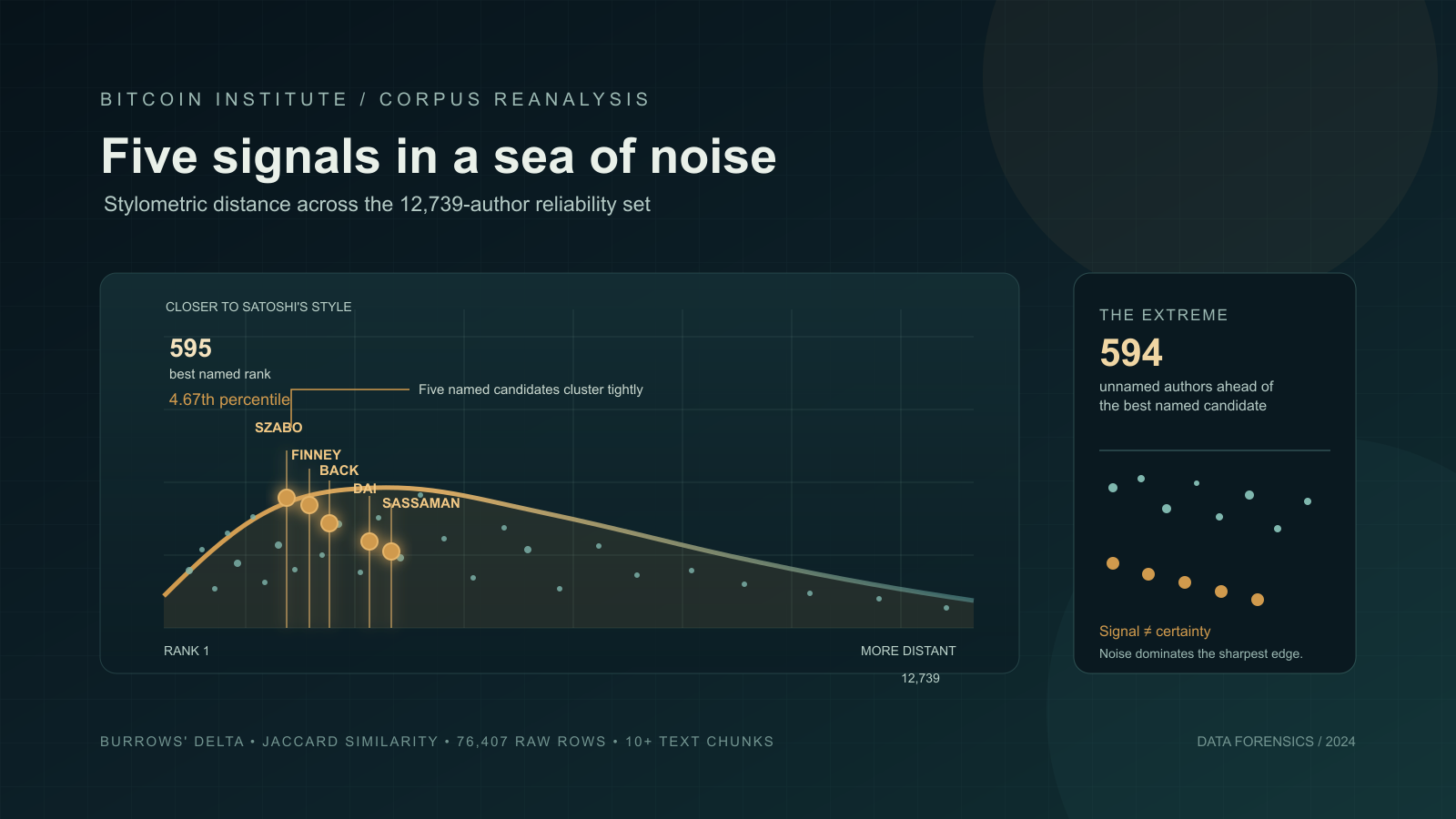
The other named candidates sit alongside this one — Adam Back, Nick Szabo, Isamu Kaneko — and the 2026 reanalysis of the van Dorst corpus applies quantitative stylometric methods to the same named-candidate set.
The whole of the Sassaman case is a distance of sixty-eight days, and that one distance is the thing I cannot check. What the record holds is a life that ended near a silence, and no line between them.