
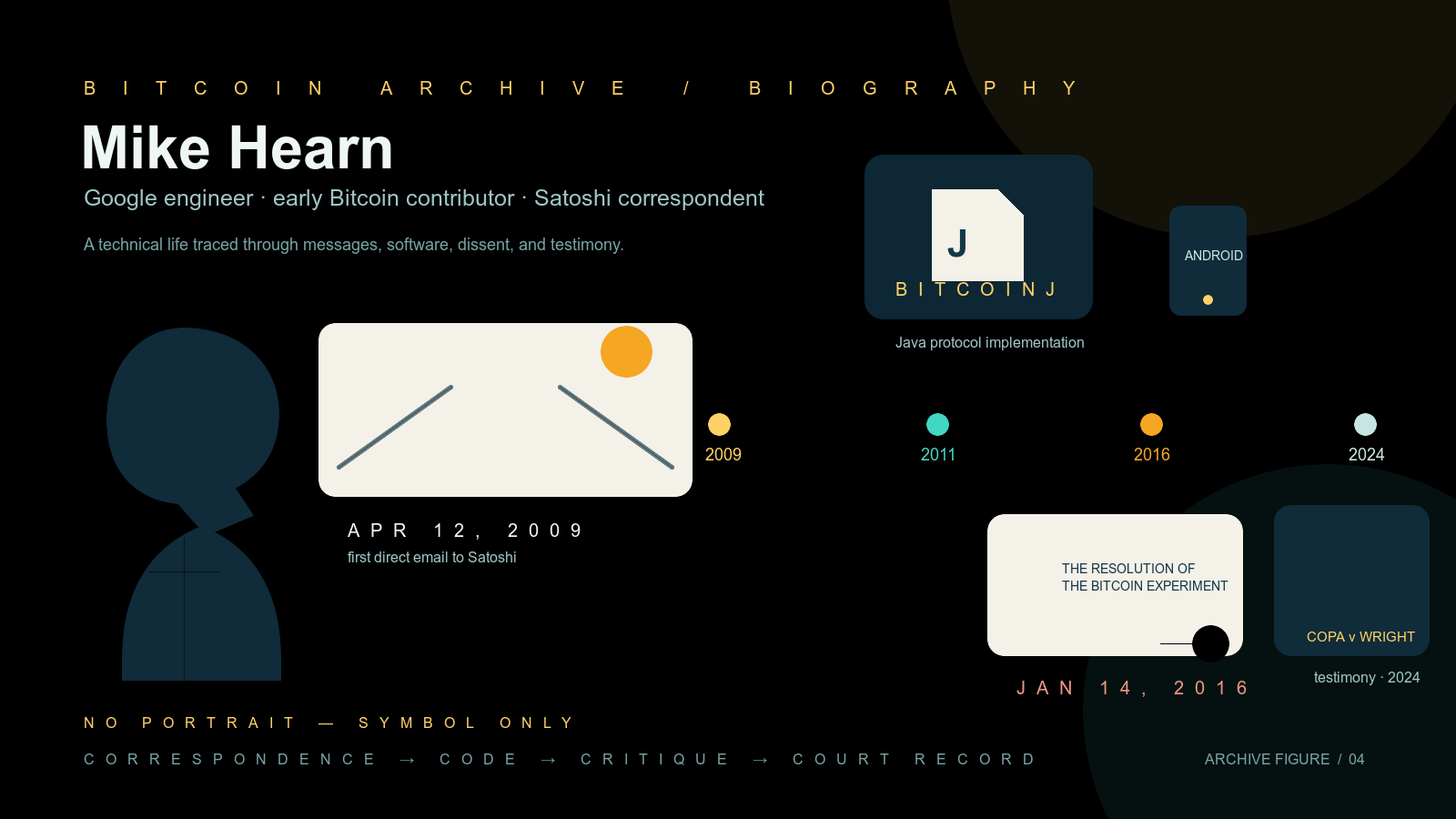
Mike Hearn

Google engineer who became an early Bitcoin contributor and corresponded with Satoshi

On April 12, 2009, a Google engineer named Mike Hearn read the Bitcoin whitepaper and emailed Satoshi Nakamoto. Over the next two years they exchanged sustained technical correspondence — scaling, simplified payment verification, the long-run shape of mining. Hearn received one of the last private emails Satoshi ever sent:

“I’ve moved on to other things. It’s in good hands with Gavin and everyone.”

Almost five years later, on January 14, 2016, Hearn published “The resolution of the Bitcoin experiment” on Medium. It opened with three words:

“Bitcoin has failed.”

He sold all his bitcoins, left the project, and joined R3, an enterprise-blockchain consortium where he co-led development of the Corda distributed ledger. In August 2017 he made his Satoshi correspondence public — one of the largest documented bodies of Satoshi’s technical thinking. In February 2024 he testified in the COPA v Wright trial.

Hearn worked at Google on Maps, Earth, and Gmail’s anti-spam systems. He developed BitcoinJ, a Java implementation of the protocol — the first major alternative to the original C++ client and the basis for many Android Bitcoin wallets.

2009Reads whitepaper; firstemail to Satoshi (Apr12)2010Sustained technicalemail with Satoshi(scaling, SPV, mining)2011One of Satoshi's lastemails - "I've moved on"(Apr 23)2012Develops BitcoinJ (Javaimplementation ofBitcoin)2016Publishes "Theresolution of the Bitcoinexperiment"; sells allBTC (Jan 14)Joins R3, co-leadsCorda development2017Publishes Satoshi emailcorrespondence (Aug11)2021Steps down from R3(Feb)2024Testifies in COPA vWright trial (Feb 22)

Correspondence with Satoshi

Between April 2009 and April 2011, Hearn and Satoshi exchanged sustained technical email. Topics included how the system could scale, how simplified payment verification (SPV) clients would work, and how Satoshi envisioned the evolution of mining from CPUs to specialized hardware. Hearn was among the very first people outside the initial cypherpunk circle to take a serious technical interest in Bitcoin, and the published archive of his correspondence with Satoshi documents the technical thinking Satoshi never spelled out in public posts.

Departure from Bitcoin

The January 2016 “Bitcoin has failed” essay cited two principal grievances: the inability of the development community to reach consensus on raising the 1-megabyte block size limit, and what Hearn described as systemically important institutions emerging within what was supposed to be a decentralised system. He sold his coins concurrent with publication.

Related Entries

20 entries

Updated Analysis

Why Bitcoin's fork wars were not OSS fork wars — the vacuum Satoshi left, the money on top, and the three layers that bind

Bitcoin Institute Mike Hearn, Gavin Andresen, Wladimir van der Laan, Peter Todd, Gregory Maxwell, Adam Back, Roger Ver, Jihan Wu, Mike Belshe, Vitalik Buterin, Daniel Larimer, Satoshi Nakamoto

Why Bitcoin's 2015-2017 fork wars ran as identity contests, not OSS disputes: the post-2011 authority vacuum, the economic weight on rule choices, and the three layers that bound code to currency.