Spent per txout
PR #122 thread starter by sipa in bitcoin/bitcoin.
Bitcoin Core developer behind BIP-32, libsecp256k1, SegWit, and Taproot
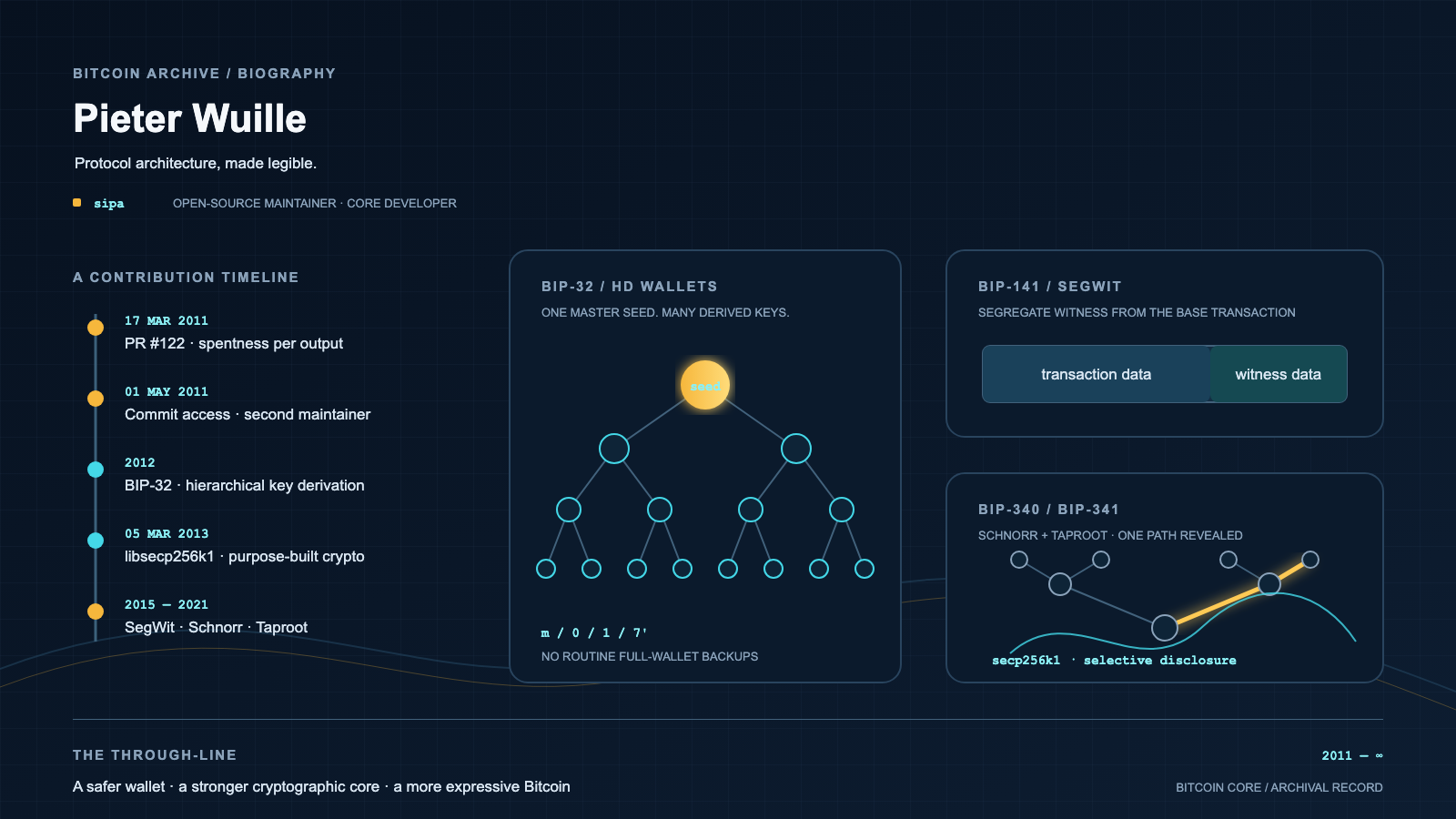
Hierarchical deterministic wallets. Segregated Witness. Schnorr signatures. Taproot. The four BIPs that define how every modern Bitcoin wallet derives keys, how every modern transaction escapes malleability, how block capacity expanded, and how Taproot’s privacy and script flexibility work — all four were authored or co-authored by Pieter Wuille (known on GitHub and IRC as sipa). He also started libsecp256k1 in 2013, the purpose-built elliptic-curve library that replaced OpenSSL as Bitcoin Core’s signature backend.
Wuille is a Belgian software engineer. His first contribution to bitcoin/bitcoin was PR #122 on March 17, 2011; six weeks later he received commit access, making him the second long-term maintainer after Gavin Andresen. He co-founded Blockstream in 2014 and later joined Chaincode Labs.
Wuille’s first contribution to bitcoin/bitcoin is PR #122 on March 17, 2011 — a wallet-structure change to track spentness per transaction output, enabling partially-spent transactions. On May 1, 2011, Gavin Andresen granted him GitHub commit access, making him the second long-term maintainer after Andresen himself and before Wladimir van der Laan.
Wuille authored or co-authored four BIPs that between them cover a remarkable share of Bitcoin’s post-Satoshi evolution:
On March 5, 2013, Wuille started libsecp256k1, initially as a performance experiment around the GLV-method endomorphism. Gregory Maxwell soon joined, and the library grew into a full purpose-built replacement for OpenSSL’s secp256k1 implementation. It shipped as the default backend in Bitcoin Core v0.12 on January 15, 2016.
Wuille was a co-founder of Blockstream in 2014 alongside Gregory Maxwell and others, and later joined Chaincode Labs. Throughout, he has remained among the most consistent Bitcoin Core reviewers and cryptographic designers.
Between the four BIPs and libsecp256k1, Wuille’s direct design work underpins the way every modern Bitcoin wallet derives keys, every modern transaction verifies signatures, every modern payment can escape on-chain malleability, and every Taproot output achieves its privacy and script flexibility. Few post-Satoshi contributors have had so broad a surface of influence on the protocol itself.
11 entries
PR #122 thread starter by sipa in bitcoin/bitcoin.
Bitcoin's migration from SourceForge SVN to GitHub, and the chronological record of developers who received commit access to the GitHub repository in 2011.
On November 20, 2011, Bitcoin v0.5 shipped with the Crypto++ SHA-256 subset removed and replaced by OpenSSL. Wei Dai's library, a direct codebase dependency since v0.1, was gone.
Introduced hierarchical deterministic (HD) wallets — an entire tree of key pairs derived from a single master seed. Eliminated frequent-backup needs and enabled organized parent-child key derivation.
Comment by sipa in bitcoin/bitcoin PR #1367. context for Satoshi mention.
PR #2161 thread starter by sipa in bitcoin/bitcoin.
Weighing the 'Blockstream controls Bitcoin' charge against the record: where it comes from, the facts behind it, and the counter-facts — Lightning's authorship, funding spread, a shrinking Core role.
Segregated Witness (SegWit) — Bitcoin's most significant protocol upgrade since creation. Separates signature from transaction data, fixing malleability, enabling Lightning, raising block capacity.
On January 15, 2016, Bitcoin Core v0.12 replaced OpenSSL with libsecp256k1 — Wuille and Maxwell's custom elliptic-curve library — for consensus-critical ECDSA verification.
Schnorr signatures replacing ECDSA for Taproot. Provably secure, non-malleable, with efficient multi-signature aggregation — complex scripts become on-chain indistinguishable from simple payments.
Taproot — Bitcoin's most significant protocol upgrade since SegWit. Combines Schnorr (BIP 340) with MAST so complex spending conditions look like simple payments on-chain.