
Gregory Maxwell

Blockstream co-founder and designer of CoinJoin and Confidential Transactions

Gregory Maxwell, known online as gmaxwell, is a long-time Bitcoin Core contributor whose personal biographical details are not widely published. He rose to prominence through years of technically dense writing on BitcoinTalk, IRC, and the Bitcoin Core GitHub repository, and for co-founding Blockstream with Adam Back and others in 2014.

2013Joins libsecp256k1 withWuille (Mar 5)Proposes CoinJoin, aninput-merging privacyconstruction (Aug)2014Co-founds Blockstreamwith Adam Back, PieterWuille2015Designs ConfidentialTransactions (Pedersencommitments)2016libsecp256k1 ships asBitcoin Core v0.12default backend (Jan15)Liquid sidechainreleased byBlockstream2017Major reviewer forSegWit activation2018Steps back fromBlockstream; continuesBitcoin Core reviewindividually

libsecp256k1

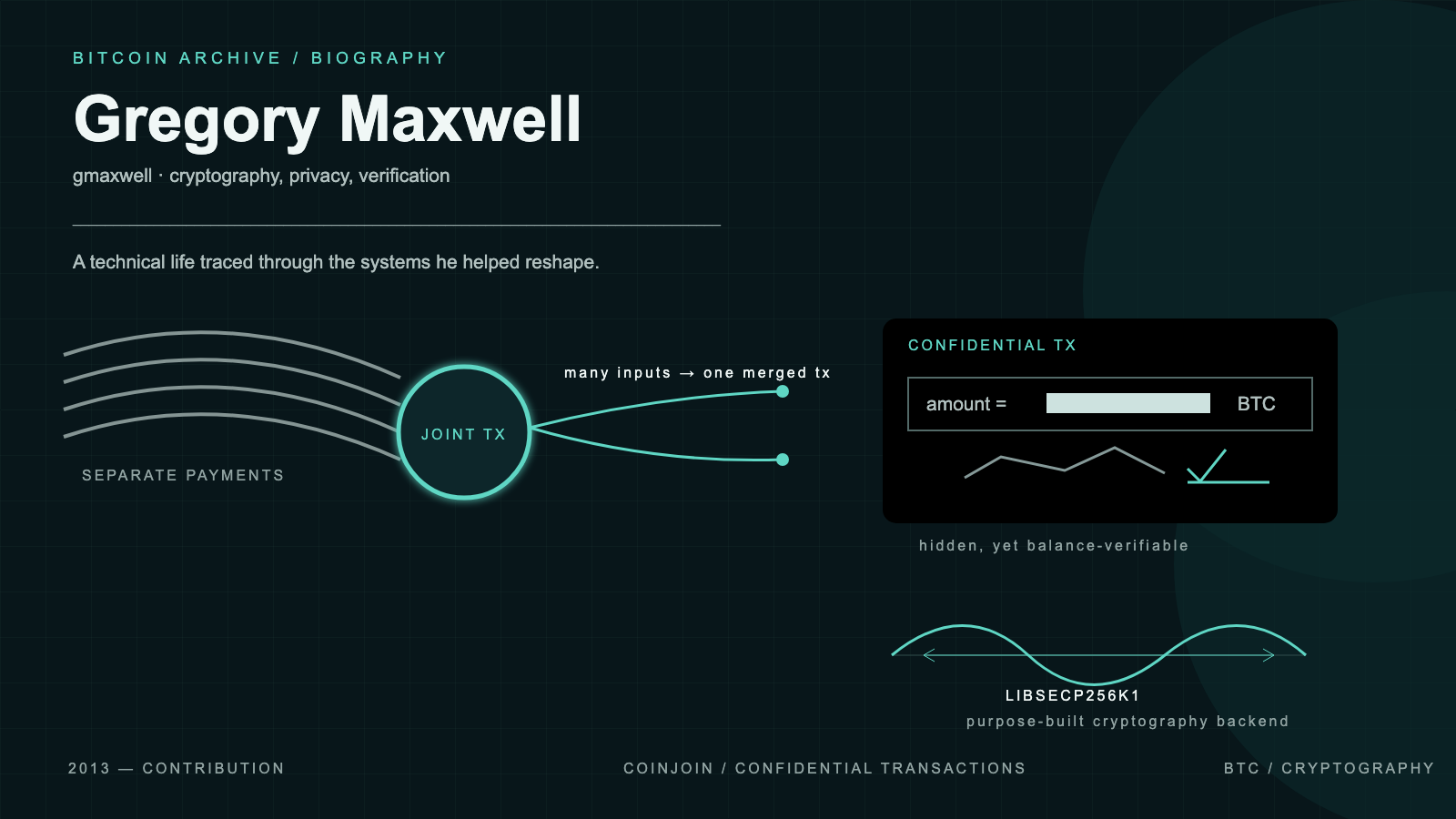
Shortly after Pieter Wuille started the libsecp256k1 library on March 5, 2013, Maxwell joined the effort. Under their joint work the library expanded from a performance experiment into a purpose-built replacement for OpenSSL’s secp256k1 implementation, shipping as the default backend in Bitcoin Core v0.12 on January 15, 2016.

CoinJoin and Confidential Transactions

Maxwell’s most widely cited privacy contributions are the CoinJoin construction — a method for combining multiple users’ payments into one transaction to break simple input-to-output heuristics — and Confidential Transactions, a scheme that hides transaction amounts behind Pedersen commitments while preserving verifiability of conservation of value. Neither design has been deployed on Bitcoin’s base layer, but they have informed a generation of Bitcoin privacy work (Wasabi, JoinMarket, Liquid) and the broader cryptocurrency-privacy literature.

Blockstream

In 2014 Maxwell co-founded Blockstream, a Bitcoin infrastructure company, with Adam Back, Pieter Wuille, and others. Blockstream has been associated with sidechain work (Liquid), satellite block delivery, and continued Bitcoin Core engineering.

Significance

Maxwell sits at the intersection of Bitcoin’s cryptographic engineering and its developer culture: a prolific reviewer, a teacher of subtle protocol mechanics in long-form forum and mailing-list posts, and one of the authors of the libraries and primitives that the modern Bitcoin stack relies on. His privacy constructions in particular sketched out much of what Bitcoin “could” be at the confidentiality layer, even when the base protocol itself chose not to incorporate them.

Related Entries

3 entries

Wikipedia

Why Bitcoin's fork wars were not OSS fork wars — the vacuum Satoshi left, the money on top, and the three layers that bind

Bitcoin Institute Mike Hearn, Gavin Andresen, Wladimir van der Laan, Peter Todd, Gregory Maxwell, Adam Back, Roger Ver, Jihan Wu, Mike Belshe, Vitalik Buterin, Daniel Larimer, Satoshi Nakamoto

Why Bitcoin's 2015-2017 fork wars ran as identity contests, not OSS disputes: the post-2011 authority vacuum, the economic weight on rule choices, and the three layers that bound code to currency.