
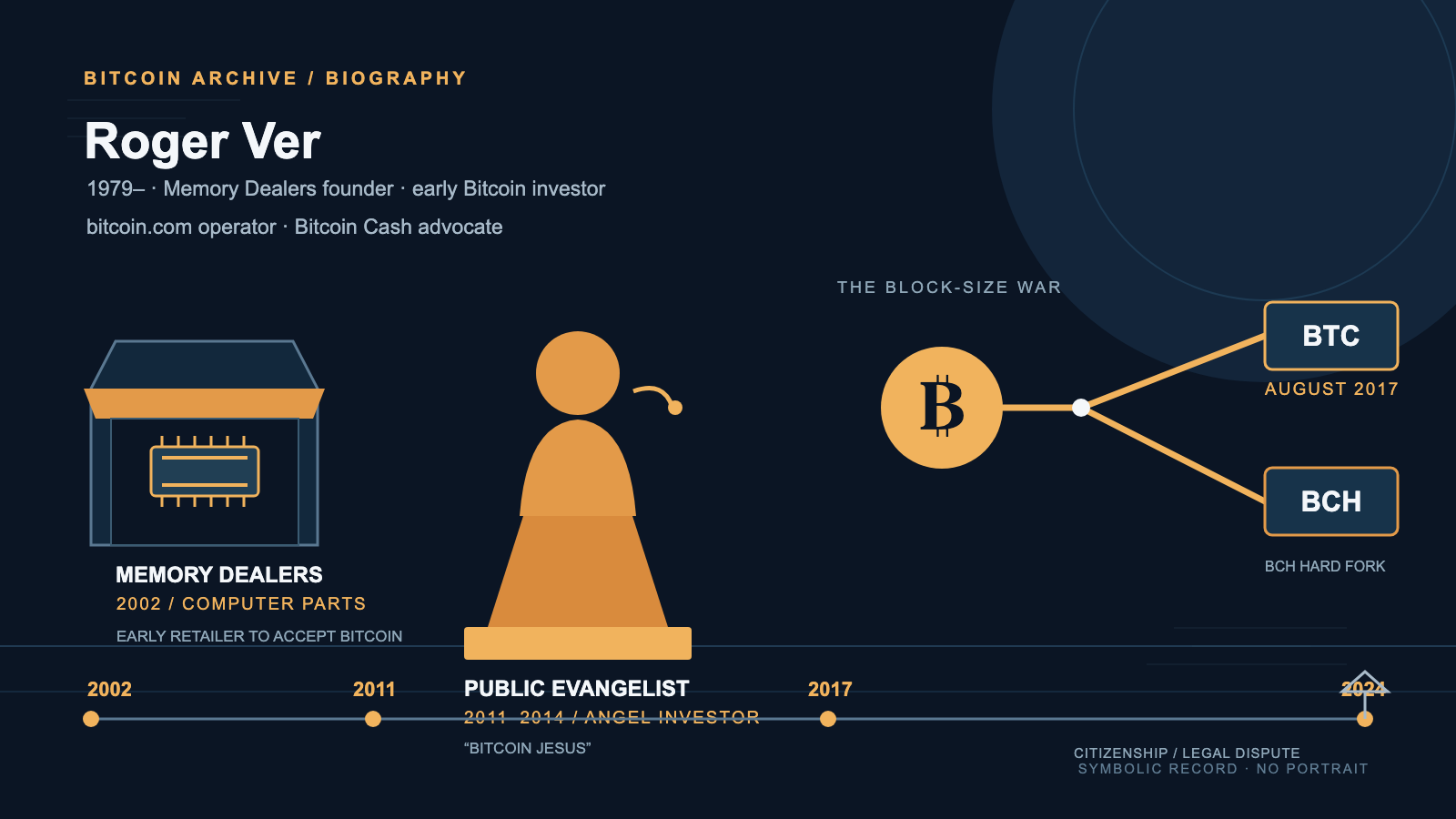
Roger Ver (1979–)

Memory Dealers founder, early Bitcoin angel investor, bitcoin.com operator, Bitcoin Cash advocate, 'Bitcoin Jesus'

Roger Keith Ver (born January 27, 1979, in San Jose, California) is an entrepreneur whose 2011 entry into Bitcoin made him one of the earliest large individual holders, the operator of one of Bitcoin’s first commercial acceptance pipelines (Memory Dealers), and an active angel investor in the founding generation of Bitcoin businesses. By 2017 he had become the most public proponent of the Bitcoin Cash hard fork, and the bitcoin.com domain — which he had acquired earlier — became the principal advocacy outlet for that chain.

Memory Dealers and entry into Bitcoin (2002–2011)

Ver founded Memory Dealers in 2002, a Silicon Valley computer-parts e-commerce business that grew into a multi-million-dollar operation through the 2000s. In early 2011 he encountered Bitcoin via the Free Talk Live podcast, recognized it as fitting his pre-existing libertarian / Austrian-economics commitments, and within months had begun making large purchases. Memory Dealers became one of the first established retailers to accept Bitcoin payments, predating most of the merchant-adoption wave that followed.

Angel investing (2011–2014)

Through 2011-2014 Ver was an early investor in many of the foundational Bitcoin businesses of that era — BitInstant (Charlie Shrem’s exchange), Blockchain.info (block explorer / wallet), Kraken (exchange), Bitpay (merchant processor), Bitcoin Magazine itself, and others. He also funded an early stake in Ripple (then a separate payments protocol). At the time he was widely characterized as the “angel investor of Bitcoin,” and the nickname “Bitcoin Jesus” — sometimes self-applied, sometimes journalist-affixed — emerged from his evangelistic style at conferences and YouTube videos.

In 2014 Ver renounced his US citizenship and acquired citizenship from Saint Kitts and Nevis, citing tax and political reasons. The renunciation event later became a structural element of the 2024 US tax-fraud charges (see below).

Block-size war and Bitcoin Cash (2015–2017)

By 2015 Ver had positioned bitcoin.com (the domain) as a public platform advocating for larger block sizes. Through the block-size war Ver was one of the loudest voices arguing that Bitcoin’s then-1 MB cap was preventing the chain from serving as everyday payments. When Bitcoin XT (2015) and Bitcoin Classic (2016) failed to activate, and the SegWit2x compromise collapsed, the larger-block faction split off via the Bitcoin Cash hard fork on August 1, 2017. Ver was the most visible public advocate; bitcoin.com became the principal outlet promoting BCH, and Ver’s framing of BCH as “the real Bitcoin Satoshi described” generated sustained controversy in the broader Bitcoin community.

US tax-fraud charges (2024)

On April 30, 2024, Spanish authorities arrested Ver on a U.S. extradition request. The U.S. Department of Justice indictment (linked under secondarySources) alleges mail fraud, tax evasion, and false tax returns related to the 2014 expatriation event — specifically, that Ver allegedly under-reported the value of his bitcoin holdings at the time of the citizenship renunciation, evading approximately $48 million in U.S. exit-tax obligations. Ver disputes the charges. The case was ongoing at the time of the most recent edit to this entry; status updates will be noted here as they become public.

Significance to Bitcoin

Ver’s record matters in this archive for three roles. First, his 2011-era investments into the founding generation of Bitcoin businesses materially shaped which projects survived their seed phase. Second, he was the principal public face of the larger-block faction during the 2015–2017 dispute, and his post-2017 promotion of BCH on bitcoin.com is the dominant editorial channel through which the BCH side of that history reached general audiences. Third, his 2024 arrest is the highest-profile criminal case involving an early Bitcoin holder to date, and the legal outcome — whichever direction it goes — will set precedents for the tax treatment of expatriated Bitcoin wealth.

Related Entries

3 entries

Wikipedia

Why Bitcoin's fork wars were not OSS fork wars — the vacuum Satoshi left, the money on top, and the three layers that bind

Bitcoin Institute Mike Hearn, Gavin Andresen, Wladimir van der Laan, Peter Todd, Gregory Maxwell, Adam Back, Roger Ver, Jihan Wu, Mike Belshe, Vitalik Buterin, Daniel Larimer, Satoshi Nakamoto

Why Bitcoin's 2015-2017 fork wars ran as identity contests, not OSS disputes: the post-2011 authority vacuum, the economic weight on rule choices, and the three layers that bound code to currency.