
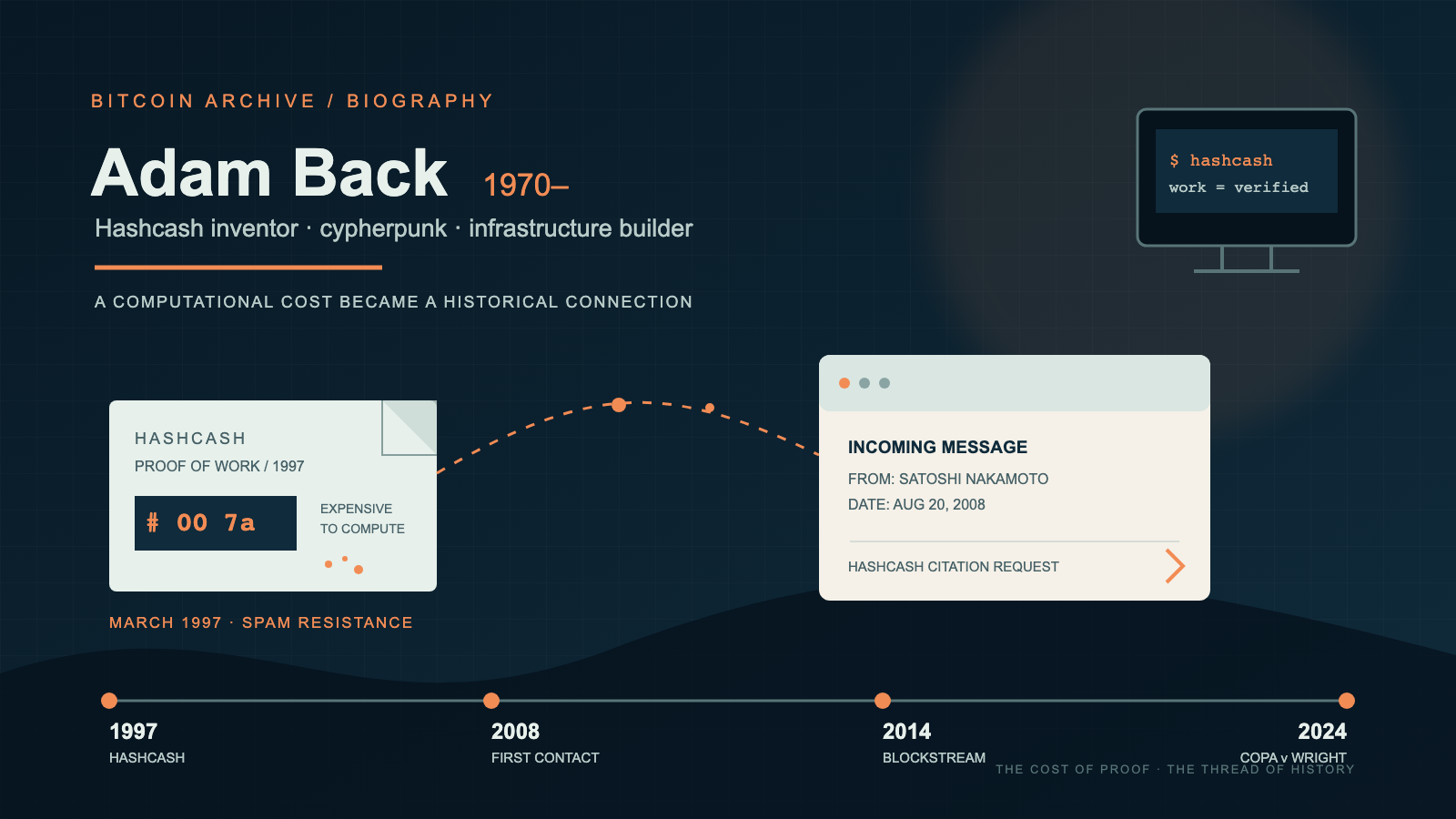
Adam Back (1970–)

Inventor of Hashcash and the first person Satoshi Nakamoto contacted

🔍 Identity hypothesis

Adam Back (born 1970, United Kingdom) is a cryptographer, cypherpunk, and the inventor of Hashcash. He earned a PhD in computer science from the University of Exeter. He is the first person known to have been contacted by Satoshi Nakamoto about what would become Bitcoin.

1997Hashcash announcedon the cypherpunksmailing list (Mar)1998Cypherpunks-listb-money critique - 7monetary-design issues(Dec)2002Hashcash paperrevised - 'mint' framingfor cost tokens (Aug)2008First known email fromSatoshi (Aug 20) -earliest Bitcoin contactRefers Satoshi to WeiDai's b-money; Satoshiemails Wei Dai (Aug22)2014Co-founds Blockstream,becomes CEO2024COPA v Wright trial -testifies under oath(Feb)2026Named as strongestSatoshi candidate byNYT / Carreyrou;self-denies (Apr)

Hashcash (1997)

In March 1997, Back proposed Hashcash, a proof-of-work system originally designed to combat email spam and denial-of-service attacks. The system required senders to compute a partial hash collision — a computationally expensive operation — before sending an email, making mass spam economically impractical. Hashcash was not a digital currency or payment system — it was purely a computational cost mechanism. Bitcoin later adopted its proof-of-work concept as the basis for mining and consensus, but the monetary and payment aspects of Bitcoin came from other intellectual lineages, including Wei Dai’s b-money and Nick Szabo’s bit gold. The Bitcoin white paper cites Hashcash as one of its key references.

First Contact from Satoshi

On August 20, 2008, Satoshi Nakamoto emailed Back, making him the first known person Satoshi contacted about the ideas that would become Bitcoin. Satoshi referenced Back’s Hashcash and asked about related prior work. Back directed Satoshi to Wei Dai’s b-money proposal. Two days later, on August 22, Satoshi emailed Wei Dai. This chain of referrals — from Back to Dai — helped Satoshi connect with the key intellectual precursors to Bitcoin’s design. Satoshi’s same-day reply to Back — “I wasn’t aware of the b-money page” — places Bitcoin’s development substantially complete before this referral and serves as a primary-source anchor for an analysis of where Satoshi stood relative to the cypherpunk movement during development.

Testimony and Email Publication

Back’s email correspondence with Satoshi was published by Bitcoin Magazine, providing important primary source documentation of Bitcoin’s earliest conceptual phase. In February 2024, Back testified in the COPA v Wright trial in London, providing first-hand testimony about his interactions with Satoshi and the timeline of Bitcoin’s creation.

Blockstream

In 2014, Back co-founded Blockstream, a blockchain technology company focused on Bitcoin infrastructure. He has served as the company’s CEO. Blockstream developed the Liquid Network sidechain and has been involved in satellite-based Bitcoin broadcasting and other Bitcoin infrastructure projects.

Significance

Back’s contribution to Bitcoin was specifically the proof-of-work concept — the idea that computational cost can serve as a scarce, verifiable resource. Hashcash provided this mechanism; the currency design, peer-to-peer payment system, and monetary policy were separate innovations. His position as the first person Satoshi contacted places him at the very beginning of Bitcoin’s documented creation history.

Related Entries

19 entries

Wikipedia

Why Bitcoin's fork wars were not OSS fork wars — the vacuum Satoshi left, the money on top, and the three layers that bind

Bitcoin Institute Mike Hearn, Gavin Andresen, Wladimir van der Laan, Peter Todd, Gregory Maxwell, Adam Back, Roger Ver, Jihan Wu, Mike Belshe, Vitalik Buterin, Daniel Larimer, Satoshi Nakamoto

Why Bitcoin's 2015-2017 fork wars ran as identity contests, not OSS disputes: the post-2011 authority vacuum, the economic weight on rule choices, and the three layers that bound code to currency.