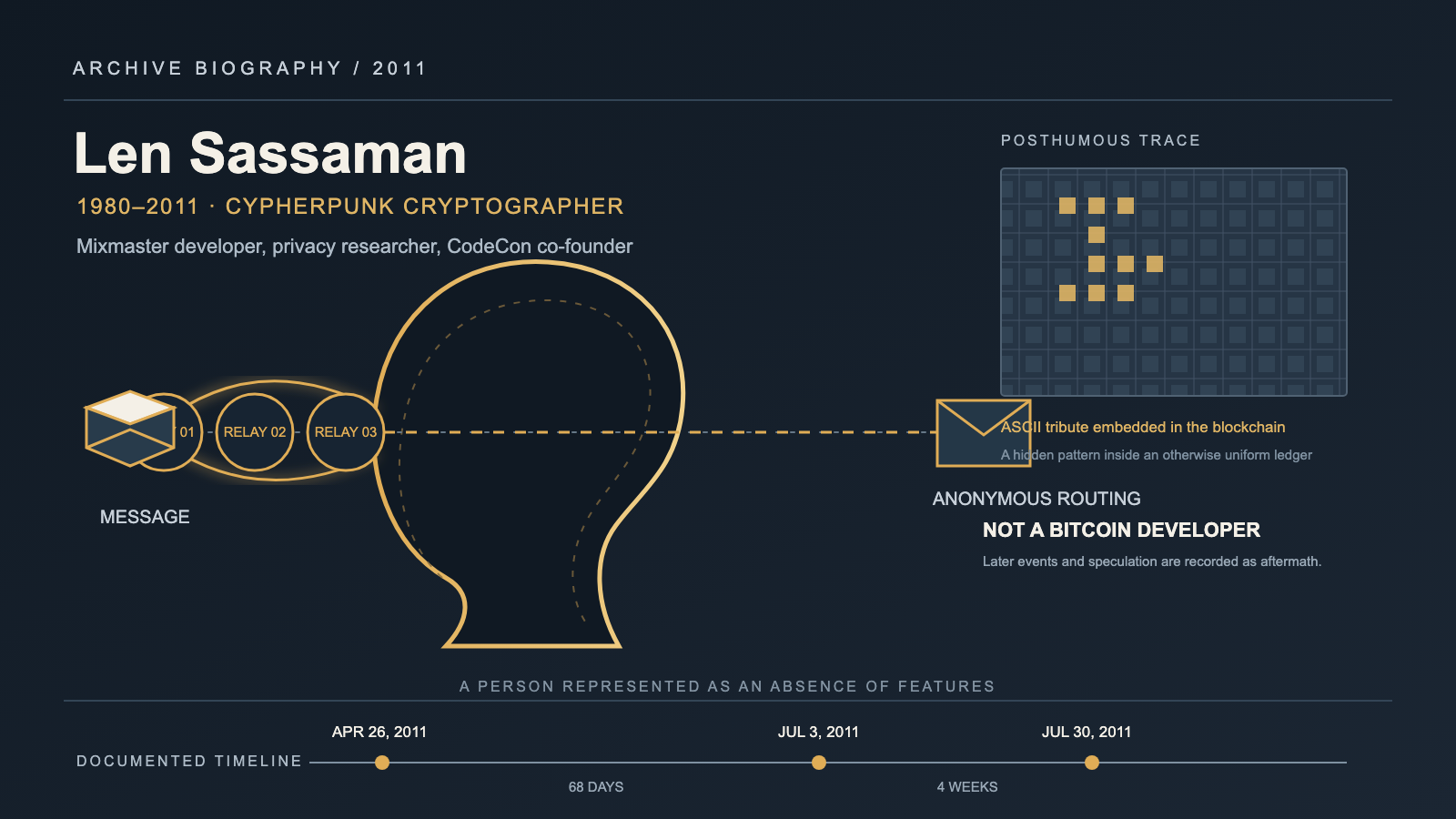

On February 22, 2021, Evan Hatch — founder of the Worlds.org cryptocurrency gaming platform — published “Len Sassaman and Satoshi: a Cypherpunk history” on Medium. The piece is a public articulation of the hypothesis that Len Sassaman was the person behind the Satoshi Nakamoto pseudonym, and it remains the foundational reference for that hypothesis in subsequent journalism.
The case as Hatch presents it
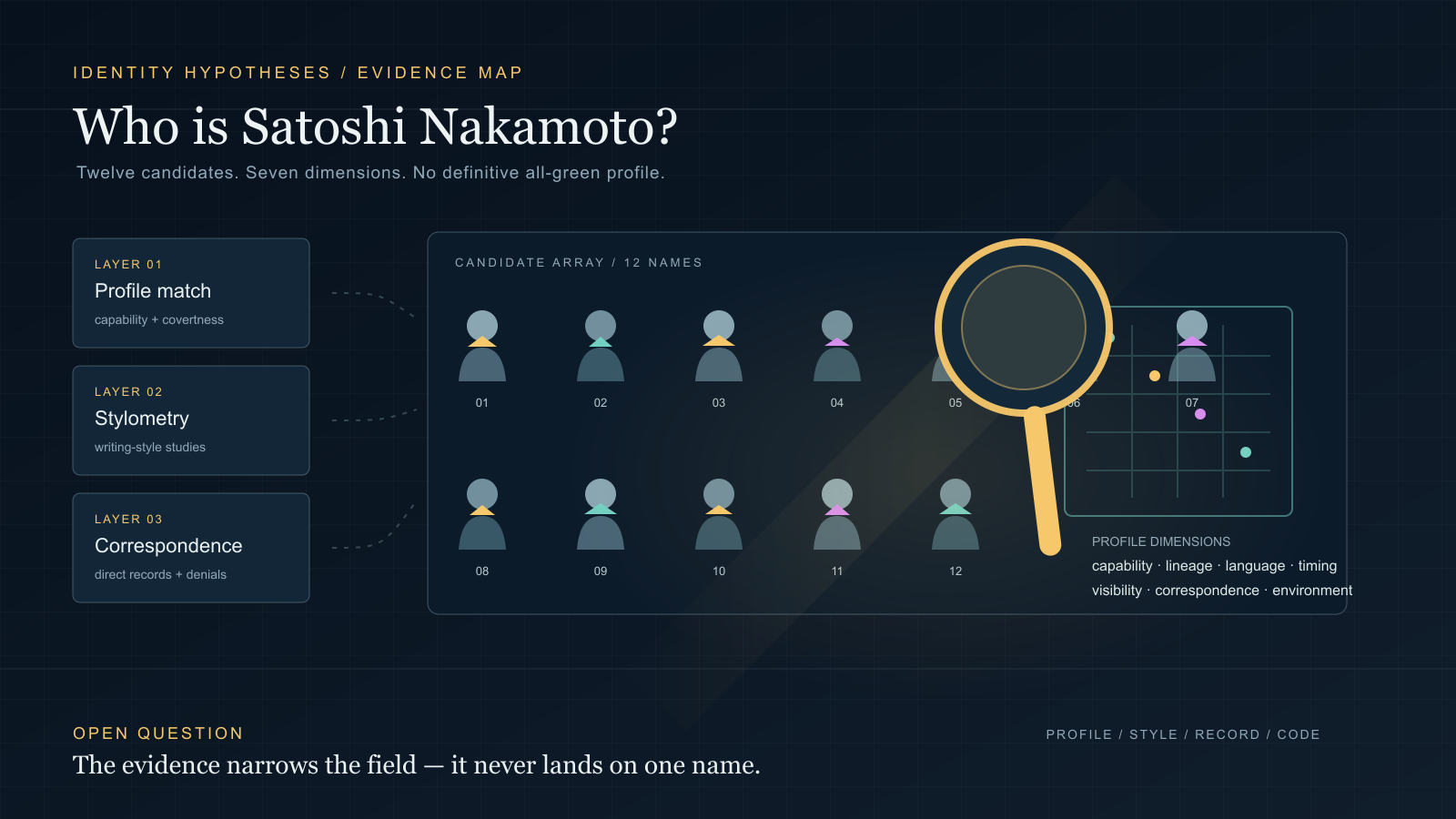
Hatch’s argument is structurally circumstantial — he combines biographical, linguistic, technical, and timing alignments without claiming forensic proof:
- Timezone and activity alignment. Satoshi’s posting cadence — late-night Bay Area / business-day European hours — matches Sassaman’s residence in Belgium during Bitcoin’s development. Hatch points to overlap with Sassaman’s documented tweet timestamps in the same window.
- Language patterns. Satoshi’s writing carried British-spelling tells (“bloody,” “maths,” British/American mixed pattern, occasional Euro references) inconsistent with a purely American author but consistent with an American who had been living in Europe — Sassaman’s pattern.
- Technical overlap. Sassaman was a working developer on remailers, PGP/cryptography, and P2P networking, and had researched Byzantine-fault-tolerance problems — the precise technical territory the Bitcoin whitepaper draws on.
- Cypherpunk-network embedding. Sassaman had documented working relationships with Hal Finney, Adam Back, and Bram Cohen — the same Bay Area cypherpunk network from which Bitcoin emerged.
- Academic register. The Bitcoin whitepaper’s LaTeX formatting and citation style match the academic-paper register of the work Sassaman produced as a PhD researcher at KU Leuven’s COSIC group, working under David Chaum, 2004–2011.
- Final-message-to-death timing. Satoshi’s last verified message dates to May 2011. Sassaman died by suicide on July 3, 2011. Hatch treats the roughly two-month gap as suggestive without claiming it is dispositive.
The same British colloquialism is cited independently elsewhere: Chain Bulletin’s Satoshi-in-London analysis treats Satoshi’s use of “bloody” as evidence for a London-based Satoshi, a distinct geographic conclusion from the Belgium-based Sassaman proposed here.
Hatch’s framing
The piece is explicitly speculative, not a forensic identification. Hatch’s strongest assertion is conditional:
I think there is a real possibility that Len was a direct contributor to Bitcoin.
Earlier in the piece Hatch writes “I hesitate to speculate about Satoshi’s identity,” signaling that the article is not making a definitive identification — it is constructing an inferential case.
The framing was preserved in subsequent press coverage that cited the article: most reports describe the Sassaman hypothesis as a cypherpunk-community speculation rather than a stylometrically proved identification (which is the formally distinct posture taken by, for example, Skye Grey 2013 for Nick Szabo or the 2026 Carreyrou NYT investigation for Adam Back).
Subsequent amplification
Hatch’s article became the canonical citation for the Sassaman hypothesis. Subsequent coverage that built on or referenced it includes:
- The Wikipedia Len Sassaman article, which uses Hatch as the primary source for the hypothesis section.
- Promotional discourse around HBO’s 2024 Money Electric: The Bitcoin Mystery documentary cycle, where Sassaman was widely-tipped as a possible name the documentary would unmask before Peter Todd was instead named.
- Cypherpunk-community discussion across Medium, Substack, and Hacker News.
A counter-analysis tradition has also developed — most prominently Peter Miller’s April 2026 Medium piece “Len Sassaman was not Satoshi Nakamoto” and David Z. Morris’s Substack response — both of which treat Hatch’s article as the canonical case the counter-argument is responding to.
Sassaman’s widow’s response
Meredith Patterson, Len Sassaman’s widow and herself a security researcher, has publicly denied that her late husband was Satoshi Nakamoto. The denial is consistent across her public posts and interviews.
Methodological framing
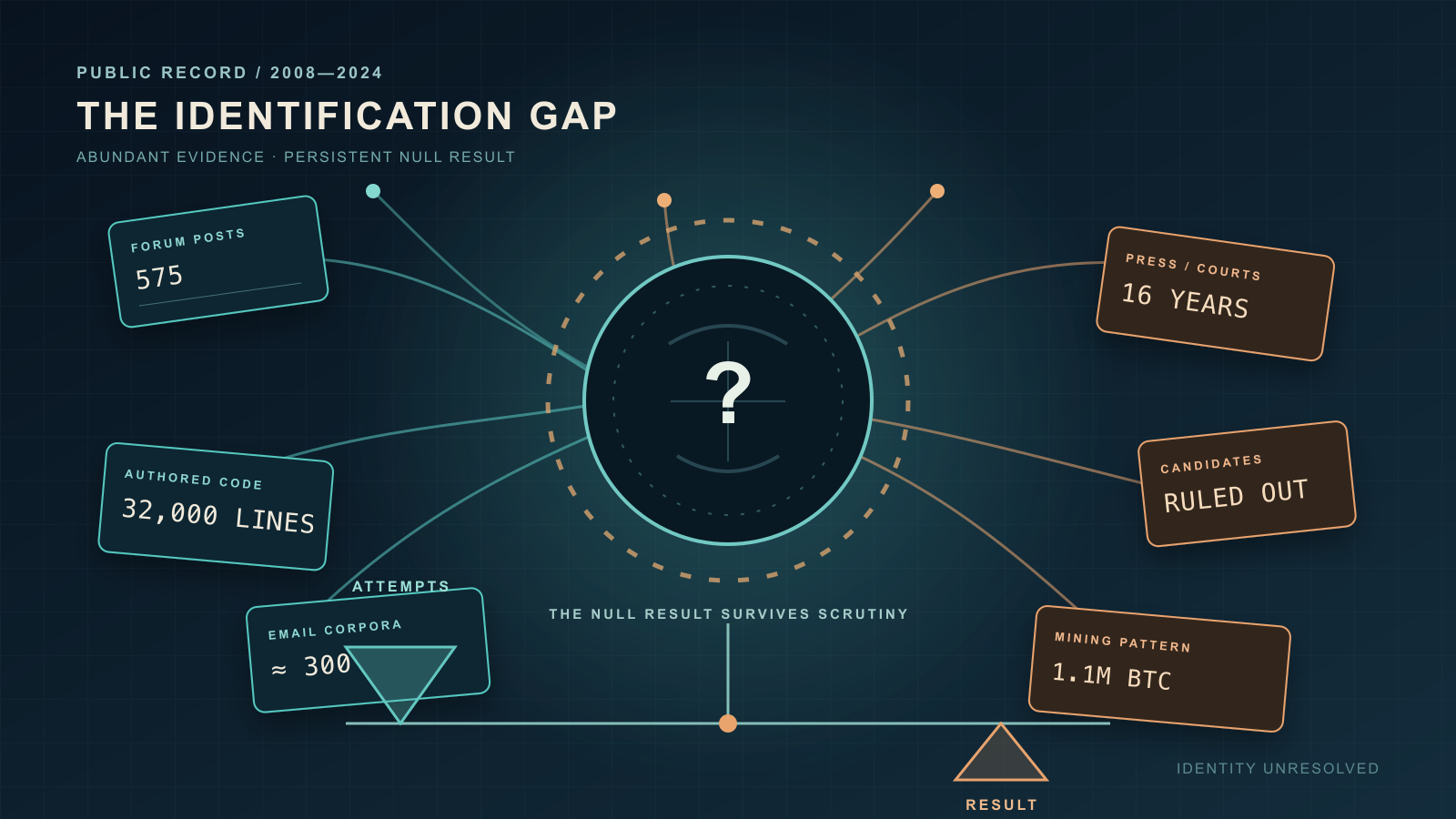
Hatch’s case is biographical-circumstantial rather than algorithmic or stylometric. No code, no key, no email metadata, and no financial trail were tied to Sassaman. The hypothesis rests on Sassaman’s cypherpunk-network embedding, his European residence during Bitcoin’s development, and the language and technical-interest overlaps Hatch enumerates.
As with all post-mortem identifications, Sassaman cannot confirm or deny — but Patterson has done so on his behalf, and a cypherpunk-community counter-tradition rejects the identification on independent grounds (timing, technical-fingerprint mismatches, Sassaman’s documented other commitments during the development window).
For the analytical treatment of the Len Sassaman = Satoshi hypothesis (Hatch’s evidence weighed against the post-mortem identification structure, Patterson’s denial, the cypherpunk-community counter-arguments, and the broader documentary record), see the Len Sassaman = Satoshi identity hypothesis entry.