
Re: Bitcoin v0.1 released
Dustin Trammell's first email to Satoshi after running the Bitcoin alpha. Reports usage, mentions a public timestamp service, and asks about coin maturity (generated coins showing 0.00 credit).
Information security researcher who was among the first to run Bitcoin
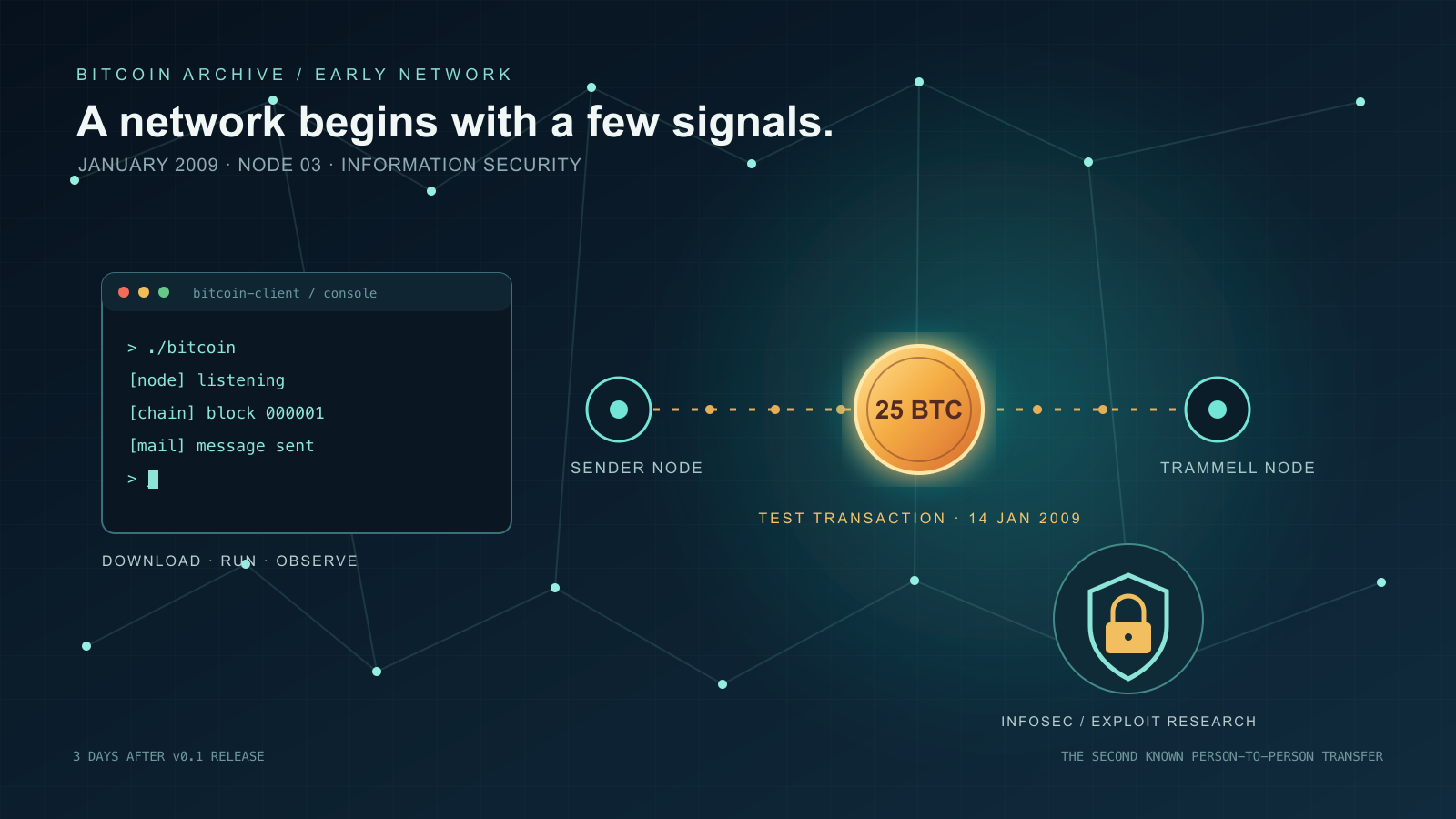
On January 11, 2009, three days after Bitcoin v0.1’s public release, an Austin-based infosec researcher named Dustin Trammell downloaded the software, ran it, and emailed Satoshi the same day. Three days after that, on January 14, 2009, Satoshi sent him 25 BTC as a test transaction — the second-known person-to-person Bitcoin transfer in history, after the 10 BTC sent to Hal Finney two days earlier.
Trammell is a cybersecurity researcher based in Austin, Texas, known in the infosec community for vulnerability and exploit-development work.
On January 11, 2009 — three days after Bitcoin v0.1 was released — Trammell emailed Satoshi Nakamoto after downloading and running the software. He reported his experience and asked questions about the system’s design. Satoshi responded the same day, beginning a brief but significant email correspondence.
Trammell began mining Bitcoin in its earliest days, potentially operating one of the first nodes on the network alongside Satoshi and Hal Finney. On January 14, 2009, Satoshi sent Trammell 25 BTC as a test transaction, making it one of the earliest known person-to-person bitcoin transfers (following the 10 BTC Satoshi sent to Hal Finney on January 12). In their correspondence, Satoshi discussed technical details including coin maturity rules and how the system handled new blocks.
Trammell’s early adoption and his direct correspondence with Satoshi place him among the very first Bitcoin users. His emails with Satoshi — preserved by the Satoshi Nakamoto Institute — date from the weeks when the entire network was a handful of nodes.
24 entries
Dustin Trammell's first email to Satoshi after running the Bitcoin alpha. Reports usage, mentions a public timestamp service, and asks about coin maturity (generated coins showing 0.00 credit).
Trammell's first email to Satoshi after running the Bitcoin alpha. Shares a public timestamp service link and asks about coin maturity (generated coins showing 0.00 credit).
Satoshi replies to Dustin Trammell, explaining the coin maturity system and recommending an upgrade to version 0.1.3 which had stabilized the software.
Trammell tells Satoshi about his proof-hashes Google Group, gives feedback on the credit field display, reports running v0.1.1 and will upgrade, and offers to help test new features.
Trammell reports two issues upgrading from v0.1.0 to v0.1.3: the old process wouldn't exit, and all four generated coins showed 'Generated (not accepted)' — likely orphans from the communications bug.
Trammell asks what prevents the most powerful node from generating the majority of bitcoins — one of the earliest questions about mining centralization.
Satoshi informs Trammell that bugs are fixed in v0.1.3 and offers to send him some coins via the send-to-IP feature, one of the earliest known direct Bitcoin transfers.
Trammell provides his IP address for Satoshi to send coins, explains the proof-hashes group is open for posting, discusses Bitcoin's early vulnerability, and compares mining to a roulette wheel.
Trammell's detailed security analysis of Bitcoin's send-to-IP feature, identifying MITM vulnerabilities including ARP poisoning and ISP-level interception. Recommends always using Bitcoin addresses.
Satoshi discusses dynamic IPs, asks permission to CC the conversation to bitcoin-list and the Cryptography mailing list, and envisions Bitcoin use cases including pay-to-send email and micropayments.
Satoshi responds to Trammell's MITM analysis by classifying attacks into two types (chain-of-communication vs. anyone on the Internet), proposes a combined IP+address fix, and notes wallet encryption.
Trammell argues Bitcoin addresses are more secure than IP-based sending since they verify through multiple channels. He proposes an address-advertisement toggle and reports an exit socket bug.
Trammell confirms his IP is static, agrees to CC publicly, says he'll join bitcoin-list, reveals he started mining as an investment after Hal Finney's message, and discusses micropayment uptake.
Satoshi CC's his Trammell exchange to bitcoin-list and the Cryptography list, sharing his Bitcoin vision including the famous line 'It might make sense just to get some in case it catches on.'
Satoshi reveals the wallet location (%appdata%\Bitcoin), explains it uses a transactional database (DBM) safe from crash/power loss, and confirms socket cleanup code is added for the next release.
Satoshi expresses confidence that some form of electronic currency will be in use within a decade, describing Bitcoin as the first attempt at a non-trust-based system.
Trammell reports confusion about a 100 BTC transfer between his own two Bitcoin instances — the transaction details showed 'Satoshi' as a label, leading him to wonder if Satoshi had sent the coins.
Satoshi explains the 'Satoshi' label came from Trammell's own address book, that transactions show the receiving address (not the sender), and recommends per-payer addresses to identify payers.
Trammell realizes the confusing 'Satoshi' label was on his own receiving address, confirms he has multiple addresses at home, and asks if 'Satoshi' was the default since he doesn't recall setting it.
Satoshi explains the default address label is 'Your Address', suggests the mislabeling was a UI-driven user error, and acknowledges that per-payer receiving addresses have no real-world analogy.
Trammell admits the mislabeling was his error, suggests changing 'Received with' to 'Received payment to' for clarity, and draws a PayPal analogy as the closest parallel to multiple addresses.
Satoshi responds to Hal Finney's botnet/pay-per-send point, proposing that fake mailboxes could 'reverse-spam' spammers by harvesting their POW tokens. He also describes e-gold's 'dusting' problem.
When correspondents wished Satoshi merry Christmas, predicted Bitcoin at $10M per coin, or hoped he was doing well, his replies opened on the technical topic and never returned. Five-pattern audit.
In a podcast interview, security researcher Dustin Trammell (Druid) describes being possibly the second node on the Bitcoin network — seeing only one other node for hours after first connecting.