Event Added Updated Analysis

Was Paul Le Roux Satoshi? The E4M cryptographer named by The Mastermind
He wrote E4M, then built a criminal empire. The evidence behind The Mastermind (2019) naming Paul Le Roux as Satoshi, weighed.

E4M / TrueCrypt-precursor author and convicted criminal mastermind
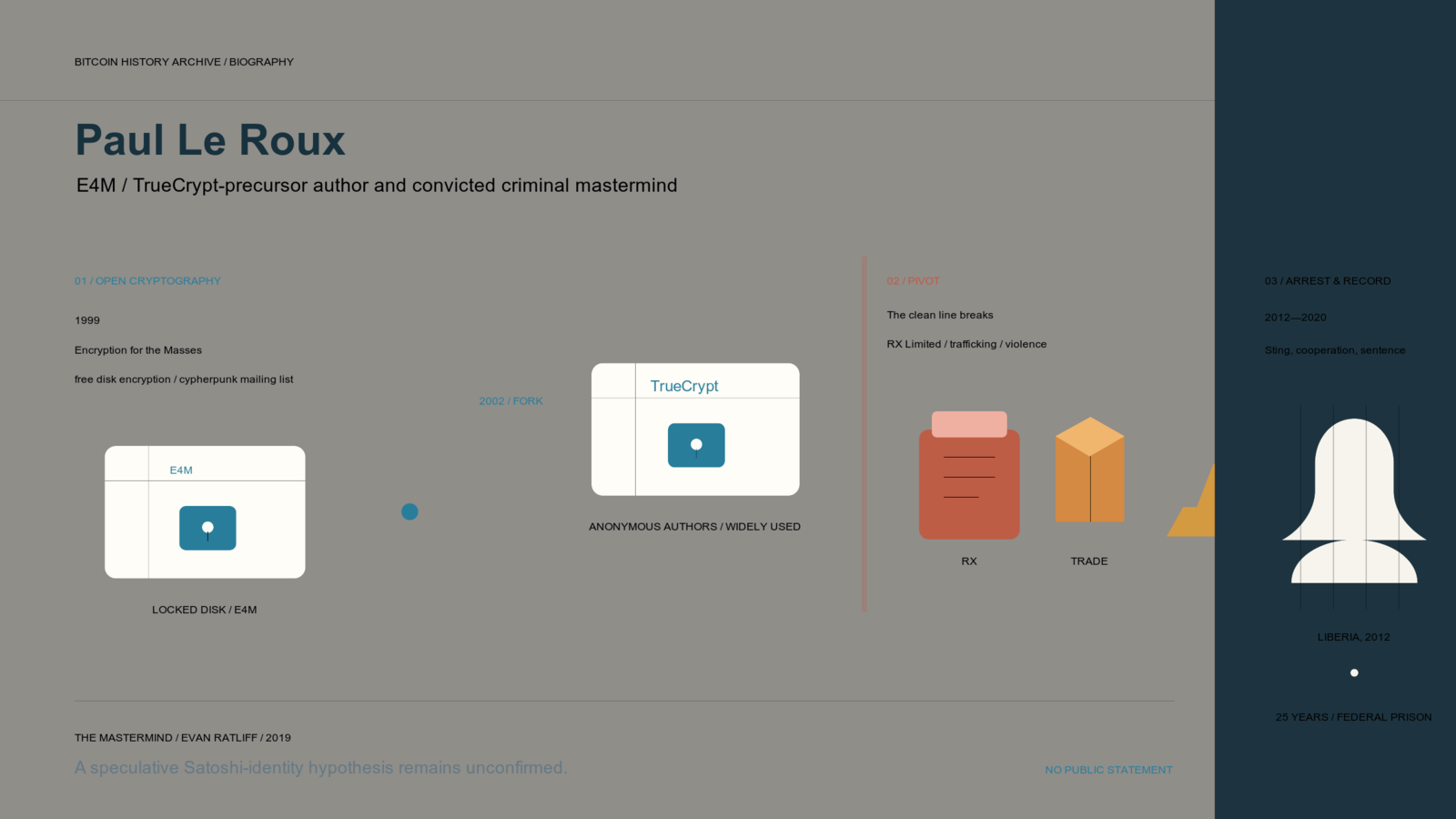
In December 1998, a Rhodesian-born programmer named Paul Le Roux released Encryption for the Masses (E4M) — an open-source disk-encryption package — and circulated it on the cypherpunks mailing list. Its codebase was later built into TrueCrypt, first released in February 2004.
By the mid-2000s Le Roux had moved on from cryptography and built one of the largest international criminal enterprises of the 2000s — RX Limited online pharmacies, arms trafficking, methamphetamine production — chronicled in journalist Evan Ratliff’s 2019 book The Mastermind. He was arrested by US authorities in Liberia in September 2012 and has been incarcerated and cooperating with the US Drug Enforcement Administration since.
Le Roux (born December 24, 1972 in Bulawayo, Rhodesia — now Zimbabwe) is named in some Satoshi identity hypotheses, which cite his cypherpunk-era cryptography credentials and timing.
In December 1998 Le Roux released Encryption for the Masses (E4M), a free open-source disk-encryption package, distributed under an open-source license. He announced the project on the cypherpunks mailing list and engaged in a limited number of cryptographic discussions there. In February 2004 the E4M codebase was built into TrueCrypt, which became one of the most widely deployed open-source disk-encryption packages of the 2000s and 2010s. The TrueCrypt project’s original developers remained anonymous and the lineage from E4M was the subject of years of speculation about Le Roux’s possible authorship of TrueCrypt itself — never definitively resolved in public.
From the early 2000s Le Roux’s operational focus shifted from open-source cryptography to building an international criminal organization. The enterprise spanned multiple verticals: RX Limited (a network of US online pharmacies dispensing controlled prescriptions of disputed legality), arms trafficking, methamphetamine production in the Philippines, gold-smuggling operations, and contract violence. The full scope is documented in Evan Ratliff’s The Mastermind (Random House, 2019) and the accompanying Atavist Magazine long-form series.
In September 2012 Le Roux was arrested by US authorities in Liberia after being lured there in a sting operation. He immediately became a DEA cooperator, providing extensive evidence against members of his own organization. He was sentenced to 25 years in US federal prison in 2020 — substantially reduced, in exchange for his cooperation, from the maximum possible sentence of life imprisonment. He has not made public statements while incarcerated, including on the Satoshi-identity question.
Le Roux’s connection to the Satoshi-identity question is entirely external — there is no documented contact with Satoshi Nakamoto, no statement by Le Roux on the question, and no Bitcoin-related material in the public record from him. He was named as a Satoshi candidate primarily through Evan Ratliff’s 2019 The Mastermind and accompanying journalism, on a capability-plus-covertness-plus-motive argument. The case for and against, and the 2026-05-03 van Dorst corpus reanalysis that excludes him from its stylometric candidate set, are laid out in the Paul Le Roux = Satoshi hypothesis; see the identity-hypotheses overview (§2.1) for the comparison with the other named candidates.
3 entries
He wrote E4M, then built a criminal empire. The evidence behind The Mastermind (2019) naming Paul Le Roux as Satoshi, weighed.
Finding Satoshi (Tooley / Miele, April 2026) names Hal Finney and Len Sassaman as Bitcoin co-creators — Finney coded, Sassaman wrote the paper. Lopp and Back disputed the timing.
Recurring Satoshi candidates aligned across four independent layers — profile match, stylometric attribution, direct correspondence, and development environment.