
Who Is Satoshi Nakamoto: 12 Geniuses and the Mystery of the Century
Recurring Satoshi candidates aligned across four independent layers — profile match, stylometric attribution, direct correspondence, and development environment.
Australian businessman who falsely claimed to be Satoshi Nakamoto
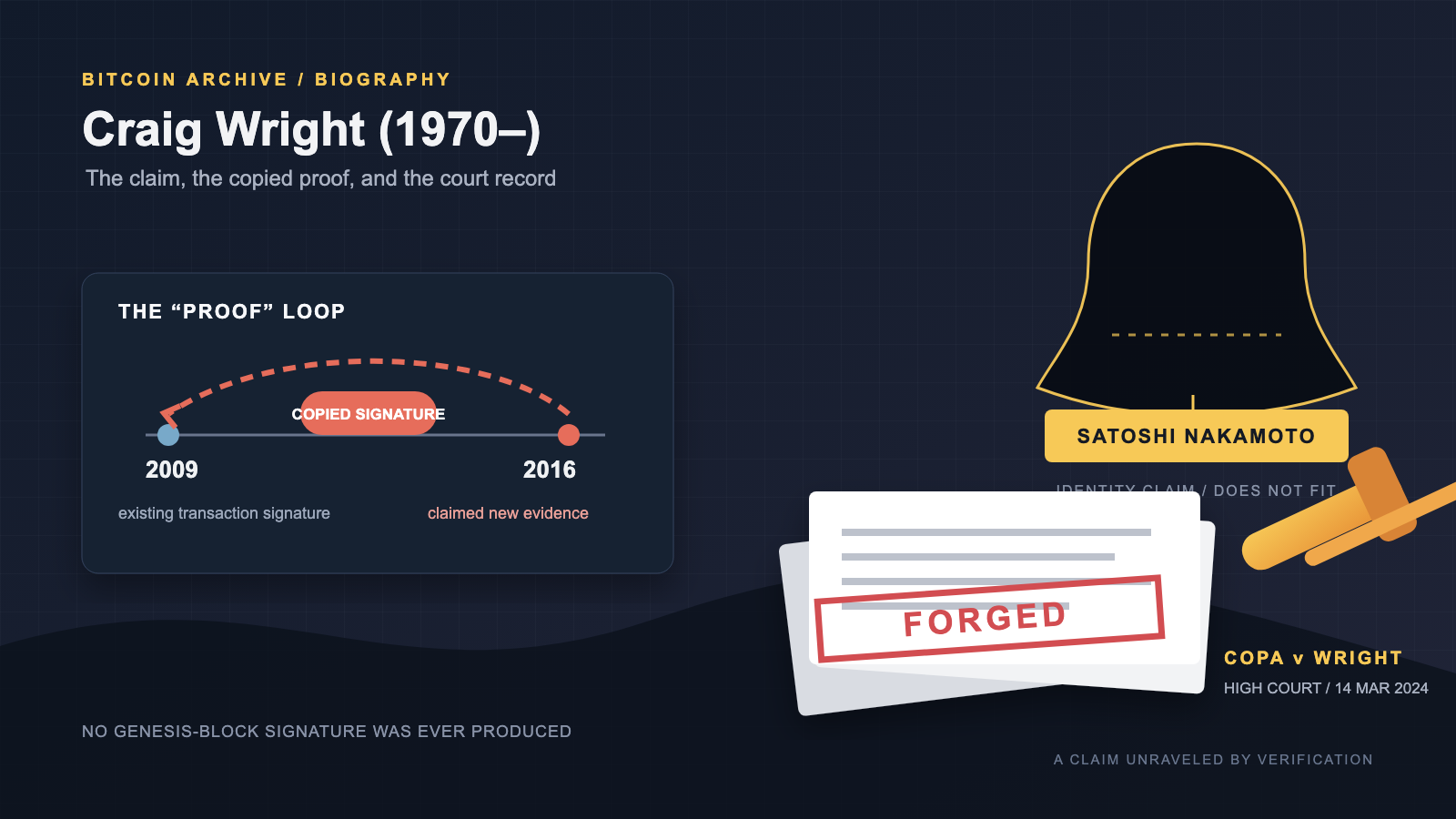
On May 2, 2016, Craig Wright publicly declared himself to be Satoshi Nakamoto in coordinated interviews with the BBC, The Economist, and GQ. He offered cryptographic proof — a digitally signed message using keys associated with early Bitcoin blocks. Within hours, security researchers showed he had reused an existing signature from a 2009 Bitcoin transaction rather than producing a new signature with the claimed keys.
Eight years later, on March 14, 2024, Justice Mellor of the UK High Court delivered the ruling in the case brought by the Crypto Open Patent Alliance:
- Dr. Wright is not the author of the Bitcoin White Paper.
- Dr. Wright is not the person who adopted or operated under the pseudonym Satoshi Nakamoto in the period 2008 to 2011.
- Dr. Wright is not the person who created the Bitcoin System.
- Dr. Wright did not author the initial versions of the Bitcoin software.
The judge characterised Wright as an extremely dishonest witness and concluded he had engaged in deliberate and extensive forgery of documents to support his false claim of being Satoshi Nakamoto. The self-claim, the arguments it rested on, and the counter-evidence are laid out as a Satoshi-identity hypothesis in Was Craig Wright Satoshi?
Craig Steven Wright is an Australian computer scientist and businessman, born in October 1970 in Brisbane, Australia.
The December 2015 Wired and Gizmodo investigations had preceded the May 2016 claim — the journalists had been the first to suggest Wright as a possible Satoshi candidate, citing materials later shown to be fabricated. After the May 2016 “proof” collapsed under scrutiny, Wright promised further evidence but never delivered. He instead posted:
“I believed that I could put the years of anonymity and hiding behind me. But I can’t.”
In February 2021, Wright sued the pseudonymous operator of bitcoin.org (Cobra) over Bitcoin whitepaper copyright. On June 28, 2021, the court issued a default judgment in Wright’s favor — not because the claim had merit, but because Cobra chose to protect his anonymity rather than reveal his identity to defend himself.
Wright’s identity claims rested on signing with the keys to early blocks (1–9) but never extended to the genesis-block coinbase key — the single demonstration that would be dispositive, which the genesis-block hardcode analysis notes has never been performed, by Wright or anyone.
Wright sought permission to appeal the COPA ruling, and lost. On March 7, 2025, the Court of Appeal ordered him to pay £225,000 in costs — £100,000 to COPA and £125,000 to the Bitcoin developers he had also sued — after finding that his written submissions, prepared with an AI tool, cited non-existent cases and made false statements about the trial that risked seriously misleading the court. It is reported as the first time a UK civil court has ordered costs over a litigant’s misuse of AI.
12 entries
Recurring Satoshi candidates aligned across four independent layers — profile match, stylometric attribution, direct correspondence, and development environment.
Genealogy of every Bitcoin protocol fork that left a separate chain alive (Bitcoin Cash, SV, Gold) and the adjacent cryptocurrencies derived from Bitcoin (Namecoin, Litecoin, Dogecoin).
Technical analysis of Bitcoin's genesis block from v0.1 source: hardcode auto-construction, the five-day gap as timestamp artifact, two-layer authorship reading, PoW headroom, key possession.
Wired and Gizmodo simultaneously publish articles identifying Australian computer scientist Craig Steven Wright as the probable creator of Bitcoin, based on leaked documents and emails.
The only Satoshi claim made by its own subject: Craig Wright's 2016 self-identification, its reused-signature 'proof,' and the 2024 COPA ruling that he is not Satoshi and forged evidence.
Craig Wright publicly declared himself Satoshi in BBC, Economist and GQ interviews. His blog cryptographic proof was quickly debunked — he had reused a 2009 transaction signature.
Bitcoin SV (Satoshi Vision) split from Bitcoin Cash on November 15, 2018, after a hash war between the Bitcoin ABC and Bitcoin SV factions. The SV chain restored larger blocks and 'original' opcodes.
After the London High Court ordered bitcoin.org to remove the Bitcoin whitepaper, Cobra responded on Twitter with a critique declaring cryptographic rules superior to court-enforced ones.
Craig Wright sued bitcoin.org operator Cobra over Bitcoin whitepaper copyright. Cobra refused to reveal his identity, resulting in a default judgment ordering bitcoin.org to remove the whitepaper.
During Day 13 of COPA v Wright, Martti Malmi testified via video link and submitted 260 emails (140,000 words) exchanged with Satoshi between May 2009 and February 2011, published on GitHub.
Mike Hearn testifies at the COPA v Wright trial, recounting his direct interactions with Satoshi and describing how Wright failed his technical check questions at a 2016 dinner.
The UK High Court rules definitively that Craig Steven Wright is not Satoshi Nakamoto, finding that he fabricated evidence on a grand scale to support his false claim.