
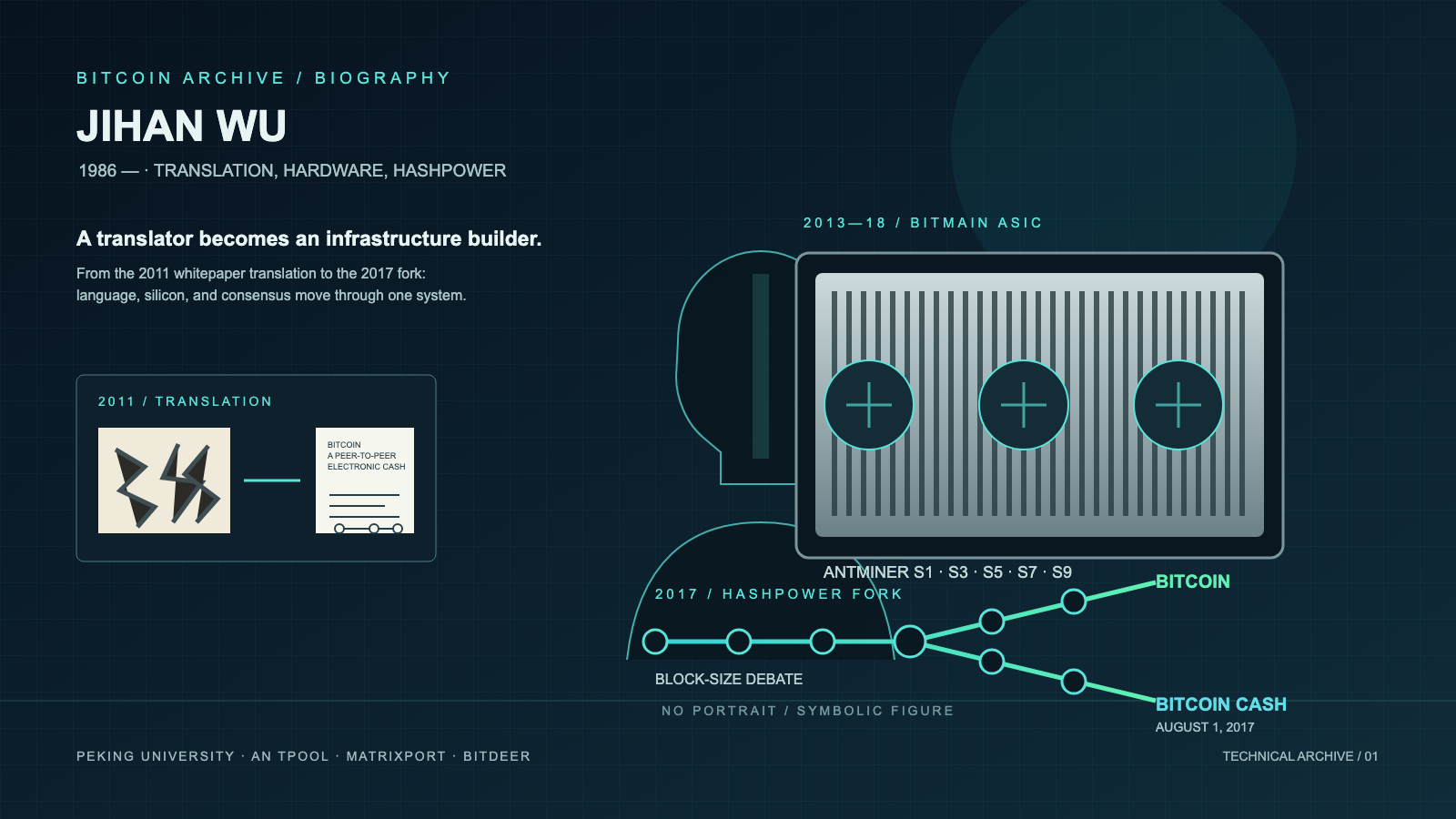
Jihan Wu (1986–)

Bitcoin whitepaper Chinese translator, Bitmain co-founder, ASIC mining empire builder, Bitcoin Cash hashpower backer

Jihan Wu (Chinese: 吴忌寒; born 1986 in Chongqing, China) is a Chinese entrepreneur whose work on Bitcoin began with the 2011 Chinese-language translation of the Bitcoin whitepaper and grew into Bitmain — the dominant ASIC mining-hardware manufacturer of the 2014–2018 era. By 2017 he was one of the most influential figures in Bitcoin mining, and he committed Bitmain-aligned hashpower to the Bitcoin Cash hard fork at launch.

Bitcoin entry and whitepaper translation (2011)

Wu studied economics and journalism at Peking University before working as a financial analyst. He encountered Bitcoin in 2011 and, recognizing the lack of accessible Chinese-language documentation, produced a Chinese translation of Satoshi’s Bitcoin whitepaper that circulated widely in early Chinese Bitcoin communities. The translation predates the founding of major Chinese Bitcoin exchanges and was an early contribution to the Chinese-language Bitcoin information ecosystem.

Bitmain (2013–2018)

In 2013 Wu co-founded Bitmain Technologies with Micree Zhan, a chip designer. Bitmain’s first commercial product — the Antminer S1 ASIC, released in late 2013 — entered a market dominated by Avalon and BFL. Through subsequent generations (S3, S5, S7, S9) Bitmain became the dominant Bitcoin ASIC manufacturer of the 2015–2018 era, controlling a majority share of new mining hardware shipments at peak. Bitmain also operated AntPool, which became the largest Bitcoin mining pool by hashrate during the same period.

Wu’s role through this period was the public-facing co-CEO; Zhan was the chip-engineering side. The two co-founders’ division of responsibilities — Wu external/business/community, Zhan internal/engineering — would become structurally significant in the later leadership conflict.

Block-size war and Bitcoin Cash (2015–2017)

Wu was a vocal proponent of larger Bitcoin blocks throughout the 2015–2017 block-size war. He supported Bitcoin XT (2015), Bitcoin Classic (2016), and Bitcoin Unlimited (2016) in turn, signed the New York Agreement (May 2017), and after the SegWit2x compromise collapsed, committed Bitmain-aligned hashpower to the Bitcoin Cash fork on August 1, 2017. Bitmain’s hashpower was a critical factor in BCH’s ability to maintain block production through the early days of the split when the chain’s difficulty algorithm was still being tuned.

Bitmain leadership conflict and post-2018 ventures

Through 2018-2019 a public conflict developed between Wu and Zhan over Bitmain’s strategic direction (in particular its expansion into AI chips and the abortive 2018 Hong Kong IPO). The dispute briefly produced parallel leadership claims and corporate-governance disputes that played out in Chinese and international press. The eventual resolution — after multiple rounds of management changes — left Zhan in control of Bitmain proper while Wu spun off into separate ventures.

Post-Bitmain, Wu founded Matrixport (2019, a Bitcoin financial services / custody platform) and Bitdeer (originally a Bitmain-internal cloud-mining service spun off in 2018, later operating independently with Wu in leadership). Both remain Bitcoin-centric businesses; Wu continues to be active in Bitcoin mining and adjacent infrastructure.

Significance to Bitcoin

Wu’s record matters in this archive for three reasons. First, the 2011 Chinese whitepaper translation is a foundational document in the Chinese-language Bitcoin community. Second, Bitmain’s 2014–2018 dominance of ASIC manufacturing made Wu one of the most consequential individuals in Bitcoin mining-economics during that period; the geographic concentration of mining in China during the same years is partly downstream of Bitmain’s customer base. Third, his commitment of hashpower to Bitcoin Cash at launch was structurally necessary for BCH to survive its first weeks; without large early hashpower, the chain would have been vulnerable to reorganization attacks during the difficulty-adjustment ramp.

Related Entries

3 entries

Wikipedia

Why Bitcoin's fork wars were not OSS fork wars — the vacuum Satoshi left, the money on top, and the three layers that bind

Bitcoin Institute Mike Hearn, Gavin Andresen, Wladimir van der Laan, Peter Todd, Gregory Maxwell, Adam Back, Roger Ver, Jihan Wu, Mike Belshe, Vitalik Buterin, Daniel Larimer, Satoshi Nakamoto

Why Bitcoin's 2015-2017 fork wars ran as identity contests, not OSS disputes: the post-2011 authority vacuum, the economic weight on rule choices, and the three layers that bound code to currency.