
Daniel Larimer (1980–)

bytemaster, later BitShares / Steem / EOS founder who argued for off-chain instant payments in 2010

Daniel Larimer (born 1980), known on BitcoinTalk as bytemaster, is an American software developer who went on to found three major blockchain projects whose core design premise was first articulated in his 2010 Bitcoin forum posts: that on-chain settlement alone could not meet the throughput and latency requirements of real-world payments.

Early Bitcoin Posts (2010)

Larimer first appears on BitcoinTalk on July 28, 2010, writing:

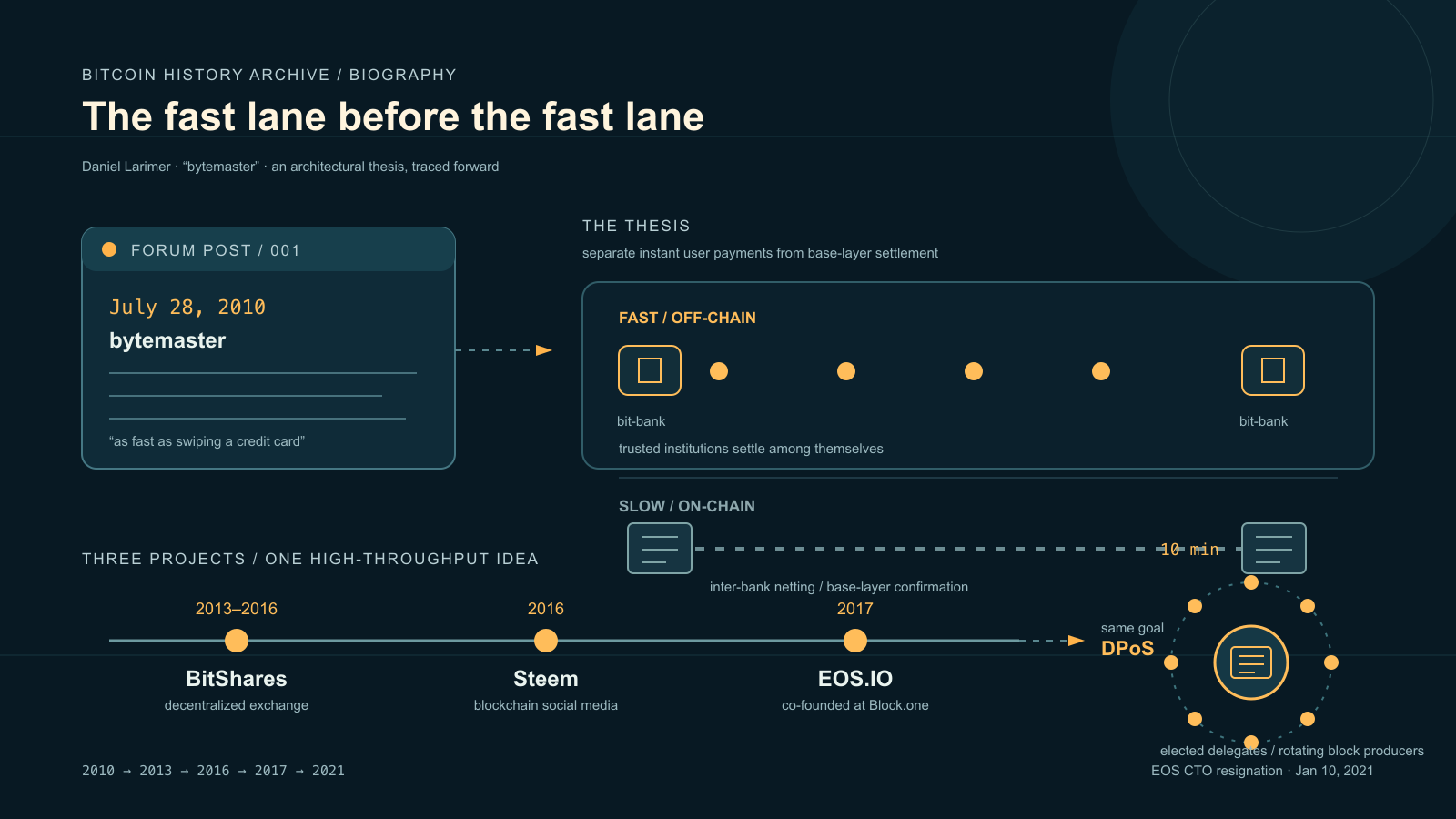
“I am convinced that bandwidth, disk space, and computation time necessary to distribute and ‘finalize’ a transaction will be prohibitively expensive for micro-payments. […] 10 minutes is too long to verify that payment is good. It needs to be as fast as swiping a credit card is today.”

In the same post he proposed “bit-banks” — trusted institutions that would settle among themselves off-chain for instant transfers, with on-chain settlement reserved for inter-bank netting. This is the same architectural thesis — decoupling fast user-level transactions from slow base-layer consensus — that he would later implement as Delegated Proof-of-Stake (DPoS) across his subsequent projects.

Later Projects

Between 2013 and 2016, Larimer worked on BitShares, a decentralized exchange platform built on DPoS. In 2016 he moved to Steem, a blockchain-based social media platform. In 2017 he co-founded EOS.IO with Brendan Blumer at Block.one, and served as its CTO until announcing his resignation on January 10, 2021. Each project pursued the same premise: high-throughput consensus by concentrating block production in a rotating set of elected validators.

Significance

Larimer’s 2010 BitcoinTalk posts are among the earliest public arguments that Bitcoin’s base layer would not by itself serve micropayments or retail-speed commerce. History validated both sides of that argument in different ways — Bitcoin layered solutions (Lightning, Liquid) followed exactly the “off-chain instant, on-chain settlement” pattern he sketched, while his own projects pursued it by sacrificing the open validator set for higher throughput. Either way, his 2010 objection marks the point where a coherent counter-vision to pure Nakamoto consensus enters the public record.

Related Entries

9 entries

Wikipedia

Why Bitcoin's fork wars were not OSS fork wars — the vacuum Satoshi left, the money on top, and the three layers that bind

Bitcoin Institute Mike Hearn, Gavin Andresen, Wladimir van der Laan, Peter Todd, Gregory Maxwell, Adam Back, Roger Ver, Jihan Wu, Mike Belshe, Vitalik Buterin, Daniel Larimer, Satoshi Nakamoto

Why Bitcoin's 2015-2017 fork wars ran as identity contests, not OSS disputes: the post-2011 authority vacuum, the economic weight on rule choices, and the three layers that bound code to currency.