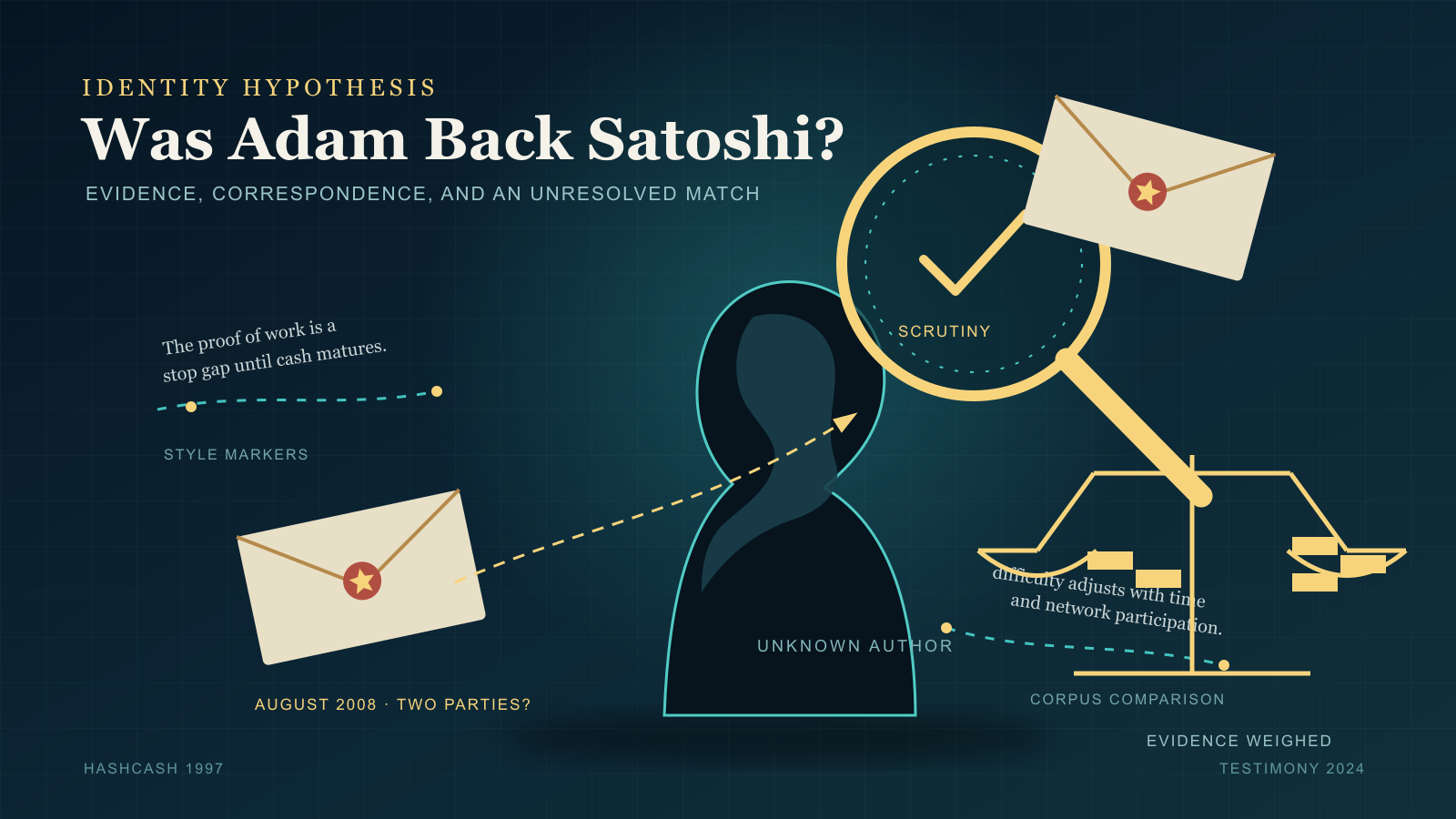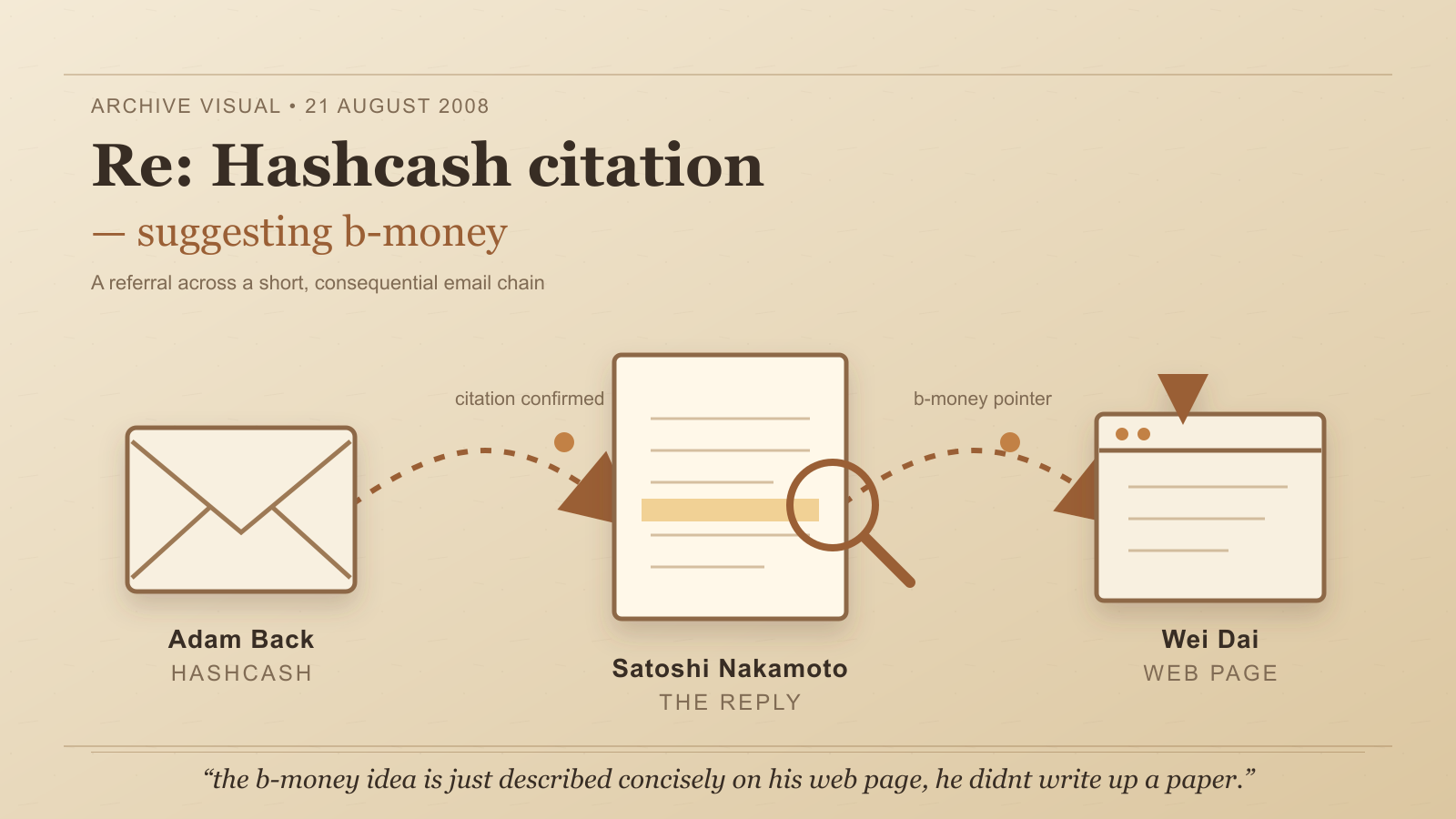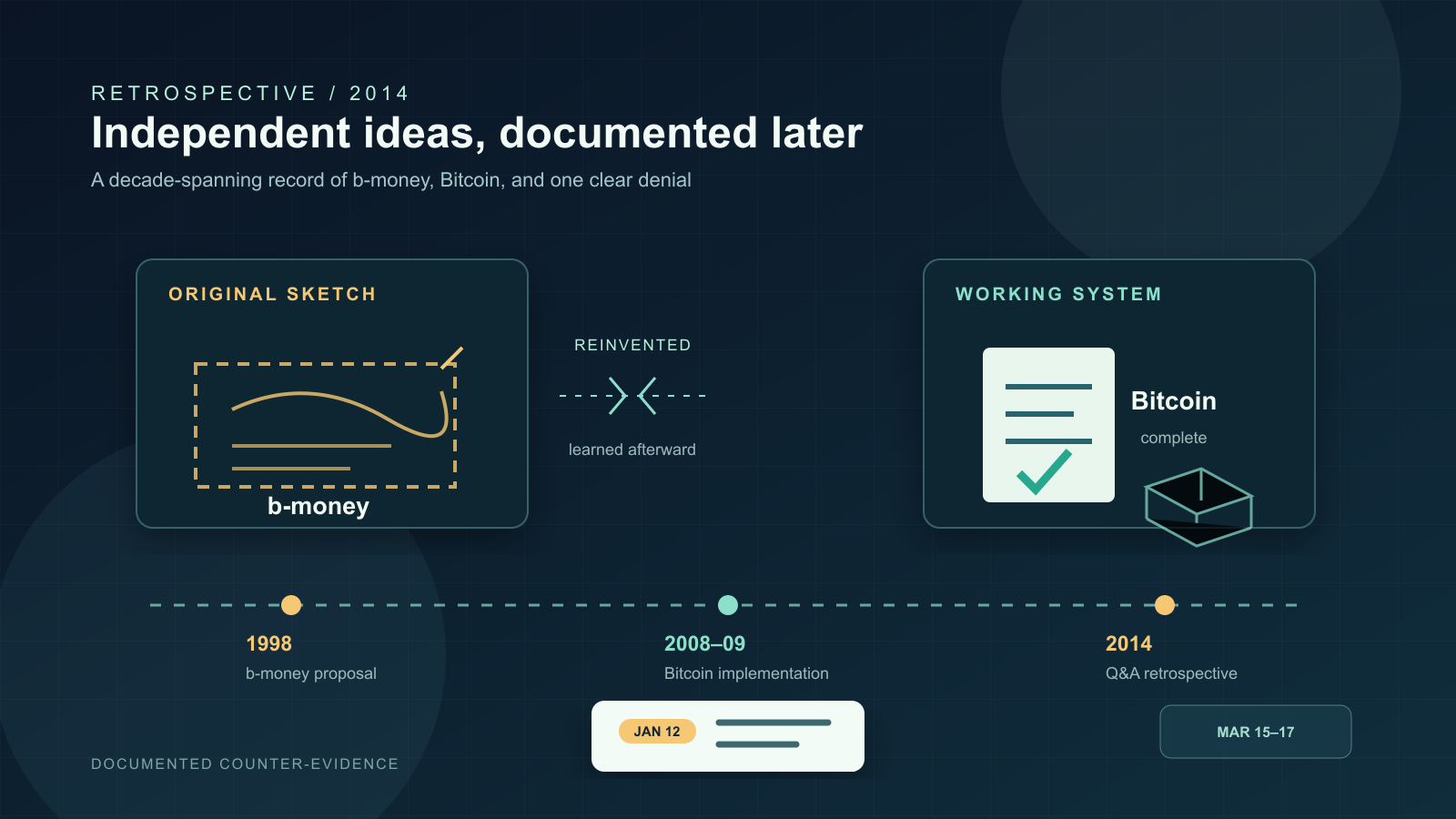
“Thanks, I wasn’t aware of the b-money page, but my ideas start from exactly that point.”
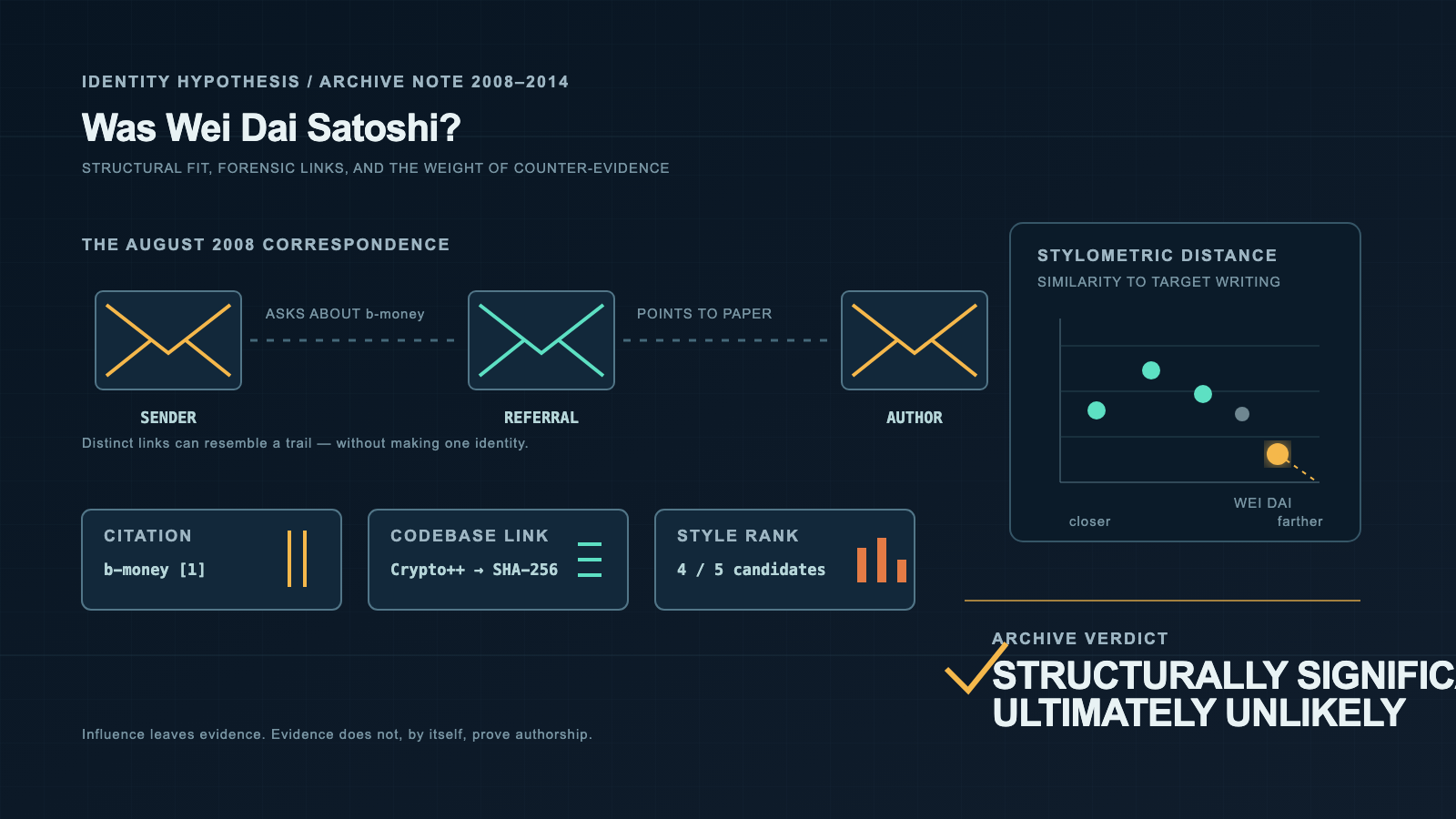
Satoshi wrote this to Adam Back on August 21, 2008 — well over a year into Bitcoin’s design (Satoshi’s own “last year and a half” timeline, stated three months later on the cryptography mailing list, locates the start around mid-2007), and hours after Back introduced him to Wei Dai’s 1998 b-money proposal that same day. b-money was the closest pre-existing system in the same design space. Satoshi had not seen it.
This entry reads three observations together:
- the b-money disclaimer above, in Satoshi’s own words
- Wei Dai’s 2014 retrospective assessment that Satoshi was “not previously active” in cypherpunk communities
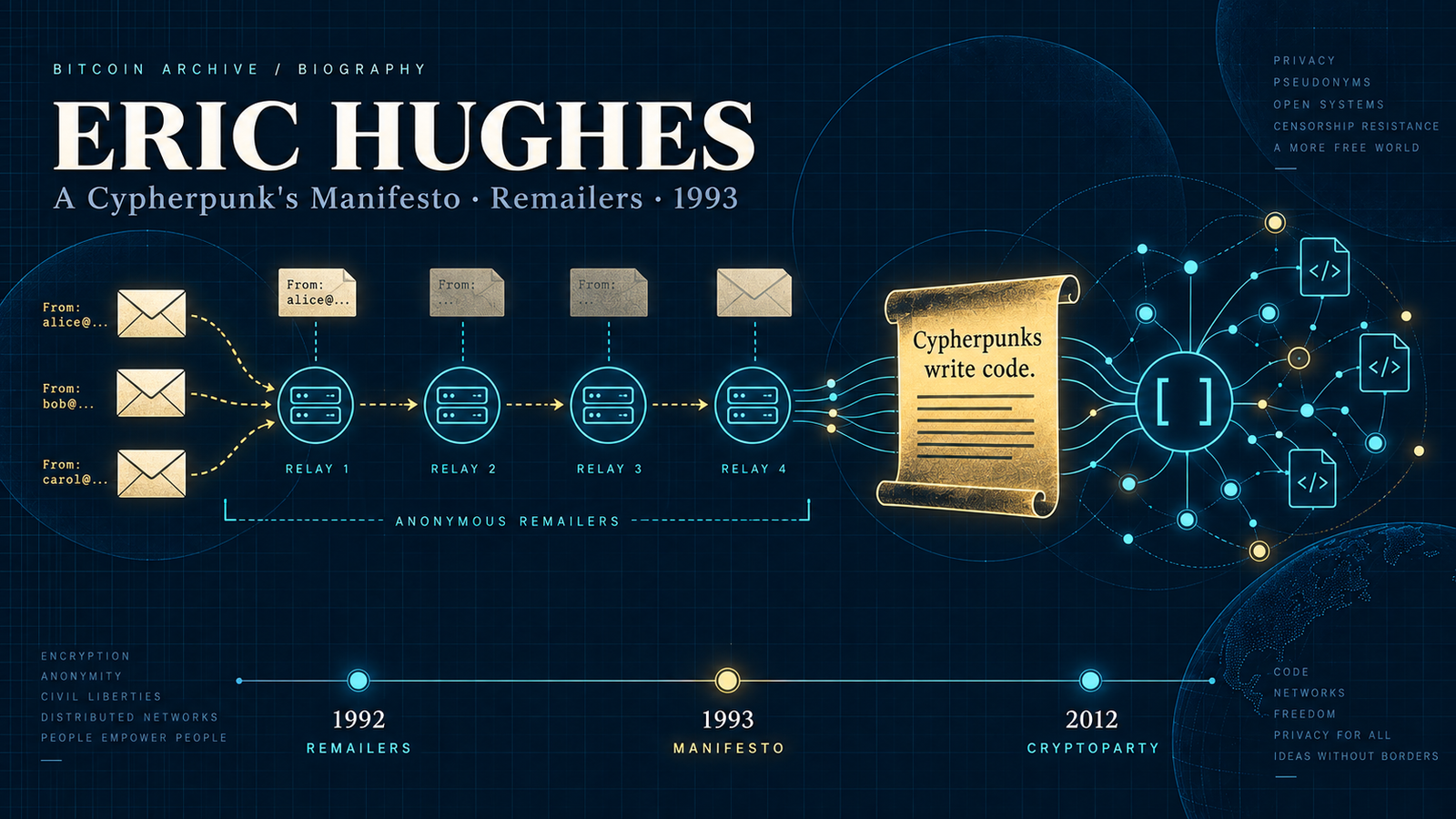
- the tight alignment between Satoshi’s documented practice and the six-point ideological core of Eric Hughes’s 1993 A Cypherpunk’s Manifesto
How does a designer who appears never to have participated in the cypherpunk community arrive at a system that maps almost point-by-point onto its founding manifesto?
A companion analysis, The “Satoshi Nakamoto” pseudonym and AKIRA: a techno-orientalist reading, addresses the pseudonym itself as a separate reading against the cyberpunk / techno-orientalist symbolic field of the 1980s–90s. Adjacent: the Genesis Block hardcode analysis (Block 0 as object) and the launch-period environment analysis (launch week as event).
1. Cypherpunk: history, core, technical lineage
1.1 Origin and naming
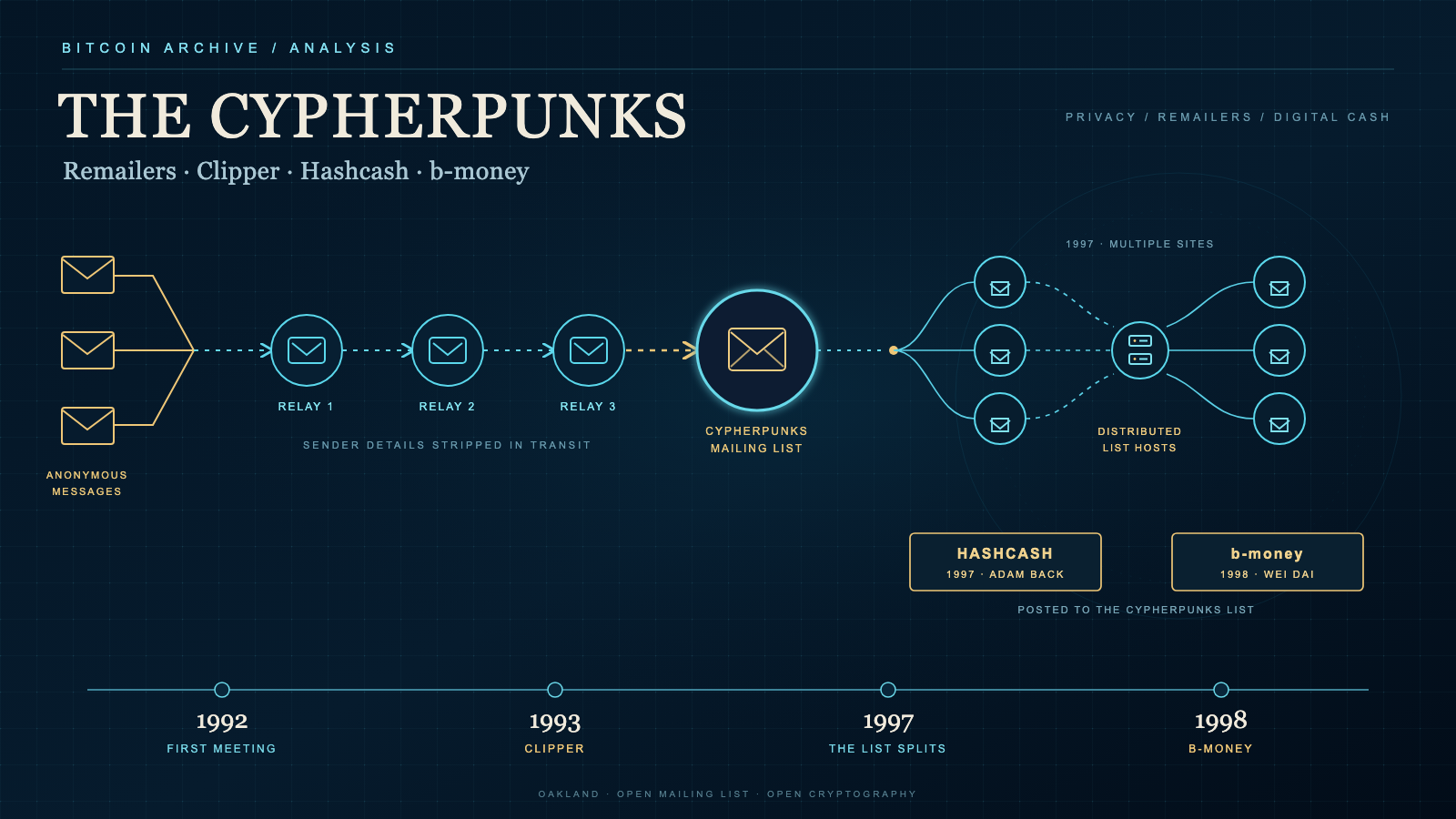
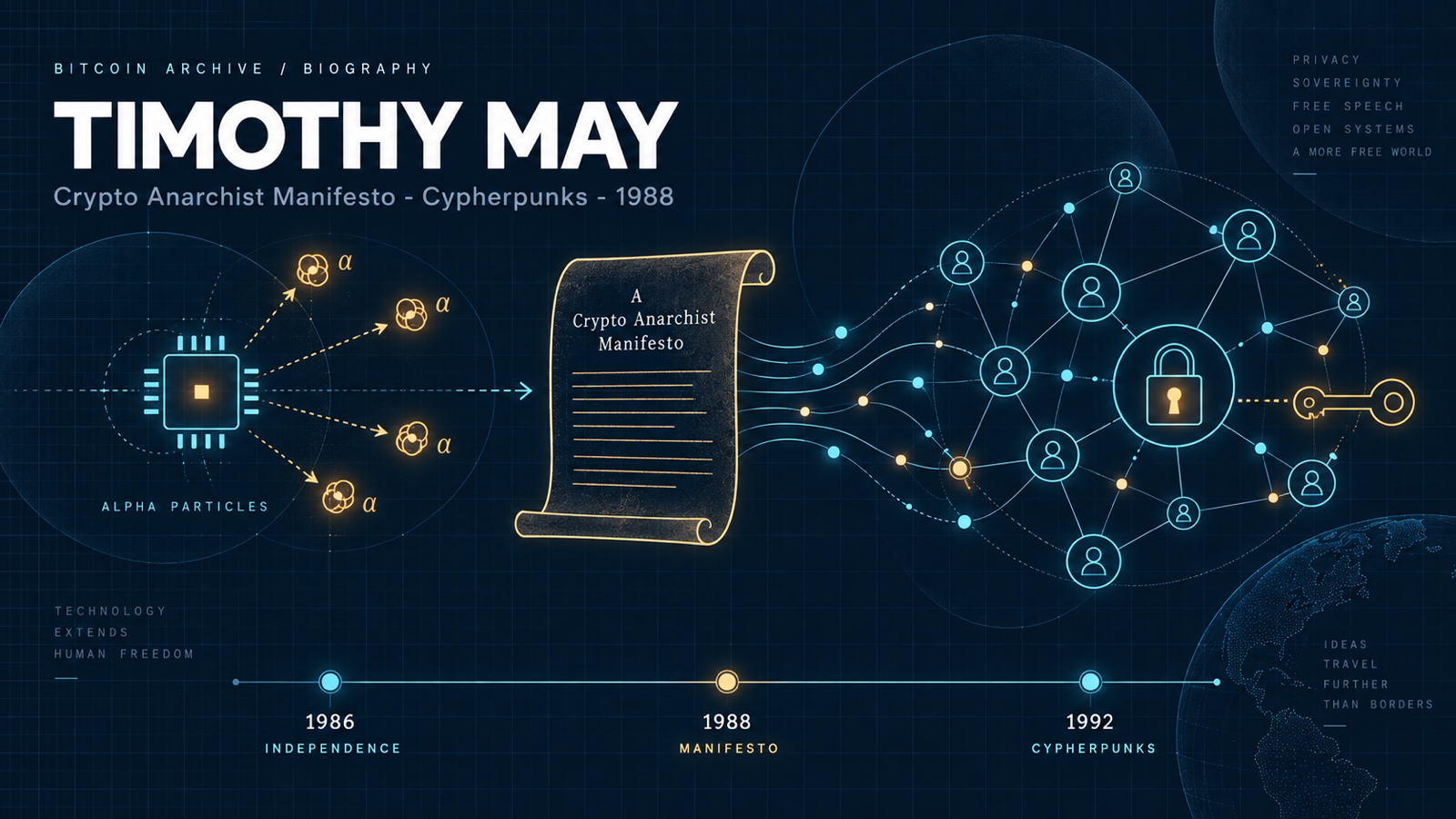
The cypherpunk movement took shape in the San Francisco Bay Area in 1992, founded by Eric Hughes, Timothy C. May, and John Gilmore: the first meeting was held in Oakland that September, and Gilmore’s machine toad.com hosted the mailing list. The name came from Jude “St. Jude” Milhon, then an editor at Mondo 2000, playing on “cipher” and “cyberpunk.” How the group and its list developed through the 1990s is traced in the Cypherpunks movement analysis. Satoshi posted the Bitcoin whitepaper announcement on October 31, 2008 not to that list but to the cryptography mailing list at metzdowd.com.
1.2 The ideological core
Two foundational texts define the movement’s stated worldview:
- Timothy C. May (1988), The Crypto Anarchist Manifesto: “A specter is haunting the modern world, the specter of crypto anarchy.”
- Eric Hughes (1993), A Cypherpunk’s Manifesto: “Cypherpunks write code. We know that someone has to write software to defend privacy, and since we can’t get privacy unless we all do, we’re going to write it.”
The principles articulated and reinforced across these documents and the mailing list discourse can be condensed into six points. They are quoted or close-paraphrased from the manifestos and the contemporaneous list discussion:
| # | Cypherpunk principle | Source phrasing |
|---|---|---|
| 1 | Privacy is not secrecy; privacy is power | ”Privacy is necessary for an open society in the electronic age. Privacy is not secrecy. A private matter is something one doesn’t want the whole world to know” (Hughes 1993) |
| 2 | Code is the form of activism | ”Cypherpunks write code… We publish our code so that our fellow Cypherpunks may practice and play with it” (Hughes 1993) |
| 3 | Trust is to be replaced by mathematics, not extended to institutions | ”We must defend our own privacy if we expect to have any… We the Cypherpunks are dedicated to building anonymous systems” (Hughes 1993) |
| 4 | Decentralization as a structural commitment | ”Untraceable digital cash” and peer-to-peer transactions are central to the May/Hughes vision; centralized intermediaries are the threat model |
| 5 | Pseudonymity as legitimate civic ground | ”Our code is free for all to use, worldwide. We don’t much care if you don’t approve of the software we write” (Hughes 1993); pseudonymous economic and speech participation is treated as legitimate, not as evasion |
| 6 | Free flow of information; censorship-resistant communication | ”We must come together and create systems which allow anonymous transactions to take place… Information longs to be free” (Hughes 1993, paraphrasing the broader cypherpunk maxim) |
These are the six axes against which §3 will compare Satoshi’s documented practice.
1.3 The technical lineage to Bitcoin
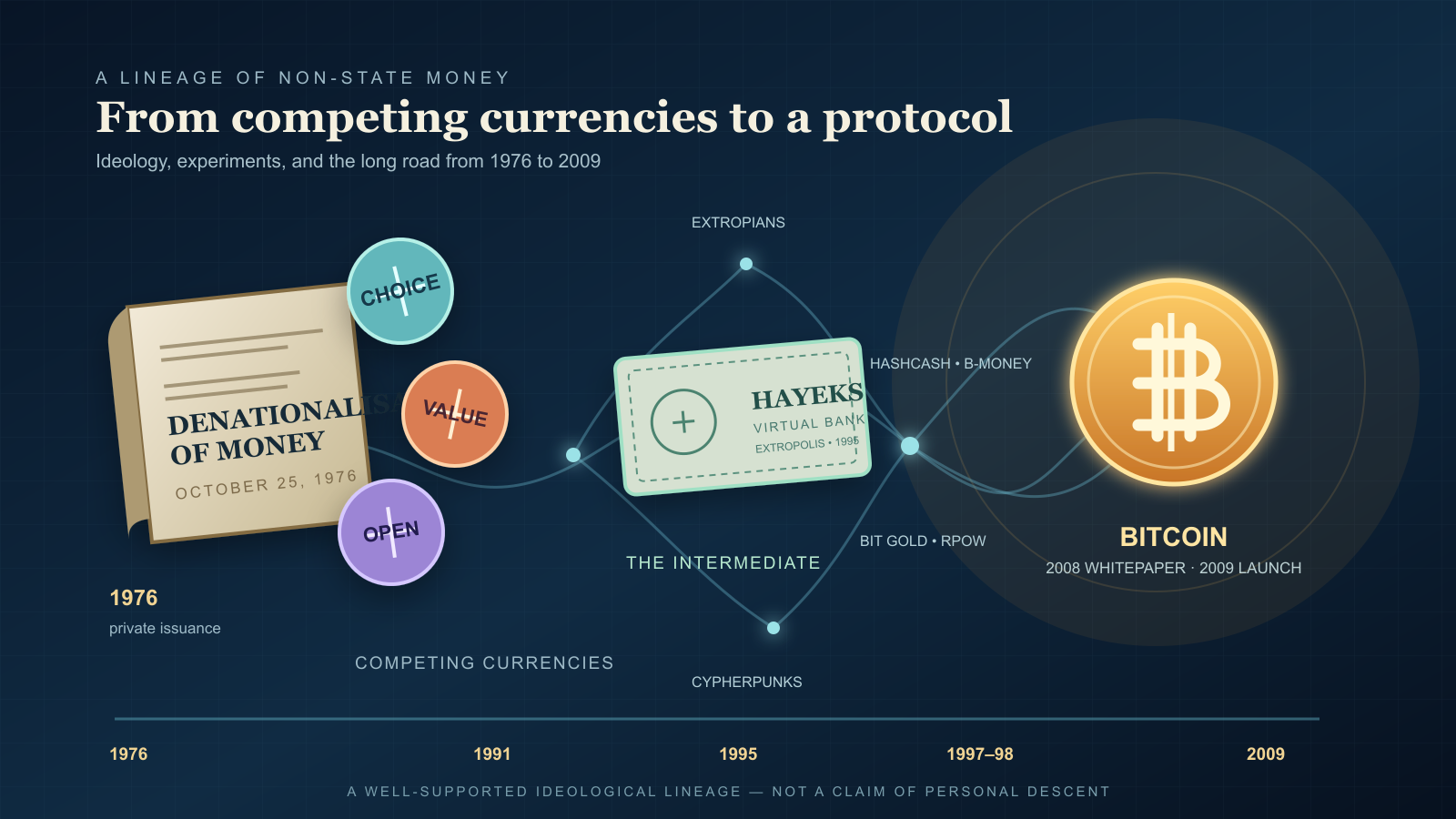
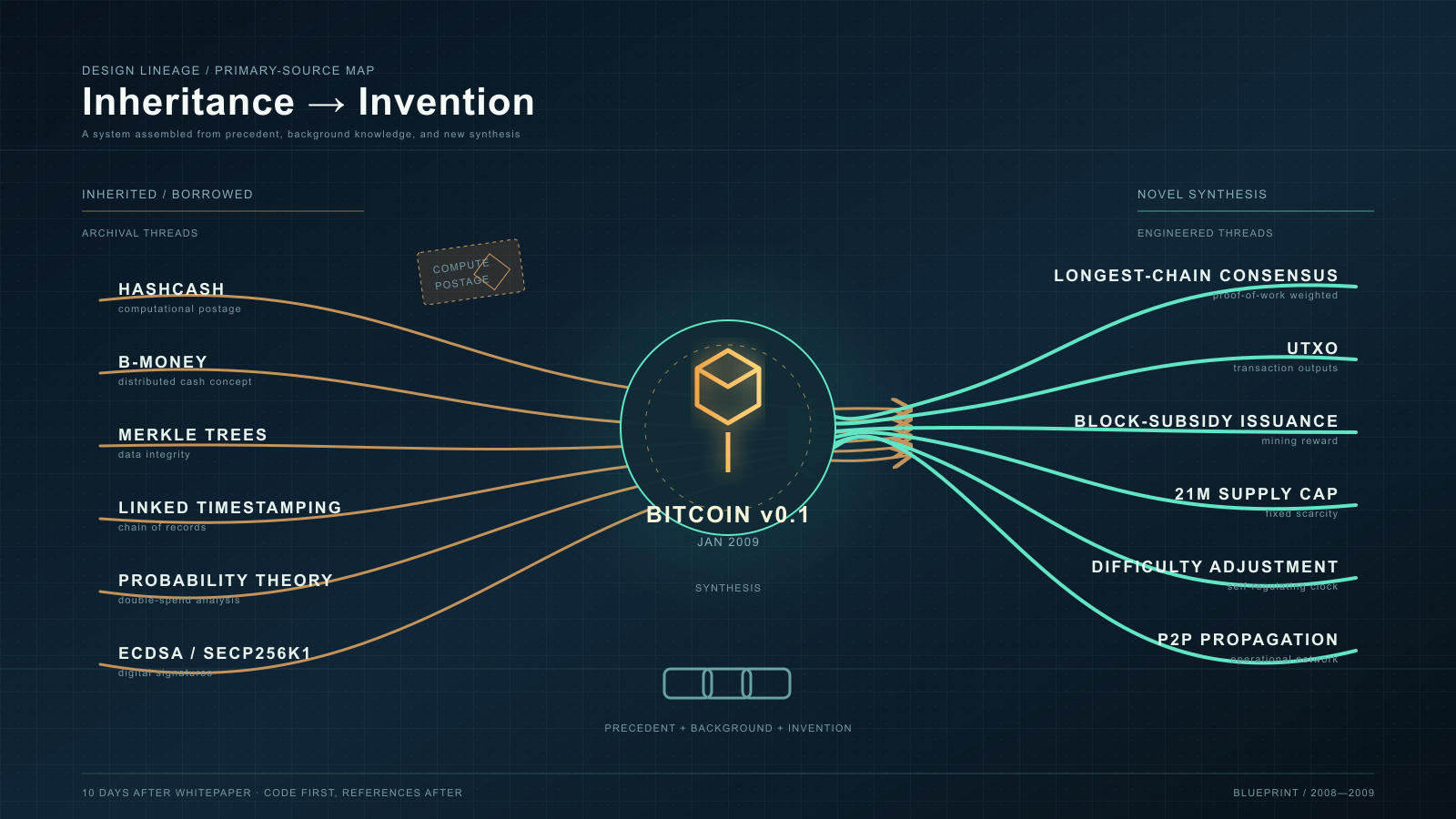
The cypherpunk movement produced a series of digital-cash and proof-of-work proposals over the decade preceding Bitcoin. Each is documented in this archive:
| Year | Author | Proposal | Relation to Bitcoin |
|---|---|---|---|
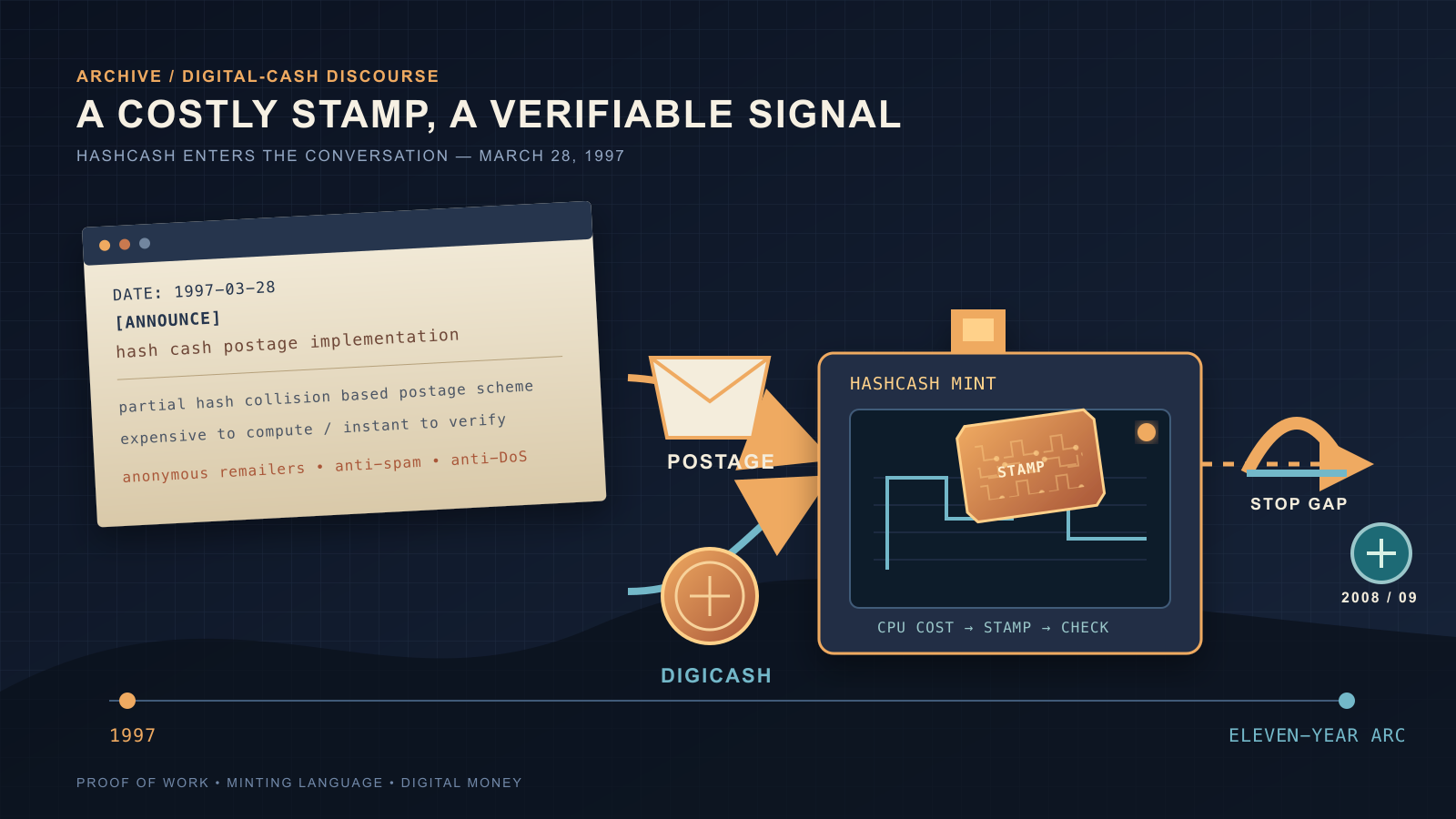
| 1997 | Adam Back | Hashcash | Proof-of-work as anti-spam/anti-Sybil mechanism. Cited as reference [6] in the Bitcoin whitepaper |
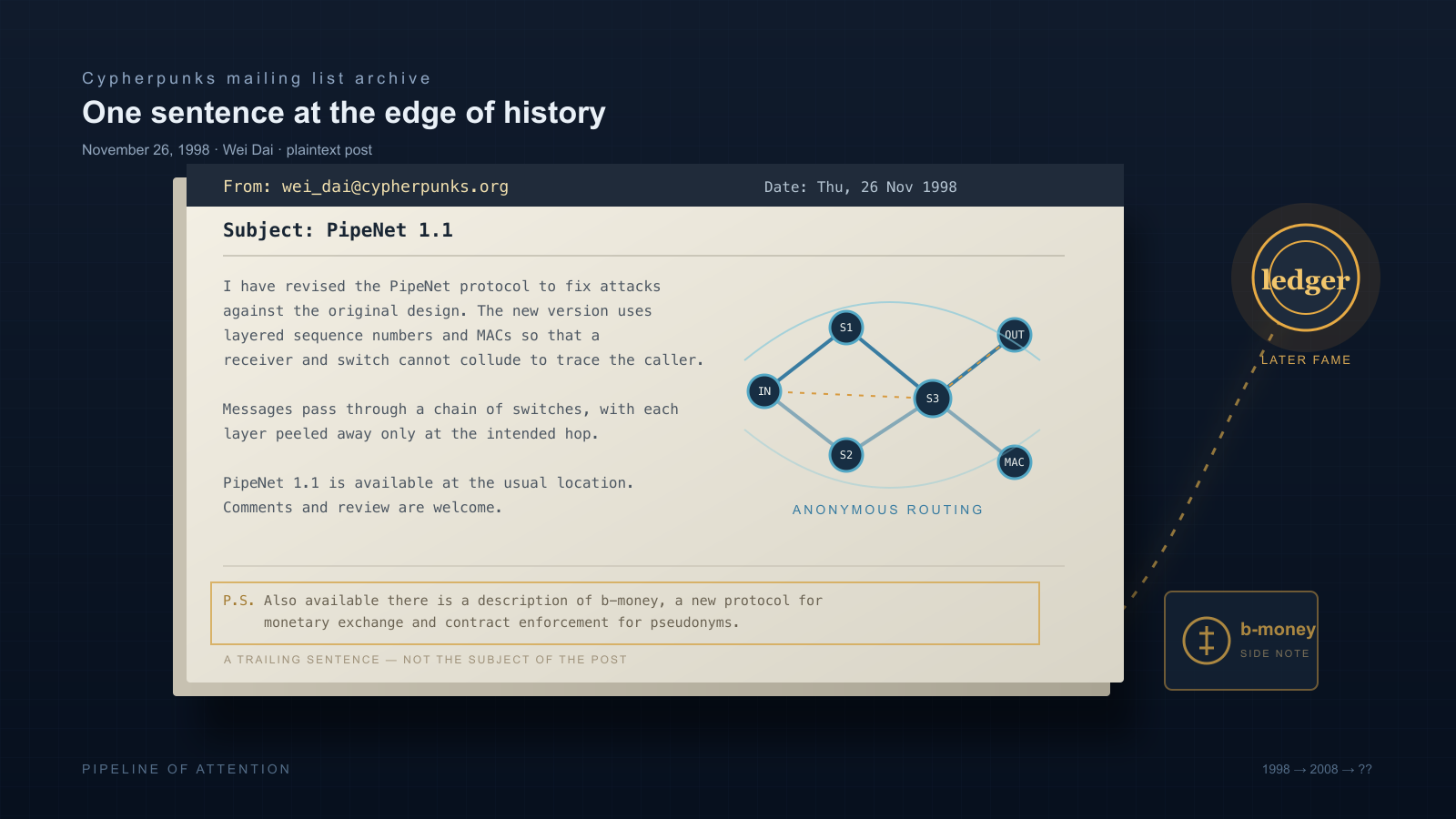
| 1998 | Wei Dai | b-money | Distributed digital cash with broadcast-based ledger and computational-puzzle issuance. Cited as reference [1] in the Bitcoin whitepaper |
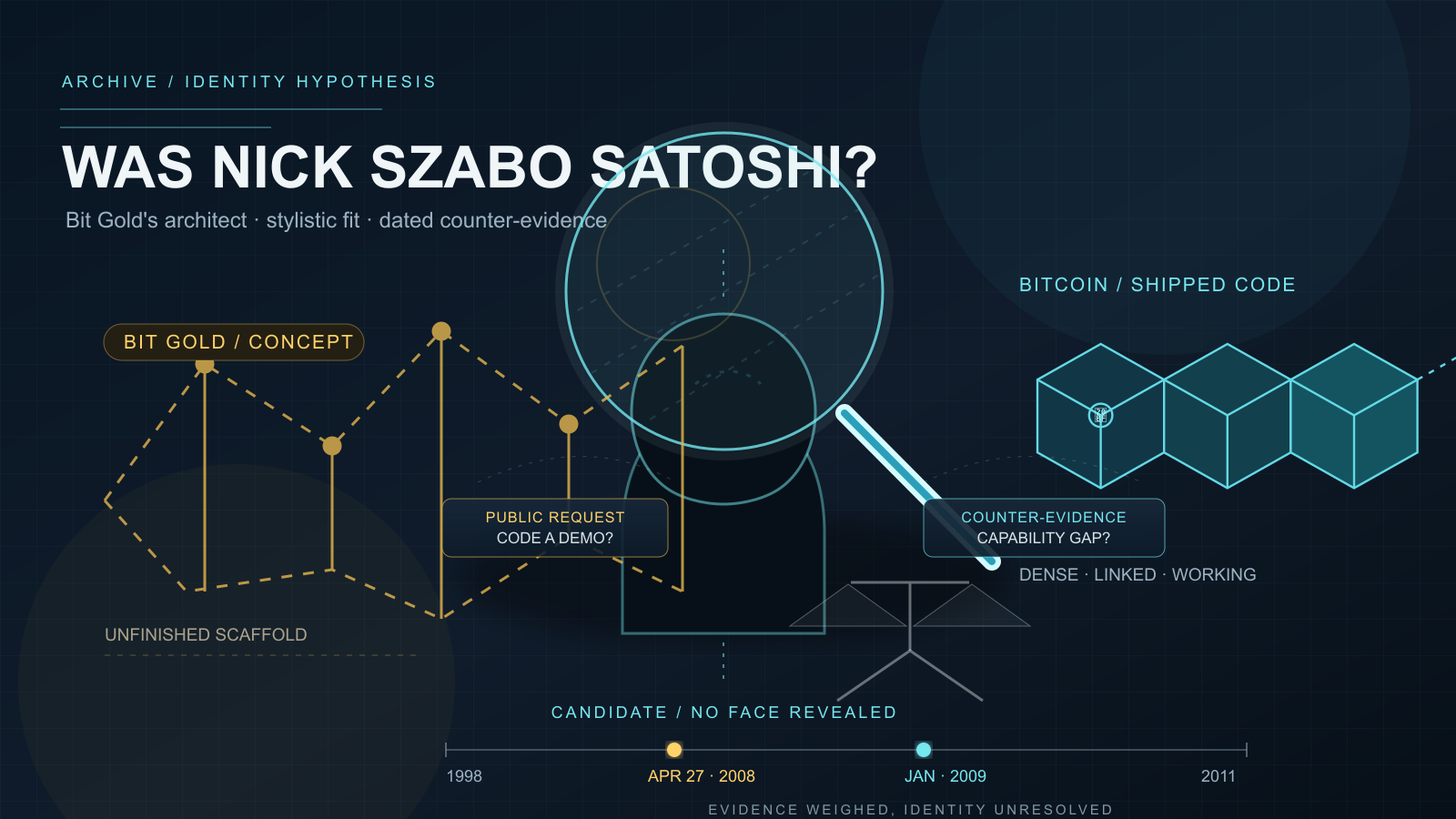
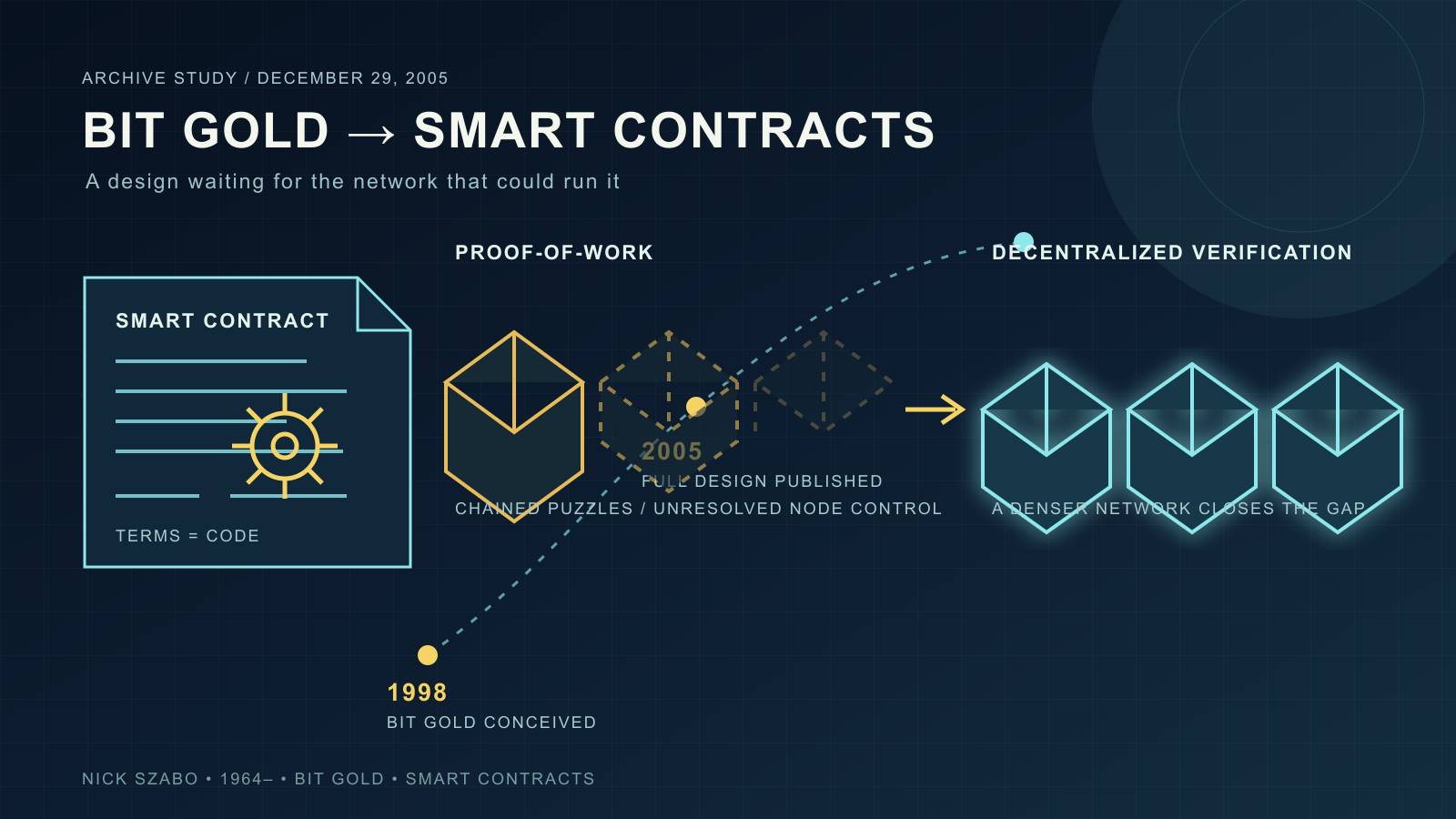
| 1998 | Nick Szabo | Bit Gold | Chained proof-of-work tokens; not cited in the whitepaper but acknowledged by Satoshi in later forum posts |
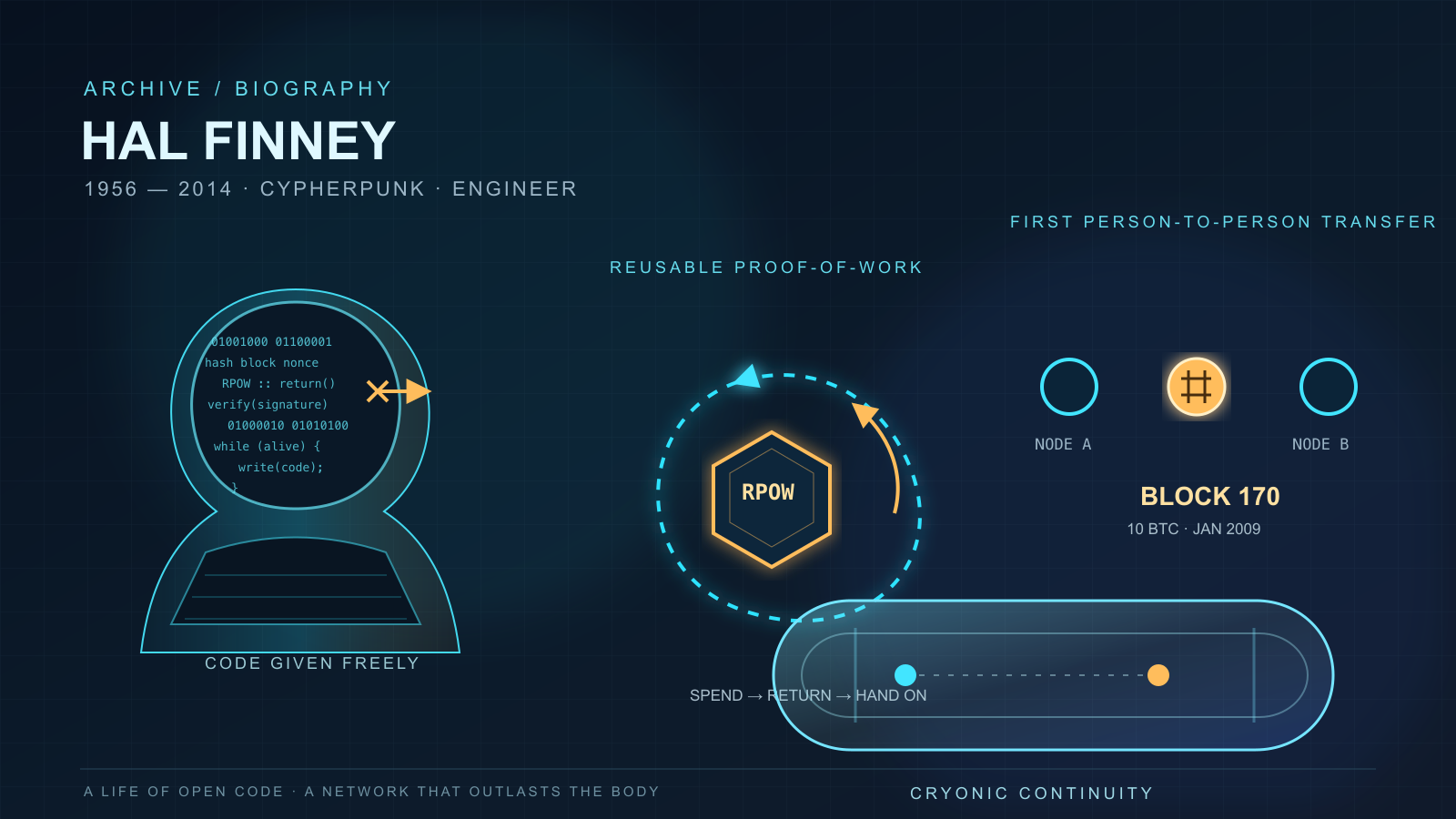
| 2004 | Hal Finney | RPOW (Reusable Proof-of-Work) | Centralized server issuing reusable PoW tokens; Finney later became Bitcoin’s first known non-Satoshi node operator |
| 2008 | Satoshi Nakamoto | Bitcoin | The synthesis |
Which of these proposals Bitcoin reuses, borrows, or synthesizes — component by component — is worked out in the design-lineage analysis.
§2 examines what of this lineage Satoshi actually knew during the development period, and what he did not.
2. What Satoshi documented knowing — and not knowing — during the development period
2.1 The coding-period statements and what Satoshi said about the work order
Satoshi referenced the duration of his Bitcoin work in the public record several times. Two are coding-period framings.
On November 17, 2008, 17 days after the whitepaper was posted, on the cryptography mailing list (archived post):
“I believe I’ve worked through all those little details over the last year and a half while coding it, and there were a lot of them.”
On July 21, 2009, in a private email to Martti Malmi (archived):
“need a break from it after 18 months development”
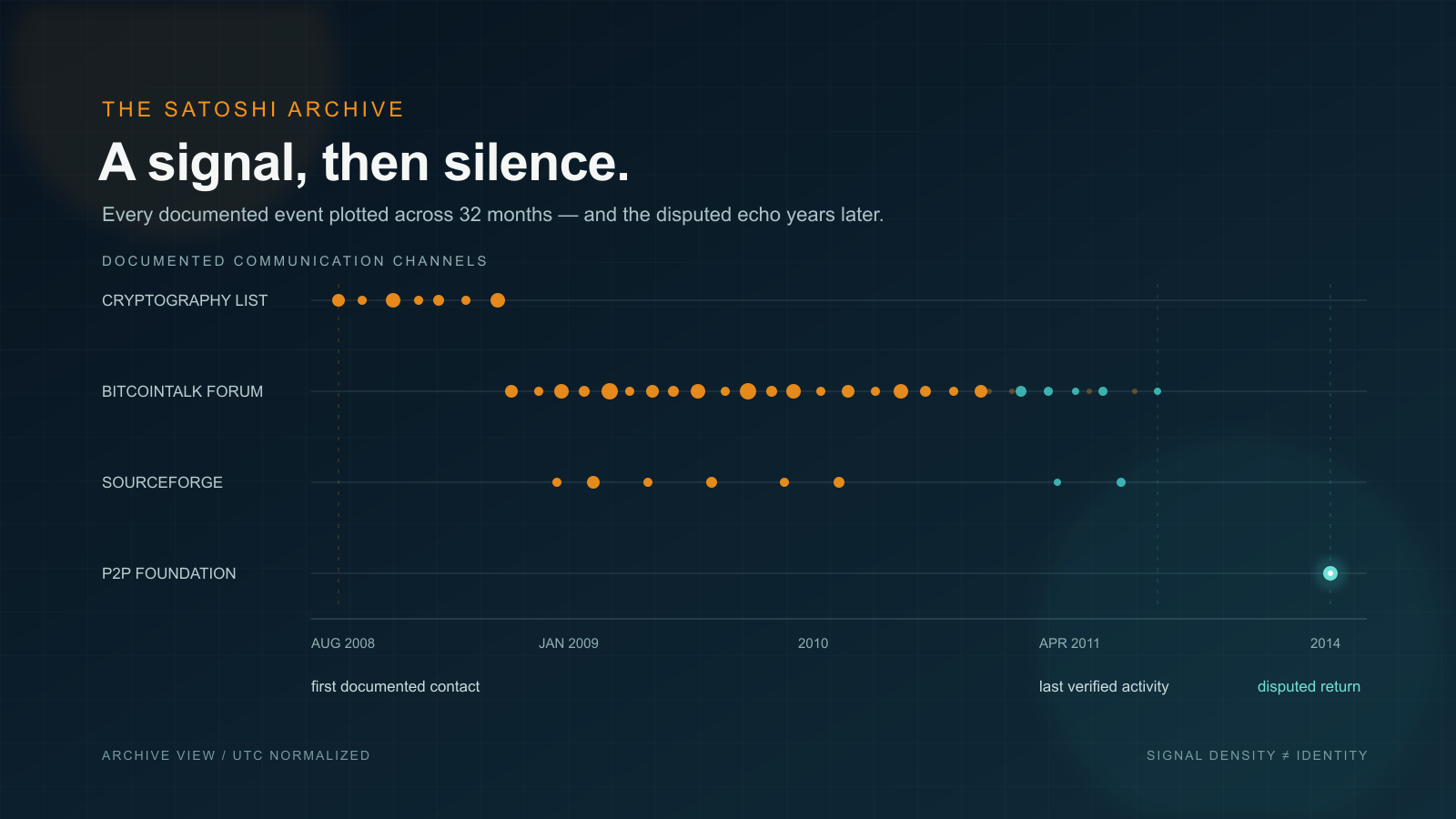
Read together, these two locate an approximately 18-month coding period whose end-point sits around the v0.1 release in January 2009, with the start in mid-2007.
Two later statements broaden the picture. On June 18, 2010, asked by Laszlo Hanyecz on BitcoinTalk how long he had been working on the design, Satoshi replied:
“Since 2007. At some point I became convinced there was a way to do this without any trust required at all and couldn’t resist to keep thinking about it. Much more of the work was designing than coding.”
And on January 10, 2011, in a private email to Mike Hearn about ECDSA key sizes (archived):
“I must admit, this project was 2 years of development before release”
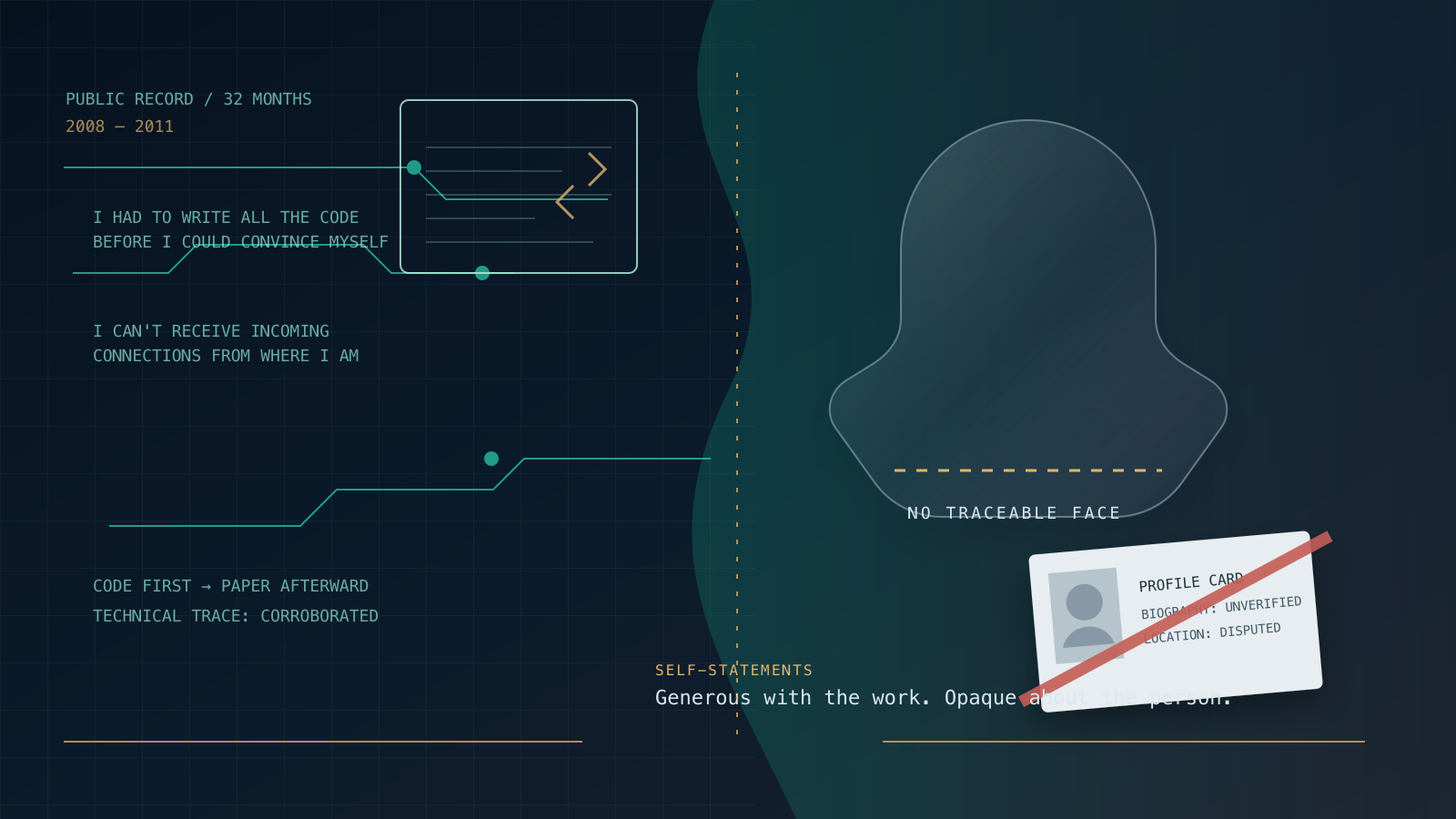
The June 2010 reply’s “Much more of the work was designing than coding” is about the share of effort within the work, not about a discrete pre-coding design phase. The work order Satoshi himself documented separately is that the code came first and the paper came second — “I had to write all the code before I could convince myself that I could solve every problem, then I wrote the paper” (Satoshi to Hal Finney, November 9, 2008). The 18-month coding span and the “Since 2007” / “2 years of development before release” framings describe the same pre-release work with different scopes and granularities — the contemporaneous coding-window framing and the later approximately-2-year retrospective; they do not establish a separate design phase that preceded coding.
2.2 What was known during that period
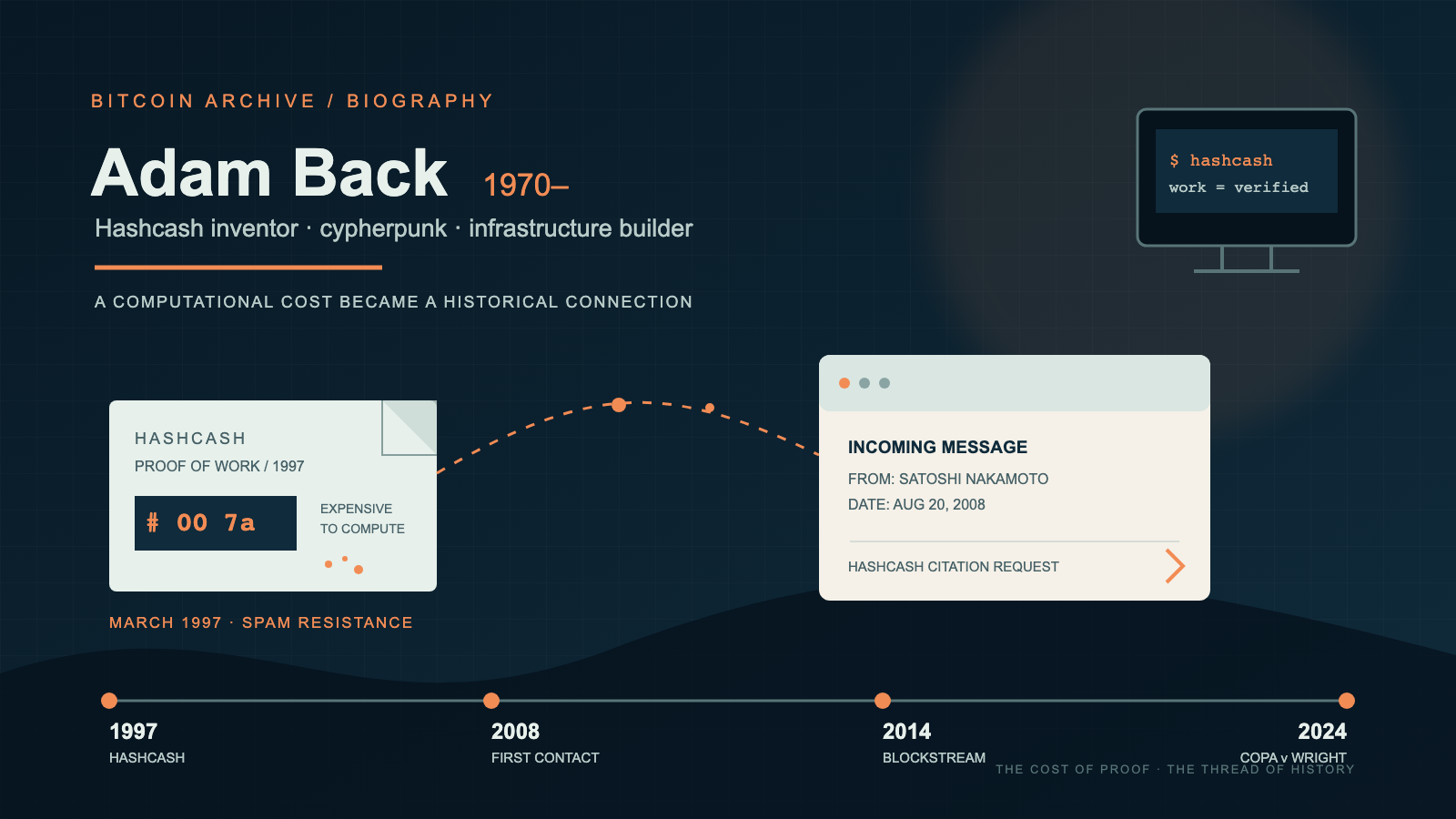
The earliest known Satoshi communication is dated August 20, 2008 — the email to Adam Back asking for the correct Hashcash citation (archived). At that point, the design was substantially complete: Satoshi was preparing to release “a paper that expands on your ideas into a complete working system” and attached a pre-release draft (ecash.pdf).
Adam Back’s reply on August 21, 2008 introduced Satoshi to b-money for the first time. Satoshi’s response is recorded verbatim in the COPA v. Wright trial evidence:
“Thanks, I wasn’t aware of the b-money page, but my ideas start from exactly that point.”
This is a primary-source confirmation, in Satoshi’s own words, that during the pre-disclosure phase of the project (the coding period running from mid-2007 to August 2008, within the approximately 2-year pre-release work Satoshi later described as “Since 2007” / “2 years of development before release”) he did not know about b-money — the closest pre-existing proposal in design space. He learned of it only after the system was substantially built, then contacted Wei Dai directly the next day (August 22, 2008) and added the citation as reference [1] to the whitepaper.
2.3 What this constrains
The chronology constrains what can be said about Satoshi’s relationship to the cypherpunk technical lineage during development:
| Source | Status during the pre-disclosure implementation phase (mid-2007 to 2008-08-20) |
|---|---|
| Hashcash (Back 1997) | Known — Satoshi sought the citation himself |
| b-money (Dai 1998) | Not known — Satoshi’s own admission to Back |
| Bit Gold (Szabo 1998) | Public record contains no Satoshi statement during this period; later forum acknowledgments date from 2010 onward |
| RPOW (Finney 2004) | Public record contains no Satoshi statement during this period |
Cypherpunks mailing list (1992-2001) and successor cryptography@metzdowd.com | Reading possible, active participation undocumented — Satoshi posted the whitepaper announcement on October 31, 2008, but no earlier participation under the Satoshi name has surfaced |
Wei Dai’s January 2014 retrospective (archived) provides a second independent constraint:
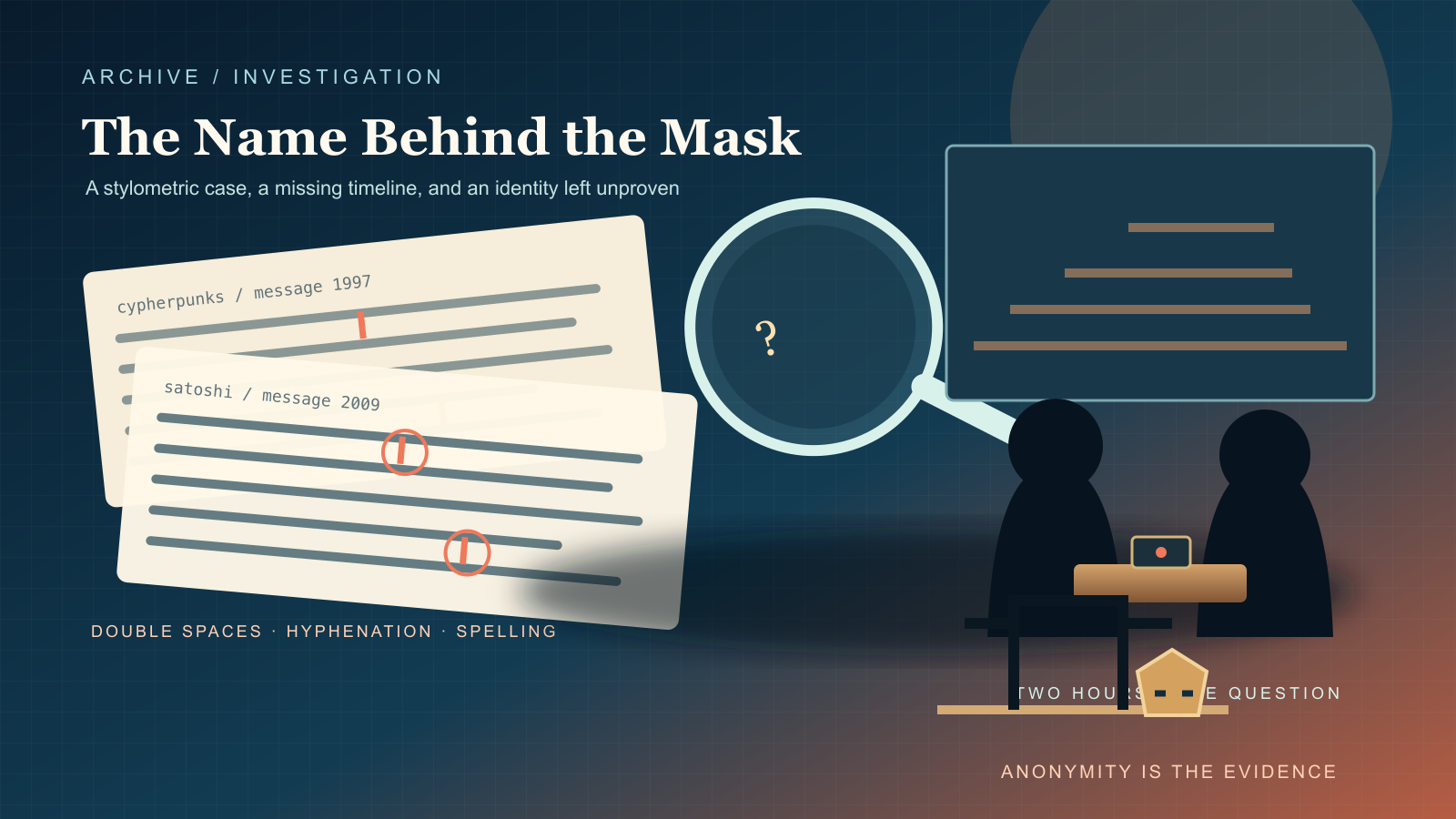
“My guess is that he’s not anyone who was previously active in the academic cryptography or cypherpunks communities, because otherwise he probably would have been identified by now based on his writing and coding styles.”
Two independent strands — Satoshi’s b-money disclaimer and Dai’s identifiability argument — converge: a designer working outside the cypherpunk community’s visible participation, with Hashcash as the one known prior reference.
3. Documented practice and the cypherpunk core: an alignment table
The following table compares Satoshi’s documented practices (left column, traceable to public records) against the six cypherpunk principles from §1.2 (right column). Each row labels the source for the practice claim.
| Cypherpunk principle | Satoshi’s documented practice | Source |
|---|---|---|
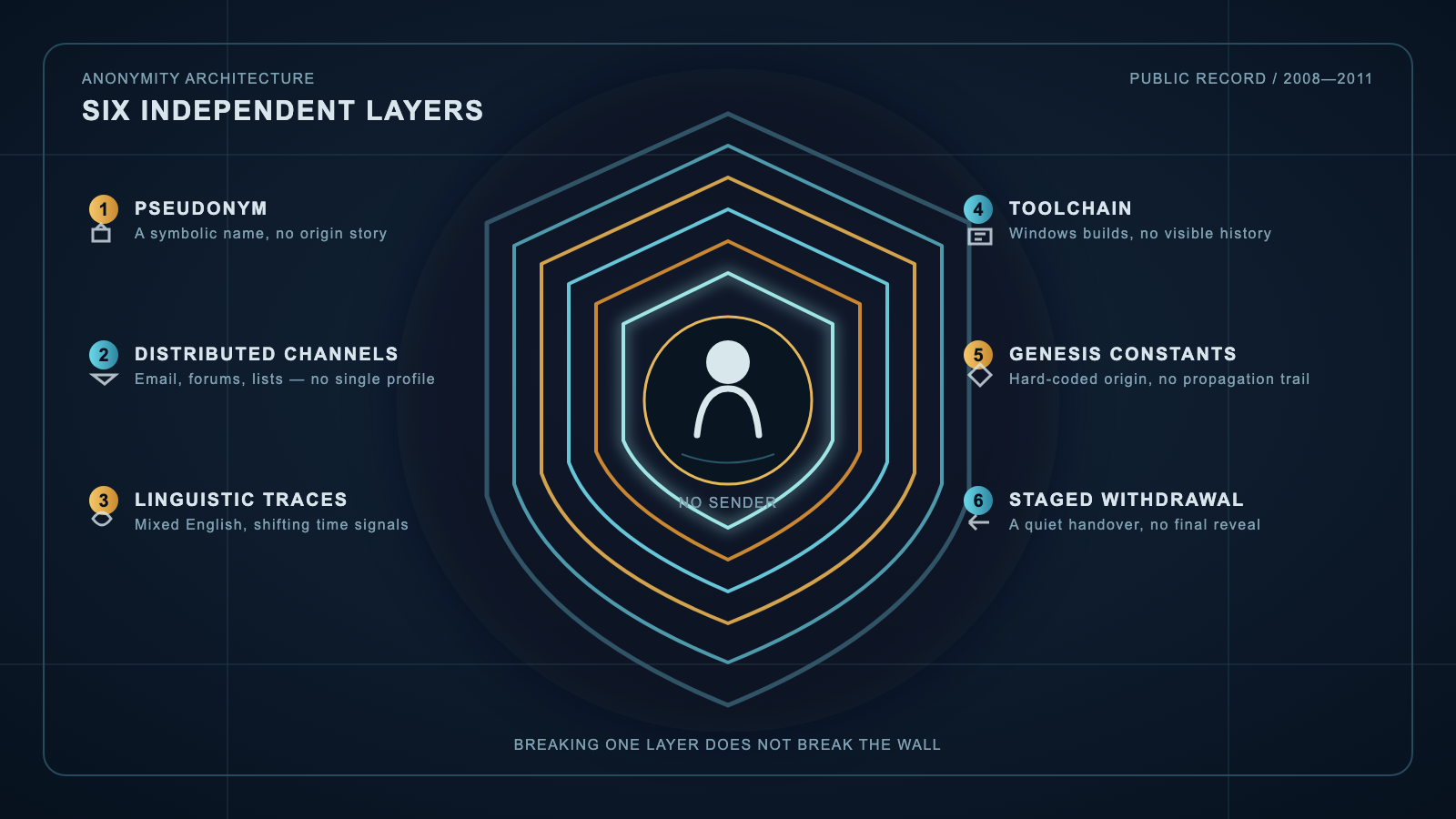
| 1. Privacy is power | Strong personal anonymization throughout — pseudonymous handle, anonymous email relay (AnonymousSpeech.com), no IP-traceable identifiers, never sent identity-revealing metadata in correspondence | Email headers in CoinDesk’s 2020 release; Hal Finney’s contemporaneous correspondence |
| 2. Code as activism | Released code first, then described it; the whitepaper announcement linked directly to the running v0.1 binary; subsequent fixes shipped as code, not statements | v0.1 release post 2009-01-08; v0.1.2 patch announcement Jan 11, 2009 |
| 3. Trust replaced by mathematics, not institutions | Genesis block coinbase: “The Times 03/Jan/2009 Chancellor on brink of second bailout for banks” — explicit framing of the system against the institutional bailout context; consensus rules constructed entirely from cryptographic verification, no trusted third party | Block 0 coinbase; whitepaper §1 “What is needed is an electronic payment system based on cryptographic proof instead of trust” |
| 4. Decentralization as structural commitment | Peer-to-peer architecture from v0.1; no central server in the protocol; the genesis block’s hardcoded structure (see genesis analysis) makes Block 0 itself decentralizable — every node reconstructs it locally | v0.1 source code; whitepaper §5 “Network” |
| 5. Pseudonymity as civic ground | Operated under “Satoshi Nakamoto” as a fully-functional civic-economic identity — published a paper, ran code, conducted correspondence, accepted attribution and citation — without ever revealing a backing identity | Entire Satoshi correspondence corpus 2008-2011 |
| 6. Free flow of information / censorship resistance | Released v0.1 source code under the MIT license from day one; published the whitepaper to an open mailing list; replied to objections in public archived discussion; declined to gatekeep | v0.1 source license header; cryptography ML thread Oct-Nov 2008 |
The alignment is unusually tight on all six points. None of the matches is engineered after-the-fact: each row’s right column was documented in 2008-2011 contemporary records, before the cypherpunk-Satoshi alignment had become a topic of analysis.
4. The “independent arrival” reading — and what stays open
Three observations now sit on the table:
- (a) Satoshi did not know b-money during the pre-disclosure coding period (own admission, August 2008).
- (b) Satoshi was likely not previously active in cypherpunk communities (Wei Dai’s identifiability argument, 2014).
- (c) Satoshi’s documented practice maps point-by-point onto the cypherpunk philosophical core (§3 alignment).
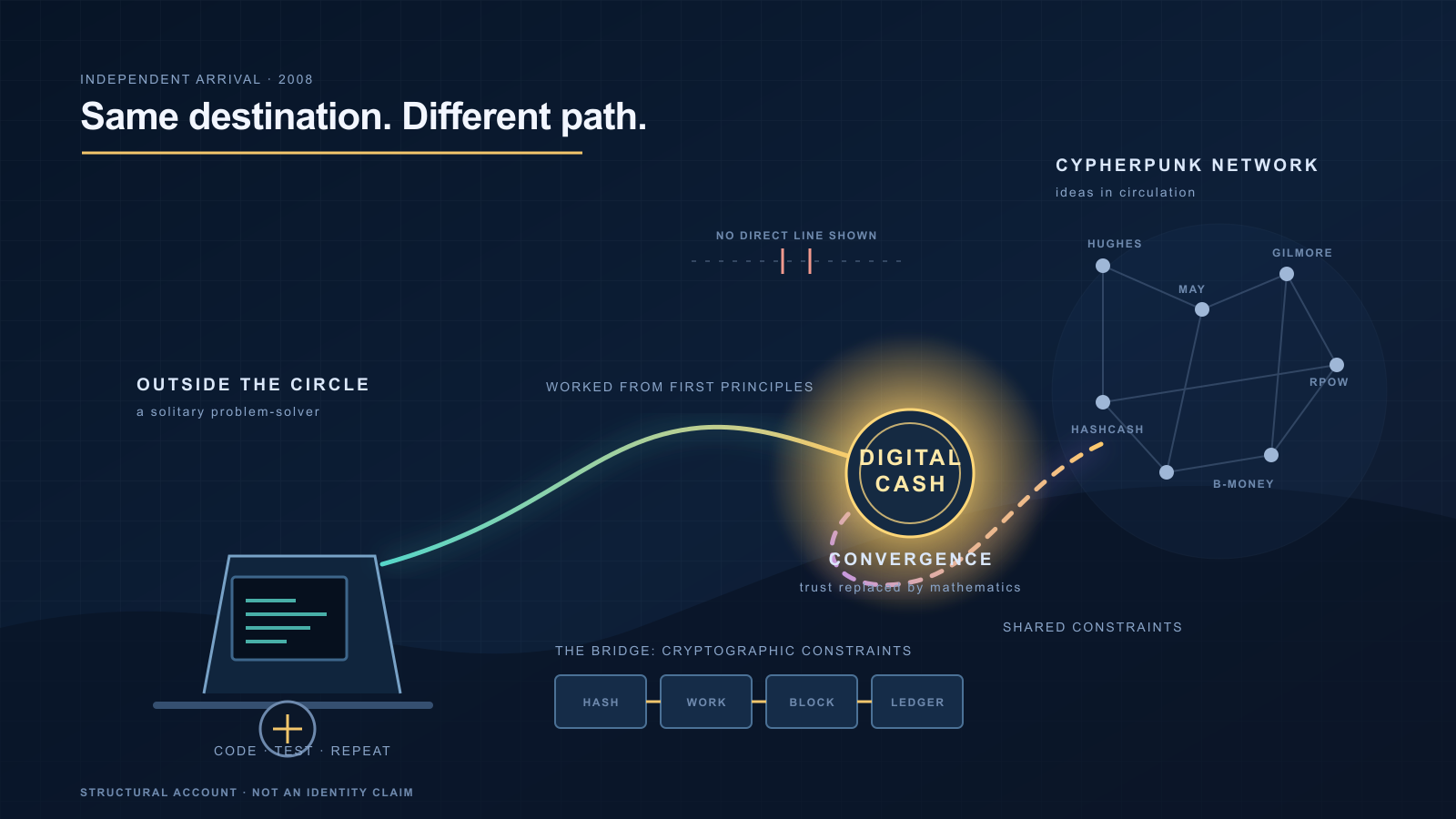
Combining (a)+(b)+(c), the most parsimonious reading is independent arrival: Satoshi reached the cypherpunk core not by participating in the community that articulated it, but by working through the same problem (digital cash without trusted intermediaries) under the same constraints (cryptographic primitives, distributed adversarial environment) and converging on the same answers. Wei Dai’s b-money is itself an instance of independent arrival on overlapping ground; Satoshi’s b-money disclaimer is structurally the same admission, one generation later.
The same pattern holds at a sharper resolution than the philosophical core. The specific configuration Bitcoin realizes — a Hashcash-style proof-of-work used as the minting mechanism for a decentralized digital cash — had been named a decade earlier by Adam Back himself. Replying to Wei Dai on the Cypherpunks list on December 6, 1998, Back proposed Hashcash as b-money’s minting function — “to create value you burn CPU time, just like with hashcash” — a configuration he proposed as a candidate but did not implement. But that articulation sits inside the b-money discussion — the same channel Satoshi documented not knowing. Satoshi did not inherit the configuration from the person who had already named it; he reached it and implemented it — resolving the Moore’s-law inflation problem Back flagged via difficulty adjustment, and adding the ledger, consensus, and 21-million cap that Back’s one-line sketch lacked. The independent arrival is therefore not only of the cypherpunk philosophical core but of the specific proof-of-work-as-value mechanism, reached without the one channel that had already articulated it. The passive-reader caveat below applies here too: the documented record places Back’s 1998 phrasing inside a discussion Satoshi did not know, but does not foreclose passive exposure.
But the reading should be held in three tiers, not collapsed into a single claim:
| Tier | Claim | Status |
|---|---|---|
| Established | Satoshi did not know b-money during the development period | Primary-source confirmation in own words (Aug 21, 2008) |
| Strongly supported | Satoshi was not a visible cypherpunk community participant | Wei Dai testimony + identifiability argument + absence of pre-2008 Satoshi-attributable mailing list activity |
| Genuinely open | Whether Satoshi was a passive reader of cypherpunk material — books, archived list discussion, Mondo 2000, the manifestos — during or before the development period | The public record neither establishes nor refutes this |
The “independent arrival” reading is compatible with the open tier in either direction. A reader who absorbed the manifestos quietly and built a system that operationalizes them would equally fit the documented record. What the record rules out is visible community membership, not exposure to the ideas.
This matters because it limits how strong a claim the alignment in §3 can support: the alignment is striking, but it is not by itself evidence of any specific identity hypothesis (cypherpunk insider, libertarian outsider, academic cryptographer working alone, or any other). It is evidence that the system Satoshi built and the principles Hughes articulated converge — and that this convergence happened with no visible community-level transmission.
5. Limits and counter-readings
- The alignment in §3 is curated, not exhaustive. Six principles is a condensation of a larger discourse. A different condensation (four principles, ten principles) would change the apparent tightness of the alignment. The reading is therefore strong evidence of structural overlap, not proof of correspondence.
- “Independent arrival” is one of several readings of (a)+(b)+(c). Alternatives: Satoshi was a quiet long-term reader; Satoshi reached the same conclusions through libertarian/Austrian-economics literature without going through the cypherpunk channel; Satoshi was an academic cryptographer whose institutional grounding routed around community identification. The public record is consistent with each.
- Wei Dai’s identifiability argument is heuristic, not deductive. Some cypherpunks may have written under pseudonyms and would have been hard to match by writing style. Dai’s argument is a defeasible probability claim, not a proof.
- No identity claim follows from this entry. Nothing here narrows Satoshi’s identity to a country, employment status, age, or any other personal attribute. The contribution is structural: a documented account of what intellectual position the system was built from.
This analysis covers the cypherpunk channel of the ideological transmission. The earlier Hayek→Extropian leg of the same lineage — Hayek’s 1976 Denationalisation of Money, the 1995 Extropian “Hayeks” thought-experiment, and how that economic-libertarian frame reached the 1990s digital-cash discussions before the cypherpunk movement coalesced — is treated as a separate analysis in the Hayek-Extropian lineage entry. The behavioural side of Satoshi’s documented practice — how he kept the same cypherpunk-aligned position on the technical axis while declining to extend the conversation to non-technical openings — is treated in Satoshi’s non-technical silence.
The reading downstream
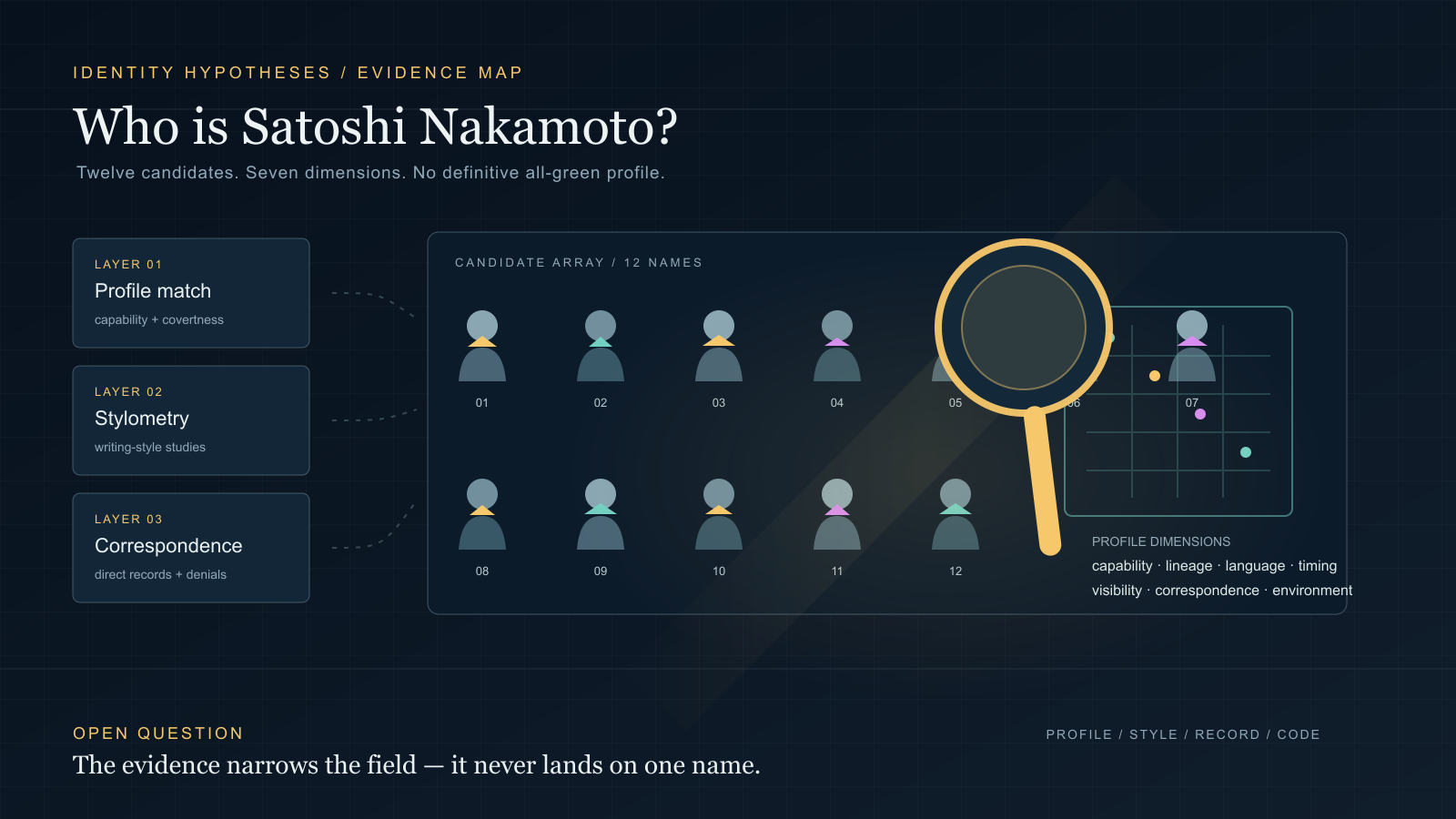
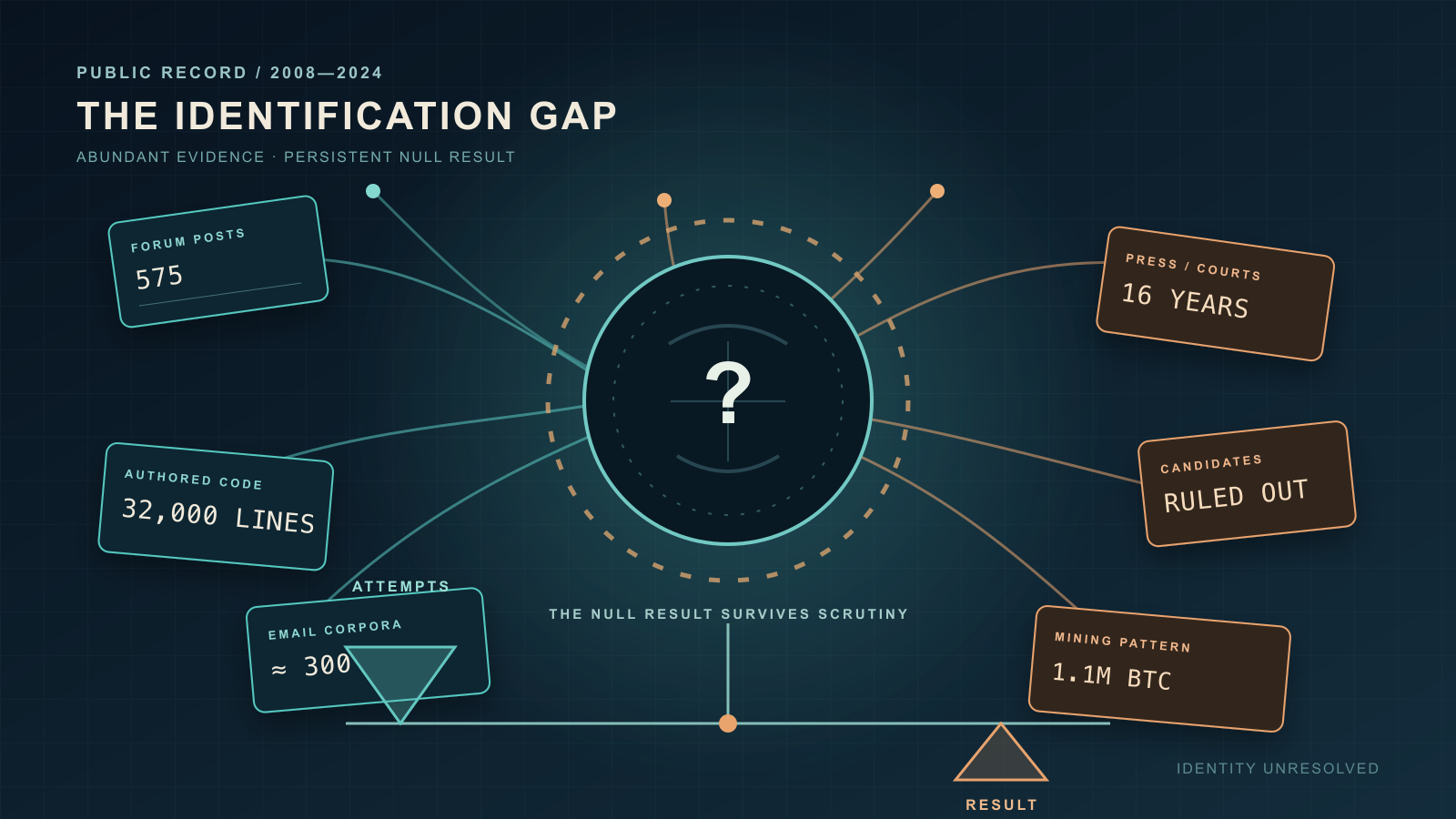
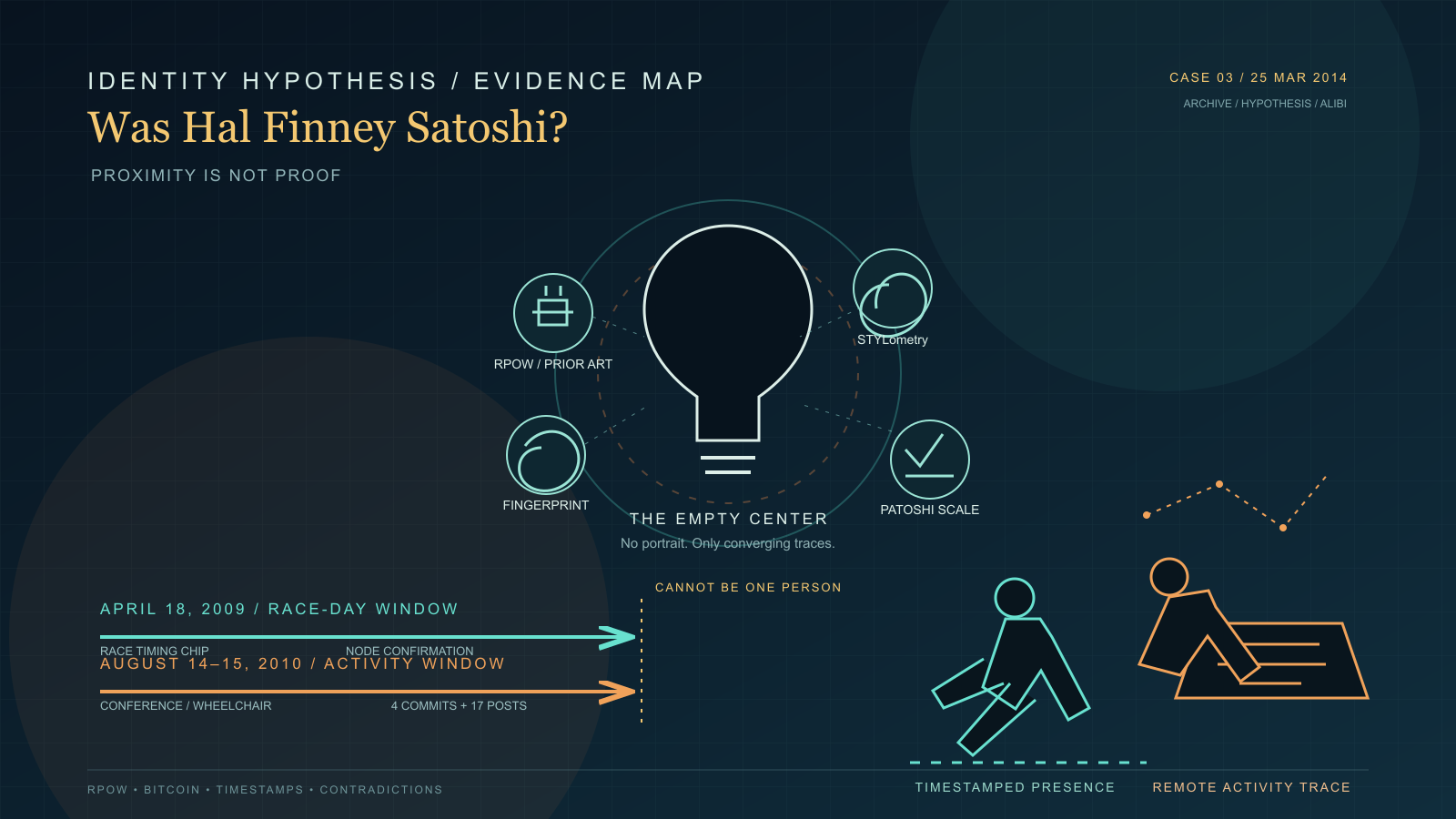
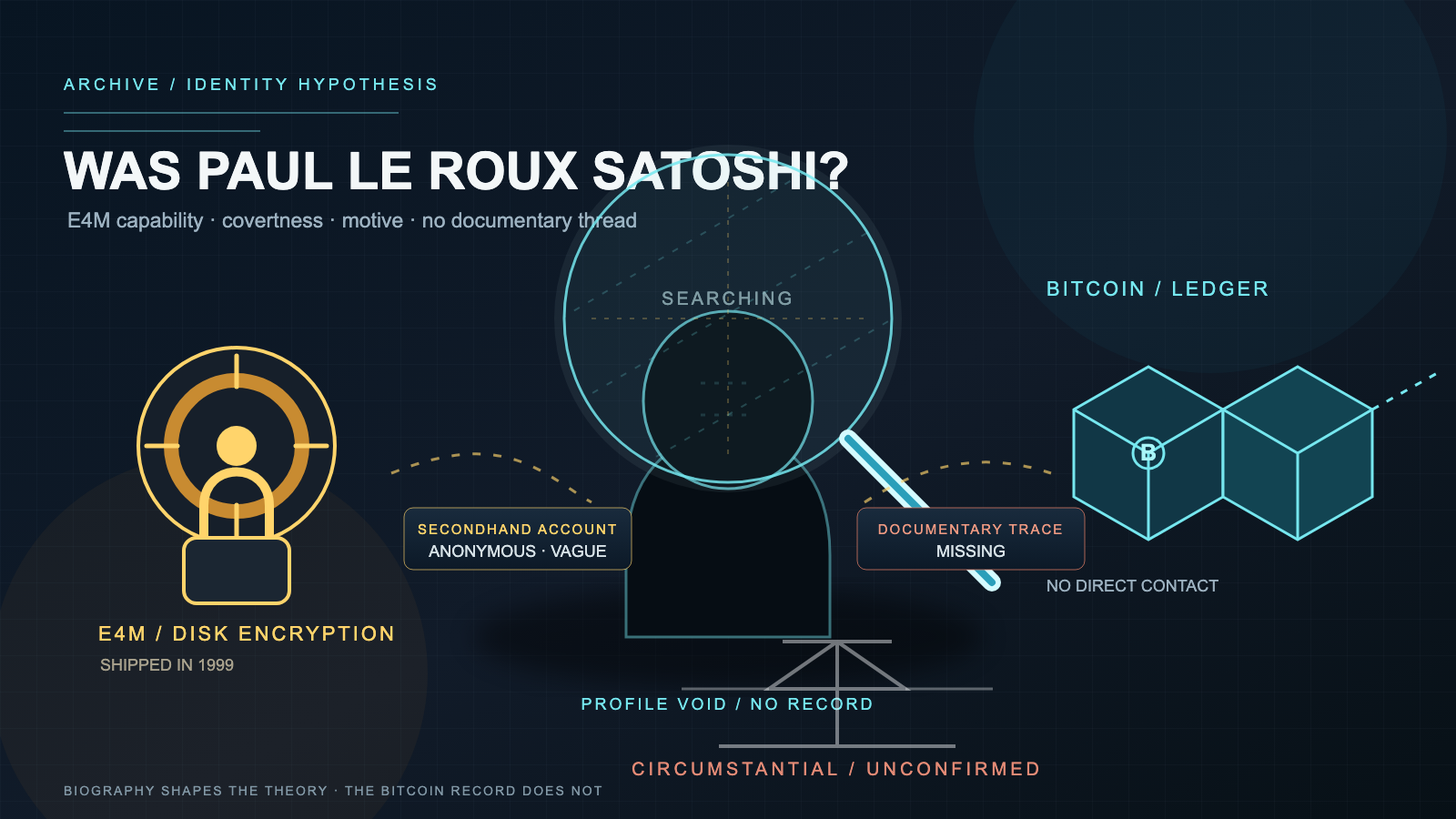
Every candidate hypothesis has to answer the independent-arrival question, which is why it runs through the identity-hypotheses overview and each individual case — Adam Back, Wei Dai, Nick Szabo, Hal Finney.
The manifesto’s first rule was that cypherpunks write code. The person who wrote the code that mattered most was, on every surviving record, outside the room where the rule was written. What this page leaves, and what I cannot close, is that gap: a set of principles and a system that embodies them, and no visible hand joining the two.