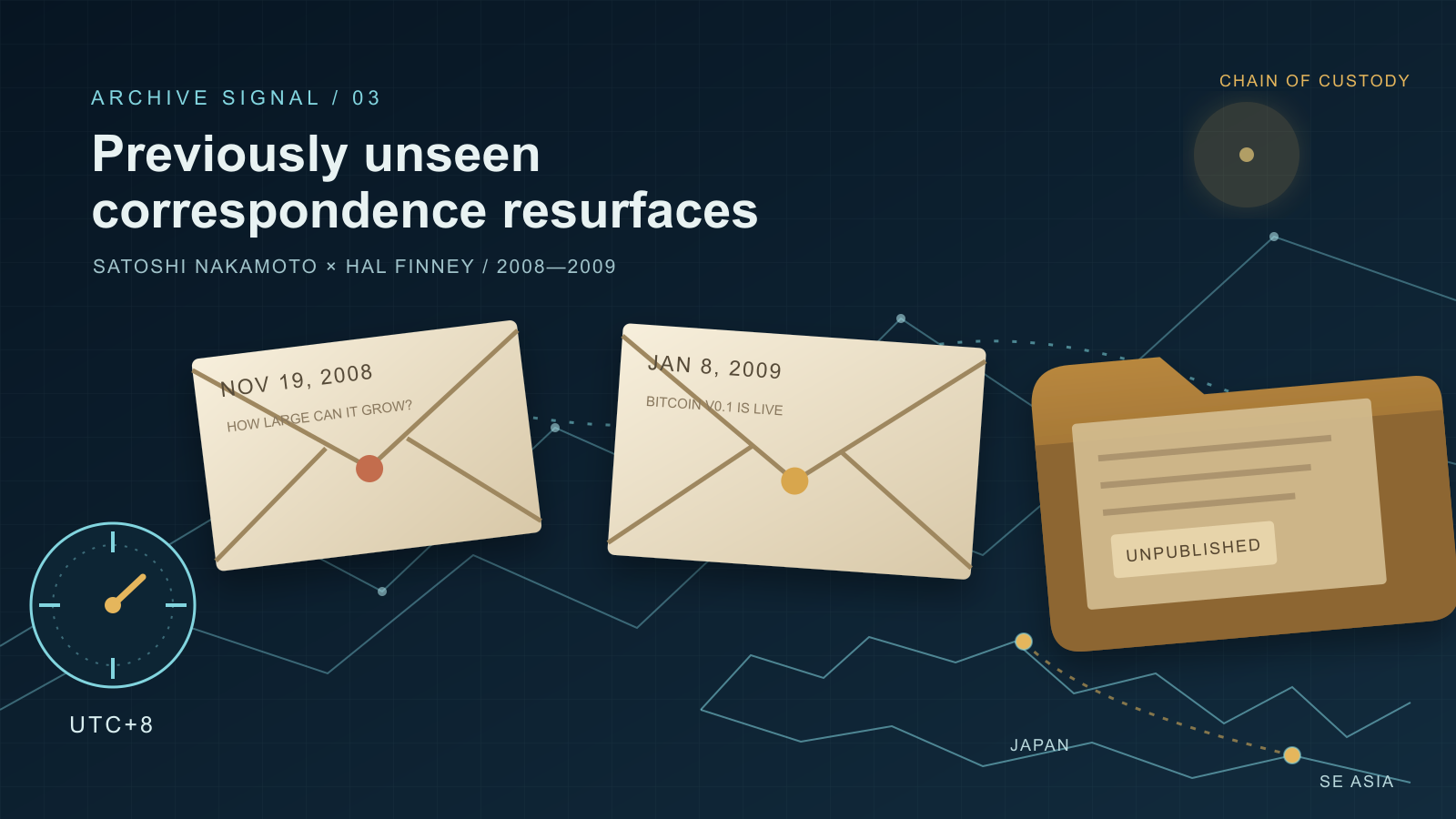
On January 12, 2009, Satoshi wrote to Hal Finney:
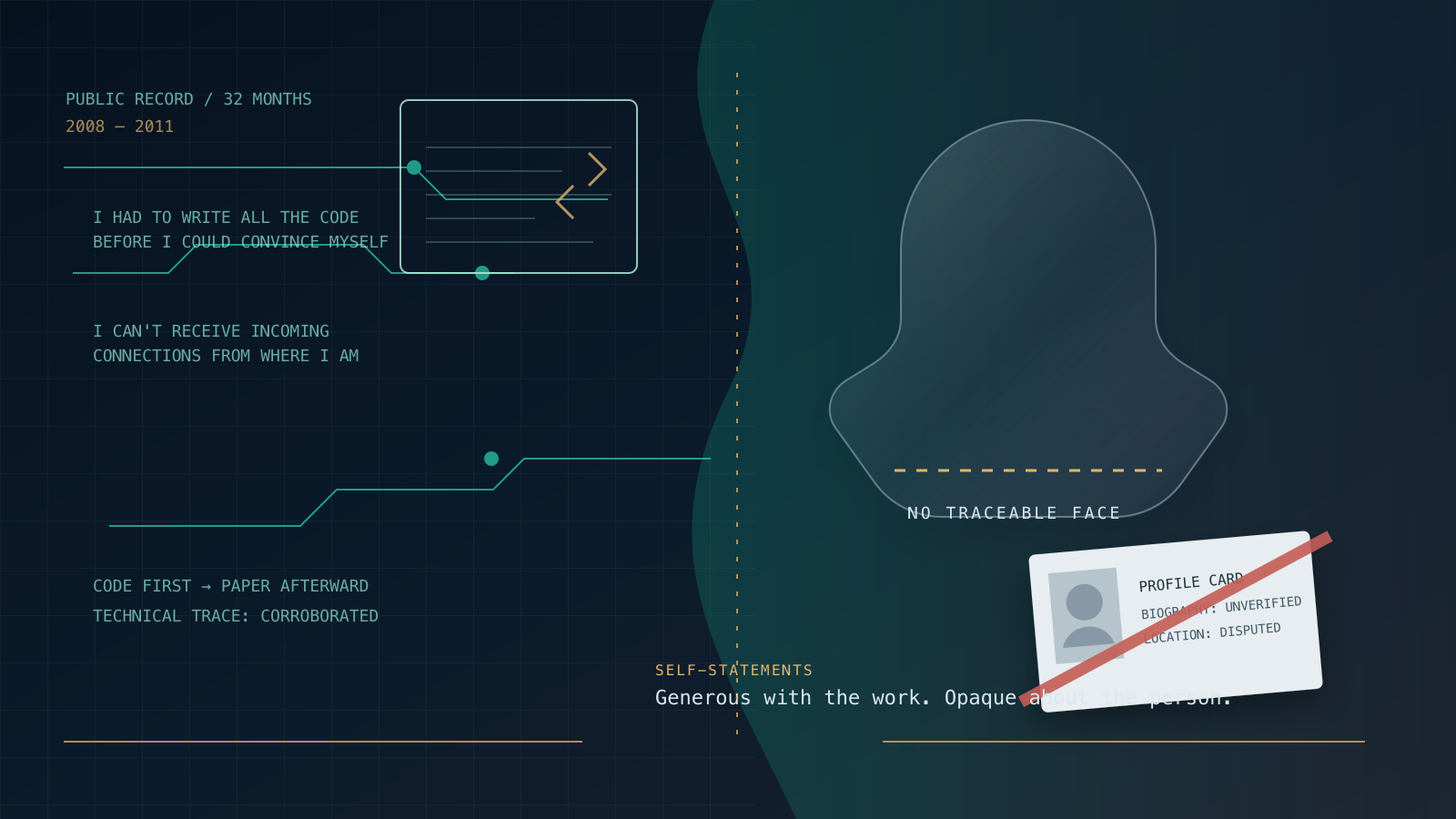
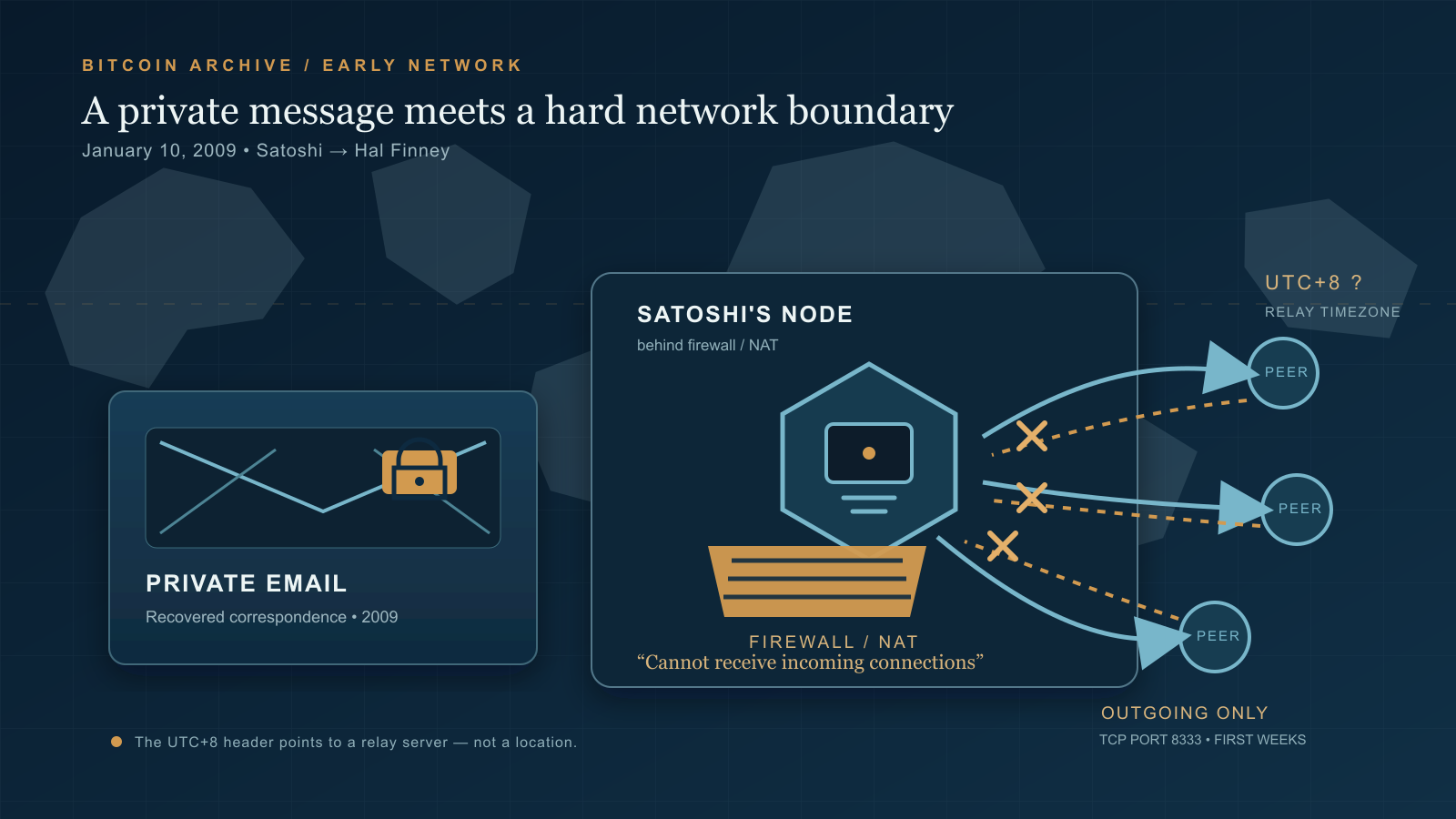
Satoshi Nakamoto“Unfortunately, I can’t receive incoming connections from where I am, which has made things more difficult.”
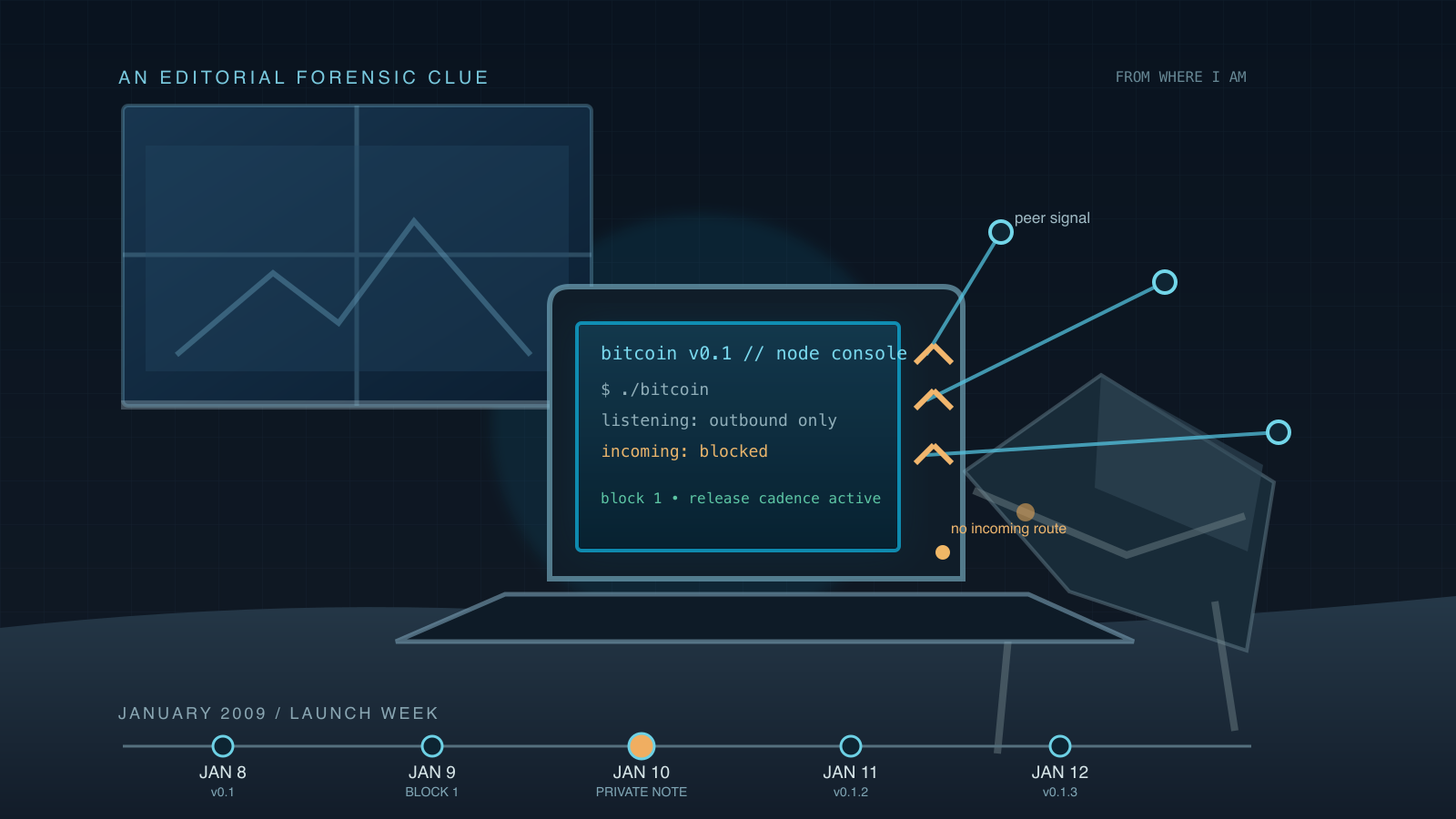
The clause “from where I am” — location-contingent, implicitly not a permanent property of Satoshi’s setup — combined with the unusually dense cadence of his Bitcoin work during the January 8–12, 2009 launch week, is the converging evidence this analysis reads. The reading is editorial.
This phrase is one line in a longer record of things Satoshi said about himself, catalogued in the self-statements inventory, which flags it as an operational disclosure rather than an identity-locating one; this analysis takes the same disclosure further, asking what kind of environment it actually points to.
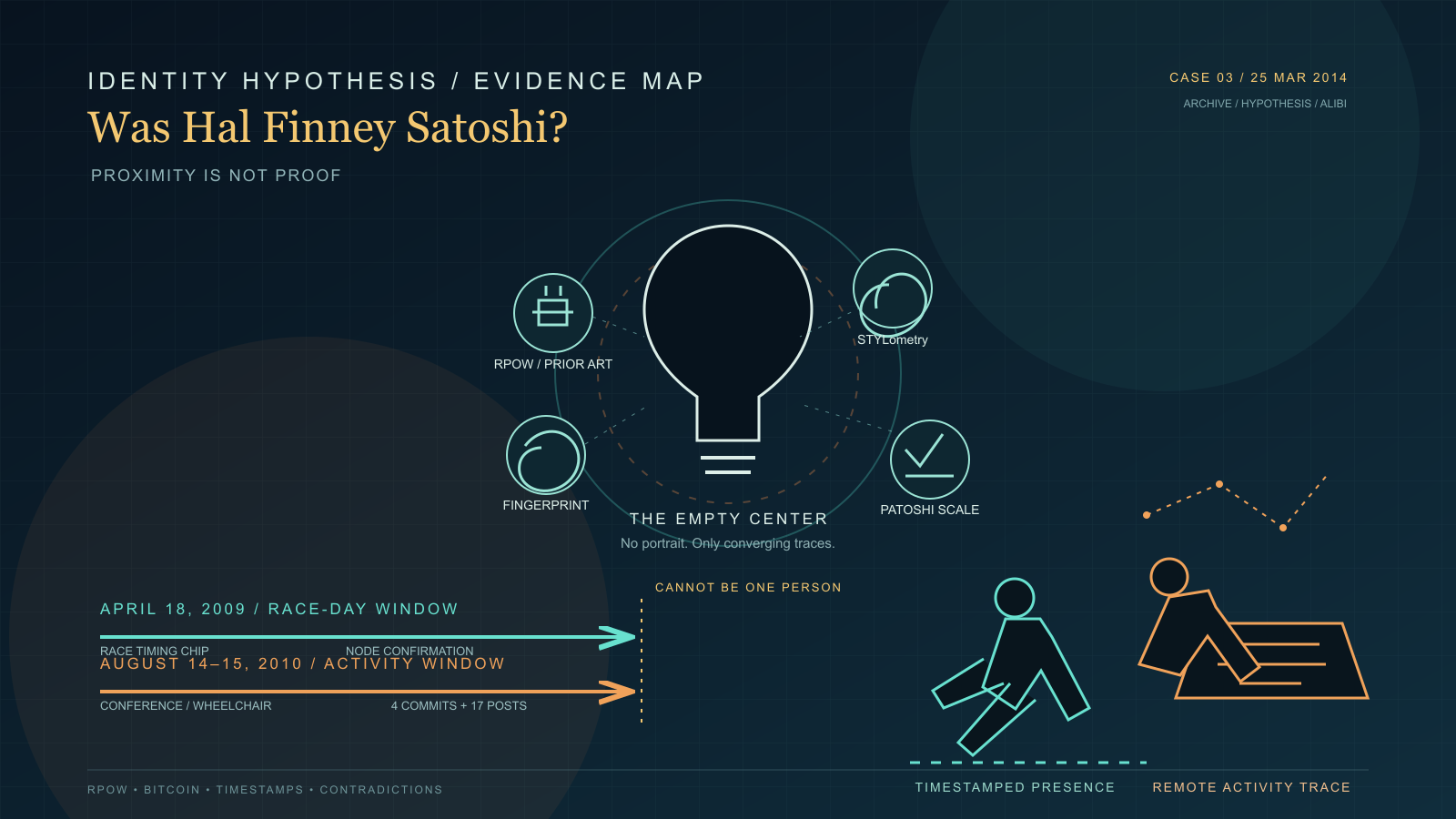
This entry is time-adjacent to the Genesis Block hardcode analysis, which covers the structural question of Block 0 and the Jan 3 → Jan 9 gap. The same launch week is read from a different angle — the IP-address divergence between Finney’s and Satoshi’s nodes recorded in the January 10, 2009 Bitcoin debug log — in the Hal Finney identity-hypothesis analysis.
1. The two signals
1.1 The email phrase (primary source)
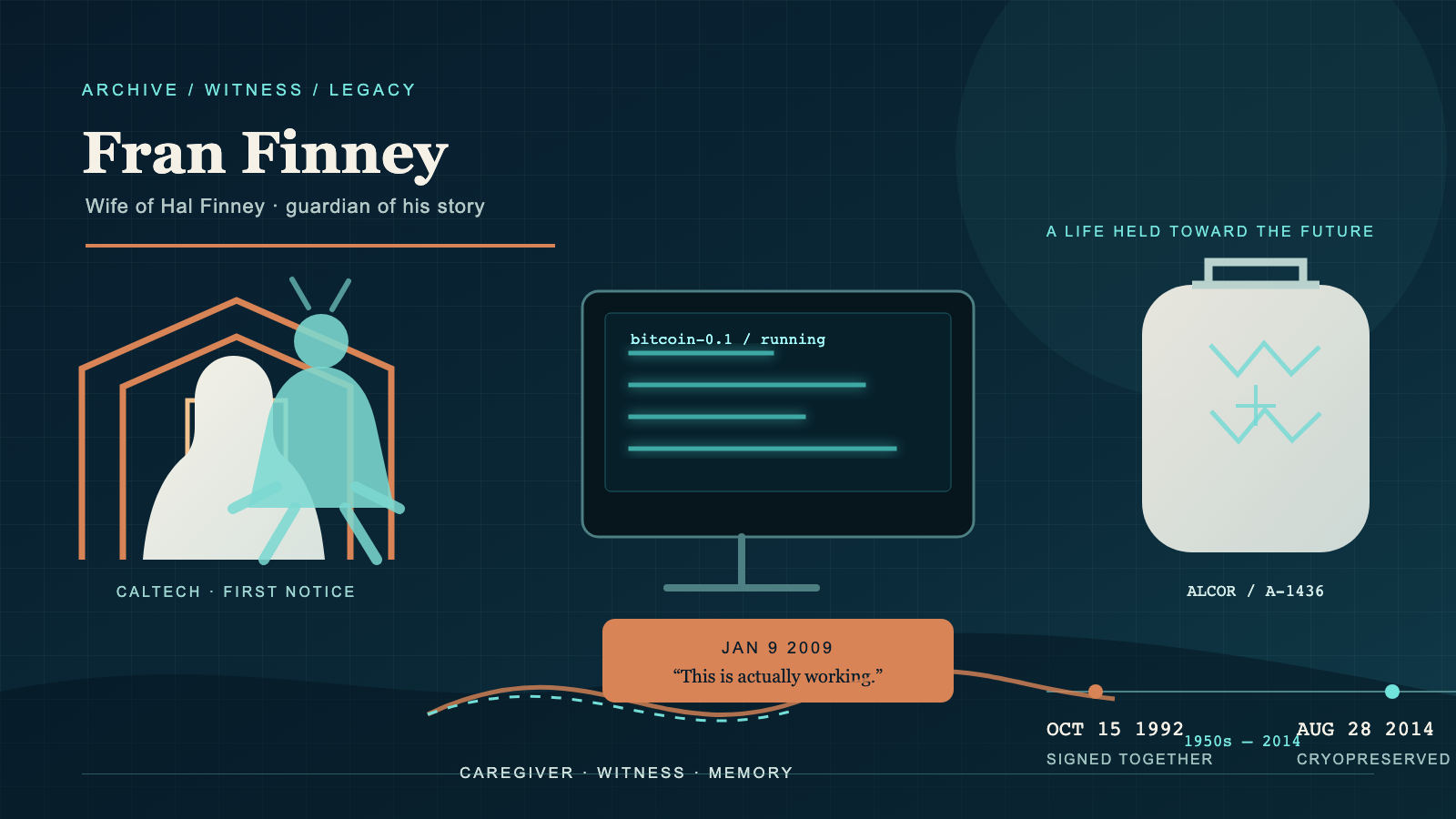
Satoshi’s private email to Hal Finney of January 12, 2009 falls on the last day of the launch window. Its text was first published by CoinDesk in November 2020, obtained from Finney’s personal computer via his widow Fran Finney; CoinDesk gives the date but no header timestamp. The operative passage:
Satoshi Nakamoto“Unfortunately, I can’t receive incoming connections from where I am, which has made things more difficult.”
The clause we focus on is “from where I am”.
1.2 Activity cadence (primary sources)
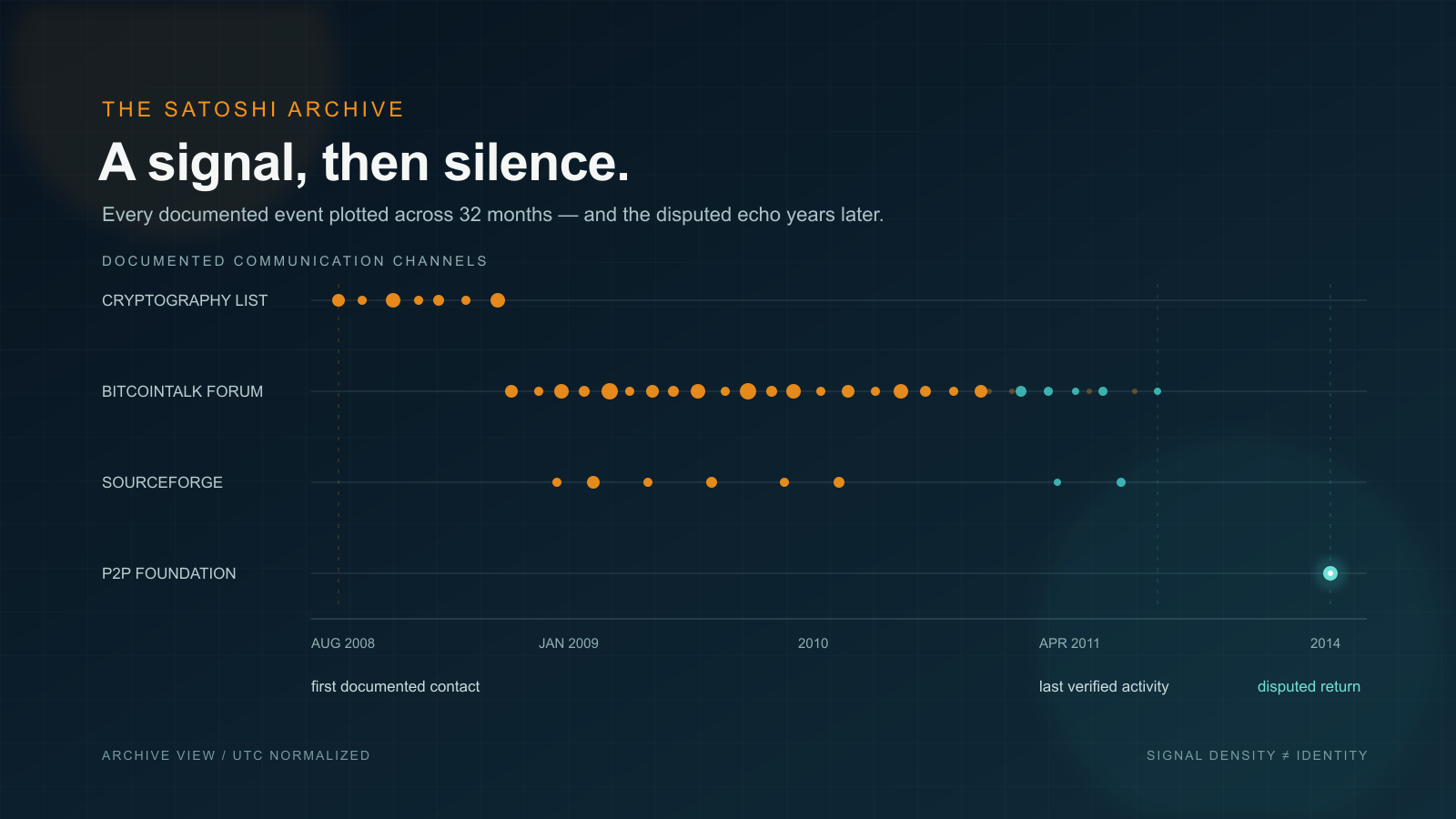
Between Jan 8 and Jan 12, 2009 — a five-day window — Satoshi made at least four public posts, including three software releases:
Launch-week event density (UTC)
| UTC timestamp | Event | Channel |
|---|---|---|
| 2009-01-08 19:27 | Bitcoin v0.1 released | cryptography mailing list |
| 2009-01-09 02:54:25 | Block 1 mined (on-chain nTime; node was started minutes earlier) | — |
| 2009-01-11 22:32 | Bitcoin v0.1.2 now available | bitcoin-list |
| 2009-01-12 (time unknown) | Satoshi → Finney: “from where I am” | private email |
| 2009-01-12 20:20 | Bitcoin v0.1 Alpha release notes | bitcoin-list |
| 2009-01-12 22:48 | Bitcoin v0.1.3 | bitcoin-list |
In Satoshi’s own words from the January 11 v0.1.2 announcement:
Satoshi Nakamoto“All the problems I’ve been finding are in the code that automatically finds and connects to other nodes, since I wasn’t able to test it in the wild until now. There are many more ways for connections to get screwed up on the real Internet.”
That release note documents that Satoshi personally reproduced, debugged, and shipped fixes for peer-connection problems during this same week — including a specific fix for “behind a firewall” scenarios where “it could only receive one connection, and the second connection would constantly disconnect and reconnect.”
2. What “from where I am” does not fit
English phrasing that qualifies a limitation with “from where I am” carries a location-contingent and typically temporal nuance. If the speaker intended a permanent structural constraint of their ordinary setup, a flatter form would be natural:
- Permanent constraint: “I can’t receive incoming connections” — no locative qualifier needed.
- Location-contingent constraint: “I can’t receive incoming connections from where I am” — “where I am” frames the constraint as tied to current place / current circumstances, implicitly not a universal property of the speaker’s setup.
This reading has two consequences worth naming explicitly.
(a) Permanent Tor-routed operation is a poor fit for this phrasing.
An always-on Tor client (without a configured Hidden Service) does structurally prevent incoming connections, regardless of geographic location. If that were Satoshi’s arrangement, “from where I am” would be an over-specific qualifier — the constraint would not depend on location at all. Additionally, there is no public record documenting that Satoshi routed Bitcoin v0.1 P2P traffic through Tor; the documented anonymization (Tor for web/email, anonymous mail services) specifically concerns user-surface activity.
(b) A permanent home-ISP CGNAT / building NAT is also a weak fit.
If Satoshi’s usual home ISP structurally blocked incoming connections (CGNAT, shared building NAT, etc.), that would again be a universal property of “my setup” rather than “where I am.” The locative qualifier would be an odd word choice for a consistent-home arrangement.
Neither reading is strictly ruled out — English phrasing is flexible — but both pay a word-choice cost that is avoided if we read the clause as genuinely locative and contingent.
3. What “from where I am” does fit
The word-choice cost is minimized if the clause is read at face value: Satoshi is writing from a specific current location, and that location’s network environment differs from something else — typically, from somewhere he could receive incoming connections under different circumstances.
Candidate environments that match this reading:
- A temporary stay in accommodation with no port-forward access — an extended-stay hotel, serviced apartment, guest house, relative’s or friend’s home
- Travel to a secondary location for the holiday/new-year period or for a personal reason
- Any managed network (hotel Wi-Fi, rental housing) where the speaker has no administrative control over incoming-port policy
All of these are compatible with “from where I am” in a way that a permanent everyday setup is not.
4. Combining the two signals: time availability
The second signal — the four-day cadence of three releases plus multiple posts plus private correspondence — is independently noteworthy. Satoshi:
- Started the live network and mined continuously
- Reproduced and diagnosed real-network connectivity problems that could not be found in-house before Jan 9 (per the v0.1.2 release note)
- Shipped v0.1.2 on Jan 11 and v0.1.3 on Jan 12
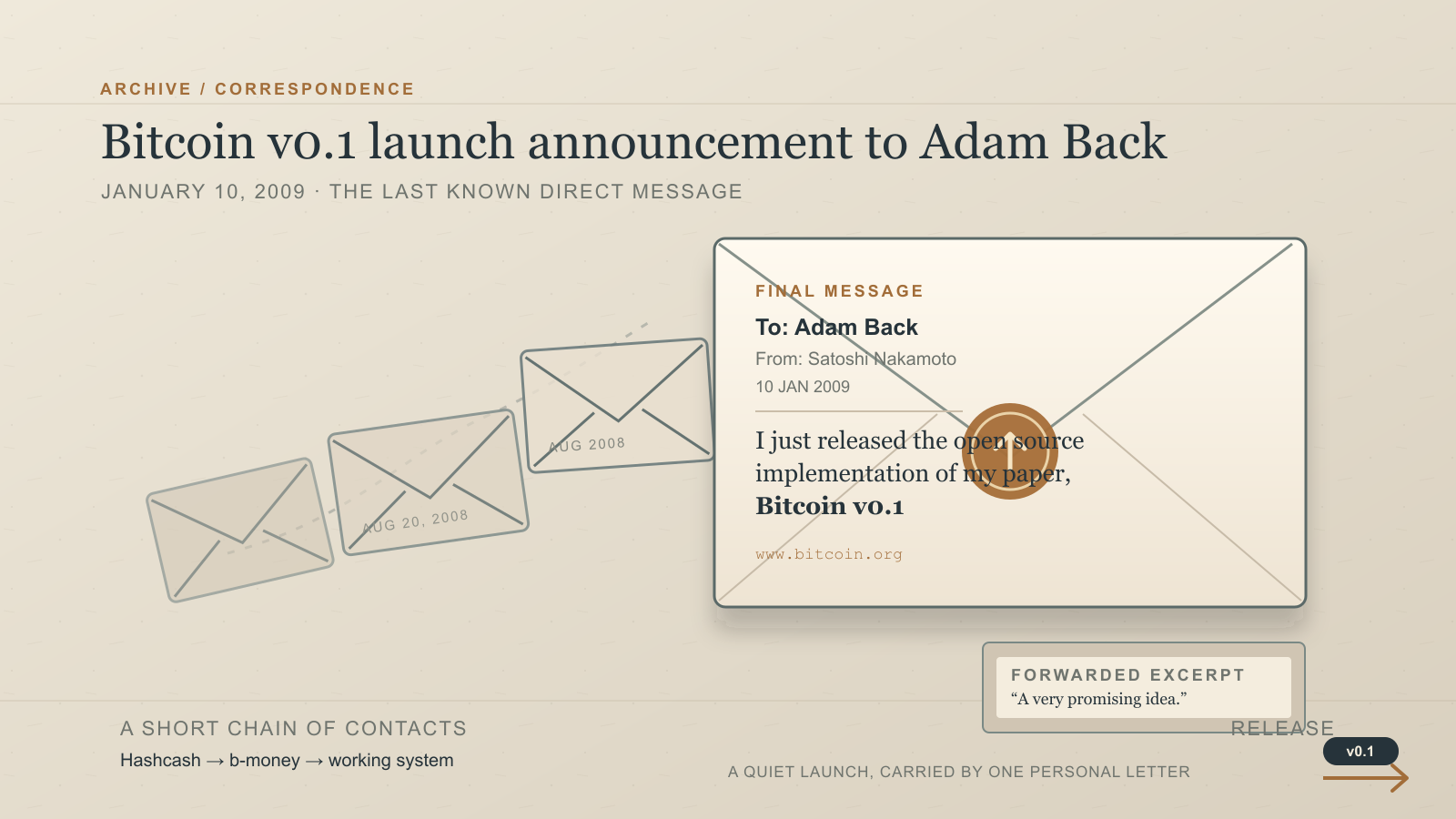
- Corresponded with Hal Finney in parallel, and used the same window to notify Adam Back that the software had launched — a third channel of activity alongside the public releases and the Finney email
This level of dedicated focus is difficult to sustain in the margins of a full-time job or institutional responsibility. It is compatible with:
- A multi-day continuous block of personal time (a vacation, sabbatical, or personal leave period)
- An employment situation with discretionary time — self-employment, contracting, or a flexible schedule
- An employment gap (between jobs, post-graduation, etc.)
The week Jan 8-12, 2009 falls in the post–New Year period, which in many cultures (including Japan, which Satoshi’s chosen pseudonym evokes) is part of an extended holiday window. A year-end-break reading is one consistent explanation of the time availability, but other explanations remain open.
5. The combined forensic profile
Taken together, the two signals — read interpretively — are consistent with a Satoshi who, during the launch week:
- Was not at his usual everyday location, based on the location-contingent phrasing;
- Had several continuous days of dedicated time, based on the release cadence;
- Was operating from a place that sustained continuous machine operation (stable power and internet for days), ruling out short-duration settings such as cafés or libraries;
- Was in an environment where incoming network ports were not under his administrative control, which is typical of extended-stay lodging and managed shared accommodations.
A plausibility-ranked short list of the kinds of environment this profile is consistent with:
- Extended-stay accommodation during a holiday / travel period (most consistent with both signals)
- Temporary assignment to a secondary location with stable connectivity
- Stay at a friend’s or relative’s network, borrowed for the launch week
- A structurally similar home — unusual home network (CGNAT, building NAT) combined with a happens-to-be-free period — this fits the second signal but strains the locative nuance of the first
The ranking is relative within this forensic reading; it is not an empirical distribution.
6. Limits of this reading
This is an interpretive analysis built on a single linguistic clue plus activity counts. It is subject to several specific limits:
- The linguistic inference is probabilistic. “From where I am” admits a permanent-setting reading in colloquial English; the locative reading we adopt is the more natural reading, not the only one.
- Activity cadence is not conclusive evidence of time availability. Some people sustain extraordinary output in short windows regardless of their day-to-day obligations.
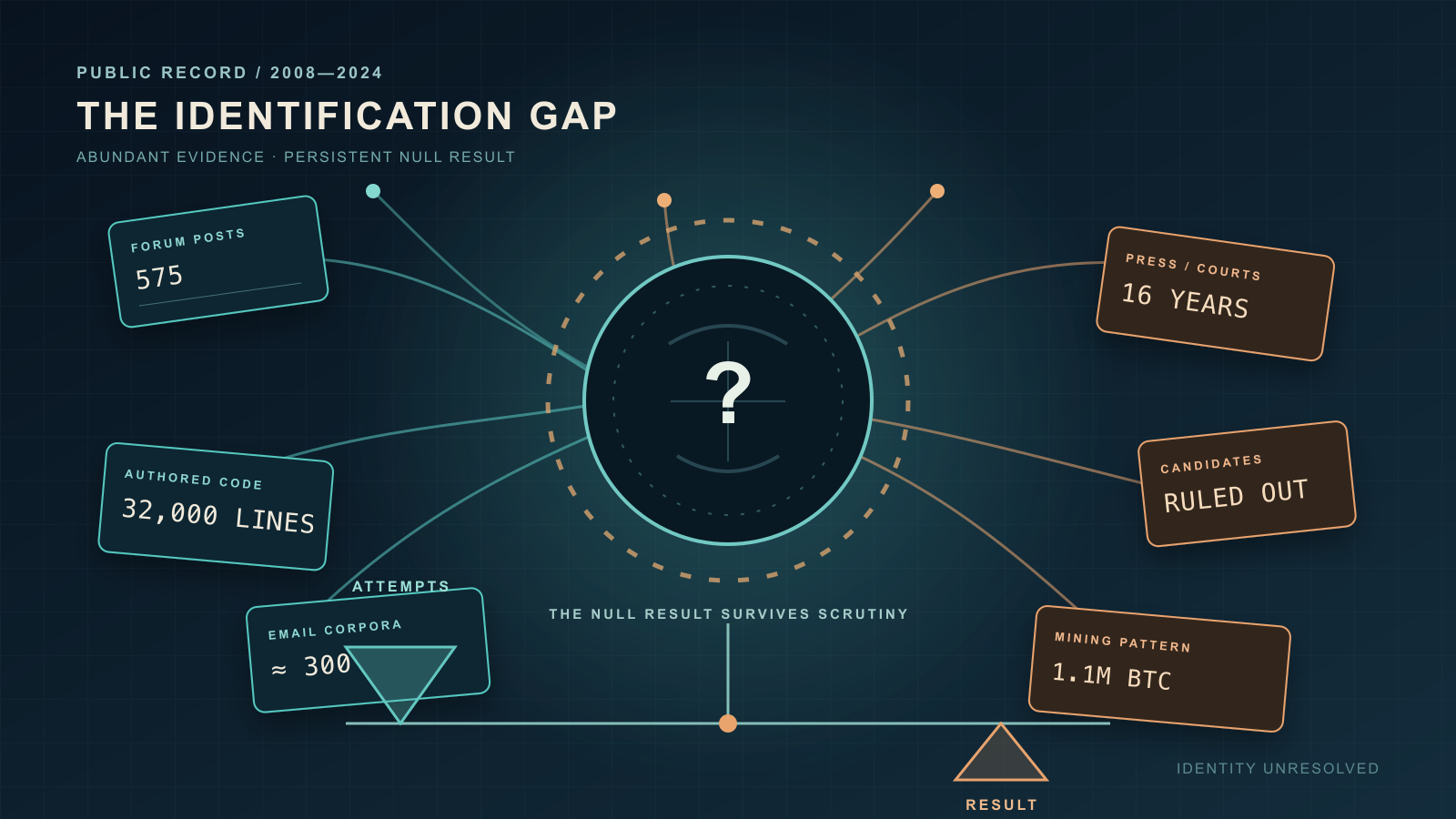
- Primary sources are thin. The reasoning rests largely on one private email and a handful of public announcements.
- No geographic or demographic claim follows. This analysis does not identify a country, city, employment status, or age bracket. It characterizes the shape of an environment compatible with the evidence, not a specific identity.
- Saturation-bias disclosure. The reading does interact with the well-known set of behavioral observations in the Satoshi biography (strong anonymization, informal development practices, no visible institutional affiliation). We note the compatibility without upgrading it to evidence for any specific identity hypothesis.
What this analysis does contribute is a concrete forensic reading of a passage that appears in the primary record, and an articulation of why the natural English reading of that passage points away from the most common “home ISP” assumption and toward a situationally-temporary environment during the launch week.
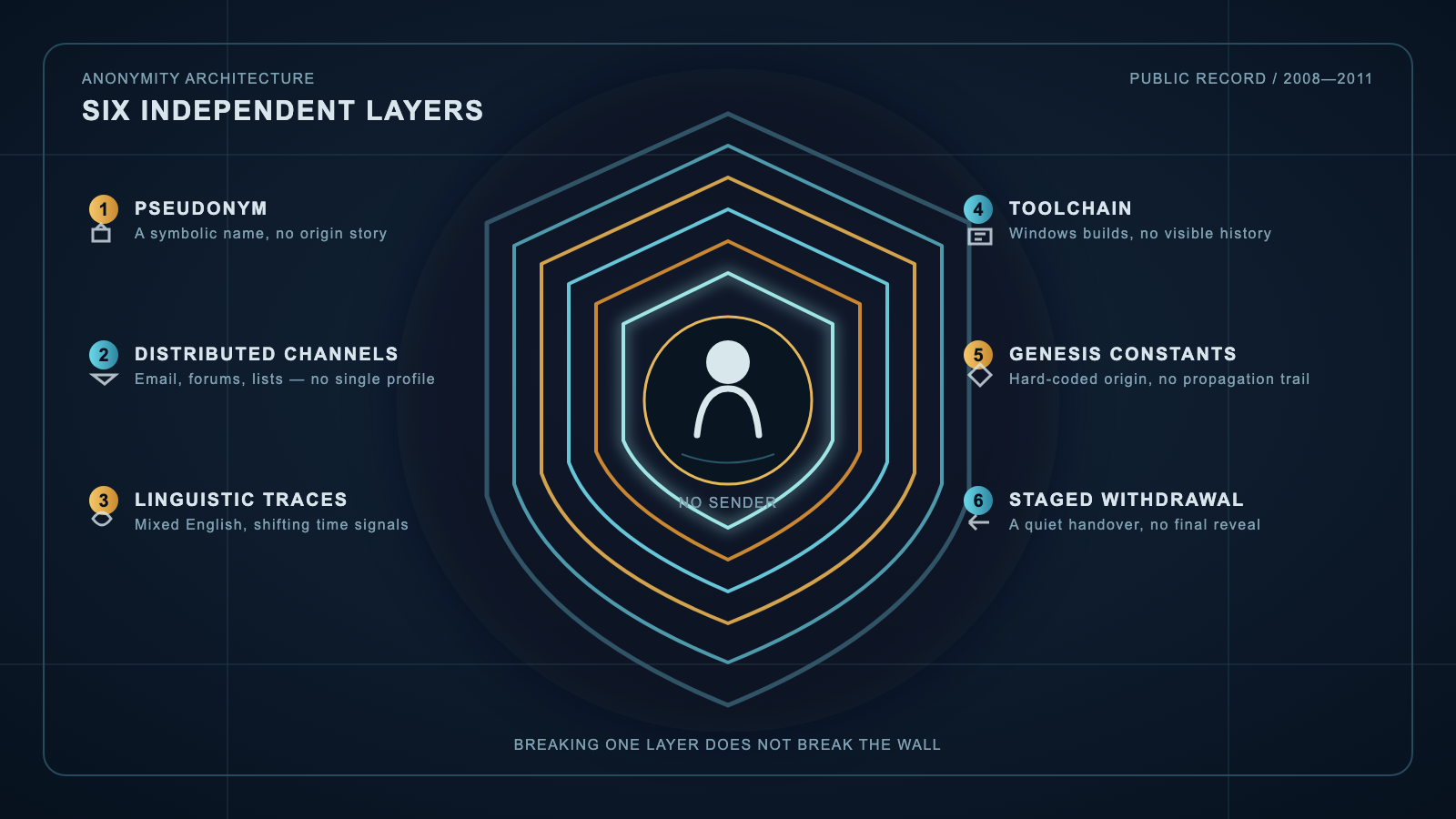
This launch-environment reading is examined further, alongside the six-layer anonymity structure, in the Satoshi anonymity-architecture analysis.
One clause in a private email, and four days of releases around it. That is all I have, and it is not enough to say where. “From where I am” is the closest Satoshi ever came to naming a place, and what it names is only that the place was not the usual one.