
Bitcoin Institute

Eric Hughes

Coined "Cypherpunks write code" and founded the Cypherpunks mailing list

Figures

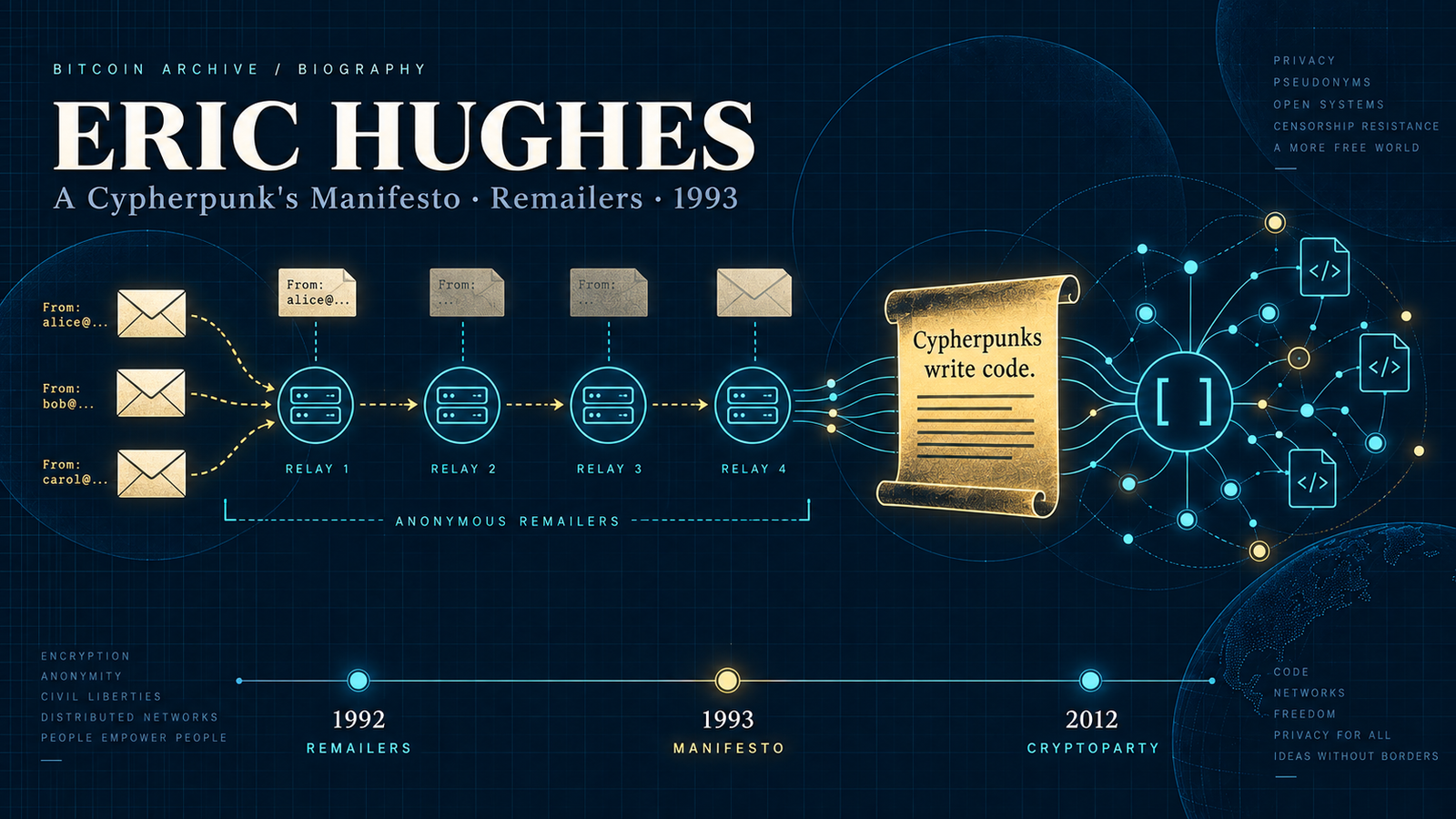
Dark-navy illustration: three envelopes labeled with sender addresses pass through four relay nodes marked as anonymous remailers, their sender labels fading at each hop; a gold manifesto scroll reading "Cypherpunks write code." feeds a network of code-bracket icons; a timeline below marks 1992, 1993, and 2012.

The manifesto is signed with a university email address and a date: Eric Hughes, hughes@soda.berkeley.edu, 9 March 1993. One of its lines is four words long, and it is an instruction rather than an argument: “Cypherpunks write code.” Fifteen years later, the electronic cash the Cypherpunks had talked about since the list began reached running code through someone who left no trace, in any surviving record, of having taken part in the list Hughes ran.

Remailers and DigiCash (1992)

Hughes was a mathematician, and by November 1992 he had already worked briefly for David Chaum’s DigiCash, the company trying to turn blind signatures into bank-issued anonymous money. That autumn he and Timothy May called the first physical meeting of the group that became the Cypherpunks, with John Gilmore as the third founder. Steven Levy’s 1993 Wired profile describes May as the group’s theoretician and Hughes as the moderator of its meetings, running an agenda that mixed works-in-progress with reports from the political front.

What Hughes brought to those meetings was working software. Reporting on Hackers 8.0, the Hackers Conference held at Lake Tahoe on November 6–8, 1992, May wrote that Hughes “described anonymous remailers implemented in Perl and now running,” along with a version by Hal Finney that embedded PGP. A remailer strips the sender from a message and forwards it; chain several and no single operator can connect the two ends. The idea had a long life on the list: Len Sassaman would later lead development of Mixmaster, one of its descendants.

1992Co-founds theCypherpunks withTimothy May, JohnGilmore (autumn)His Perl anonymousremailers are running(Nov)1993Publishes ACypherpunk's Manifesto(Mar 9)Appears masked on thecover of Wired(May/Jun)1997Adam Back announcesHashcash on the list(Mar 28)1998Wei Dai announcesb-money on the list(Nov 27)2012Keynote at theAmsterdam CryptoParty(Sep 27)

A Cypherpunk’s Manifesto (1993)

The manifesto is short, and it does not argue for secrecy. Its opening distinction is the one the rest of the text depends on:

“Privacy is not secrecy. A private matter is something one doesn’t want the whole world to know, but a secret matter is something one doesn’t want anybody to know. Privacy is the power to selectively reveal oneself to the world.”

From there it moves to cash. When he buys a magazine and hands the clerk money, Hughes wrote, “there is no need to know who I am”; an open society therefore needs anonymous transaction systems, and “until now, cash has been the primary such system.” Then it turns from what the Cypherpunks believe to what they do:

“Cypherpunks write code. We know that someone has to write software to defend privacy, and since we can’t get privacy unless we all do, we’re going to write it. We publish our code so that our fellow Cypherpunks may practice and play with it. Our code is free for all to use, worldwide.”

The same paragraph ends with two sentences that read, in hindsight, like a specification: “We know that software can’t be destroyed and that a widely dispersed system can’t be shut down.” Wired put three masked Cypherpunks, Hughes among them, on the cover of its second issue that spring. A year later Levy introduced him simply as the “founder of the Cypherpunk mailing list.”

ContributionYearWhat became of it
Anonymous remailers in Perl1992Line continued by later designs such as Mixmaster
Cypherpunks mailing list1992Where Hashcash (1997) and b-money (1998) were first announced
A Cypherpunk’s Manifesto1993Read alongside May’s 1988 manifesto as the movement’s founding text

The list and what came through it

The list Hughes founded carried the two proposals the Bitcoin whitepaper would later name in its references. Adam Back announced Hashcash there in March 1997, and Wei Dai posted b-money there in November 1998. Neither Hughes nor his manifesto appears in the whitepaper’s references, and Satoshi Nakamoto told Back in August 2008 that he had not known b-money at all. This archive’s reading of that gap sets Satoshi’s documented practice against six principles drawn mostly from Hughes’s text and finds them aligned almost point for point, with no visible route by which the manifesto reached him.

By 2012 Hughes sounded less certain that the world would follow. Speaking by Skype to the Amsterdam CryptoParty that September, he told the room, as Der Spiegel reported, that people do not encrypt their email as a matter of course and that nobody starts encrypting because it is cool; the task was to build good applications that carry encryption along with them.

Significance

Hughes’s contribution to Bitcoin is not a component. It is a working order: build the thing first, publish it for anyone to run, and let the system outlast any one person’s approval. Satoshi followed that order exactly, writing the code before the paper and releasing it under a free license to an open list, without any record of having taken it from Hughes. I read that as the manifesto’s real success. A rule that has to be taught is a club’s rule; one that a stranger arrives at alone, by working the same problem, was describing the problem all along.

Related Entries

3 entries