One Saturday in the group’s first months, a one o’clock meeting in a small conference room at Cygnus Support, a Silicon Valley company that sold support for free software, did not really get underway until almost three. Steven Levy, describing it for Wired in 1993, counted about fifteen people sitting at the table, wandering the room, or lying on the floor. Two of them spent part of the afternoon unable to make a new AT&T “secure” phone work. The group called itself the Cypherpunks.
It had no charter. In the FAQ he later wrote for the group, Timothy May answered his own question about “formal rules, charter, etc.” with “no formal rules or charter - no agreed-upon mission.” What it did have was a mailing list. Two of the designs the Bitcoin whitepaper would cite in 2008 were first posted there.
How it started (1992)
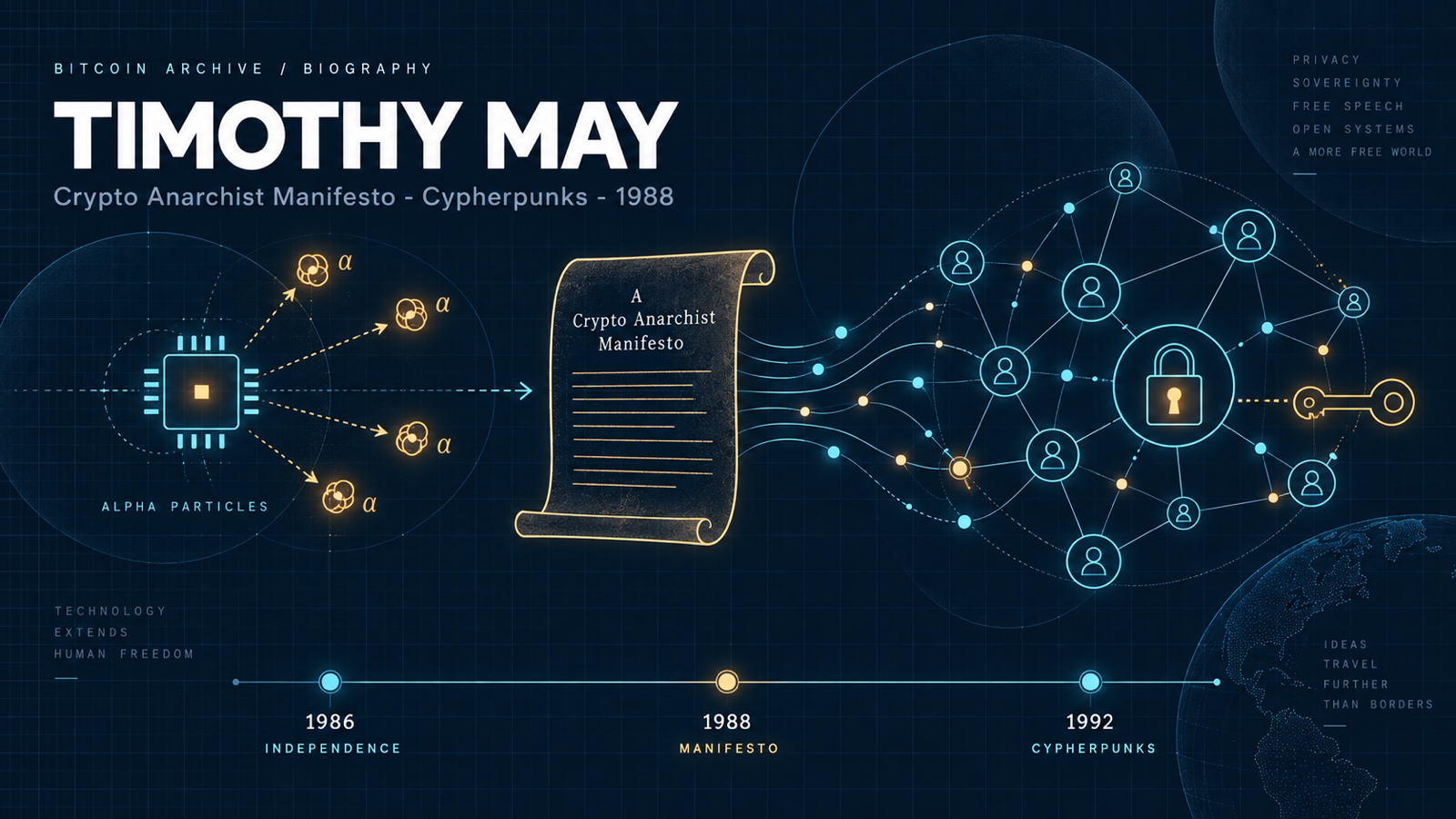
May and Eric Hughes spent three days in May 1992 talking almost without a break about one problem: the ideas of the academic cryptography conferences, from digital cash to Chaum’s mixes, still had almost no running code years after they were published. Hughes decided to host a gathering. The first meeting took place in Oakland that September, in the same week PGP 2.0 came out. In May’s account, the morning covered the basics and the afternoon went to a “Crypto Game” of remailers, digital money, and information for sale. When May posted The Crypto Anarchist Manifesto to the list that November, he introduced it as the text he had read at this founding meeting; he had written it in 1988.
John Gilmore offered his machine, toad.com, to host a mailing list, and his company’s offices for monthly meetings. The list began almost at once; the earliest message in its surviving archive is dated September 21, 1992. The name came from Jude Milhon, “St. Jude,” then an editor at Mondo 2000, who told the group at one of the earliest meetings: “You guys are just a bunch of cypherpunks.” It was adopted immediately. May put the membership at “about 500-700,” and wrote that it had leveled off at around 500 subscribers.
Remailers first
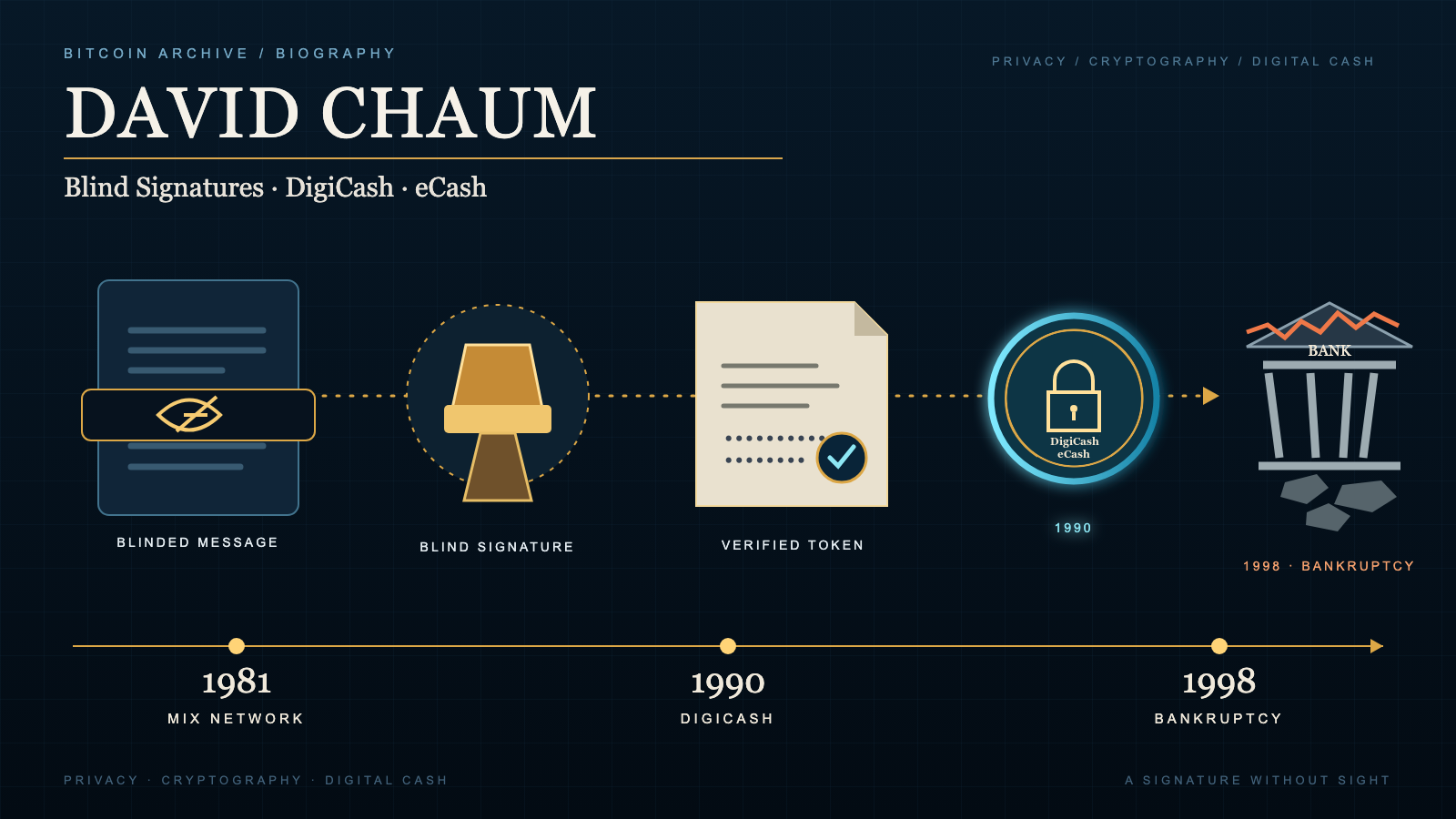
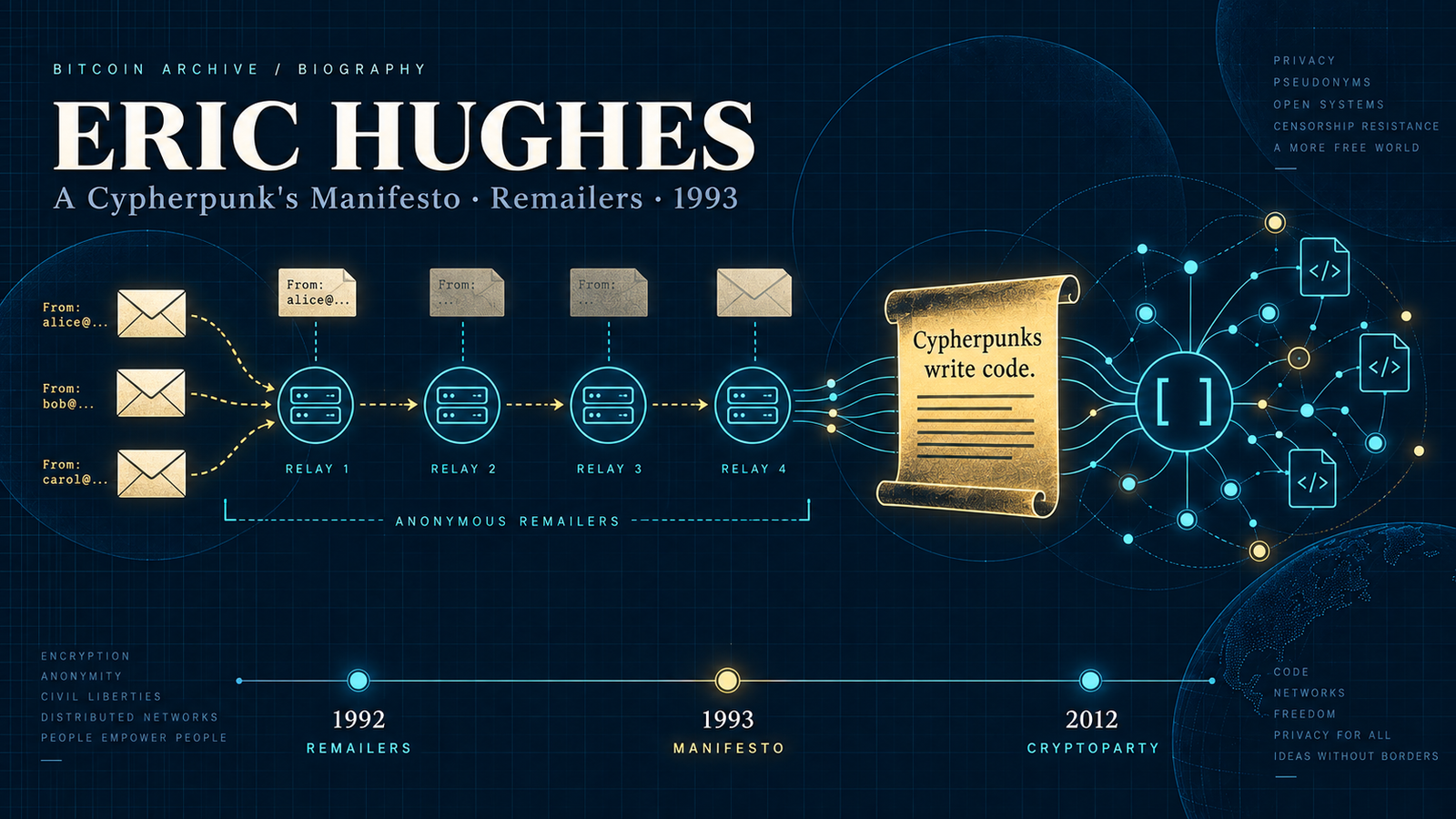
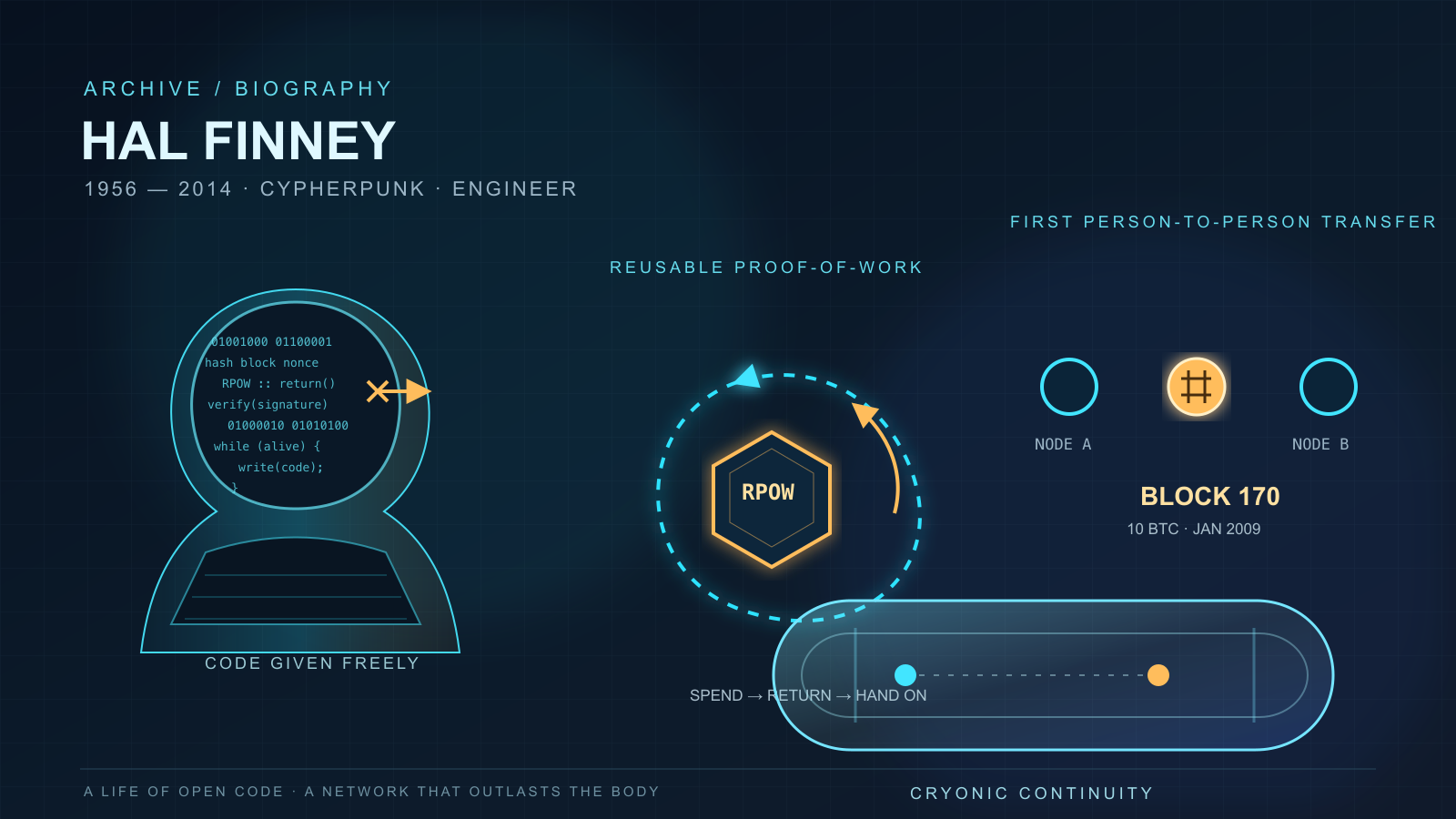
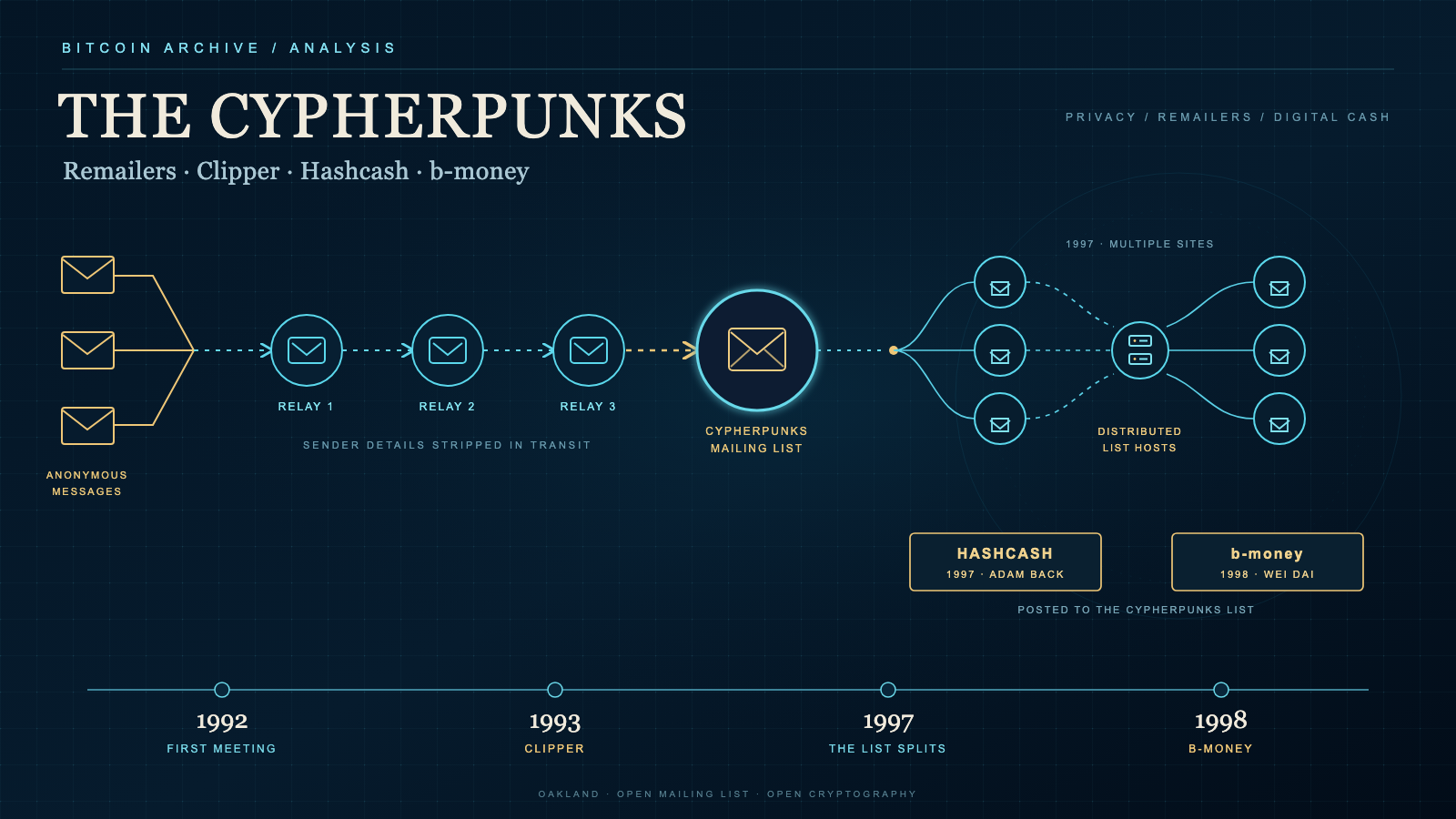
The first thing the list built was a way to send mail without a sender. On September 24, 1992, three days after the earliest archived message, a note signed only “Mr. Crypto” arrived from an anonymous address to announce “Eric’s Cheap Remailing Service”: mail sent to Hughes’s address with a Request-Remailing-To line would be stripped of its headers and passed on. The next day Hughes posted the Perl for a version that could hop from one remailer to the next: “I wrote it this morning.” A remailer strips the sender from a message and forwards it, and a chain of them leaves no single operator able to connect the two ends. By November, as May reported from the Hackers Conference, Hal Finney had a version that embedded PGP. May described the early remailers as “quick, if incomplete, implementations of David Chaum’s 1981 ‘digital mixes,’” the design in which David Chaum had first proposed anonymous forwarding.
Hughes’s A Cypherpunk’s Manifesto of March 1993 turned that habit into a line: “Cypherpunks write code.” May’s FAQ read it more modestly, as “a clarifying statement, not an imperative,” and guessed that “probably less than 10% of the list writes serious code.” What that minority posted to the list, and where each piece went:
| Year | Who | Posted to the list | What became of it |
|---|---|---|---|
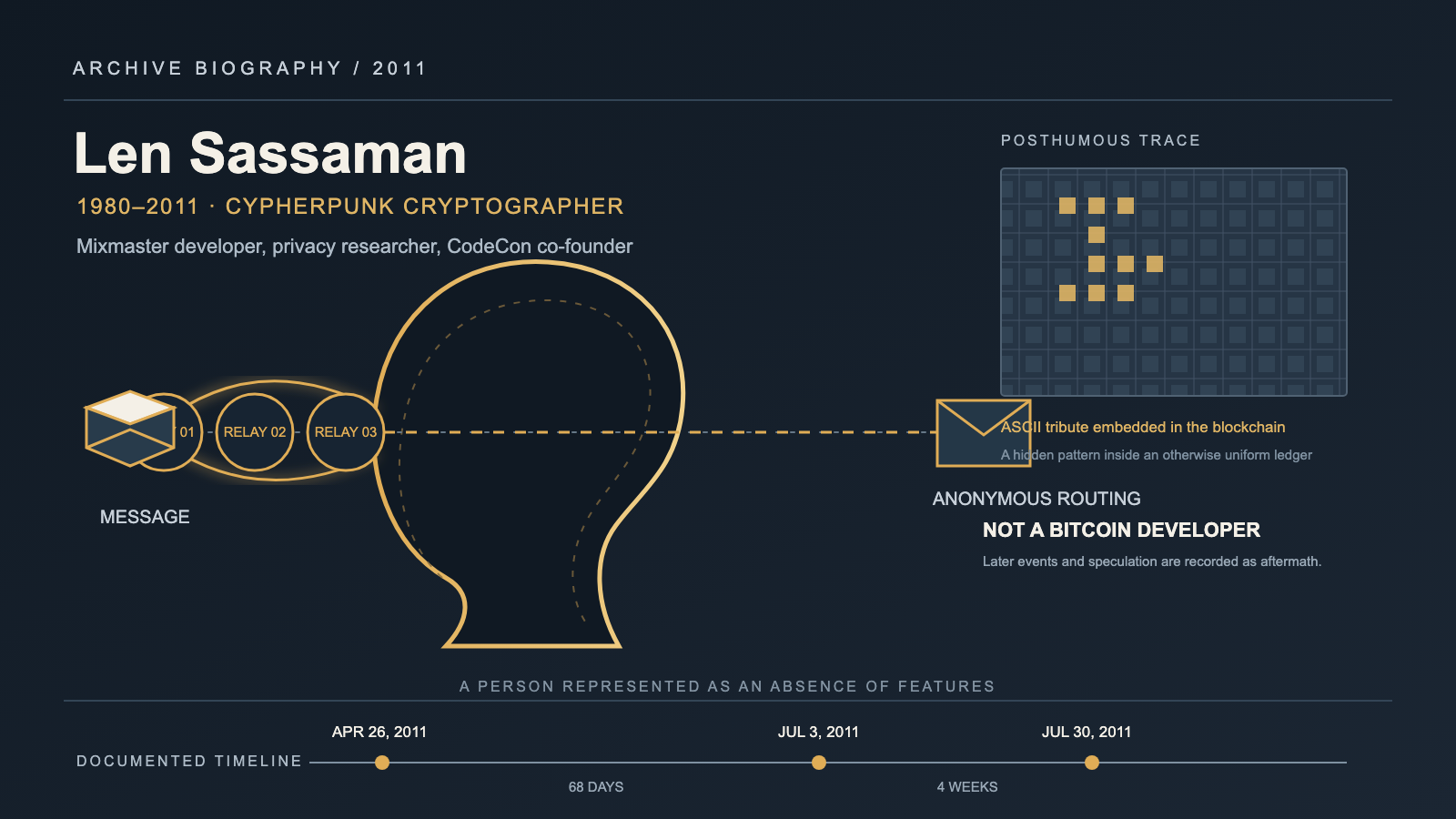
| 1992 | Eric Hughes, Hal Finney | Anonymous remailers | Continued in Lance Cottrell’s Mixmaster, later maintained by Len Sassaman as lead developer |
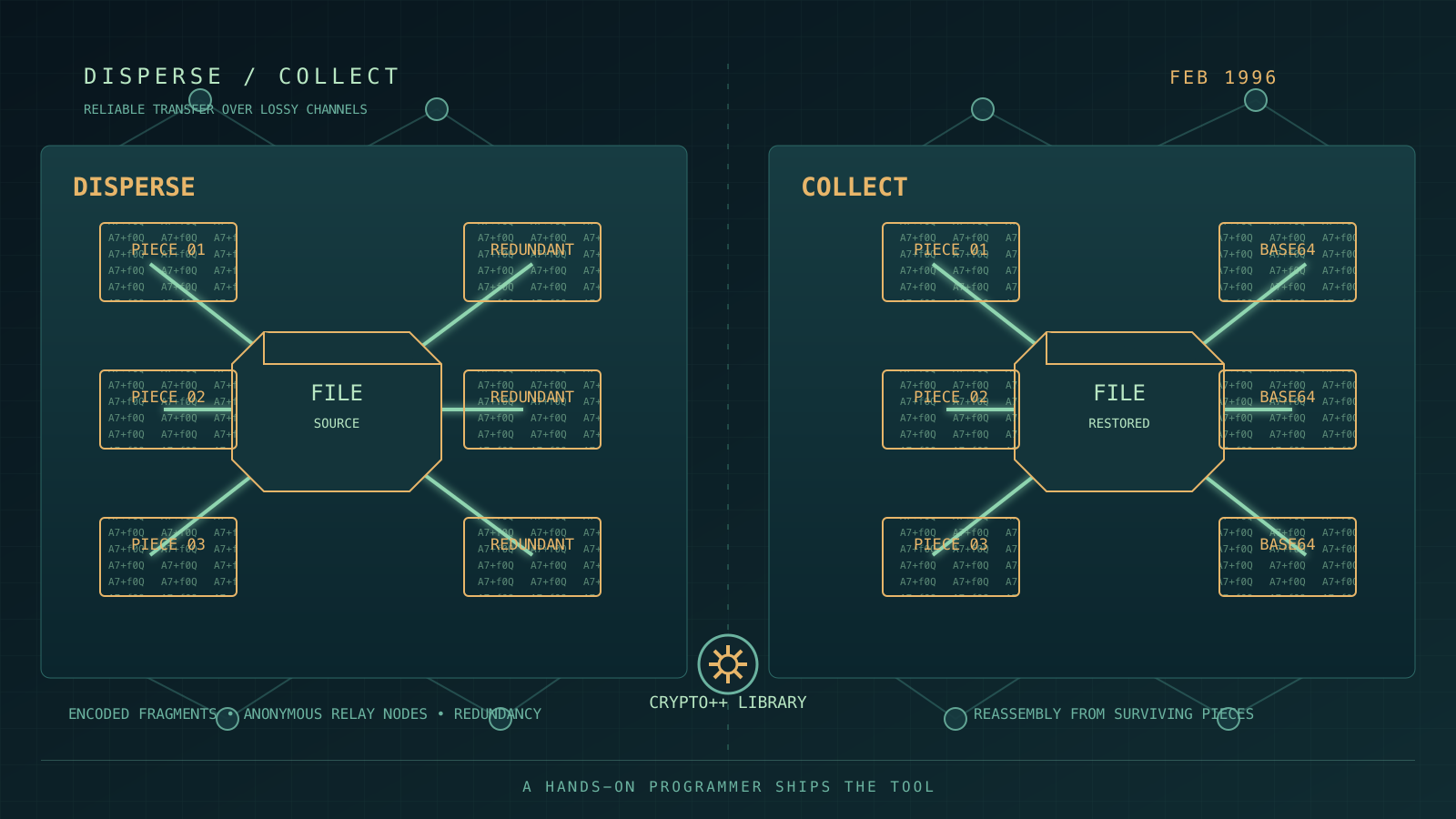
| 1996 | Wei Dai | Disperse/Collect, built on his Crypto++ library | Crypto++‘s SHA-256 routines ship inside Bitcoin v0.1 |
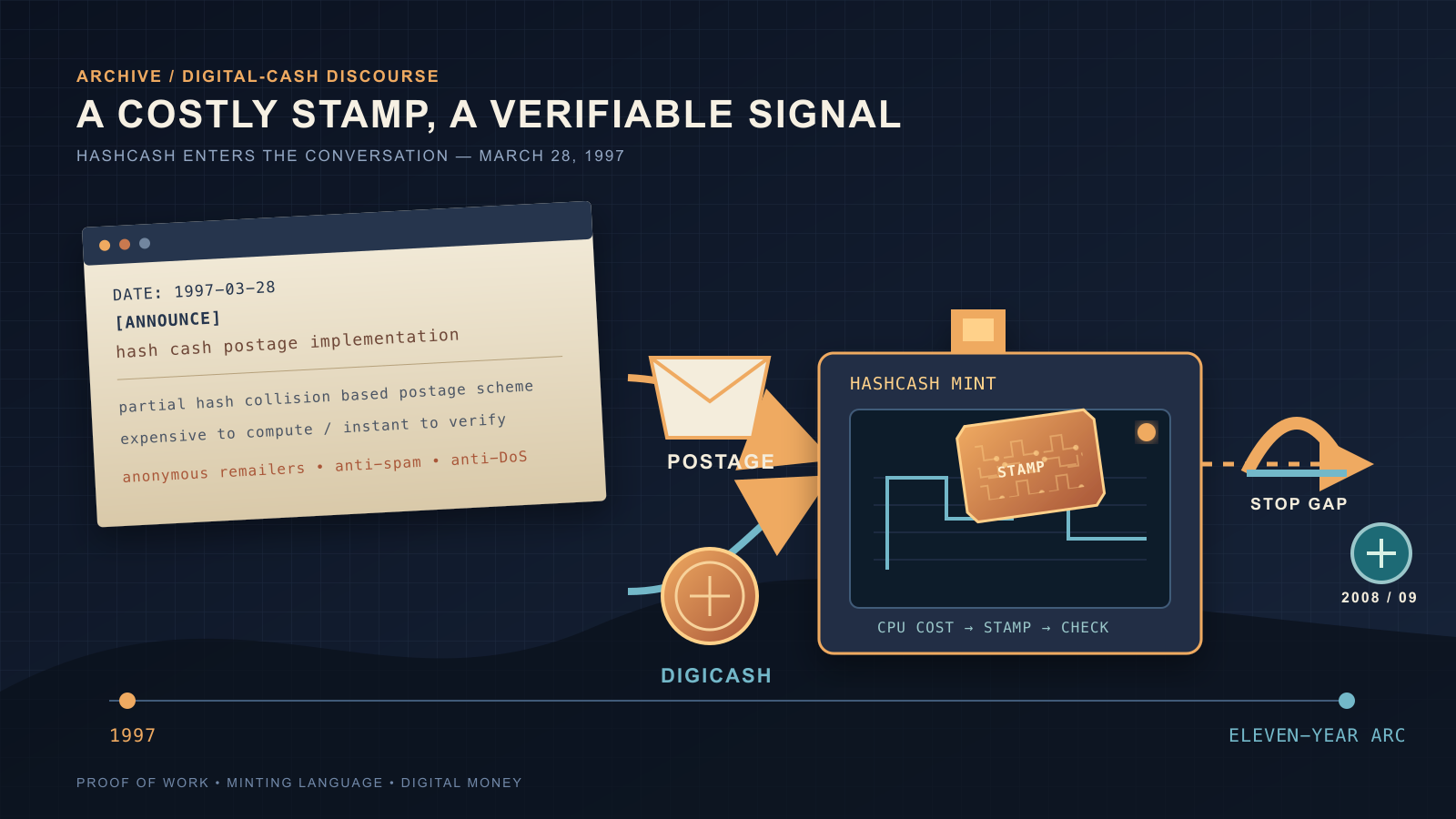
| 1997 | Adam Back | Hashcash | Reference [6] of the Bitcoin whitepaper |
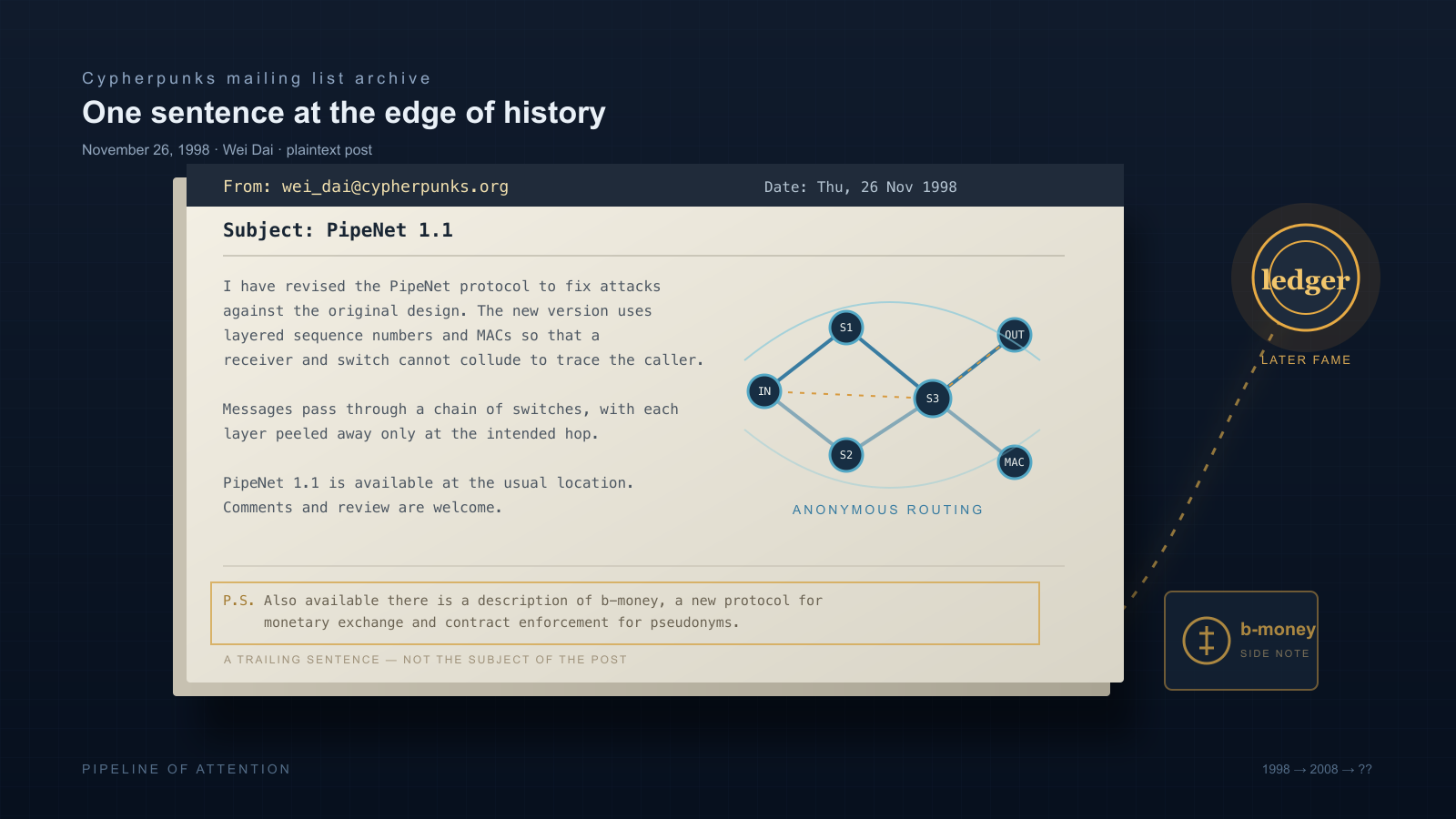
| 1998 | Wei Dai | b-money | Reference [1] of the Bitcoin whitepaper |
Clipper, six months in
On April 16, 1993, the White House announced the Clipper chip, a government-designed encryption chip whose keys would be deposited in two “key-escrow” databases, open to officials with legal authorization to wiretap. Gilmore forwarded the press secretary’s statement to the list the same day. The group had formed, as May later put it, “just 6 months before the Clipper announcement caused a firestorm of interest in public key cryptography,” and in his FAQ the “Clipper bombshell occupied much of our time, with some effect on policy.” The list had been founded to get cryptography into running code. From its seventh month it was also arguing over who would be allowed to hold the keys.
1997: whose list?
On January 5, 1997, Gilmore announced that Sandy Sandfort would moderate the list for a month, and that toad.com would move the current subscribers onto the moderated version. May unsubscribed, by his own account “within an hour of reading” the decision. On February 2 he explained why, conceding that Gilmore was free to set the rules on his own machine, and then asking the question the dispute came down to: “is the physical hosting of the Cypherpunks mailing list coterminous with the ‘Cypherpunks’?”
Gilmore answered on February 11: “I’ve come to the conclusion that I’m not willing to host the cypherpunks list any more.” The list had ten days to find a new home. That same day Sten Drescher announced that he and Jim Choate were setting up “a network of majordomos hosting a Cypherpunks mailing list,” and on February 12 Lance Cottrell, the author of Mixmaster, opened cypherpunks@cyberpass.net, saying he favored “the multi-node list model, where no one site can censor the list.” Twenty-one months later, Wei Dai addressed his b-money announcement to cypherpunks@cyberpass.net.
What reached Bitcoin
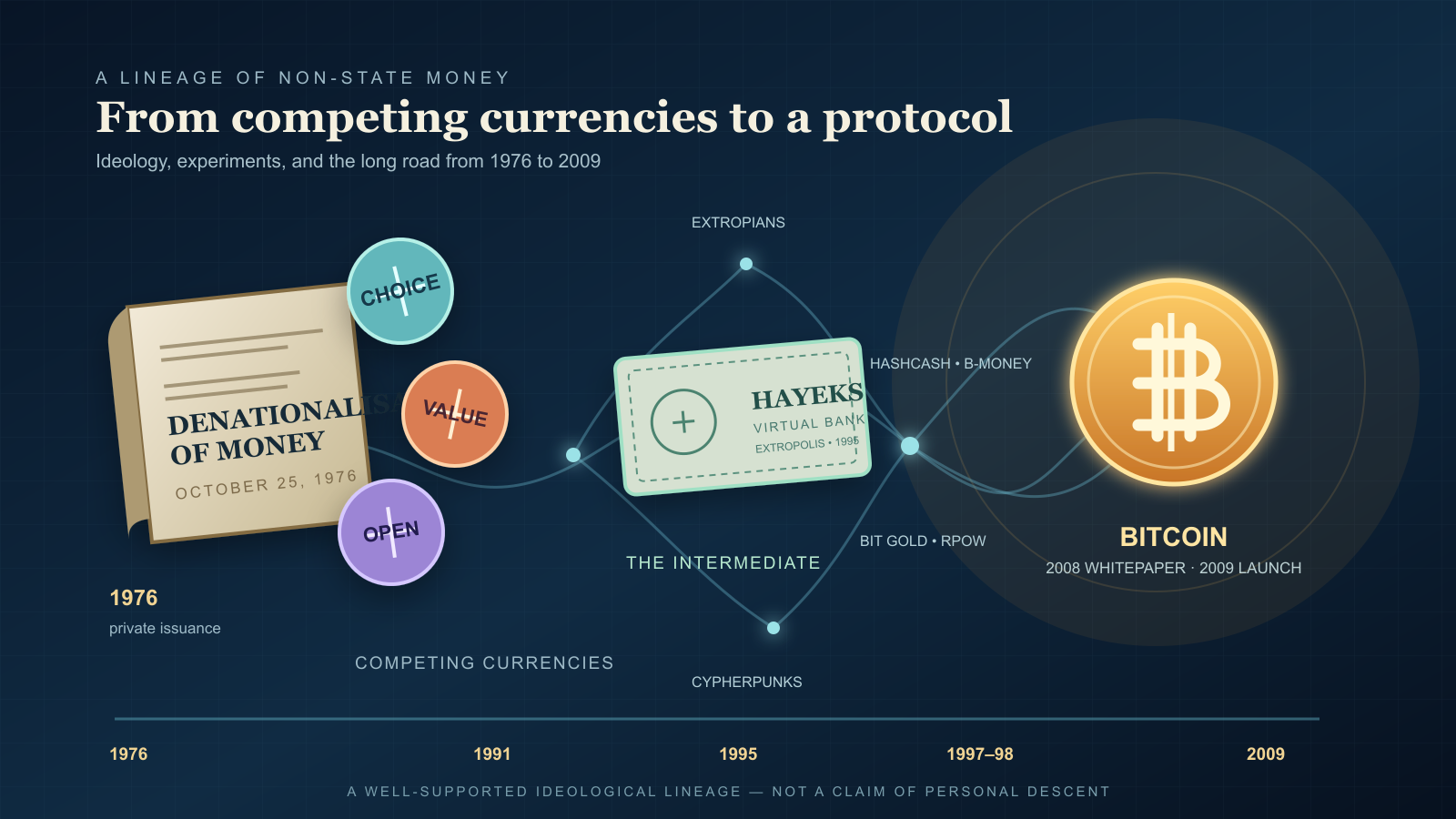
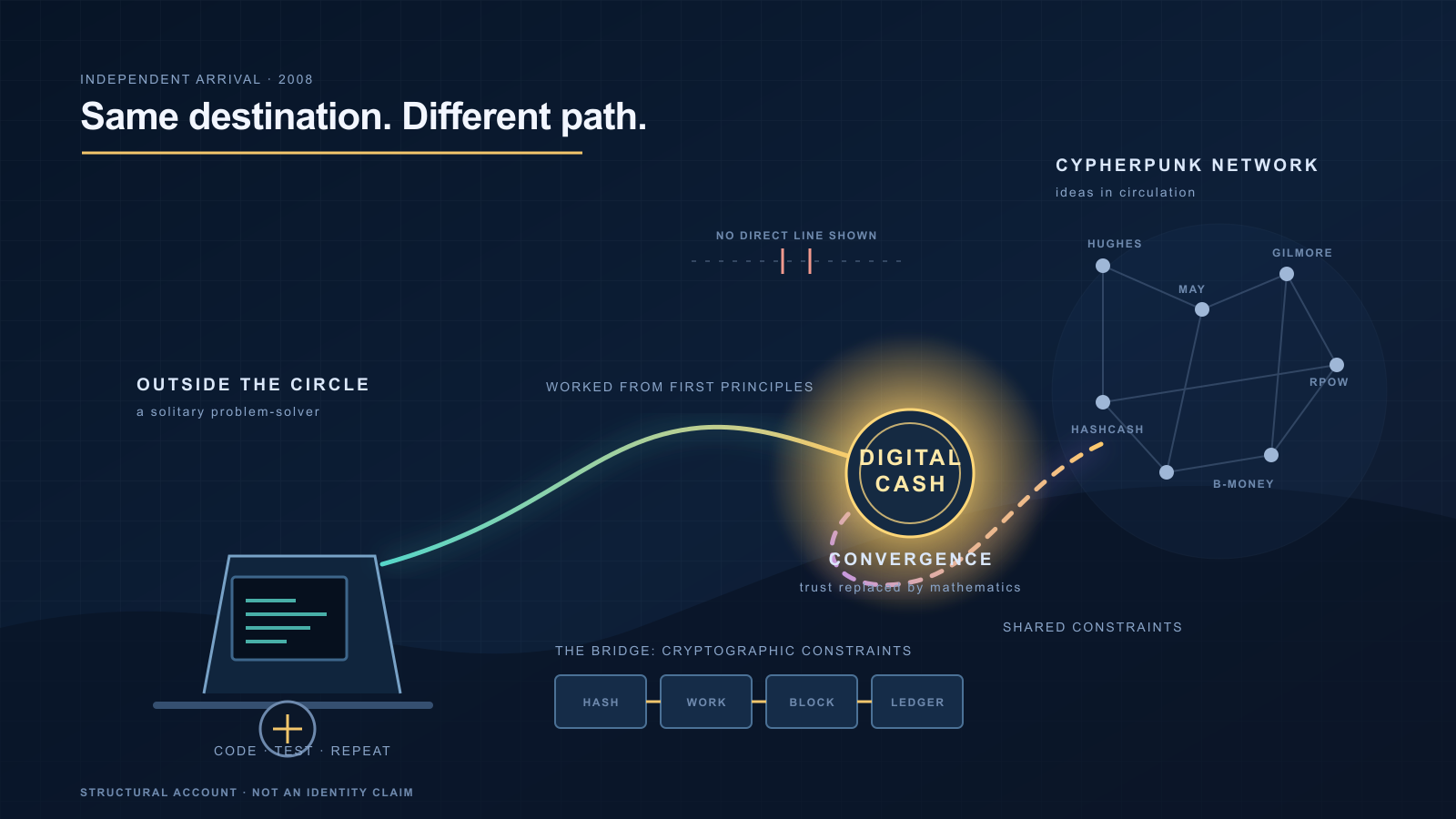
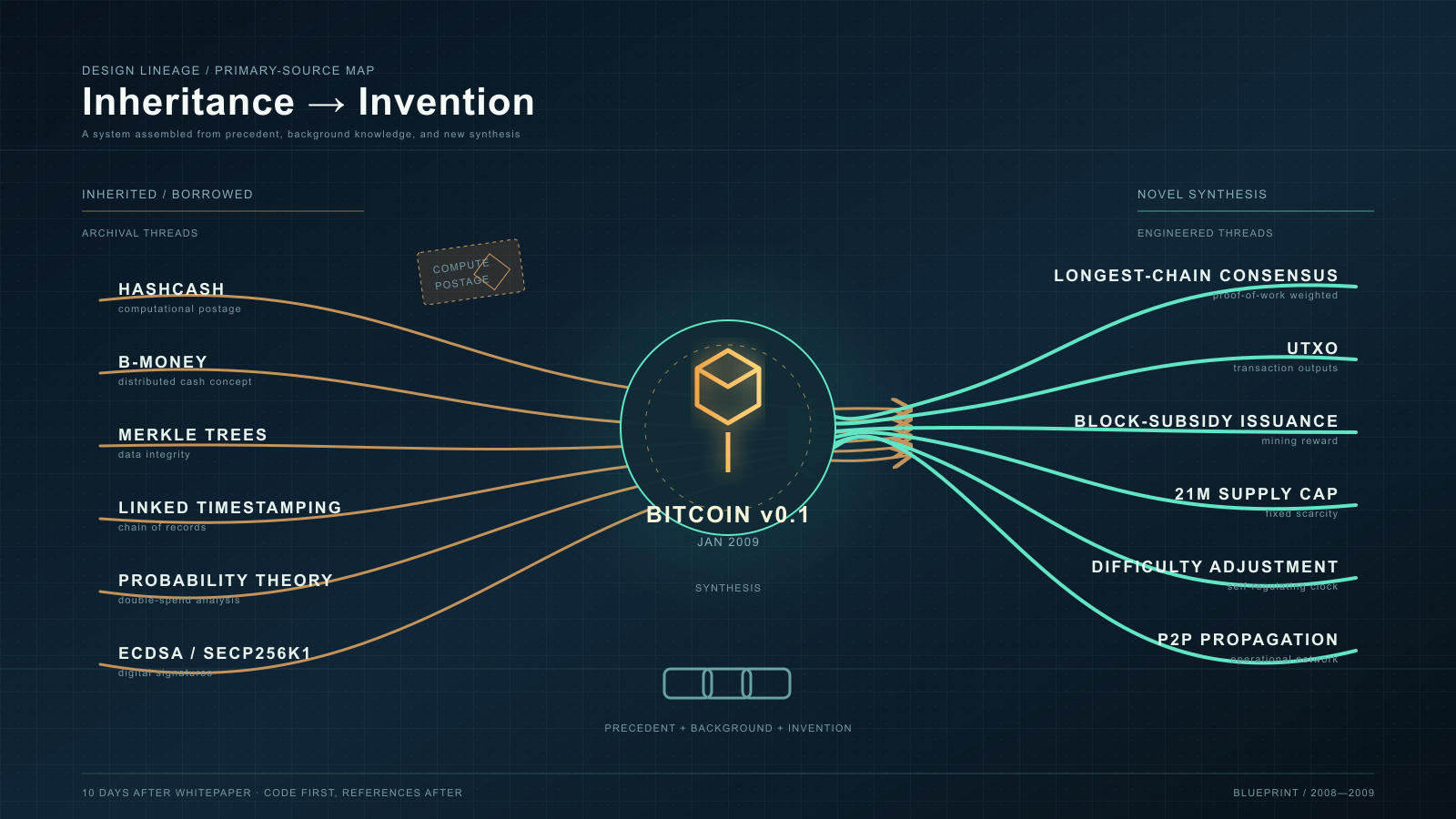
The Bitcoin whitepaper, posted on October 31, 2008, cites b-money as its first reference and Hashcash as its sixth. Both had been announced on this list. The whitepaper itself was not: Satoshi Nakamoto posted it to the cryptography mailing list, and had told Back in August 2008 that he “wasn’t aware of the b-money page.” How Satoshi reached the Cypherpunks’ positions without any visible part in the list is worked through in the independent-arrival analysis, and which of the list’s designs Bitcoin actually reuses in the design-lineage analysis. The economic strand that reached the same discussions from Hayek’s side is in the Hayek-Extropian lineage.
May’s question in 1997 was whether the Cypherpunks were whoever owned the machine. The list answered by giving up having a single owner, and b-money went out over that arrangement. I think that was the group’s most Cypherpunk act, more than either manifesto: they rebuilt their own list so that no one site could shut it down. Eleven years later someone with no visible part in the list asked the same thing of money.