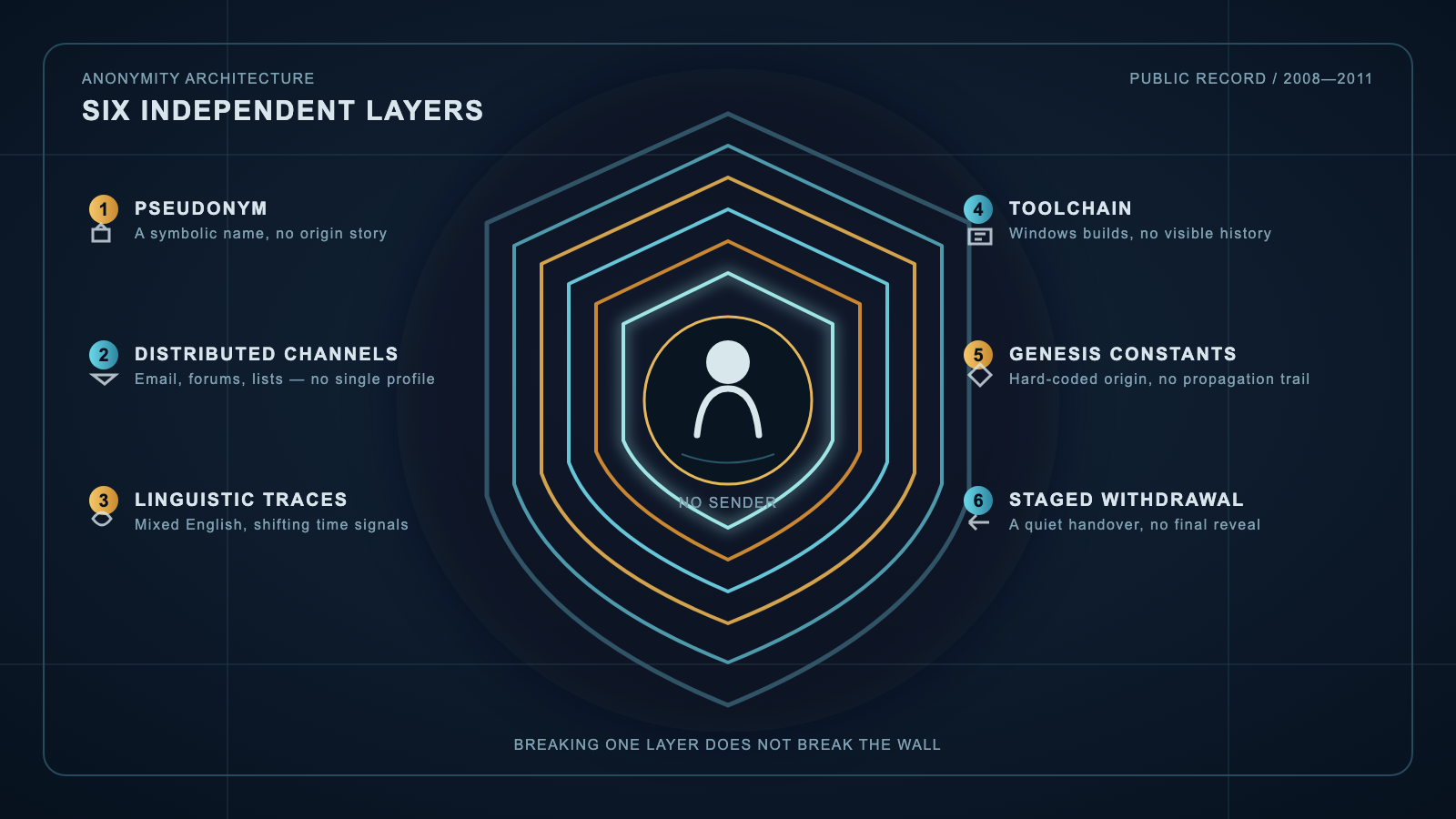
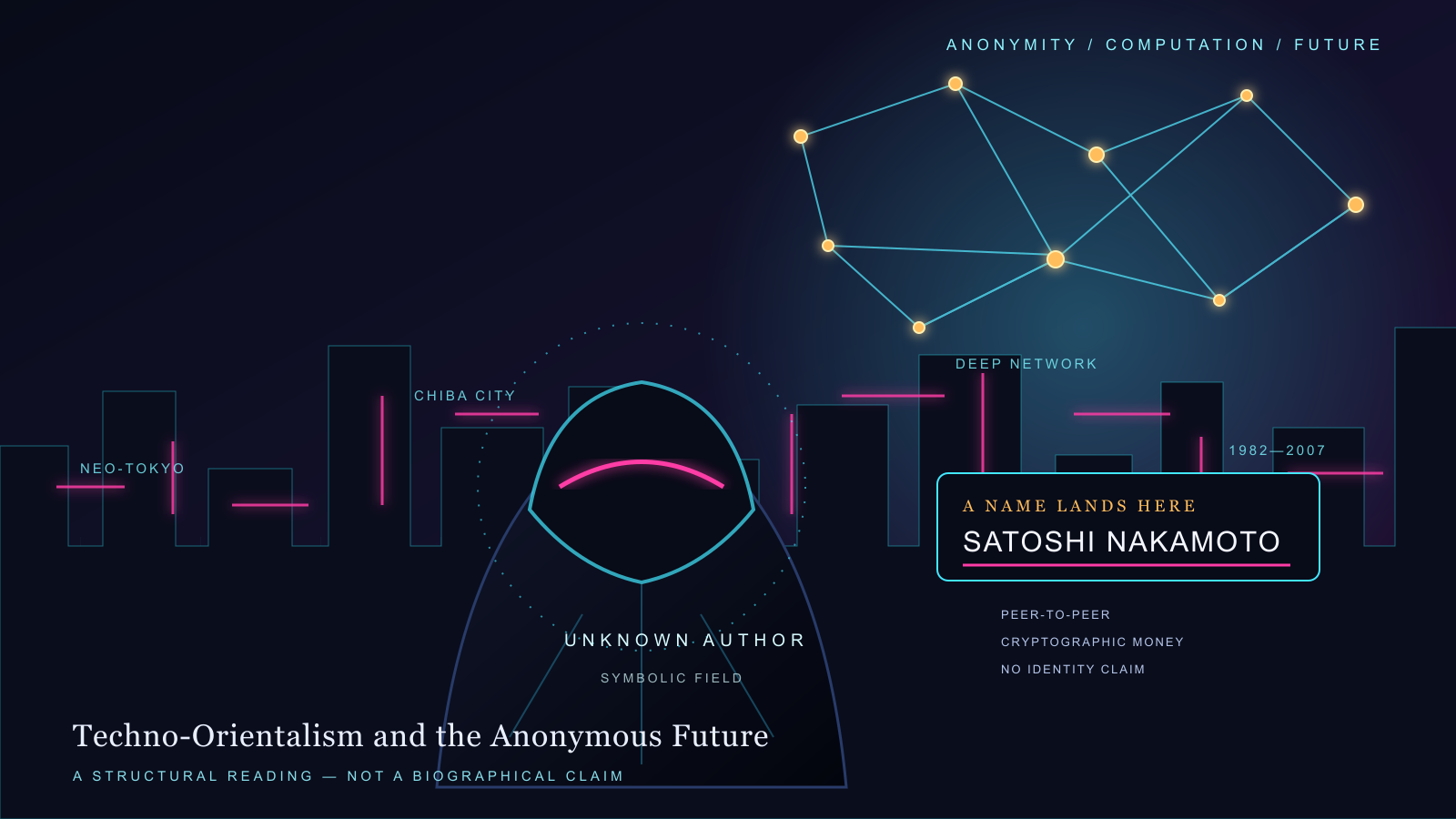
The name “Satoshi Nakamoto” does more than conceal a person. It also arrives carrying a ready-made cultural picture: Japanese signs, networked anonymity, and a future built in the shadow of collapsing cities. That picture is not evidence of who chose the name. It is the reception field that appears before the name can be turned into a clue.
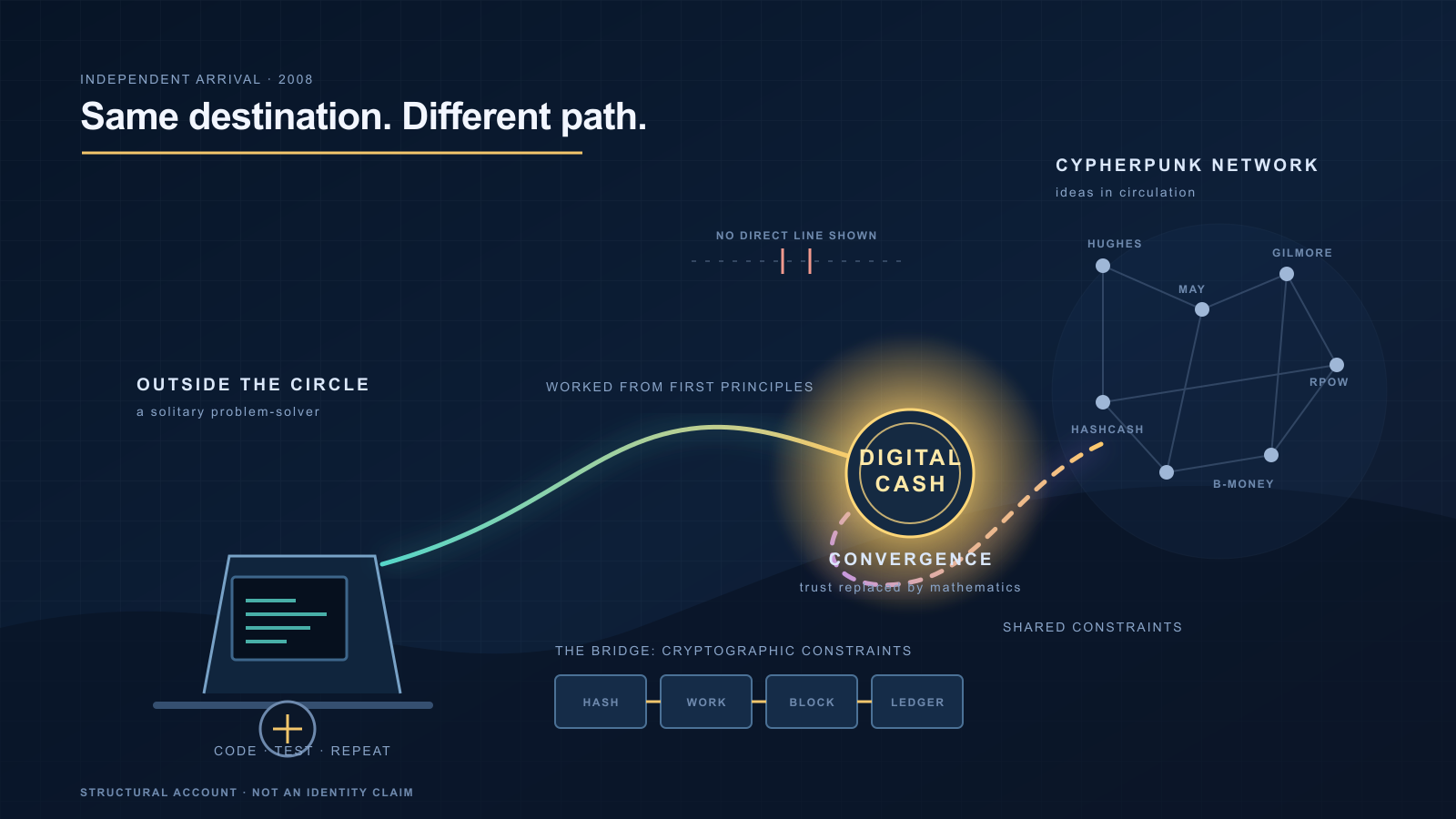
Satoshi’s intellectual position — the independent-arrival reading of his relationship to the cypherpunk movement and its philosophical core — is treated separately in the companion entry, Independent arrival at the cypherpunk core.
1. The symbolic field
In the late 1970s through the 1990s, a recognizable assemblage of fictional and aesthetic works framed advanced computation, networked anonymity, and the loss of stable Western identity through Japanese — or more broadly East Asian — visual and onomastic markers. The pattern has been catalogued under the term techno-orientalism in critical-theory literature beginning with David Morley and Kevin Robins’s 1995 Spaces of Identity, and more comprehensively in the 2015 anthology Techno-Orientalism: Imagining Asia in Speculative Fiction, History, and Media edited by David S. Roh, Betsy Huang, and Greta A. Niu.
Representative works in the assemblage:
| Year | Work | Element relevant to the pseudonym field |
|---|---|---|
| 1982 | Blade Runner (Scott) | Los Angeles densely overlaid with Japanese / Chinese signage; future = orientalized cityscape |
| 1984 | Neuromancer (Gibson) | Chiba City as the opening ground of cyberspace; matrix-jockeys, ICE, and a Japanese-corporate substrate |
| 1988 | AKIRA (Otomo, manga 1982-1990; film 1988) | Neo-Tokyo as the canonical post-collapse / post-singular city |
| 1995 | Ghost in the Shell (Oshii film, Nov 1995) | Networked intelligences without bodies, operating from a Japanese urban substrate |
| 1989-93 | Mondo 2000 cyberpunk discourse | Japanese loanwords (sōkaiya, salaryman, otaku) and Tokyo as the emblematic future city |
By the time Bitcoin was designed (mid-2007 onward), this assemblage had already settled into the cultural background for a generation. The symbolic claim it carried was specific: the deep network is opaque, anonymous, intelligent, and reads as Japanese.
2. What the pseudonym lands inside
A pseudonymous Japanese name attached to a peer-to-peer cryptographic monetary system — released to a mailing list, accompanied by a 9-page paper, surfacing without any visible prior participation — lands precisely inside this symbolic field. The pseudonym is legible in techno-orientalist terms in a way that, for example, a Western pseudonym (“John Smith”) or a deliberately neutral handle (“Anon01”) would not be. It activates the connotative chain Japanese name → networked anonymous intelligence → deep substrate of the future system.
This is a structural observation about the space the name occupies. It is not evidence about Satoshi’s intent, country of origin, native language, or identity. The same symbolic effect would result whether the name was chosen with the assemblage in mind, or chosen for an unrelated reason and absorbed by the assemblage in reception, or chosen as a deliberate inversion — because the assemblage was, by 2008, dense enough that any Japanese pseudonym attached to a deep-net cryptographic project would land inside it.
3. Why the descriptive observation has analytic value
Three analytic facts follow without requiring an intent claim:
- Reception was pre-shaped. The Bitcoin community’s tendency to read “Satoshi Nakamoto” as evocative of networked anonymous intelligence is not idiosyncratic; it is the assemblage operating on the pseudonym.
- Identity-hypothesis evaluation is biased by the field. Hypotheses that locate Satoshi in Japan, in East Asia, or in the cyberpunk-adjacent expatriate / academic populations carry extra resonance not because the evidence supports them more strongly, but because the assemblage rewards them. Identity research must net out this bias.
- The pseudonym contributes a separate layer of meaning to the system. Independent of code and whitepaper, the pseudonym itself does cultural work. In a monetary system whose explicit thesis is replacing trusted intermediaries with cryptographic verification, the choice of a pseudonym that maximally evokes “networked anonymous intelligence” is consonant with the system’s thesis whether or not that consonance was deliberate.
4. Limits and counter-readings
- The reading does not assert intent. The descriptive observation about symbolic space is independent of whether the pseudonym was deliberately chosen for that effect. Treating it as evidence of Japanese authorship, or of any specific cultural background, would be a category error.
- The assemblage is one of several relevant frames. A reader could equally read the pseudonym against Japanese cryptography or computer-science conventions of naming, or as an inversion of Western-pseudonym norms in the cypherpunk tradition. The techno-orientalist frame is descriptively productive because the field was unusually dense by 2008, not because it is the only available reading.
- No identity claim follows from this entry. Nothing here narrows Satoshi’s identity to a country, native language, or any other personal attribute. The contribution is restricted to describing the symbolic space the name inhabits. The separate, evidentially answerable question — whether Satoshi actually was Japanese, independent of why the pseudonym takes a Japanese form — is treated in the nationality question analysis.
The name can carry a powerful atmosphere without carrying a usable identity clue. That is the line this reading needs to hold: “Satoshi Nakamoto” belongs to a cultural field that shaped reception, but the field cannot tell us who stood behind it. Any identity claim that begins from the name has to account for that pull before it counts the name as evidence.