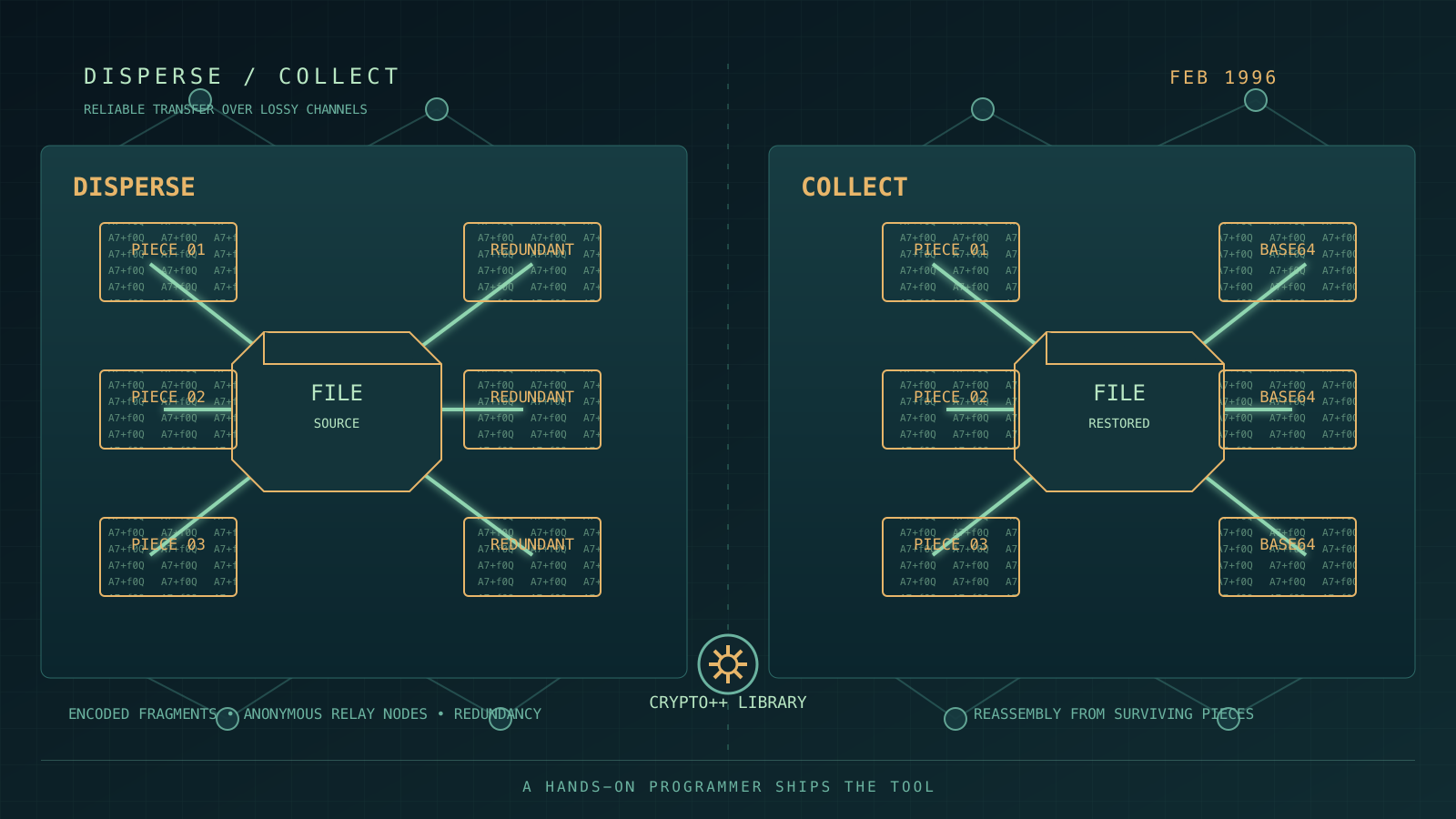
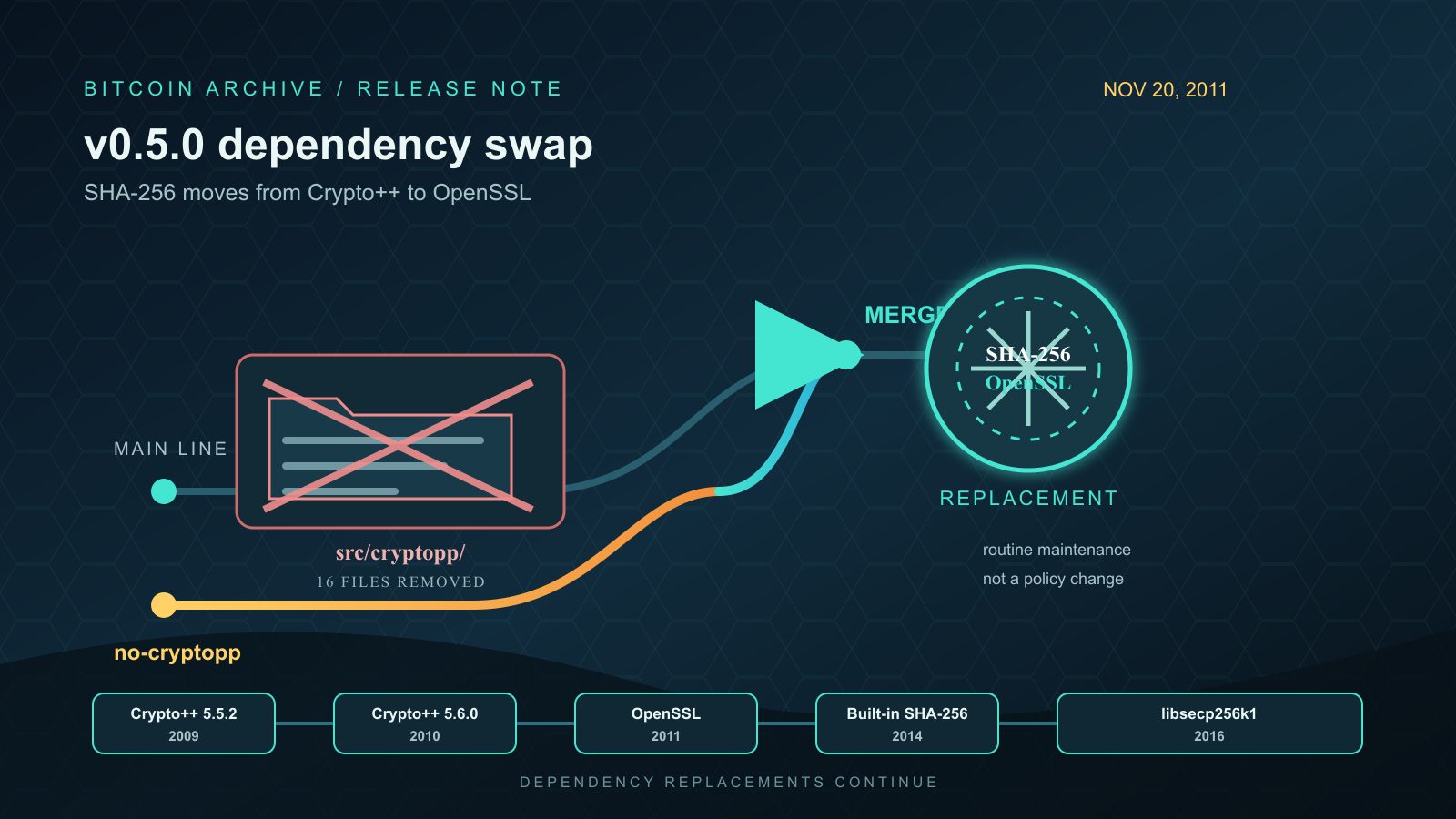
On November 20, 2011, Bitcoin v0.5.0 shipped with the Crypto++ SHA-256 subset that Satoshi Nakamoto had added in July 2010 (SVN rev 114) removed from the codebase. Going forward, Bitcoin called OpenSSL’s SHA-256 routines for the same work. Crypto++ — Wei Dai’s C++ cryptographic library, first previewed publicly fifteen years earlier as Disperse/Collect, the only candidate-authored library Bitcoin had ever included as a direct in-tree code dependency — was no longer part of Bitcoin Core.
The commit and the merge
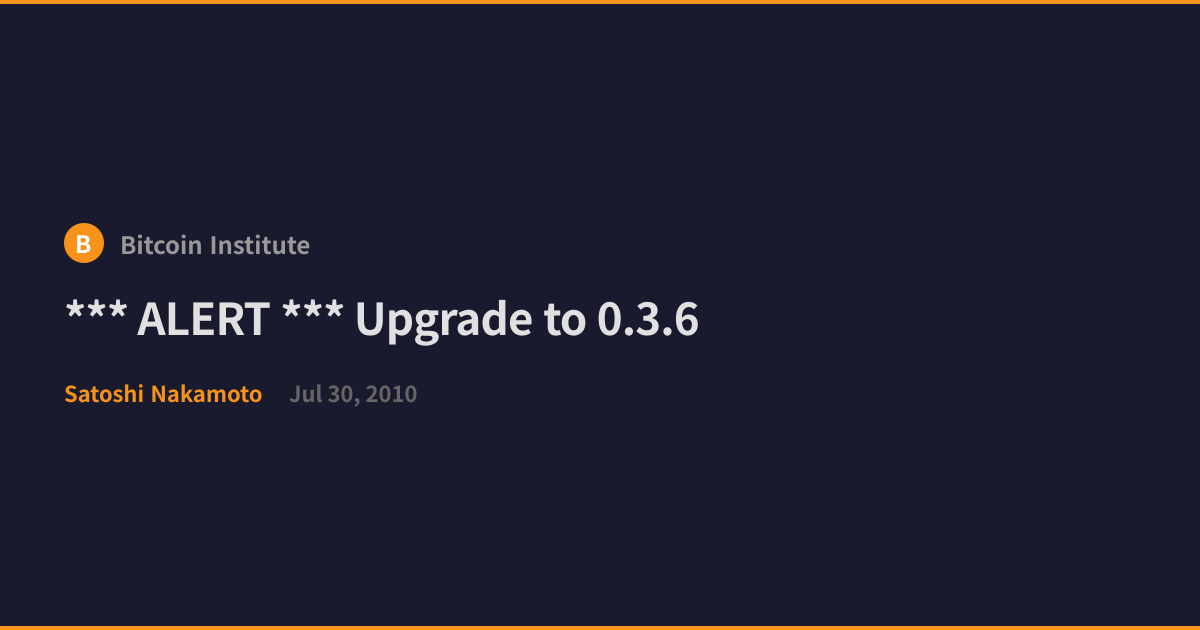
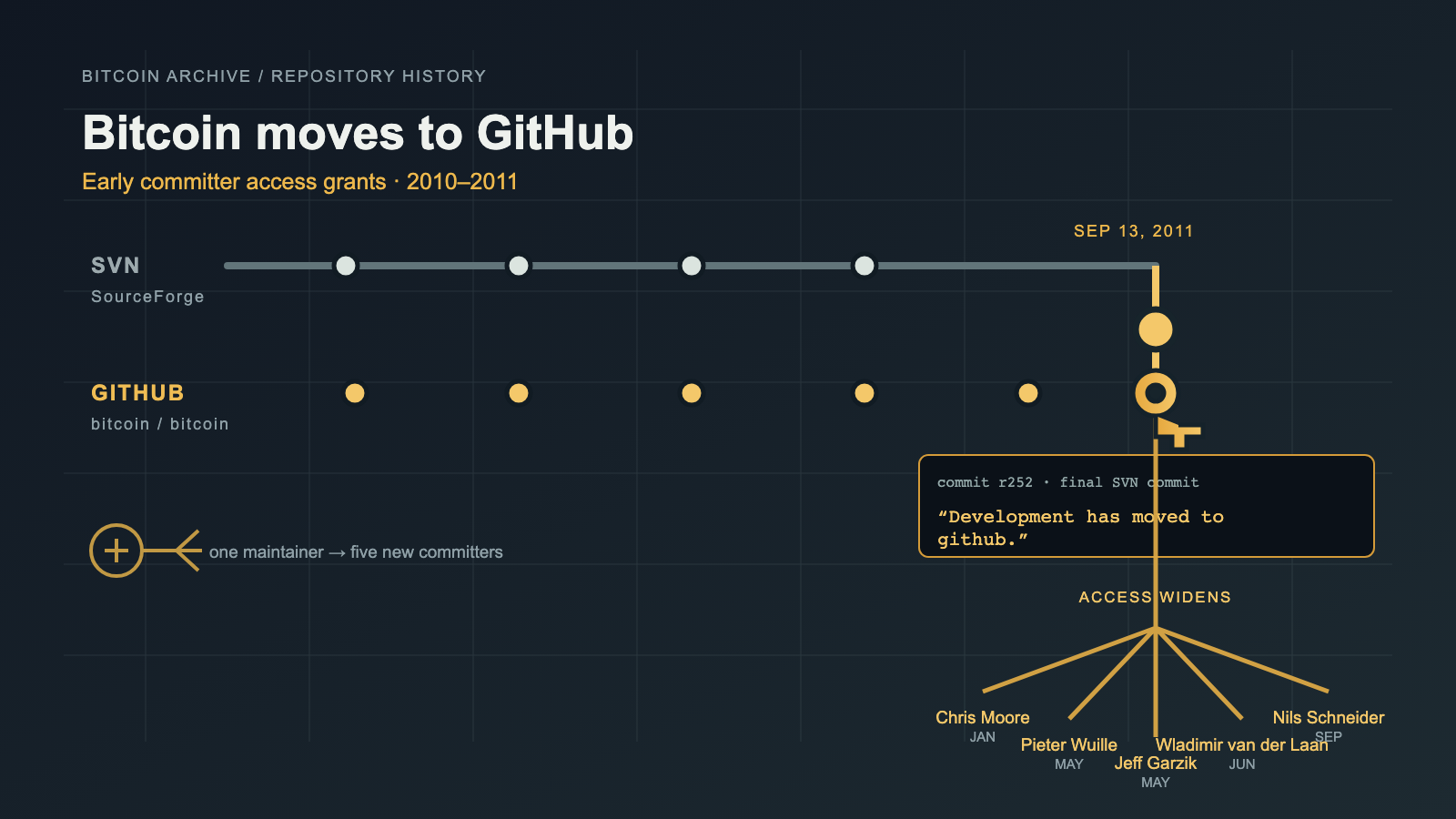
The change came from outside the Satoshi-era contributor pool. Nils Schneider (BitcoinTalk handle tcatm) — the same contributor Satoshi had credited in the v0.3.6 release alert for a midstate-cache mining optimization in 2010 — opened a branch named no-cryptopp. The substantive commit (6ccff2cb) on September 27, 2011 rewrote SHA256Transform() in src/main.cpp to call OpenSSL’s SHA256_Init / SHA256_Update instead of Crypto++‘s CryptoPP::SHA256::Transform, removed the using CryptoPP::ByteReverse import, and deleted the entire src/cryptopp/ directory tree (16 files: sha.cpp, sha.h, cryptlib.h, config.h, cpu.cpp, cpu.h, iterhash.h, misc.h, obj/.gitignore, pch.h, secblock.h, simple.h, smartptr.h, stdcpp.h, License.txt, Readme.txt). Schneider had received GitHub commit access to bitcoin/bitcoin just eight days earlier, on September 19, 2011 — one of five developers granted access that year, as the site’s GitHub-migration committer-access record documents in detail.
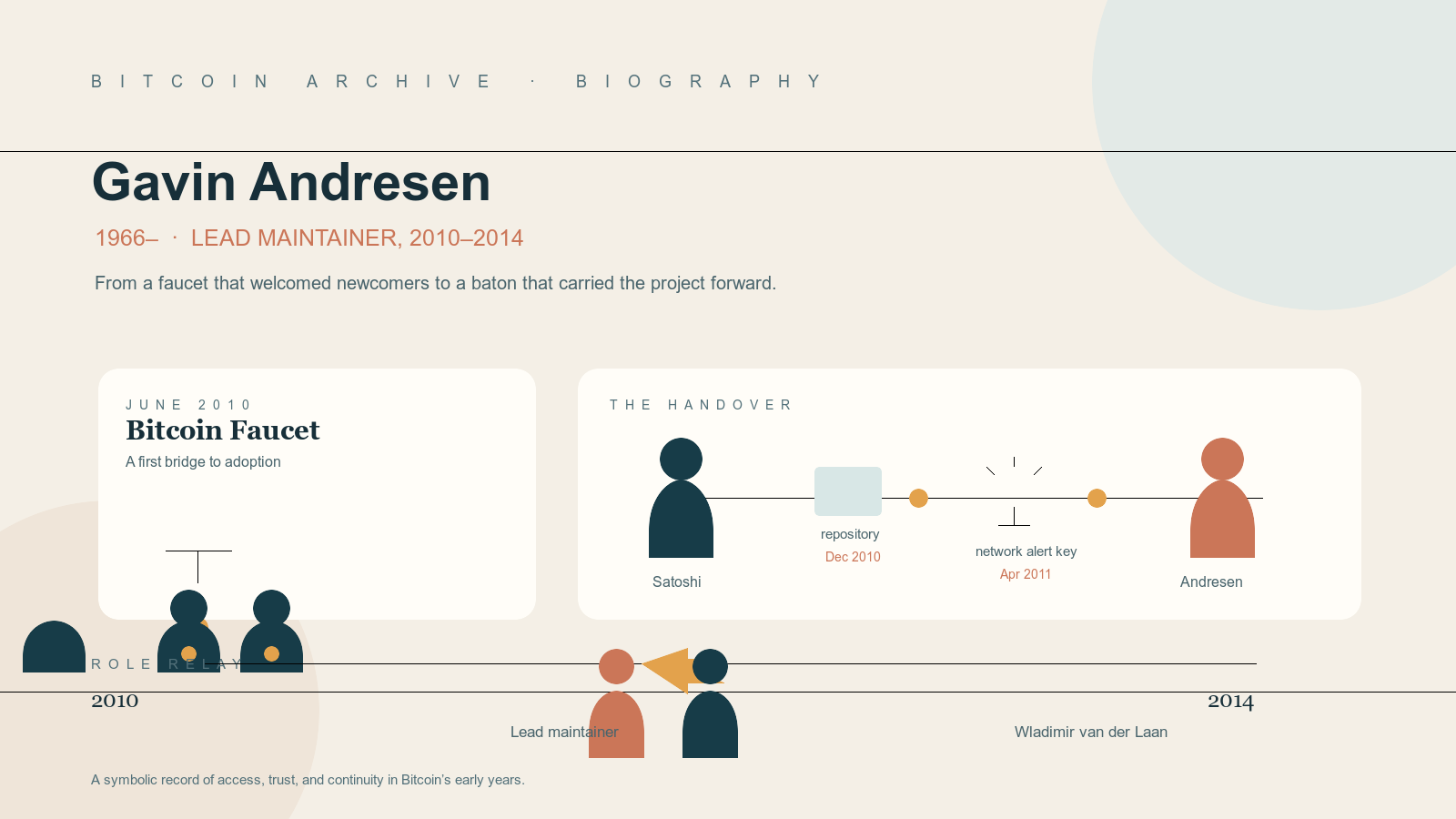
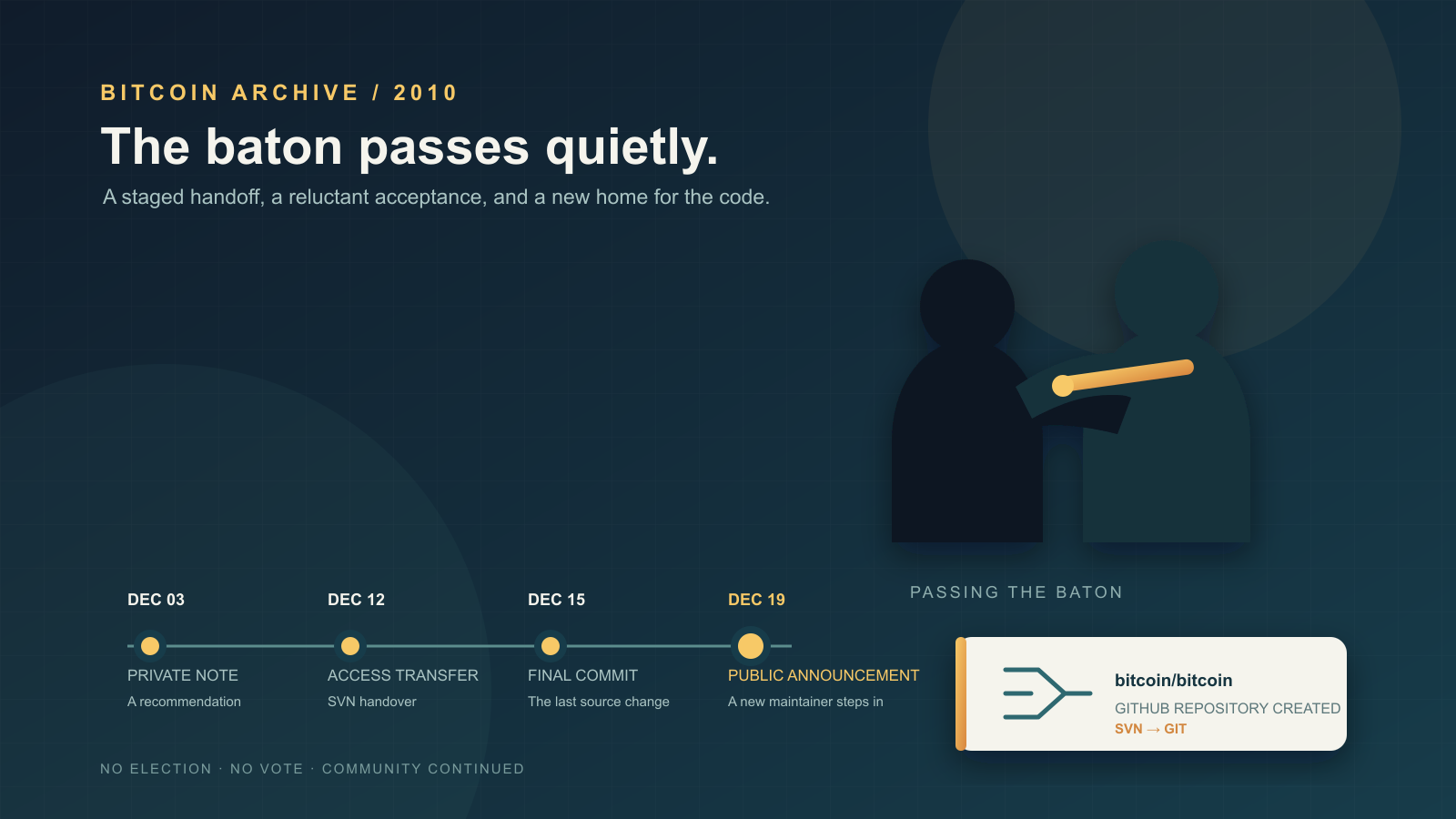
Gavin Andresen — by then the project’s lead maintainer following Satoshi’s April 2011 handover — merged the branch on October 5, 2011 (commit b898c8fc, Merge branch 'no-cryptopp' of https://github.com/tcatm/bitcoin). The merge made Bitcoin Core’s main line OpenSSL-only for SHA-256 going forward. Bitcoin v0.5.0 was tagged on November 20, 2011 and shipped that change to users six weeks later.
What was removed, in context
Bitcoin had bundled a Crypto++ SHA-256 subset since the earliest archived release. Satoshi had personally staged the move from Crypto++ 5.5.2 to Crypto++ 5.6.0 with SSE2-optimized assembly in v0.3.6 (July 2010) and explicitly tracked the dependency in his own commit message: “I added a subset of the Crypto++ 5.6.0 library to the SVN. I stripped it down to just SHA and 11 general dependency files.” Crypto++ was, in plain code-archaeological terms, the one named-candidate-authored library that Bitcoin ever depended on directly.
By 2011, the Bitcoin Core project’s center of gravity had moved off the Crypto++ codepath. The 2010 mining-speed argument that justified bundling the Crypto++ assembly subset (CPU SHA-256 throughput for solo mining) was being decisively obsoleted by GPU and FPGA mining — by late 2011, no serious miner was running the reference client’s CPU SHA-256 path against the network. The Crypto++ subset’s purpose as performance-critical mining code had evaporated, and what remained was an in-tree third-party copy with non-trivial maintenance cost and license-file overhead. Removing it for an existing system dependency (OpenSSL, which Bitcoin already linked for ECDSA) was a code-cleanup decision, not a cryptographic policy change. The replacement preserves the protocol behavior — OpenSSL’s SHA256_Update produces the same digest as Crypto++‘s SHA256::Transform over the same input.
What followed
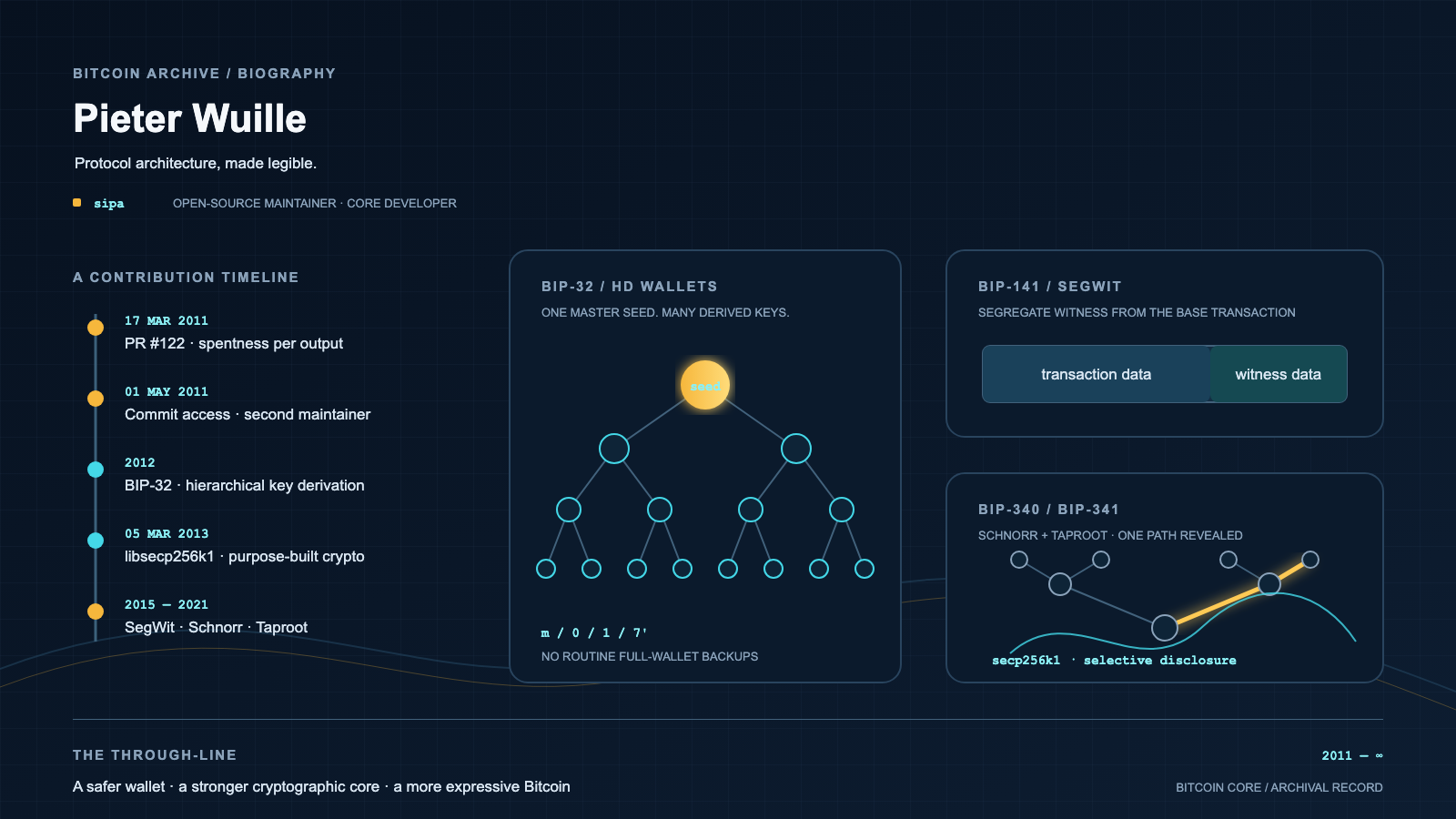
The OpenSSL SHA-256 path was itself replaced by a Bitcoin Core in-tree implementation in 2014. Pieter Wuille’s commit 977cdadea8 (April 20, 2014, “Add a built-in SHA256/SHA512 implementation”) introduced src/sha2.cpp with hand-written SHA-256 and SHA-512 routines, and subsequent commits switched the consensus-critical hash callsites off OpenSSL. From that point, Bitcoin Core no longer depended on a third-party SHA-256 implementation at all.
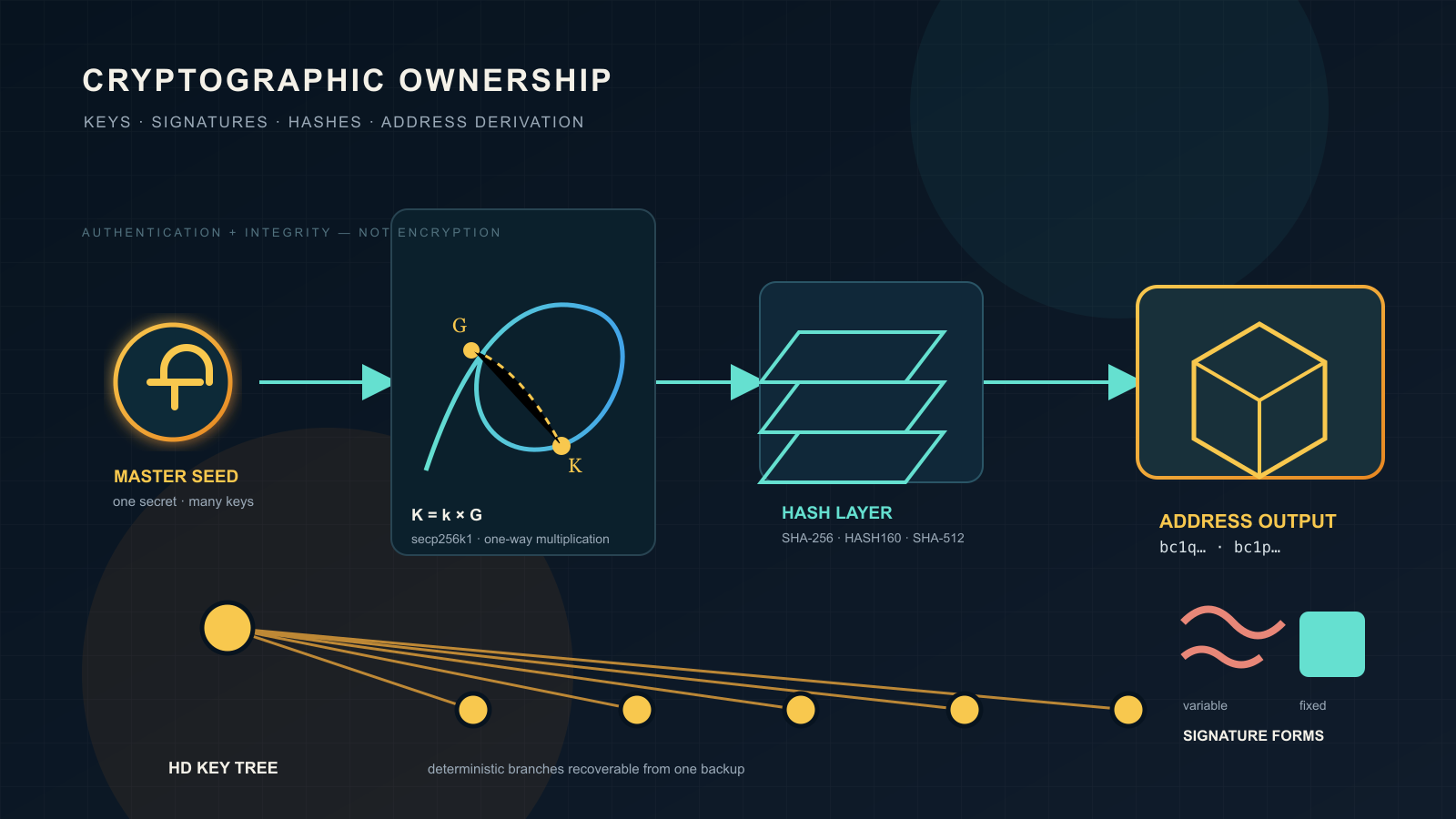
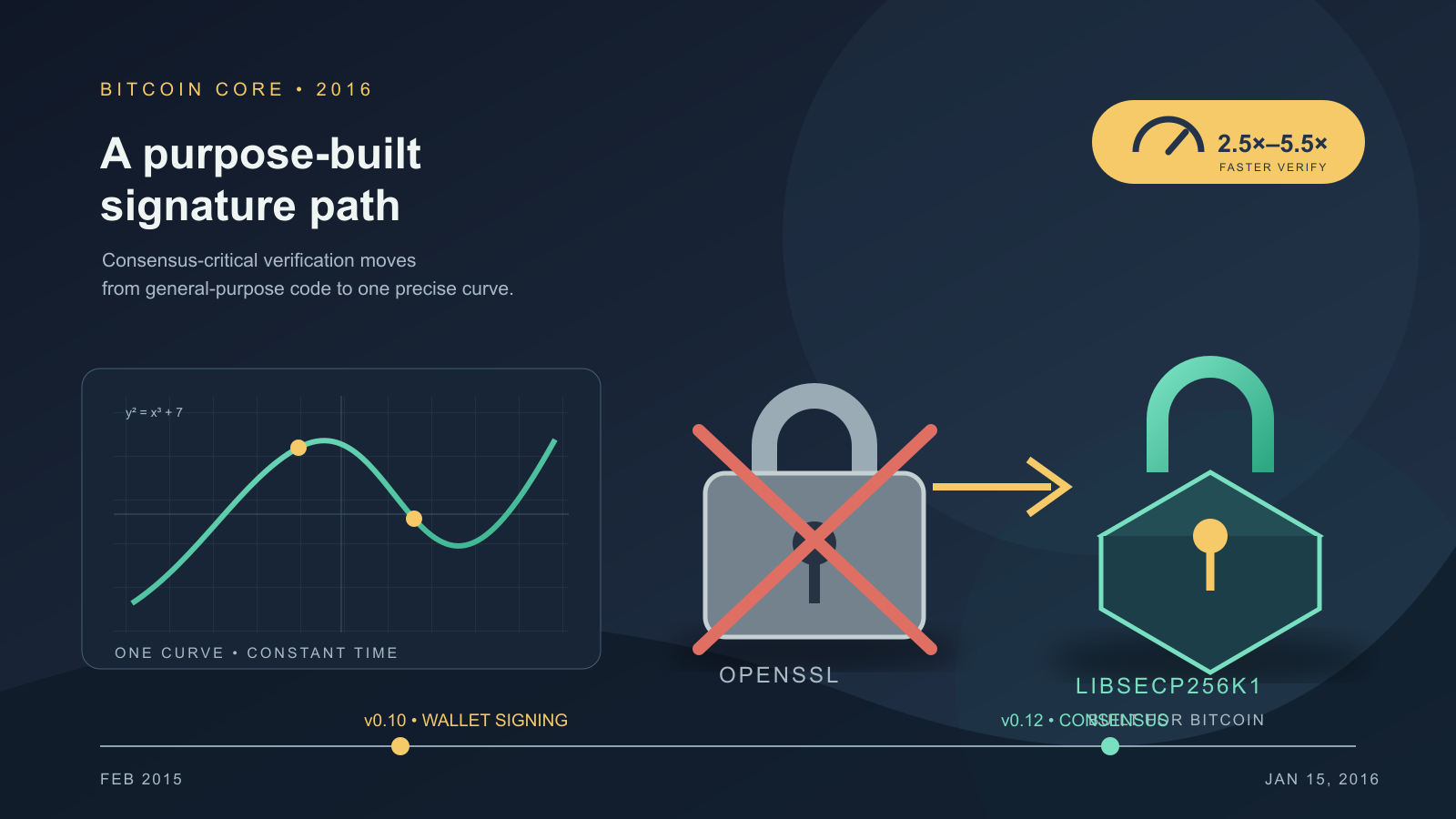
The OpenSSL ECDSA dependency persisted longer and was eventually replaced by libsecp256k1 in Bitcoin Core v0.12 (January 2016).
The chain of replacements:
| Year | Component | From | To | Author |
|---|---|---|---|---|
| 2009 | SHA-256 | — | Crypto++ 5.5.2 (in-tree subset) | Satoshi Nakamoto (v0.1) |
| 2010 | SHA-256 | Crypto++ 5.5.2 | Crypto++ 5.6.0 SSE2 ASM (in-tree subset) | Satoshi Nakamoto (v0.3.6, with BlackEye and tcatm credited) |
| 2011 | SHA-256 | Crypto++ 5.6.0 | OpenSSL | Nils Schneider, merged by Gavin Andresen (v0.5.0) |
| 2014 | SHA-256 | OpenSSL | Built-in (sha2.cpp) | Pieter Wuille |
| 2016 | ECDSA | OpenSSL | libsecp256k1 | Pieter Wuille and Gregory Maxwell (v0.12.0) |
Relevance to the Satoshi-identity question
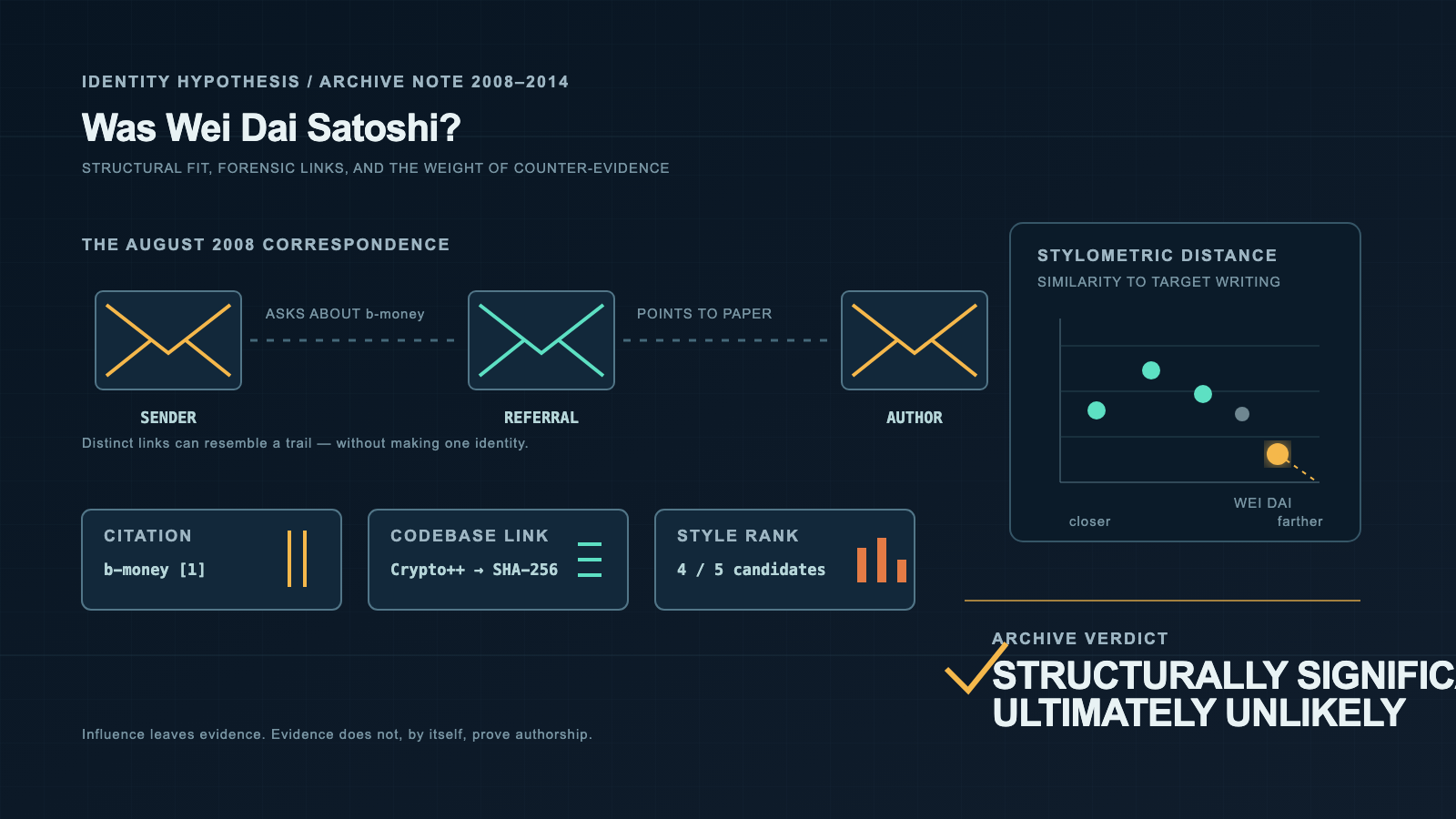
The Wei Dai = Satoshi hypothesis treats Bitcoin’s v0.1 Crypto++ dependency as a structural argument: among the named candidates, only Wei Dai authored a library Bitcoin actually included in its source tree. That argument is bounded in time. By Bitcoin v0.5 (November 2011), Bitcoin Core no longer carried the Crypto++ subset; the structural codebase dependency on Wei Dai’s library lasted from v0.1 (January 2009) through v0.4.x. The change was not made on cryptographic or identity grounds — it was a routine code-cleanup driven by a community contributor (Schneider) reducing in-tree maintenance burden, ratified by the post-Satoshi maintainer (Andresen). But the artifact it produced is a 34-month window during which “Bitcoin depends on Wei Dai’s library at the source-tree level” was a live claim. Outside that window, the claim has to be made about historical releases, not the running protocol.
The Wei Dai = Satoshi hypothesis entry §1.2 frames the codebase dependency as evidence against the null hypothesis that Wei Dai is structurally indistinguishable from other candidates on direct code-contribution grounds. That evidence ends at v0.5.0.
This Crypto++-removal step is the earlier endpoint of a longer dependency-replacement arc: Crypto++ to OpenSSL in v0.5 (2011), then OpenSSL to libsecp256k1 in v0.12 (2016), which the 2016 libsecp256k1 entry covers.