
Jeff Garzik (1974–)

Linux kernel developer and early Bitcoin contributor

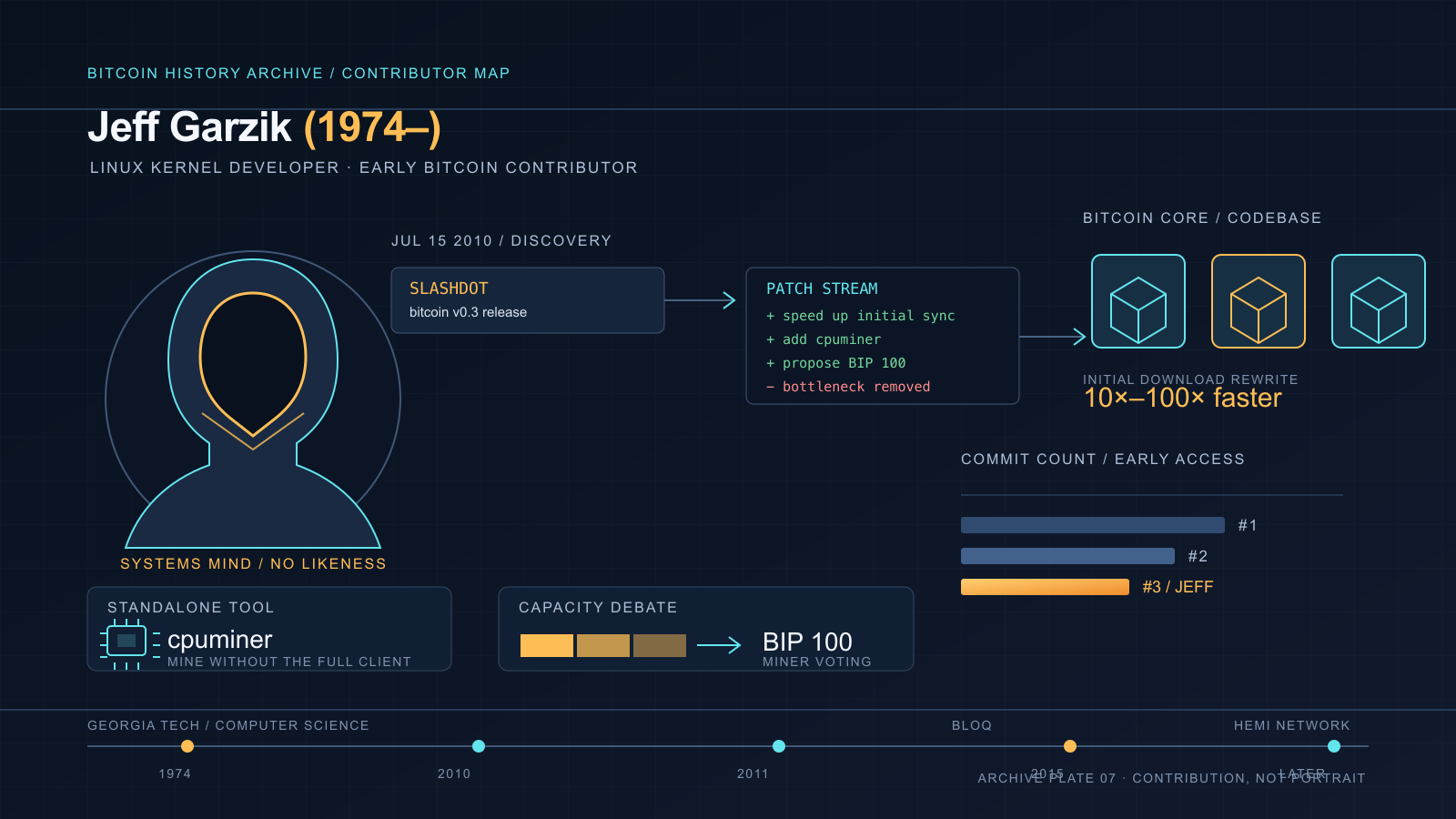
A dark, tech-themed infographic featuring a faceless head-and-shoulders silhouette outline on the left, connected by arrows to a code-patch list box, a row of three outlined block icons, a small CPU chip icon, a horizontal ranking bar chart, and a timeline of dots along the bottom.

In July 2010, a Red Hat Linux kernel developer named Jeff Garzik read a Slashdot post about Bitcoin, pulled the codebase, and started sending patches. Within months he had become the top non-Satoshi commit-count contributor, ranking just behind Satoshi and Gavin Andresen. He wrote cpuminer (one of the first standalone Bitcoin mining tools), authored multiple BIPs including the BIP 100 dynamic-block-size proposal, and co-founded the enterprise-blockchain firm Bloq in 2015.

Garzik studied computer science at Georgia Institute of Technology and built his early career on Linux-kernel work at Red Hat. His kernel-level systems experience translated directly to Bitcoin’s C++ codebase.

Discovery of Bitcoin

The July 2010 Slashdot post that reached Garzik covered Bitcoin’s v0.3 release — a traffic surge early developers later called “the Great Slashdotting,” and the moment a wave of programmers first found the project. Garzik was one of them, and his kernel background let him start reading and patching the C++ code right away.

Bitcoin Core Contributions

Garzik became one of the top three contributors to Bitcoin Core by commit count — behind only Satoshi Nakamoto and Gavin Andresen — and was among the earliest developers granted commit access to the repository. His first major work went after the part of the client that hurt new users most: he rewrote the initial blockchain download to run 10x to 100x faster — though the contemporaneous v0.3.18 SourceForge release notes describe this same category of work more modestly, as speeding up the initial block download only “a little.”

cpuminer

Garzik created cpuminer, widely used open-source software for CPU mining Bitcoin. The tool was one of the first standalone mining applications, enabling users to mine without running the full Bitcoin client.

Interaction with Satoshi

The working relationship played out over email and patch submissions: Garzik would write a change, test it, turn it into a patch, and send it to Satoshi; if Satoshi accepted it, the code went into the project’s Subversion repository. Garzik later described Satoshi as “practical and sane, which made interactions very easy and comfortable” — a collaborator who, by his account, “never used his voice at all — no video, no voice chat, no casual conversations.”

Bitcoin Improvement Proposals

Garzik authored multiple Bitcoin Improvement Proposals (BIPs), including BIP 100, which proposed a dynamic block size limit determined by miner voting. His scaling proposals were part of the broader debate about Bitcoin’s transaction capacity that became a central issue in the Bitcoin community.

Later Career

In 2015 Garzik co-founded Bloq, an enterprise blockchain firm, and later led Hemi Network. His scaling work — BIP 100 above all — kept him in the larger-block, throughput-first camp of the capacity debate that dominated Bitcoin’s middle years.

Related Entries

55 entries

Article

"The Rise and Fall of Bitcoin" — Wired's landmark feature on Bitcoin's first boom and bust

Benjamin Wallace Satoshi Nakamoto, Gavin Andresen, Laszlo Hanyecz, Jeff Garzik, Hal Finney, Wei Dai, Nick Szabo, Stefan Thomas, Dan Kaminsky, Amir Taaki

Benjamin Wallace's Wired feature — an early major mainstream article on Bitcoin. Traces the whitepaper, mining boom, Mt. Gox hack, and growing pains, ending with Garzik's "We really don't care."