Event Added Updated Forum Post 19 messages

JSON-RPC method idea: list transactions newer than a given txid
Context post by genjix in BitcoinTalk topic 2151. before msg28228.
Author of BIP 1, libbitcoin founder, and the coder who left Bitcoin to fight ISIS
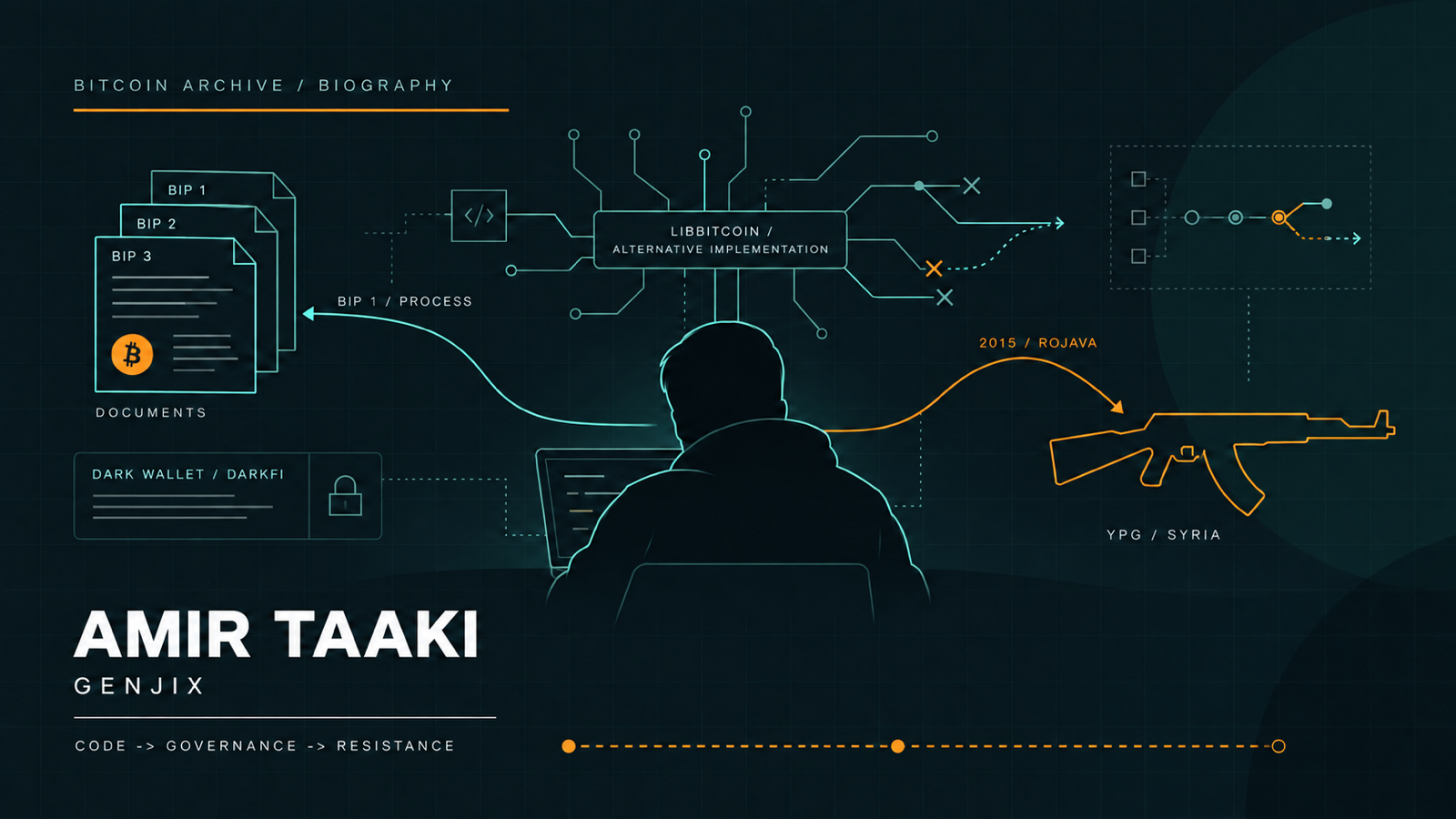
On August 19, 2011, Amir Taaki submitted BIP 1: “BIP Purpose and Guidelines,” the document that created the entire process by which Bitcoin changes. Every Bitcoin Improvement Proposal since, including the ones that added SegWit and Taproot, exists inside a structure Taaki wrote. That November, under his BitcoinTalk handle genjix, he was already on record guessing at Satoshi Nakamoto’s identity from the code alone: Wired quoted him saying Satoshi’s notation style “was popular in the late ’80s and early ’90s. Maybe he’s around 50, plus or minus 10 years.” He was one of Bitcoin’s earliest and most technically serious contributors. In 2015 he set all of it aside, flew to Iraq, and crossed into Syria to fight ISIS.
Taaki registered on BitcoinTalk on October 18, 2010, and posted under the handle genjix, a “Legendary”-ranked account with more than 2,200 posts by the time it went quiet. On November 10, 2010, he opened a thread asking where to send Bitcoin’s case to WikiLeaks; a month later, in the same thread, Satoshi posted his last major public statement on the subject, not as a reply to Taaki directly but as a rebuff of another poster’s push to court WikiLeaks’s attention.
Taaki helped build one of the first Bitcoin businesses in the UK: an exchange that began as “Britcoin” and was incorporated as Intersango Ltd, where UK company records list him as a director from February 2012. He organized the first major London Bitcoin conference in September 2012. That same year he took over management of Bitcoinica, an exchange that had already been hacked once; further coins were lost during the cleanup, and Kraken’s Jesse Powell served him with a negligence lawsuit in person at a London Bitcoin conference. “I’m not a business guy, I’m a coder,” he told Vice in 2015, looking back on the episode. Intersango itself was later dissolved, and a California lawsuit alleging a co-founder froze the other two out and kept the exchange’s remaining bitcoin was still working through the courts as of a June 2025 appellate ruling.
BIP 1 gave Bitcoin’s entire proposal system its shape: three categories of BIP (Standards Track, Informational, Process), the workflow for submitting one, and the editor’s role in accepting or rejecting it. BIP 2 formally superseded it, but the categories and workflow it defined are still how a Bitcoin Improvement Proposal gets made.
Taaki’s next project pushed in the opposite direction from consensus-building. He founded libbitcoin, a full alternative implementation of Bitcoin written from scratch, in parallel with Bitcoin Core. His own account of why is blunt: he says that when he tried to contribute to Bitcoin Core, Gavin Andresen blocked him and told him he shouldn’t be allowed to discuss Bitcoin publicly again. “That’s why I started working on Libbitcoin, to rewrite Bitcoin source code to have alternative implementation,” he said. In “The libbitcoin Manifesto” (2013), he made the underlying argument explicit: “Central authorities are always a magnet for corruption and that will never change… A diversified Bitcoin of many wallets and implementations is a strong and pure Bitcoin.” libbitcoin outlived his direct involvement — it has been maintained for most of the past decade by Eric Voskuil and the Libbitcoin Institute.
In 2014 Taaki co-created Dark Wallet with Defense Distributed founder Cody Wilson, funded through an Indiegogo campaign that raised more than $50,000. The wallet built CoinJoin-style coin mixing directly into its default behavior, aiming to make transaction tracing meaningfully harder. At a 2014 Toronto hackathon, Taaki and a team of Airbitz developers built a decentralized-marketplace prototype called DarkMarket, which was later forked by other developers into what became OpenBazaar. Forbes named him to its 30 Under 30 list that year for the work. Dark Wallet’s development stalled by 2015, and Cointelegraph reported that Taaki himself had become largely unreachable to the remaining team.
The politics behind the project were never incidental. Taaki co-founded unSYSTEM, a small anarchist collective that also included Wilson, and lived for a period in a squat in the former anti-G8 protest headquarters in Hackney, London. He describes himself as “an anarchist or democratic confederalist,” rejecting the nation-state in favor of self-governing local communities — a political vocabulary that, within a year, would take on a much more literal meaning.
In February 2015, Taaki flew from Madrid to Iraq and crossed into Rojava, the Kurdish-controlled region of northern Syria, to join the YPG militia fighting the Islamic State. He had no combat training. “I had no training, and I was given a Kalashnikov,” he later said, describing how he learned to shoot from other Western volunteers en route to the front. He spent roughly three and a half months in front-line combat before moving into economic and civil-society work for Rojava’s administration, where he tried to build a Bitcoin-based economy that could route around the international embargo on the region: “To establish a decentralized economy, you need decentralized money.” He returned to London in May 2016.
He was detained on arrival. His phones and laptops were seized, and he was questioned about the Kurds, Bitcoin, and ISIS. In his own account, he spent close to a year on bail under a curfew — required to stay home during the day, barred from travel, and obligated to check in regularly at a police station. “After one year, the police dropped the case,” he said. No terrorism charge was ever filed, and no trial took place; British authorities did not comment publicly on the investigation. Taaki has said that on later visits to the UK he was repeatedly detained and questioned for hours at the border, which is why he eventually stopped returning.
He didn’t leave the work behind. In 2017 he ran “The Academy,” a hacker-training collective aimed at bringing cryptocurrency infrastructure to Rojava; from 2018 to 2020 he ran a similar project, “Autonomous Polytechnics,” out of Barcelona. Since 2021 his main project has been DarkFi, a privacy-focused blockchain built around anonymous applications and anonymous organizations — the technical continuation of the same argument he’d been making since the libbitcoin Manifesto, that privacy and decentralization are inseparable from resistance to central authority.
When the 2024 HBO documentary Money Electric: The Bitcoin Mystery proposed Peter Todd — Dark Wallet’s former “Chief Scientist” — as Satoshi Nakamoto, Taaki publicly pushed back, laying out the same kind of code-level reasoning he’d offered Wired thirteen years earlier: unusual notation, quirks that pointed to an older programmer, a style he didn’t recognize as Todd’s. “Whenever anyone says X is Satoshi,” he wrote, “my first response is always ‘show me the code.’” The line closes a circle: the same instinct that led him to guess at Satoshi’s age from a glance at the codebase in 2011 was still the standard he held everyone else to, including a friend, thirteen years on.
4 entries
Context post by genjix in BitcoinTalk topic 2151. before msg28228.

Benjamin Wallace's Wired feature — an early major mainstream article on Bitcoin. Traces the whitepaper, mining boom, Mt. Gox hack, and growing pains, ending with Garzik's "We really don't care."
genjix starts a discussion: Wikileaks contact info?
The foundational BIP defining the Bitcoin Improvement Proposal process itself, modeled after Python's PEP. Three types: Standards Track, Informational, Process.