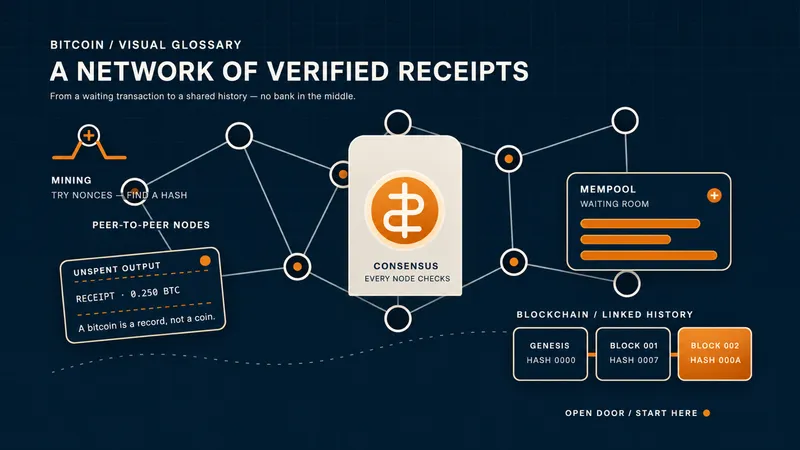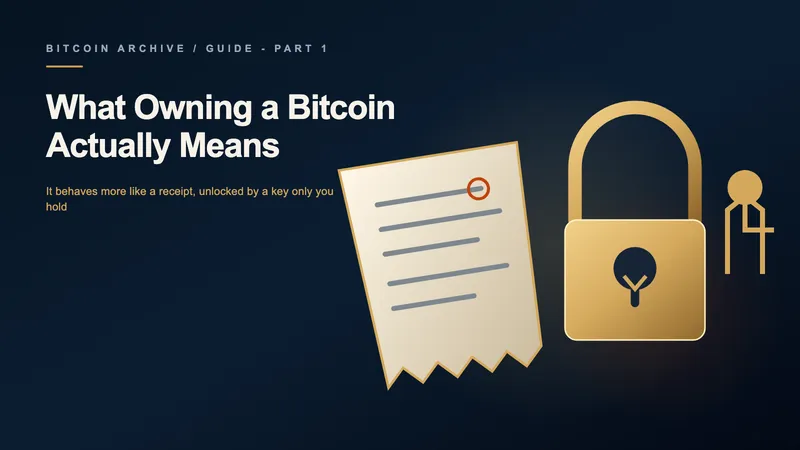

Picture a shared notebook that thousands of computers around the world each keep their own copy of — and somehow, the copies never end up disagreeing for long about what’s written in them. No single computer holds the master copy; anyone can propose adding a page, and every computer that keeps a copy checks it before accepting it into its own. That notebook is what Bitcoin actually is. The previous page covered what gets written on its pages — receipts changing hands. This page covers the notebook itself: which computers keep it, who runs them, and what stops the copies from drifting apart.
Thousands of independent copies
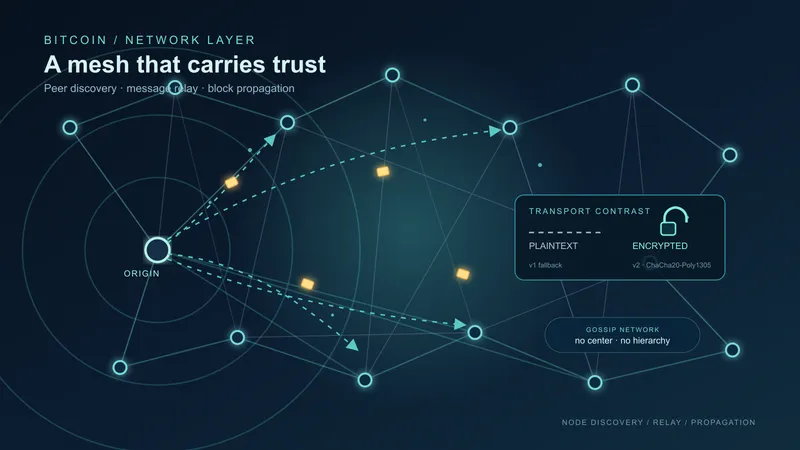
Anyone can run Bitcoin’s software on an ordinary computer; each computer that does is called a node. Nodes don’t go through any central server — they talk directly to each other, passing along anything new they hear about, the way a piece of gossip spreads person to person rather than through an announcement board. This direct, no-middleman style of network has a name: peer-to-peer, usually shortened to P2P — the design-document page covers the transport this gossip actually runs on.
Every node independently checks every new page against the same set of rules before accepting it, using its own copy of the notebook to do so. Nobody has to trust any other single node — each one verifies for itself.
Who keeps the copies
A copy of the notebook lives on a computer, not with a person. Someone has to set that computer up, so who does, and why?
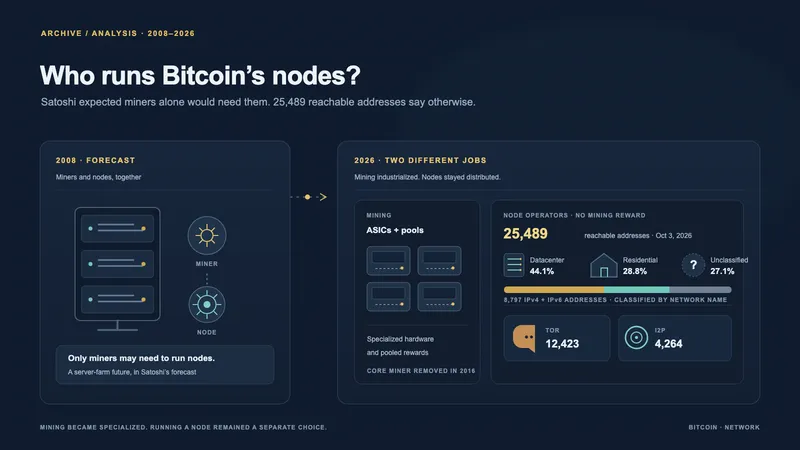
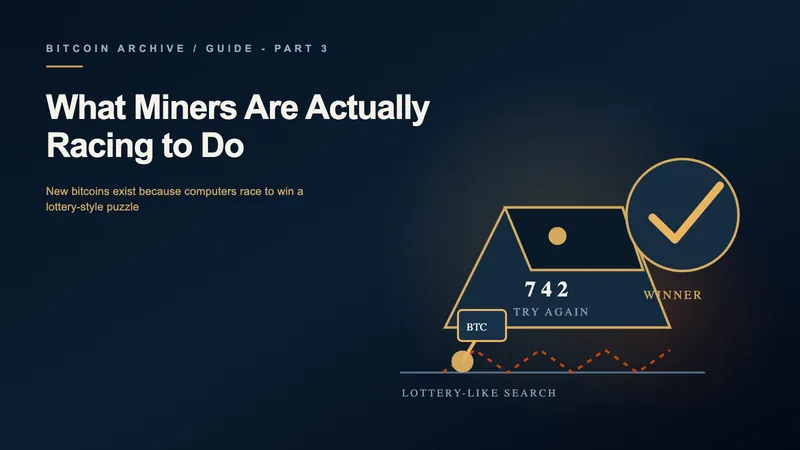
- Anyone can, and it pays nothing. Running a node takes a few hundred gigabytes of disk space (around 10 gigabytes in a slimmed-down mode that throws away old pages) and an always-on internet connection. It earns no new bitcoins. Those go only to whoever adds the next page, which is what the next page is about; today that takes specialized machines, so a node usually just checks pages without trying to add them.
- People run one anyway. A node lets you check your own money against the rules without trusting anyone else’s computer, and it keeps other people from learning which addresses are yours. Businesses that take payments run their own for the same reasons. Some nodes sit on rented servers in data centers; others run on a small box at someone’s home.
- You don’t need one to own bitcoin. A phone wallet that doesn’t run a node asks someone else’s node about your addresses, and coins left on an exchange live in the exchange’s own records. That is more convenient, and it means trusting whoever runs that node or that exchange.
- Anyone can read the notebook. Websites that read a node’s copy let anyone look up any page and any payment ever made. What they show is addresses and amounts, not names.
How this role drifted from what Satoshi expected, and what today’s nodes look like in numbers, is traced in who runs Bitcoin’s nodes, and why.
A page you can’t quietly rewrite
New transactions aren’t written into the notebook one at a time. They’re gathered up in batches — a batch is called a block — and a new block is added roughly every ten minutes.
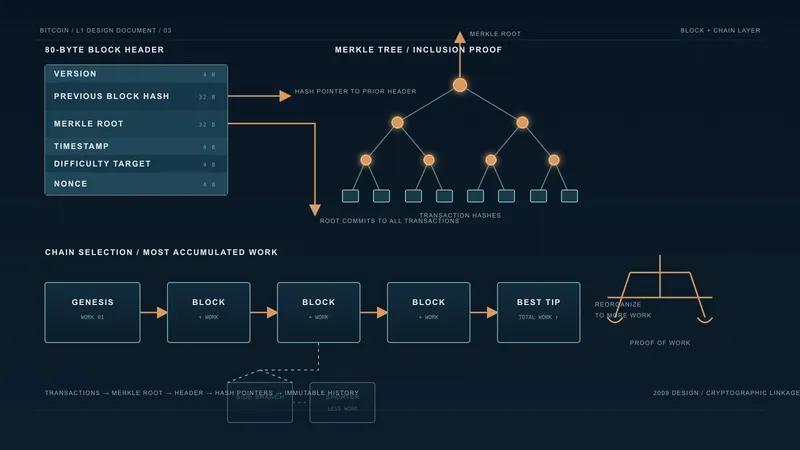
What stops someone from sneaking back to page 40 and changing what it says? Each block carries its own short fingerprint, called a hash, calculated from everything the block contains. Change even a single character inside the block, and the fingerprint comes out completely different — there’s no way to tweak the contents while keeping the same fingerprint, and no way to work backward from a fingerprint to guess the contents.
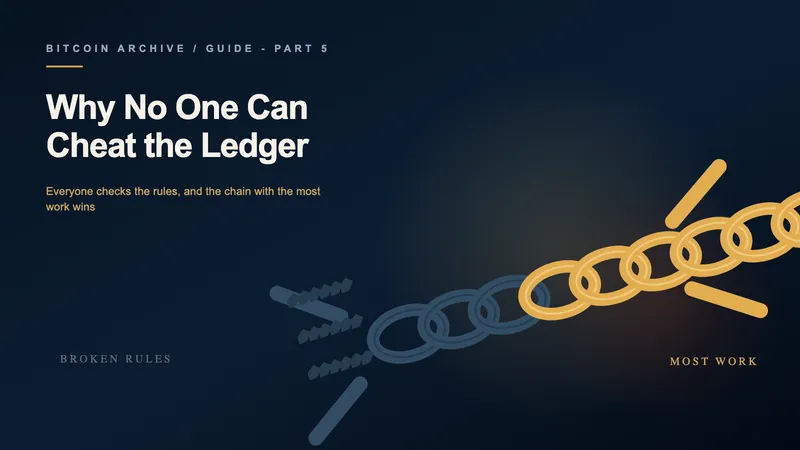
Here’s the part that actually locks the pages together: every block also stores the previous block’s fingerprint inside itself. Change something on an old page, and that page’s fingerprint changes — which no longer matches what the next page says it should be, which breaks that page too, and the one after it, all the way to today. Rewriting history quietly isn’t just hard here; the pages are built to make it visible immediately.
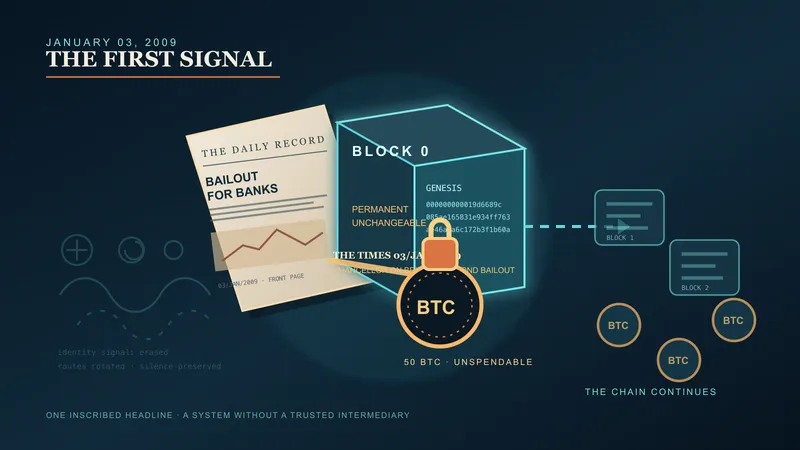
That very first page is called the genesis block — nothing came before it to link back to, so it’s the one block that had to be special-cased into existence rather than added the normal way. Everything since has been chained on top of it in an unbroken line, which is where the word blockchain comes from: a chain of blocks, each one anchored to the last.
So every node ends up agreeing on the same chain, checked page by page, impossible to quietly edit after the fact. That still leaves an open question: who actually gets to add the next page, and why would anyone bother? The next page answers that.