
Three days after the whitepaper appeared on the cryptography mailing list, Satoshi Nakamoto answered James A. Donald’s worry that the system would not scale to the size it needed. Ordinary users, he wrote, would not need the whole chain:
Satoshi Nakamoto (Cryptography mailing list post, November 03, 2008, 1:37:00 AM UTC)Long before the network gets anywhere near as large as that, it would be safe for users to use Simplified Payment Verification (section 8) to check for double spending, which only requires having the chain of block headers, or about 12KB per day. Only people trying to create new coins would need to run network nodes. At first, most users would run network nodes, but as the network grows beyond a certain point, it would be left more and more to specialists with server farms of specialized hardware. A server farm would only need to have one node on the network and the rest of the LAN connects with that one node.
Half of that forecast came true. Creating new coins did leave ordinary computers for specialized hardware. The other half did not: on October 3, 2026, a crawler could still connect to 25,489 Bitcoin node addresses, and the software those nodes run cannot create a single coin. Nobody pays them. So who runs them, and what do they get for it?
1. In 2008, a node was a miner
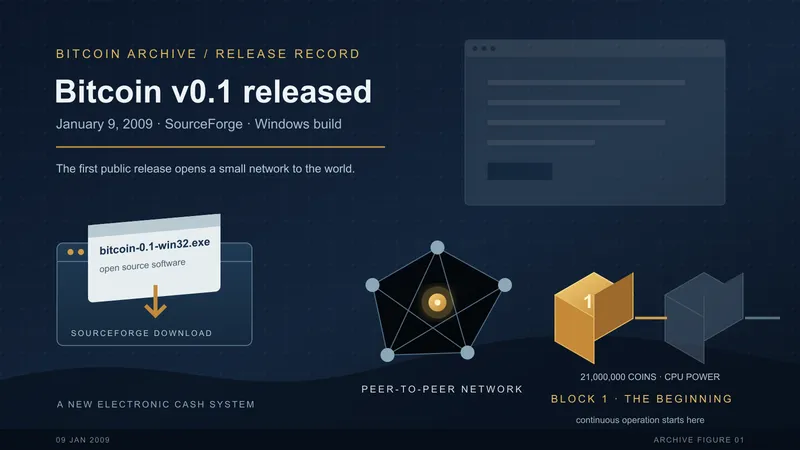
In the whitepaper, “node” and “miner” are the same thing. Section 6 gives the block’s first transaction, a new coin, to “the creator of the block,” and calls that “an incentive for nodes to support the network.” The software matched the paper. Bitcoin v0.1 was one program that sent payments, checked the chain, and offered to “generate coins by contributing CPU power to the network.” Everyone who ran Bitcoin in 2009 ran a node, and every node could mine.
Satoshi treated that as a starting arrangement. In a reply in a thread on scalability, he said so outright:
Satoshi Nakamoto (BitcoinTalk post, July 29, 2010, 2:00:38 AM UTC)The current system where every user is a network node is not the intended configuration for large scale. That would be like every Usenet user runs their own NNTP server. The design supports letting users just be users. The more burden it is to run a node, the fewer nodes there will be. Those few nodes will be big server farms. The rest will be client nodes that only do transactions and don’t generate.
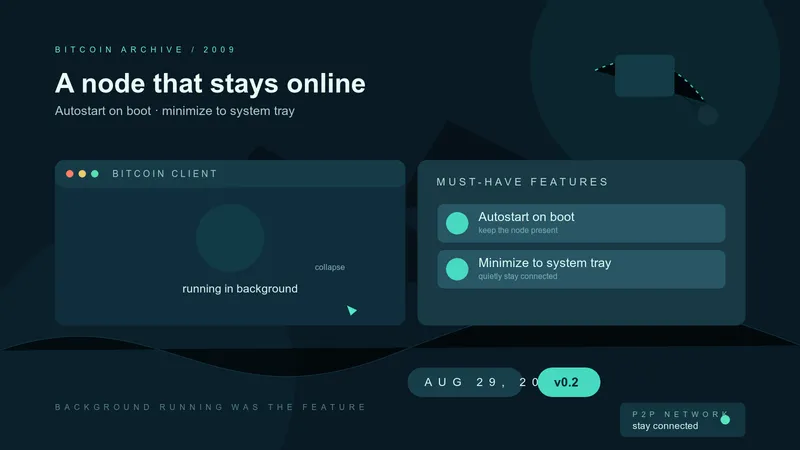
A year earlier, while the network was small, he had pushed the other way. In August 2009 he told Martti Malmi that starting the client automatically was “the most important missing feature right now that would make an order of magnitude difference in the number of nodes,” and put off a Linux port: “Linux would help server farms, but actually we’d like to favour individual users.”
The whitepaper had left one exception. Its section on simplified verification ends: “Businesses that receive frequent payments will probably still want to run their own nodes for more independent security and quicker verification.” In Satoshi’s picture, full nodes would be run by those who create coins and by businesses that take payments. Ordinary users would check only block headers.
2. What came true, and what did not
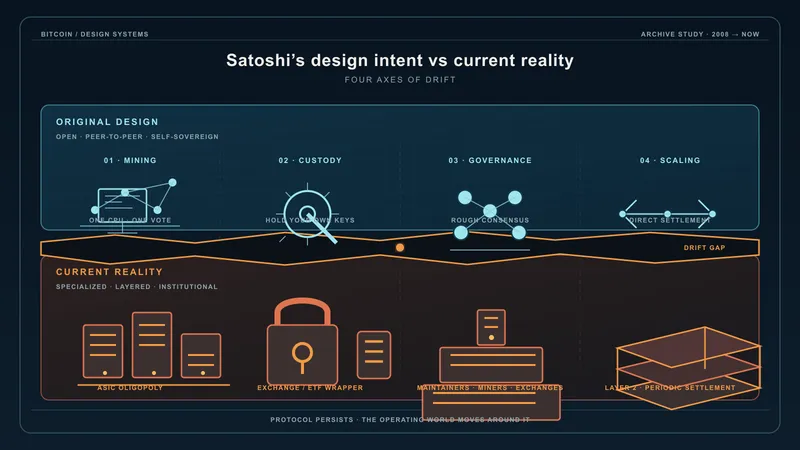
| Satoshi’s expectation (2008–2010) | October 2026 | |
|---|---|---|
| Who creates coins | Specialists with server farms | Specialized machines (ASICs) organized into mining pools |
| Does the node software mine | Yes; nodes are the miners | No; Bitcoin Core removed its built-in miner in 2016 |
| Who runs full nodes | Coin creators and businesses taking payments | 25,489 reachable addresses; who stands behind them is not recorded |
| What a node costs | A growing burden, so fewer nodes | Bitcoin Core’s download page: about 600 GB to download plus 5–10 GB a month, or about 10 GB with pruning |
| What a node earns | The block reward, for the node that creates the block | Nothing, unless the same operator also mines |
Mining went where Satoshi said it would. GPUs arrived in May 2010, the first commercial ASIC in January 2013 (the design-versus-reality analysis has the chronology), and miners pooled their work from the end of 2010, starting with the pool Marek Palatinus proposed. By August 2016 the separation was official in the code. Bitcoin Core 0.13.0 removed the miner that had been built in since v0.1, with one line of explanation: “As CPU mining has been useless for a long time, the internal miner has been removed.”
The node went the other way. Instead of growing heavier until only server farms could carry it, it got lighter. Pruning, available since 2015, lets a node keep the rules and the current state while deleting old blocks, and Bitcoin Core’s download page now says a pruned node needs “as little as 10GB total without sacrificing any security.” A node no longer needs to be a farm. It also no longer gets paid: the reward goes to whoever creates the block, and the node software no longer tries.
3. Where the nodes are
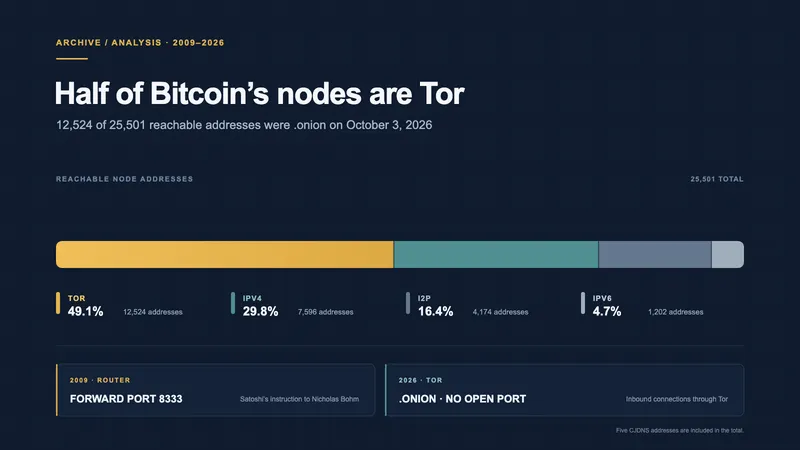
The October 3 snapshot, taken at 04:37 UTC, gives every reachable address a network, and every clear-net address an internet provider. Of the 25,489 addresses, 12,423 were Tor onions and 4,264 were I2P; neither says where the machine is, and why so many nodes hide their addresses is a separate story, counted there from a snapshot taken 56 minutes earlier, at 03:41 UTC, whose totals differ slightly. Of the rest, the 8,797 IPv4 and IPv6 addresses can be sorted by the name of the provider that hosts them:
| Provider type | Addresses | Share of 8,797 | Largest names |
|---|---|---|---|
| Data centers and cloud hosts | 3,878 | 44.1% | Akamai Connected Cloud 881, Hetzner 862, OVH 385, Google Cloud 341, Amazon 332, DigitalOcean 213 |
| Home and small-business internet providers | 2,532 | 28.8% | Comcast 262, AT&T 197, Deutsche Telekom 145, Vodafone, Charter, Free |
| Not classifiable by name | 2,387 | 27.1% | Verizon’s UUNET 162 (homes and businesses mixed), small regional networks |
The sorting is by provider name only, so it cannot tell a home connection from a small office on the same provider, and a quarter of the addresses could not be placed at all. What it can say is that Satoshi’s server farms exist, and that they are not alone. Four in ten clear-net nodes sit in rented servers; three in ten sit on the kind of connection people have at home, alongside the Tor onions that hide where they sit.
4. Why, with no reward
No survey counts what node operators want, so the reasons have to come from what the project tells them. The bitcoin.org guide to running a full node says that “miners, businesses, and privacy-conscious users rely on particular behavior from the full nodes they use, so they will often run their own full nodes.” The Bitcoin Wiki’s page on full nodes lists four reasons:
- Checking the rules without trusting anyone. A full node itself confirms that no coin was spent twice, that no coin was spent by someone who did not own it, and that no coins were created outside the schedule.
- Privacy. A light wallet has to ask someone else’s server about its addresses, and that server learns which addresses belong together. A wallet attached to one’s own node asks no one.
- Security. A light wallet can be fooled for a time into accepting an invalid transaction; a full node cannot.
- Economic strength. A full node enforces the rules even if most miners change them. The Wiki adds a condition: this counts only if one’s own transactions actually go through one’s own full node. “Just running a full node on a server somewhere does not contribute to Bitcoin’s economic strength.”
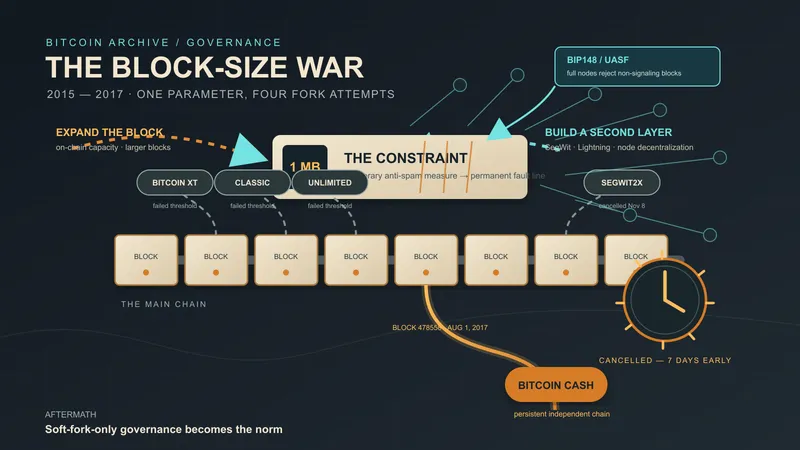
That last reason is the one Satoshi’s picture had no place for, and the one the record shows in use. In 2017, during the block-size war, the BIP148 campaign announced that non-mining full nodes would reject, from August 1, every block that did not signal SegWit. Nodes that created no coins set a deadline for the miners who did.
Who does not need a node also follows from the same reasons. A shareholder in a spot Bitcoin ETF holds no keys at all; the trust holds the coins, so there is nothing for the shareholder to check. An exchange customer is in the same position for coins left on the exchange. For readers new to Bitcoin, the beginner guide’s page on the shared ledger walks through who keeps the copies in plainer terms.
In 2008 Satoshi drew a network where nodes would shrink to the people paid to create coins, plus the businesses that took them. The coin creators went to their farms as he said. The nodes did not follow. Twenty-five thousand addresses stay up for no reward, many of them in data centers, many on home connections, half of them behind Tor. That is the one role the whitepaper did not write down: checking the rules for oneself, unpaid, so that nobody else has to be trusted to do it. How many people stand behind those addresses, and which of the four reasons moves each of them, no record counts.