BIP 44 — Multi-Account Hierarchy for Deterministic Wallets
Defines a BIP32-based path (purpose'/coin_type'/account'/change/index) letting one seed manage multiple coins and accounts, plus the account-discovery algorithm for recovering wallets.
Founded Bitcoin's first mining pool, then co-wrote its seed-phrase standard

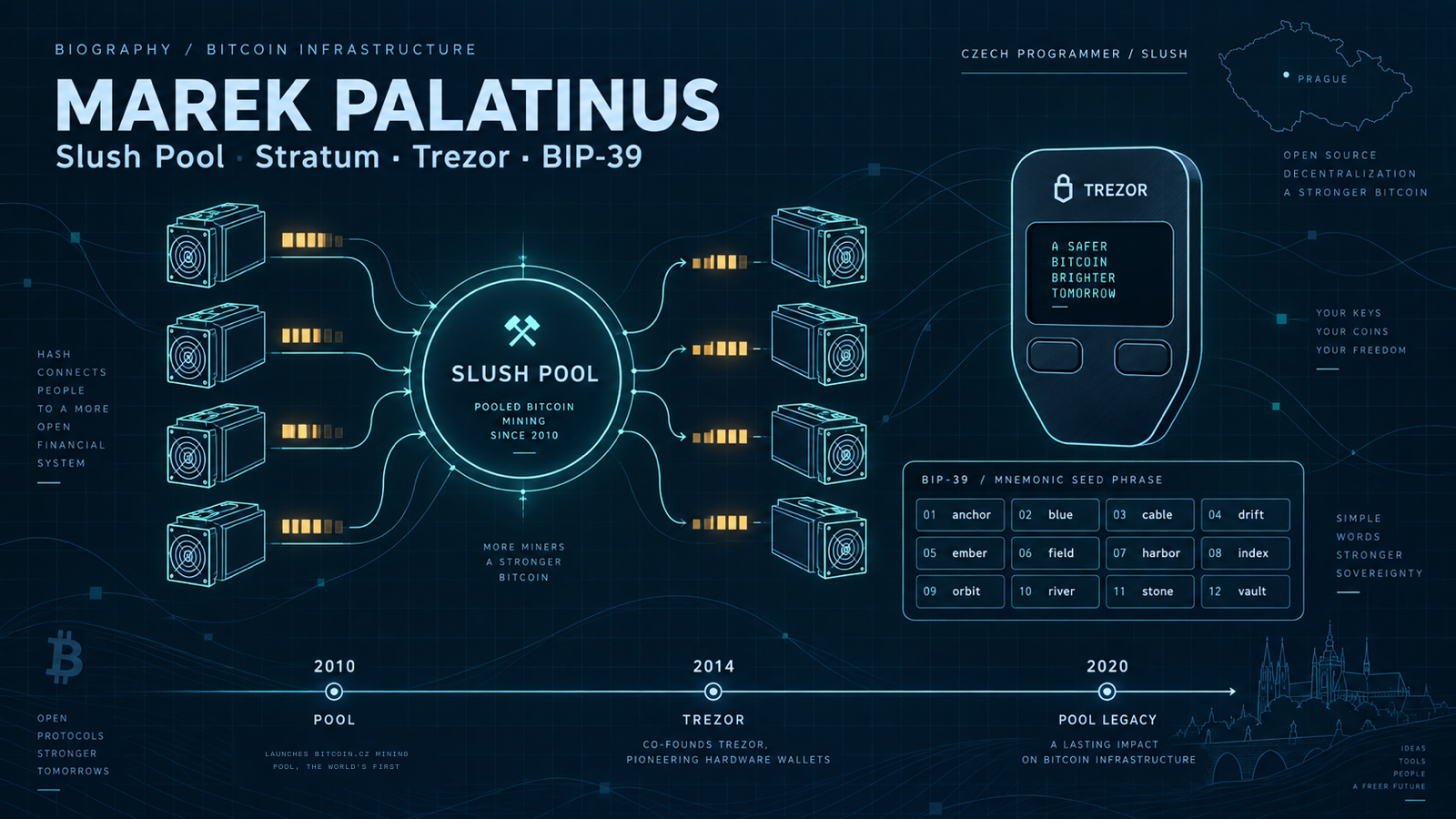
The first Bitcoin mining pool. The Stratum protocol that still tells most of the network’s miners what to work on. The first hardware wallet. The handful of ordinary words that back up nearly every Bitcoin wallet in use today. All four trace back to one person: Marek Palatinus, a Czech programmer who posted under the name slush and was, by his own account, only a few weeks into Bitcoin when he wrote the message that started it.
On November 27, 2010, Palatinus proposed a way for miners with weak hardware to combine their machines and split whatever they found: “Join poor CPU miners to one cluster and increase their chance to find a block!” He was upfront about what that required from strangers. Someone would have to trust a single operator not to keep the reward for himself — and that operator was him: “You need to trust in central authority (me) that I don’t steal block for myself. But I’m goofing around for few week and I’m amazed with bitcoin idea, so I don’t plan to steal anybody right now :-).”
Weeks after his post, the pool went live as the Bitcoin.cz Mining Pool — by Braiins’s own later account, the world’s first publicly available Bitcoin mining pool. Members pointed their own miners at Palatinus’s server; the server handed out unsolved work and paid out each miner’s share of any block found, proportional to the hashes they had actually contributed. Nothing about that arrangement was decentralized. It ran on exactly the kind of trust his own post admitted to — in an operator who happened to be a stranger a few weeks into the project himself.
The pool grew regardless, and outgrew its founder’s own company. In 2013, Braiins — a mining-technology firm that had been building software around it — bought a majority stake, and in 2016 the pool was renamed Slush Pool, after the handle attached to the original post. Palatinus stayed involved until 2020, when Braiins bought out his remaining stake. He marked the exit on Twitter: “After ten years in #bitcoin, one epoch of my life is over. I’m no longer affiliated with @slush_pool. I wish @braiins_systems all best and good luck with the project; my little baby is in good hands!” Two years later, Braiins folded the pool’s original name into its own, renaming it Braiins Pool.
The Bitcoin.cz Mining Pool’s early software still relied on getwork, the method built into the reference client for handing miners a block header to hash. As network hashrate climbed, getwork turned into a bottleneck: it made a fresh network round trip for every unit of work, at a rate mining hardware was fast outgrowing. In 2012, Palatinus designed a replacement — the Stratum mining protocol — that let a pool hand out much larger batches of work per round trip and told miners how to build their own block headers locally in between. More than a decade later, pools still run either his original protocol, now called Stratum V1, or its successor Stratum V2, developed collaboratively and still maintained by Braiins.
Palatinus crossed paths with Pavol Rusnak, an open-source and security engineer, at Brmlab, Prague’s hackerspace, in late 2011, not long before the city’s first Bitcoin conference. In 2013 the two joined Alena Vranova to co-found SatoshiLabs, building a way of holding a Bitcoin private key that didn’t depend on trusting whatever internet-connected computer it happened to sit on. Their answer shipped on July 29, 2014, as the Trezor Model One — a small, single-purpose device with a display and two physical buttons, built to sign transactions without ever exposing the private key to the computer it plugged into. It was the first hardware wallet ever sold, and it created a product category that a large share of the industry’s cold storage still runs on. Vranova ran the company as CEO through its early years; Palatinus took over as SatoshiLabs CEO in January 2017, and stepped down as Trezor’s CEO in January 2023 to become an advisor.
Palatinus and Rusnak’s second lasting standard had nothing to do with a physical device. On September 10, 2013, they co-authored BIP-39 with Aaron Voisine and Sean Bowe, defining how to turn computer-generated randomness into a sequence of ordinary words — typically twelve or twenty-four of them — that a person can write on paper or read aloud, and later convert back into the seed for an entire wallet. It replaced a real failure mode: wallets whose owners lost everything because a raw hexadecimal seed was too easy to mistype or too awkward to store. BIP-39 became the standard nearly every wallet, Bitcoin and otherwise, still uses to back up its keys.
The following April, they extended it with BIP-44, which builds on Pieter Wuille’s BIP-32 to define a single path structure — purpose, coin, account, chain, address — that lets one seed phrase manage multiple accounts across multiple cryptocurrencies, and lets a wallet rediscover all of them after being restored from that phrase alone. Between the two BIPs, the seed phrase a new wallet shows a user today, and the derivation path that turns it into addresses, both go back to the same two people.
| Contribution | Started | Status today |
|---|---|---|
| Bitcoin.cz Mining Pool | 2010 | Renamed Braiins Pool (2022), still operating |
| Stratum protocol | 2012 | V1/V2 still coordinate most pooled mining |
| Trezor Model One | 2014 | SatoshiLabs’ Trezor line continues; Palatinus became SatoshiLabs CEO in 2017, stepped down as Trezor CEO in 2023, and stayed on as an advisor |
| BIP-39 / BIP-44 | 2013–2014 | Still the standard for wallet seed phrases and multi-account paths |
None of what Palatinus built asks to be noticed. Nobody reads the twelve words on their recovery sheet and thinks of a Czech programmer who was weeks into Bitcoin when he closed a forum post to strangers with “Are you interested in?” That is exactly the measure of it. A mining pool, a communication protocol, a physical key, and a list of words — the four things a person needs the least reason to ever ask who invented them — all trace back to the same one, and all four are still running.
5 entries
Marek Palatinus ↔ Pavol Rusnak
Defines a BIP32-based path (purpose'/coin_type'/account'/change/index) letting one seed manage multiple coins and accounts, plus the account-discovery algorithm for recovering wallets.
Thread starter by slush in BitcoinTalk topic 1976.
Quoted post by slush in BitcoinTalk topic 1946.
Context post by slush in BitcoinTalk topic 1334. before msg24101.
Marek Palatinus ↔ Pavol Rusnak
Defined the standard for generating human-readable mnemonic seed phrases (typically 12 or 24 words) from random entropy. Combined with BIP 32, became the universal Bitcoin wallet backup method.