How Bitcoin actually works: a visual glossary from coins to consensus

Figures: Satoshi Nakamoto

This entry is written to be readable without prior background — no prior knowledge of Bitcoin, cryptography, or how computers exchange data is assumed. By the time you reach the bottom, you should be able to read the rest of the Archive without getting lost in jargon. Every key term gets a one-line definition the first time it appears, plus a diagram showing where it fits.

If you want to look up a single word, jump to the Quick reference glossary. Otherwise read top-to-bottom — each chapter assumes only what the previous chapters covered.

1. What is Bitcoin, exactly?

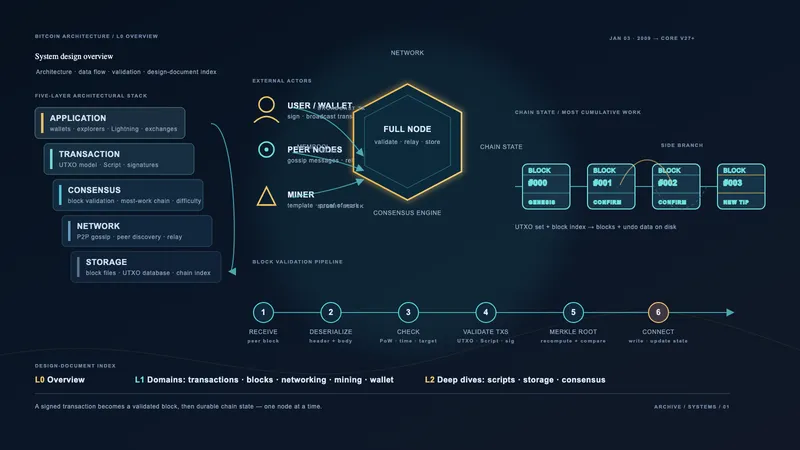
Bitcoin is an electronic money system that works without a bank in the middle. The dollars in your bank account are entries in a database your bank controls — if the bank goes offline, freezes your account, or makes a mistake, you are stuck. Bitcoin replaces that single controlling bank with a network of thousands of computers, run by anyone who wants to participate, none of them in charge.

Each of those computers is called a node. Nodes talk to each other directly, not through any central server. That style of network is called peer-to-peer, often abbreviated P2P.

Peer-to-peer Bitcoin network

Node

Node

Node

Node

Node

Node

Node — a computer running Bitcoin software, connected to other Bitcoin nodes. Anyone can run one. Peer-to-peer (P2P) — a network where computers talk to each other directly, with no central server in the middle.

The rules of the system are defined by a short paper Satoshi Nakamoto published in 2008, the Bitcoin whitepaper. The software was released two months later, in January 2009, and has been running continuously ever since.

One refinement before we move on. The node described above — the kind that stores the entire blockchain and independently verifies every rule — is called a full node. A lighter variant called a light node, or SPV client (for simplified payment verification), only downloads a tiny summary at the top of each block (the block header) and asks full nodes whether specific transactions exist. Many phone wallets run on SPV; many others use a still simpler model — querying a central server API operated by the wallet provider — which is even lighter but trusts the provider for everything. The whitepaper’s § 8 sketches the SPV idea; the production engineering came years later, driven largely by Mike Hearn’s bitcoinj work. For the rest of this entry, “node” means full node unless stated otherwise.

The rest of this entry explains, step by step, how that runs-by-itself system actually works.

2. Quick reference glossary

Use this as a lookup table. Each term links to the chapter where it is explained with a diagram.

TermMeaning
NodeA computer running Bitcoin software
Full nodeNode holding the whole blockchain and verifying every rule (assumed kind here)
Light node (SPV)Node downloading only block headers, trusting full nodes for the rest (typical on phones)
Peer-to-peer (P2P)Direct computer-to-computer network, no central server
WalletSoftware that holds your keys and lets you send/receive bitcoins
Private keyA secret number; whoever holds it controls the coins
Public keyA number derived from the private key; safe to share
AddressA short text string derived from the public key, for receiving coins
Digital signatureCryptographic proof that the holder of a private key authorised something
TransactionA message that moves coins from one or more inputs to one or more outputs
InputA reference to a previous output you are now spending
OutputA new chunk of coins, locked to a recipient address
UTXOAn unspent output — the actual form a “coin” takes
BTC / satoshiThe unit (1 BTC = 100,000,000 satoshi)
BlockA batch of transactions, packaged together
HashA short fingerprint number computed from any data
Hash functionThe function that produces a hash; tiny input change = totally different hash
BlockchainAll the blocks, chained together by hashes, oldest to newest
Genesis blockThe very first block, Block 0
Block heightThe position number of a block in the chain (Block 0 is height 0)
MinerA node that tries to add new blocks
MiningThe process of trying to add a new block
NonceA number a miner keeps changing to find a valid block hash
Proof-of-work (PoW)The puzzle a miner must solve to add a block
DifficultyHow hard the puzzle currently is
Coinbase transactionThe special first transaction in a block that creates new bitcoins
Block rewardNew bitcoins minted in the coinbase transaction
Transaction feeA small extra amount included with a transaction, paid to the miner
Miner rewardBlock reward + total transaction fees in the block
HalvingThe block reward cut in half every 210,000 blocks (~4 years)
MempoolThe waiting room of transactions not yet in a block
ConfirmationOne block added on top of yours; more confirmations = more permanent
ConsensusAll nodes agreeing on the same blockchain
VerificationA node checking that a transaction or block follows the rules
Double-spendingThe attempt to spend the same coin twice; the problem Bitcoin solves
TamperingTrying to change a block after the fact
Longest chainThe chain with the most accumulated work; the one all honest nodes follow

3. What a coin actually is: the UTXO model

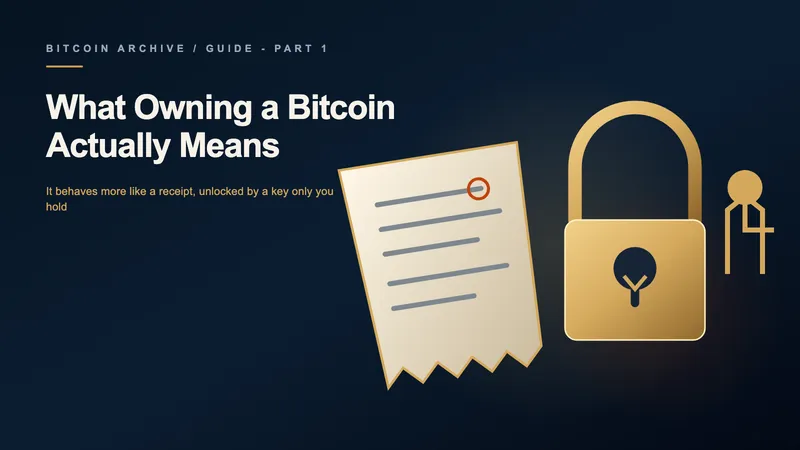
A “bitcoin” is not a coin object sitting somewhere with your name on it. It is much closer to a receipt.

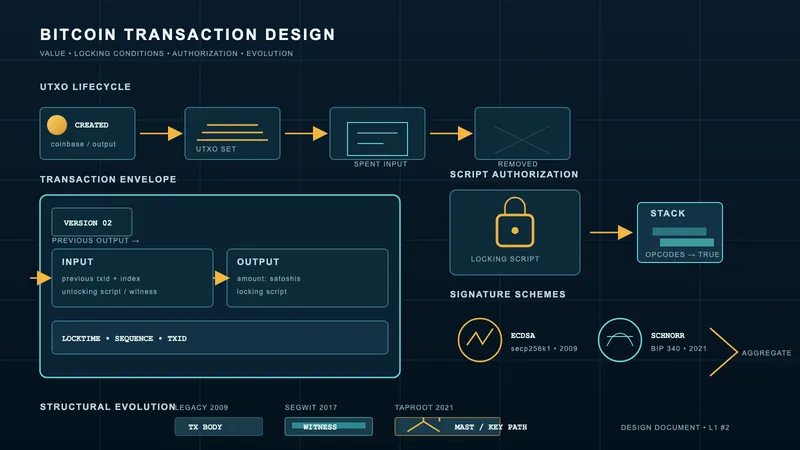
Imagine you receive 1 BTC from a friend. What you actually receive is a transaction record on the network that says: “this 1 BTC chunk is now locked to the address that this private key can unlock.” The chunk is called an output. As long as you have not spent it, it is called an unspent output — abbreviated UTXO (Unspent Transaction Output). Your “balance” is the sum of every UTXO locked to addresses your wallet can unlock.

To spend bitcoins, your wallet builds a new transaction that:

  1. Lists one or more existing UTXOs as inputs (the coins you’re consuming),
  2. Creates one or more new outputs (the new chunks of coins, locked to recipient addresses),
  3. Signs the whole thing with the private keys that control the inputs.

Outputs - new UTXOs created (total: 1.199 BTC)

Inputs - existing UTXOs you are spending (total: 1.2 BTC)

UTXO A: 0.7 BTC

UTXO B: 0.5 BTC

Transaction

(signed with private keys)

To friend: 1.0 BTC

Change back to you: 0.199 BTC

Implicit fee: 1.2 - 1.199 = 0.001 BTC

(not an output - collected by miner via coinbase)

Inputs are always entire UTXOs — you cannot spend “half” of a UTXO. If you owe 1 BTC but your only UTXO is 1.2 BTC, the transaction spends the whole 1.2 BTC, creates one 1.0 BTC output to the recipient, and creates another ~0.199 BTC output back to your own wallet (called change). The remaining 0.001 BTC, not assigned to any output, becomes the transaction fee the miner who includes this transaction collects (chapter 5).

The amounts use BTC as the unit you usually see, but internally Bitcoin counts in satoshi: 1 BTC = 100,000,000 satoshi. The smallest unit you can transfer is 1 satoshi, named after the system’s author.

Private key

secret random number

Public key

derived from private

Address

short text like 1A1zP1...

Anyone can send to this address

Used to sign transactions

that spend coins locked to this address

The private key is the only thing that matters for control. Lose it, and the coins locked to its address are unrecoverable. The public key and address are derived from the private key by one-way mathematics; sharing them is safe. The digital signature is a piece of data the wallet generates from the private key plus the transaction itself; anyone in the network can verify the signature is valid for that address without ever seeing the private key.

The Bitcoin whitepaper covers this in Section 2 (“Transactions”).

4. Blockchain: the permanent record

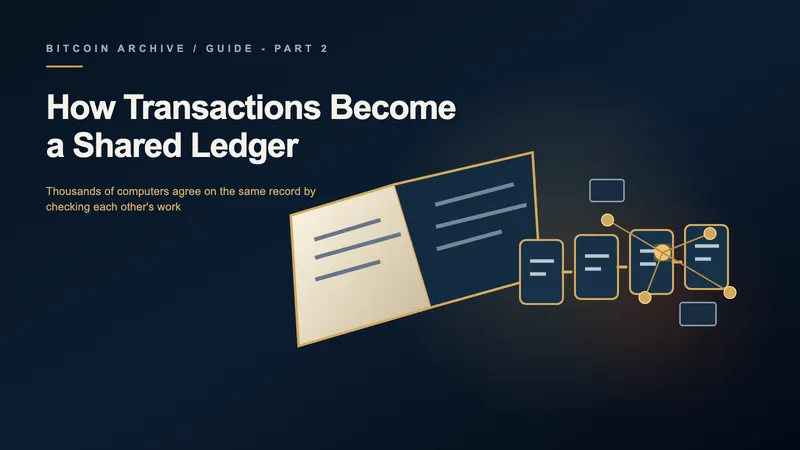
Transactions broadcast across the peer-to-peer network are not immediately final. They are batched into blocks — packages of transactions that all became official at roughly the same moment. Blocks are produced about every 10 minutes on average.

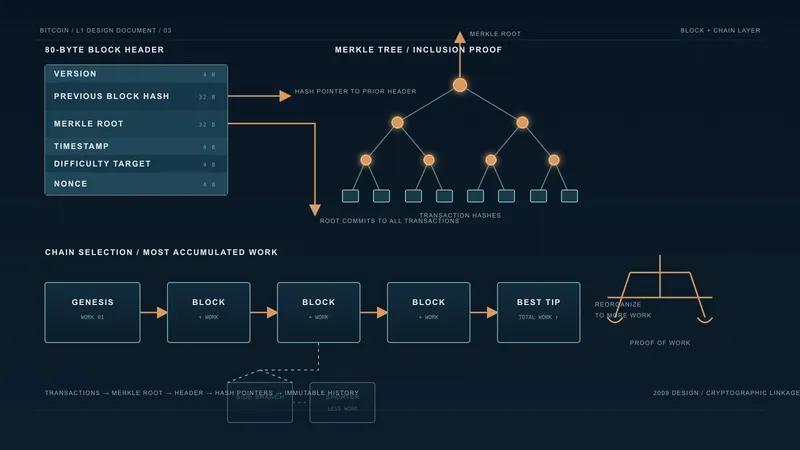
Each block contains its own short fingerprint called a hash. A hash is computed by a hash function — a piece of math that turns any input data (a block, a sentence, a file, anything) into a fixed-size short number. Two important properties of the hash function Bitcoin uses (SHA-256):

  • Even a one-character change to the input produces a completely different hash.
  • You cannot work backwards from the hash to figure out the input.

Input: 'The Times 03/Jan/2009 Chancellor on brink of second bailout for banks'

SHA-256

e8b...4f2 (illustrative — actual hash is a specific 256-bit number)

Input: 'The Times 03/Jan/2009 Chancellor on brink of second bailout for bank'

(one character removed)

SHA-256

91a...7c5 (illustrative — entirely different from above)

Each new block also includes the hash of the previous block inside itself. That linking is what makes it a chain: every block points backwards to the one before it, all the way back to the very first block ever produced.

Block 0

Genesis

hash: 000...26f

Block 1

previous-hash: 000...26f

own hash: 000...d24

Block 2

previous-hash: 000...d24

own hash: 000...8c7

Block 3

previous-hash: 000...8c7

own hash: 000...b13

... continues past height 900,000 today

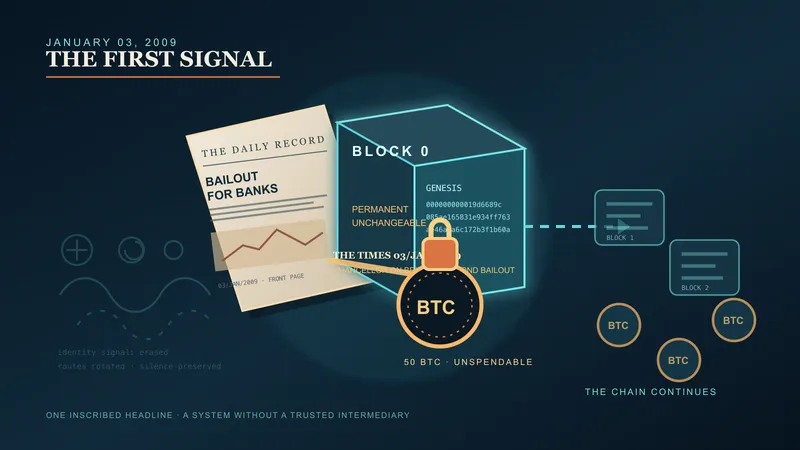
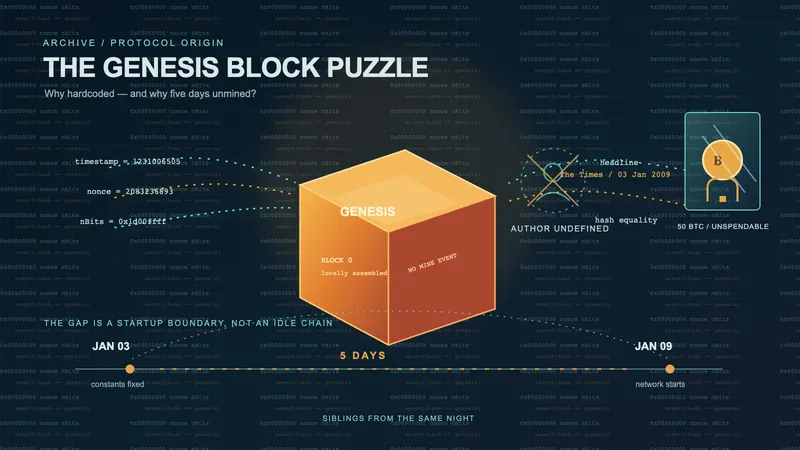
The very first block is called the genesis block (or Block 0). It is special — its parameters were hardcoded into the source by Satoshi rather than mined; the genesis-block hardcode analysis reads the v0.1 source for the details. Every block’s position counted from Block 0 is called its block height: the genesis is height 0, the next block is height 1, and so on.

The whole linked structure — genesis to the most recent block — is the blockchain. Everyone running a node has the same copy of it.

5. Mining: issuance and validation

Before going into mining itself, three terms that sound similar but are not the same thing:

  • A node runs the Bitcoin software and verifies the chain — that is its job.
  • A miner is a node that also spends compute power racing to produce the next block.
  • A wallet is software that manages your keys and builds transactions; it can live inside a node, talk to a node, or sit on a phone with no full node at all.

Mining is a strictly added activity on top of being a node. A wallet is a separate concern again — a phone wallet usually talks to someone else’s node, often via SPV (chapter 1). Bitcoin Core ships all three roles in one program, which is the most common reason these terms get conflated.

Nodes - verify the chain

Miners - also race for the next block

ASIC-driven mining rig

Bitcoin Core

node + wallet, no mining

Pure verifier

node only

Phone wallet

SPV, no full node

Hardware wallet

keys only

So who decides which transactions go into the next block, and where do new bitcoins come from?

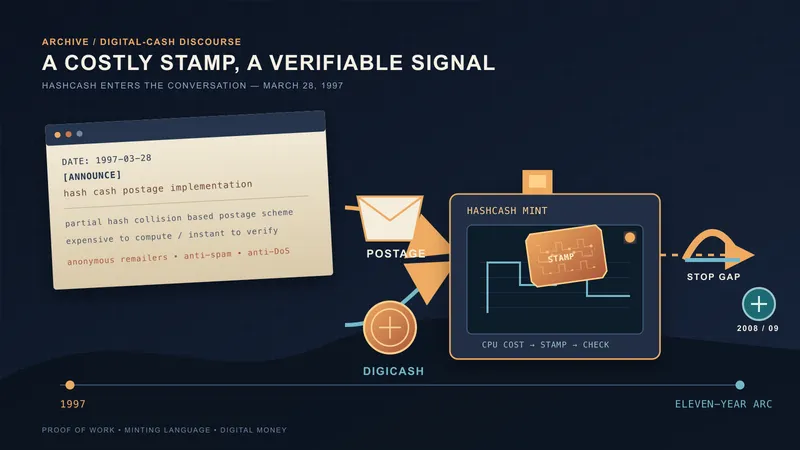
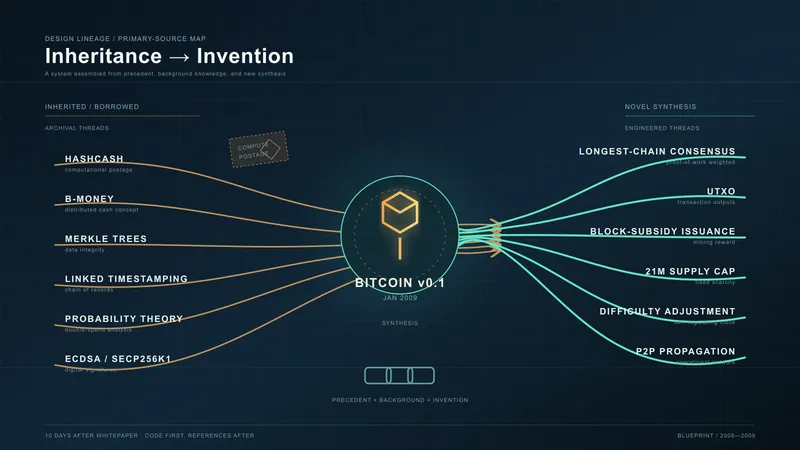
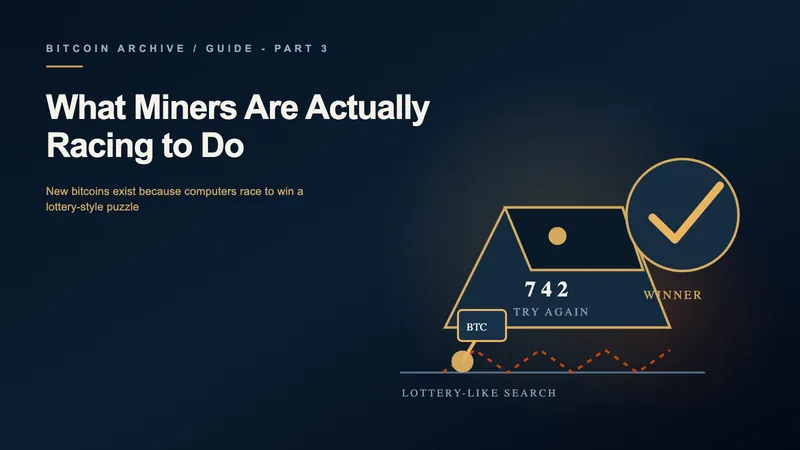
The answer is mining. Any node willing to do the work can be a miner. Miners collect waiting transactions, package them into a candidate block, and then race to solve a puzzle. The puzzle is: find a number to put in the block such that the block’s hash starts with a certain number of zeros. That number you keep changing is called the nonce. Because the hash function (chapter 4) gives completely unpredictable outputs, the only way to find a winning nonce is to keep trying. This trying-millions-of-numbers process is called proof-of-work (often abbreviated PoW) — first proposed for spam control in Adam Back’s 1997 Hashcash, reused in Bitcoin as the core mechanism.

NetworkMinerNetworkMinerCollect waiting transactionsAdd coinbase tx (creates new BTC)Try nonce 0 ... compute block hash ... noTry nonce 1 ... compute block hash ... noTry nonce 2 ... compute block hash ... no... (millions of tries) ...Try nonce 2083236893 ... hash starts with enough zeros - WINBroadcast the new blockEvery node verifies and adds it

How many leading zeros are required is called the difficulty. The network adjusts the difficulty every 2,016 blocks (about every two weeks) so that, regardless of how much total computing power miners throw at the puzzle, a winning block is found roughly every 10 minutes on average.

The miner who wins gets to insert one special transaction at the top of the block — the only transaction in Bitcoin whose input doesn’t reference any previous output (it consumes no prior coins). This is the coinbase transaction, and the outputs it creates are the only way new bitcoins ever come into existence. The amount it creates is called the block reward. On top of that, the miner also collects all the transaction fees attached to the regular transactions they included. Together, those two amounts form the miner reward.

Coinbase transaction

Block reward

newly issued BTC

Regular transactions in the block

Sum of fees

Miner reward

= what the miner takes home

The block reward is not constant. It started at 50 BTC per block in January 2009 and cuts in half every 210,000 blocks — about every four years. This event is called the halving (sometimes written halvening). After enough halvings, the block reward becomes 0 satoshi, and miners earn only transaction fees. The total number of bitcoins that will ever exist is the sum of every block reward across this schedule and works out to a hair under 21 million BTC. The deeper consequences of the schedule are worked through in the mining-reward exhaustion analysis.

2009 - 2012

50 BTC

2012 - 2016

25 BTC

2016 - 2020

12.5 BTC

2020 - 2024

6.25 BTC

2024 - 2028

3.125 BTC

... continues halving

~2140: reward effectively 0

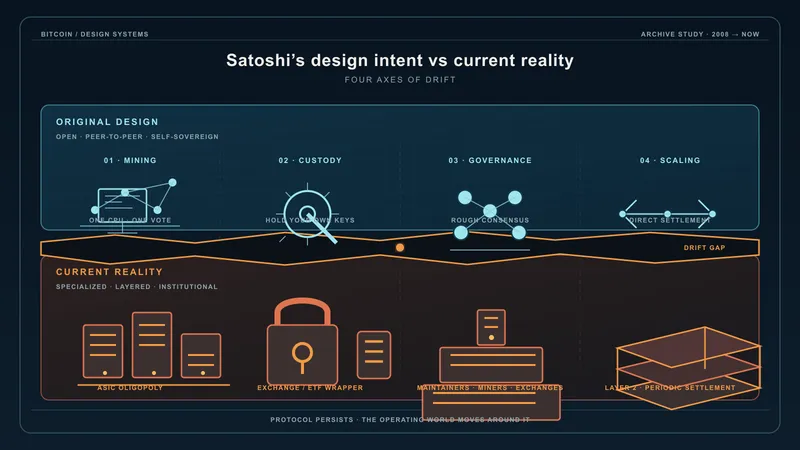
Why almost no nodes actually mine. “Any node can be a miner” is true at the protocol level, but in practice almost no nodes do. Modern mining requires industrial-scale ASIC hardware (application-specific integrated circuit chips that compute Bitcoin’s hash function and nothing else, using far less electricity per attempt than any general-purpose computer can). The industrial ASIC era began in 2013, after Satoshi’s 2011 disappearance — so the Satoshi-era “one-CPU-one-vote” picture is the original design intent, not the operational reality on the ground today. The full story of that drift (along with three other axes where current Bitcoin differs from Satoshi’s design) is the companion entry Satoshi’s design intent vs Bitcoin’s current reality.

6. Mempool: the waiting room

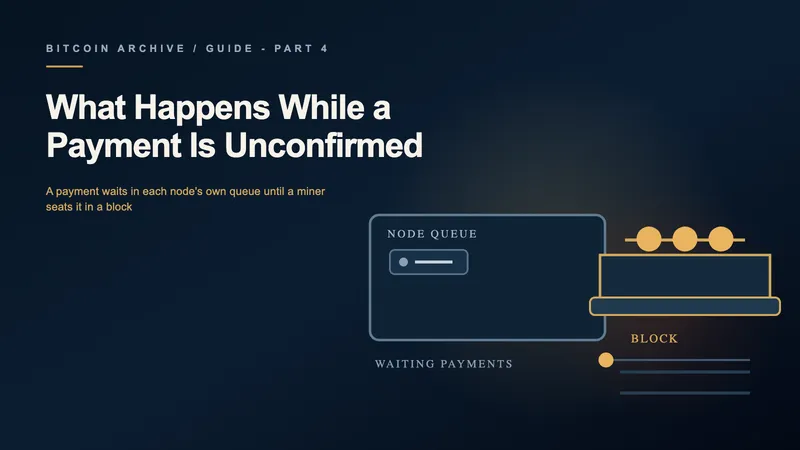
When you send a transaction, it does not appear in a block instantly. First, it travels through the peer-to-peer network and lands in the mempool of each node — the local waiting room of transactions not yet packaged into a block. Miners pick from the mempool when assembling a candidate block, and they tend to pick transactions with higher fees first because fees go directly to them.

broadcast

gossip

gossip

Your wallet

Node

Node

Node

Mempool

pending

Mempool

pending

Miner picks higher-fee txs first

Next block

Transaction confirmed

Once your transaction is in a block, it has one confirmation. The block that comes after — building on top of yours — adds a second confirmation. Each additional block on top adds another confirmation and makes the transaction exponentially harder to reverse. Six confirmations is the long-standing rule-of-thumb threshold for “essentially final.”

7. Consensus and tamper-resistance

If anyone with a computer can be a miner, what stops a malicious miner from inventing transactions, undoing yours, or printing themselves a million BTC?

Two design ideas, working together:

1. Verification by every node. When a miner broadcasts a new block, every node independently checks: are the signatures on every transaction valid? Are the coins being spent actually unspent UTXOs (not already used)? Does the block hash satisfy the proof-of-work? Does the coinbase reward match the schedule? If any check fails, the node rejects the block. A miner who tries to insert an invalid transaction simply produces a block the rest of the network refuses to accept.

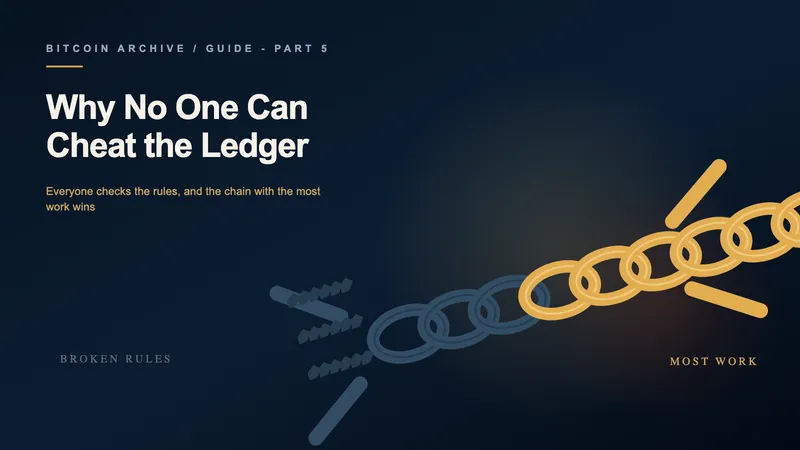
2. The longest chain wins. Once in a while, two miners legitimately find a valid block at nearly the same moment. The network briefly has two competing chains. The next block built on either one breaks the tie — the chain that gets the next block first is now the longest chain (technically: the chain with the most accumulated proof-of-work), and the orphaned block is dropped. Every honest node always follows whichever chain is longest.

This second rule is what makes tampering structurally hopeless. Suppose an attacker wants to change a transaction in a block from 100 blocks ago — maybe to undo a payment they made. Changing the transaction changes the block’s hash, which breaks the next block’s “previous hash” link, which breaks the block after that, all the way to the tip. The attacker must redo all 100 blocks’ proof-of-work from scratch — and meanwhile every honest miner in the world is extending the real chain. The attacker will never catch up unless they control more total computing power than the entire honest network combined.

Real chain

... B98 - B99 - B100 - B101 - B102 - B103 ...

honest miners keep extending

Attacker's altered chain

... B98 - B99 - B100' - B101' ...

must redo all PoW alone

Which chain is longer?

Real chain wins

attacker's work is wasted

This is also how double-spending is prevented. If a malicious user broadcasts two conflicting transactions that try to spend the same UTXO twice, one of them gets into the chain first and the other is rejected by every node (the UTXO is no longer unspent). The race is decided in minutes, not by trust.

The agreement on a single canonical chain across all nodes — emerging from these mechanical rules, with no central coordinator — is what is called consensus.

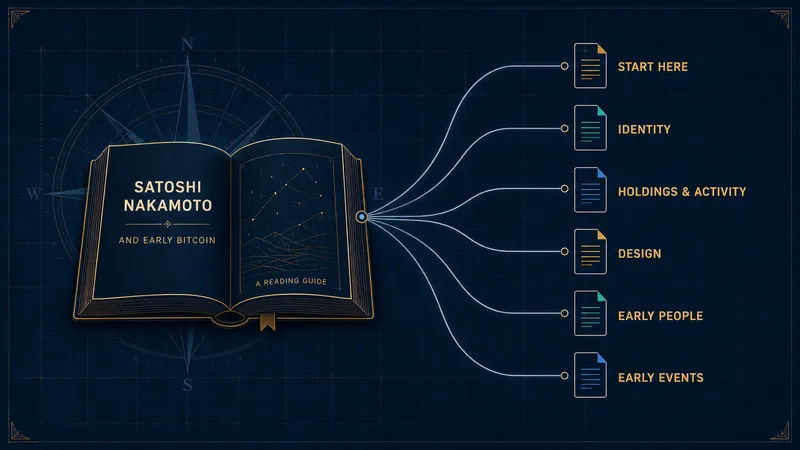
The chapters above are the model. From here, every term you saw can be followed deeper: