
When quantum computers break Bitcoin, does the world end with it? The question is dramatic, but it compresses two old algorithms into a single catastrophe. Shor can turn a visible public key into a private key; Grover reduces SHA-256’s effective preimage resistance from 256 bits to 128 bits without breaking the hash.
What can be documented is narrower: which Bitcoin assets expose a public key, what Bitcoin’s cryptography actually assumes, what post-quantum standardization has already produced, and how far the public timeline claims can be trusted. The arrival year of a cryptographically relevant quantum computer (CRQC) remains unknowable from outside the small group of national labs and hyperscaler research programmes working toward it.
1. What a quantum computer actually breaks
Two algorithms matter. They are old (1994 and 1996) and well understood:
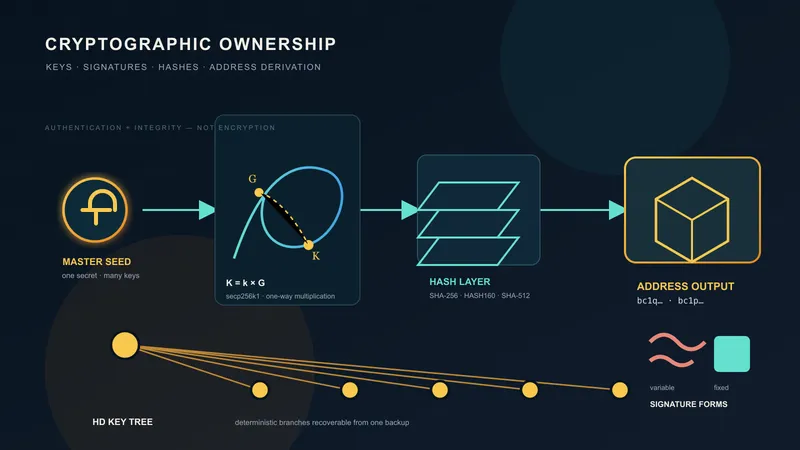
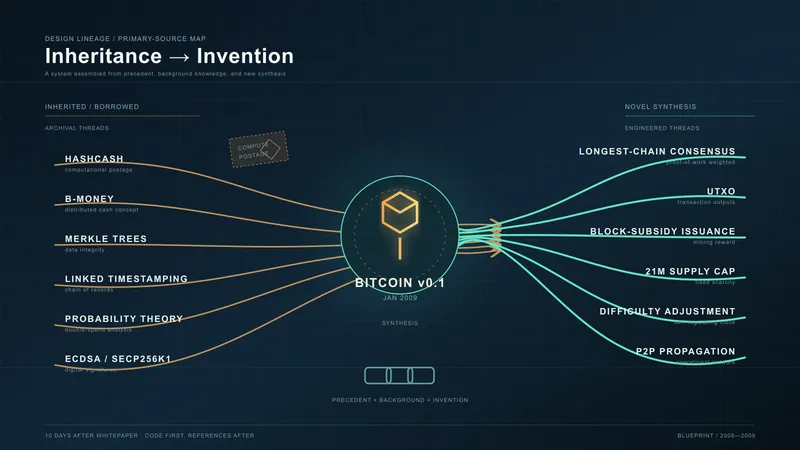
- Shor’s algorithm (1994, formal publication 1997) solves the discrete-logarithm problem in polynomial time on a sufficiently large quantum computer. Bitcoin’s signature scheme — ECDSA on the elliptic curve secp256k1 — rests on the assumption that discrete-log on this curve is hard. Shor’s algorithm makes that assumption fail: a quantum computer with enough logical qubits and low enough error rates can recover a private key from the corresponding public key.
- Grover’s algorithm (1996) gives a quadratic speedup for unstructured search. Against SHA-256, this means an attacker can find a preimage in roughly 2^128 quantum operations instead of 2^256 classical operations. 2^128 is still infeasible. Grover reduces SHA-256’s security; it does not break it.
The asymmetry is the central technical fact of the topic. The signature side of Bitcoin (ECDSA) collapses; the hashing side (SHA-256, RIPEMD-160) bends but does not break. Whatever happens in 2040 or 2060, the proof-of-work mining algorithm itself is not the first thing that fails.
The route from a recovered private key to stolen coins:
The attack only works if the public key has been visible on-chain — a condition that does not hold for every Bitcoin output type.
2. What breaks beyond Bitcoin
The same Shor’s algorithm that breaks ECDSA on secp256k1 breaks RSA, Diffie-Hellman, and all elliptic-curve cryptography in current production use. These are not Bitcoin-specific primitives — they are the load-bearing cryptography of the internet, the financial system, and most government infrastructure.
| Domain | Quantum-vulnerable primitive in current use | Institutional response |
|---|---|---|
| TLS / HTTPS | RSA key exchange, ECDHE, ECDSA certificates | NIST FIPS 203 (ML-KEM) selection; IETF drafts for ML-KEM-based hybrid key exchange in TLS 1.3 |
| Banking payments (EMV, SWIFT, card networks, PKI) | RSA signatures, ECDSA | BIS Project Leap (phase 1 with the Banque de France and the Deutsche Bundesbank; phase 2 in 2025 adding the Bank of Italy, Nexi-Colt and Swift) on post-quantum-secure central-bank channels and payments |
| Government / military PKI, classified communications | RSA, ECC | US National Security Memorandum 10 (May 2022); NSA CNSA 2.0 (2022) mandating PQC transition by 2035; parallel programmes in the UK (NCSC), the EU, and Japan |
| Code-signing, firmware-signing, software updates (OS, IoT) | RSA, ECDSA | NIST IR 8547 (2024) migration-strategy guidance to federal agencies and vendors |
| ”Harvest now, decrypt later” against recorded encrypted traffic | Any of the above, applied to past or present captures | CISA quantum-readiness advisory (August 2023) explicitly warning on captured-data risk |
What is Bitcoin-specific is the structure of its attack surface — a public ledger where every spent transaction permanently publishes the public key it spent from, and where some output types put the public key on chain at creation rather than at spend. The cryptographic break itself is a world-scale problem. The NIST PQC standardization and the NSA-2035 mandate place Bitcoin on the same migration timeline as the world’s banks, telecoms, and governments. “The day Bitcoin gets broken” is not the day Bitcoin alone gets broken — and the work of preparing for that day has been underway, in parallel and at scale, since the 2016 NIST call.
3. What is exposed today
Bitcoin has accumulated several output formats over its life. They expose the public key at different points, and the exposure window is the entire vulnerability surface for a quantum attack on dormant coins. The archive’s Bitcoin chart page has the full per-halving cards and supply curve. Which form a coin is held in decides its exposure:
| Output type | Public key on chain when… | Quantum exposure |
|---|---|---|
| P2PK (Pay-to-Public-Key, 2009-2010 era) | At creation — the public key is the script | High. The key is visible from the moment the output is created; any quantum-capable adversary can recover the private key whenever they like. Includes most of the early “Satoshi-era” coins. |
| P2PKH (Pay-to-Public-Key-Hash) | At spend — the script holds only HASH160(pubkey) until the owner signs | Low while unspent, high when spent. Each spend reveals the public key; if the address is then reused, subsequent UTXOs are exposed. |
| P2WPKH (Segregated-Witness, BIP 141) | At spend, same as P2PKH | Low while unspent. Same exposure pattern as P2PKH. |
| P2TR (Taproot, BIP 341) | At creation — the 32-byte x-only public key is the script | High. Taproot deliberately puts the key on-chain to enable key-path spends without revealing the script tree. BIP 341 addresses the point directly: it calls the protection a hashed key offers against quantum computers “very weak at best,” since transactions are not protected while being confirmed and a large portion of the supply is exposed regardless. |
| P2MR (Pay-to-Merkle-Root, BIP 360 draft) | At spend; the key path is removed, commitment is only the Merkle root of a script tree | Long-exposure-resistant. Soft-fork proposal that strips the Taproot key path. Post-quantum signature integration is treated as a separate future proposal. Currently a draft. |
Two consequences follow directly from this table:
- Coin reuse is the real exposure, not “Bitcoin” in the abstract. A user who never reuses an address, holds only in P2PKH/P2WPKH, and migrates to a quantum-safe scheme before spending is in a different threat class from a user with P2PK or reused P2PKH outputs.
- P2TR’s design tradeoff is paid in quantum exposure. Taproot was chosen for spend privacy and aggregation efficiency, not for long-term quantum resistance. BIP 341 itself states that actual resistance would require different cryptographic assumptions, and that the proposal “focuses on improvements that do not change the security model.”
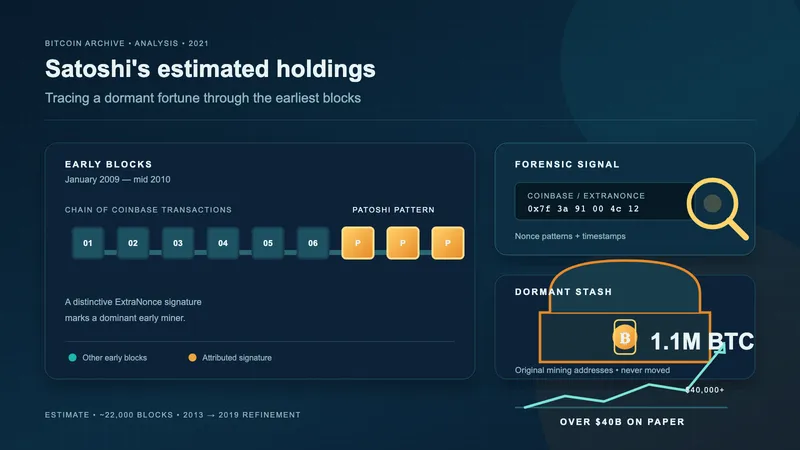
The pool of P2PK coins from the 2009-2010 era — including most of Satoshi Nakamoto’s estimated 1.1 million BTC mined balance — sits in the “high exposure, no migration possible without the keyholder” category. Whether those coins are ever moved is a question Shor’s algorithm cannot answer; only the keyholder can.
4. The timeline debate
The arrival year of a CRQC capable of running Shor’s algorithm against a 256-bit elliptic curve is contested. Two records exist: institutional commitments and public statements.
The institutional record:
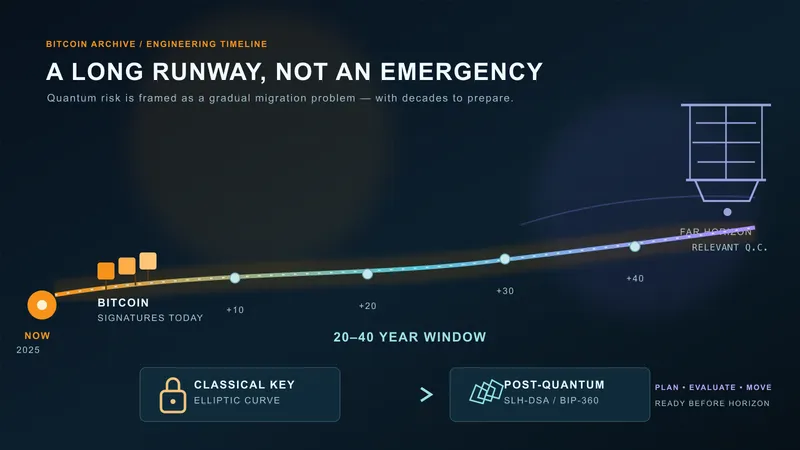
The NSA’s CNSA 2.0 deadline is the most concrete single number in the debate. Whether one reads it as a prediction of when a CRQC will exist or as a prudential margin against the chance that one might, the institutional behaviour is consistent: spend the 2020s standardizing post-quantum cryptography; spend the 2030s rolling it out.
The named-individual record (from cryptographers and Bitcoin infrastructure people the archive holds entries for):
- Adam Back’s November 2025 statement places the practical quantum threat to Bitcoin at “20-40 years” out, with SLH-DSA-class signatures as the appropriate response. This is the position of one of Bitcoin’s named cryptographer-adjacent figures, not a consensus number.
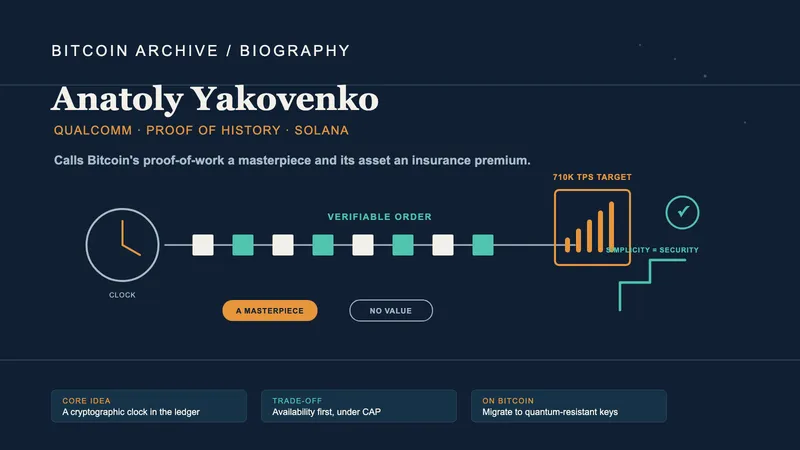
- Solana founder Anatoly Yakovenko, in a 2025 conversation, put the odds of a breakthrough within five years at roughly even — a timeline an order of magnitude more urgent than Back’s, on the identical question.
- Industry quantum-hardware roadmaps (IBM, Google) target machines with tens of thousands of physical qubits by the early 2030s. The translation from physical qubits to logical qubits — and from logical qubits to a CRQC running Shor’s algorithm on secp256k1 — involves error-correction overheads that are themselves the subject of active research.
The “harvest now, decrypt later” concern raises the timeline question for one specific class of data: anything currently visible on-chain (P2PK, exposed P2TR, revealed P2PKH after spend) is captured now by anyone monitoring the chain, and can be attacked whenever a CRQC exists. The migration window is not “until a CRQC arrives”; it is “until a CRQC arrives, minus the time between now and migration.”
5. Migration paths
Several proposals address quantum exposure in different ways. The archive holds the BIP 360 (P2MR) draft — a soft-fork output type that behaves like Taproot with the key-path spend removed, committing only to the Merkle root of a script tree. P2MR is resistant to long-exposure attacks on elliptic-curve keys (where a public key sits visible on-chain after a spend), but explicitly not to short-exposure attacks (where a key revealed in the mempool is recovered before the transaction confirms). BIP 360 itself notes that short-exposure protection would require introducing post-quantum signatures, treated as a separate future proposal.
Post-quantum signature schemes themselves — ML-DSA, FALCON, SLH-DSA — would be considerably larger than ECDSA: SLH-DSA signatures are roughly 8-50 KB depending on parameter set, against ECDSA’s ~72 bytes.
The proposals trade off along three axes:
- Signature size. Lattice schemes (ML-DSA / FALCON) are kilobyte-scale; hash-based (SLH-DSA) is tens of kilobytes; ECDSA is sub-kilobyte. Block-space pressure scales accordingly.
- Security assumption. Lattice schemes rest on the hardness of well-studied but younger problems (Module-LWE, Module-SIS). Hash-based schemes (SLH-DSA) rest only on hash-function security and have the smallest “what if this assumption falls” surface. Cryptographers weight these differently.
- Upgrade compatibility. A soft-fork hybrid (BIP 360 style) is reversible if the chosen PQC scheme later turns out to be weak; a hard-fork replacement is not. Soft-fork hybrids are preferred for that reason, and they are also slower to deploy because users must opt in.
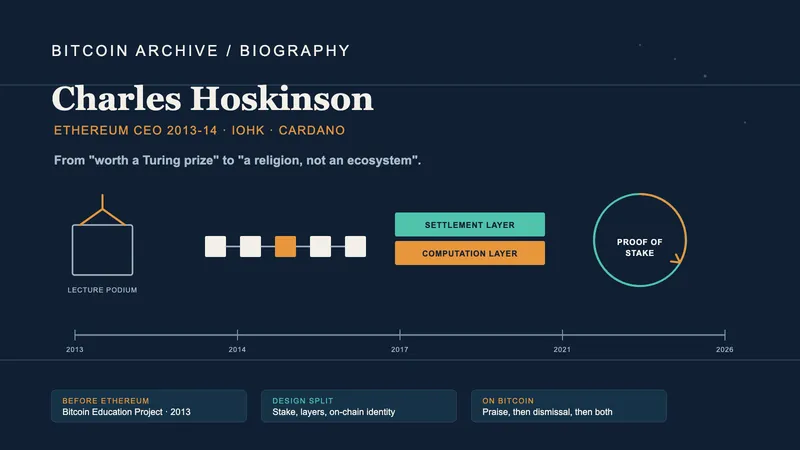
The migration question for already-issued coins is harder than the question for new coins. New issuance can use a post-quantum scheme by default once one is deployed. Existing P2PK / exposed P2TR / reused P2PKH outputs cannot be migrated by the protocol — only by the keyholder signing a transaction with the legitimate private key, while that private key is still uncompromised. Coins whose keyholders are dead, lost, or absent will sit in their current form regardless of what the network does. Several proposals exist for what to do with them — including controversial “use them or lose them” sunset rules — but none has consensus. Cardano’s Charles Hoskinson objected publicly to one such proposal in April 2026, citing the 1.7 million BTC he estimated it would render permanently unrecoverable.
6. Limits of this entry
The entry presents what the cryptography commits to and what the institutional and named-individual record says. It does not predict an arrival date, and it explicitly does not endorse the “the day Bitcoin breaks is the day the world ends” framing of the title:
- A CRQC’s arrival is a research-program outcome whose distribution is not known to outside observers. Estimates from credible sources range from “this decade” (rare, generally from people building the hardware) to “this century or never” (rare, generally from cryptographers concerned about the hardness of error correction). Bitcoin Institute treats the institutional NSA-2035 line and the named Adam Back 20-40 year line as the two best-documented points.
- Bitcoin’s protocol can soft-fork to add post-quantum signature support. That property — not a fixed cryptographic substrate — is what makes the engineering view of this topic differ from the world-ending one.
- The migration risk concentrates on specific UTXO categories, not on Bitcoin as a system. P2PK era coins, exposed P2TR outputs, and reused P2PKH addresses are the high-exposure pool. Coins held in unspent P2PKH/P2WPKH with no reuse, then migrated before a CRQC exists, are in a different threat class.
Quantum risk is not a date that can be circled on a calendar as the day Bitcoin suddenly breaks. It is a migration problem with a known asymmetry, a public-key exposure map, and an unresolved question over dormant coins whose owners may never move them. The protocol can still change. The difficult part is moving exposed value before the threat is no longer hypothetical.