
What this page is
This page is L2 #9 — Architecture evolution (Satoshi era vs v27+) in the design-document series — the first of three cross-cutting deep dives. Each domain page carries a short two-era comparison of its own; here all eight run side by side, with the split-architecture diagrams no single domain page can show.
Scope. Every comparison uses two fixed reference points: Satoshi’s v0.1 release (January 8, 2009) and modern Bitcoin Core v27+ baseline. Intermediate versions are mentioned only when they introduced a structural change.
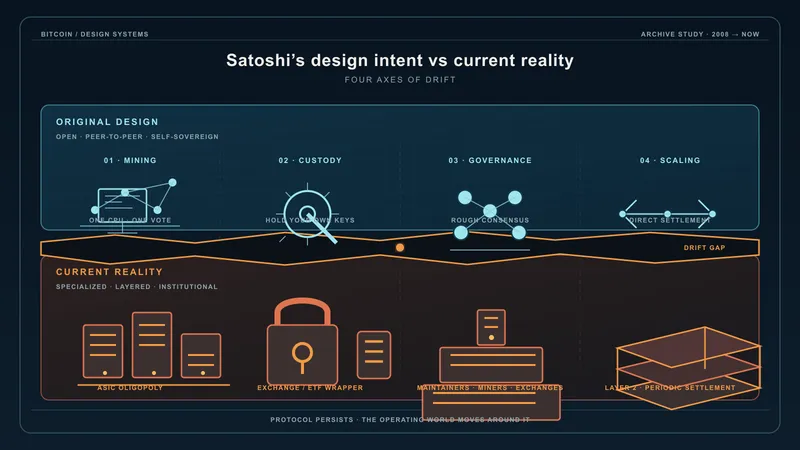
The page does not cover design drift at the social or economic layer — those are analyzed in the design-intent vs current-reality entry. Each section below contains a split diagram (v0.1 left, v27+ right) and a comparison table, matching the L1 numbering.
1. System-wide architecture
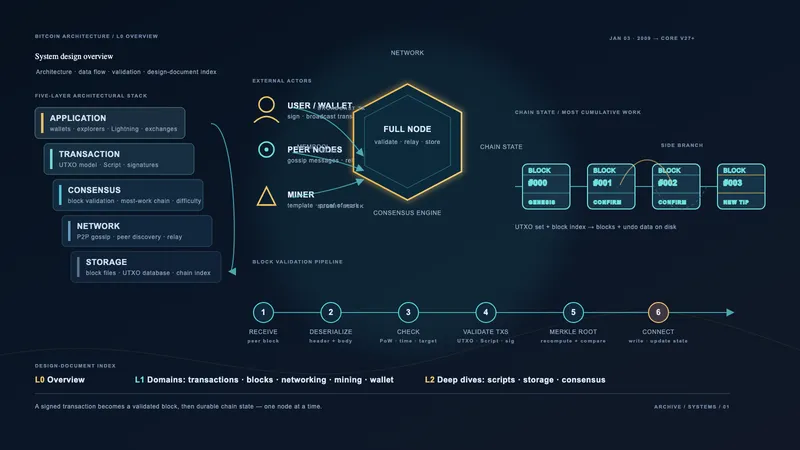
The most visible change between v0.1 and v27+ is architectural decomposition. Satoshi shipped a single binary that fused the wallet, the miner, the GUI, the validation engine, and the network layer into one process, backed by Berkeley DB indexes and flat block files. Modern Bitcoin Core separates these concerns into distinct modules, processes, and storage backends.
| Aspect | v0.1 (January 2009) | v27+ baseline |
|---|---|---|
| Binary | Single executable: wallet + miner + GUI + node | bitcoind (node), bitcoin-wallet (wallet), bitcoin-qt (GUI) — separate binaries |
| Process model | One process, one address space | Logically separated; experimental multiprocess work in progress (not yet default) |
| Database | Berkeley DB for indexes and wallet; flat files for block data | LevelDB (UTXO set, block index) + flat files (blocks) + SQLite (wallet) |
| Mining | Internal CPU miner, same process | External via getblocktemplate (BIP 22/23); Stratum v2 in ecosystem |
| Interfaces | None at launch; JSON-RPC added in v0.2.6 (February 2010) | JSON-RPC (full read/write), REST (read-only), ZMQ (push notifications) |
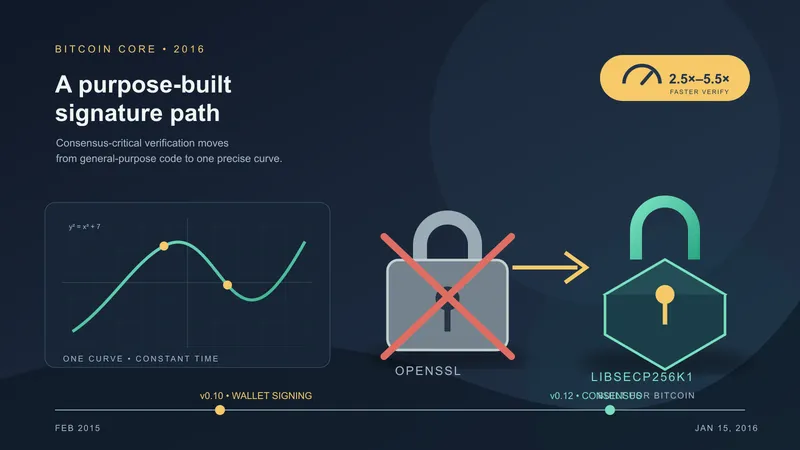
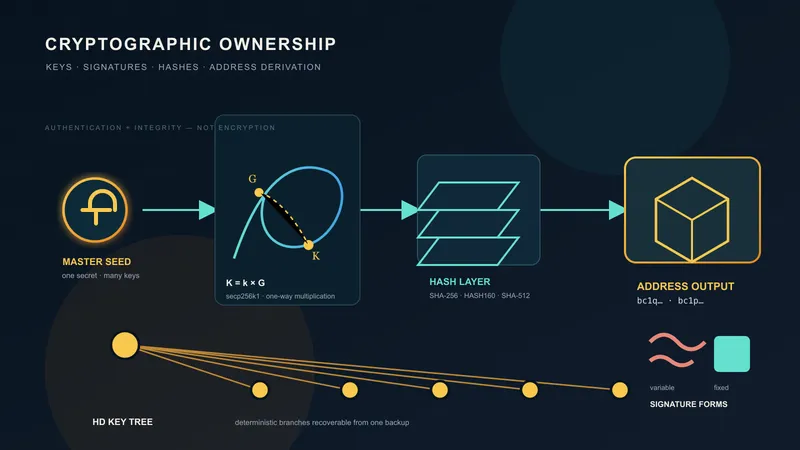
| Cryptography library | OpenSSL (ECDSA/secp256k1); Crypto++ (SHA-256) | libsecp256k1 (ECDSA/Schnorr), internal SHA-256 with hardware acceleration |
2. Network layer
| Feature | v0.1 | v27+ baseline | Key BIP / version |
|---|---|---|---|
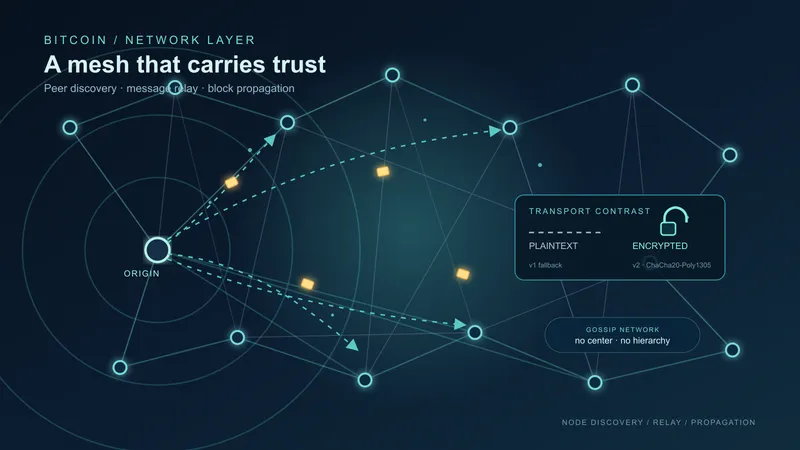
| Peer discovery | IRC channel + addr | DNS seeds + addrv2 + peers.dat cache | BIP 155 (addrv2, v0.21) |
| Address types | IPv4 only | IPv4, IPv6, Tor v3, I2P, CJDNS | BIP 155 |
| Outbound peers | New outbound connections opened until the node had 15 connections of any kind; a fixed 8 outbound came in August 2010 | 8 full-relay + 2 block-relay-only + feeler + anchor | v19+ (block-relay-only) |
| Block relay | Full block to every peer, whatever its size | Compact blocks: header + short IDs (~20 kB) | BIP 152 (v0.13) |
| Transport | Plaintext TCP | Opportunistic encrypted transport (ChaCha20-Poly1305) | BIP 324 (v26, default v27) |
| Initial sync | Sequential: one block at a time | Headers-first: parallel block download | v0.10 |
| Eclipse resistance | Minimal | Outbound rotation, diverse eviction, anchor peers, block-relay-only peers | v19+ |
See L1 #1 — P2P network design for the full design-document treatment.
3. Transaction layer
| Feature | v0.1 | v27+ baseline | Key BIP / version |
|---|---|---|---|
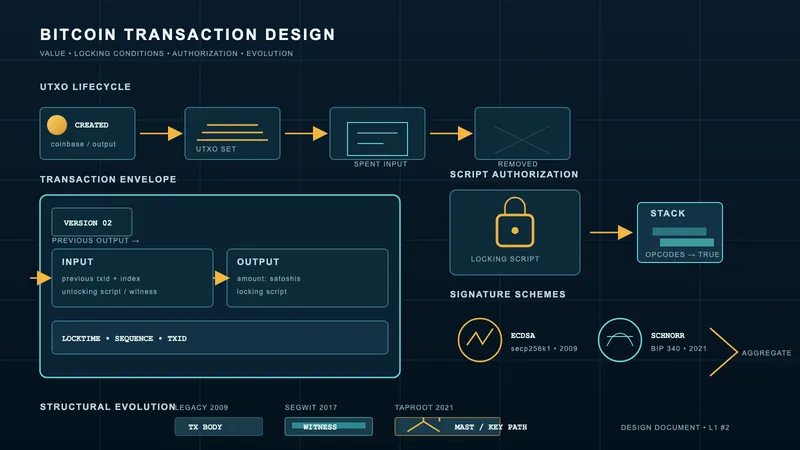
| Format | Legacy: version + inputs + outputs + locktime | SegWit: + marker/flag + witness | BIP 141 (2017) |
| Transaction ID | SHA-256d of full serialized transaction | txid excludes witness; wtxid includes it | BIP 141 |
| Malleability | Possible — third parties can alter scriptSig | Fixed — witness excluded from txid | BIP 141 |
| Script types | P2PK, P2PKH | P2PKH, P2SH, P2WPKH, P2WSH, P2TR | BIP 16, 141, 341 |
| Signature scheme | ECDSA via OpenSSL | ECDSA + Schnorr via libsecp256k1 | BIP 340 (2021) |
| Opcodes | Full set (including later-disabled) | Reduced set; in tapscript the disabled opcodes become OP_SUCCESSx | BIP 342 |
| Timelocks | Absolute locktime only | Absolute + relative (BIP 68) + script-level (OP_CLTV, OP_CSV) | BIP 65, 68, 112, 113 |
| Replace-by-Fee | nSequence replacement (not a fee mechanism), disabled in August 2010; first-seen afterward | Full RBF default | BIP 125 (v0.12 opt-in; v24 option added; v28 default) |
| Coin selection | Exact match, else 1,000 randomized subset-sum passes or the smallest larger coin (the knapsack’s ancestor) | BnB + knapsack + single-random-draw + CoinGrinder; waste metric | BnB v0.17; single random draw and waste metric v23; CoinGrinder v27 |
See L1 #2 — Transaction design for the full design-document treatment.
4. Block and chain layer
| Feature | v0.1 | v27+ baseline | Key BIP / version |
|---|---|---|---|
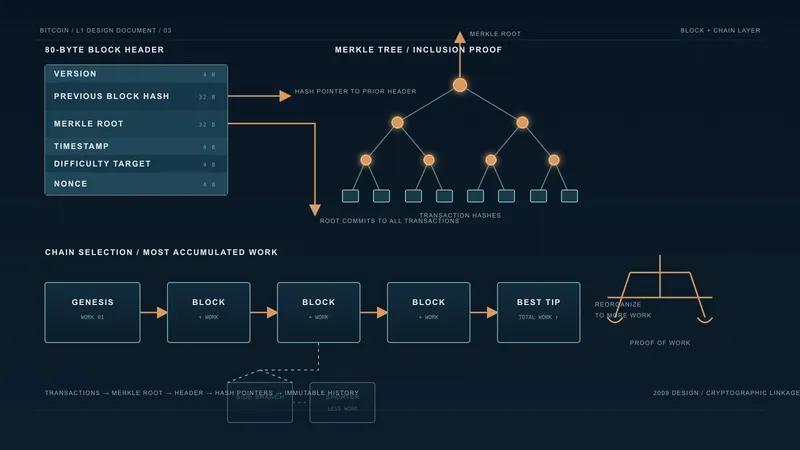
| Header format | 80 bytes, version 1 | 80 bytes, same structure; BIP 9 signaling bits | BIP 9 |
| Block version | Always 1 | Version-bits (0x20000000 base + signal bits) | BIP 9 (2016) |
| Merkle tree | Single tree over full serialized transactions | Primary tree (stripped txs) + witness commitment in coinbase | BIP 141 |
| Size limit | No limit in v0.1; 1 MB added 2010 | 4 MWU weight limit | BIP 141 (2017) |
| Witness discount | Does not exist | Witness bytes at 1/4 weight (1 WU vs 4 WU) | BIP 141 |
| Coinbase data | Arbitrary up to 100 bytes | BIP 34: block height prefix required | BIP 34 (2013) |
| Sigop limit | No limit in v0.1; 20,000 added 2010 | 80,000 per block (weight-adjusted); tapscript counts differently | BIP 141, 342 |
See L1 #3 — Block and chain design for the full design-document treatment.
5. Consensus layer
| Feature | v0.1 | v27+ baseline | Key BIP / version |
|---|---|---|---|
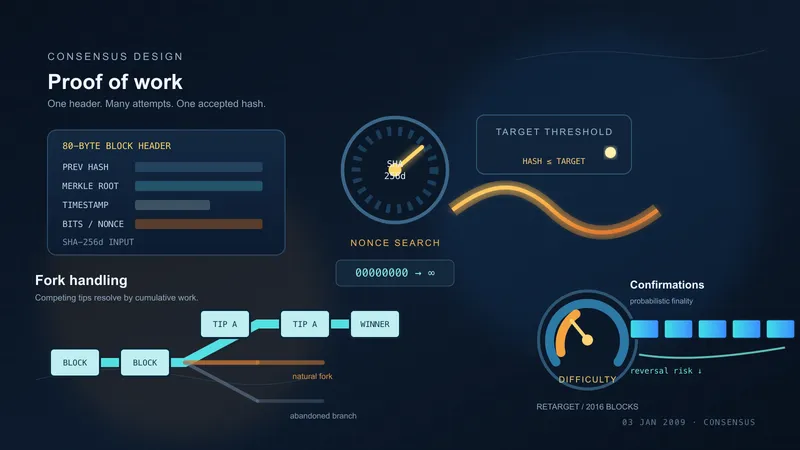
| Hash function | SHA-256d (double SHA-256) | Same | — |
| Chain selection | Longest chain (height comparison, nBestHeight) | Most-work chain (nChainWork, since v0.3.3) | — |
| Difficulty adjustment | Every 2,016 blocks; off-by-one bug | Same algorithm; bug preserved (fixing = hard fork) | — |
| Soft fork activation | Direct code change (flag day) | BIP 9 versionbits; Speedy Trial (a modified BIP 9) for Taproot | BIP 9 |
| Script validation | Combined scriptSig + scriptPubKey execution | Separated evaluation; SegWit witness programs; tapscript | BIP 141, 342 |
| Timestamp rule | Must exceed the median of the previous 11 blocks (median-time-past, present since v0.1) | Same acceptance rule; BIP 113 extends MTP to lock-time evaluation | BIP 113 |
| Checkpoints | None in v0.1; hardcoded checkpoints added July 2010 (v0.3.2) | assumevalid replaces most checkpoint functionality | v0.14+ |
See L1 #4 — Consensus design for the full design-document treatment.
6. Monetary and incentive layer
| Feature | v0.1 | v27+ baseline | Key BIP / version |
|---|---|---|---|
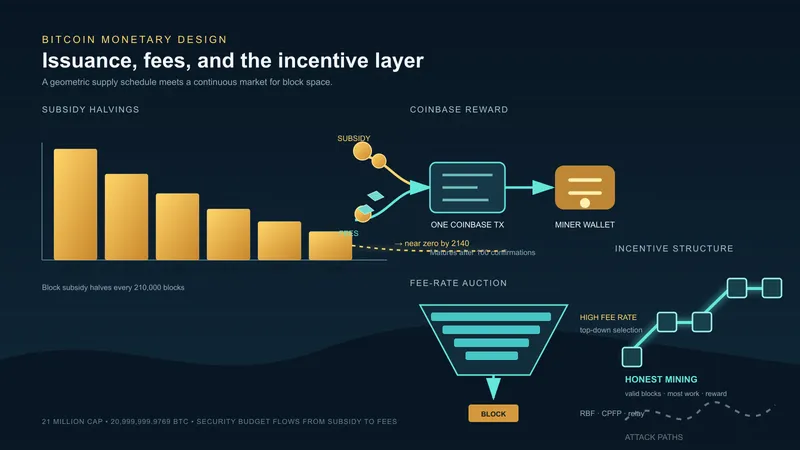
| Total supply cap | 20,999,999.9769 BTC | Same — consensus-frozen constant | — |
| Subsidy calculation | nSubsidy >>= (nHeight / 210000) | Same arithmetic; zero-guard for shift ≥ 64 | — |
| Fee behavior | Most transactions free; priority by coin age | Fee-rate auction (sat/vB); coin-age priority removed | — |
| CPFP | Not implemented | Ancestor-aware mempool; package evaluation | v0.13+ |
| Block template | Internal miner; trivial ordering | getblocktemplate (BIP 22/23); fee-rate sorted | BIP 22, 23 |
| Witness discount | Does not exist | Witness bytes at 1/4 weight | BIP 141 |
See L1 #5 — Monetary design for the full design-document treatment.
7. Cryptography layer
| Feature | v0.1 | v27+ baseline | Key BIP / version |
|---|---|---|---|
| Cryptography library | OpenSSL | libsecp256k1 (constant-time) | v0.10 (2015, signing); v0.12 (2016, verification) |
| Signature schemes | ECDSA only | ECDSA (legacy/SegWit v0) + Schnorr (Taproot) | BIP 340 (2021) |
| Key format | Uncompressed public keys (65 bytes) | Compressed (33 bytes); x-only (32 bytes, Taproot) | BIP 340 |
| Signature malleability | Possible — s value alterable | Low-S rule (BIP 146) for ECDSA; Schnorr non-malleable | BIP 146 |
| Nonce generation | OpenSSL PRNG | RFC 6979 deterministic (ECDSA); BIP 340 synthetic (Schnorr) | RFC 6979 |
| Hash functions | SHA-256d/RIPEMD-160 via OpenSSL; mining SHA-256 via bundled Crypto++ | Same algorithms; internal with hardware acceleration (SHA-NI, ARMv8-A) | — |
| Sighash algorithm | Legacy sighash (quadratic in inputs) | BIP 143 (SegWit v0, linear) + BIP 341 (Taproot, epoch-tagged) | BIP 143, 341 |
See L1 #6 — Cryptography design for the full design-document treatment.
8. Storage layer
| Feature | v0.1 | v27+ baseline | Key version |
|---|---|---|---|
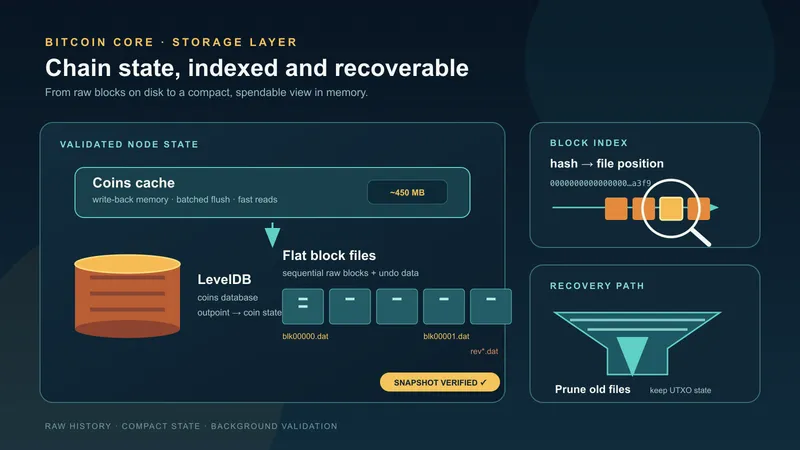
| Primary database | Berkeley DB (indexes + wallet) | LevelDB (UTXO set + block index); flat files (blocks) | v0.8 (2013) |
| UTXO storage | Full transactions with spent-flag vector | Only unspent outputs; outpoint-indexed, compact serialization | v0.8 |
| Coins cache | No separate cache; BDB handled reads/writes | Dedicated in-memory write-back cache (default 450 MiB) | v0.15+ |
| Block storage | Flat files (blk*.dat), ~2 GB rotation | Sequential flat files (blk*.dat, ~128 MiB each) | v0.8 |
| Undo data | Not needed; spent transactions stayed in the BDB index, and a reorg only cleared their spent pointers | Dedicated rev*.dat files for fast rollback | v0.8 |
| Pruning | Not available | Available; minimum retention 550 MiB | v0.11 (2015) |
| assumeUTXO | Not available | Snapshot-based bootstrap with background verification | v26 (loadtxoutset); v28 (mainnet snapshot) |
| Disk size | Negligible (chain was tiny) | ~774 GB of blocks archival (October 2026); ~10 GB pruned | — |
See L1 #7 — Storage design for the full design-document treatment.
9. Wallet and interface layer
| Feature | v0.1 | v27+ baseline | Key BIP / version |
|---|---|---|---|
| Architecture | Embedded in single binary | Logically separated; experimental multiprocess in progress (not yet default) | v27+ |
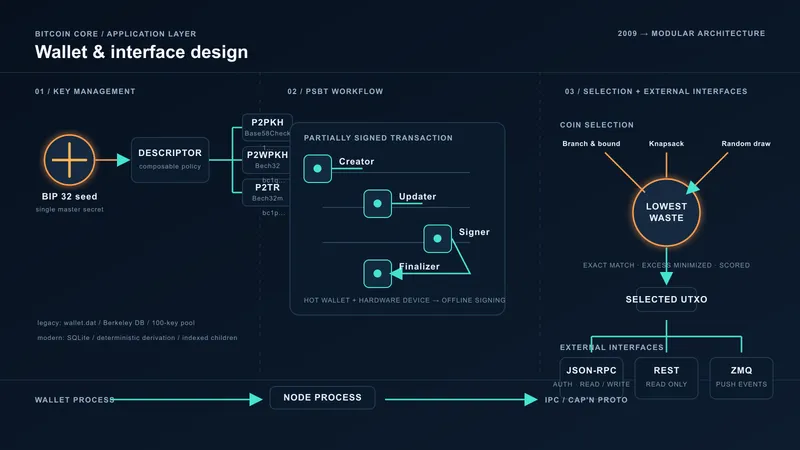
| Key generation | Independent random keys; a 100-key pool from v0.3.14 (October 2010) | Descriptor wallets: deterministic from master seed | BIP 380+ (default v23) |
| Key storage | Berkeley DB (wallet.dat) | SQLite (wallet.dat, new format) | v26 (BDB deprecated for new wallets) |
| Backup model | Export file after every new key | Descriptor backup covers all derived keys (raw BIP 32 seed, not BIP 39) | BIP 32 + descriptors |
| Signing | Internal, same process | Internal, PSBT (BIP 174/370), or hardware wallet via HWI | BIP 174 (2018) |
| Multi-device signing | Not supported | PSBT workflow: create → update → sign → combine → finalize | BIP 174, 370 |
| Fee bumping | Not available | Replace-by-Fee (bumpfee), CPFP | BIP 125 |
| Interfaces | None at launch; JSON-RPC added in v0.2.6 (February 2010) | JSON-RPC (full), REST (read-only), ZMQ (push notifications) | — |
| Process model | Monolithic (wallet + node + miner + GUI) | Modular binaries: bitcoind, bitcoin-wallet, bitcoin-qt; runtime process separation experimental | v27+ |
See L1 #8 — Wallet design for the full design-document treatment.
10. Structural migration timeline
11. What changed vs what did not
Seventeen years of development transformed the implementation, but the consensus-critical core remains exactly as Satoshi shipped it.
Unchanged since v0.1:
- SHA-256d proof of work
- 2,016-block difficulty adjustment (including the original off-by-one bug)
- UTXO model
- 21 million supply cap
- 210,000-block halving interval
- coinbase maturity (100 blocks)
- secp256k1 curve
- 10-minute target block interval
- permissionless participation
Transformed since v0.1:
- storage engine (BDB indexes + flat block files → LevelDB indexes + flat files + SQLite wallet)
- cryptography library (OpenSSL → libsecp256k1)
- signature schemes (ECDSA only → ECDSA + Schnorr)
- block capacity (no limit → 1 MB → 4 MWU)
- transaction format (legacy → SegWit)
- script system (full opcodes + concatenated execution → reduced set + separated evaluation + tapscript)
- key management (independent random keys → HD derivation + descriptors)
- peer transport (plaintext → encrypted)
- peer discovery (IRC → DNS seeds + addrv2)
- mining interface (internal CPU → external via getblocktemplate)
- initial sync (sequential → headers-first + assumeUTXO)
- fee market (free → fee-rate auction with RBF/CPFP)
- process architecture (monolithic → modular)
- soft fork activation (flag day → BIP 9 version bits)
- chain selection rule (height only,
nBestHeight→ most-work chain,nChainWork)
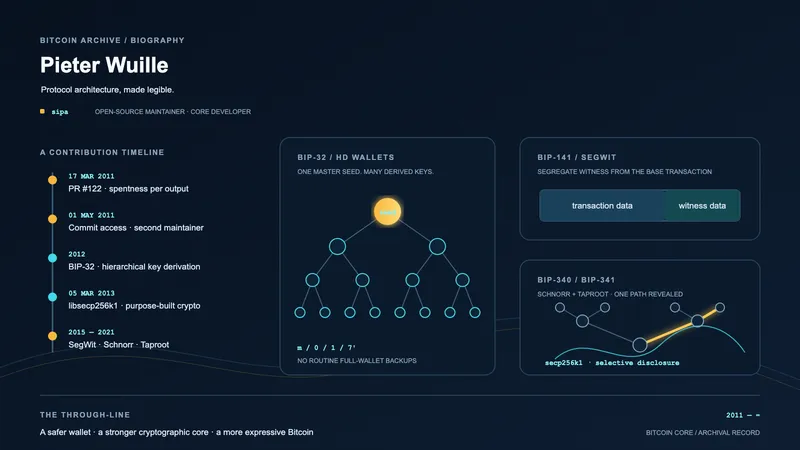
Four of these items — HD key derivation, SegWit, the ECDSA-to-Schnorr signature transition, and libsecp256k1 itself — trace back to one person: Pieter Wuille authored or co-authored BIP 32, BIP 141, and BIP 340/341, and started libsecp256k1 in 2013.
12. Limits of this page
This page compares two reference points across all domains but does not replace the domain pages. For full treatment of any subsystem, see the L1 page linked at the bottom of each section above.
Out of scope:
- Social and economic drift (mining centralization, custody, governance, scaling — see the design-intent vs current-reality analysis)
- Security model (threat analysis, 51% attack economics — see L2 #11 Security model)
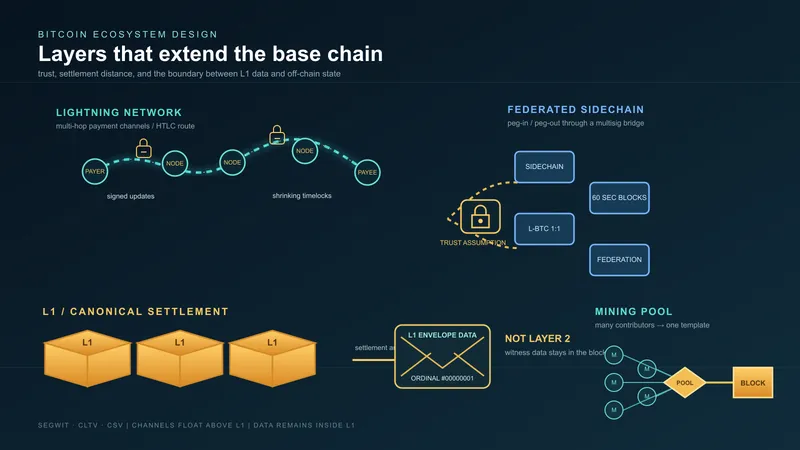
- Ecosystem (Lightning, sidechains, Ordinals — see L2 #10 Ecosystem)
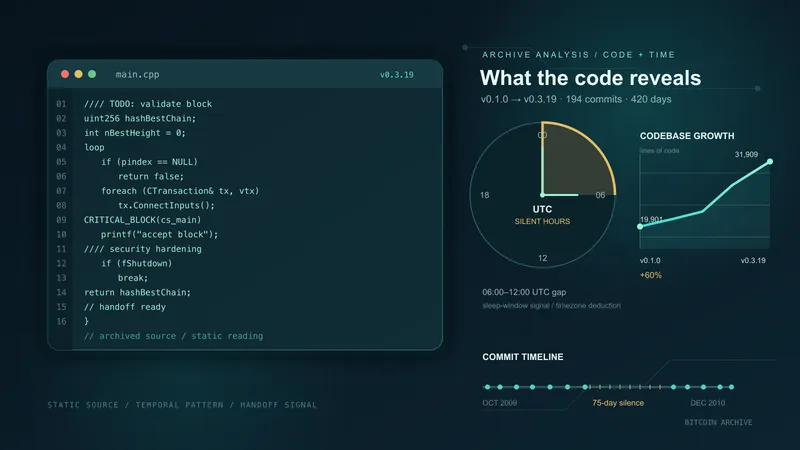
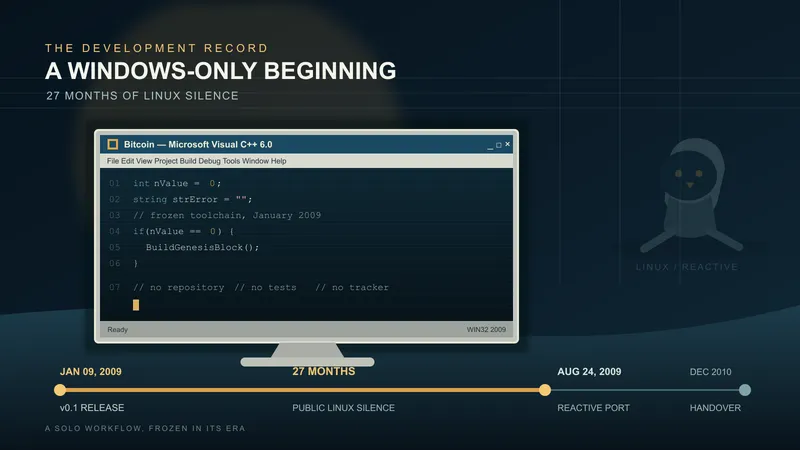
- Satoshi’s coding style (see the Satoshi code analysis and Windows development environment entries)
The Windows development-environment analysis reads the same drift from the toolchain side.