
Introduction
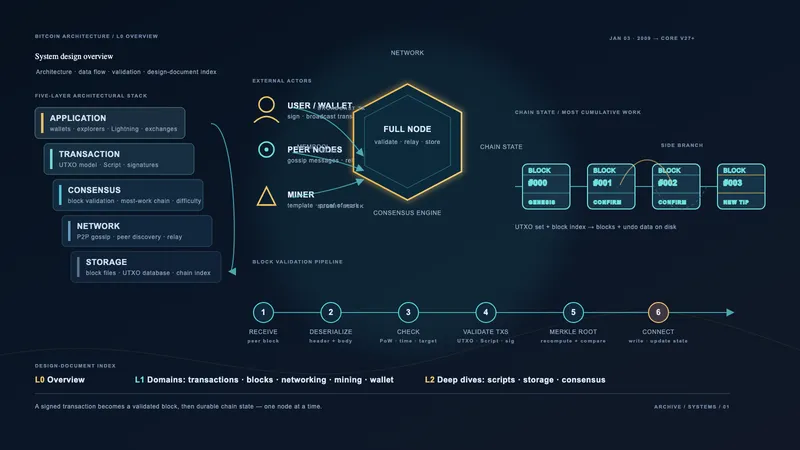
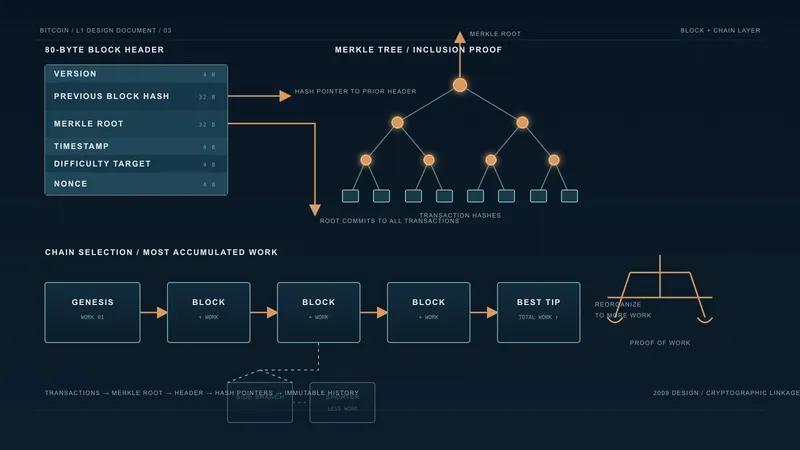
This page is L1 #4 — Consensus design in the design-document series. It is the direct successor to the block and chain design page. Where that page describes the data structures — headers, Merkle trees, the chain of hashes — this page describes the rules that determine which chains are valid and which chain tip wins.
Consensus is Bitcoin’s substitute for a central authority. Every full node independently evaluates every block against the same set of deterministic rules. No block is accepted on trust; no node defers to another node’s judgment. The result is a system in which thousands of machines converge on a single transaction history without coordination, voting, or leadership election.
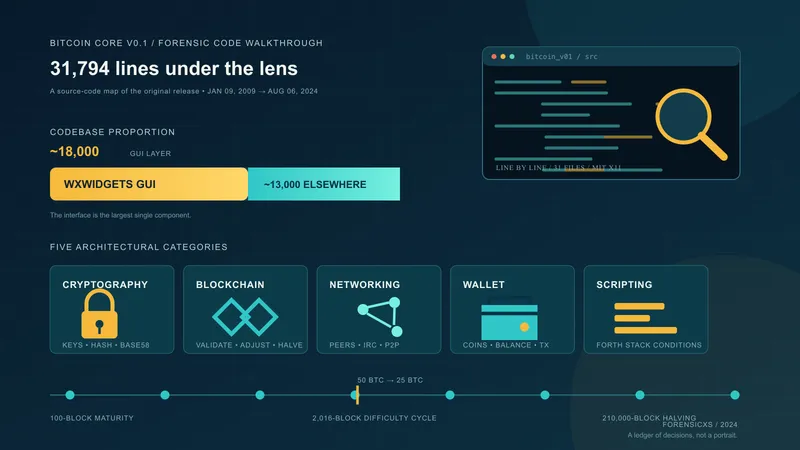
The page covers five areas: the proof-of-work puzzle that makes block production costly, the difficulty adjustment that regulates block frequency, the validation rules that define a legal block, the fork-handling logic that resolves competing chains, and the finality model that quantifies confirmation security. Forensicxs’s 2024 code walkthrough documents these same rules as they first shipped in the v0.1 source, including the 2,016-block difficulty window.
New to these concepts? What miners are actually racing to do and why no one can cheat the ledger introduce the mining race and the rules that keep it honest with no prior knowledge assumed; this page is the design-document treatment of the same mechanisms.
Where behavior differs between the Satoshi-era implementation (v0.1, January 2009) and modern Bitcoin Core (v27+ baseline), both are noted.
1. Proof of work
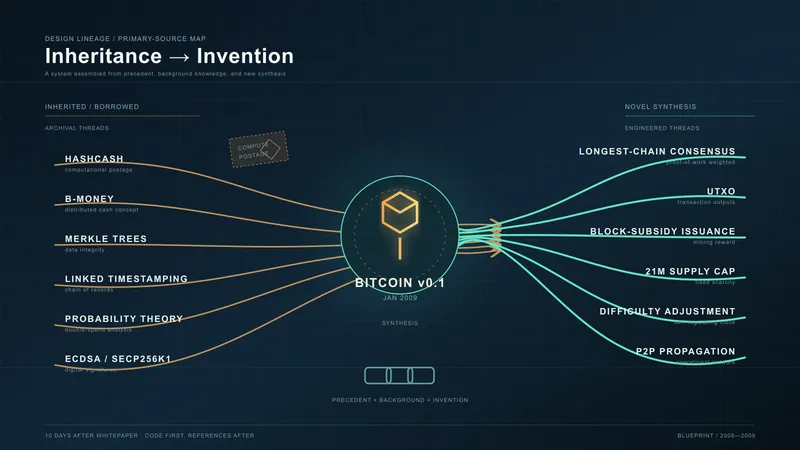
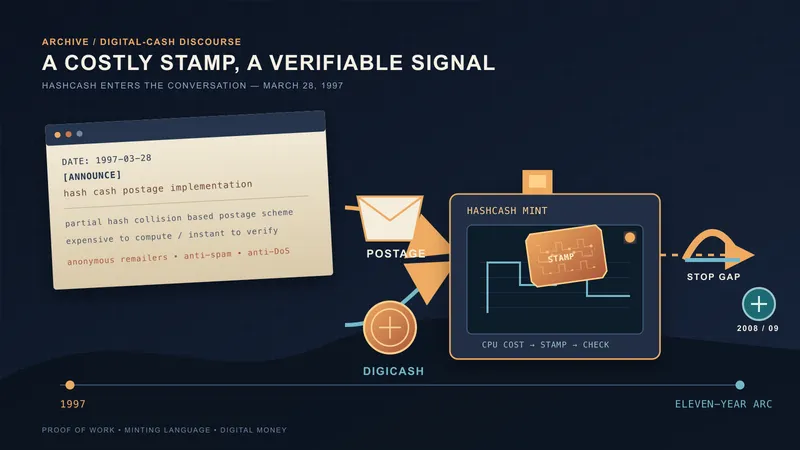
Proof of work is the mechanism that makes block production computationally expensive. A miner must find a nonce (and other mutable header fields) such that the SHA-256d hash of the 80-byte block header falls below a network-wide target value. Because SHA-256 is a one-way function, the only known strategy is brute-force iteration. The puzzle itself is not a Bitcoin invention: it reuses Adam Back’s 1997 Hashcash, the cypherpunk anti-spam scheme the whitepaper cites directly, adapted from a per-email cost function into the per-block cost function documented here — the one cryptographic primitive the design-lineage analysis treats as contemporaneous reuse rather than general-knowledge borrowing or novel synthesis.
Mining loop
The loop this illustrates in code terms: assemble the block header (prev hash, Merkle root, timestamp, difficulty bits), compute its SHA-256d, and check whether the result falls at or below the target. A pass broadcasts the block; a failure increments the nonce (or mutates the coinbase to refresh the extra-nonce space) and hashes again.
The double-SHA-256 (SHA-256d) operation applies SHA-256 twice in sequence: SHA-256(SHA-256(header)). A commonly cited benefit of hashing twice is that it blocks the length-extension attacks single-pass SHA-256 allows.
Proof-of-work parameters
| Parameter | Value | Notes |
|---|---|---|
| Hash function | SHA-256d (double SHA-256) | Unchanged since v0.1 |
| Input | 80-byte block header | Version, prev hash, Merkle root, timestamp, bits, nonce |
| Nonce field | 32 bits (4 bytes) | Provides ~4.3 billion candidates per header configuration |
| Extra nonce | Coinbase transaction data | Mutating the coinbase changes the Merkle root, refreshing the nonce search space |
| Target representation | nBits compact format (4 bytes) | Encodes the 256-bit target as a 3-byte mantissa with a 1-byte exponent |
| Difficulty 1 target | 0x00000000FFFF... (truncated) | The baseline target against which all difficulty values are expressed as ratios |
| Valid hash criterion | hash ≤ target | Lower target = higher difficulty = harder to find a valid hash |
2. Difficulty adjustment
Bitcoin targets a 10-minute average interval between blocks. Because total network hash rate fluctuates — new miners join, old hardware retires, energy costs shift — the protocol adjusts the target value every 2,016 blocks (approximately every two weeks).
Retarget cycle
In arithmetic terms: the elapsed time between the first and last block of the 2,016-block window is divided by the expected time (2,016 × 600 seconds) to get a ratio, that ratio is clamped to [1/4, 4], and the old target is multiplied by the clamped ratio to produce the new target applied to the next window.
Adjustment parameters
| Parameter | Value | Notes |
|---|---|---|
| Target block time | 600 seconds (10 minutes) | Satoshi later called it “a good guess” if propagation takes a minute: nodes then lose only 10% of their work |
| Retarget period | 2,016 blocks | At the target rate, this spans exactly 14 days |
| Expected window time | 1,209,600 seconds (14 days) | 2,016 × 600 |
| Maximum upward adjustment | 4× (target becomes 4× easier) | Prevents a sudden hash-rate drop from stalling the chain indefinitely |
| Maximum downward adjustment | 1/4× (target becomes 4× harder) | Prevents a hash-rate surge from making blocks dangerously fast |
| Adjustment granularity | Integer arithmetic on 256-bit target | No floating-point; deterministic across all implementations |
Network difficulty has climbed from 1 at the genesis block to about 1.33 × 10¹⁴ at the October 3, 2026 adjustment (block 969,696), a roughly 130-trillion-fold increase as aggregate network hash rate grew.
Satoshi-era bugs
Two known issues in the original difficulty adjustment code have persisted as consensus rules for the network’s entire history:
-
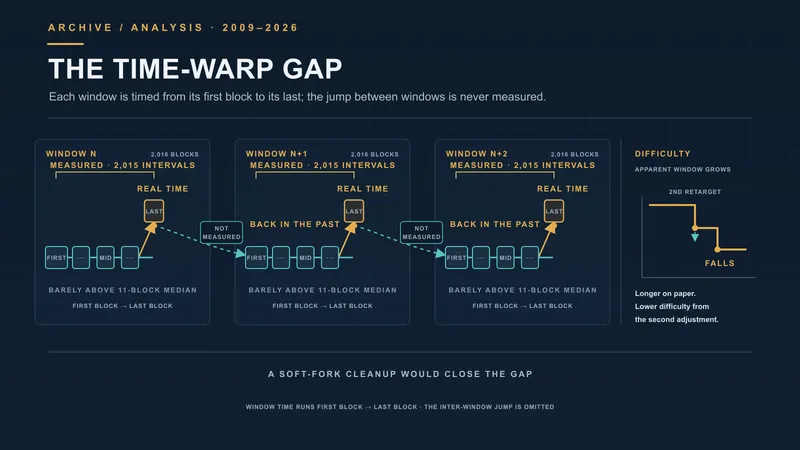
Off-by-one error. The retarget calculation uses the timestamp of block N (the first block of the window) and block N+2,015 (the last), measuring across 2,015 intervals rather than 2,016. The actual retarget window is therefore one block shorter than intended. At a 10-minute target, this produces a systematic bias of roughly 0.05%.
-
Timewarp vulnerability. Because the adjustment algorithm only examines the timestamps of two blocks (first and last in the window), and never measures the gap between one window’s last block and the next window’s first, a majority-hash-rate miner can hold most timestamps nearly still, stamp only the last block of each window with the real time, and set the next window’s first block back into the past, making the chain appear slower than it actually is and gradually reducing difficulty while producing blocks faster than the target rate. This attack is theoretical against an honest majority but becomes feasible for a sustained >50% attacker. A soft-fork fix (the “timewarp attack mitigation”) has been proposed as part of the Great Consensus Cleanup — see the time-warp attack analysis for the full mechanics — but the proposal has not yet gained the operator consensus needed to activate.
3. Block validation rules
When a node receives a new block, it applies a deterministic sequence of checks before accepting the block into its local chain state. Every check must pass; a single failure causes the entire block to be rejected.
Validation decision tree
Each gate above corresponds to a specific check: proof of work (header hash ≤ target), timestamp (within the acceptable range), size (block weight ≤ 4 MWU), Merkle root (matches the recomputed value), coinbase (exactly one, reward ≤ subsidy + fees), and transactions (signatures valid, referenced UTXOs exist, no double-spends within the block). A block clears every gate before its chain state is updated.
Validation checks
| Check | Rule | Introduced |
|---|---|---|
| Header proof of work | SHA-256d hash of header ≤ target encoded in nBits | v0.1 |
| Timestamp range | Must be > median of previous 11 blocks (MTP) and < node’s local time + 2 hours | v0.1 (GetMedianTimePast()) |
| Block weight | ≤ 4,000,000 weight units (4 MWU) | BIP 141 (2017); replaces the v0.1-era 1 MB byte-size limit |
| Merkle root | Header’s Merkle root must match the root recomputed from the block’s transaction list | v0.1 |
| Coinbase validity | Exactly one coinbase; output value ≤ block subsidy + sum of transaction fees; must include block height in scriptSig (BIP 34) | v0.1; BIP 34 added 2013 |
| Transaction validity | Every input references an existing, unspent output; all scripts evaluate to true; no input is spent twice within the block | v0.1 |
| Signature operations | Total sigops across all transactions ≤ limit (legacy: 20,000; SegWit: weighted) | No limit in v0.1; 20,000 added September 2010; SegWit revised counting |
| Transaction finality | All transactions satisfy locktime and sequence constraints | v0.1; BIP 68/112 added relative timelocks, BIP 113 median-time-past locktime |
4. Fork types and handling
A fork occurs whenever two or more blocks share the same parent — the chain splits into competing branches. Forks arise from three distinct causes, each with different characteristics and resolution mechanisms.
Fork comparison
The most common fork happens by accident, not by design: two miners find valid blocks at nearly the same time.
Once a natural fork resolves, the surviving rule set can still change in one of two directions:
| Soft fork (rule tightening) | Hard fork (rule relaxation or change) | |
|---|---|---|
| Effect on old rules | New rule makes some previously valid blocks invalid | New rule makes some previously invalid blocks valid |
| Non-upgraded nodes | Still accept all new blocks — backward compatible | Reject blocks that upgraded nodes accept |
| Split risk | None, if a majority of hash rate upgrades | Permanent, unless every node upgrades |
Notable forks
| Event | Year | Type | Mechanism | Outcome |
|---|---|---|---|---|
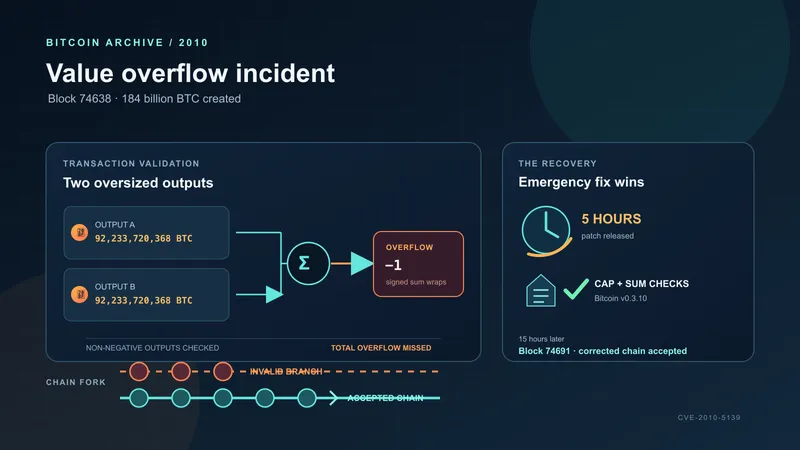
| Value overflow incident | 2010 | Emergency soft fork | Patched CheckTransaction to reject outputs > 21 M BTC | Chain reorganized; invalid block orphaned within hours |
| BIP 66 (strict DER) | 2015 | Soft fork | IsSuperMajority (750/1000 enforce; 950/1000 reject old-version blocks) | Enforced canonical signature encoding |
| SegWit (BIP 141) | 2017 | Soft fork | BIP 9 versionbits | Introduced witness discount, fixed malleability, enabled script versioning |
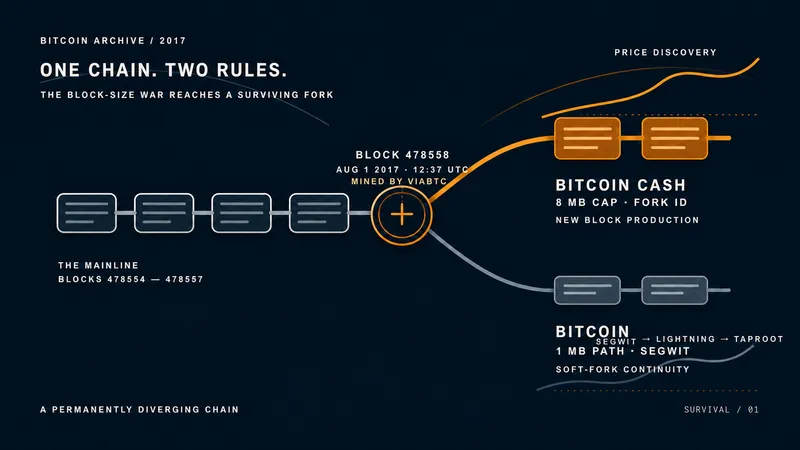
| Block size → BCH | 2017 | Hard fork | Disagreement on scaling path | Bitcoin Cash split; incompatible 8 MB block-size rule created a permanent chain divergence |
| Taproot (BIP 341) | 2021 | Soft fork | Speedy Trial (modified BIP 9) | Added Schnorr signatures, Tapscript, and MAST |
The value overflow incident above is the clearest real-world instance of this emergency-soft-fork mechanism in action — see the incident write-up for how the patch was deployed and the invalid block orphaned within hours.
The August 2017 Bitcoin Cash split listed above is the fully-documented instance of the hard-fork pattern described in this section — see the Bitcoin Cash fork entry for the block height, launch parameters, and aftermath of that specific divergence.
Chain selection rule
When a node encounters competing chain tips, it selects the most-work chain — the chain with the greatest cumulative proof of work (tracked internally as nChainWork). This is commonly but incorrectly described as the “longest chain”; in practice, a shorter chain with higher-difficulty blocks can have more total work than a longer chain with lower-difficulty blocks. The most-work rule ensures that the chain backed by the greatest expenditure of computational energy wins.
5. Consensus rule evolution
Bitcoin’s consensus rules are not static. They evolve through carefully staged activation mechanisms that allow the network to adopt new rules without requiring simultaneous coordination of all participants.
Activation mechanism timeline
Activation parameters comparison
| Mechanism | Signaling method | Threshold | Timeout behavior | Used for |
|---|---|---|---|---|
| Flag day | None (hardcoded height/time) | N/A | Activates unconditionally at the specified point | 1 MB limit, early patches |
| IsSuperMajority | Block nVersion ≥ N | 750/1,000 blocks to enforce; 950/1,000 to reject old-version blocks | No explicit timeout; stays pending until threshold is met | BIP 34, BIP 66, BIP 65 |
| BIP 9 versionbits | Individual bit in nVersion | 95% of retarget period (1,916/2,016) | Fails if not locked in before end date; bit becomes available for reuse | CSV (BIP 68/112/113), SegWit (BIP 141) |
| BIP 8 (LOT=true) | Individual bit in nVersion | 95% of retarget period | Mandatory lock-in at timeout (miners cannot prevent activation) | Proposed during Taproot activation debate; not the mechanism ultimately used |
| BIP 8 (LOT=false) | Individual bit in nVersion | 95% of retarget period | Fails at timeout (same as BIP 9) | Proposed but not deployed standalone |
| Speedy Trial | Individual bit in nVersion | 90% of retarget period | Short signaling window; no mandatory lock-in at timeout | Taproot (BIP 341) |
6. Finality model
Bitcoin provides probabilistic finality, not absolute finality. A confirmed transaction becomes exponentially harder to reverse with each subsequent block, but no finite number of confirmations makes reversal mathematically impossible.
Confirmation depth vs. attack probability
The table below applies the formula in Section 11 of the whitepaper, showing the probability that an attacker with a given fraction of network hash rate can catch up and overtake the honest chain after a transaction has reached a given confirmation depth. The whitepaper itself prints the q = 10% column (z = 0 to 10) and q = 30% at depths 0, 5, 10 and on to 50; the other values here are computed from the same formula and rounded to four decimal places.
| Confirmations | q = 10% | q = 15% | q = 20% | q = 25% | q = 30% |
|---|---|---|---|---|---|
| 1 | 0.2046 | 0.3097 | 0.4159 | 0.5223 | 0.6277 |
| 2 | 0.0510 | 0.1150 | 0.2039 | 0.3154 | 0.4457 |
| 3 | 0.0132 | 0.0442 | 0.1032 | 0.1961 | 0.3246 |
| 4 | 0.0035 | 0.0173 | 0.0530 | 0.1235 | 0.2391 |
| 5 | 0.0009 | 0.0068 | 0.0274 | 0.0784 | 0.1774 |
| 6 | 0.0002 | 0.0027 | 0.0143 | 0.0499 | 0.1321 |
At 6 confirmations (approximately 1 hour), an attacker controlling 10% of network hash rate has a 0.02% chance of reversing the transaction. Against a 30% attacker, the same depth still carries a 13.2% reversal probability — which is why high-value transactions often wait for more confirmations.
Why Bitcoin has no absolute finality
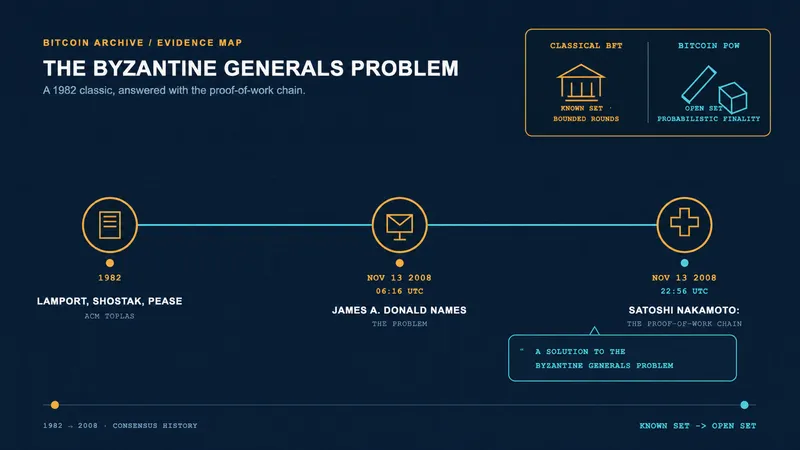
In Byzantine fault tolerant (BFT) consensus systems such as Tendermint or HotStuff, a block is considered final once a supermajority (typically 2/3) of validators signs it. After that point, the block cannot be reverted without violating the protocol’s safety guarantee.
Bitcoin’s design makes a fundamentally different trade-off:
| Property | Bitcoin (Nakamoto consensus) | BFT systems |
|---|---|---|
| Finality type | Probabilistic — reversal probability decreases exponentially with depth | Deterministic — final after supermajority vote |
| Participant set | Open — any machine can mine without permission | Closed — validator set is known and bounded |
| Fault tolerance | Tolerates < 50% adversarial hash rate | Tolerates < 1/3 adversarial validators |
| Liveness under partition | Continues producing blocks (may fork temporarily) | Halts until supermajority reconnects |
| Reversal cost | Proportional to the cumulative proof of work buried atop the transaction | Requires corrupting ≥ 1/3 of the validator set |
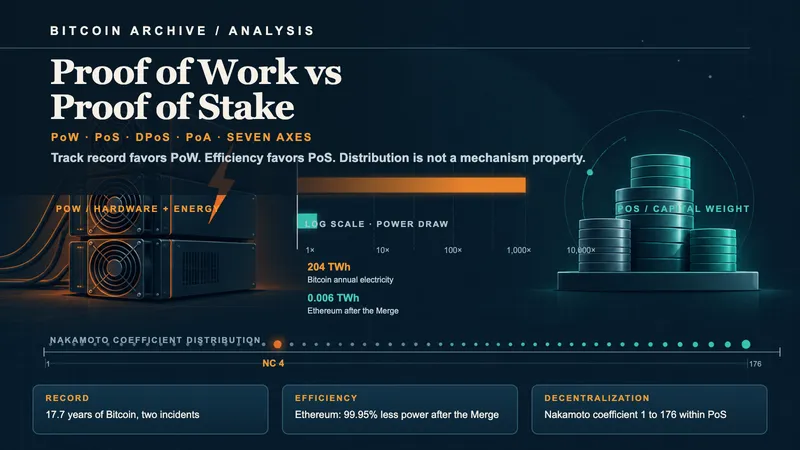
Bitcoin chose probabilistic finality because it enables an open, permissionless participant set — the defining property that makes the system censorship-resistant. A closed-membership BFT system can provide instant finality but requires knowing who the participants are, which reintroduces the trust assumption Bitcoin was designed to eliminate. Solana’s Tower BFT is a live instance of the trade-off on the other side of this table: a bounded validator set voting toward instant-feeling finality, made possible only because a shared cryptographic clock gives every validator the same deadline to vote against — a problem Bitcoin’s design never had to solve, because it never assumed a shared clock existed. How this trade measures up against proof of stake and the other mechanisms, axis by axis with dated numbers, is set out in the proof-of-work versus proof-of-stake comparison.
7. Two-era comparison
| Feature | Satoshi era (v0.1, Jan 2009) | Modern Bitcoin Core, v27+ baseline |
|---|---|---|
| Hash function | SHA-256d (double SHA-256) | Same |
| Chain selection | Simple block-height comparison (nBestHeight); no cumulative-work tracking | Most-work chain (nChainWork, introduced v0.3.3, July 2010) replaces height comparison |
| Difficulty adjustment | Every 2,016 blocks; off-by-one bug present | Same algorithm; off-by-one preserved as consensus (fixing it would be a hard fork) |
| Block size limit | None in v0.1; 1 MB added mid-2010 | 4 MWU weight limit (BIP 141) |
| Coinbase maturity | 100-block maturity rule | Same |
| Soft fork activation | Direct code change (flag day) | BIP 9 versionbits; Speedy Trial (a modified BIP 9) for Taproot |
| Script validation | Combined scriptSig + scriptPubKey execution | Separated evaluation; SegWit witness programs; Taproot script-path spending |
| Timestamp validation | Median-time-past (MTP) rule: must be > median of previous 11 blocks (GetMedianTimePast(), nMedianTimeSpan = 11) | Same rule, unchanged since v0.1 |
| Checkpoints | None in v0.1; hardcoded checkpoints added July 2010 (v0.3.2) as an anti-DoS measure | assumevalid (skip script verification below a trusted block hash) replaces most checkpoint functionality |
| Header-first sync | Not available; blocks downloaded and validated sequentially | Headers-first synchronization (download all headers, then request blocks in parallel) |
| Cryptography library | Bundled Crypto++ for the SHA-256 mining path; OpenSSL for ECDSA and other hashing | Internal SHA-256 (with hardware acceleration); libsecp256k1 for ECDSA/Schnorr |
8. Limits of this page
This page covers the consensus layer in isolation. The following topics are out of scope and addressed in their respective domain pages within the design-document series:
- Block data structures — header format, Merkle tree construction, and coinbase layout are covered in the block and chain design page.
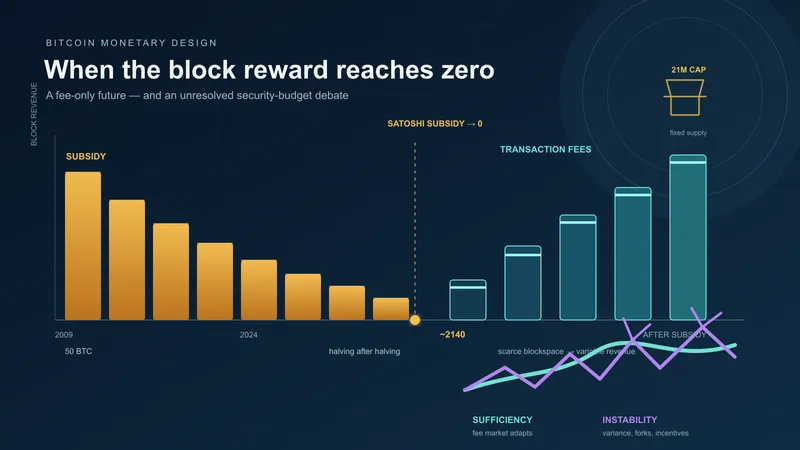
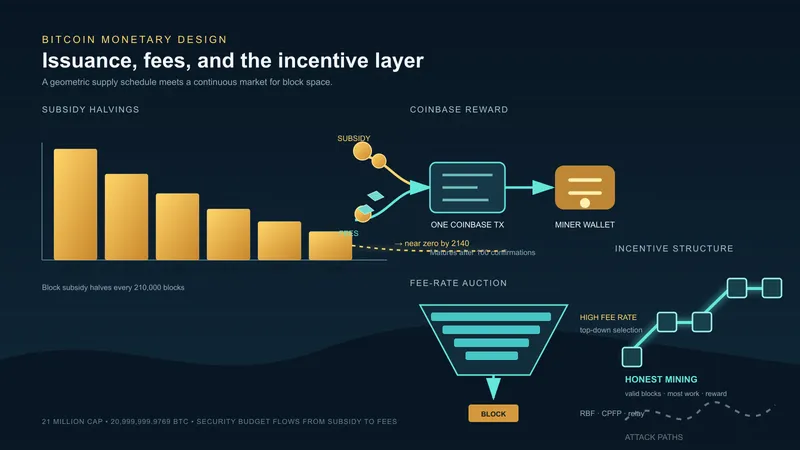
- Mining economics — block template construction, fee-market dynamics, pool protocols, and the issuance schedule. The mining reward exhaustion analysis examines the long-term transition to a fee-only security budget.
- Transaction validation details — UTXO lookup, Script evaluation, and signature verification are covered in the transaction design page.
- Network-layer block propagation — how blocks travel across the P2P network, compact block relay (BIP 152), and Eclipse/Sybil resistance.
- Security model — 51% attack economics, selfish mining, and the full threat model are deferred to the L2 security-model deep dive.
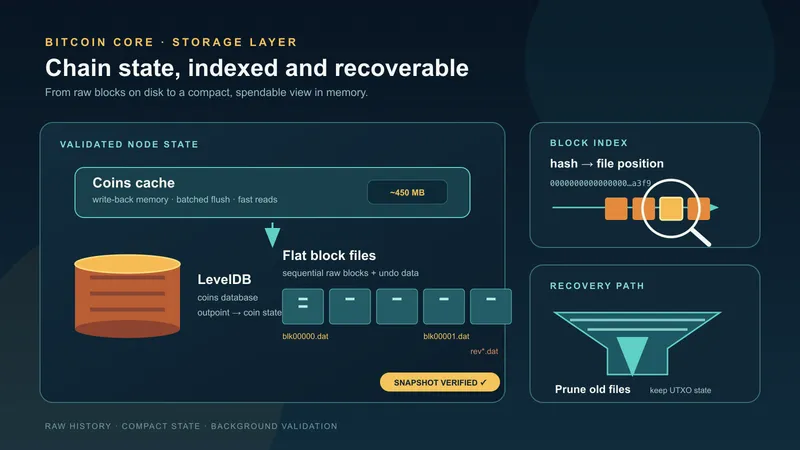
Four neighbouring pages take the consensus rules from different sides. The P2P network design covers the transport that carries them. The monetary design covers issuance and difficulty as monetary policy rather than as validation. The security-model deep dive covers what happens when the rules are attacked — double-spend mitigation, 51% economics, selfish mining. And the storage design page covers what happens once a block clears these rules — how the accepted chain and its UTXO set are actually written to disk.