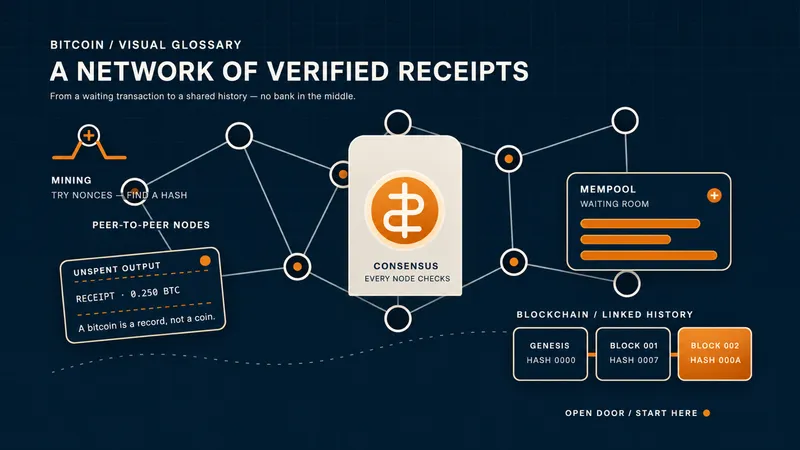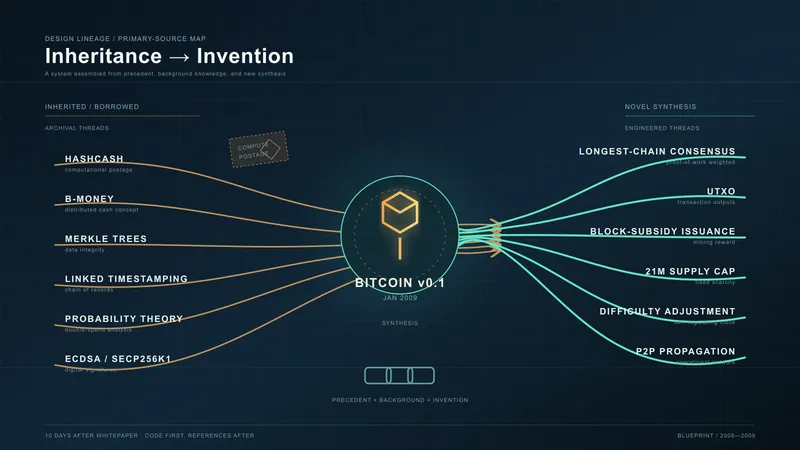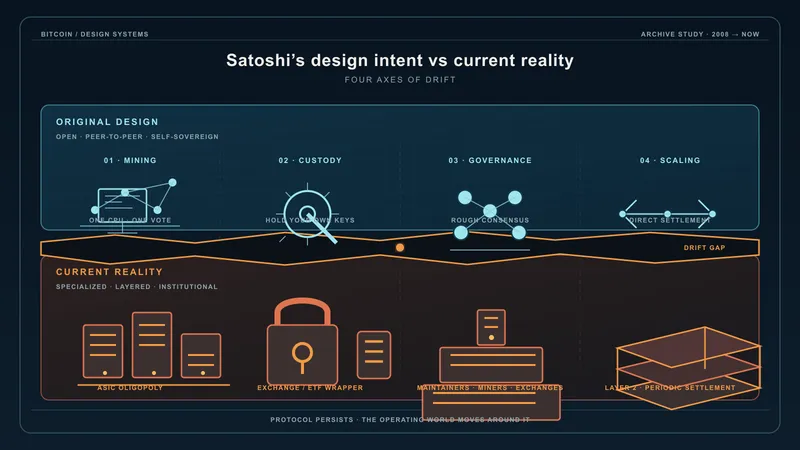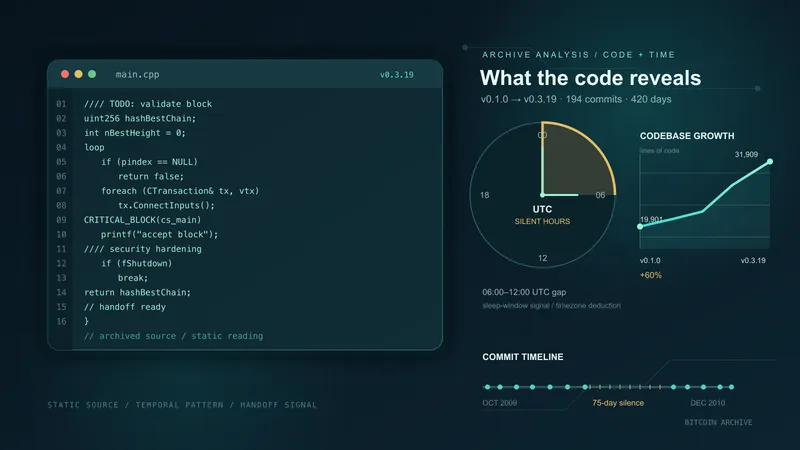

What this document series is
This is an editorial design reading of Bitcoin — a set of twelve pages written by Bitcoin Institute that decompose the system into its constituent parts and explain how they fit together. The series is not a protocol specification and does not carry normative authority. It is an analytical companion to the whitepaper, the beginner’s guide, and the reference implementation source code.
Baseline. Unless stated otherwise, “modern Bitcoin Core” means the v27+ codebase. Satoshi-era descriptions refer to v0.1 (January 2009). Where behavior differs between the two, both are noted.
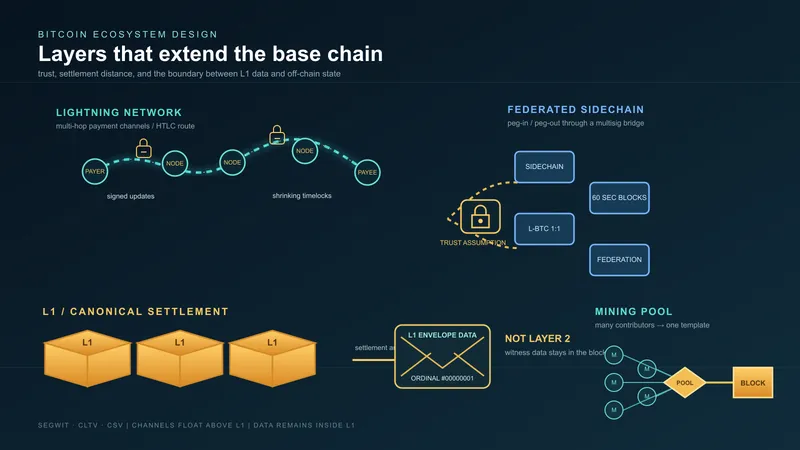
Scope. The series covers the Bitcoin protocol and its reference implementation. Layer-2 systems (Lightning Network, sidechains) and application-layer software (wallets, exchanges, indexers) are mentioned at interface boundaries but not decomposed in detail.
This page is L0 — System design overview in the design-document series. It provides the system-wide picture and links to each domain page.
1. System architecture
The diagram below shows every major subsystem and the data paths between them. Each box maps to one or more pages deeper in the series.
| Subsystem | Role | Design page |
|---|---|---|
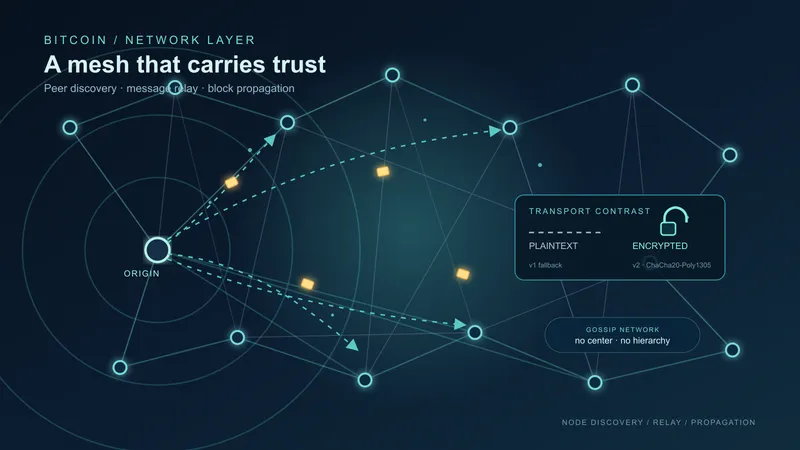
| Network layer | P2P gossip, peer management, message serialization | L1 #1 P2P |
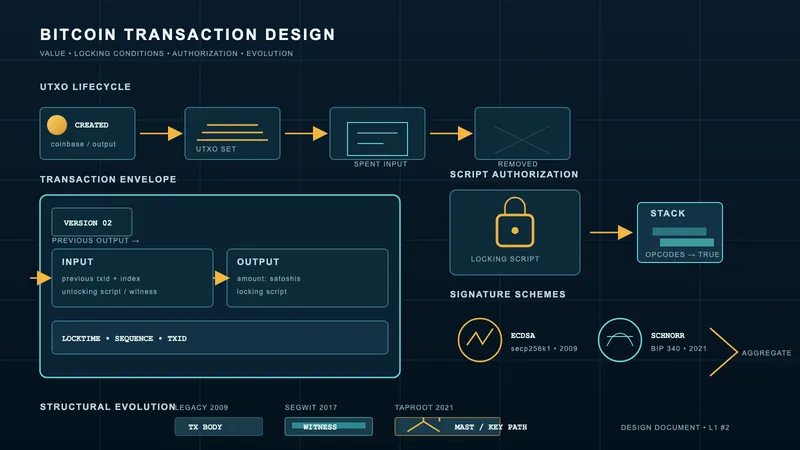
| Transaction layer | UTXO model, Script, inputs/outputs, signatures | L1 #2 Transaction |
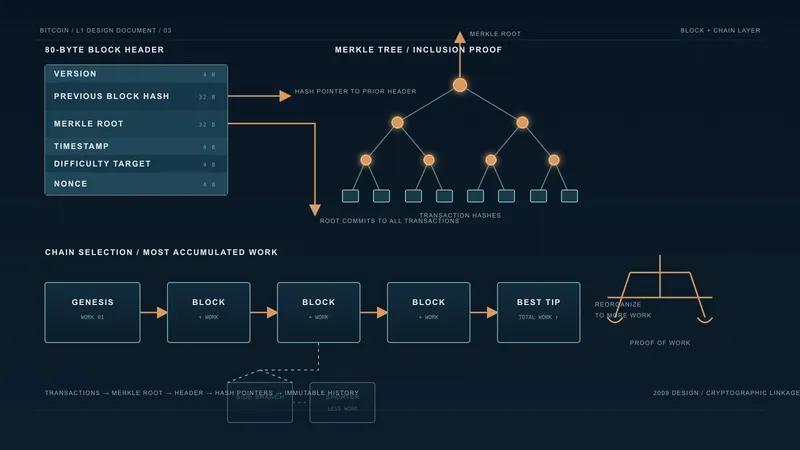
| Block / chain layer | Header, Merkle tree, chain structure, coinbase | L1 #3 Block/Chain |
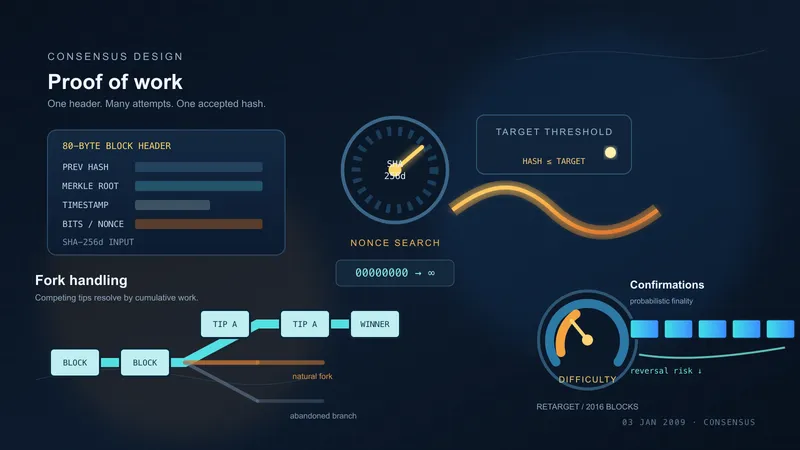
| Consensus engine | PoW, difficulty adjustment, fork handling, validation | L1 #4 Consensus |
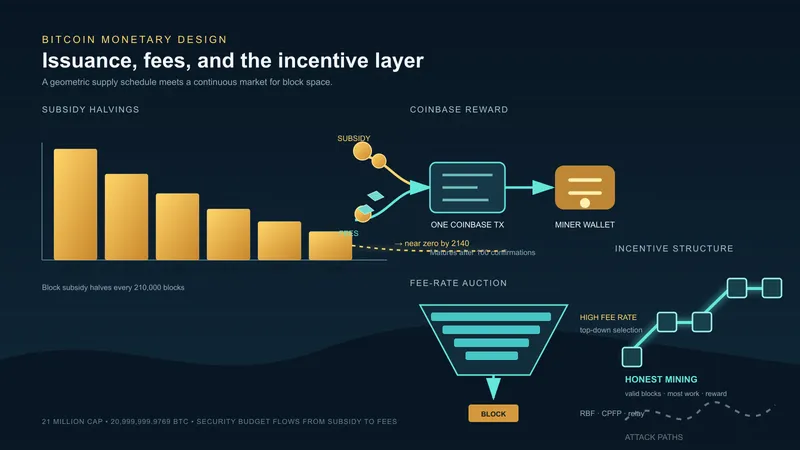
| Monetary layer | Issuance schedule, fee market, miner incentives | L1 #5 Monetary |
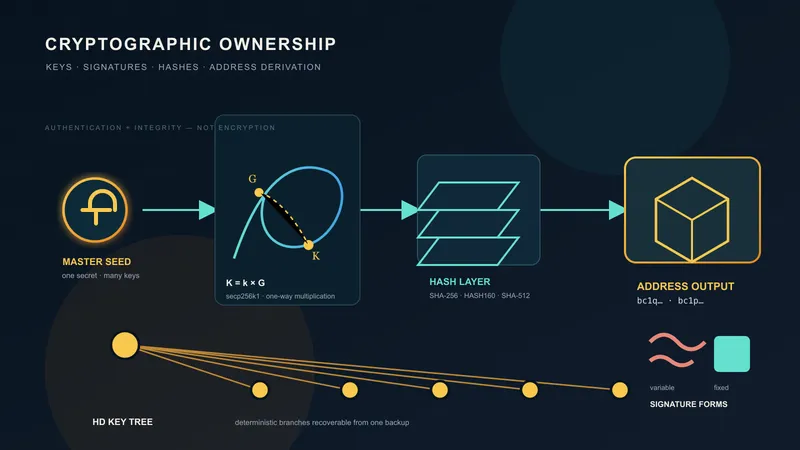
| Cryptography layer | Keys, signatures, hashes, address derivation | L1 #6 Cryptography |
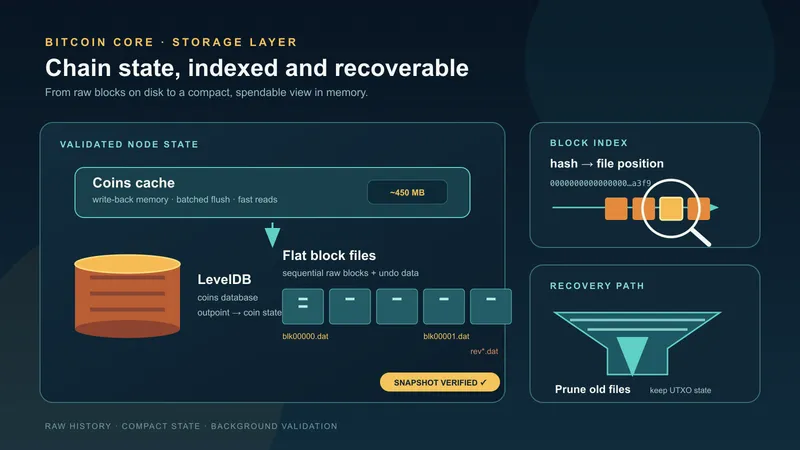
| Storage layer | Block files, UTXO database, chain state on disk | L1 #7 Storage |
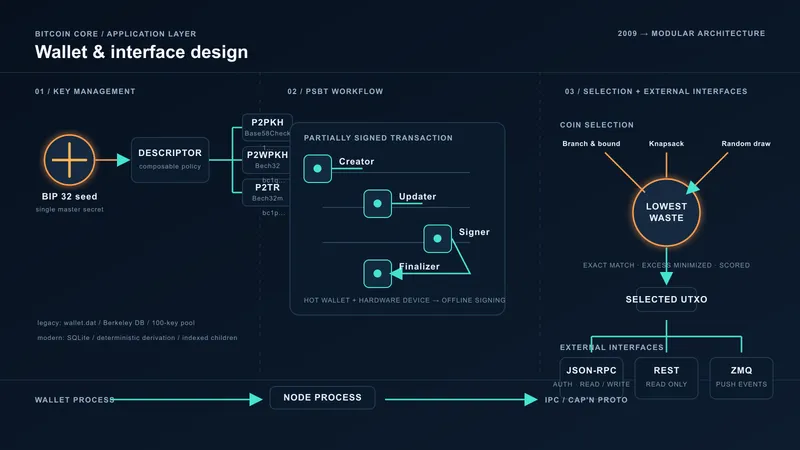
| Wallet / interface | Key management, coin selection, PSBT, RPC | L1 #8 Wallet |
2. Layer model
Bitcoin’s design stacks into five layers. Each layer depends only on the layers below it.
| Layer | What it decides | Key data structures |
|---|---|---|
| Application | User-facing behavior: address generation, coin selection, fee estimation, payment channels | HD key trees (BIP 32/44/84), PSBT |
| Transaction | What a valid spend looks like: inputs, outputs, lock scripts, witness data | CTxIn, CTxOut, CScript, witness stack |
| Consensus | Which blocks are accepted and which chain tip wins | Block header, Merkle tree, difficulty target, nChainWork |
| Network | How nodes find each other and exchange data | version, inv, getdata, block, tx messages |
| Storage | How validated data persists to disk and how it is retrieved | LevelDB (UTXO set), blk*.dat / rev*.dat flat files |
3. Data flow: transaction to blockchain
The sequence below traces a single transaction from the moment a user signs it to the moment it is buried under confirmations.
Key design properties visible in this flow:
- No central checkpoint. Every node validates independently — there is no authority a transaction must pass through.
- Two-phase acceptance. A transaction is first accepted into the mempool (unconfirmed), then accepted into a block (confirmed). The mempool is local and non-binding; only block inclusion is consensus-level.
- Most-work chain wins. If two miners find blocks at nearly the same time, the network temporarily forks. Nodes follow whichever chain accumulates the most total proof-of-work. The losing block becomes stale (orphaned); its transactions return to the mempool.
4. Component interaction map
The flowchart below shows how the major code-level components interact when a node receives a new block from the network.
5. Two-era comparison
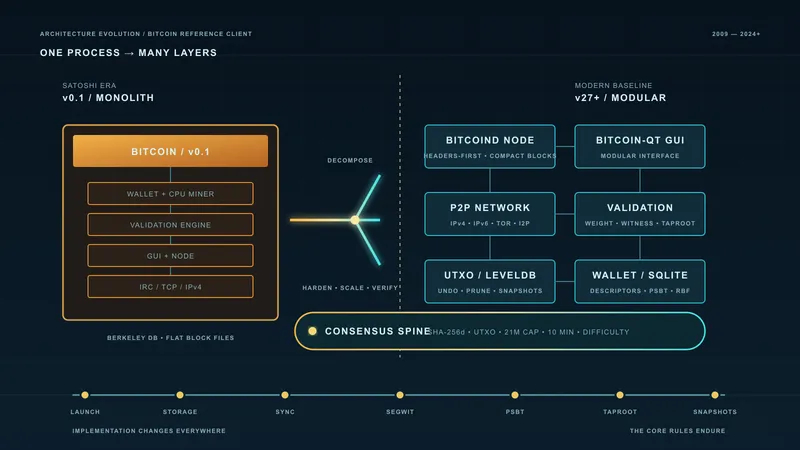
The table below gives a brief structural comparison between the Satoshi-era v0.1 implementation and modern Bitcoin Core (v27+ baseline). Each row is explored in depth in the domain pages listed in § 7.
| Aspect | Satoshi v0.1 (Jan 2009) | Modern Bitcoin Core, v27+ baseline |
|---|---|---|
| Consensus rule enforcement | Single CheckBlock / CheckTransaction path | Separated into consensus, policy, and validation layers |
| Chain selection | Longest chain (block-height comparison, nBestHeight) | Most-work chain (nChainWork), since v0.3.3 |
| Script system | Full opcode set including OP_CAT, OP_MUL, etc. | Many opcodes disabled (2010); SegWit witness versioning added (2017) |
| Transaction format | Version 1, no witness | SegWit witness field (BIP 141), version 2 (BIP 68 / 112 / 113) |
| Block size | No explicit limit in v0.1 (1 MB added in 2010) | 4 MWU weight limit (BIP 141) |
| Network protocol | 12 message types | 27+ message types; compact blocks (BIP 152), addr v2 (BIP 155) |
| Peer discovery | Hardcoded IRC channel + addr messages | DNS seeds, addrv2, Tor/I2P/CJDNS support |
| Storage | BDB for indexes and wallet; raw blocks in flat files (blk*.dat) | LevelDB (UTXO set), flat block files (blk*.dat), undo files (rev*.dat) |
| Mining | CPU only, internal miner in client | External via getblocktemplate (BIP 22/23); Stratum v2 in ecosystem |
| Wallet | Integrated in node binary, random keys | Descriptor wallets (BIP 380+), logical separation (experimental multiprocess in progress) |
| Cryptography | OpenSSL for ECDSA; bundled Crypto++ for the mining SHA-256 | libsecp256k1 (custom ECDSA/Schnorr), internal SHA-256 |
6. Reading guide
Different readers benefit from different paths through the series.
| Audience | Suggested reading order |
|---|---|
| New to Bitcoin | Start with the beginner’s guide, then return here, then L1 #2 (transaction) → #3 (block) → #4 (consensus) |
| Developer | This overview → L1 #2 (transaction) → #3 (block) → #4 (consensus) → #1 (P2P) → #7 (storage) |
| Researcher / economist | This overview → L1 #5 (monetary) → #4 (consensus) → #2 (transaction) → L2 #9 (architecture evolution) |
| Security auditor | L1 #2 (transaction) → #4 (consensus) → #1 (P2P) → #6 (cryptography) → L2 #11 (security model) |
7. Design-document index
The series is organized into three levels:
- L0 — this page (system overview)
- L1 — eight domain pages, each covering one subsystem end-to-end
- L2 — three deep-dive pages on cross-cutting topics
L1 — Domain pages
| # | Page | Scope |
|---|---|---|
| 1 | P2P network | Peer discovery, connection lifecycle, message format, gossip relay, compact blocks, BIP 324 transport |
| 2 | Transaction | UTXO lifecycle, transaction structure, Script evaluation, signatures (ECDSA/Schnorr), SegWit, Taproot |
| 3 | Block / chain | Header fields, Merkle tree, chain structure, most-work chain selection, block weight, coinbase |
| 4 | Consensus | PoW mechanics, difficulty adjustment, block validation, fork types, activation mechanisms, finality model |
| 5 | Monetary | 21M cap arithmetic, halving schedule, fee market, miner incentives, fee-only future |
| 6 | Cryptography | secp256k1, ECDSA/Schnorr, SHA-256d, address derivation, HD wallets, quantum considerations |
| 7 | Storage | Block files, UTXO database (LevelDB), chain state, mempool, pruning, assumeUTXO |
| 8 | Wallet / RPC | Descriptor wallets, coin selection, PSBT, fee estimation, RPC/REST/ZMQ interfaces |
L2 — Cross-cutting deep dives
| # | Page | Scope |
|---|---|---|
| 9 | Architecture evolution | Side-by-side v0.1 vs v27+ comparison across all 8 domains |
| 10 | Ecosystem | Lightning Network, sidechains (Liquid), L1 extensions (Ordinals), mining pools |
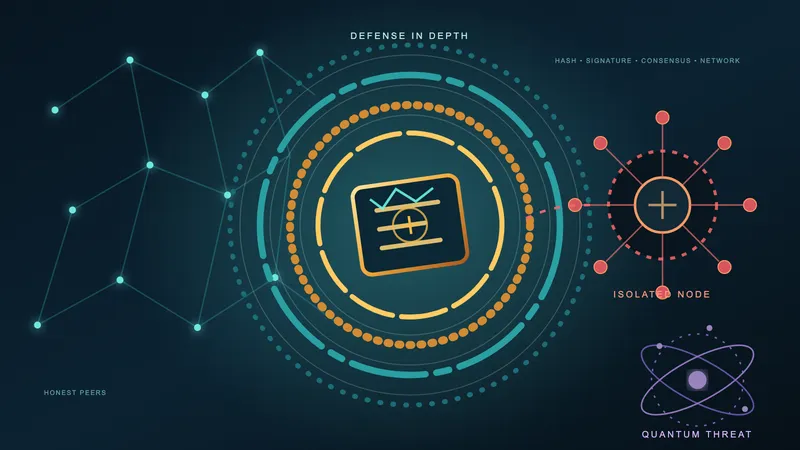
| 11 | Security model | Trust assumptions, attack taxonomy, defense layers, economic security, quantum threat |