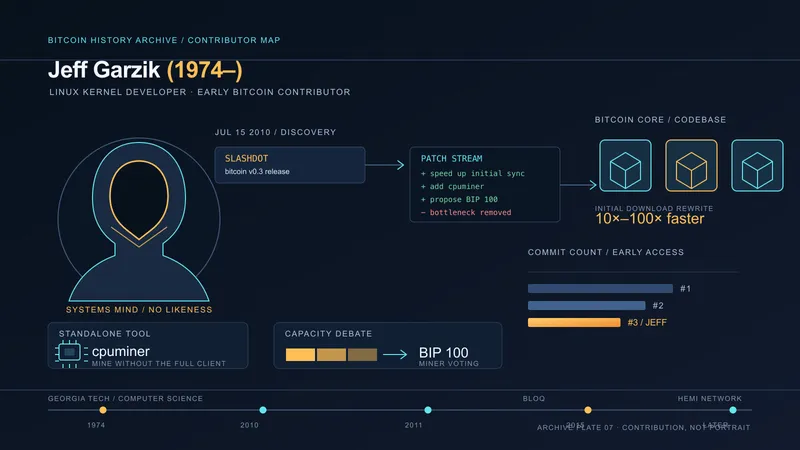

Jeff Garzik discovered Bitcoin through a Slashdot post announcing Bitcoin v0.3 in July 2010 — the “Great Slashdotting.” He spent five years as a Bitcoin core developer while working at Red Hat. At one point, his contribution to Bitcoin’s codebase was the third-largest after Satoshi Nakamoto and Gavin Andresen.
From BREAKER Magazine, October 29, 2018:
He wrote it as one of BREAKER’s pieces for the whitepaper’s tenth anniversary, and began in 2010, on a vacant plot around Raleigh, North Carolina, where he had parked a 1984 Fleetwood Southwind RV bought for about $1,000: “Thus, a hacker’s monastery was born.” His day job was at Red Hat, as a Linux kernel “maintainer” for the Ethernet controller and for a subsystem that connects data storage devices.
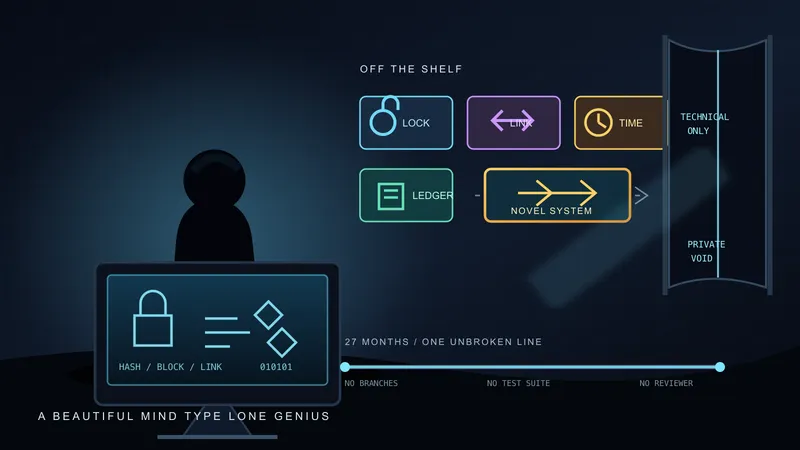
He came to the code a skeptic. In a distributed cluster, any server could already be unplugged without losing data, so what was new? “Skepticism led to curiosity. Curiosity led to revelation. Satoshi had invented what many had seen as impossible: a truly decentralized multi-node computing cluster.”
Satoshi was “practical and sane, which made interactions very easy and comfortable.”
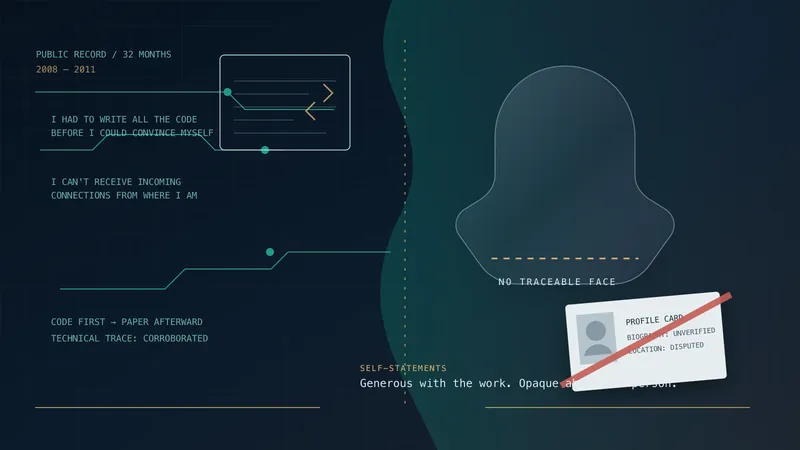
Satoshi’s anonymity “encouraged volunteers to rely on trusting the objective reality of the code, rather than whether the project leader had the conventional bona fides.”
Garzik’s development process: he would write a software change, test it, create a software patch, and email it to Satoshi. If Satoshi accepted it, it would be merged into the Subversion source code repository.
“Satoshi was the sole gatekeeper for changes in the very beginning,” much as Linus Torvalds was for Linux, and “if your proposed change was rejected, you rarely knew exactly why.”
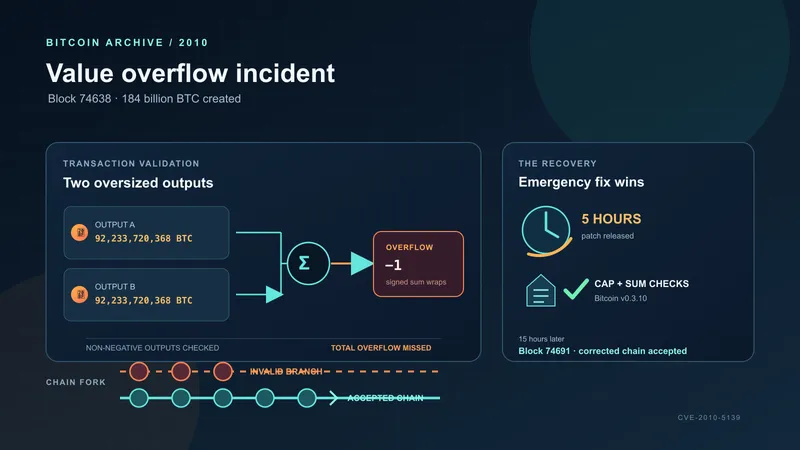
The article describes the August 2010 value overflow incident as a bug that “created 184 million bitcoin, or nearly nine times as much as was ever supposed to be minted.” [Editor: The figure is wrong. The bug created about 184 billion BTC, roughly 8,800 times the 21 million cap.]
Early contributors “would only know Satoshi through his contributions on mailing lists and forums.” Garzik’s account confirms, from a collaborator’s side, the pattern found in Satoshi’s own correspondence and collected in the inventory of Satoshi’s self-statements: generous with technical disclosure, silent about the man.
From CoinDesk interview, July 9, 2013:
Satoshi was “a fantastic designer and architect” who “thought about the system at a very deep level.”
Satoshi “spent a couple of years thinking about the system, and then according to what he said, he had to write the system to prove to himself that it would work.”
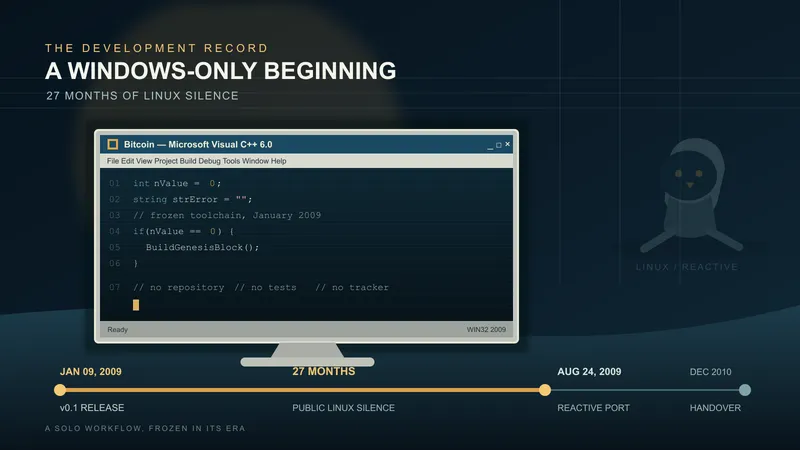
He “rarely followed standard engineering practices, like writing unit or stress tests.”
The original Bitcoin was Windows-only, poorly portable, and “a jumble of source code” — a verdict reached independently in the study of Satoshi’s Windows development environment, from the Visual C++ 6.0 toolchain and Hungarian notation still visible in the surviving code.
Several features required immediate disabling upon public release because they were “obviously exploitable.”
Garzik’s initial work focused on optimizing blockchain downloads, creating code that “increased the speed of the initial download by 10x-100x.”
He later became CEO of Bloq and Hemi Network.
This piece is itself quoted as “an earlier retrospective” in the wider collection of what others said about Satoshi, alongside Garzik’s fuller 2024 remarks.