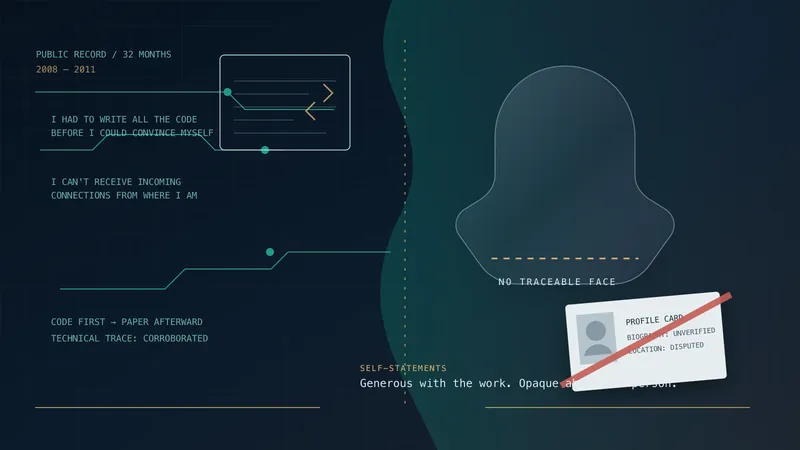

A correspondent opened with “Happy Christmas, Satoshi,” adding that he did not know where in the world Satoshi was or whether he celebrated Christmas there. The reply did not say thank you, Merry Christmas, or anything personal. It began with SPV design. Across the surviving correspondence, that small refusal appears again and again: the channel stays open for protocol and closes when a person might come into view.
Mike Hearn (email to Satoshi, December 27, 2010, 8:21:00 PM UTC)Happy Christmas Satoshi, assuming you celebrate it wherever you are in the world :-)
Two days later, Satoshi’s reply began:
Satoshi Nakamoto (email to Mike Hearn, December 29, 2010, 10:42:00 PM UTC)The simplified payment verification in the paper imagined you would receive transactions directly, as with sending to IP address which nobody uses, or a node would index all transactions by public key and you could download them like downloading mail from a mail server…
No “Happy Christmas.” No “thanks.” No “you too.” The reply opened with SPV client-mode design, went on to Hearn’s questions about the 21 million figure, the 10-minute block target and the block-size limit, and ended without ever circling back to the season’s greeting. This is not an isolated incident. Across roughly two and a half years of recorded correspondence (August 2008 to April 2011), Satoshi’s responses to non-technical content from his correspondents follow a small number of identifiable patterns — and from one of them in particular almost never deviate.
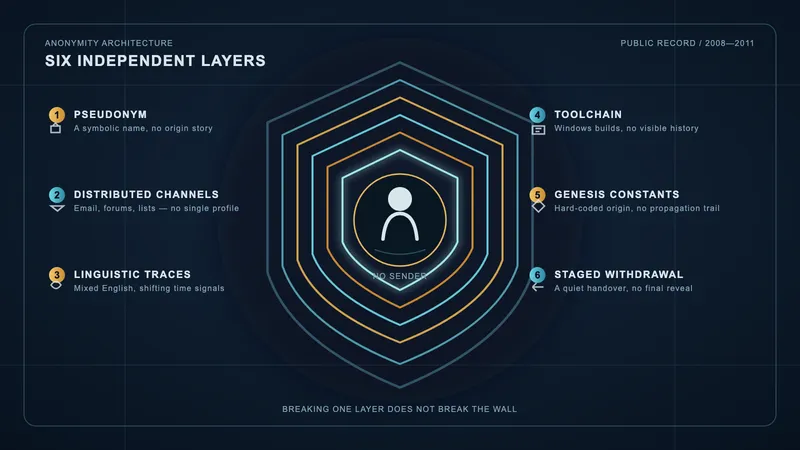
This response pattern is a layer of Satoshi’s anonymity architecture distinct from the technical layer (Tor, anonymising email, metadata stripping) treated in Satoshi’s anonymity architecture. The technical layer keeps the channel opaque; this one keeps the content opaque.
1. Catalogue of observed cases
The table below catalogues the cases this Archive has primary-source-confirmed. It is not exhaustive — the Mike Hearn correspondence runs to 33 messages, the Martti Malmi archive to more than 250, and the BitcoinTalk forum and cryptography@metzdowd.com archive add hundreds more contexts. The selection here is the set of clearly non-technical moves the senders made.
| Date | Sender → recipient | Non-technical content from the sender | Satoshi’s reply opener | Reply’s handling of the non-technical content | Pattern |
|---|---|---|---|---|---|
| 2010-12-27 → 12-29 | Mike Hearn → Satoshi | ”Happy Christmas Satoshi, assuming you celebrate it wherever you are in the world :-)" | "The simplified payment verification in the paper imagined you would receive transactions directly…” | Not addressed at all | 1. Complete silence |
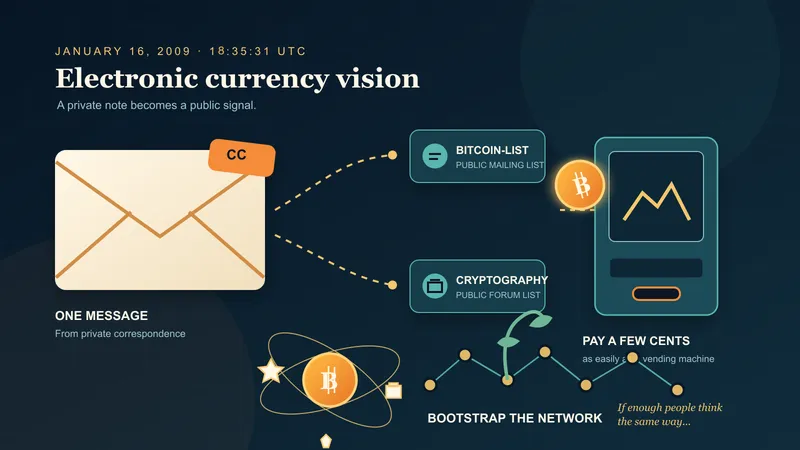
| 2009-01-10 → 01-16 | Hal Finney → cryptography ML | ”As an amusing thought experiment, imagine Bitcoin is successful… each coin a value of about $10 million… 100 million to 1 odds…” | Satoshi’s January 16 message is addressed to Dustin Trammell, not Finney | No individual reply. Satoshi’s later message in the same thread reaches the topic only obliquely: “It might make sense just to get some in case it catches on. If enough people think the same way, that becomes a self fulfilling prophecy.” Finney’s $10M figure and 100-million-to-one odds are never engaged | 2. Oblique general remark |
| 2009-04-12 → 04-12 | Mike Hearn → Satoshi | ”So many questions :) But it’s rare that I encounter truly revolutionary ideas. The last time I was this excited about a new monetary scheme was when I discovered Ripple.” | Satoshi: “Hi Mike, I’m glad to answer any questions you have.” | Minimal formal greeting only. “revolutionary,” “excited,” and Ripple-discovery moment are not engaged emotionally; Ripple is engaged as a technical comparator at the end | 3. Minimal-greeting deflection |
| 2011-03-07 → 03-09 | Mike Hearn → Satoshi | ”I hope you are doing well… Hope you can find the time/energy to rejoin us soon!… it’s exciting times for the network!” + BitcoinJ open-source announcement | Satoshi: “That’s great news! … I’m happy to answer any questions.” | Single acknowledgement of the technical-release news; “doing well,” “rejoin us,” “exciting times” are all bypassed; remainder is dense technical discussion of merkle branches, sequence numbers, nLockTime, contracts | 3. Minimal-greeting deflection |
| 2011-01-06 → 01-06 | Gavin Andresen → Satoshi | ”Satoshi, I assume you don’t want to deal with press/PR/interviews?” — a personal-disposition question, not a technical one | Satoshi’s reply (Malmi archive #254) — the response to that line: “True” | One word. No reason given, no concern aired, no preference explained. Confirmation of the disposition is recorded; the disposition itself is not unpacked | 4. Single-word factual confirmation |
| 2009-05-02 → 05-02 | Martti Malmi → Satoshi | First contact via SourceForge: “I’m Trickstern from the anti-state.com forum, and I would like to help with Bitcoin…” (introduces himself, no technical question) | Satoshi: “Thanks for starting that topic on ASC, your understanding of bitcoin is spot on. Some of their responses were rather Neanderthal…” | Exception. Satoshi engages socially: praises Malmi’s understanding, characterises ASC respondents as “Neanderthal,” shares a “flammable but no spark” metaphor, indicates his own view on what to say publicly | 5. Relational response (rare exception) |
| 2009-12-22 → 12-25 | Martti Malmi ↔ Satoshi (holiday-period exchanges) | Several exchanges across Dec 22–25 about VPS memory, RPC, exchange-service setup — both sides stay technical; neither party introduces a holiday greeting | Satoshi 12-25 reply: “You’re right, I was looking at a test run with 250,000 blocks… duh.” (technical correction + light self-deprecation) | Both sides keep the channel technical. The absence of a greeting here is symmetric: Malmi did not open one either | 1. Complete silence (mutual) |
| 2010-12-30 → (Satoshi reply not preserved as separate entry) | Mike Hearn → Satoshi | ”By the way, your code is easy to read and has been an invaluable reference. So thanks for that.” | Acknowledged only insofar as the technical thread continues; the code-praise compliment receives no targeted return | Praise not addressed. Pattern continues into 2011 thread | 1. Complete silence |
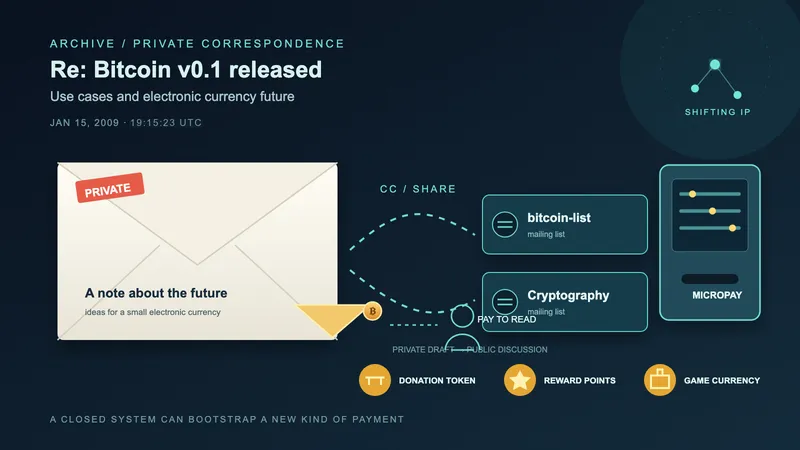
The 2009-01-16 row’s oblique remark was not composed for that public posting alone — Satoshi had first reached for the same “long-odds investment” framing a day earlier, in a private email to Dustin Trammell that only mentioned Finney’s suggestion in passing before pivoting to use cases. The public version CC’d to the mailing lists is a polished rewrite of that same deflection, not a fresh one.
2. Five patterns
The patterns differ in their surface mechanics but share a structural property: the specific person, the specific feeling, the specific prediction is never engaged. Pattern 1 refuses the chance entirely. Pattern 2 launders the topic into a sufficiently general statement that no individual is being responded to. Pattern 3 returns the social ritual just enough to keep the exchange polite. Pattern 4 confirms an external fact about Satoshi (preference, disposition) without supplying the why. Pattern 5 — the exception — is restricted to a domain (shared anti-fiat-money cypherpunk ground) where personhood can be expressed without disclosing personal information.
3. Why Hearn’s Christmas greeting works as a soft probe
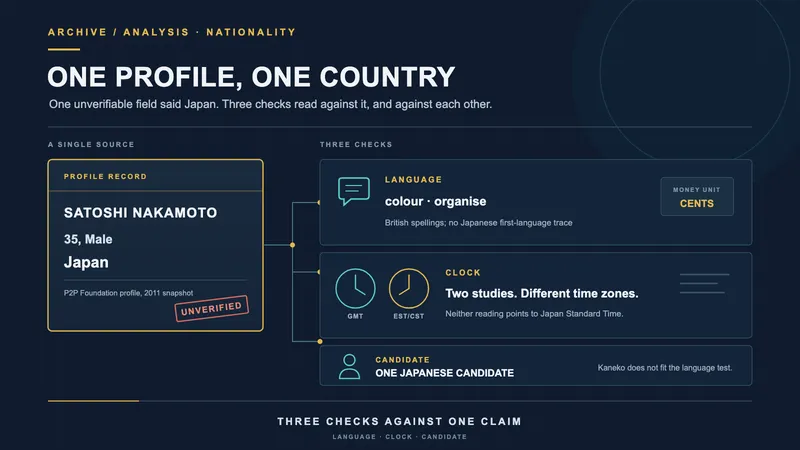
Read at face value, Mike Hearn’s December 27 greeting is a friendly seasonal note. Read against Satoshi’s known information posture, the same sentence is also — without Hearn necessarily intending it — a soft probe of two identification-relevant facts: geographic location and cultural frame, the same two variables the nationality-question analysis investigates from language and timestamp evidence rather than from the shape of a declined reply.
| Probe surface | What an answer would disclose |
|---|---|
| ”wherever you are in the world” | Geographic location (continent, country, region) |
| “assuming you celebrate it” | Cultural / religious frame (Christian-tradition country, secular country, non-Christian-majority country) |
:-) | The smiley signals that the sender knows the question is light and that no answer is required — a polite acknowledgement that personal information is being touched |
Any direct reply forks information:
| Hypothetical Satoshi reply | What it would leak |
|---|---|
| ”Merry Christmas, you too” | Christian-tradition / Western cultural frame likely |
| ”I don’t celebrate it, but happy holidays” | Non-Christian-tradition / different cultural frame likely |
| ”I’m not in your timezone, but thanks anyway” | Timezone / region |
| ”I celebrate it differently here” | Distinct geographic / cultural marker |
| Any acknowledgement at all | At minimum, signals that Satoshi received and processed a social opening — establishing a baseline against which future openings can be probed |
The only zero-information reply is no reply to that line at all. Satoshi takes it. This is a degenerate case of a classical information-theory result: when every possible output of a channel carries information about the sender, the only way to send nothing about the sender is to close that channel. Satoshi’s “communication-layer” anonymity discipline keeps the personal-information channel closed on demand.
This reading does not require Hearn to have intended a probe — the smiley suggests he likely did not. It only requires that an answer would have leaked, and that Satoshi behaved as if he knew it would.
4. How this layer relates to the technical anonymity layer
| Anonymity layer | Tools | Threat addressed |
|---|---|---|
| Technical layer | Tor, vistomail / anonymousspeech.com webmail, PGP, header / metadata stripping, no IP-traceable identifiers | Network-level deanonymization (linking an IP, mail server, or header to a real person) |
| Communication layer (this entry) | Subject-matter restriction (technical-only), minimal-greeting deflection, single-word factual confirmation, refusal to discuss personal preference / location / culture / opinion on non-technical topics | Content-level deanonymization (linking what is said to a real person — culture, geography, age, political stance, emotional register) |
The two layers are complementary: the technical layer can be broken by adversaries with infrastructure access; the communication layer cannot be broken by infrastructure at all, because nothing is in the channel to expose. Even an attacker who fully decrypted every Satoshi message would find primarily technical correspondence with the personal-information channels held closed. Satoshi’s own biography treats this discipline and the self-statements inventory as the two companion axes of the same documentary silence. Jeff Garzik, one of Bitcoin’s earliest core developers, described the same discipline from direct experience in 2024: “he would never let slip any personal information whatsoever, never talk about his mood, the time of day.”
5. The Malmi exception — and what it suggests
The May 2, 2009 first-contact exchange with Martti Malmi is the cleanest exception Bitcoin Institute has surfaced. Satoshi tells Malmi that his understanding of Bitcoin is “spot on,” labels the ASC forum’s anti-fiat-money skeptics “Neanderthal,” and shares a “flammable but no spark” metaphor for monetary adoption — engaging on political-cultural ground rather than personal-information ground.
The distinction matters. The exception does not break the discipline; it operates within a strict additional constraint:
| What Satoshi engages in the Malmi exception | What is still withheld |
|---|---|
| Political-cultural stance (anti-fiat-money sympathy, view of monetary skeptics) | Location, age, profession, schedule, family, language background |
| Strategic judgement (“I’d probably better refrain from mentioning that in public anymore until we’re closer to ready to start”) | Personal preference about specific issues outside Bitcoin |
| Self-characterisation (“My writing is not that great, I’m a much better coder”) | Identifying details of either the coding or the writing capability |
The Malmi exception is selective engagement on shared ideological ground that does not itself disclose identification-relevant information. Satoshi could indicate sympathy with anti-state-money politics without disclosing any of: country, age, language, profession, family situation. The exception is structurally consistent with the discipline rather than against it.
6. Why the recipients did not protest
A possible objection: if Satoshi was systematically refusing to engage with personal content, one would expect at least some correspondent to push back (“not even a Merry Christmas? :-)”). The archive’s recorded correspondence does not contain any such pushback.
Reasons consistent with the record:
- Technical reciprocation was generous. Satoshi’s technical replies are unusually long, careful, and helpful — the December 29 reply Hearn received in lieu of a greeting is a long design discussion of client-only mode, followed by answers to his questions on the 21 million figure, the block target and the block-size limit. Receiving substantive technical help is, for the kind of correspondent Satoshi attracted, more valuable than a Christmas greeting.
- The pattern is consistent, not erratic. A pattern that holds 100% of the time reads as a known constraint rather than as a slight. Once a correspondent had received two or three responses, the discipline would have been visible, and probing it further would have read as poor form.
- The recipients’ own writing style adjusts over time. Hearn’s later 2011 messages still contain personal asides (“I hope you are doing well,” “Hope you can find the time/energy to rejoin us soon!”), but Hearn does not phrase them as demands for response; they are offered as polite framing that the recipient is free to ignore. Malmi’s 2009-12 exchanges contain no greeting at all on Christmas day — he had already adjusted to the channel norm.
7. Limits and counter-readings
- The pattern is read from the discipline’s consistency, not from any single message. Any one of the cases above could be explained as Satoshi being busy, terse, or focused. The reading rests on dozens of opportunities to break the discipline being declined.
- “Studied” is an inferred characterisation, not a documented one. Satoshi never describes the discipline. Whether it was conscious training, ingrained habit, or operational policy is not directly recoverable. The reading is restricted to the observed behaviour and its consistency.
- The exception class may be larger than the Malmi case alone. A full sweep of the Malmi archive and the BitcoinTalk forum may surface additional relational moves. This entry’s catalogue is anchored on representative cases rather than exhaustive enumeration; further examples should be added to the matrix in §1 as they are surfaced.
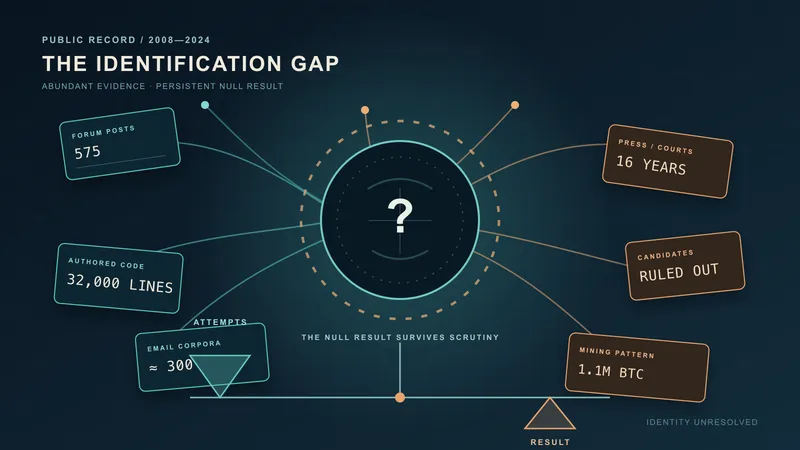
- No identity claim follows. The discipline characterises how Satoshi communicated, not who he was. The same discipline is consistent with intelligence-trained operatives, lifelong introverts, security-conscious researchers, and anyone with a long-standing personal practice of public-private separation. It selects against identities that would be expected to leak emotion or geography casually; it does not select for any specific identity.
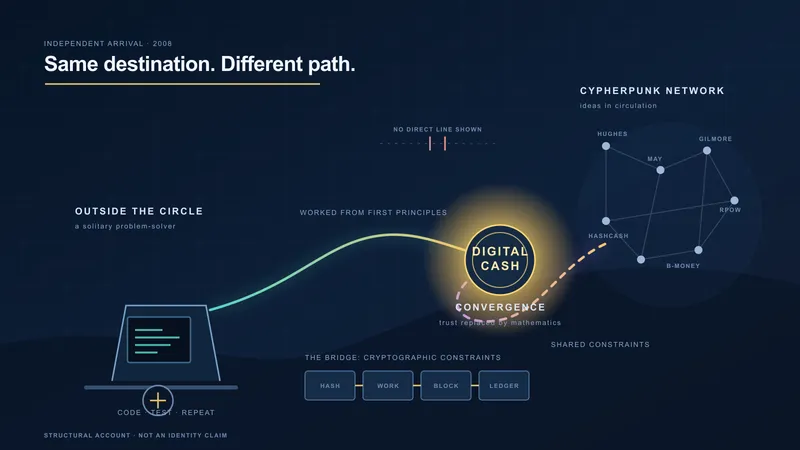
The cypherpunk-independent-arrival analysis covers the technical axis of the same documented practice; the pattern here is its behavioural counterpart. Hearn’s own 2025 retrospective offers a first-hand character read consistent with this discipline: open and engaged on substance, guarded on everything personal. No candidate identity follows from this discipline alone, but the same identity-protective posture bears on every entry in the Satoshi-identity hypotheses overview: it selects against whichever candidates would have been expected to leak emotion or geography casually.
This is less a portrait of a cold or secretive person than a boundary visible in the traffic itself: greetings, praise, location, and feeling reach the edge of the exchange, then the reply returns to protocol—or stops. Malmi’s rare exception keeps the boundary from becoming a caricature. It shows that a person could appear in shared ideas while remaining absent from the personal record.