
Bitcoin Institute

Jameson Lopp

The security researcher whose home was swatted over a phone call

Figures

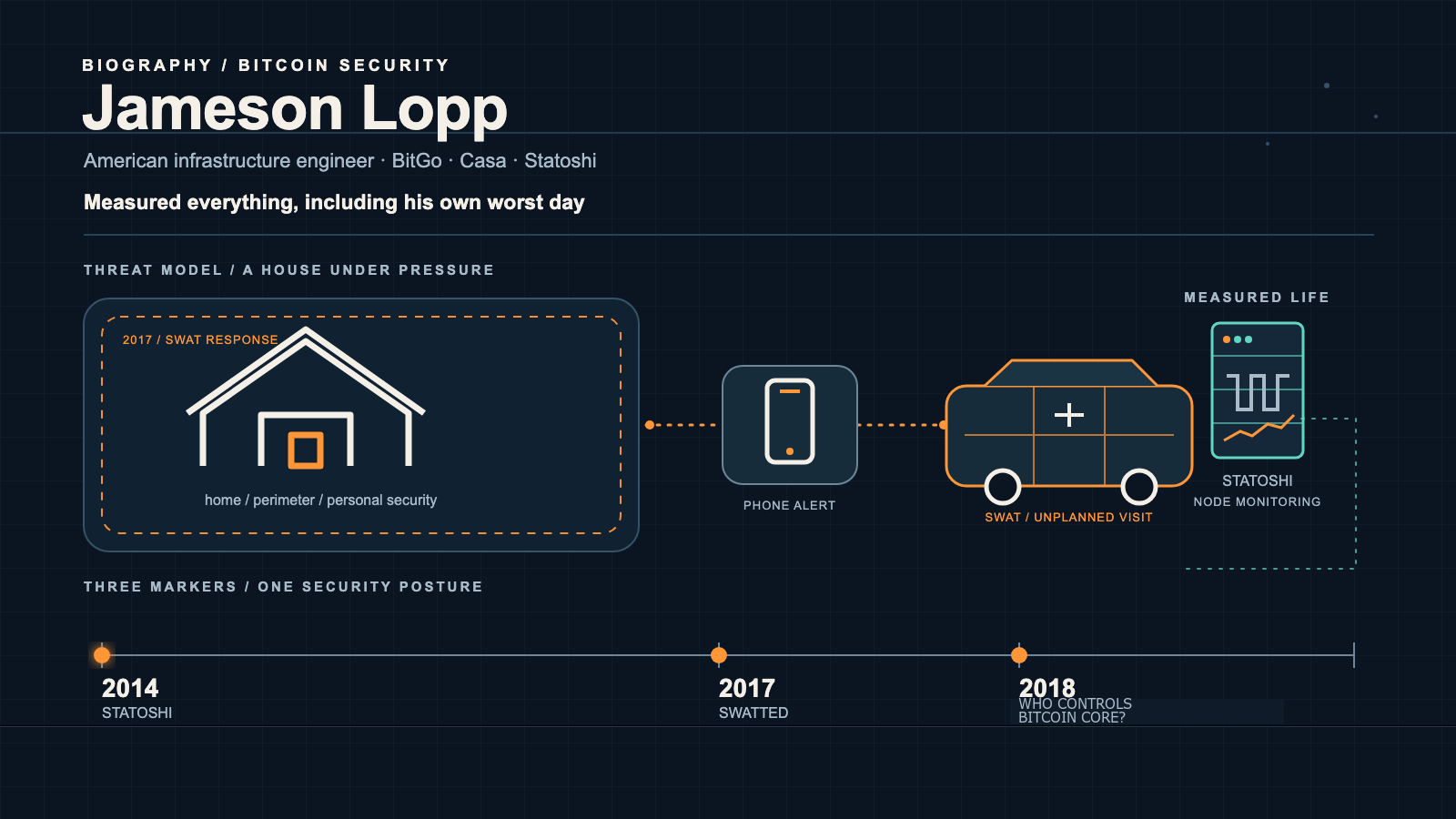
Editorial infographic titled "Jameson Lopp," showing a house icon ringed by a dashed perimeter, a phone icon connected by a dotted line to a police-car icon, a server rack icon linked to a small graph, and a horizontal timeline marking 2014, 2017, and 2018.

On October 17, 2017, patrol cars, a mobile command post, and a fire truck surrounded a house in Durham, North Carolina, after an anonymous caller told police there was a hostage situation inside. There were no hostages. The house belonged to Jameson Lopp, a Bitcoin infrastructure engineer who had spent nearly three years at BitGo building custody software.

Lopp never learned who made the call or why. He had been vocal in Bitcoin’s protocol debates on Twitter, but the caller referenced neither those debates nor anything else identifiable — he said afterward that he couldn’t rule out a simple extortion attempt over a grudge. What he was certain of was the arithmetic of the hoax itself:

“A single phone call can eat up tens if not hundreds of thousands of dollars in public resources just to determine whether or not a threat is real.”

Lopp studied computer science at the University of North Carolina at Chapel Hill, then spent eight years, from 2007 to 2015, as a web developer and later a software engineer at Bronto Software, an email-marketing company in Cary, North Carolina — ordinary infrastructure work, years before he wrote a line of Bitcoin code. He started engaging with the Bitcoin protocol around 2012.

2007Computer sciencedegree, UNC ChapelHill - joins BrontoSoftware as a webdeveloper2014Launches Statoshi,real-time Bitcoin nodetelemetry (May 7)2015Joins BitGo as aninfrastructure engineer2016Co-founds Casa withJeremy Welch and NickNeuman2017Swatted at his Durham,NC home over ananonymous 911 call(Oct 17)2018Publishes "WhoControls Bitcoin Core?"(Dec 15)2022"Was Satoshi a GreedyMiner?" - Patoshimining-behavioranalysis (Sep 16)2023"Hal Finney Was NotSatoshi Nakamoto" -race-day alibi analysis(Oct 21)

Statoshi (2014)

On May 7, 2014, Lopp announced Statoshi, a fork of Bitcoin Core instrumented to emit real-time performance metrics — peer counts, memory-pool behavior, block-relay timing — from the perspective of a single running node. Counting nodes on the network was already easy; knowing how well any of them actually performed was not. Statoshi filled that gap, and Lopp has continued maintaining it.

BitGo, the swatting, and Casa

Lopp joined BitGo, the multisig custody firm Mike Belshe had co-founded two years earlier, in 2015 as an infrastructure engineer. He was still there when the October 2017 swatting happened. In 2016 he had already co-founded Casa, a self-custody security company, with Jeremy Welch and Nick Neuman; he serves as its Chief Security Officer. Casa’s product — distributing the keys to a Bitcoin holding across multiple devices and locations — is, in effect, an engineering answer to the same threat model the swatting exposed: that a single point of failure, physical or digital, is what an attacker goes after.

”Who Controls Bitcoin Core?” (2018)

On December 15, 2018, Lopp published “Who Controls Bitcoin Core?,” arguing that the recurring question of who can merge code into the Bitcoin Core repository is a category error. Bitcoin Core is a focal point for development, he wrote, not a point of command — no one controls Bitcoin, and no one controls the focal point for Bitcoin’s development, because users who run the software are free to reject any change the developers propose. He pointed to the 2017 UASF episode, in which an anonymous developer forked Bitcoin Core into “Bitcoin UASF” software to force Segregated Witness activation after Core itself declined to adopt the more confrontational BIP 148 proposal, as the demonstration: the fork, not a maintainer’s veto, was what actually moved the network.

Satoshi forensics

Lopp has also turned his engineering habits — model it, compute it, check the arithmetic — on two of the archive’s central Satoshi questions. In 2022, building on Sergio Demian Lerner’s Patoshi mining-pattern research, he modeled what Satoshi’s known mining hardware could have produced at full capacity and found it was roughly double what Satoshi actually mined — the basis of his “Was Satoshi a Greedy Miner?” analysis. In 2023, he built a timestamp-by-timestamp case that Hal Finney could not have been Satoshi, anchored to Finney’s documented location during a 10-mile race in Santa Barbara — his “Hal Finney Was Not Satoshi Nakamoto” analysis.

Significance

Lopp’s own case is the one piece of Bitcoin’s history he didn’t choose to write. A stranger’s phone call ended in a SWAT team at his door for a crime that had never happened, and the reason for it was never established. He turned the same instinct that produced Statoshi’s dashboards and the Patoshi arithmetic — measure it, don’t guess — into a company built to make that kind of single point of failure obsolete. Whether that is a satisfying enough answer to what happened to him in October 2017 is a separate question; it is, at least, the only one he ever got.

Related Entries

2 entries