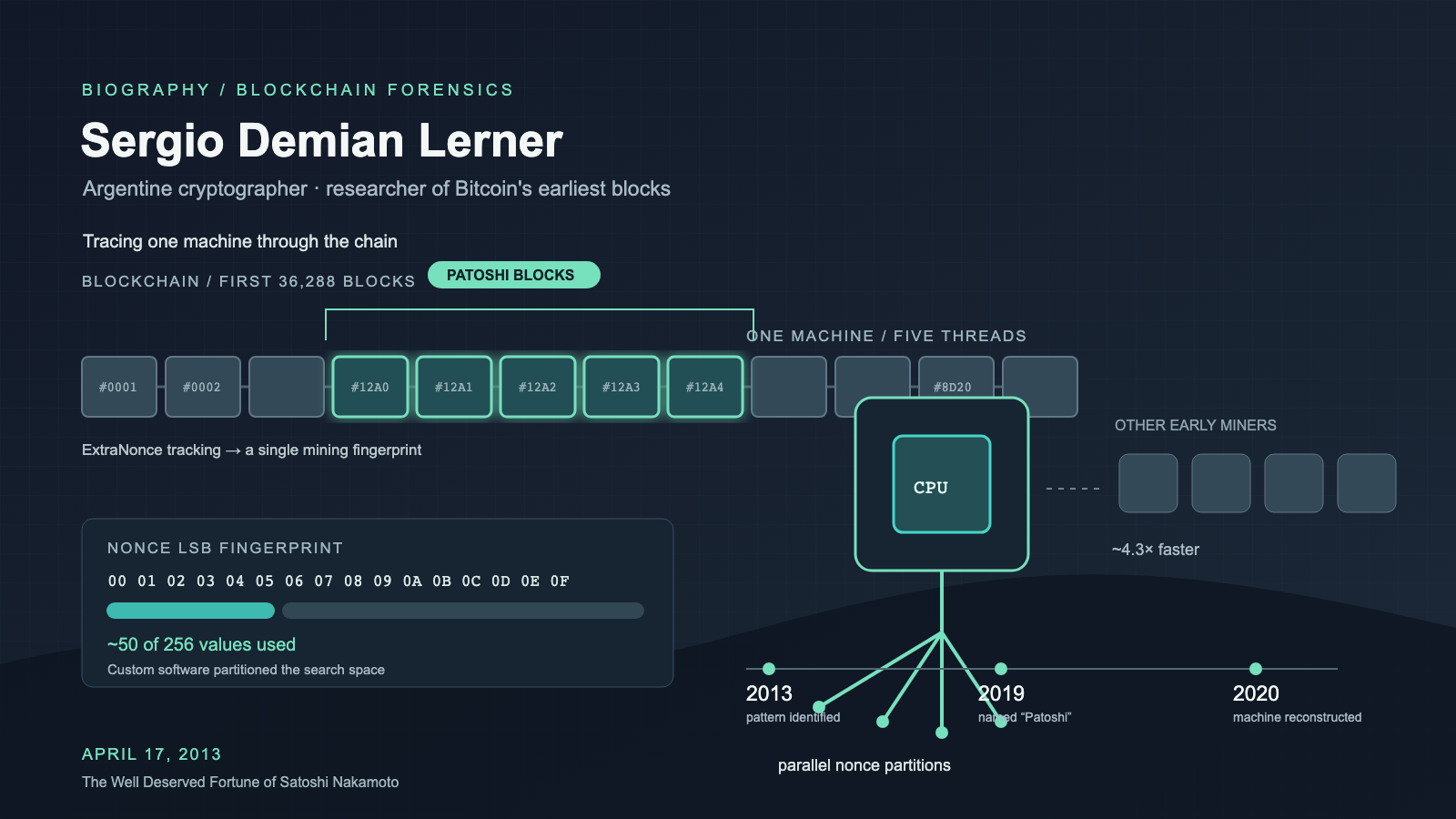
On April 17, 2013, Argentine Bitcoin researcher Sergio Demian Lerner published “The Well Deserved Fortune of Satoshi Nakamoto, Bitcoin creator, Visionary and Genius” on his blog Bitslog. The post presented the first systematic analysis of Bitcoin’s earliest mining patterns.
Method
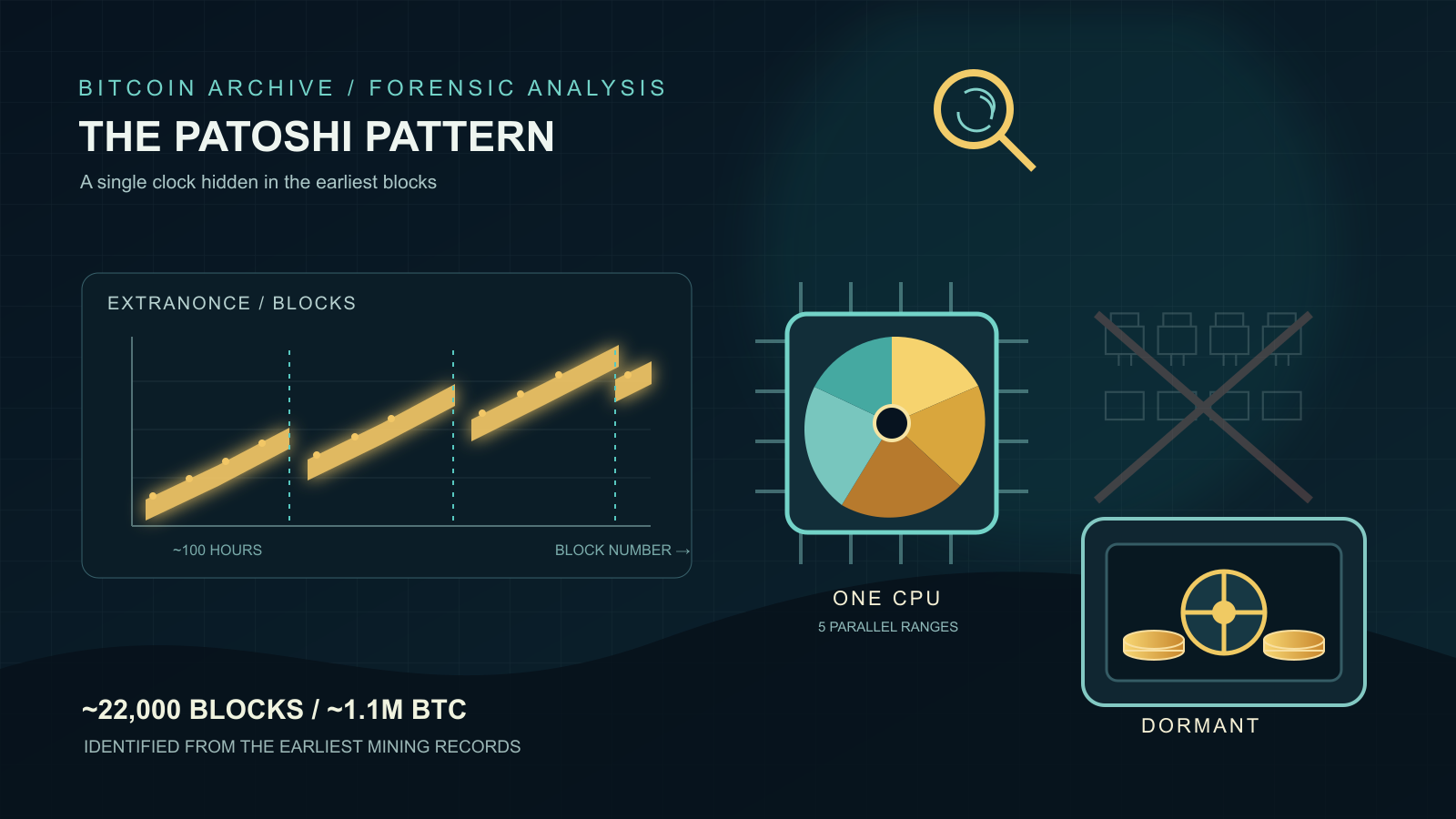
Lerner tracked the ExtraNonce field in coinbase transactions across blocks 0 through 36,288 (January 2009 to January 2010), using it as a “slow realtime clock” to identify when a miner’s client was restarted. He found a single entity mining with consistent slope segments, restarting roughly every ~100 hours.
Key findings
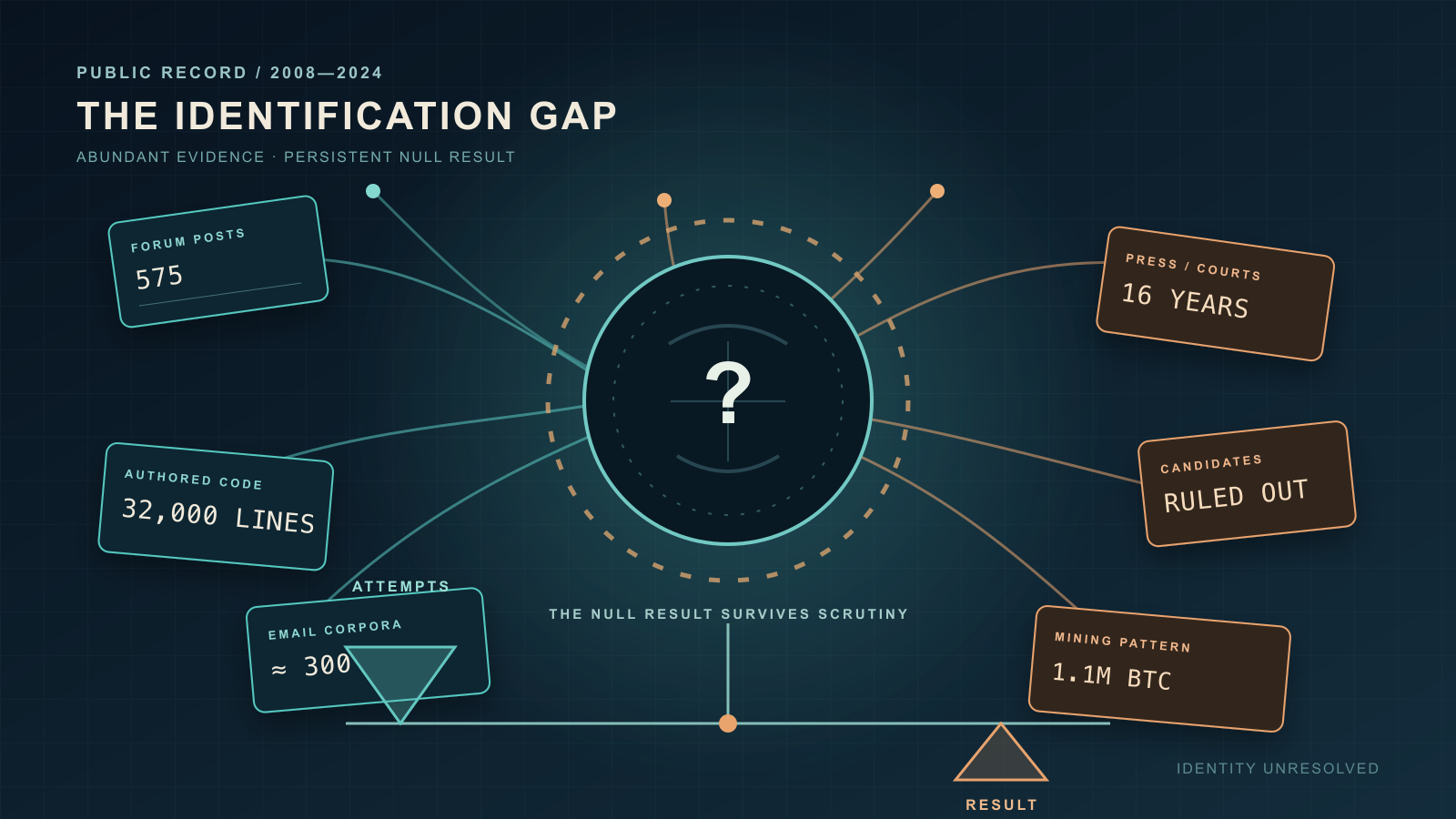
- A single entity mined approximately 1,000,000 BTC in the first year (refined to ~980,000 BTC in a follow-up post on April 24, 2013)
- Of the 1,814,400 BTC awarded to all miners in that period, 1,148,800 BTC remained unspent
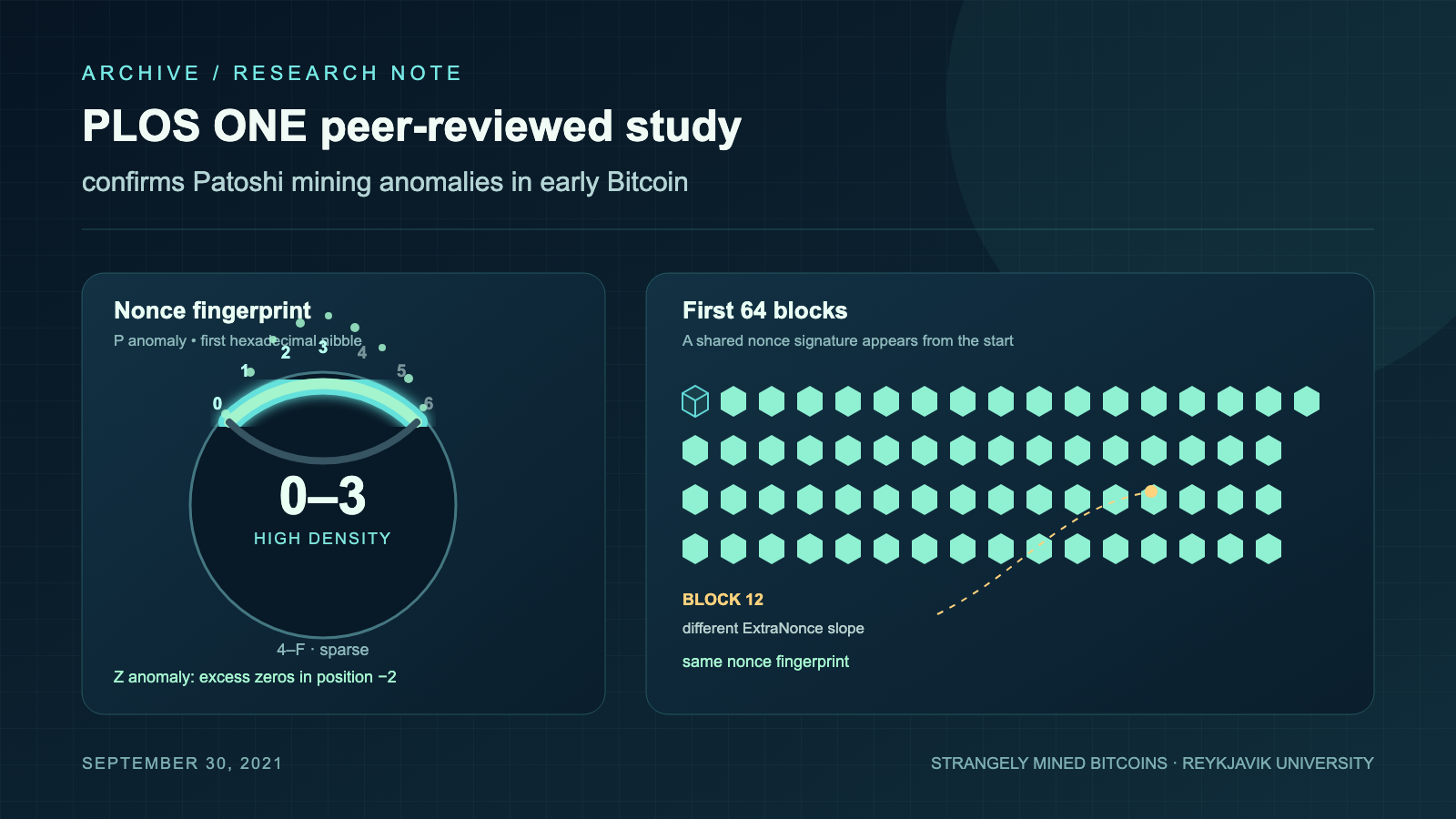
- Block 1 was the first mined by this entity; Block 12 was the first mined by a different user
- The post found that the entity “hasn’t spend any coins (as last as the eye can see).” Replying to a reader under the April 24 follow-up, Lerner put the spent part at about 100 BTC: “I saw only two blocks rewards (100 BTC) that seem to be part of a Satoshi mining pattern being spent. There may be some few more.”
The Nonce Mystery (September 2013)
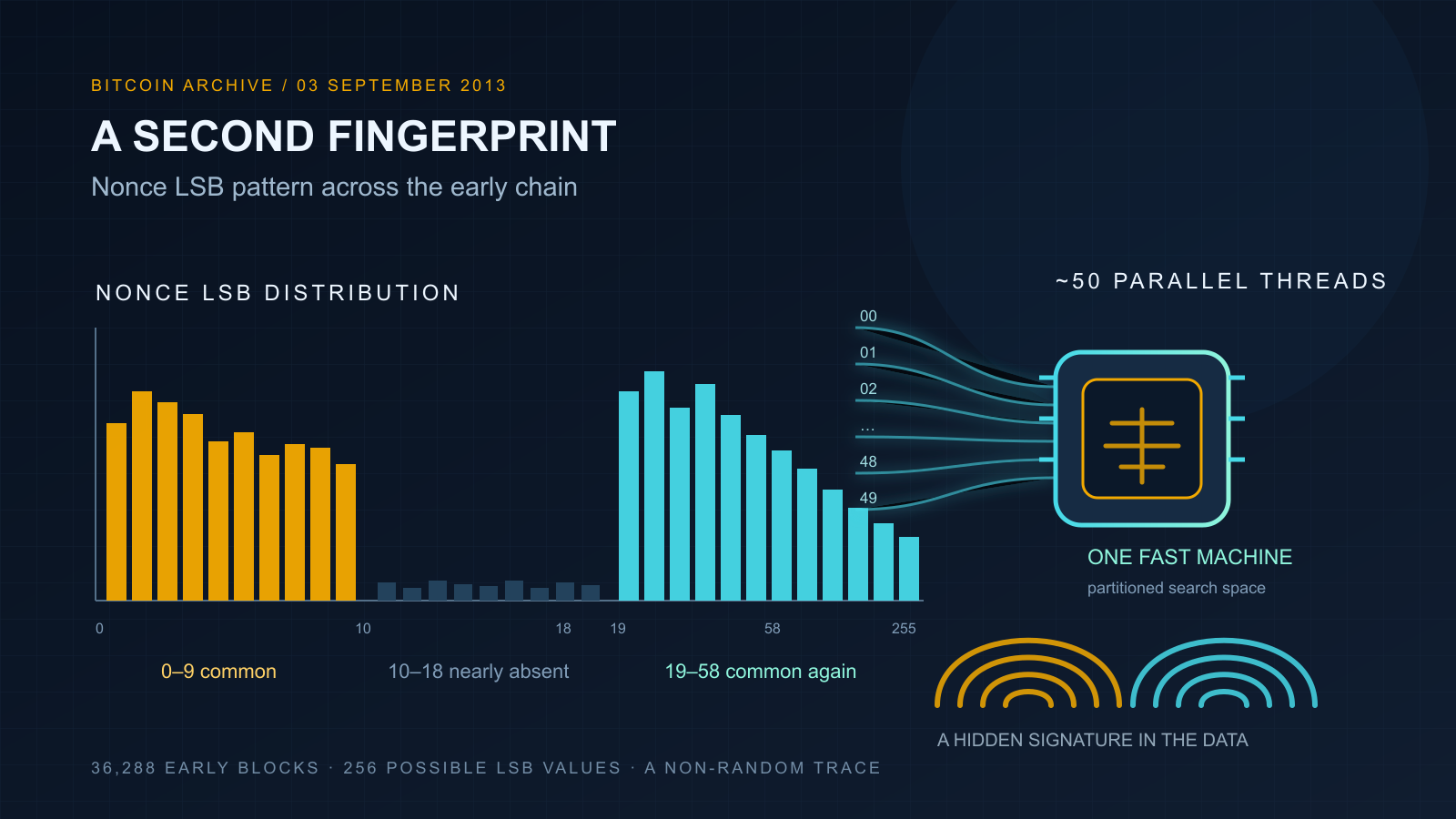
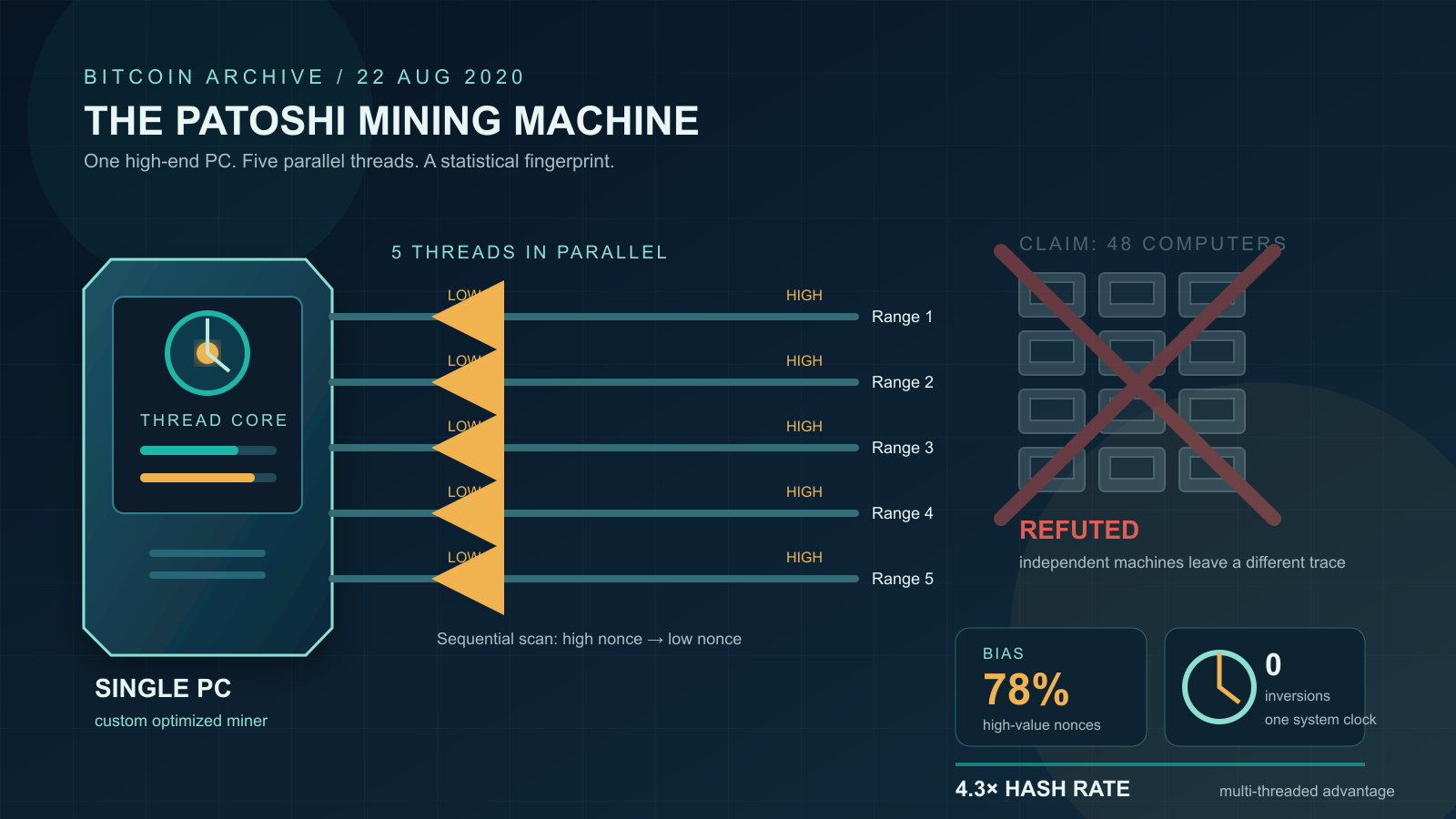
Lerner discovered that the entity’s nonce values were restricted to specific byte ranges — the least significant byte was limited to values [0..9] ∪ [19..58], roughly 50 out of 256 possible values. This nonce space reduction explained why the entity appeared to mine ~4.3× faster than other miners.
The “Patoshi” Pattern (April 2019)
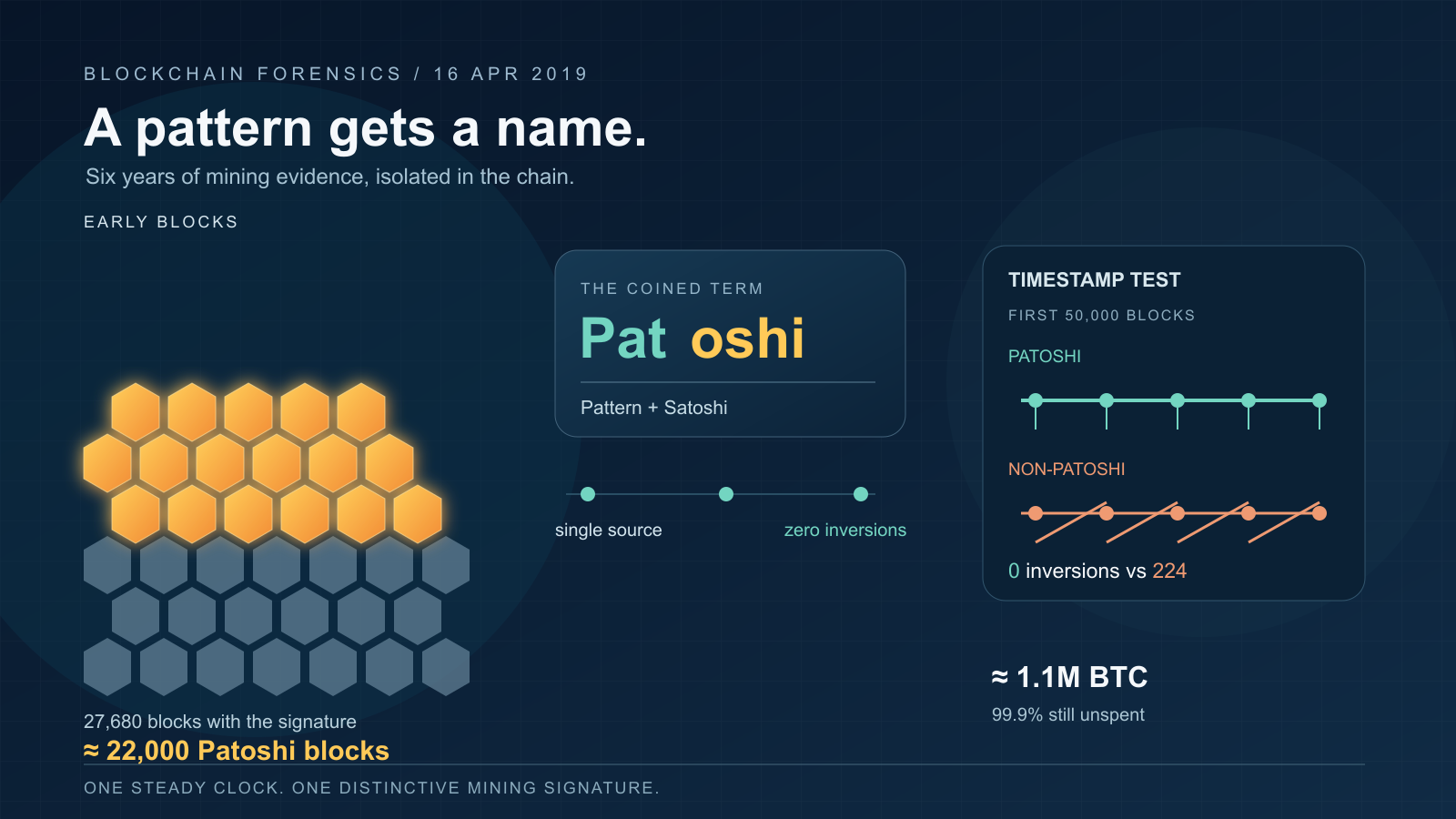
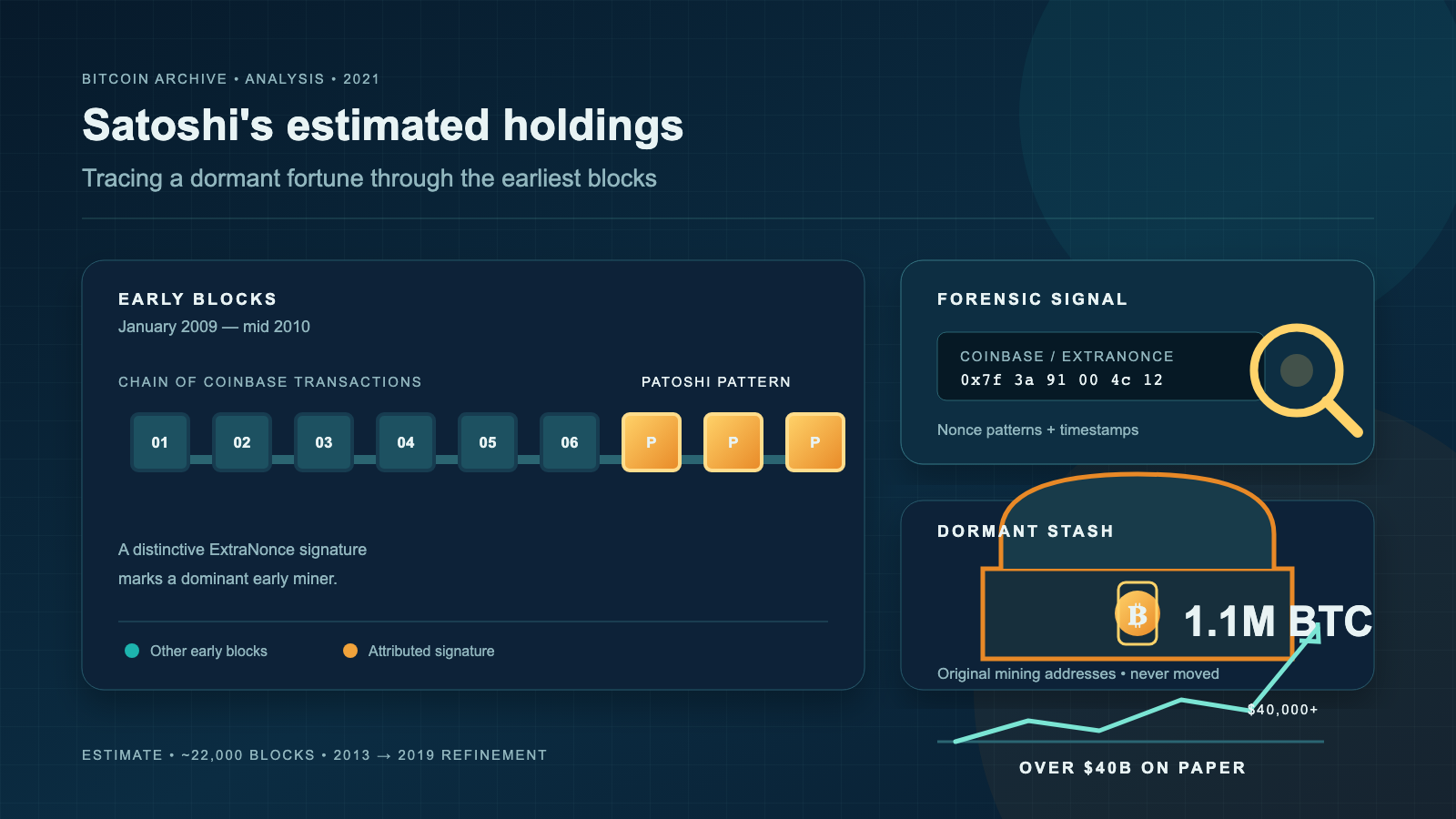
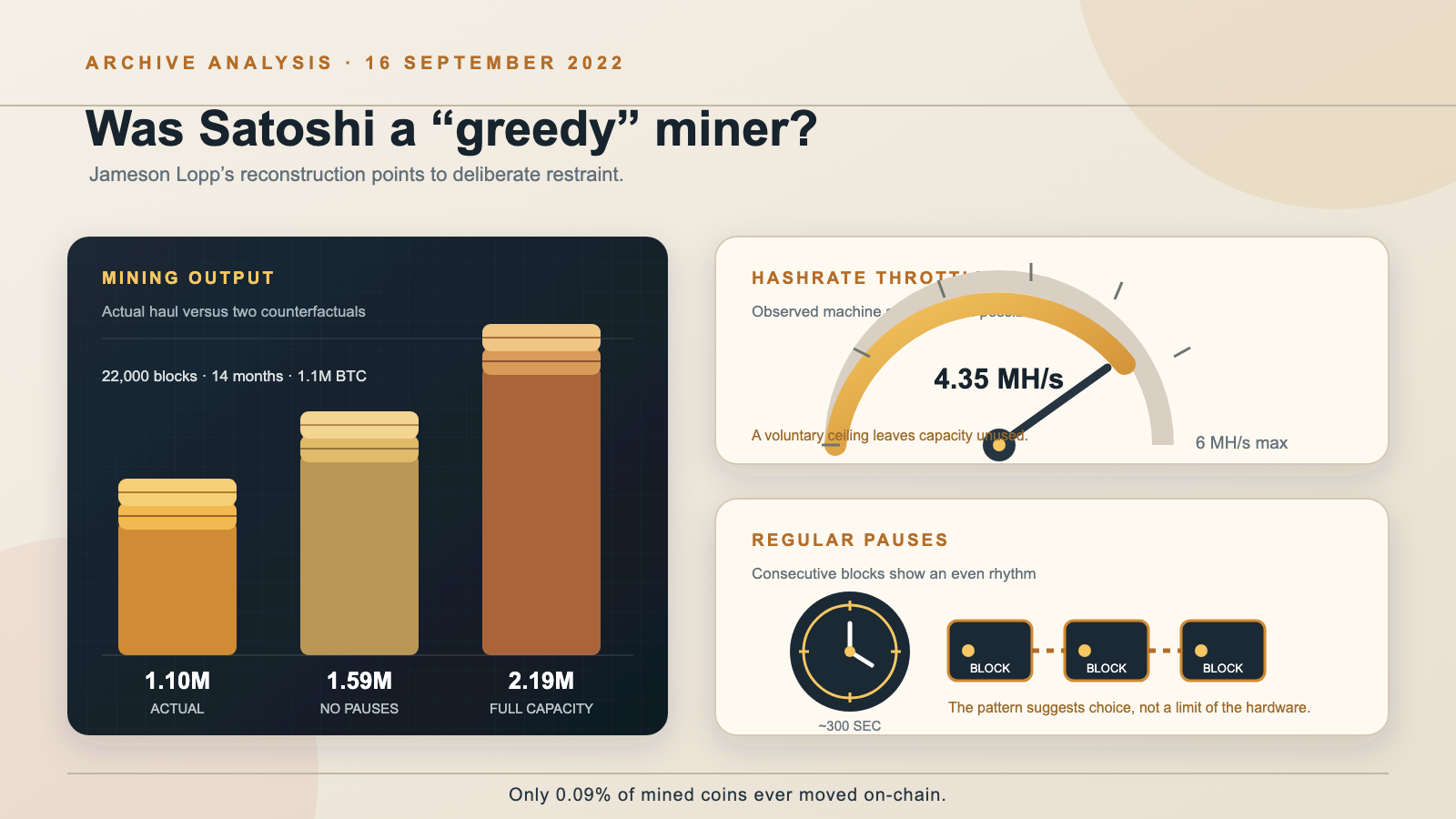
In “The Return of the Deniers and the Revenge of Patoshi,” Lerner coined the term “Patoshi” for the pattern and updated his estimate to ~22,000 blocks / ~1.1 million BTC. He provided new evidence: zero timestamp inversions between consecutive Patoshi blocks (versus 224 inversions among non-Patoshi blocks), proving the miner used a single PC clock.
The Mining Machine (August 2020)
In “The Patoshi Mining Machine,” Lerner concluded that Patoshi used a single high-end CPU with multi-threading — not 50+ networked computers. The nonce space was divided into 5 subranges scanned by parallel threads, using a modified mining client (not stock Bitcoin v0.1) with likely SSE2 optimizations.
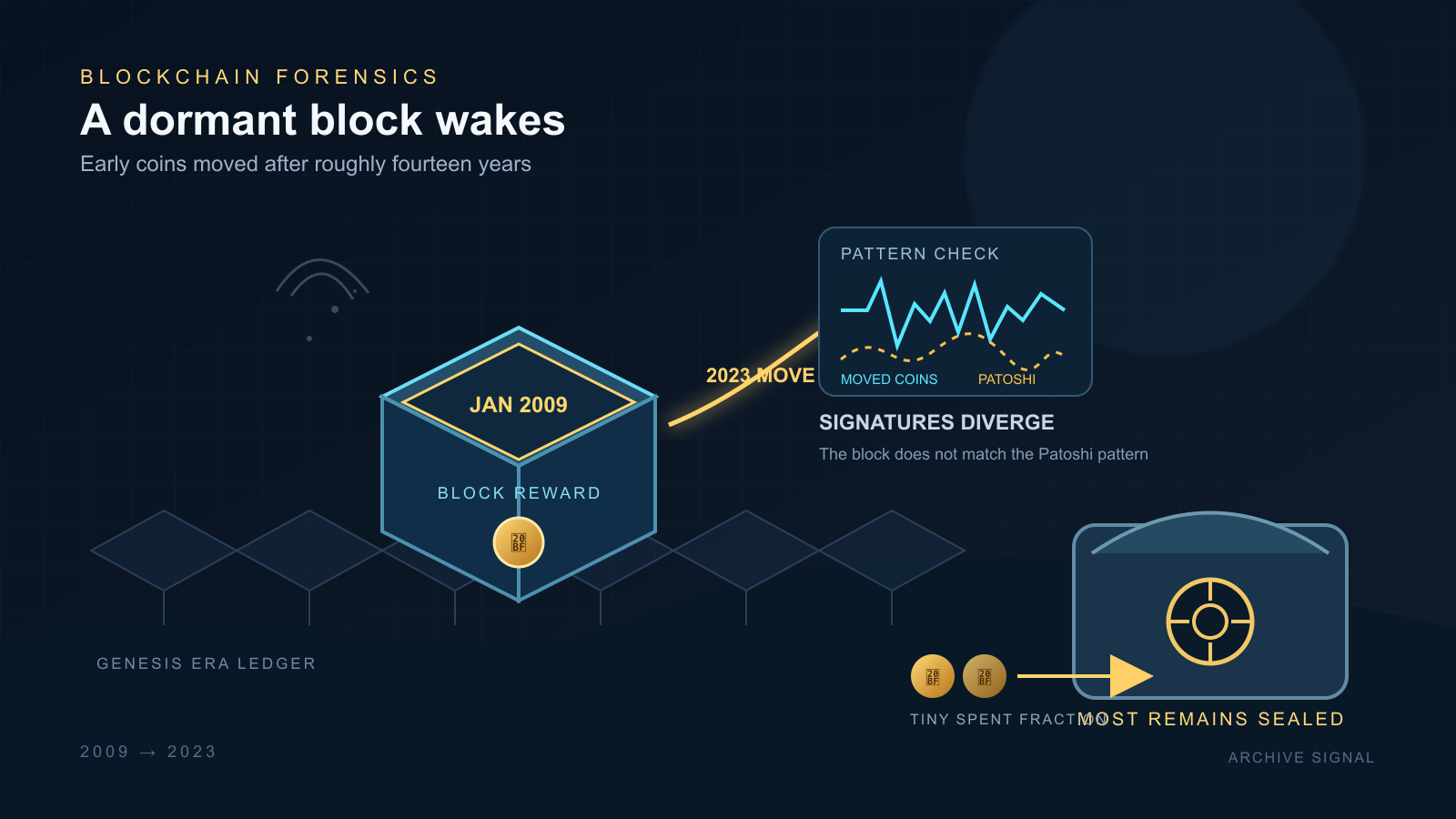
The Patoshi analysis remains one of the most significant pieces of blockchain forensics ever conducted. It established that Satoshi Nakamoto accumulated roughly 5% of Bitcoin’s total 21 million supply — and left nearly all of it unspent. Counted on the block list Jameson Lopp later published, 31 block rewards, 1,550 BTC, have moved, the first of them in Satoshi’s January 2009 payment to Hal Finney.
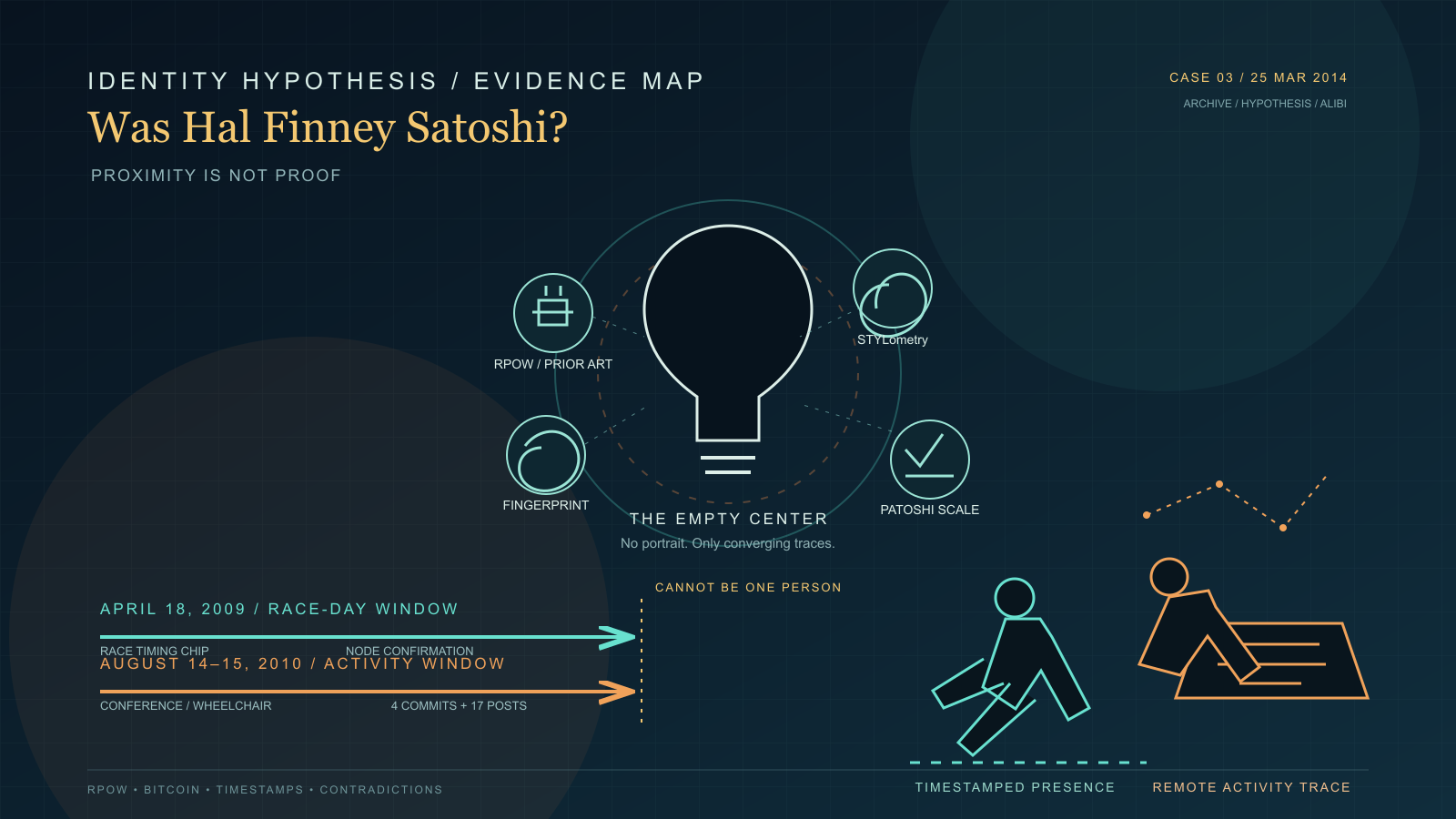
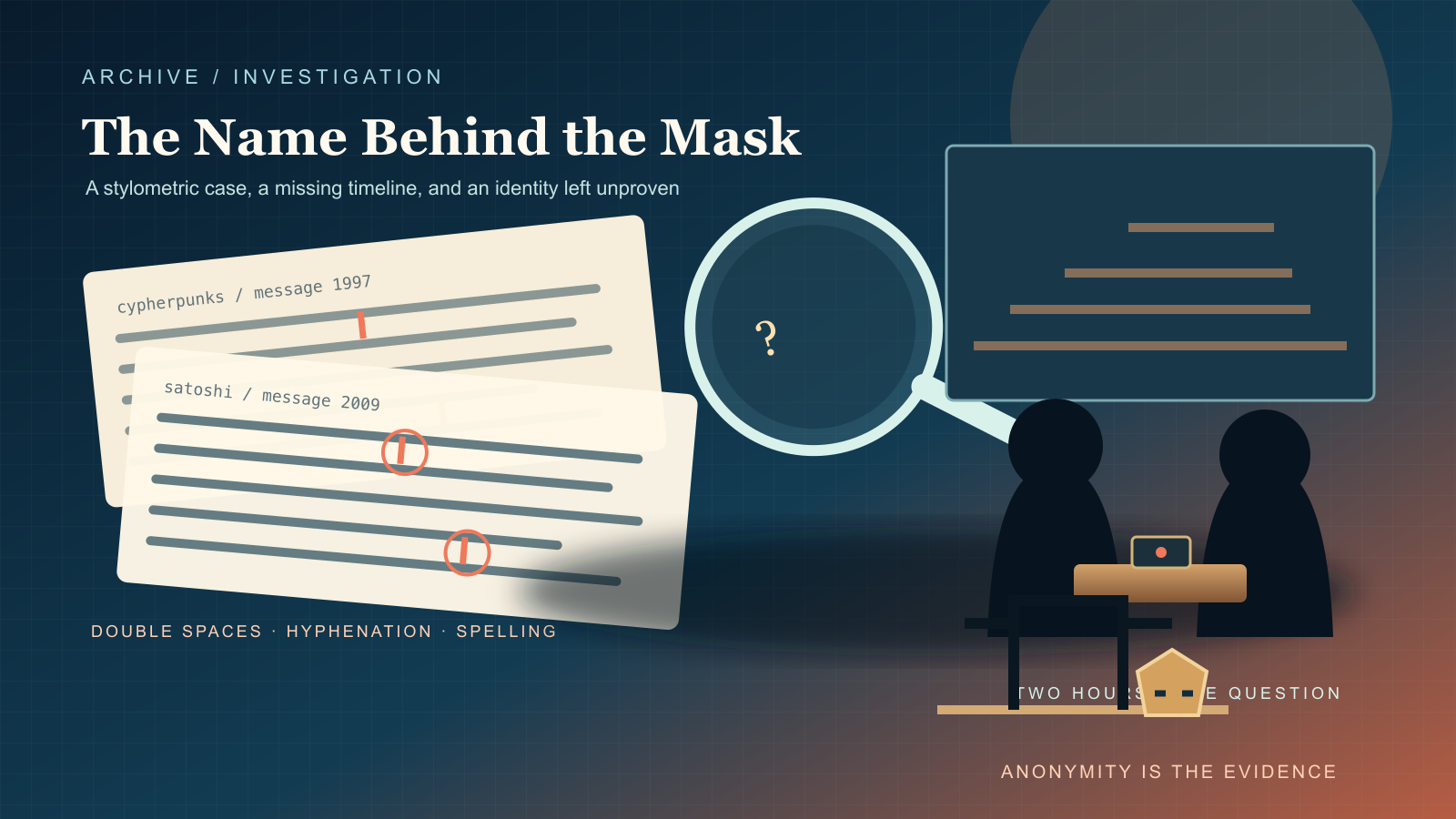
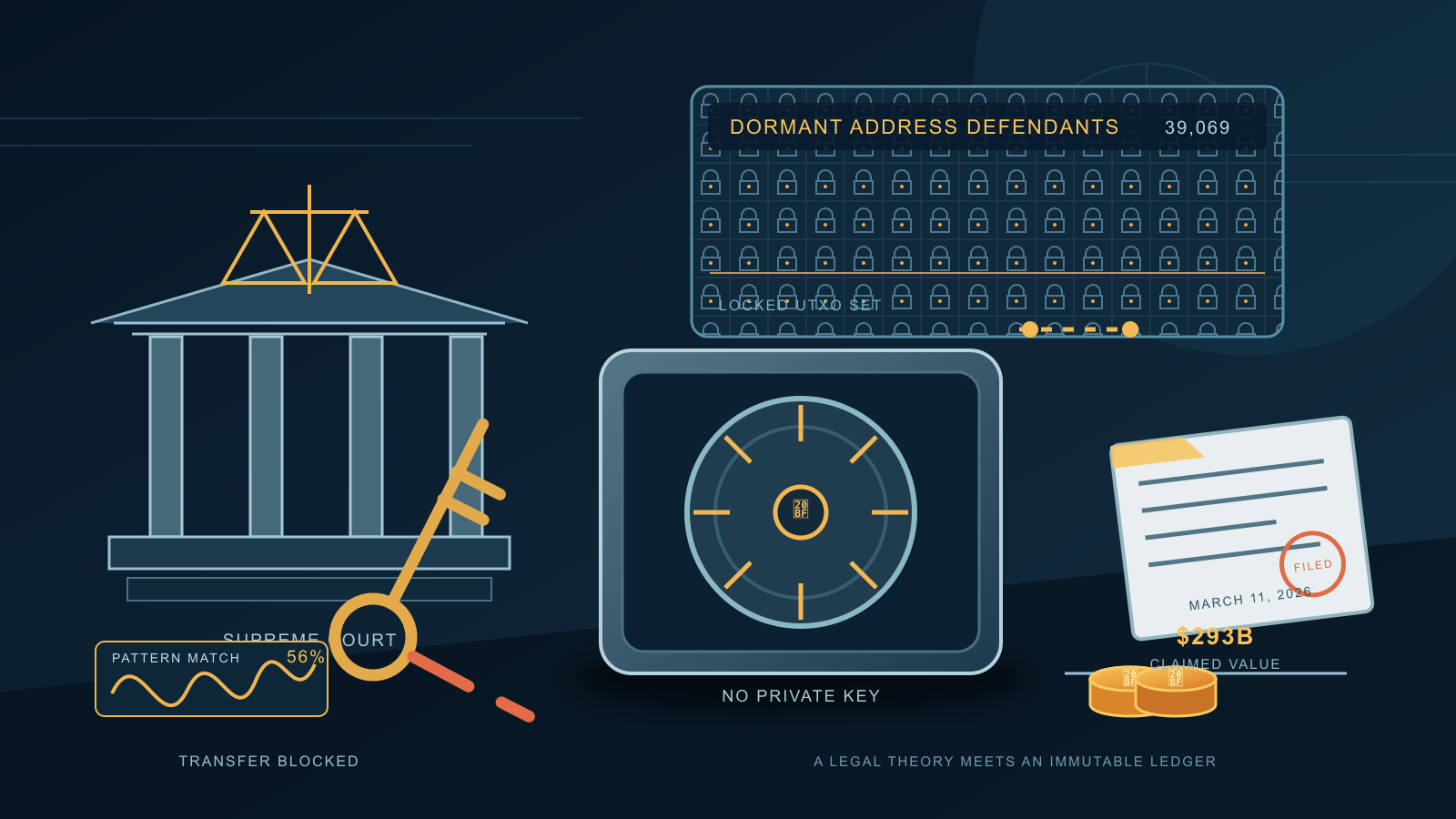
Subsequent work has refined the original signal in several directions: the Lerner biography tracks the analyst across the multi-year follow-up record; the 2013 nonce-LSB discovery and the 2019 “Patoshi” naming record the methodological additions; the 2021 PLOS ONE Patoshi-anomaly study is the first peer-reviewed treatment of the same pattern; the Hal Finney identity hypothesis reads Patoshi against the Finney-as-Satoshi possibility; the identification-asymmetry analysis treats Patoshi as a forensic-attribution case study; and the 2026 Noah Doe lawsuit invokes the dormant-coin attribution Patoshi established as the legal predicate for a custodial-recovery claim.
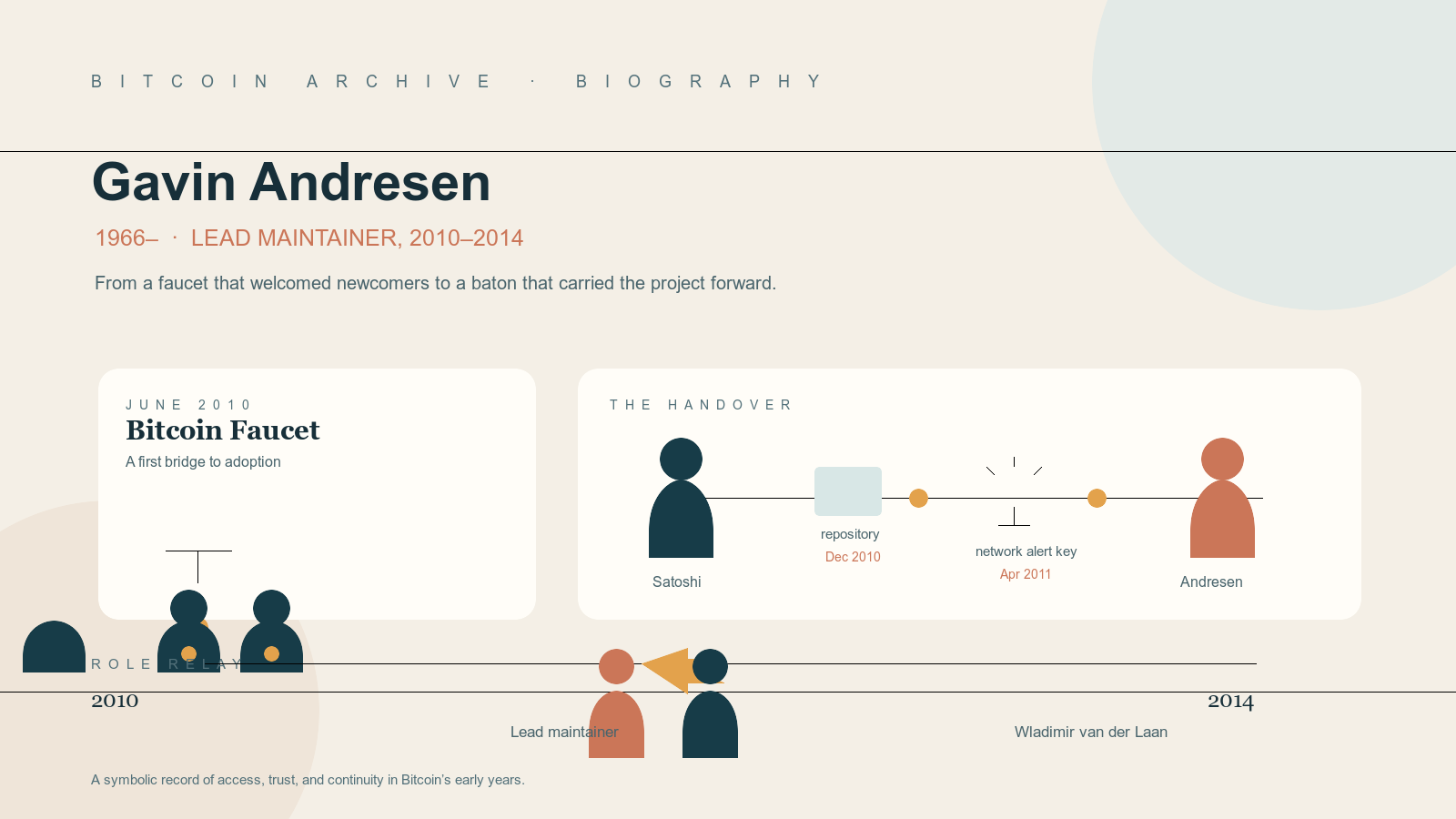
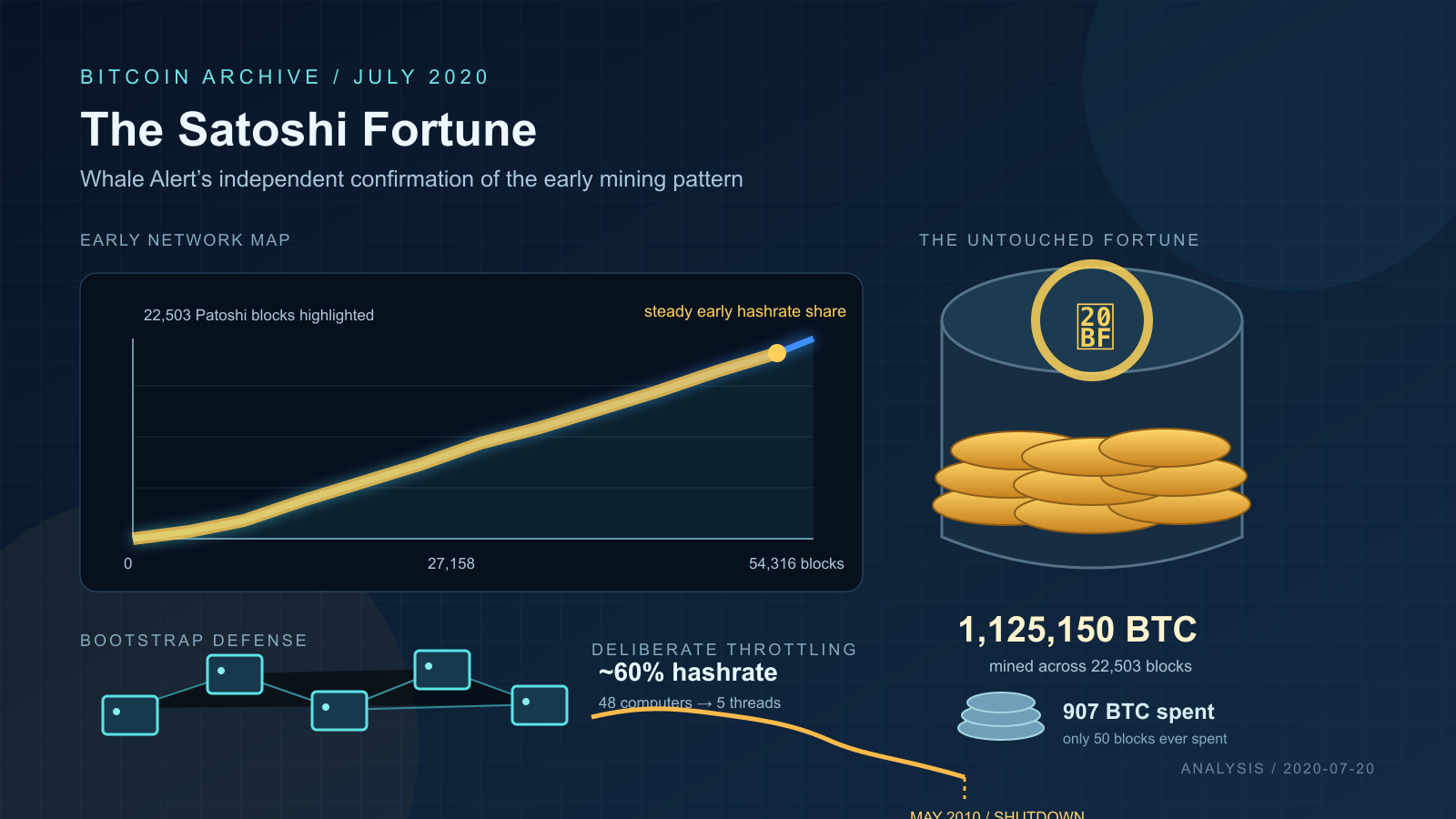
Three further entries extend the same forensic line: the 2020 Patoshi mining-machine analysis resolves the hardware question — a single multi-threaded CPU, not a 48-machine farm; the 2021 holdings analysis compiles the ~1.1 million BTC estimate across independent reviews; Gavin Andresen’s biography records the same ~1.1 million BTC figure as settled fact — the holdings that did not transfer with the lead-maintainer role; and Jameson Lopp’s 2022 “greedy miner” analysis uses the same Patoshi reconstruction to show Satoshi deliberately throttled mining capacity below what the hardware could produce. A decade later, the same signature was used as a filter rather than a fingerprint: the 2023 early-Bitcoin movement checked a newly-spent January 2009 block reward against the Patoshi pattern, found no match, and concluded the coins belonged to another early miner rather than Satoshi. Whale Alert’s 2020 “Satoshi Fortune” report independently corroborated this same finding with closely matching totals. The publication date itself became evidence in a later identity case: Adam Back joined BitcoinTalk on April 17, 2013 — the same day this analysis first put a public figure on Satoshi’s early-mining fortune.