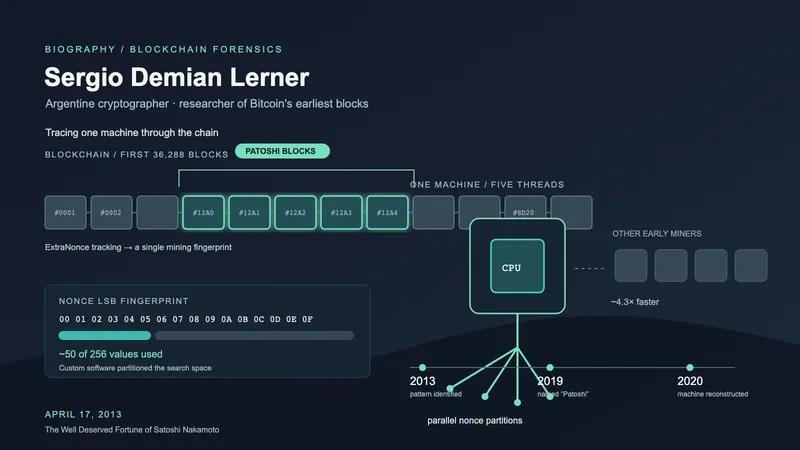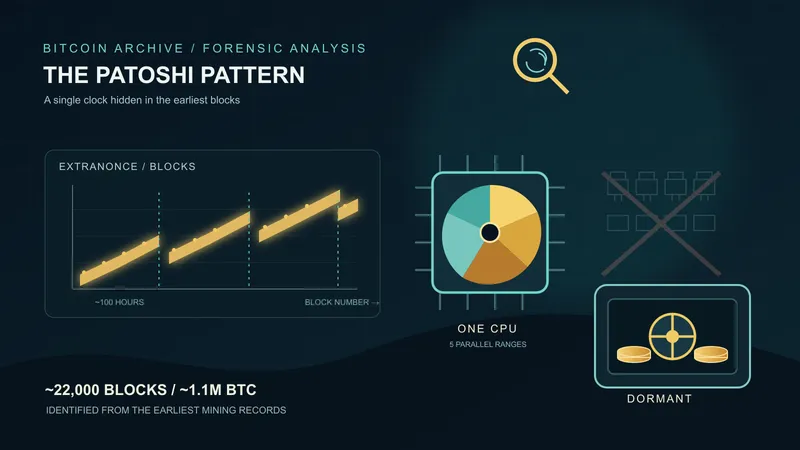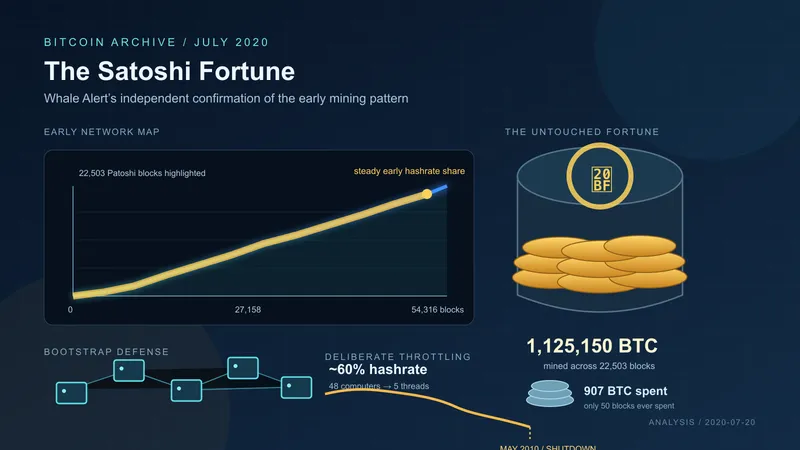

On August 22, 2020, Sergio Demian Lerner published “The Patoshi Mining Machine” on his blog Bitslog — a detailed technical reconstruction of the hardware and software behind Satoshi’s mining operation. The article appeared one month after Whale Alert’s “The Satoshi Fortune” report, which had claimed Satoshi used approximately 48 computers.
Re-mining simulation
Lerner conducted a re-mining experiment, simulating the Patoshi mining algorithm against the actual blockchain data. This allowed him to test competing hypotheses about Satoshi’s hardware configuration.
Key findings
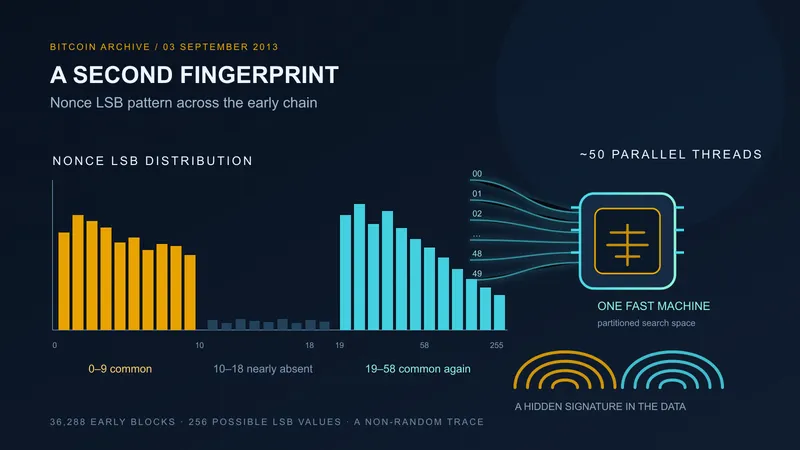
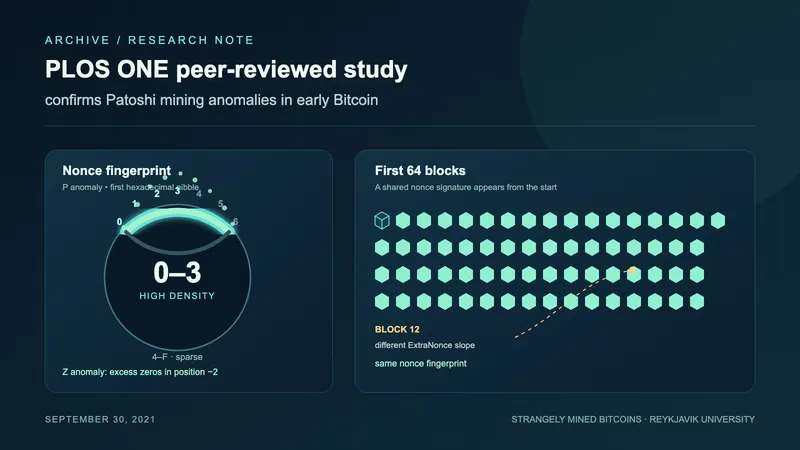
- The Patoshi miner scanned only part of the nonce space: 5 subranges of 163,840,000 nonce values each, all below 983,040,000
- Within each subrange, nonces were scanned sequentially from high to low (the “Inner Negative” algorithm): when re-mining found a second solution in the same header, the higher inner nonce was the real block 78% of the time, against 48% on the outer nonce
- The imbalance shrank when two subranges were analyzed together, which Lerner read as the 5 subranges being scanned in parallel, consistent with 5 threads on a single multi-core CPU
- The mining software was not the stock Bitcoin v0.1 client, which counted the nonce upward; Patoshi’s own software counted down
Single PC, not a network
Lerner concluded that the Patoshi miner used a single high-end CPU with multi-threading — not 50+ networked computers. Multiple lines of evidence supported this:
- Parallel subranges: In Lerner’s words, the shrinking imbalance across two subranges “contradicts a theory that Patoshi deployed the first mining farm of 50 independent computers (or any other highly decoupled system)”
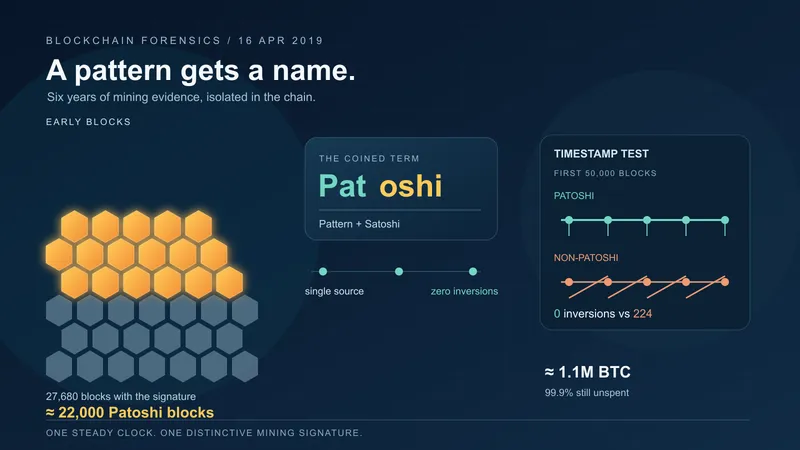
- Timestamp coherence: Zero timestamp inversions across 22,000+ Patoshi blocks (established in his 2019 analysis) proves a single system clock
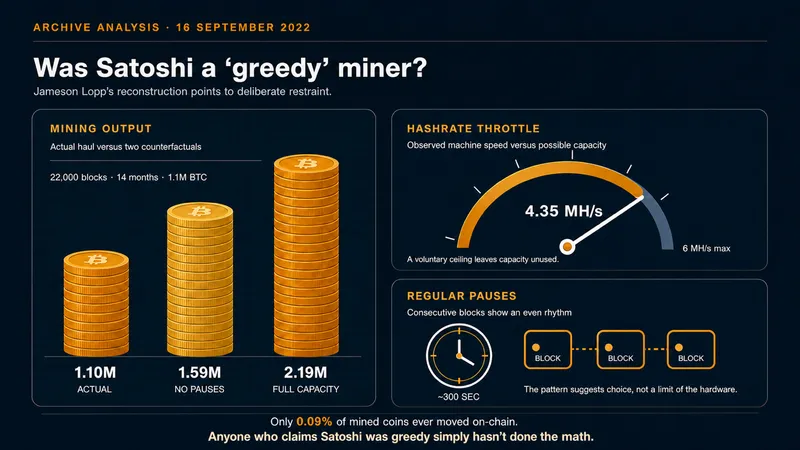
- Hash rate: The post says the other early miners mined “much slower than Patoshi” but gives no multiplier. The 4.3 figure is from Lerner’s 2013 follow-up, where the restricted nonce range made the machine look about 4.3 times faster than it really was
Implications
The analysis contradicted the picture of about 50 networked computers, the one Whale Alert’s report had put at about 48 a month earlier; Lerner’s post itself does not name Whale Alert. The distinction matters: a single PC running custom software is consistent with a lone individual bootstrapping the network, while a 48-machine operation would suggest organizational resources. Lerner’s findings reinforced the picture of Satoshi as a technically skilled individual working alone on consumer hardware.
This hardware conclusion builds directly on Lerner’s two earlier findings: the 2013 Patoshi-pattern analysis that first isolated the single-miner signal from the ExtraNonce field, and the 2013 nonce-LSB discovery that established the nonce-partitioning fingerprint this re-mining simulation reproduces.