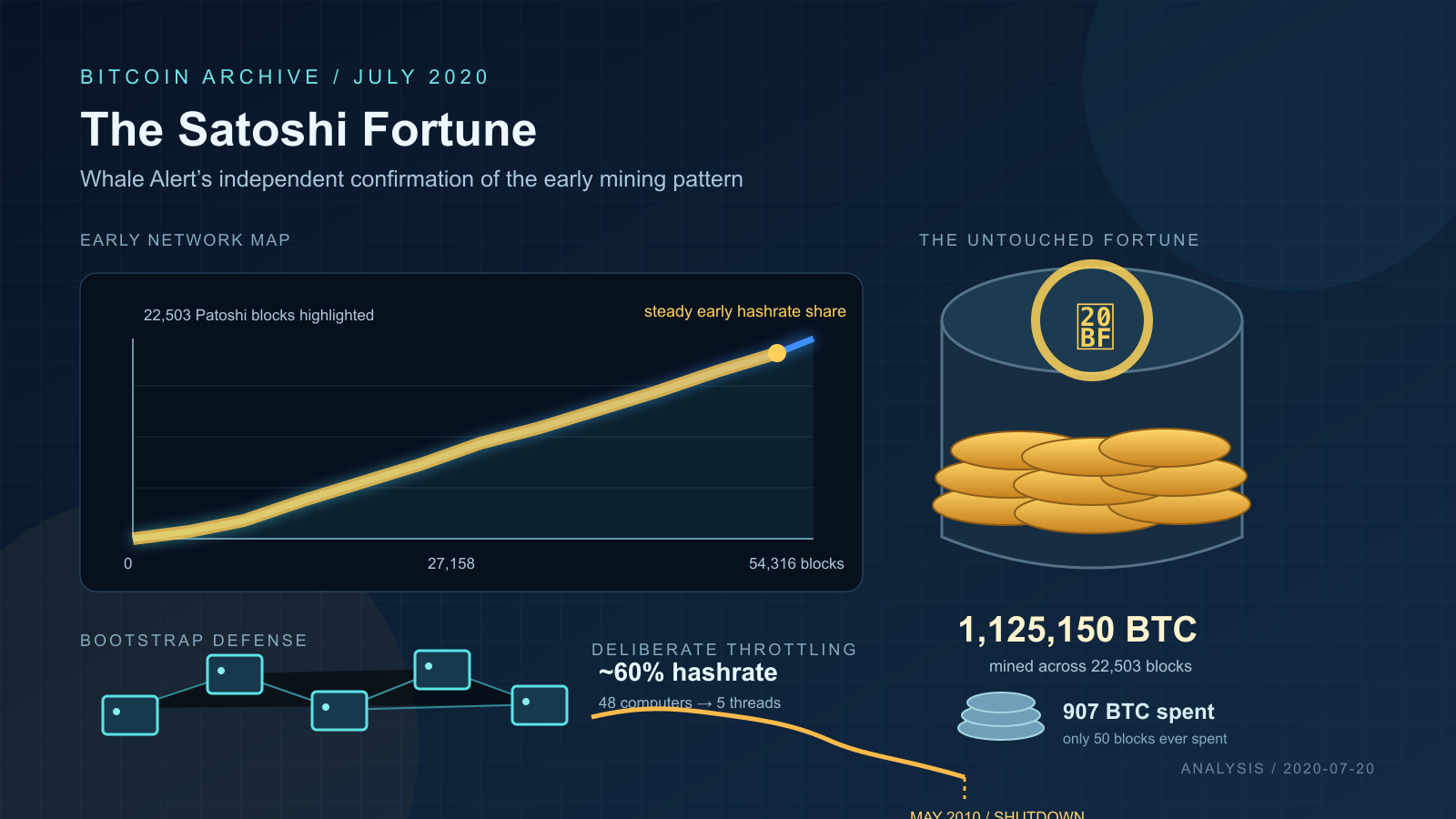
In July 2020, blockchain tracking service Whale Alert published “The Satoshi Fortune,” an independent analysis of Satoshi Nakamoto’s mining activity that largely corroborated Sergio Demian Lerner’s original 2013 Patoshi-pattern analysis, while introducing its own interpretation of Satoshi’s mining infrastructure.
Key findings
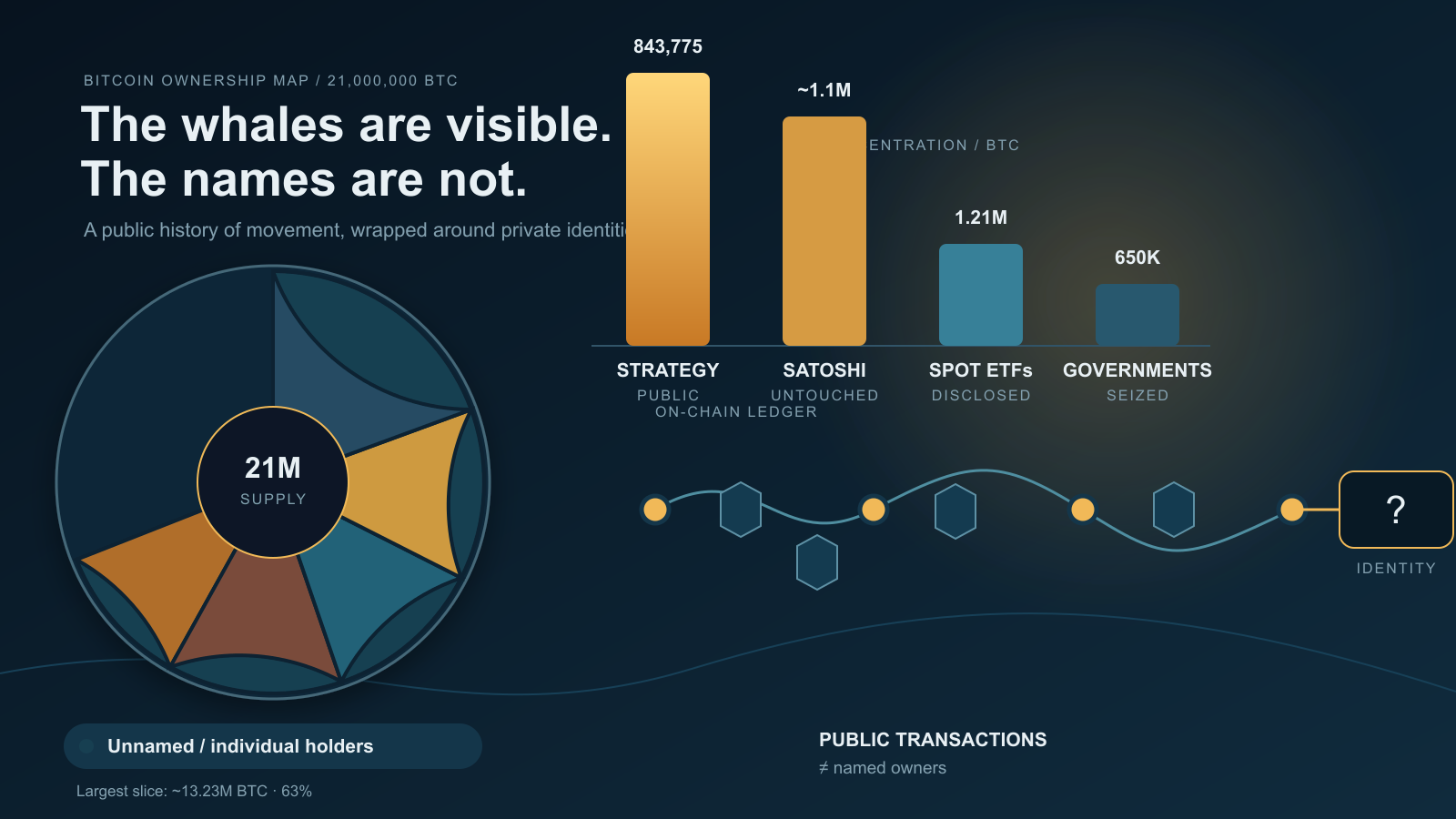
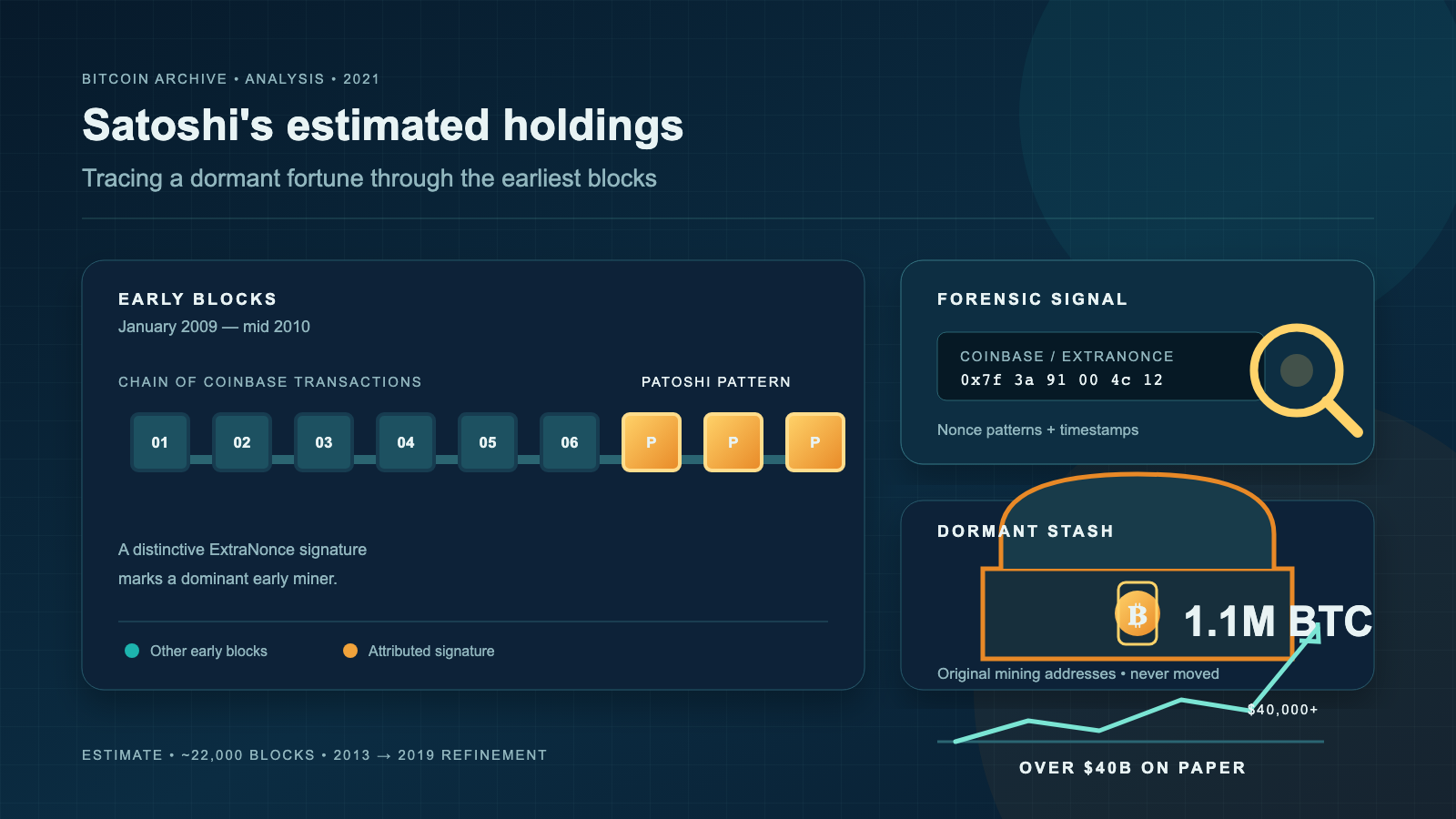
- Satoshi mined 1,125,150 BTC up to block 54,316
- 22,503 of the first 54,316 blocks were mined by the Patoshi miner
- Of these, only 50 blocks (907 BTC) had ever been spent; the remaining 1,122,693 BTC were untouched
- Estimated value at the time of publication: at least $10.9 billion
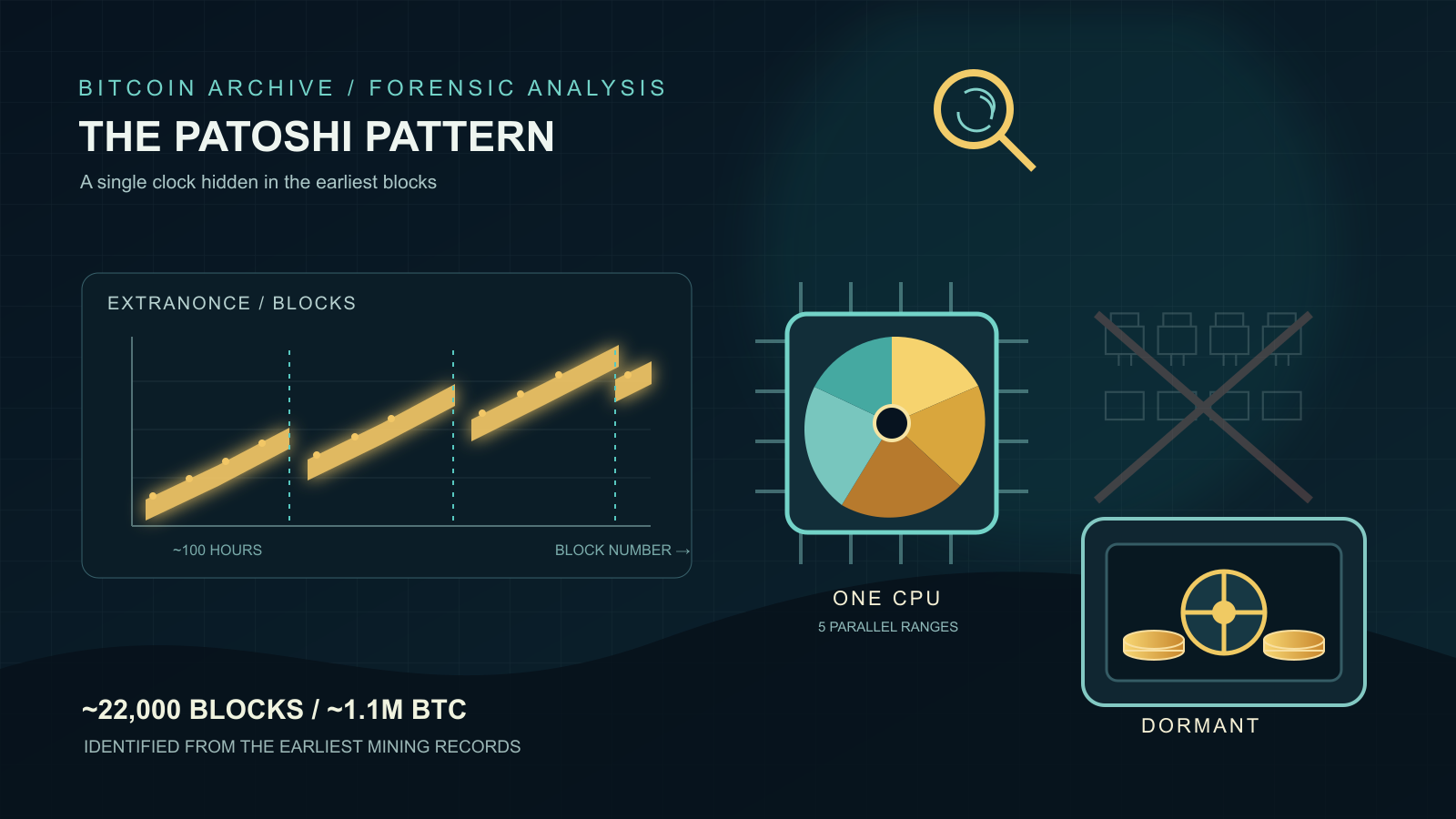
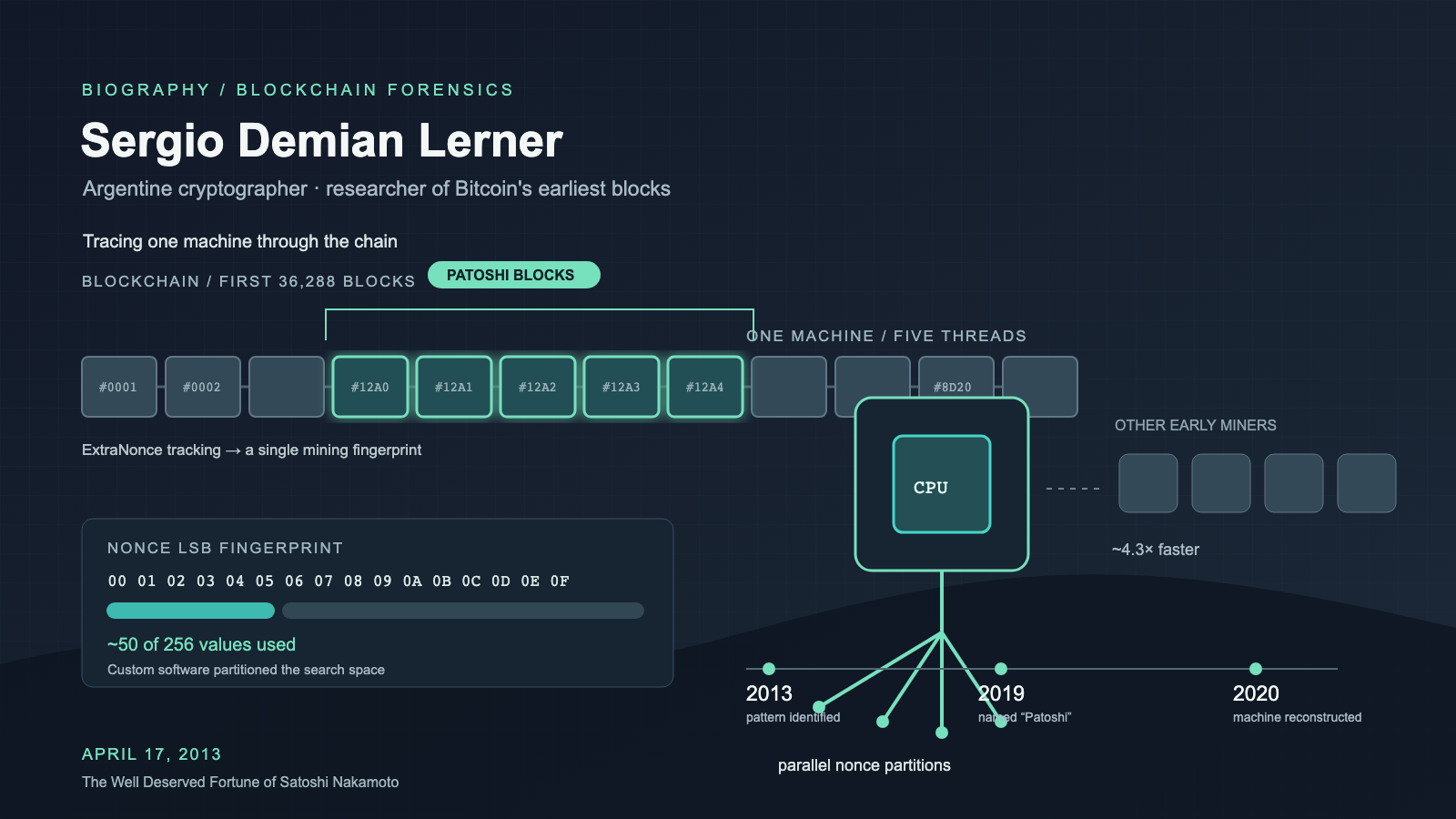
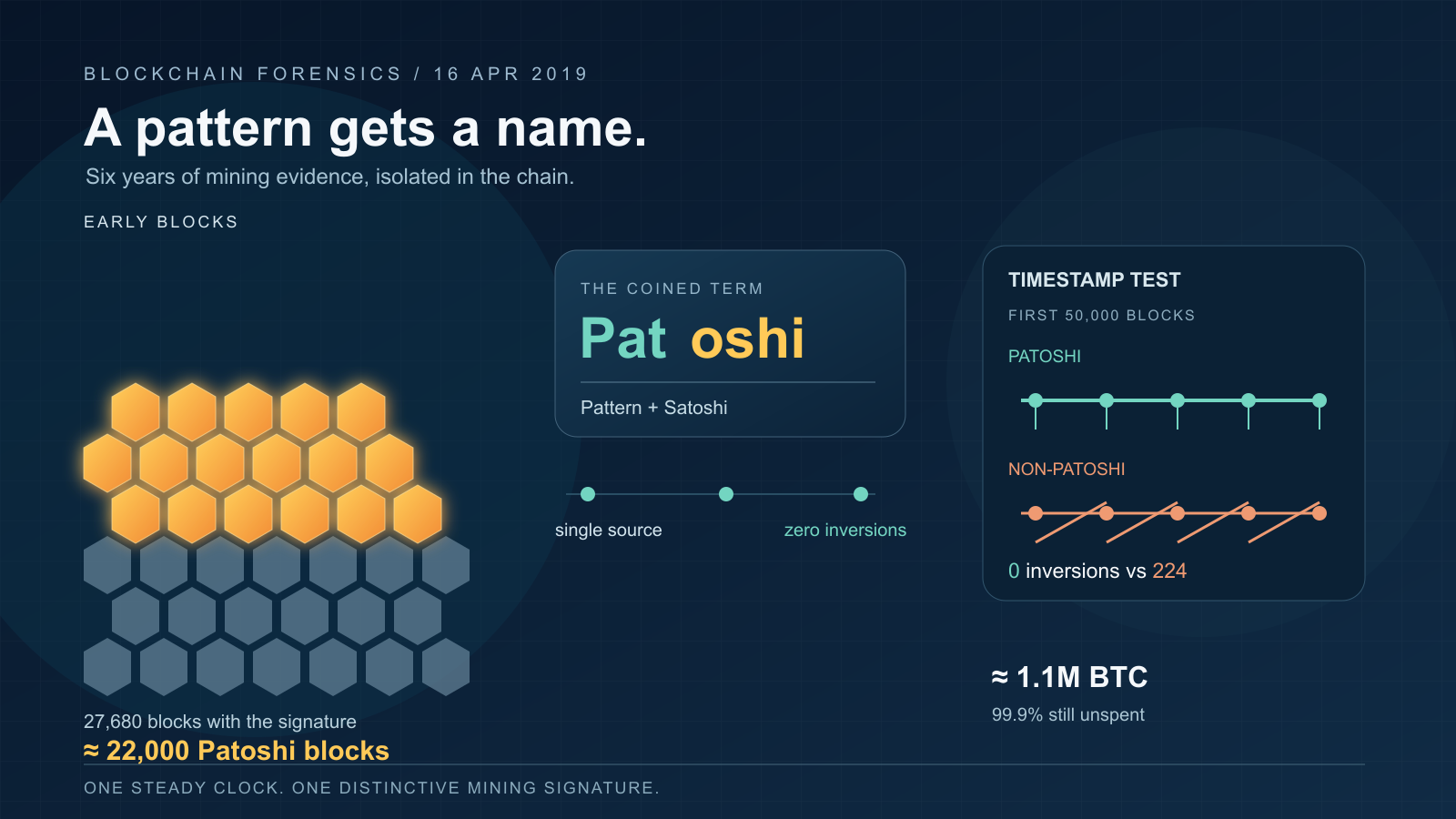
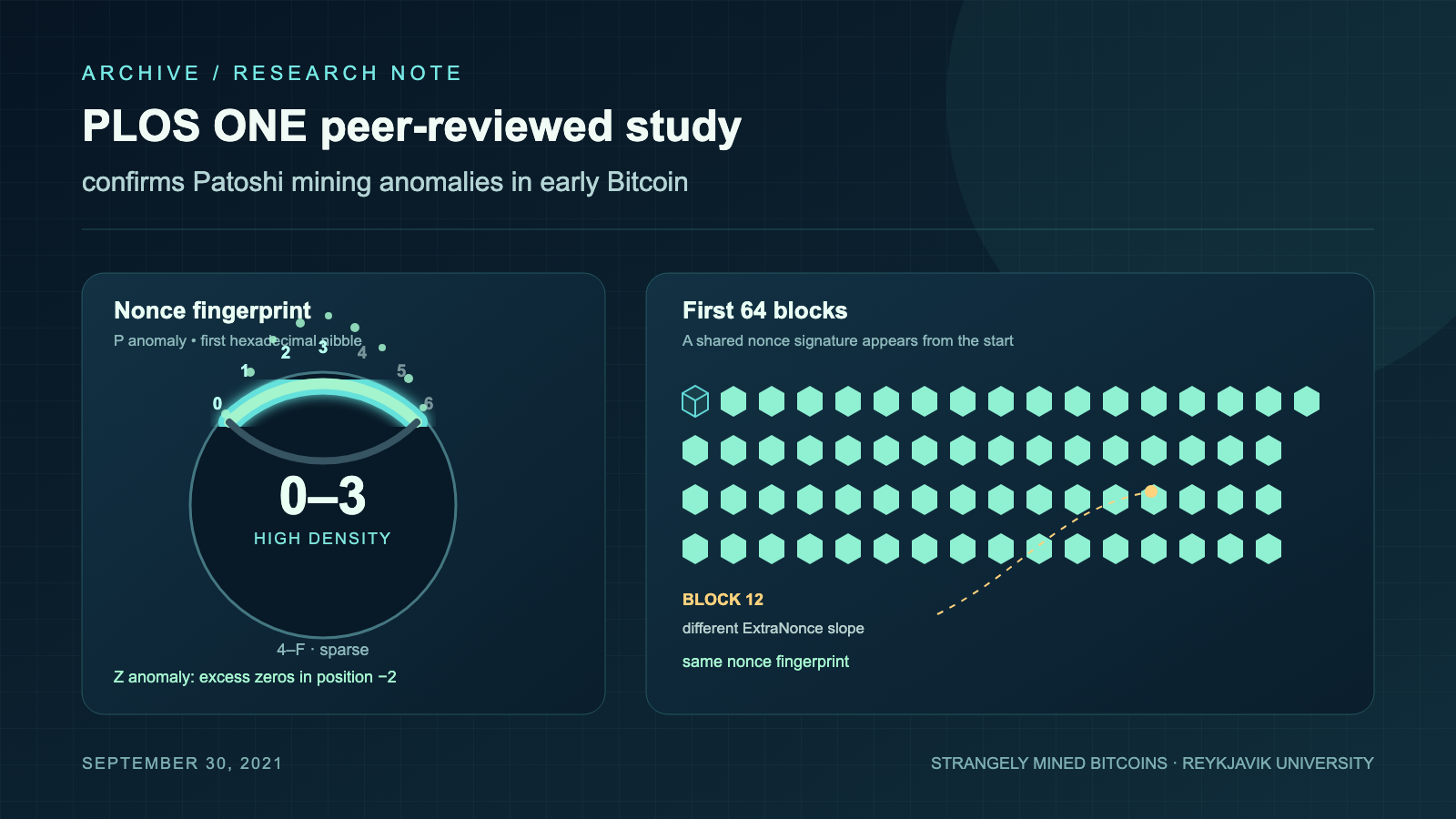
These totals closely matched the estimates Sergio Lerner had already published in his 2019 Patoshi-naming update — roughly 1.1 million BTC across about 22,000 blocks, derived independently through timestamp-inversion analysis. A year later, a peer-reviewed PLOS ONE study reached the same nonce-based pattern and coin totals through its own independent methodology.
Mining behavior
Whale Alert found that Satoshi maintained a steady share of approximately 60% of the network hashrate as the network grew, using an estimated 48 computers (or CPU threads). Satoshi systematically adjusted processing power to mine approximately 3.6 blocks per hour, ensuring sufficient hashrate to defend against a 51% attack while the network was still vulnerable.
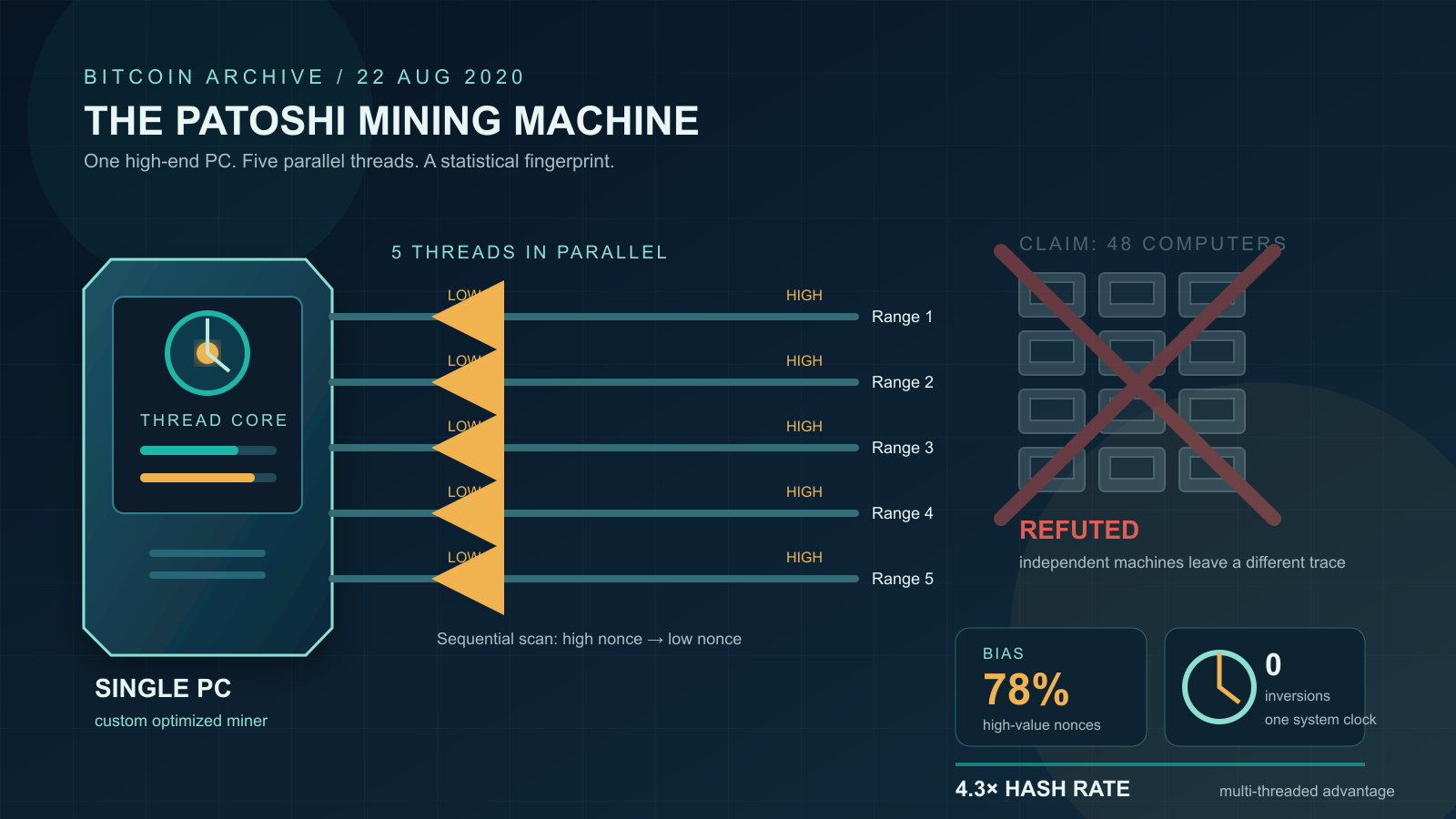
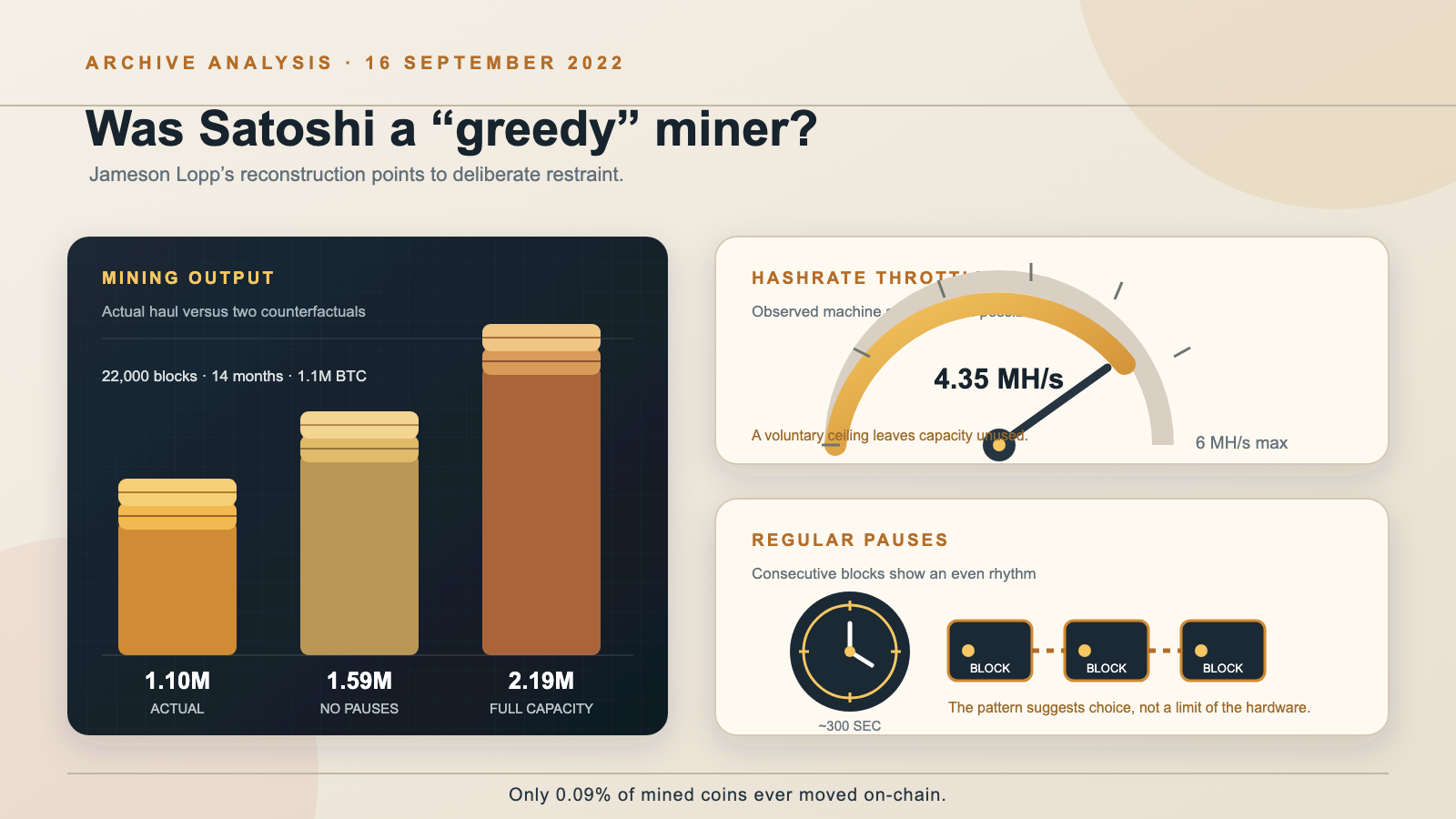
Note on the “48 computers” claim: One month after this report, Sergio Demian Lerner published “The Patoshi Mining Machine” (August 22, 2020), presenting a re-mining simulation that demonstrated the Patoshi miner used a single high-end CPU with 5 parallel threads — not 48+ separate computers. Lerner showed the nonce space was divided into 5 subranges with sequential scanning within each, producing a 78% high-value bias inconsistent with independent machines. Jameson Lopp’s 2022 analysis reached the same single-operator, deliberately-throttled picture from a different angle: modeling how many blocks the observed hardware could have mined at full capacity (~2.19 million BTC) against what Satoshi actually claimed (~1.1 million BTC) — roughly half. Lerner’s and Lopp’s independent analyses now converge on a single multi-threaded PC.
Intentional throttling
The analysis identified a pattern of deliberate hashrate reduction over time. As other miners joined the network, Satoshi did not compete for dominance but instead progressively decreased mining speed. The Patoshi miner was shut down entirely in May 2010, months before Satoshi’s final communications.
Conclusion
The report concluded: “The timing of the shutdown, the mining behavior, the systematic decrease in mining speed and the lack of spending strongly suggest that Satoshi was only interested in growing and protecting the young network.” All but the 907 BTC noted above have never been spent, reinforcing the interpretation that Satoshi mined to bootstrap the network — not for personal enrichment.
The report’s total was later folded into a wider survey of Satoshi’s likely holdings that cross-checked it against Lerner’s and BitMEX Research’s independent estimates — see Analyses estimate Satoshi Nakamoto’s Bitcoin holdings at approximately 1.1 million BTC.