
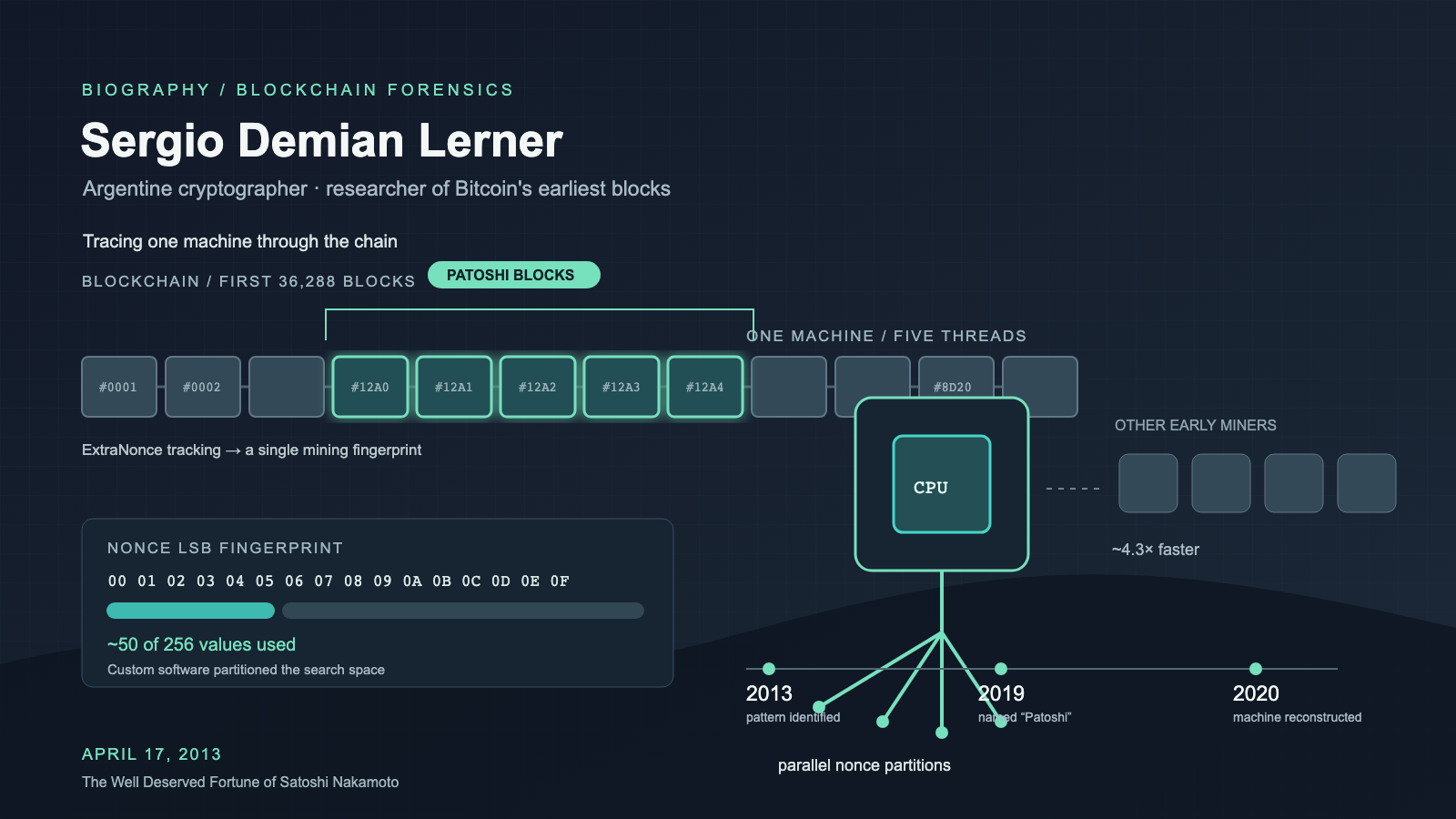
On April 17, 2013, Argentine cryptographer Sergio Demian Lerner published “The Well Deserved Fortune of Satoshi Nakamoto” on his blog Bitslog. By tracking the ExtraNonce field across the first 36,288 blocks, he identified a single entity that had mined approximately 1 million BTC in Bitcoin’s first year. Virtually none of these coins had ever been spent. Five months later, he found a second fingerprint in the same miner’s nonce values; in 2019 he named the pattern “Patoshi” and refined the count to about 22,000 blocks and 1.1 million BTC; in 2020 he reconstructed the machine — a single high-end CPU running 5 nonce-space-partitioned threads, roughly 4.3× faster than any other early miner.
Lerner’s analysis is the most important blockchain forensic work in Bitcoin’s history. It established that Satoshi Nakamoto accumulated roughly 5% of Bitcoin’s 21-million supply, on one machine, and chose never to spend it.
First Patoshi Analysis (April 2013)
On April 17, 2013, Lerner published “The Well Deserved Fortune of Satoshi Nakamoto” — the first systematic analysis of Bitcoin’s earliest mining patterns. By tracking the ExtraNonce field in coinbase transactions across the first 36,288 blocks, he identified a single entity that had mined approximately 1 million BTC in Bitcoin’s first year. Virtually none of these coins had ever been spent.
Nonce LSB Discovery (September 2013)
Five months later, Lerner discovered a second, independent fingerprint. The least significant byte (LSB) of nonce values in the dominant miner’s blocks was restricted to approximately 50 out of 256 possible values — a pattern consistent with custom mining software that partitioned the nonce search space across parallel threads. This proved the miner used modified software, not the standard Bitcoin client.
”Patoshi” Naming (April 2019)
In “The Return of the Deniers and the Revenge of Patoshi,” Lerner coined the term “Patoshi” — a portmanteau of “Pattern” and “Satoshi” — which became the standard reference in all subsequent research. He updated his estimate to approximately 22,000 blocks and 1.1 million BTC. His timestamp inversion analysis provided near-mathematical proof: zero inversions between consecutive Patoshi blocks versus 224 among non-Patoshi blocks, proving the use of a single PC clock.
The Mining Machine (August 2020)
Lerner concluded that the Patoshi miner used a single high-end CPU with multi-threading — not 50+ networked computers. The nonce space was divided into 5 subranges scanned by parallel threads, with likely SSE2 optimizations. The machine appeared approximately 4.3 times faster than any other early miner.
Significance
Lerner’s research established that Satoshi Nakamoto accumulated roughly 5% of Bitcoin’s total 21 million supply — and chose never to spend it. This finding has profound implications for Bitcoin’s economics, Satoshi’s motivations, and the interpretation of early Bitcoin history. His work has been independently verified and extended by multiple researchers.