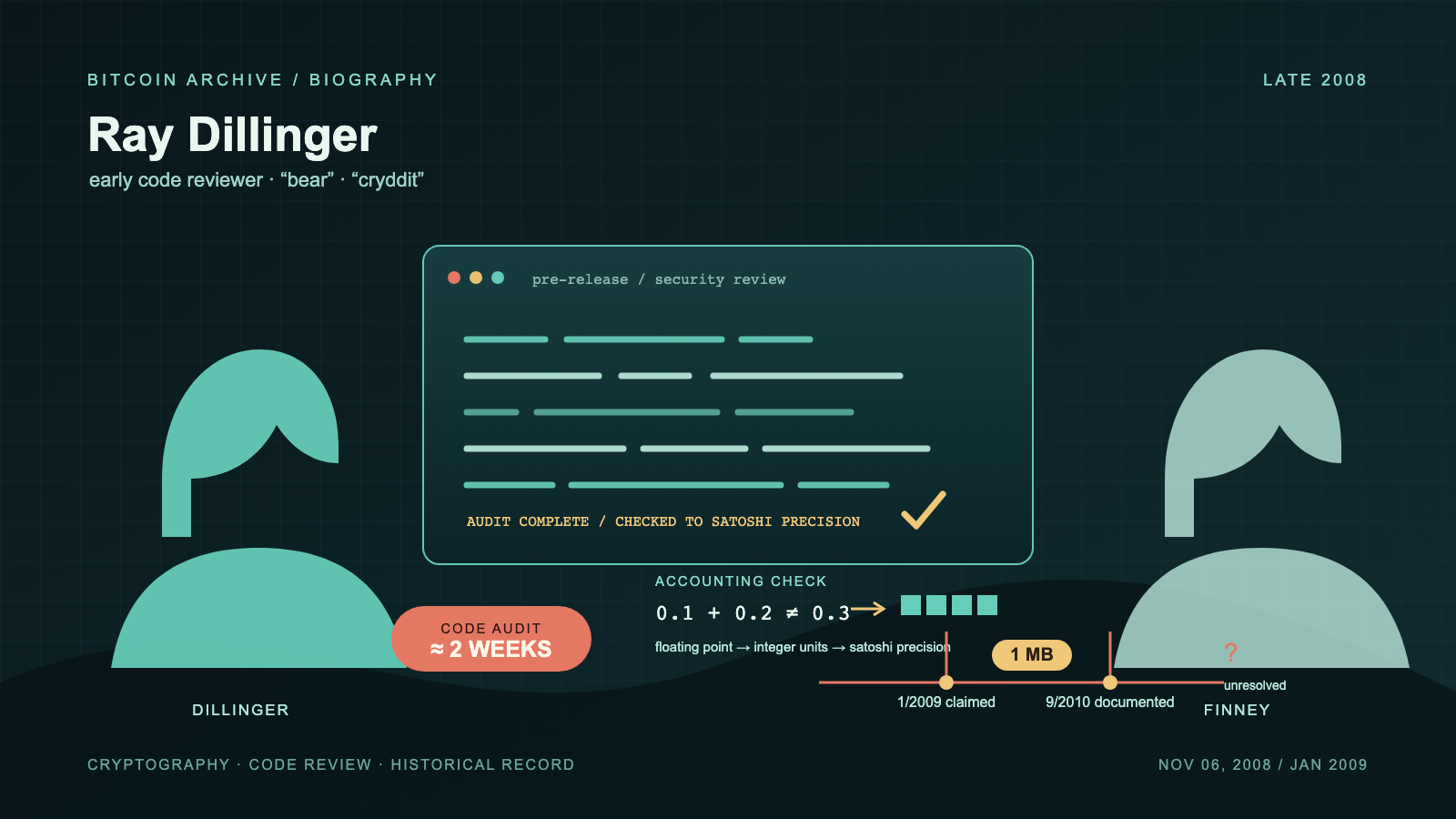
Before Bitcoin v0.1 was released to the public in January 2009, only two people are known to have audited its source code: Hal Finney, and Ray Dillinger. Dillinger spent roughly two weeks examining the code for vulnerabilities and attack vectors. He has also been connected to the origin of Bitcoin’s 1 MB block size limit, recalling early discussions in which the cap was added to prevent spam transactions from overwhelming the network — a parameter that would later become the center of the 2015–2017 block-size war.
Dillinger is a computer scientist known by his online handles bear and cryddit. He studied computer science at the University of Kansas and has been active in the cryptography and cypherpunk communities for decades.
Pre-Release Code Review
In late 2008, Satoshi Nakamoto shared Bitcoin’s source code privately with a small number of people before the public release in January 2009. Dillinger conducted a security audit of the code, examining it for potential vulnerabilities and attack vectors. Hal Finney simultaneously reviewed the code from a different perspective. In a later BitcoinTalk post, Dillinger recalled spending approximately two weeks reviewing the code, focusing on ways the system might be exploited. In a 2018 interview marking the whitepaper’s tenth anniversary, he gave the technical substance of that review — the floating-point-versus-integer accounting discovery and the satoshi-precision analysis.
Block Size Limit
Dillinger has been connected to the origin of Bitcoin’s 1 MB block size limit, one of the most debated parameters in Bitcoin’s history. In later public statements, he described how early discussions about potential denial-of-service attacks led to consideration of limiting block size to prevent spam transactions from overwhelming the network.
Mailing List Participation
Dillinger participated in the cryptography mailing list discussion about Bitcoin in November 2008, posting under the name “Ray Dillinger.” His posts engaged with the technical details of Bitcoin’s design, including questions about the incentive structure and security model.
Later Reflections
In September 2017, Dillinger published a reflective post on BitcoinTalk titled “If I’d known then what I know now,” in which he discussed what he might have done differently had he understood Bitcoin’s future significance. He reflected on the early code review process and the design decisions that shaped Bitcoin’s development. In an October 2022 interview with security researcher SerHack, Dillinger provided additional details about the pre-release review process and his early interactions with Satoshi.